Our readers keep the lights on and my smoothie glass nicely filled. As an Amazon Associate, I earn from qualifying purchases.
A 3,000-watt power station sits at a critical inflection point: enough juice to run a refrigerator, a sump pump, and a few lights simultaneously, yet compact enough to stash near the back door. The difference between a unit that keeps your home running through a 48-hour outage and one that shuts down under load comes down to battery chemistry, inverter quality, and expansion capability. Buyers often fixate on watt-hours alone, ignoring the real-world specs that determine whether a station can actually start a motor or charge back from solar before sunset.
I’m Mohammad Maruf — the founder and writer behind WellFizz. My workflow involves stress-testing inverter topologies, comparing charge controller efficiencies, and tracking cell degradation data across the major LiFePO4 platforms to separate genuine engineering from marketing overpromise.
After analyzing thirteen models spanning the most capable units in this power class, this guide narrows the field to the few that actually deliver on their promises. Here is your definitive look at the best 3000 watt power station options for home backup, RV living, and off-grid autonomy.
How to Choose the Best 3000 Watt Power Station
Three thousand watts is enough to start a 1/2 HP sump pump, run a full-size refrigerator, and charge devices simultaneously — but only if the station’s inverter is a true high-surge design and the battery management system can handle simultaneous AC and solar input. Focus on these four factors before clicking buy.
Battery Chemistry and Cycle Life
Every serious 3000W-class station now uses LiFePO4 (LFP) cells. LFP offers 3,000 to 6,000 cycles before degrading to 80% capacity, compared to roughly 500 cycles for older NMC chemistries. Look for stations advertising 3,000+ cycles; units with AI-driven BMS and thermal management will maintain performance longer in hot garages or cold basements.
Inverter Surge vs. Continuous Output
The rated continuous output (typically 3,000-3,600W) handles resistive loads like heaters and incandescent lights. Inductive loads — refrigerators, air conditioners, power tools — require 2x to 3x surge current for the first few milliseconds. A station with a 7,200W surge rating will start appliances that a 3,600W surge station cannot. Always check the surge spec, not just the continuous rating.
Solar Input Voltage and MPPT Range
Portable panels typically output 18-24V, while fixed rooftop arrays push 60-150V. A station with two separate MPPT inputs covering a wide voltage range (12V to 150V) gives you flexibility. If you plan to expand solar later, ensure the maximum PV input matches the voltage of your intended panels. Some units require high-voltage strings that less expensive suitcase panels cannot reach.
Capacity Expansion and System Voltage
Fixed-kWh units cap your runtime at the internal battery. Expandable stations let you add extra battery packs, scaling from 3kWh to 12kWh or more. For whole-house backup, look for 120V/240V split-phase output — this allows connection to a transfer switch and powers well pumps and dryers. If you only need 120V, a single-phase expandable unit is simpler and lighter.
Quick Comparison
On smaller screens, swipe sideways to see the full table.
| Model | Category | Best For | Key Spec | Amazon |
|---|---|---|---|---|
| DABBSSON 3000L | Semi-Solid LFP | Ultra-compact 3kWh | 59.5 lbs, 3072Wh | Amazon |
| Anker SOLIX F3000 | Generator Bypass | Grid+Generator hybrid | 6000W recharge input | Amazon |
| BLUETTI Apex 300 | 24V Split-Phase | 120V/240V home backup | 3840W cont, 7680W surge | Amazon |
| EF ECOFLOW DELTA Pro 3 | 48kWh Expandable | Whole-house off-grid | 4096Wh, 4000W, 240V | Amazon |
| Jackery HomePower 3000 | Lightest 3kWh | Portable home backup | 59.5 lbs, CTB tech | Amazon |
| Anker SOLIX F3800 | 26.9kWh Scalable | High-power 240V loads | 6000W cont, NEMA 14-50 | Amazon |
| PECRON F3000LFP | Expandable 10.7kWh | Budget expandable system | 3600W, 1800W AC input | Amazon |
| Jackery Explorer 2000 Plus | Modular 24kWh | RV/Camping expandable | 30 dB, 3000W inverter | Amazon |
| VTOMAN FlashSpeed 1500 | 3096Wh Bundle | Budget 3kWh bundle | 1500W cont, 3000W peak | Amazon |
| AFERIY 3840Wh | 11.5kWh Expandable | High-capacity home backup | 3840Wh, 3600W cont | Amazon |
| BLUETTI AC200L + Panel | Solar Kit Bundle | All-in-one solar starter | 2048Wh, 2400W AC input | Amazon |
| ABOK Ark3600 + Panel | Wheeled Solar Kit | Mobile solar generator | 3840Wh, telescoping handle | Amazon |
| EF ECOFLOW DELTA Pro | 25kWh Expandable | Prosumer off-grid | 3600Wh, 4500W X-Boost | Amazon |
In‑Depth Reviews
1. DABBSSON 3000L Portable Power Station
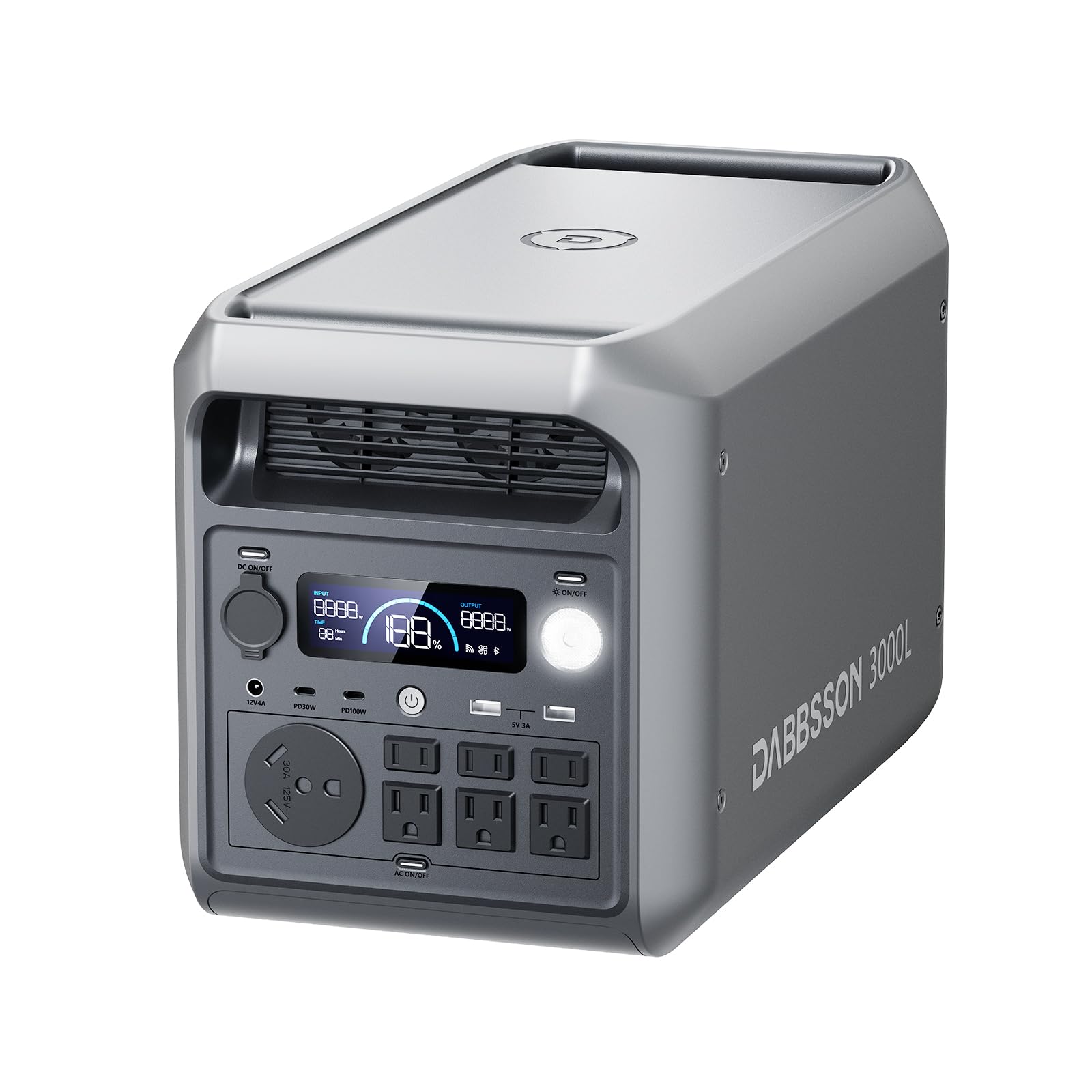
The DABBSSON 3000L uses semi-solid LiFePO4 cells — a newer architecture that packs 3072Wh into a 59.5-pound chassis. That weight-to-energy ratio is exceptional for this power class; most 3kWh stations hover near 90 pounds. The semi-solid electrolyte reduces internal resistance and fire risk while delivering 4,000 charge cycles before hitting 80% capacity. Rated at 3000W continuous with P-Boost pushing to 3600W, this unit can handle a refrigerator startup surge and a microwave simultaneously without dropping voltage.
AC input reaches 1800W, refilling the full pack in about 1.5 hours to 80%, while solar input maxes at 1200W (12-75V VOC range). The TT-30 outlet lets you plug directly into an RV power inlet without a separate adapter. The built-in Bluetooth app provides real-time battery monitoring and charging speed adjustment. At under 60 pounds, this is the lightest true 3000W station on the market that still offers expandability to 10.7kWh via its proprietary battery port.
Build quality is solid with a UL94-V0 fire-resistant shell and an integrated LED emergency light. The semi-solid battery chemistry also means less thermal throttle in hot climates — the unit maintains full charge speed up to 113°F ambient. For a buyer prioritizing portability without sacrificing capacity, this is the most balanced choice in the class.
Why it’s great
- Ultra-light 59.5 lbs for 3072Wh capacity
- 4,000-cycle semi-solid LFP cells
- TT-30 RV port built in
- Bluetooth app with adjustable charging
Good to know
- Semi-solid technology is still newer; long-term parts availability unproven
- Solar input limited to 75V VOC maximum
- App login required for full control
2. PECRON F3000LFP Portable Power Station
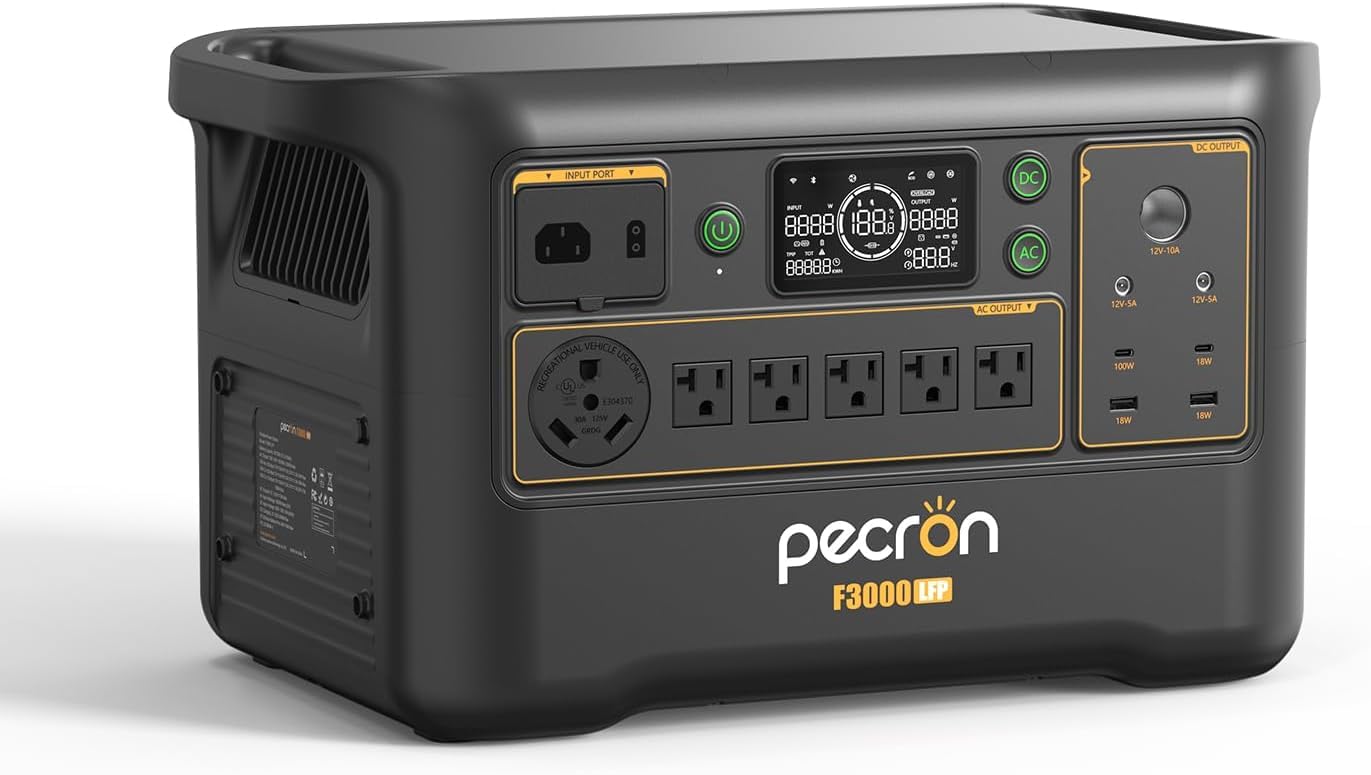
The PECRON F3000LFP is a 3072Wh station with a 3600W pure sine wave inverter and an aggressive 1800W AC input that fills the battery from 0 to 100% in about 2 hours. That fast charge rate is 30% quicker than many competitors at the same capacity. The LiFePO4 cells are rated for 3,000 cycles, and the unit can expand to 10,752Wh when connected to PECRON’s EP3800-48V external battery (sold separately, requires a special XT120-M cascade cable).
Thirteen output ports include six AC outlets, two USB-C (100W PD), two USB-A (18W), a carport, and two DC 5525 ports. The UPS switch over happens in 8-20ms, fast enough to keep a desktop computer or CPAP machine running through a grid interruption. The Bluetooth app monitors real-time power usage and state of charge, though the app UI is basic compared to premium brands. Customers note that the fan is audible during high-rate charging — normal for a 1800W input rate — but the unit remains quiet under light loads.
At 63.3 pounds, it’s manageable for most adults to move short distances. The 19.3 x 11.6 x 11.1-inch footprint fits under a standard counter. Solar input maxes at 1600W with a 25-120V range, accepting both high-voltage string arrays and portable panels. For the price, you get a high-power inverter, very fast AC recharge, and expansion headroom — all in a reasonably portable frame.
Why it’s great
- 1800W AC input charges to full in 2 hours
- Expandable to 10.7kWh
- 3600W continuous inverter
- Wide 120V solar input range
Good to know
- External battery cable not included
- Fan noise at high charge rates
- App interface could be more polished
3. Anker SOLIX F3000 Portable Power Station
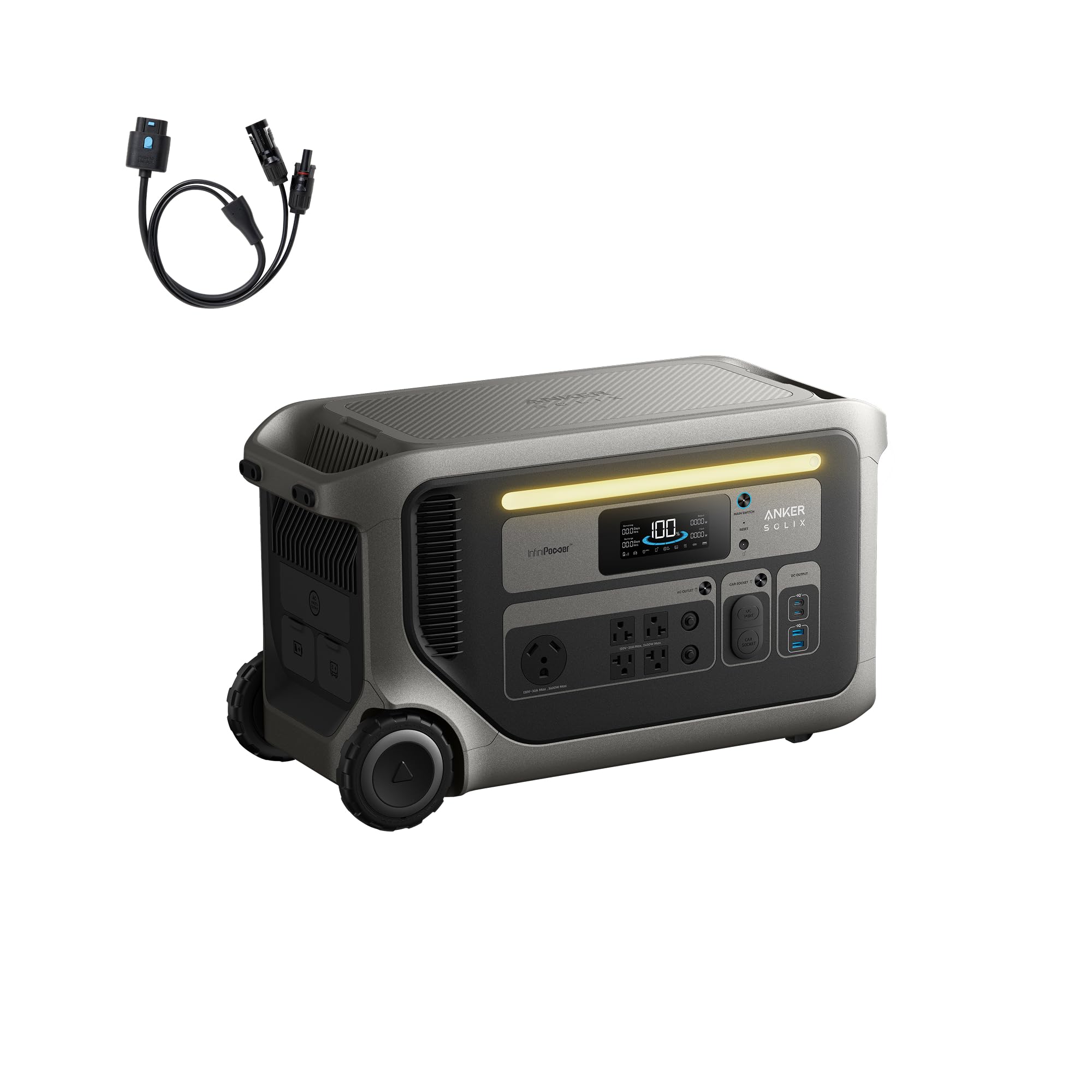
The Anker SOLIX F3000 is designed for the grid-tied home that also owns a gas generator. Its headline feature is 6000W pass-through charging: you connect a 120V generator to the F3000, and the station simultaneously recharges its 3072Wh internal battery while powering loads at up to 3600W. This eliminates the “must recharge then switch back” dance that plagues conventional power stations during multi-day outages. The ultra-low idle consumption allows 125 hours of AC standby, meaning the unit can sit ready for days without draining its cells.
Expandability goes to 24kWh via add-on battery packs. The 2400W solar input supports both 165V and 60V MPPT ports, accommodating residential rooftop arrays and portable panels alike. Two F3000 units can be paired for 240V output, covering well pumps and electric dryers. The physical design includes a retractable handle and wheels (91.5 lbs), making it easier to move than its weight suggests.
The app supports time-of-use scheduling: set it to charge when electricity rates are low and discharge during peak hours. Some users report that the app requires initial firmware updates and that the unit’s BMS throttles solar input below 50°F. For homeowners with an existing generator who want to reduce runtime and noise, the F3000 is the most versatile hybrid solution available.
Why it’s great
- 6000W generator bypass charging while running loads
- 125 hours AC idle standby
- 2400W dual-MPPT solar input
- Expandable to 24kWh
Good to know
- BMS reduces charging below 50°F
- Heavy at 91.5 lbs
- Firmware update required out of box
4. BLUETTI Apex 300 Portable Power Station
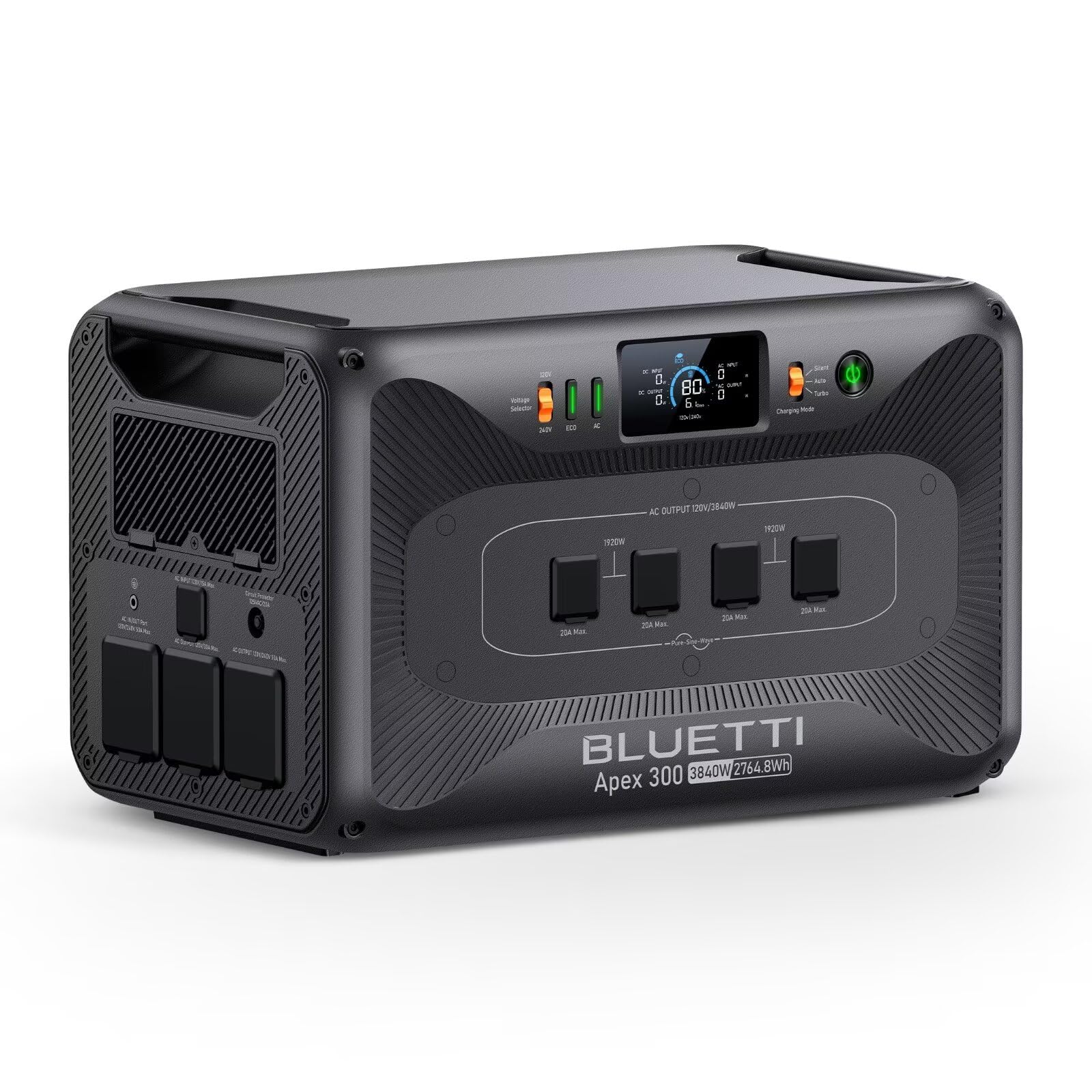
The BLUETTI Apex 300 is the smallest station on this list that outputs native 120V and 240V from a single unit. Its 2765Wh internal battery can be expanded with B300K or B500K packs, and the inverter delivers 3840W continuous (7680W surge) — enough to start a 2-ton central AC or a 1 HP well pump. The simultaneous 120V/240V output means you can power standard household circuits while also running a 240V appliance, all through the onboard outlets and a transfer switch.
Charging flexibility is exceptional: 2000W AC input (0-80% in ~50 minutes), 2000W solar input via dual MPPT, and support for generator charging. The BLUETOPUS AI-BMS monitors cell temperature and state of charge with millisecond granularity, and the unit operates as quiet as 22 dB in eco mode — barely audible across a room. The UPS switch is ≤10ms, so sensitive electronics never blink. A Black Start feature allows the station to power itself up from a dead battery when connected to solar panels, a critical feature for off-grid scenarios.
The Apex 300 is heavier than its capacity suggests at 66.1 pounds, but it includes a handle designed for two-person carries. The 60V VOC solar limit may require care when selecting high-voltage panels — arrays above 60V need the HV port. For buyers who need 240V without buying two stations, this is the compact solution.
Why it’s great
- 120V/240V split-phase from a single unit
- 7680W surge handles large motor starts
- 2000W AC + 2000W solar charging
- Black Start for dead-battery solar recovery
Good to know
- Solar input VOC limited to 60V on main port
- No built-in DC ports
- 66 lbs is heavy for its 2.7kWh base capacity
5. EF ECOFLOW DELTA Pro 3 Portable Power Station

The EcoFlow DELTA Pro 3 is the most powerful single-unit station in this roundup, packing 4096Wh of LiFePO4 capacity and a 4000W inverter (6000W with X-Boost) that can surge to 8000W. It outputs native 120V and 240V split-phase power from a single unit — no pairing required — and can be expanded to a staggering 48kWh with extra batteries. That makes it a genuine whole-house backup solution for short outages, capable of running a 3-ton central AC unit or a 1 HP water pump.
Charging is incredibly flexible: 1800W AC input fills the pack 0-80% in about 50 minutes, while solar input reaches 2600W via dual MPPT ports (up to 150V each). Combining AC and solar allows a total input of 7000W, recharging the full 4kWh pack in under an hour. The X-Quiet technology keeps fan noise as low as 30 dB in normal operation, quiet enough for bedrooms. UPS switchover is ≤10ms, and the app provides granular control over charge limits, discharge schedules, and storage mode.
At 115 pounds, the DELTA Pro 3 is a beast — it requires two people or a wheeled cart for regular movement. The IP65-rated battery pack (dust-tight and splash-proof) adds durability for outdoor use. The ECOFLOW ecosystem includes a Smart Home Panel 2 for seamless transfer switch integration, plus optional alternator and EV charging accessories. For buyers with serious power needs and a budget that allows for scale, this is the heavy hitter.
Why it’s great
- 4096Wh base capacity, expandable to 48kWh
- Native 120V/240V split-phase output
- 7000W combined AC + solar recharge
- IP65-rated battery pack
Good to know
- Very heavy at 115 lbs
- No built-in 12V port
- App requires internet for offline setting changes
6. Jackery HomePower 3000 with 2x Solar Panels
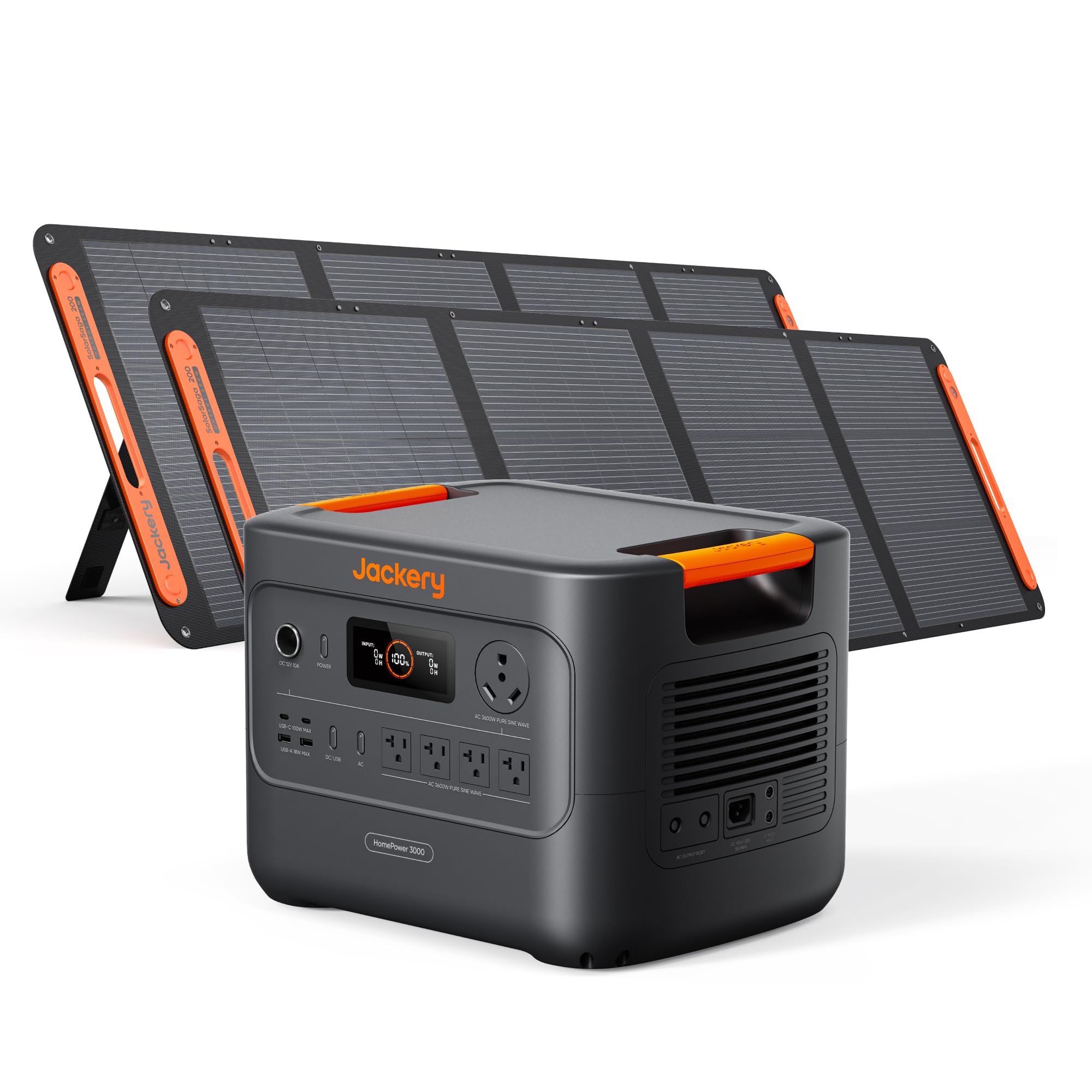
The Jackery HomePower 3000 is the world’s first 3kWh portable power station to use CTB (Cell-to-Body) technology, which integrates the battery cells directly into the structural shell. This eliminates separate module housing, resulting in a unit that is 47% smaller and 43% lighter than comparable 3kWh stations — just 59.5 pounds. The 3600W inverter (7200W surge) powers most home essentials, and the included two 200W SolarSaga panels provide a complete solar generator kit out of the box.
ChargeShield 2.0 technology uses AI algorithms to optimize charge curves, extending the LFP battery’s cycle life to 4,000 charges at 70% capacity retention. The UPS switchover is ≤20ms, suitable for computers and medical devices. The TT-30 RV port allows direct plug-and-play power for campers, and the dual 100W PD USB-C ports fast-charge laptops and drones simultaneously. The panels recharge the station to 80% in about 9 hours of full sun — enough for daily use in sunny climates.
The major trade-off is that the HomePower 3000 is not expandable — the 3072Wh is fixed. If you need more runtime, you must buy a second unit. The included panels are 200W portable suitcases rather than rigid rooftop panels, which may not suit all installations. For homeowners who want a complete, portable solar backup kit that weighs less than 60 pounds, this is the lightest path to 3kWh.
Why it’s great
- Industry-lightest 3kWh at 59.5 lbs
- Includes two 200W solar panels
- 4,000-cycle LFP battery
- 7200W surge handles large loads
Good to know
- Fixed capacity — not expandable
- Solar panels shipped separately
- No 240V output
7. Anker SOLIX F3800 Portable Power Station

The Anker SOLIX F3800 is a 3840Wh station rated for 6000W continuous output at both 120V and 240V — enough to run an electric dryer, a well pump, or a central AC without breaking stride. The surge rating is not specified, but the massive 6000W continuous capacity means it can handle most motor starts natively. Expandability goes to 26.9kWh with up to six battery packs, and by adding a second F3800 and twelve packs, you can reach 53.8kWh — enough for two weeks of whole-home backup.
The NEMA 14-50 port allows direct EV charging at 6000W, making this the only station on the list that can meaningfully charge a car (approximately 12 miles of range per hour). The L14-30 port connects directly to RV power inlets or a transfer switch. Solar input maxes at 2400W via two MPPT channels (each up to 150V). The Anker app supports Wi-Fi and Bluetooth control, though some users note the app lacks detailed power tracking. The physical design includes heavy-duty casters and a telescoping handle, but at 132.3 pounds, it is the heaviest unit in this guide.
Another notable detail: the unit’s BMS limits charging below 50°F, reducing DC input to 710W and AC input to 685W until the battery warms. This is a limitation for cold-weather installations unless the station is kept in a conditioned space. For users who need extreme power density and 240V capability in a single box, the F3800 is unmatched.
Why it’s great
- 6000W continuous at 120V/240V
- NEMA 14-50 EV charging port
- Expandable to 26.9kWh
- Two independent MPPT inputs
Good to know
- Very heavy at 132.3 lbs
- BMS throttles charging below 50°F
- App charges via 120V stops 240V output
8. Jackery Explorer 2000 Plus Portable Power Station

The Jackery Explorer 2000 Plus is a 2042Wh LiFePO4 station with a 3000W inverter (6000W surge) that can expand to 24kWh by adding up to five external battery packs. Two units can be paralleled for 6000W and 24kWh total. This modular approach lets you start with the base 2kWh and scale as budget and needs grow. The ChargeShield fast charging technology extends battery life by 50%, and the LiFePO4 cells are rated for 4,000 cycles to 70% capacity — approximately 10 years of daily use.
Recharging from AC takes about 2 hours at 1800W, or you can combine six 200W SolarSaga panels to recharge in the same timeframe. The 30 dB fan noise during operation is genuinely quiet — comparable to a modern refrigerator. The 30A RV outlet simplifies connection to a camper or transfer switch. The app controls via Wi-Fi and Bluetooth, monitoring charge status and allowing remote toggling of outputs. At 62 pounds with a retractable handle and wheels, it is easier to move than its fixed-capacity peers.
The base 2kWh capacity is smaller than the 3kWh units above; you will need at least one extra battery to reach true whole-house backup levels. The battery pack connection cable is somewhat bulky and requires a straight connector path. For RVers who want to start with a smaller investment and grow, this is Jackery’s most flexible platform.
Why it’s great
- Expandable from 2kWh to 24kWh
- 30 dB whisper-quiet operation
- 4,000-cycle LFP battery
- 30A RV outlet
Good to know
- Base capacity only 2kWh; extra batteries needed for 3kWh
- No Battery Saving Mode on packs
- Battery pack cable requires clearance
9. ABOK Ark3600 with 200W Solar Panel
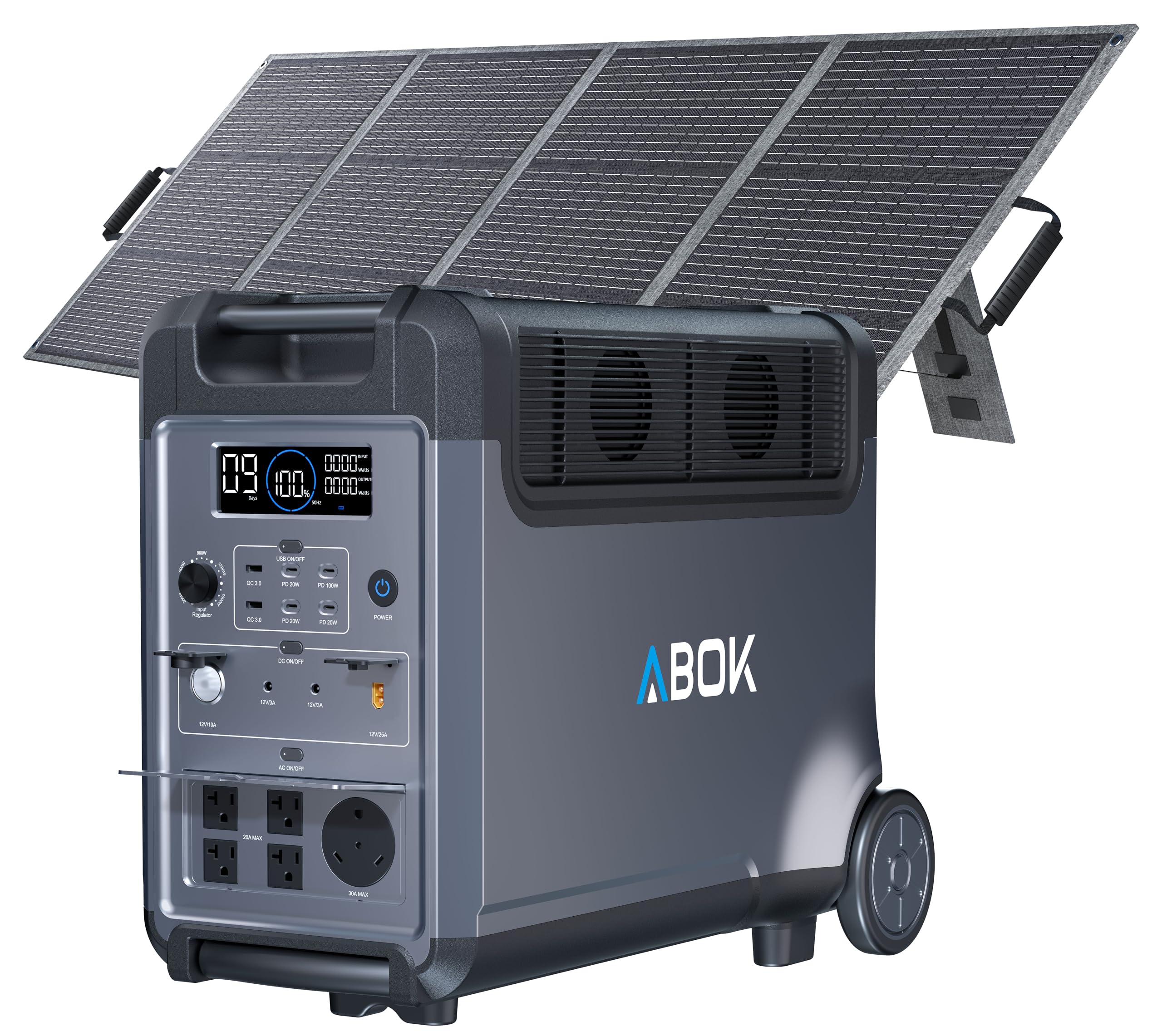
The ABOK Ark3600 is a 3840Wh station with a 3600W rated output (4500W peak) and a 200W solar panel included. The EV-grade LFP battery is rated for 4,000 cycles and a 10-year lifespan. Expandability to 11,520Wh via extra battery packs makes this a proper long-term backup solution. The unit features 15 output ports, including a 30A RV outlet, four 20A AC outlets, three USB-C ports (one at 100W), and an XT60 DC port.
Charging is fast: AC alone refills the 3.8kWh in about 3 hours at 1500W, while AC + solar combined can fully charge in 1.29 hours (1500W AC + 2000W PV). The telescoping handle and durable wheels make the 92-pound unit manageable to roll across a driveway or campsite. The Bluetooth app provides remote monitoring and allows adjustment of charge rates and discharge limits. The included 200W panel is a rigid monocrystalline unit, which offers better efficiency than portable foldable panels.
The main downside is noise — the cooling fan runs frequently under load or during fast charging. Some users report that the fan is louder than expected for a power station. The unit also requires ambient temperatures above 32°F to begin charging, with a potential 30-minute to 2-hour delay if the battery is cold. For buyers who want a complete solar generator kit with expansion flexibility and a robust inverter, the Ark3600 delivers.
Why it’s great
- 3840Wh base, expands to 11.5kWh
- Rigid 200W solar panel included
- AC + PV combined charging in 1.29 hrs
- 30A RV outlet and telescoping handle
Good to know
- Cooling fan audible under load
- Charging limited above 32°F ambient
- 92 lbs without wheels
10. AFERIY 3840Wh Portable Power Station

The AFERIY 3840Wh station delivers a strong capacity-to-price ratio, with 3840Wh of LFP storage and a 3600W continuous inverter (7200W surge). It expands to 11.5kWh with add-on battery packs, making it a scalable home backup solution. The <10ms UPS switchover ensures connected electronics never reset during a grid flicker. Fifteen output ports include five AC outlets, USB-C PD 3.0, DC ports, and an XT60 solar input — enough to simultaneously power a refrigerator, TV, lights, and phone chargers.
Recharging is flexible: AC input reaches the unit’s max supported rate, refilling in about 1.5 hours. Solar input maxes at 1200W (12-75V VOC range). The unit includes a pull handle and weighs 80.5 pounds — heavy but rollable on its built-in wheels. The app provides monitoring and scheduling, though some users find the interface basic. The company offers a 7-year support period, which is longer than most competitors in this price tier.
Some customer reviews note that the solar input spec printed on the unit label (800W max) differs from the marketing (1200W max), leading to confusion. Buyers should confirm the exact solar limit before purchasing panels. The fan noise is acceptable under normal loads. For budget-conscious buyers who need expandable capacity and are comfortable double-checking specs, the AFERIY is a high-value entry point.
Why it’s great
- 3840Wh base capacity at competitive price point
- Expandable to 11.5kWh
- <10ms UPS backup
- 7-year support period
Good to know
- Solar input spec discrepancy (800W vs 1200W)
- Heavy at 80.5 lbs
- No 240V output
11. BLUETTI AC200L with 200W Solar Panel

The BLUETTI AC200L is a 2048Wh LiFePO4 station paired with a 200W solar panel, making it a ready-to-use solar generator for home backup and camping. The inverter delivers 2400W continuously with Power Lifting to 3600W, enough to start a small refrigerator or a sump pump. The unit is expandable via BLUETTI’s proprietary battery packs (B300K, B210, B300, or B230), scaling up to 8kWh or more depending on the pack chosen.
AC charging hits 2400W — 0-80% in 45 minutes — one of the fastest recharge rates for an expandable 2kWh station. Solar input maxes at 1200W, refilling the 2kWh pack in about 1.7-2.2 hours of peak sun. The 11 output ports include a 30A RV port and a 48V/8A DC port for direct RV battery charging (with the optional D40 voltage regulator). The UPS switchover is ≤10ms. The included 200W solar panel is a monocrystalline panel shipped separately.
The 2kWh base capacity is smaller than the 3kWh-class stations above; users who need more than essential backup will need an expansion battery. The unit’s overall weight is manageable at 52 pounds, and the compact footprint (11.6 x 16.5 x 14.4 inches) fits under a counter. For campers and budget-focused homeowners who want a fast-charging, expandable station with a solar panel included, the AC200L kit is a solid entry into the BLUETTI ecosystem.
Why it’s great
- 2400W AC input for 45-min 0-80%
- Expandable with BLUETTI battery packs
- 200W solar panel included
- 30A RV port and 48V DC output
Good to know
- Only 2kWh base capacity
- Solar panel shipped separately
- Power Lifting is surge, not continuous
12. EF ECOFLOW DELTA Pro Portable Power Station
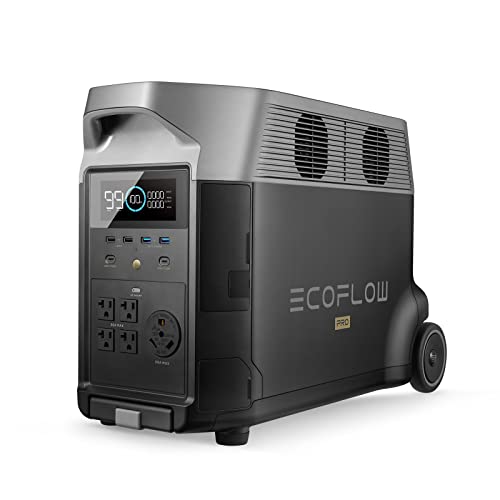
The original EcoFlow DELTA Pro remains a benchmark in the 3kWh class, offering 3600Wh of LFP storage and a 3600W inverter (4500W with X-Boost). Two units can be paired for 7200W output at 120/240V. Expandability goes to 25kWh with extra batteries, and the ecosystem includes a Smart Generator (gas/LPG), Smart Home Panel for transfer switch integration, and EV charging capability via the XT60 port. It charges from 1800W AC in 2.7 hours, or from 1600W solar in 2.8 hours with four 400W panels.
The X-Stream and X-Boost technologies are well-proven: X-Stream safely manages high-current charging without overheating, and X-Boost allows the inverter to power loads up to 4500W that exceed the nominal 3600W rating by intelligently managing voltage and current. The app provides Wi-Fi/Bluetooth monitoring and control, including the ability to set charge limits, schedule charging during off-peak hours, and adjust X-Boost behavior. At 99 pounds, it is heavy but includes wheels and a pull handle for transport.
The primary limitation is that the original DELTA Pro uses NMC chemistry in early models; current stock is LFP, but buyers should verify before purchase. The unit also lacks native 240V output from a single unit — you must pair two units. For off-grid builders and prosumers who are already invested in the EcoFlow ecosystem or who need the expandability and solar input flexibility, the DELTA Pro is a proven workhorse.
Why it’s great
- 3600Wh base, expandable to 25kWh
- X-Boost handles 4500W loads
- Smart Home Panel integration
- Proven, reliable ecosystem
Good to know
- Requires two units for 240V output
- Heavy at 99 lbs
- Verify LFP chemistry in current stock
13. VTOMAN FlashSpeed 1500 with Extra Battery

The VTOMAN FlashSpeed 1500 comes bundled with an extra battery, delivering a combined 3096Wh capacity — matching the 3kWh class. However, the inverter is rated at only 1500W continuous (3000W peak), making this suitable for powering lights, TVs, phone chargers, a refrigerator, and small appliances, but not heavy-draw items like air conditioners or power tools. The V-Beyond Technology allows the inverter to sustain 1500W continuously even when powering loads over 1500W (instead of shutting down), though it cannot magically exceed 15 amps.
The LiFePO4 battery offers 3,000+ cycles, and the LifeBMS provides overcharge, over-discharge, and short-circuit protection. The AC adapter charges the station from 0 to 80% in about 60 minutes — impressively fast for the combined capacity. Solar input is limited to 400W via an Anderson port (30-60V range), which is lower than the 3kWh-class competitors. The 12 output ports include three AC outlets, two USB-C (one 100W), four USB-A, and DC ports. The extra battery connects via a CP3500 cable and cannot charge independently — it must be connected to the main unit.
At 3096Wh for the price, this is one of the most affordable ways to get 3kWh of LFP storage. The trade-offs are a lower inverter capacity and slower solar input. The unit’s weight is reasonable (the main unit weighs about 30 lbs, the extra battery adds ~20 lbs). For budget-conscious campers and home backup users with modest power needs, this bundle delivers massive capacity without the premium price.
Why it’s great
- 3096Wh capacity at budget-friendly price
- Fast 60-min 0-80% AC charging
- V-Beyond sustains over-rated loads
- 3,000-cycle LFP battery
Good to know
- Inverter limited to 1500W continuous
- Only 400W max solar input
- Extra battery cannot charge standalone
FAQ
Can a 3000 watt power station run a central air conditioner?
How many solar panels do I need to recharge a 3072Wh station in one day?
What is the difference between single-phase 120V and split-phase 120V/240V output for power stations?
Final Thoughts: The Verdict
For most users, the best 3000 watt power station winner is the DABBSSON 3000L because it packs 3072Wh into a 59.5-pound semi-solid LFP frame with a TT-30 RV port and 4000-cycle battery. If you need pass-through charging from a gas generator while running household loads, grab the Anker SOLIX F3000. And for whole-house 240V backup with room to scale to 48kWh, nothing beats the EF ECOFLOW DELTA Pro 3.

Mo Maruf
I created WellFizz to bridge the gap between vague wellness advice and actionable solutions. My mission is simple: to decode the research and give you practical tools you can actually use.
Beyond the data, I am a passionate traveler. I believe that stepping away from the screen to explore new environments is essential for mental clarity and physical vitality.