Our readers keep the lights on and my smoothie glass nicely filled. As an Amazon Associate, I earn from qualifying purchases.
When the grid goes down or you need power at a remote campsite, a 3000-watt generator hits the sweet spot between portability and muscle—enough to run a fridge, a window AC, and a few lights without dragging a 200-pound monster behind your truck. But the difference between a generator that starts on the first pull and one that becomes a yard ornament comes down to inverter technology, fuel flexibility, and real-world noise levels, not just the peak wattage printed on the box.
I’m Mohammad Maruf — the founder and writer behind WellFizz. I’ve spent hundreds of hours analyzing generator specifications, combing through owner experiences, and comparing build quality across dozens of models to separate the units that deliver reliable power from those that fall short under load.
After researching the top contenders on the market, these are the models that earned their spot in this guide to finding the best 3000-watt generator for your specific needs, whether that’s emergency home backup, RV boondocking, or job site power.
How To Choose The Best 3000-Watt Generator
Not all generators wearing a 3000-watt badge deliver the same real-world performance. The core difference is inverter vs. conventional (open-frame) design. Inverter generators produce cleaner power below 3% total harmonic distortion (THD), making them safe for laptops and sensitive electronics, and they run quieter and more fuel-efficiently by adjusting engine speed to the load. Conventional generators run at a fixed speed, burn more fuel, and produce dirtier power that can damage electronics over time. For any 3000-watt class generator used with modern appliances or RV equipment, inverter technology isn’t a luxury—it’s a requirement.
Fuel Type: Gasoline vs. Dual Fuel vs. Battery
Gasoline offers the highest peak wattage and widest availability, but it degrades over time and requires carburetor maintenance. Propane burns cleaner, stores indefinitely, and is better for the engine’s longevity, though it reduces peak output by roughly 10-15%. Dual-fuel models give you the flexibility to switch on the fly. Battery power stations (solar generators) eliminate fuel, noise, and fumes entirely, but their usable runtime at 3000W is limited by battery capacity—typically 2-4 kWh before needing a recharge. For extended off-grid use, fuel-based generators still dominate. For short-term backup or quiet overnight RV use, a large battery station paired with solar panels can be the better fit.
Noise Level and Runtime
Noise is measured in dBA at a specific distance (usually 23 feet). Budget models often hit 60-65 dBA—roughly the volume of a normal conversation. Premium inverter generators can drop below 52 dBA, quiet enough to hold that same conversation next to the running unit. Runtime is typically listed at 25% or 50% load. Eco-mode (variable engine speed) can extend a 1-gallon tank from 4 hours to 8+ hours on light loads. If you camp in quiet RV parks or have close neighbors, prioritizing a model under 55 dBA with eco-throttle is a smart move.
Quick Comparison
On smaller screens, swipe sideways to see the full table.
| Model | Category | Best For | Key Spec | Amazon |
|---|---|---|---|---|
| PowerSmart 3000W | Inverter | Value-focused home backup | 59 dB at 23 ft, 5.0h runtime | Amazon |
| PowerSmart 3800W | Inverter | Quiet camping & tailgating | 59 dBA, 143cc engine | Amazon |
| Westinghouse iGen2800DFc | Dual Fuel Inverter | Lightweight dual-fuel camping | 52 dBA, 45 lb, propane ready | Amazon |
| WEN 56360i | Inverter | Ultra-light RV travel | 46 lb, 149cc engine | Amazon |
| WEN DF360iX | Dual Fuel Inverter | Dual-fuel with CO watchdog | 49 lb, propane 2600W rated | Amazon |
| Champion 4500W | Dual Fuel Inverter | Extended run on propane | 61 dBA, 21h runtime on LPG | Amazon |
| DJI Power 2000 | Battery Station | Zero-fume RV & home backup | 30 dB, 2048Wh, 55min recharge | Amazon |
| Generac GP3300i | Inverter | High altitude & home backup | PowerRush tech, COsense | Amazon |
| Jackery Explorer 2000 Plus | Battery Station | Expandable solar off-grid | 30 dB, 2042Wh, up to 24kWh | Amazon |
| Jackery HomePower 3000 | Battery Station | Whole-house light backup | 3072Wh, 20ms UPS switch | Amazon |
| Honda EU3000iS | Inverter | Premium long-life investment | 50-57 dBA, 19.6h runtime | Amazon |
In‑Depth Reviews
1. PowerSmart 3000W Portable Inverter Generator
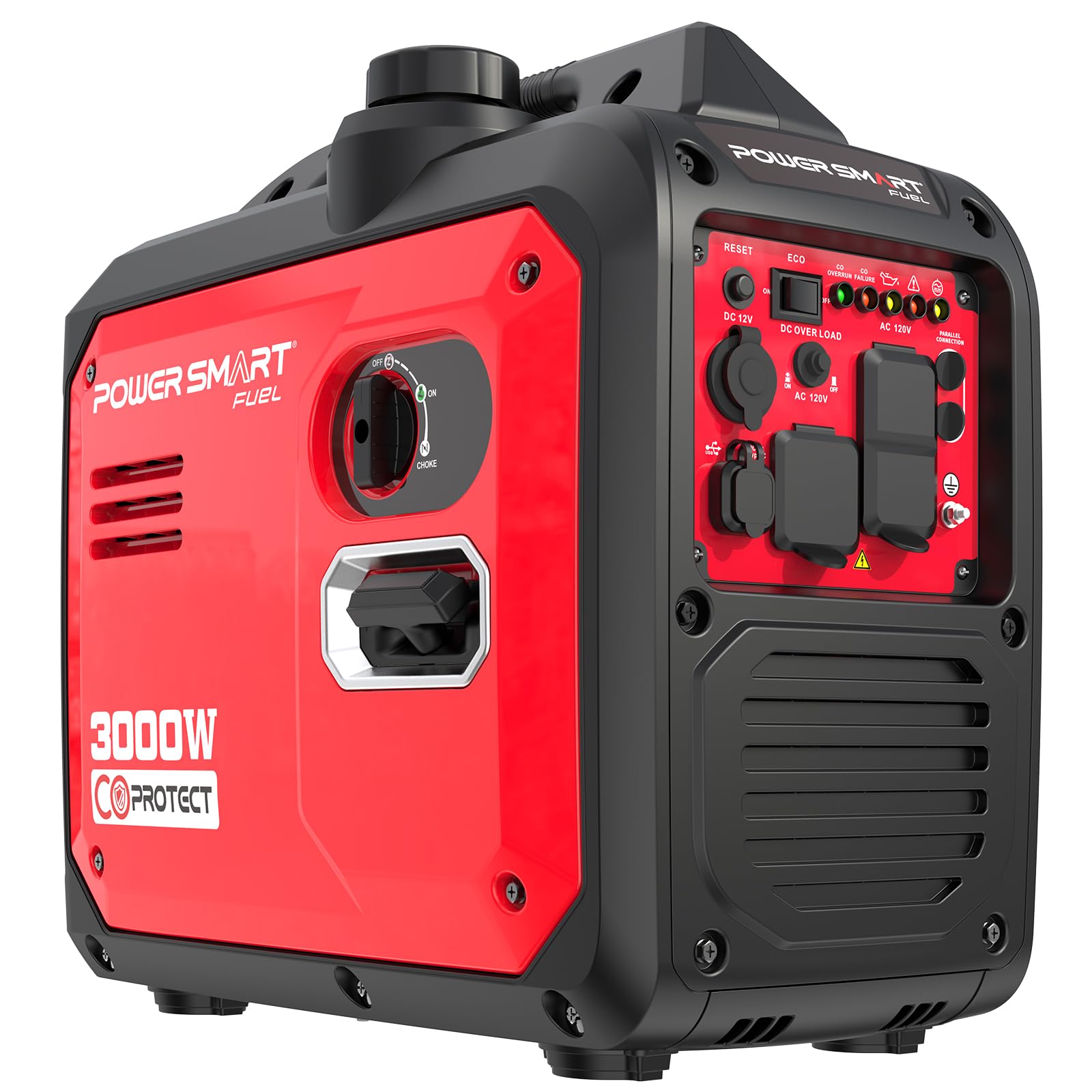
The PowerSmart 3000W delivers a rare combination of affordability, quiet operation at 59 dB, and clean inverter power under 3% THD, making it a strong candidate for anyone needing a primary backup unit without breaking the bank. Its 121.6cc OHV engine produces 2600 rated watts and 3000 surge watts, enough to run a 13,500 BTU RV air conditioner or a home refrigerator plus a few lights off the same tank. The built-in CO alarm adds a critical safety layer that many budget units omit entirely.
At 52 pounds, this generator is light enough for one person to lift into a truck bed, and the parallel-ready ports let you double your output by connecting a second identical unit. Owners consistently report first-pull starts and whisper-quiet idle that makes it usable in campsites with noise restrictions. The 1.06-gallon fuel tank provides about 5 hours of run time at a 50% load, which is decent but not class-leading for extended outages.
Where the PowerSmart slightly trails is fuel capacity and the lack of a fuel gauge — you’ll want to track run time manually. The manual start system works reliably, but users with arthritis might wish for an electric start option. For the price, the combination of inverter efficiency, safety features, and build quality is hard to beat in the 3000W class.
Why it’s great
- CO alarm standard for family safety
- Parallel capable for scalable power
- First-pull start with 59 dB operation
Good to know
- No fuel gauge or hour meter
- 5-hour runtime is average for the category
2. PowerSmart 3800W Portable Inverter Generator
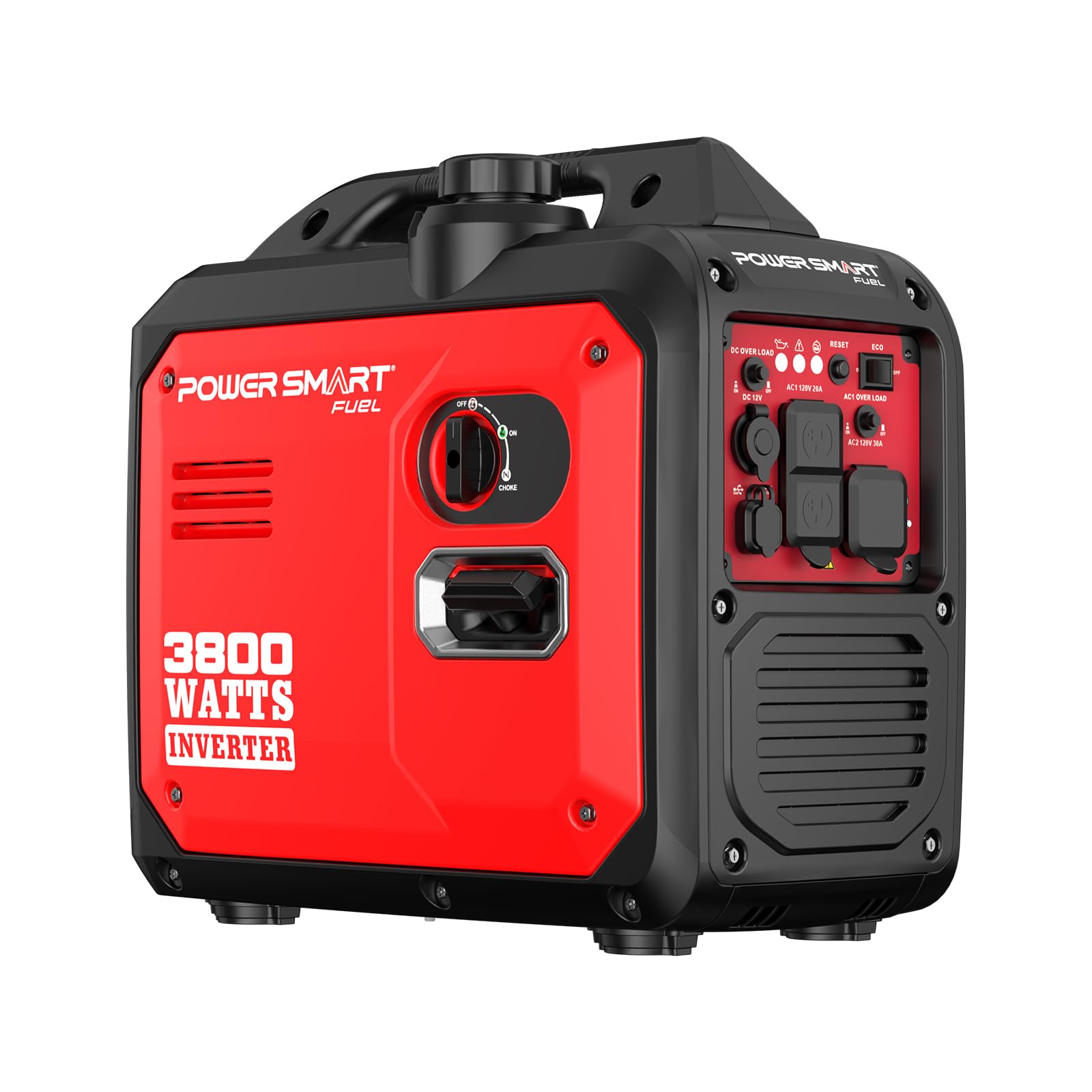
Stepping up to a bigger 143cc engine, the PowerSmart 3800W provides 3200 rated watts and 3800 surge watts — enough overhead to start a larger air conditioner or well pump without tripping the overload. The clean sine wave output stays under 3% THD, making it safe for sensitive electronics like CPAP machines, laptop chargers, and smart home hubs. At 59 dBA, it’s comparable to a normal conversation, so it won’t dominate your campsite or backyard.
Weighing the same as the smaller PowerSmart model at 52 pounds, this unit feels impressively light for its output class. The economy mode automatically adjusts engine RPM to match the load, which owners report extends the 1.19-gallon tank to roughly 6.5 hours in real-world mixed use. The recoil start system has earned consistent praise for catching on the first or second pull even after sitting for weeks.
The trade-off for the extra power is a slightly shorter runtime at full load — expect about 4.5 hours if you’re drawing 1600W continuously. The included wrench and basic tool kit are functional, but the lack of a wheel kit means you’ll be carrying it manually. For buyers who need a bit more headroom than the standard 3000W class offers without paying for a premium brand, this is a smart middle ground.
Why it’s great
- Clean sine wave under 3% THD for electronics
- Economy mode extends fuel runtime
- Lightweight 52 lb for its power class
Good to know
- No built-in wheels for rolling transport
- Runtime limited to 4.5h at 50% load
3. Westinghouse iGen2800DFc Dual Fuel Inverter Generator
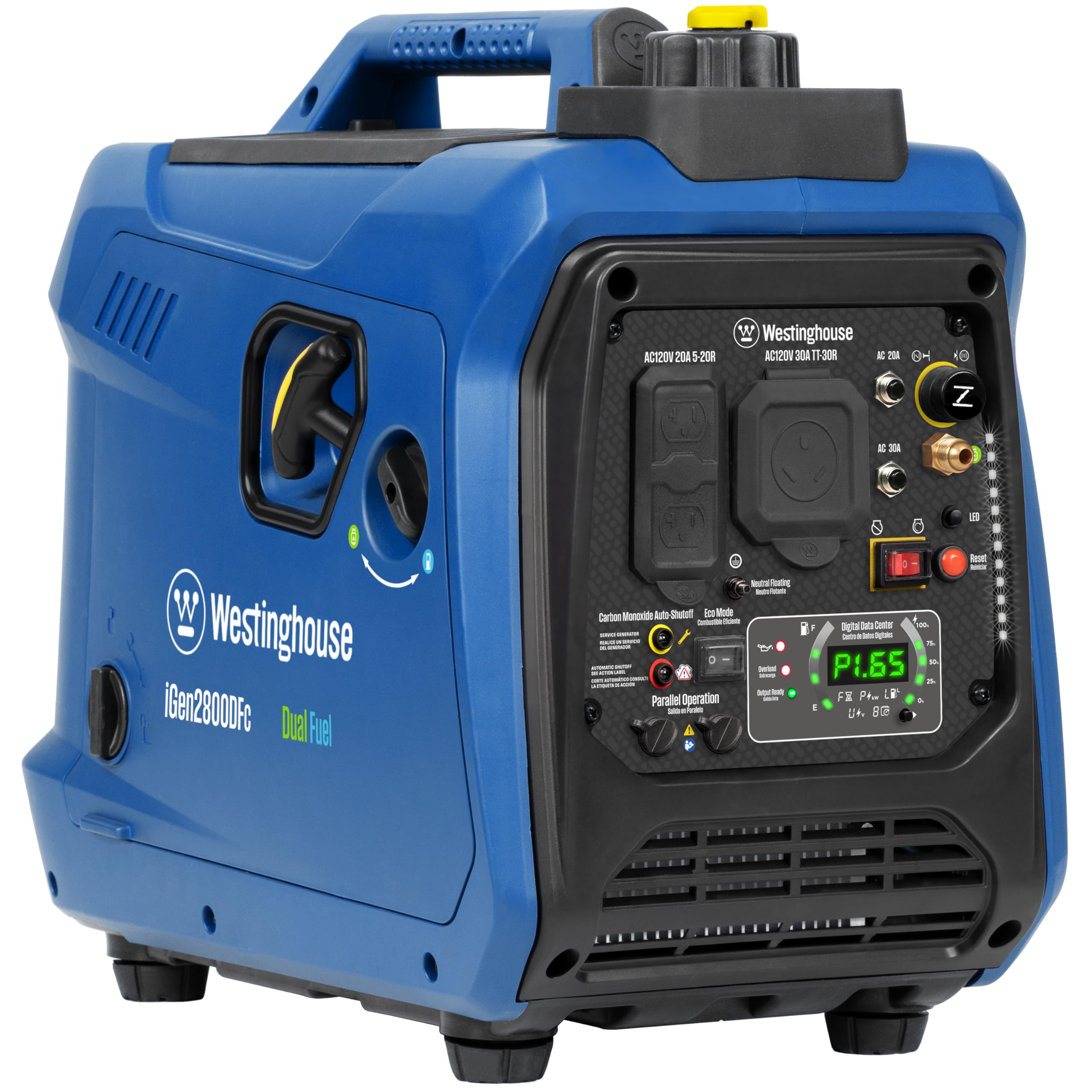
The Westinghouse iGen2800DFc is the lightest and quietest dual-fuel inverter generator in this lineup at just 45 pounds and 52 dBA — quieter than a typical window air conditioner. Running on gasoline it provides 2800 peak and 2200 rated watts, while propane drops to 2520 peak and 1980 rated. That’s enough to power a small RV refrigerator, lights, and charge devices, but you’ll want to watch your starting loads on larger appliances.
The dual-fuel flexibility is a major advantage for storage and emergency preparedness — propane doesn’t go bad and won’t gum up the carburetor during months of disuse. The LED panel displays fuel level and remaining runtime, a feature rarely seen at this weight class. Owners consistently praise the first-crank start and the quiet idle that makes overnight camping generator runs viable without disturbing neighbors.
Keep in mind that 2200 continuous watts on gas limits this unit to lighter loads. Running a 13,500 BTU RV AC will push the iGen2800DFc to its limit, especially on propane where the rated output is lower. The TT-30R outlet is a nice touch for direct RV hookup, but dedicated full-time RVers may want a larger Westinghouse model for headroom. For weekend campers and emergency phone/fridge backup, this is an excellent portable option.
Why it’s great
- Ultra-light 45 lb with dual-fuel flexibility
- Only 52 dBA for campsite-quiet operation
- LED panel shows fuel level and runtime
Good to know
- 1980W rated on propane limits large appliances
- Customer support and parts availability reported as inconsistent
4. WEN 56360i 3600-Watt Portable Inverter Generator

The WEN 56360i packs a 149cc engine that produces 3600 surge watts and 2900 rated watts into a chassis that weighs just 46 pounds — the lightest gas inverter generator in this review relative to its output. That makes it an ideal companion for small travel trailers and pop-up campers where every pound matters. The inverter output stays clean enough for sensitive electronics, and the TT-30R receptacle lets you plug your RV directly without a dogbone adapter.
Owners consistently mention the fuel shut-off feature, which lets the carburetor run dry before storage and extends the lifespan of the fuel system — a common pain point with cheaper generators. The three-year warranty is also a class-leading perk at this price tier. Real-world reports show about 4-5 hours of runtime on a single tank when powering a 13,500 BTU RV air conditioner, with significantly longer run times under lighter loads with eco-mode engaged.
The downside is the lack of any CO shutdown sensor, a safety feature that’s becoming standard on even budget models from competitors. The manual recoil start system is reliable but can take more pulls in cold weather (owners note 4 pulls at 14°F). For RVers who prioritize portability and want a proven brand with solid warranty support, the 56360i is a capable choice despite the missing CO sensor.
Why it’s great
- Ultra-light 46 lb with 2900W rated output
- Fuel shut-off for long-term storage hygiene
- Three-year warranty included
Good to know
- No carbon monoxide auto-shutdown sensor
- Cold starts may require multiple pulls
5. WEN DF360iX Dual Fuel Inverter Generator

The WEN DF360iX addresses the biggest gap in the standard WEN 56360i by adding a CO Watchdog automatic shutdown sensor and dual-fuel capability, all while keeping the weight at a manageable 49 pounds. On gasoline, it delivers 3600 surge watts and 2900 rated watts; on propane, those numbers drop to 3500 surge and 2600 rated. The 149cc engine runs remarkably quiet, comparable to a normal conversation according to the Department of Health and Human Services guidelines cited in the product specs.
This generator is essentially a safety-upgraded version of the 56360i with the flexibility to run on propane for indefinite storage. The tool-free LPG quick-connector makes switching fuels effortless at the campsite or during an outage. The informational display shows voltage, frequency, runtime, and load percentage — valuable data that most budget inverters hide behind a simple power light. Owners note that the carburetor drain and fuel shut-off work together to keep maintenance low.
A few owners have reported that the 20A outlets hold plugs loosely, which can be a nuisance when using heavy-duty extension cords at full load. The price jump over the gasoline-only version is noticeable, but the added safety and fuel flexibility justify the cost for anyone who stores their generator for months between uses. If you want inverter-clean power with propane backup and automatic CO protection, this is one of the most well-rounded mid-range options available.
Why it’s great
- CO Watchdog auto-shutdown for family safety
- Dual-fuel with tool-free LPG quick connect
- Full info display shows voltage, load, and runtime
Good to know
- 20A outlets may have loose plug fitment
- Premium price over the gasoline-only WEN version
6. Champion 4500-Watt Dual Fuel Inverter Generator

The Champion 4500W inverter generator sits at the higher end of the 3000-watt class with an electric start, a 212cc engine, and 3500 rated watts on gasoline (3150 on propane). What sets it apart is the phenomenal runtime — up to 14 hours on gasoline and 21 hours on propane at 25% load, making it the longest-running dual-fuel inverter in this comparison. The 61 dBA noise level is slightly above the quietest competitors but still far quieter than a conventional open-frame generator.
The electric start with a lithium battery eliminates pull-start frustration, and the Intelligauge panel gives you voltage, frequency, and operating hours at a glance. Owners report that the unit easily powers a 30A RV for several days on propane, consuming roughly 13 gallons over 4 days in real-world boondocking scenarios. The parallel-ready ports allow connection with another Champion inverter for increased output if your power needs grow. The three-year warranty and free lifetime technical support add peace of mind for a major purchase.
At 99 pounds, the Champion is considerably heavier than suitcase-style inverters and requires the included wheel kit for mobility. The height may not fit under all truck bed covers, so measure your storage space before buying. The CO Shield system provides automatic shutdown protection, though some owners wish the sensor was a bit less sensitive to avoid nuisance trips. For RVers and homeowners who want electric-start convenience and marathon propane runtime, this Champion delivers serious value.
Why it’s great
- Electric start with lithium battery is effortless
- 21-hour propane runtime is class-leading
- Three-year warranty with lifetime tech support
Good to know
- 99 lb with wheels required for transport
- 61 dBA is louder than premium inverter competitors
7. DJI Power 2000 Portable Power Station
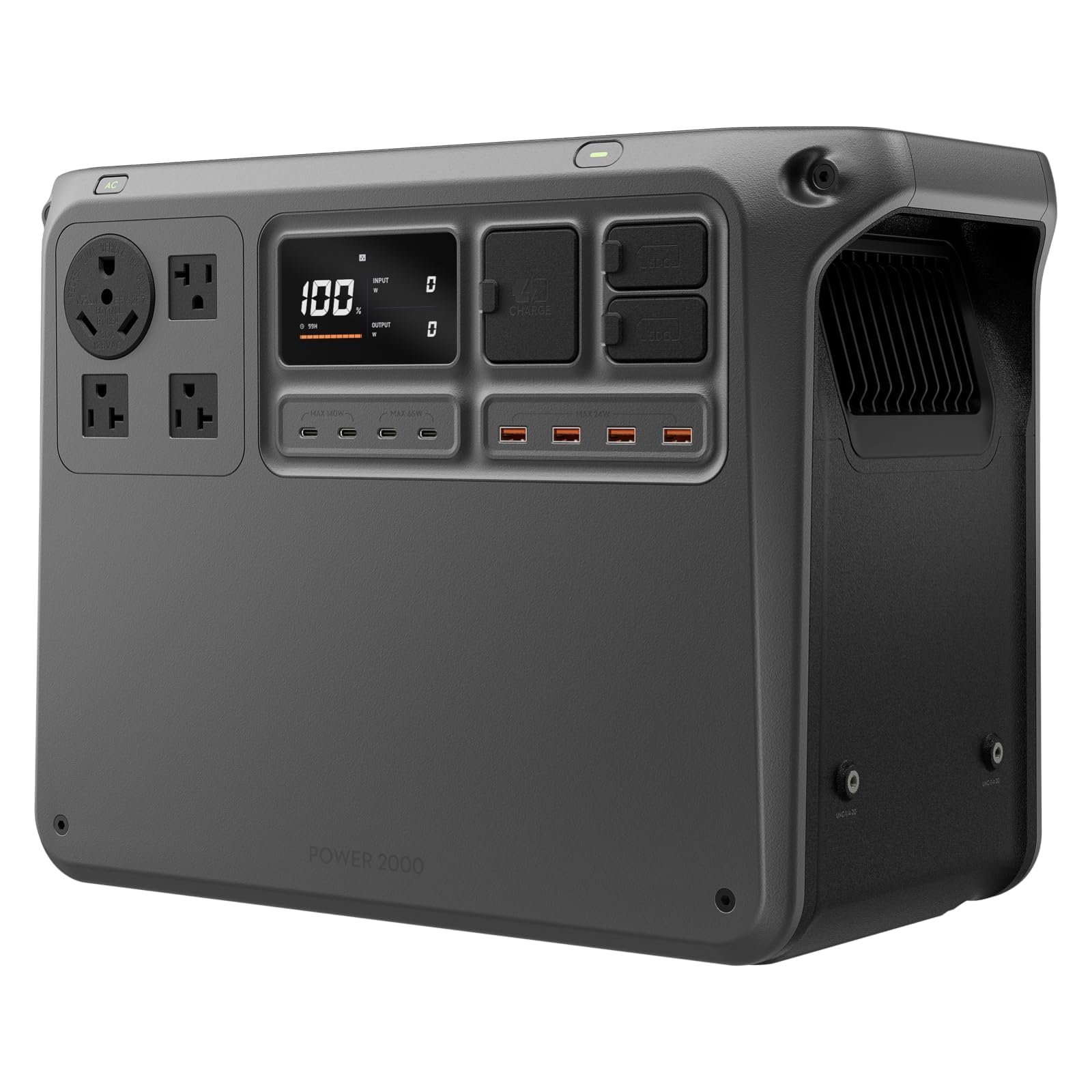
The DJI Power 2000 represents a fundamentally different approach to 3000-watt power — a lithium iron phosphate (LFP) battery station that delivers 3000W continuous output (4000W surge) from a 2048Wh internal pack with absolutely zero noise, zero fumes, and zero fuel. At just 30 dB, it’s effectively silent in an RV or a bedroom, making it the obvious choice for overnight CPAP use, indoor emergencies, or any scenario where gas fumes are unacceptable. The LFP chemistry provides 4000 charge cycles before dropping to 70% capacity, translating to a decade of daily use.
The headline feature is the recharge speed — 0 to 80% in 55 minutes via AC input, far faster than any comparable battery station. The 15 ports including dual SDC ports can keep an entire family’s devices running simultaneously. The UPS function switches in under 10 milliseconds (faster than the 20ms threshold for most electronics), so connected devices never blink during a grid outage. The DJI Home app adds remote monitoring and control via Bluetooth or WiFi.
The trade-offs are significant for anyone needing sustained high-wattage output. At 3000W draw, the internal battery will last roughly 40 minutes before requiring a recharge. Recharging from solar requires a separate MPPT adapter (not included). The proprietary SDC connectors limit third-party accessory compatibility. A few owners have reported heat buildup under moderate load. For short-duration backup, quiet RV overnight power, or mobile workstation use, the DJI Power 2000 is a premium, fume-free alternative to gas generators.
Why it’s great
- Silent operation at 30 dB with zero emissions
- Ultra-fast 55-minute recharge to 80%
- 4000-cycle LFP battery lasts 10+ years
Good to know
- Roughly 40 minutes of runtime at full 3000W load
- Solar and car charging require separate adapter
8. Generac GP3300i Inverter Generator

The Generac GP3300i brings the brand’s utility-grade engineering to a portable inverter package, leveraging PowerRush Advance Technology that delivers over 50% more starting capacity than conventional designs — meaning it can start a well pump or refrigerator compressor that would stall a standard 3000W inverter. The 3300 peak watts (3300W surge / 2900W rated) come from a 439cc engine, and the COsense technology automatically manages the generator’s shutdown if carbon monoxide levels rise, making it safer for placement near windows or doors.
The TruePower Technology keeps total harmonic distortion low enough for sensitive electronics, and the Economy Mode automatically adjusts engine speed to reduce fuel consumption under lighter loads. Owners report running a full household load (TV, WiFi, fridge, fans, chargers) for 9 hours on less than 1 gallon of gas, which is impressive efficiency for a generator of this size. The parallel-ready capability allows doubling output with a second GP3300i for whole-house backup scenarios.
At 59.5 pounds, it’s heavier than suitcase competitors but still manageable for one person. The LED indicators for low oil, overload, and ready status are helpful for less experienced users. A few owners at 5,000 feet elevation report significantly reduced output — roughly 2000W continuous — so altitude compensation is weaker than some competitors. For suburban homeowners who want Generac’s reliability and don’t plan to move the generator daily, the GP3300i is a strong, feature-rich choice.
Why it’s great
- PowerRush tech provides 50% more starting capacity
- COsense automatic shutdown for safety
- Economy Mode delivers up to 9h runtime per gallon
Good to know
- Output drops at high elevation (5,000+ ft)
- Heavier at 59.5 lb than comparable inverters
9. Jackery Explorer 2000 Plus Portable Power Station

The Jackery Explorer 2000 Plus combines a 2042Wh LiFePO4 battery with a 3000W inverter (6000W surge), and its modular expansion system lets you add up to five extra battery packs for a max capacity of 12kWh in a single unit — or parallel two units for up to 24kWh and 6000W of continuous output. This makes it one of the most scalable battery solutions available, capable of keeping an RV running for days or backing up critical home circuits during extended outages. The 30A RV outlet allows direct plug-and-play connection to a travel trailer’s power inlet.
Charging speed is excellent: full recharge from a wall outlet in about 2 hours, or 2 hours with six SolarSaga 200W solar panels in full sun. The app control via Bluetooth or WiFi lets you monitor remaining battery, adjust charging speed, and toggle outputs remotely. The LFP battery offers 4000 cycles to 70% capacity — roughly 10 years of daily use. At just 30 dB during operation, it’s silent compared to any gas generator, making it ideal for camping where noise ordinances are strict or for nighttime use in bedrooms.
At 62 pounds with a built-in retractable handle and wheels, the Explorer 2000 Plus is portable but not lightweight. The battery pack expansion cable has been noted as bulky by some users. Jackery’s warranty policy has drawn criticism — the company only honors the warranty for units purchased directly from Jackery, not from Amazon resellers. For anyone building a long-term off-grid power system with solar panels, the expandable architecture and silent operation make this a future-proof investment despite the warranty caveat.
Why it’s great
- Expandable to 24kWh for whole-home or RV backup
- Silent 30 dB operation with zero emissions
- 2-hour full recharge via AC or solar
Good to know
- Warranty only valid for direct Jackery purchases
- 62 lb with bulky battery pack cable
10. Jackery HomePower 3000 Portable Power Station
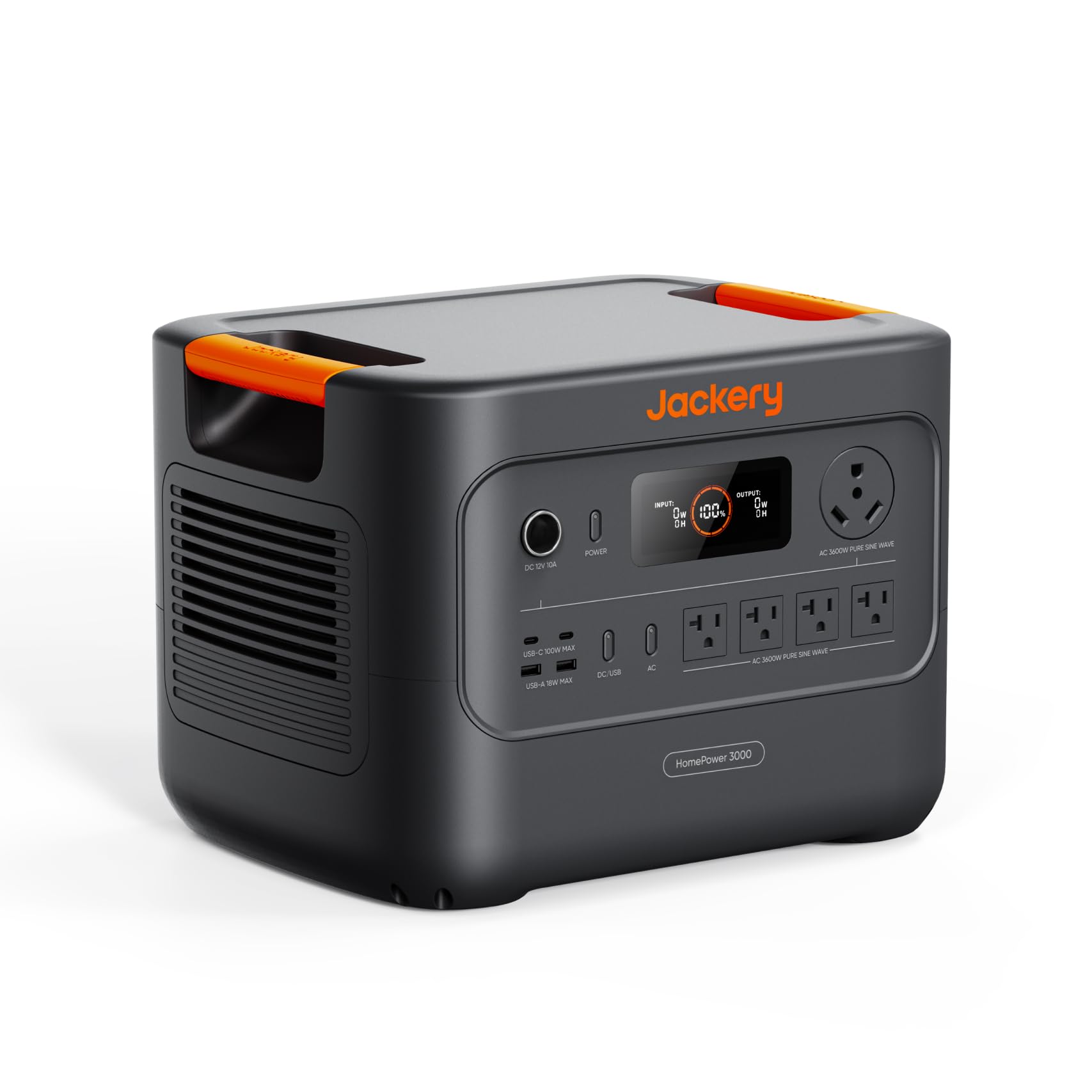
The Jackery HomePower 3000 packs a massive 3072Wh LFP battery and a 3600W inverter (7200W surge) into a chassis that’s 47% smaller and 43% lighter than comparable 3kWh stations, at just 59.5 pounds with built-in handles. That makes it realistically portable for one person to load into an RV or truck, despite the three-kilowatt-hour capacity. The 20ms UL-certified UPS switch ensures connected security cameras, medical devices, and network equipment never lose power during a grid transition.
Recharge speed is competitive: 1.7 hours via hybrid AC+DC input or 2.2 hours via standard AC. Dual 100W USB-C PD ports can fast-charge laptops and tablets simultaneously, while the TT-30R outlet provides direct RV hookup. The ChargeShield 2.0 AI algorithms optimize charging speed while extending the LFP battery’s lifespan to 4000 cycles (retaining 70% capacity). Owners report the unit can run a 30-foot travel trailer with propane heat, fridge, lights, CPAP, and limited TV for roughly 45-50% of the battery in 24 hours — impressive efficiency.
The same warranty caveat applies: Jackery only covers units purchased directly from their website, not from Amazon. The weight distribution is better than many competitors, but it’s still 60 pounds that you’ll lift into a vehicle. Some users wish the handles were retractable with wheels for longer distances. For anyone who needs a full day of silent, fume-free power for home essentials or a modern RV, the HomePower 3000 offers the best capacity-to-weight ratio in this class.
Why it’s great
- Best-in-class 3kWh density at 59.5 lb
- 20ms UPS switch for sensitive devices
- Dual 100W USB-C PD ports for fast charging
Good to know
- Warranty requires direct Jackery purchase
- No wheels or retractable handle included
11. Honda EU3000iS Inverter Generator
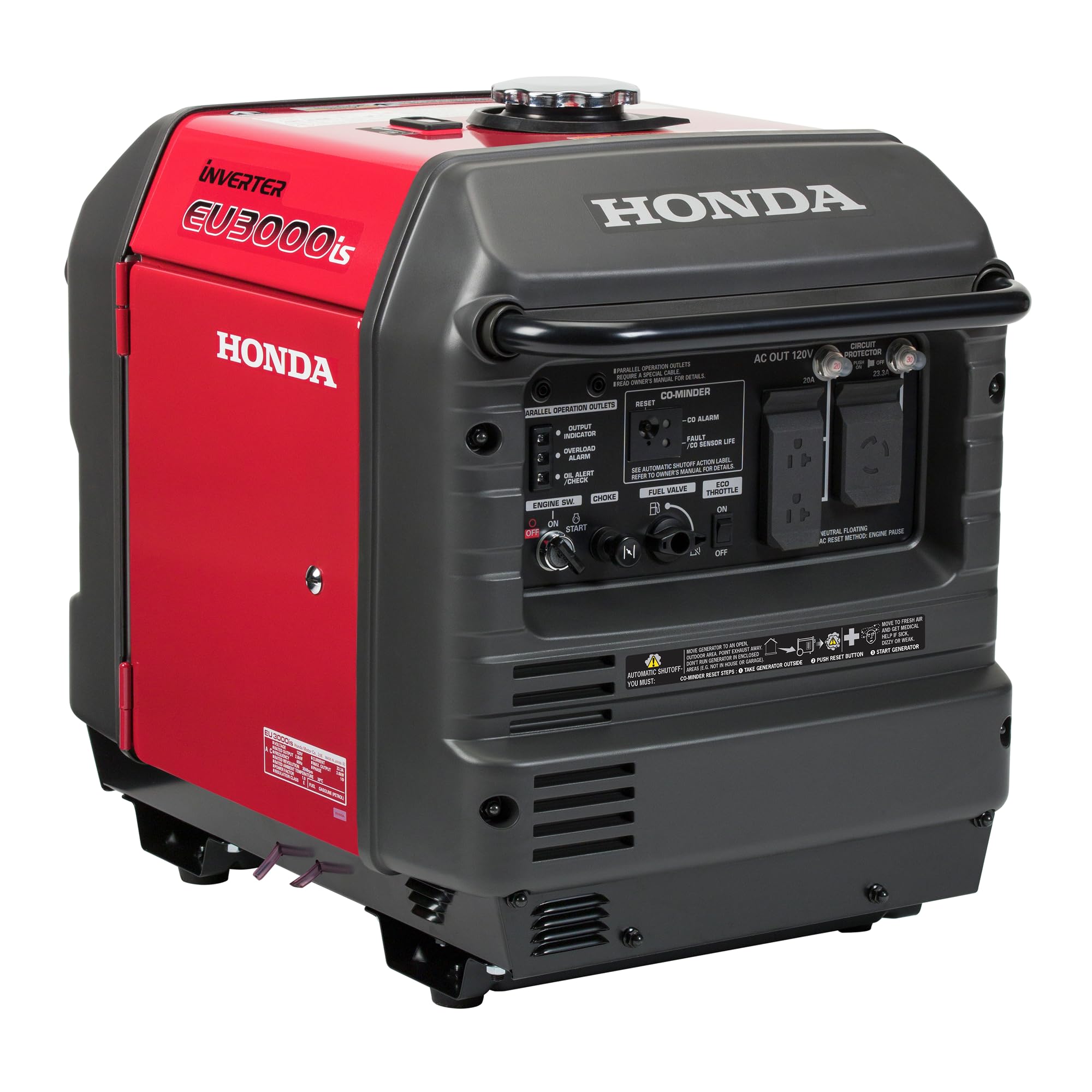
The Honda EU3000iS is the benchmark that every other inverter generator in this class is measured against — a 3000-watt gas-powered unit that runs at 50 to 57 dBA (less noise than a normal conversation) and delivers up to 19.6 hours of runtime on its 3.4-gallon fuel tank thanks to Honda’s legendary Eco Throttle System. The 418cc commercial-grade engine is renowned for starting on the first pull after years of storage, and the inverter output is clean enough for sensitive medical equipment and computers without any additional filtering.
The electric start makes ignition effortless, and the CO-MINDER carbon monoxide detection system automatically shuts down the generator before dangerous CO levels accumulate near windows, doors, or RV vents. At 144 pounds, this is not a lightweight unit — it’s designed for semi-permanent placement in an RV compartment, garage, or jobsite where you’ll move it occasionally on its built-in wheels. The 3-year residential warranty reflects Honda’s confidence in the engineering, and typical owner reports show these generators running reliably for 2,000 to 5,000 hours with basic maintenance.
The biggest barrier is the price — the EU3000iS costs roughly two to four times as much as comparable competitors, and it’s gasoline-only with no dual-fuel option. It also isn’t available for sale in California (buyers there should look at the EU3200iAC2). The weight limits portability compared to 50-pound suitcase inverters. For buyers who need absolute reliability for mission-critical backup, extended off-grid living, or commercial use, the Honda EU3000iS is the gold standard that pays for itself over a decade of trouble-free service.
Why it’s great
- Industry-best reliability with 2,000+ hour typical lifespan
- 50-57 dBA and up to 19.6h runtime on eco mode
- CO-MINDER auto shutdown for carbon monoxide safety
Good to know
- Gasoline-only with no propane or dual-fuel option
- 144 lb is heavy and not available in California
FAQ
Can a 3000-watt generator run a house?
How long does a 3000-watt generator run on a tank of gas?
Is propane or gasoline better for a 3000-watt generator?
How many watts does a 13,500 BTU RV air conditioner need?
Final Thoughts: The Verdict
For most users, the 3000-watt generator winner is the PowerSmart 3000W because it delivers reliable inverter power, a CO alarm, and parallel capability at an accessible price point that outperforms similarly priced competitors. If you want the quietest dual-fuel option for campsite use, grab the Westinghouse iGen2800DFc at 52 dBA and just 45 pounds. And for zero-emission, silent power that can expand to run an entire RV or home, nothing beats the Jackery Explorer 2000 Plus with its expandable LFP architecture and solar charging capability.

Mo Maruf
I created WellFizz to bridge the gap between vague wellness advice and actionable solutions. My mission is simple: to decode the research and give you practical tools you can actually use.
Beyond the data, I am a passionate traveler. I believe that stepping away from the screen to explore new environments is essential for mental clarity and physical vitality.