Our readers keep the lights on and my smoothie glass nicely filled. As an Amazon Associate, I earn from qualifying purchases.
A range hood is one of those kitchen investments you don’t think about until smoke fills the room or lingering odors refuse to leave. After that first frustrating experience, the search for something that actually works becomes personal. I’ve spent weeks analyzing the engineering, real owner feedback, and performance data across the most popular 30-inch ducted models to save you that headache.
I’m Mohammad Maruf — the founder and writer behind WellFizz. I specialize in dissecting appliance specifications and translating real-world user experiences into clear, practical recommendations so you can buy with confidence.
Ventilation performance comes down to more than just a high CFM number on the spec sheet. After evaluating dozens of models, I narrowed the list to the best 30 inch ducted under cabinet range hood options that deliver real performance and value.
How To Choose The Best 30 Inch Ducted Under Cabinet Range Hood
Selecting the right hood involves matching your cooking habits to the right combination of airflow, noise, filtration, and installation fit. Below are the most important factors to weigh before you buy.
Airflow Capacity (CFM)
CFM, or cubic feet per minute, measures how much air the hood moves. For heavy cooking like stir-frying or searing, look for 900 CFM or higher. Lighter cooking can get by with 600–800 CFM. A common rule is 100 CFM for every 10,000 BTU of your cooktop, but going higher never hurts if your ductwork can handle it.
Noise Level (Sones or Decibels)
A powerful fan is useless if it drowns out conversation. Noise is measured in sones or decibels. Under 4 sones (roughly 55 dB) is considered quiet. Many modern hoods with DC motors operate as low as 35 dB on the lowest setting, which is quieter than a refrigerator hum.
Filter Type: Baffle vs Mesh
Baffle filters use metal chambers to trap grease and are significantly more effective than basic mesh filters. They are also easier to clean — most are dishwasher-safe. Mesh filters require more frequent scrubbing and can become a fire hazard if grease builds up over time.
Ducted vs Ductless
This guide focuses on ducted hoods, which vent air outside through ductwork. Ducted systems remove heat, moisture, and odors completely. Ductless versions recirculate air through charcoal filters and are less effective for heavy cooking. If you have the option to run ductwork, always choose ducted.
Quick Comparison
On smaller screens, swipe sideways to see the full table.
| Model | Type | Best For | Key Feature | Amazon |
|---|---|---|---|---|
| FOTILE JQG7507 | Premium Ducted | Overall Best Performance | 1100 CFM, dual DC motors, 38.5 dB | Amazon |
| FOTILE JQG7505 | Premium Ducted | Quiet Power | 1000 CFM, motion activation, 39 dB | Amazon |
| Hauslane PS38 | Premium Ducted | Steam Self-Cleaning | 950 CFM, 6 speeds, auto clean | Amazon |
| ROBAM 1050 CFM | Premium Ducted | Sleek Glass Design | 1050 CFM, brushless motor, wash-free filter | Amazon |
| PROLINE PLJW 109.30 | Premium Ducted | Commercial-Grade Build | 1000 CFM, ultra-quiet 7 sones, 4 speeds | Amazon |
| VIKIO HOME 980CFM | Mid-Range Ducted | Best Value | 980 CFM, gesture control, 35 dB low | Amazon |
| BRANO Voice Control | Mid-Range Ducted | Smart Features | 900 CFM, voice/gesture/touch, slant vent | Amazon |
| Hauslane PS18 | Mid-Range Ducted | Versatile Installation | 860 CFM, 6 speeds, 3 vent adapters | Amazon |
| EVERKITCH 900CFM | Mid-Range Ducted | Budget-Friendly Power | 900 CFM, gesture control, dual motors | Amazon |
| TAZPI 1200 CFM | Mid-Range Ducted | Highest CFM for Price | 1200 CFM, gesture control, 55 dB max | Amazon |
| VIKIO HOME 900CFM | Entry-Level Ducted | Solid Basic Performer | 900 CFM, DC motor, 35 dB low, delay shut-off | Amazon |
In‑Depth Reviews
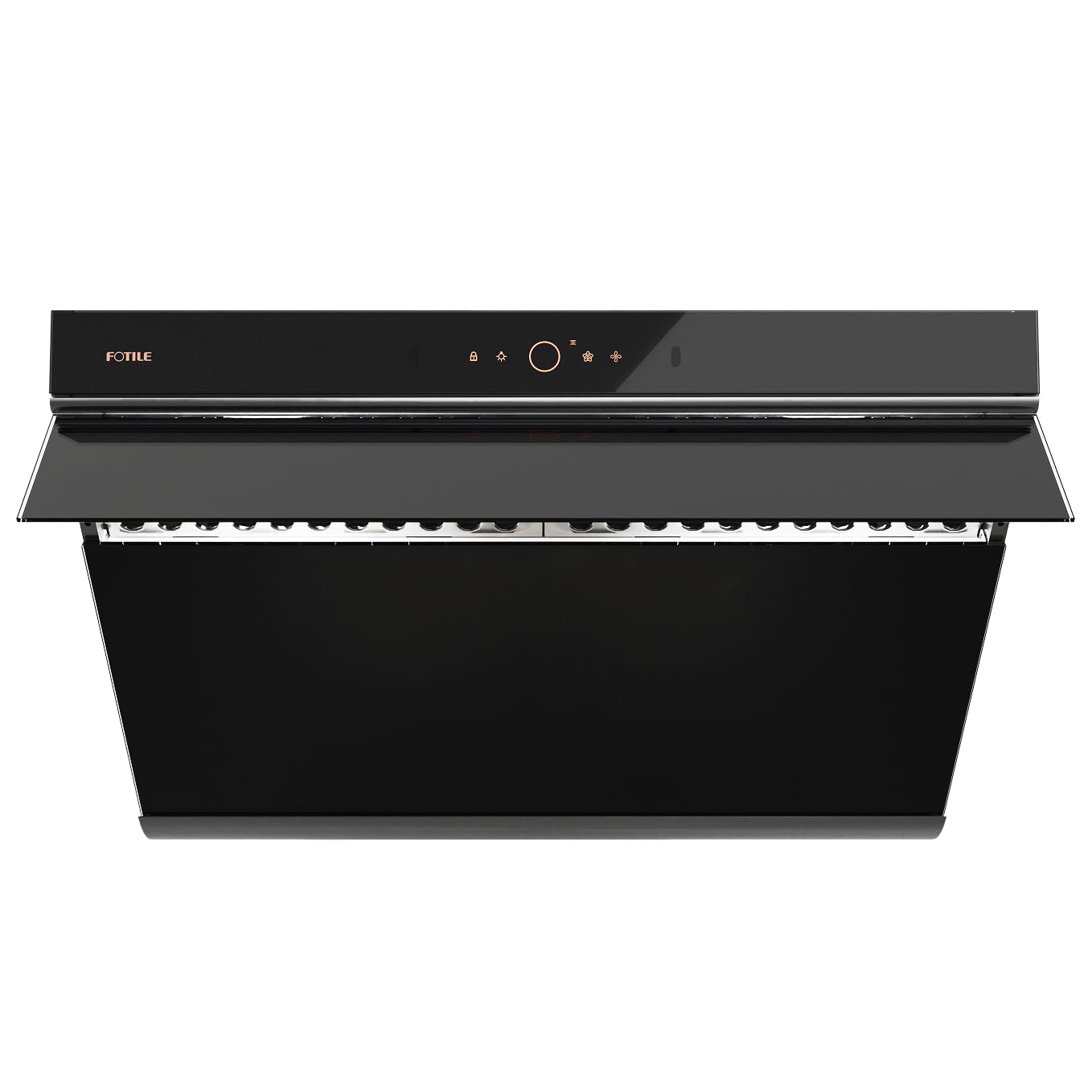
The FOTILE JQG7507 represents the pinnacle of residential range hood engineering. With dual DC motors pushing 1100 CFM and noise levels as low as 38.5 dB on low speed, it delivers industrial-grade suction without the jet-engine roar. The slant vent design opens automatically 90 degrees to capture smoke from front burners — a common weak point of traditional hoods.
Motion activation using infrared sensors means you never touch the surface with greasy hands. The touchscreen offers four speed levels including a dedicated stir-fry mode activated by holding the button for two seconds. Grease separation reaches 95%, and the removable tray makes cleanup simple. The brushed black glass finish resists fingerprints and looks stunning under any cabinet.
Installation takes about four hours for a confident DIYer, and FOTILE offers professional service in many major cities. The only real trade-off is the premium investment — but owners consistently report it outperforms cheaper alternatives and lasts for years. For serious home cooks who want the best capture and quietest operation, this is the definitive choice.
Why it’s great
- Exceptionally quiet at low speeds (38.5 dB)
- Dual DC motors provide powerful, efficient suction
- Motion activation keeps the surface clean
- Automatic baffle opens to capture front burner smoke
Good to know
- High initial cost compared to mid-range options
- Installation requires two people and about 4 hours
- Motion sensor may occasionally trigger during cleaning
2. FOTILE JQG7505

The JQG7505 shares the same slant vent DNA as its higher-CFM sibling but at a slightly more accessible price point. With 1000 CFM and dual DC motors, it still outperforms most traditional hoods while maintaining whisper-quiet operation at 39 dB on low. The motion activation technology works flawlessly — a simple wave turns the hood on or off without smudging the glass.
Four adjustable speeds give precise control, and the stir-fry mode (hold for 2 seconds) maximizes extraction for high-heat cooking. Grease and oil capture reaches 95%, and the removable filter tray slides out for easy dishwasher cleaning. The black glass finish is both elegant and practical, resisting fingerprints and wiping clean in seconds.
Installation is straightforward for under-cabinet or wall-mount setups. Owners praise the unit for handling heavy frying and reducing PM2.5 particles effectively. The only downside is the premium price, but those who invest consistently say it transforms their cooking experience. If you want near-flagship performance without the absolute top-end cost, this is the sweet spot.
Why it’s great
- Ultra-qu
Understanding the Specs
CFM (Cubic Feet per Minute)
This measures how much air the hood moves per minute. For a 30-inch gas cooktop, aim for at least 600 CFM for light cooking and 900 CFM or more for heavy frying or searing. Higher CFM is better, but only if your ductwork is sized correctly — a 6-inch round duct can handle up to about 1200 CFM efficiently.
Sones vs Decibels
Sones measure perceived loudness; decibels measure sound pressure. One sone equals about 40 dB (a quiet refrigerator). Most hoods range from 1.5 to 8 sones. For open-concept kitchens, look for under 4 sones on high speed. DC motors are generally quieter than AC motors at the same CFM.
Baffle Filters
Baffle filters use layered metal channels that force air to change direction, trapping grease in the process. They are far more effective than mesh filters and are dishwasher-safe. Look for filters made of stainless steel — they last longer and resist corrosion better than aluminum.
Ducting Configuration
Most hoods offer top or rear venting. Top venting requires a hole directly above the hood, while rear venting can be easier if your ductwork runs horizontally. Ensure your hood comes with the appropriate adapter for your setup. Some premium models include both adapters for flexibility.
FAQ
Can I install a ducted range hood myself?
Yes, if you have basic carpentry and electrical skills. The main challenges are cutting an accurate hole in the cabinet or ceiling, running ductwork, and hardwiring the hood (or using a plug-in model). Most hoods come with a template and instructions. For complex duct runs or if you’re unsure about electrical work, hiring a professional is recommended.What size duct do I need for a 900 CFM hood?
A 6-inch round duct is standard and works well for up to 1200 CFM. Using a smaller duct (like 4-inch) will restrict airflow and increase noise. Always match or exceed the hood’s outlet size. For runs longer than 25 feet, consider upsizing to 8-inch duct to maintain performance.How often should I clean the baffle filters?
Clean them every 1-2 months depending on cooking frequency. Heavy frying may require monthly cleaning. Baffle filters are dishwasher-safe — just pop them out and run them on the top rack. A clean filter improves airflow and reduces fire risk.What is the difference between ducted and ductless range hoods?
Ducted hoods vent air outside through ductwork, removing heat, moisture, and odors completely. Ductless hoods recirculate air through charcoal filters, which only trap odors (not heat or moisture). Ducted is always more effective for heavy cooking, but ductless is an option if you cannot run ductwork.Final Thoughts: The Verdict
For most people, the best 30 inch ducted under cabinet range hood winner is the FOTILE JQG7507 because it combines industry-leading 1100 CFM with whisper-quiet operation and motion activation — ideal for serious home cooks. If you want premium features at a slightly lower price, grab the FOTILE JQG7505. And for the best value with smart controls, nothing beats the VIKIO HOME 980CFM — it offers gesture control and a quiet DC motor without breaking the bank.

Mo Maruf
I created WellFizz to bridge the gap between vague wellness advice and actionable solutions. My mission is simple: to decode the research and give you practical tools you can actually use.
Beyond the data, I am a passionate traveler. I believe that stepping away from the screen to explore new environments is essential for mental clarity and physical vitality.