Our readers keep the lights on and my smoothie glass nicely filled. As an Amazon Associate, I earn from qualifying purchases.
After years of IPS glow and VA smearing, the 27-inch OLED monitor class has matured into a genuine alternative for both competitive framerate chasers and creative colorists. The core physics are simple — each pixel emits its own light, producing infinite contrast ratios and sub-0.1ms response times that LCDs simply cannot match. But the devil lives in the subpixel layout, the heatsink architecture, and the anti-burn-in firmware stack, all of which vary wildly across the eleven models I’ve examined here.
I’m Mohammad Maruf — the founder and writer behind WellFizz. I’ve spent the last eight months poring over OLED panel datasheets, cross-referencing real-world customer stress tests, and analyzing the thermal modulation algorithms that separate a three-year monitor from a six-month regret.
Whether you’re a tournament-level esports player needing 500Hz, a Mac-based content creator demanding 4K QD-OLED color accuracy, or a value-focused gamer looking for a 240Hz entry point, this deep-dive will help you navigate the best 27 inch oled monitor for your desk and your budget.
How To Choose The Best 27 Inch OLED Monitor
The buying decision for a 27-inch OLED monitor isn’t about whether OLED is better than LCD — it demonstrably is. The real questions revolve around which OLED sub-technology serves your primary use case, how much refresh rate your GPU can actually push at 1440p or 4K, and which burn-in warranty terms protect your investment.
QD-OLED vs. WOLED Panel Architecture
Qamsung’s QD-OLED uses a blue OLED backplane with quantum dot color conversion layers, producing higher peak brightness and a wider color gamut (99%+ DCI-P3) but exhibiting a slight purple tint under direct ambient light. LG’s WOLED stacks white OLED with color filters, delivering truer blacks in bright rooms and lower text fringing due to an RGWB subpixel layout. For mixed-use rooms with windows, WOLED generally wins; for dim gaming caves, QD-OLED takes the crown.
Refresh Rate vs. GPU Realism
A 240Hz panel is realistically driveable by a mid-range card like an RTX 4070 in most esports titles at 1440p. At 360Hz and above — including the 480Hz Sony M10S and the 500Hz ASUS ROG Strix XG27AQDPG — you need a top-tier GPU (RTX 4080 Super or better) to avoid frame-time stutters. Buying a 500Hz monitor for a system that can’t maintain 300+ FPS in your main game is wasted silicon and dollars.
Burn-in Mitigation and Warranty Coverage
All modern OLED monitors include pixel refresh cycles, static image detection, and screen savers. What separates the pack is hardware-level cooling: passive heatsinks (ASUS XG27AQDMG), pulsating heat pipes (Samsung G60SD), or fan-less custom structures (Sony M10S). A three-year warranty with explicit burn-in coverage — offered by ASUS and Sony — is the safety net worth prioritizing over a slightly lower sticker price.
Quick Comparison
On smaller screens, swipe sideways to see the full table.
| Model | Category | Best For | Key Spec | Amazon |
|---|---|---|---|---|
| ASUS ROG Strix XG27AQDPG | QD-OLED | Competitive esports at 500Hz | 500Hz / 0.03ms / 1440p | Amazon |
| Sony INZONE M10S | WOLED | 480Hz FPS tournament play | 480Hz / DP 2.1 / 24.5″ mode | Amazon |
| Samsung Odyssey OLED G6 G60SD | QD-OLED | 360Hz with anti-glare coating | 360Hz / Glare Free / 0.03ms | Amazon |
| MSI MPG 271QRX QD-OLED | QD-OLED | Balanced 360Hz gaming & work | 360Hz / Delta E ≤2 / KVM | Amazon |
| Alienware AW2725DF | QD-OLED | 360Hz with 3-year burn-in warranty | 360Hz / HDR True Black 400 | Amazon |
| ASUS ROG Strix XG27AQDMG | WOLED | Glossy WOLED for vibrant gaming | 240Hz / Glossy / Custom heatsink | Amazon |
| LG 27GS93QE UltraGear | WOLED | Reliable 240Hz with anti-glare | 240Hz / 98.5% DCI-P3 | Amazon |
| MSI PRO MAX 271UPXW12G 4K | QD-OLED | Mac workflow with USB-C 98W | 4K / 120Hz / 98W PD | Amazon |
| BenQ MA270UP | IPS (LED) | Mac color match at lower cost | 4K / 90W PD / Mac controls | Amazon |
| INNOCN 2780s QD-OLED | QD-OLED | Entry-level QD-OLED value | 280Hz / HDR400 / White design | Amazon |
| AOC Q27G4ZD | QD-OLED | Cheapest 240Hz OLED entry | 240Hz / 147.6% sRGB | Amazon |
In‑Depth Reviews
1. ASUS ROG Strix XG27AQDPG QD-OLED

This is the fastest 27-inch OLED on the market right now — a 500Hz QD-OLED panel that pushes motion clarity into a territory where even 360Hz monitors feel slightly behind. The 0.03ms GTG response time means virtually zero perceived blur in fast strafing or flick-shot scenarios, and the VESA DisplayHDR 500 True Black compliance delivers highlight punch that 400-nit HDR panels can’t reach.
ASUS’s OLED Care Pro suite includes a Neo proximity sensor that detects when you leave your desk and automatically blacks out the screen — a clever hardware-level burn-in prevention feature that passive software alone cannot replicate. The anti-flicker 2.0 algorithm reduces luminance fluctuation by 20% compared to last-gen panels, which matters during variable-refresh-rate operation.
On the connectivity side, you get HDMI 2.1 and DisplayPort with full bandwidth for 500Hz, plus a USB 3.2 Gen 1 hub. The 99% DCI-P3 coverage and Delta E < 2 factory calibration make it viable for color-critical work as well, though the QD-OLED purple-tint reflection is noticeable if you have direct sunlight hitting the screen.
Why it’s great
- Fastest refresh rate available at 500Hz in 27-inch form factor
- Neo proximity sensor auto-dim is unique hardware-level burn-in prevention
- DisplayHDR 500 True Black provides excellent HDR highlight detail
Good to know
- Requires a very high-end GPU to sustain 500 FPS at 1440p
- QD-OLED reflective coating shows purple tint in bright ambient light
- Premium-tier cost places it above most buyers’ budgets
2. Sony INZONE M10S

Co-developed with the esports organization Fnatic, the INZONE M10S packs a 27-inch WOLED panel running at 480Hz with a 0.03ms response time. Its low-profile stand — just 4mm thin at the base — is a genuine desk-space savior for competitive setups where mousepad real estate is critical. The 24.5-inch mode emulates smaller tournament-standard screens without physical bezels.
The custom fan-less heatsink is the thermal highlight here: Sony engineered a passive cooling structure that dissipates heat without any moving parts, meaning zero fan noise and consistent pixel refresh performance over long sessions. DisplayPort 2.1 (UHBR10) ensures full 480Hz bandwidth without compression artifacts, which is rare at this price tier.
Color reproduction is solid for a WOLED, though peak brightness at 275 nits is lower than QD-OLED rivals. The FPS Pro+ mode boosts contrast in dark game scenes by tweaking the gamma curve — a genuine advantage for spotting enemies in shadows without losing the deep blacks that OLED is known for.
Why it’s great
- 480Hz with DP 2.1 connectivity avoids DSC artifacts
- Fan-less passive cooling means zero noise during operation
- 24.5-inch mode is ideal for tournament-standard screen sizes
Good to know
- Peak brightness at 275 nits is below average for HDR content
- Higher cost than 360Hz competitors with similar panel tech
- Some early units reported pixelation issues requiring return
3. Samsung Odyssey OLED G6 G60SD

Samsung’s entry in the high-refresh OLED race uses a QD-OLED panel with a Glare Free matte coating that genuinely reduces reflections better than any other glossy or semi-glossy competitor. The 360Hz refresh rate and 0.03ms response time are paired with AMD FreeSync Premium Pro for tear-free gameplay. The dynamic cooling system — a pulsating heat pipe that Samsung claims diffuses heat five times better than graphite sheets — is a first in the monitor market.
The thermal modulation algorithms predict surface temperature and automatically adjust brightness to keep the panel within safe operating ranges. Combined with logo and taskbar detection that dims static elements, the anti-burn-in toolkit here is among the most comprehensive. The 3.9mm thinness at its top edge also makes it one of the sleekest 27-inch designs you can mount on a wall or arm.
Color coverage hits 99% DCI-P3 with a 1,000,000:1 contrast ratio, and HDR content looks punchy even in moderately lit rooms thanks to the Glare Free layer. The only connectivity catch is that the HDMI ports are 2.0 rather than 2.1, which means achieving 360Hz requires DisplayPort with DSC enabled, causing a brief black screen when alt-tabbing.
Why it’s great
- Pulsating heat pipe cooling is the most advanced thermal solution in a 27-inch OLED
- Glare Free coating performs excellently in bright room conditions
- Comprehensive burn-in detection suite (logo, taskbar, screen saver)
Good to know
- HDMI ports are 2.0 only — 360Hz requires DP with DSC
- DSC can cause 1-2 second black screen on alt-tab
- Stand height adjustment range is limited compared to rivals
4. MSI MPG 271QRX QD-OLED

The MPG 271QRX brings a 360Hz refresh rate with a 0.03ms response time on a QD-OLED panel, but its standout feature is the built-in KVM switch — allowing you to control two devices with a single keyboard and mouse setup. For users who split their time between a gaming PC and a work laptop, this eliminates the need for a separate KVM dongle and cable swapping.
The QD-Premium Color certification targets Delta E ≤ 2 factory accuracy, which holds up well for photo editing and design work. VESA DisplayHDR True Black 400 ensures deep blacks with enough highlight brightness for convincing HDR gaming. MSI’s OLED Care 2.0 includes pixel refresh, panel shift, and static image detection, though the heatsink design is less advanced than Samsung’s heat pipe or Sony’s passive cooler.
Connectivity includes HDMI 2.1 with full 48 Gbps bandwidth for console use, plus a USB-C port that supports display and data. The adjustable stand covers height, tilt, and swivel, but some users note the ergonomic range is narrower than the Alienware or LG offerings.
Why it’s great
- Integrated KVM switch streamlines multi-device workflows
- Delta E ≤ 2 factory calibration ensures color accuracy out of box
- HDMI 2.1 at full 48 Gbps bandwidth for console gamers
Good to know
- Heatsink design is less aggressive than higher-end competitors
- Stand ergonomic range is serviceable but not class-leading
- QD-OLED purple tint in reflections persists under direct light
5. Alienware AW2725DF

The AW2725DF uses a QD-OLED panel with a 360Hz refresh rate and 0.03ms response time, but its real differentiator is the 3-year burn-in warranty that covers OLED panel degradation explicitly — something many manufacturers gloss over in fine print. For long-term buyers worried about static UI elements burning in over time, this warranty is worth a premium.
Color performance hits 99.3% DCI-P3 with Delta E < 2, and the infinite contrast ratio combined with VESA DisplayHDR True Black 400 makes both SDR and HDR content look outstanding. The stand offers height, tilt, swivel, and pivot adjustment — one of the most complete ergonomic packages in this comparison — and the build quality feels solid overall.
The USB 3.2 Gen 1 hub includes downstream ports for peripherals, and the I/O cover keeps cable management clean. Some users report that text clarity is slightly compromised compared to WOLED panels due to the triangular QD-OLED subpixel arrangement, but for gaming-focused usage the trade-off is minimal.
Why it’s great
- 3-year burn-in warranty provides industry-leading peace of mind
- Full ergonomic stand with height, tilt, swivel, and pivot
- 99.3% DCI-P3 coverage with factory calibration report included
Good to know
- Text clarity fringing is more noticeable than on WOLED panels
- Brightness in HDR mode could be higher than 400 nits for some users
- Customer support experiences have been mixed on RMA processes
6. ASUS ROG Strix XG27AQDMG

The XG27AQDMG is a glossy WOLED monitor that delivers the kind of vibrant, pop-in-your-face image quality that matte screens can’t match. Its 240Hz refresh rate and 0.03ms response time make it a strong mid-range gaming option, especially for those coming from IPS panels who want to experience OLED contrast without the QD-OLED purple reflection issue.
ASUS built a custom heatsink with an advanced airflow design specifically to reduce burn-in risk, and the ROG-exclusive OLED Anti-flicker technology mitigates the flicker that can occur during refresh rate fluctuations in VRR mode. Uniform brightness setting ensures consistent luminance levels regardless of on-screen content — a feature that IPS users transitioning to OLED will appreciate.
The HDMI 2.1 input supports up to 4K 60Hz HDR for console gamers, though the native QHD 1440p resolution is the sweet spot for high-refresh PC gaming. The 3-year warranty with burn-in coverage matches Alienware’s commitment, making this one of the safest long-term bets in the 240Hz space.
Why it’s great
- Glossy WOLED delivers superior perceived contrast and color vibrancy
- Custom heatsink with anti-flicker technology improves panel longevity
- 3-year warranty with burn-in coverage included
Good to know
- No built-in speakers — requires external audio solution
- Glossy coating shows reflections in brightly lit rooms
- Pixel cleaning cycle takes 6 minutes and cannot be interrupted
7. LG 27GS93QE UltraGear
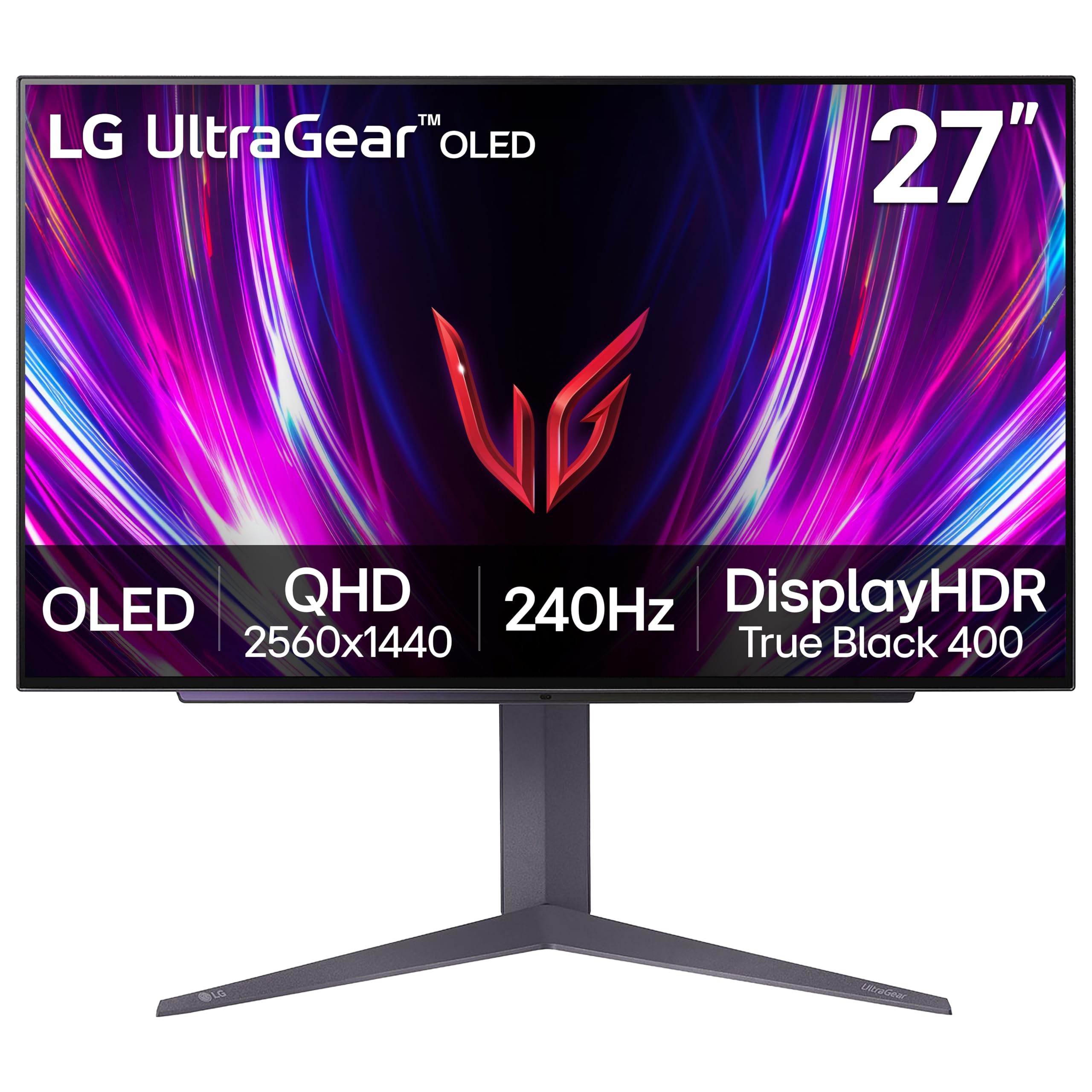
LG’s UltraGear 27GS93QE uses a third-generation WOLED panel that avoids the purple-black issue of QD-OLED entirely, delivering true blacks even in bright rooms. The matte anti-glare coating reduces reflections without introducing the fuzziness that some lower-quality matte finishes cause, making it a strong choice for mixed-use environments.
The 240Hz refresh rate with 0.03ms response time is paired with NVIDIA G-Sync Compatible and AMD FreeSync Premium Pro, covering both GPU ecosystems. DisplayHDR True Black 400 certification and 98.5% DCI-P3 coverage provide excellent color performance out of the box, and the built-in remote control for OSD navigation is a convenience that many competitors overlook.
Connectivity includes HDMI 2.1 and DisplayPort 1.4, supporting full bandwidth for 240Hz operation. The stand includes height, tilt, and pivot adjustment, though some users find the footprint too deep for compact desks. The 2-year UltraGear OLED warranty covers the panel, parts, and labor.
Why it’s great
- True WOLED blacks without QD-OLED purple tint in any lighting
- Matte anti-glare coating effectively cuts reflections without blur
- Remote control for OSD is a rare and convenient feature
Good to know
- Stand base is deep and consumes significant desk space
- Warranty period is 2 years vs. 3 years from ASUS and Alienware
- HDR peak brightness is adequate but not class-leading
8. MSI PRO MAX 271UPXW12G 4K
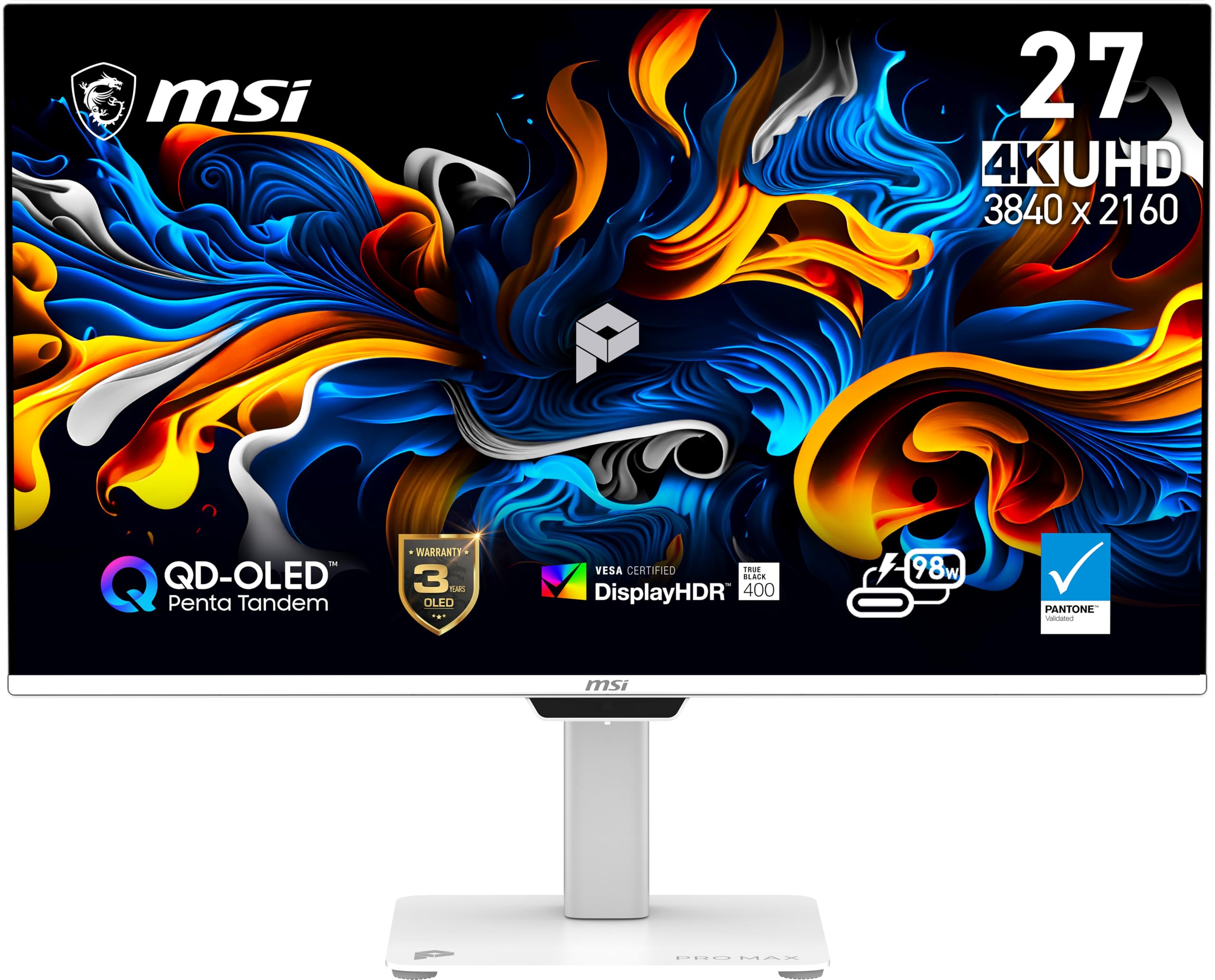
The PRO MAX 271UPXW12G is specifically designed for Mac users who want OLED quality without switching to a premium-priced Apple Studio Display. It offers 4K UHD resolution at 120Hz on a QD-OLED panel, with dual USB-C ports that deliver 98W and 15W power delivery respectively — enough to charge a MacBook Pro at full speed while driving the display with a single cable.
MSI’s Mac Optimization Software syncs macOS color profiles and maps Mac keyboard shortcuts for brightness and volume control, creating a cohesive experience that few PC-oriented OLED monitors attempt. The Delta E < 2 calibration and VESA DisplayHDR True Black 400 certification make it suitable for color-critical creative work in photography, video editing, and design.
Built-in speakers are included, though they’re adequate for system sounds rather than music production. The white chassis design stands out from the sea of black gaming monitors, and the height-adjustable stand offers solid ergonomic range. At 120Hz, it won’t satisfy competitive esports players, but for creative professionals who game casually, it’s a compelling hybrid.
Why it’s great
- Dual USB-C with 98W PD for single-cable MacBook Pro connection
- MacOS software integration for color sync and keyboard shortcuts
- 4K QD-OLED delivers premium image quality for creative work
Good to know
- 120Hz refresh rate is low for competitive gaming
- Built-in speakers are mediocre for any audio-critical use
- Higher cost than many 1440p 240Hz OLED options
9. BenQ MA270UP
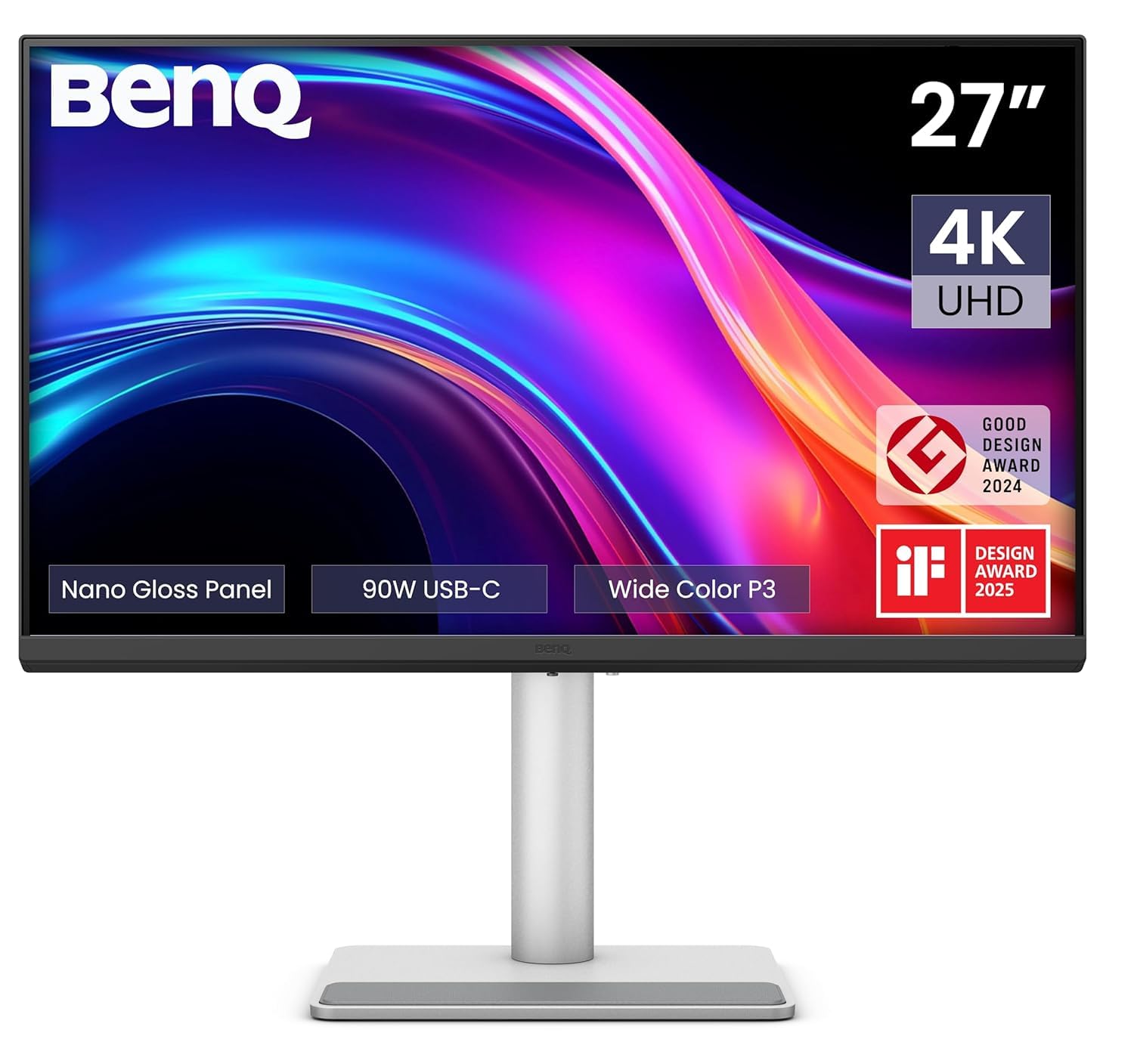
While technically an IPS rather than OLED panel, the BenQ MA270UP earns a spot here for Mac users who want Apple-like color reproduction without OLED burn-in concerns. It offers 4K resolution at 60Hz with a P3 wide color gamut that matches the MacBook Pro display profile closely enough that most content creators won’t notice the difference in side-by-side use.
The dual USB-C ports deliver 90W power delivery to your MacBook and 15W to charge an iPad or iPhone simultaneously, all over a single USB-C cable for video and data. BenQ’s exclusive color tuning calibrates the display for Mac color space out of the box, and the integrated controls allow brightness and volume adjustment directly from the MacBook keyboard.
The ergonomic stand supports height, tilt, swivel, and pivot adjustments, and the 400-nit brightness is sufficient for well-lit rooms. The contrast ratio of 2000:1 is good for an IPS panel but falls short of OLED’s infinite contrast, and the 60Hz refresh rate means it’s not suited for gaming.
Why it’s great
- Mac color matching is the best outside of Apple’s own Studio Display
- 90W USB-C power delivery charges MacBook Pro over a single cable
- Full ergonomic stand with pivot for portrait mode
Good to know
- IPS panel cannot match OLED black levels or contrast ratio
- 60Hz refresh rate makes it unsuitable for any gaming use
- Glossy screen adds reflections in bright ambient lighting
10. INNOCN 2780s QD-OLED
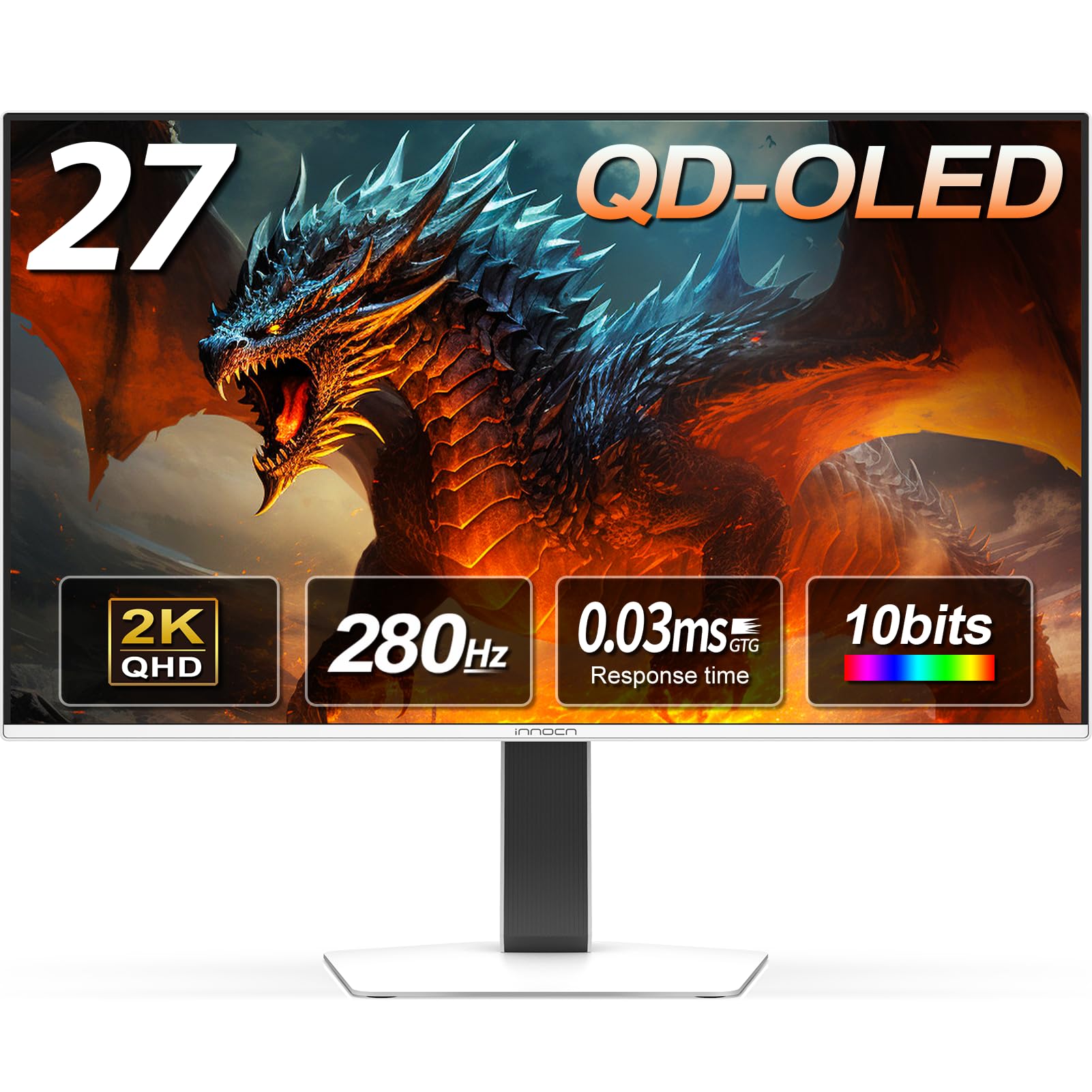
The INNOCN 2780s brings QD-OLED technology to a budget-friendly price point without cutting too many corners on core specifications. The 280Hz refresh rate (slightly above the standard 240Hz) and 0.03ms response time provide smooth competitive gaming performance, and the QD-OLED panel delivers the deep blacks and vibrant colors that make OLED desirable.
The monitor includes HDMI 2.1 and DisplayPort inputs, supporting next-gen consoles at high refresh rates. The adjustable stand covers height, tilt, and pivot, and the white chassis design offers an aesthetic alternative to the black-dominant market. Built-in speakers are included but are the weakest link — they’re tinny and lack low-end presence, so plan on using headphones or external speakers.
HDR400 certification means the peak brightness is lower than True Black 400 competitors, and the lack of advanced burn-in features like proximity detection or heat pipe cooling means you’ll rely more on the standard pixel refresh cycle. For the price, it’s a solid entry point into OLED gaming, but the thermal management is less robust than premium options.
Why it’s great
- 280Hz refresh rate is above the 240Hz standard at this price tier
- White design stands out for users building lighter-themed setups
- HDMI 2.1 supports full-speed console gaming
Good to know
- Built-in speakers are poor — external audio strongly recommended
- HDR400 is weaker than True Black 400 in highlight brightness
- Less sophisticated burn-in prevention compared to premium brands
11. AOC Q27G4ZD

The AOC Q27G4ZD is the most affordable 27-inch OLED monitor on this list, offering a QD-OLED panel with 240Hz refresh rate and 0.03ms response time at an entry-level price that undercuts every other model. The 147.6% sRGB and 110.2% DCI-P3 color gamut coverage is competitive, and the 1,500,000:1 contrast ratio delivers the expected OLED black depth.
HDR10 support provides rich detail in supported content, and the G-Sync compatibility ensures smooth gameplay with NVIDIA GPUs. The monitor comes with HDMI and DisplayPort cables in the box, and the 3-year Zero Bright Dot warranty from AOC is a nice bonus — they guarantee no bright dots in the panel for the first three years.
However, cost savings are visible in the stand: the included base lacks height adjustment, tilt is limited, and the overall build feels less premium than competitors. Text readability is also weaker than average due to the QD-OLED subpixel arrangement, and some units have arrived with dead pixels or power issues based on user reports.
Why it’s great
- Lowest cost entry point to 27-inch OLED gaming
- 3-year Zero Bright Dot warranty provides panel peace of mind
- Wide color gamut coverage exceeds many pricier monitors
Good to know
- Stand lacks height adjustment — requires VESA arm for ergonomics
- Quality control has been inconsistent based on customer reports
- Subpixel layout reduces text clarity for productivity use
FAQ
Will a 240Hz OLED monitor feel faster than a 360Hz LCD?
How noticeable is the QD-OLED purple reflection issue in a bright room?
Can I use a 27-inch OLED monitor for text-heavy productivity work?
How often should I run the pixel refresh cycle on my OLED monitor?
Is a 27-inch OLED monitor worth it over a 27-inch IPS panel for console gaming?
Final Thoughts: The Verdict
For most users, the best 27 inch oled monitor winner is the ASUS ROG Strix XG27AQDMG because it combines a glossy WOLED panel with excellent color vibrancy, a custom heatsink for burn-in resistance, and a 3-year warranty at a mid-range price that doesn’t require selling a kidney. If you want the absolute highest refresh rate for esports competition, grab the ASUS ROG Strix XG27AQDPG. And for Mac-based creative professionals who need 4K resolution and USB-C power delivery, nothing beats the MSI PRO MAX 271UPXW12G.

Mo Maruf
I created WellFizz to bridge the gap between vague wellness advice and actionable solutions. My mission is simple: to decode the research and give you practical tools you can actually use.
Beyond the data, I am a passionate traveler. I believe that stepping away from the screen to explore new environments is essential for mental clarity and physical vitality.