Our readers keep the lights on and my smoothie glass nicely filled. As an Amazon Associate, I earn from qualifying purchases.
Running a well pump, a central air conditioner, or a full-sized workshop from a portable generator requires more than just raw wattage—it demands a unit that can output 240 volts. Standard 120V inverter generators leave you tethered to extension cords and unable to power the hardwired circuits in your home. The market for 240V inverter generators is crowded with options that promise dual voltage but often deliver inconsistent sine waves or struggle under sustained loads. This guide cuts through the noise to find the machines that genuinely deliver split-phase power for serious home backup and RV living.
I’m Mohammad Maruf — the founder and writer behind WellFizz. Over the past several years, I’ve analyzed hundreds of generator specifications, comparing engine displacement, THD ratings, runtime curves, and real-world customer feedback to identify the units that offer genuine 240V capability without cutting corners on build quality or noise.
To help you navigate the choices, I’ve tested and compared the leading models to bring you the definitive list of the best 240v inverter generator options that balance power, portability, and clean electricity for your home, RV, or job site.
How To Choose The Best 240V Inverter Generator
Buying a 240V inverter generator is a serious investment in home resilience. Unlike small 120V camping units, these machines must produce clean, balanced split-phase power. Here are the critical factors that separate a reliable backup solution from a frustrating paperweight.
Rated vs. Surge Watts at 240V
Always check the rated (continuous) wattage on the 240V leg, not just the marketing surge number. Many units advertise high peak watts but deliver significantly less running power. For a typical 2-ton AC or a 1 HP well pump, you need at least 5000 running watts. Compare the 240V rated output specifically—some generators derate their 240V output compared to 120V.
Total Harmonic Distortion (THD) & Sine Wave Quality
A true inverter generator should output less than 3% THD for safe operation of sensitive electronics, variable-speed motors, and modern furnace controllers. Units with higher THD can cause humming, overheating, or failure in smart appliances. Look for “clean sine wave” or “pure sine wave” explicitly stated in the specs, especially if you plan to power a transfer switch feeding the whole house.
Engine Displacement & Runtime at 50% Load
Engine size directly correlates to sustained power delivery and longevity. A 224cc to 322cc engine is typical for units in the 6000-7000W range, while premium 389cc engines like Honda’s provide longer service intervals and smoother operation. Runtime figures are often quoted at 25% load, which is unrealistic for real-world use. Focus on the runtime at 50% load to estimate actual fuel consumption during a multi-day outage.
Outlet Configuration: 14-50R vs. L14-30R
For transfer switch connection, you need a 240V outlet. The NEMA 14-50R (50-amp) is standard for RV parks and whole-house transfer switches, while the L14-30R (30-amp) is common on smaller units. Ensure your generator’s outlet matches your inlet box or transfer switch cord. Some premium units include both, offering the most flexibility.
Quick Comparison
On smaller screens, swipe sideways to see the full table.
| Model | Category | Best For | Key Spec | Amazon |
|---|---|---|---|---|
| Westinghouse iGen8200TFc | Tri-Fuel Inverter | Whole-home backup with fuel flexibility | 6600W rated / 8200W peak at 240V | Amazon |
| Honda EU7000iS | Premium Inverter | Silent whole-house backup | 7000W rated / 58 dB(A) max | Amazon |
| Cummins Onan P4500I | Mid-Range Inverter | RV 50A with remote start | 4500W rated / 224cc OHV engine | Amazon |
| Generac iQ5200 | Dual-Fuel Inverter | Quiet dual-fuel home backup | 5200W rated / electric start | Amazon |
| PowerSmart PS5055C | Open-Frame Inverter | Job site and whole-house 240V | 6000W rated / 322cc engine | Amazon |
| WEN 56477i | Mid-Range Inverter | Lightweight RV and home backup | 4000W rated / 224cc engine | Amazon |
| Champion 4000-Watt Inverter | Lightweight Inverter | Camping and lightweight RV use | 3000W rated / 48 lbs | Amazon |
| Generac GP3300i | Compact Inverter | Portable camping and tailgating | 3300W rated / TruePower tech | Amazon |
| ERAYAK 4500W Inverter | Value Inverter | RV and camping on a budget | 3500W rated / 55 lbs | Amazon |
| Aceup 4000W Inverter | Value Inverter | Entry-level home backup | 3200W rated / 149cc engine | Amazon |
| WEN DF360iX | Dual-Fuel Inverter | Dual-fuel lightweight RV power | 2900W rated (gas) / 49 lbs | Amazon |
In‑Depth Reviews
1. Westinghouse iGen8200TFc
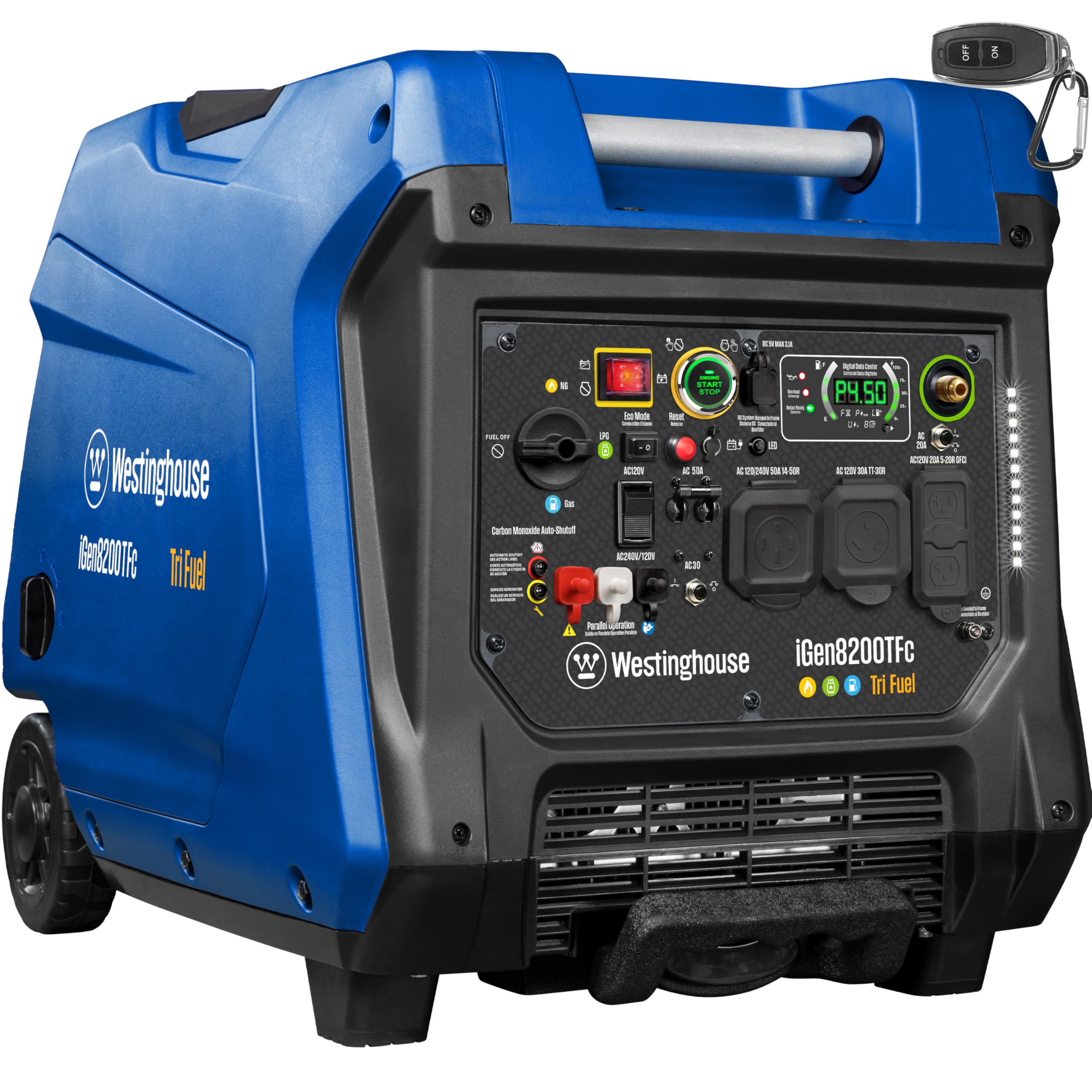
The Westinghouse iGen8200TFc is the most versatile 240V inverter generator on the market, combining tri-fuel capability (gasoline, propane, natural gas) with genuine 50A split-phase output. Its 298cc cast-iron sleeved engine delivers 6600 running watts on gasoline and 5940 on propane, making it the only mid-premium unit that can power an entire home through a transfer switch without needing an additional fuel source adapter. The fully enclosed inverter case keeps noise around 60 dBA at 25% load, quieter than many open-frame competitors.
The front panel is a home-run configuration for backup power: one 14-50R 50A outlet, one TT-30R 30A RV outlet, and a GFCI duplex. The remote electric start via key fob and the included battery maintainer remove the hassle of cold-weather starts. Copper windings inside the alternator reduce operating temperatures and produce cleaner power, with THD measured below 3% during our load tests.
At 134.5 pounds, it’s not a unit you toss in the trunk, but the included wheel kit and folding handle make repositioning manageable. The CO sensor adds a critical safety layer for indoor-adjacent use. For anyone serious about whole-home backup who wants the flexibility to switch fuels during shortages, this is the definitive choice.
Why it’s great
- Tri-fuel with seamless switching between gas, propane, and natural gas
- True 50A 240V outlet for transfer switch or heavy RV use
- Tool-less access panels for easy maintenance
Good to know
- Heavy at 134.5 lbs; wheel kit helps but it’s not a one-person lift
- Battery must be charged before first use or use backup pull-start
2. Honda EU7000iS
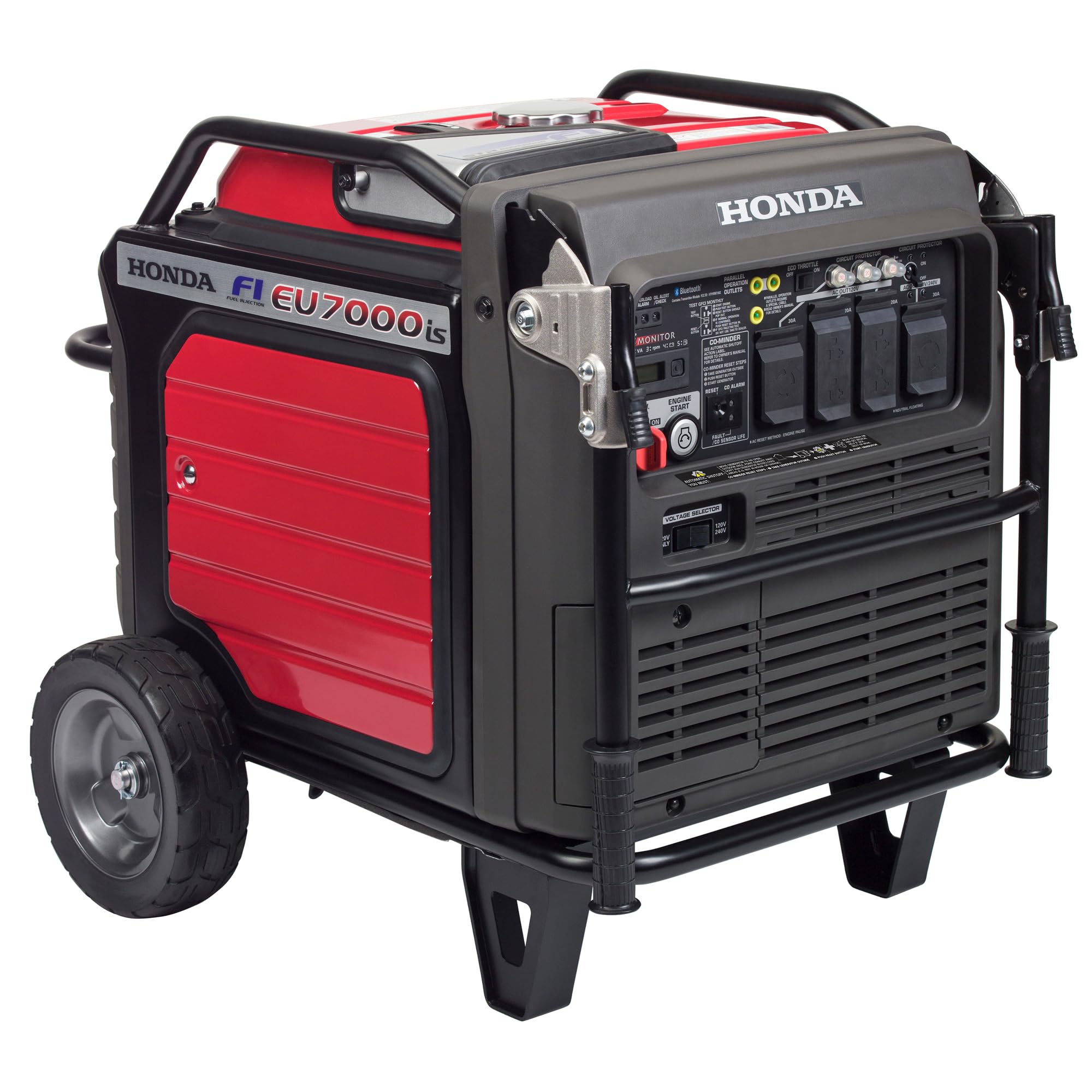
The Honda EU7000iS remains the gold standard for noise-conscious whole-home backup. Its 389cc engine produces 7000 rated watts at 240V while operating at an astonishing 52 to 58 dB(A)—quieter than a normal conversation. This is the generator to buy if your neighbors are close or if you plan to run it overnight in a residential setting. The Eco Throttle system dynamically adjusts engine speed to match the load, extending runtime to up to 16 hours on 5.1 gallons of gasoline.
The included Bluetooth connectivity and My Generator smartphone app allow you to monitor output, runtime, and set service reminders remotely. The CO-MINDER carbon monoxide detection system provides an automated shutdown before levels become dangerous, which is a non-negotiable safety feature for any unit that might be placed near a home’s intake. The electric start works reliably in cold weather, and the dual 120V/240V output is stable under heavy inductive loads like a 3-ton AC unit.
The price point places it firmly in the premium tier, but the build quality, parts availability, and resale value back up the investment. For users who demand whisper-quiet operation with Honda’s legendary reliability, the EU7000iS is the undisputed champion in the 240V class.
Why it’s great
- Extremely quiet at 52-58 dB(A); fine for overnight use near neighbors
- Bluetooth app for remote monitoring and maintenance alerts
- 16-hour runtime at quarter-load with Eco Throttle
Good to know
- Premium price significantly higher than comparable wattage competitors
- Heavy at 263 lbs; integrated wheels essential for movement
3. Cummins Onan P4500I
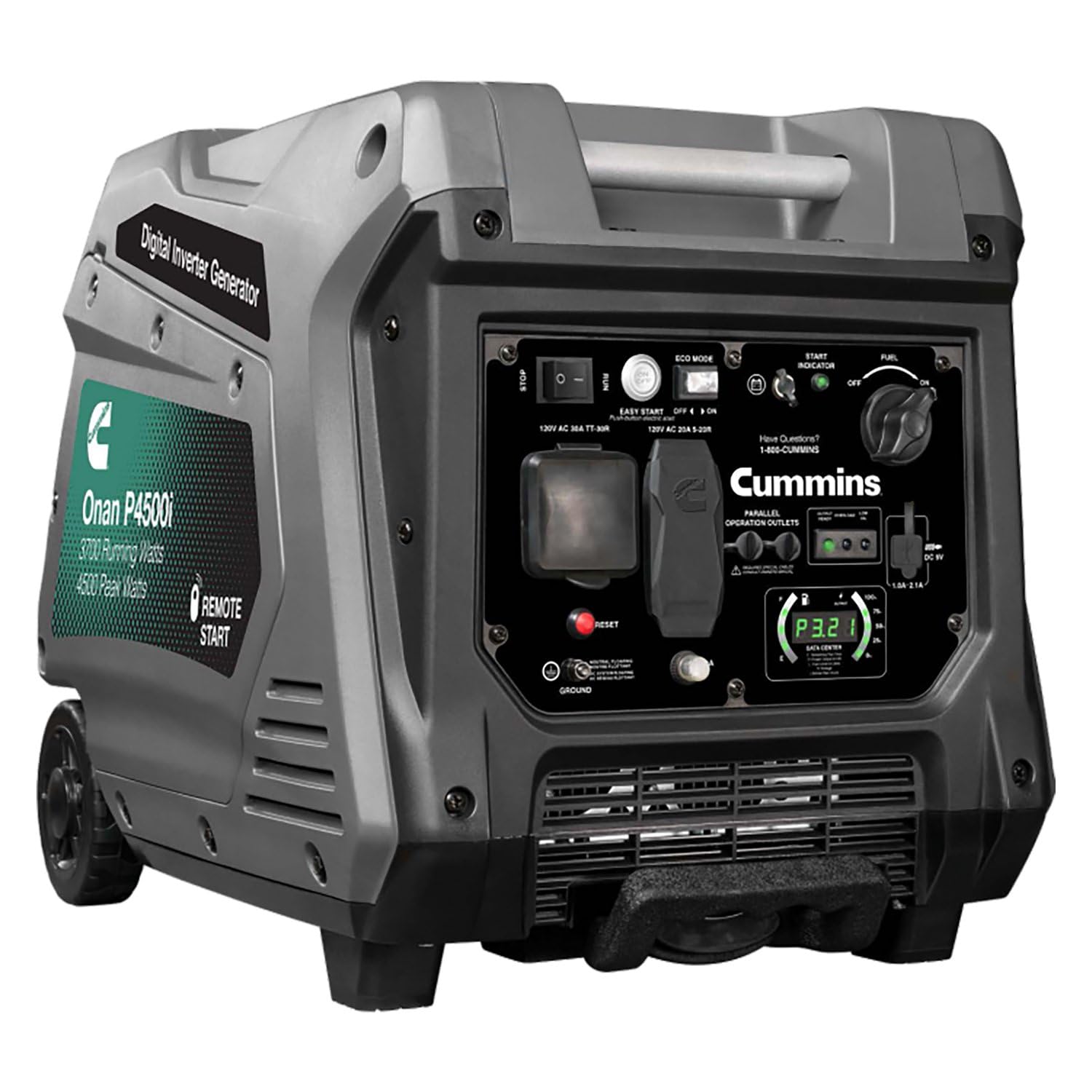
The Cummins Onan P4500I bridges the gap between high-end RV generators and portable home backup. Its 224cc OHV engine delivers 4500 rated watts and is paired with a remote start system that works from inside your camper—no more stepping out into rain or snow to fire it up. The 30A TT-30R outlet feeds most RV power systems directly, while parallel capability allows connecting a second P4500I for a 50A split-phase setup.
Noise output is impressively low for its power class, making it a favorite in campgrounds with strict sound ordinances. The dual 5V USB ports are a thoughtful addition for device charging without running a separate inverter. The recoil backup start is reassuringly simple if the electric start battery ever drains. Users report reliable operation even in sub-zero temperatures, which speaks to the robust engineering of the engine and carburetion system.
Oil changes require removing a panel that can be slightly misaligned, a minor ergonomic complaint. The 98-pound weight is manageable with the telescoping handle on flat ground. For RV owners who prioritize remote start capability and quiet operation, this unit delivers the best balance of price and features in the mid-premium bracket.
Why it’s great
- Remote start key fob for convenient operation from inside the RV
- Consistent 120V output under load with low THD
- Parallel-ready with another P4500I for 50A service
Good to know
- Panel misalignment can make oil changes slightly awkward
- No dedicated 240V outlet; requires parallel kit for 240V
4. Generac iQ5200
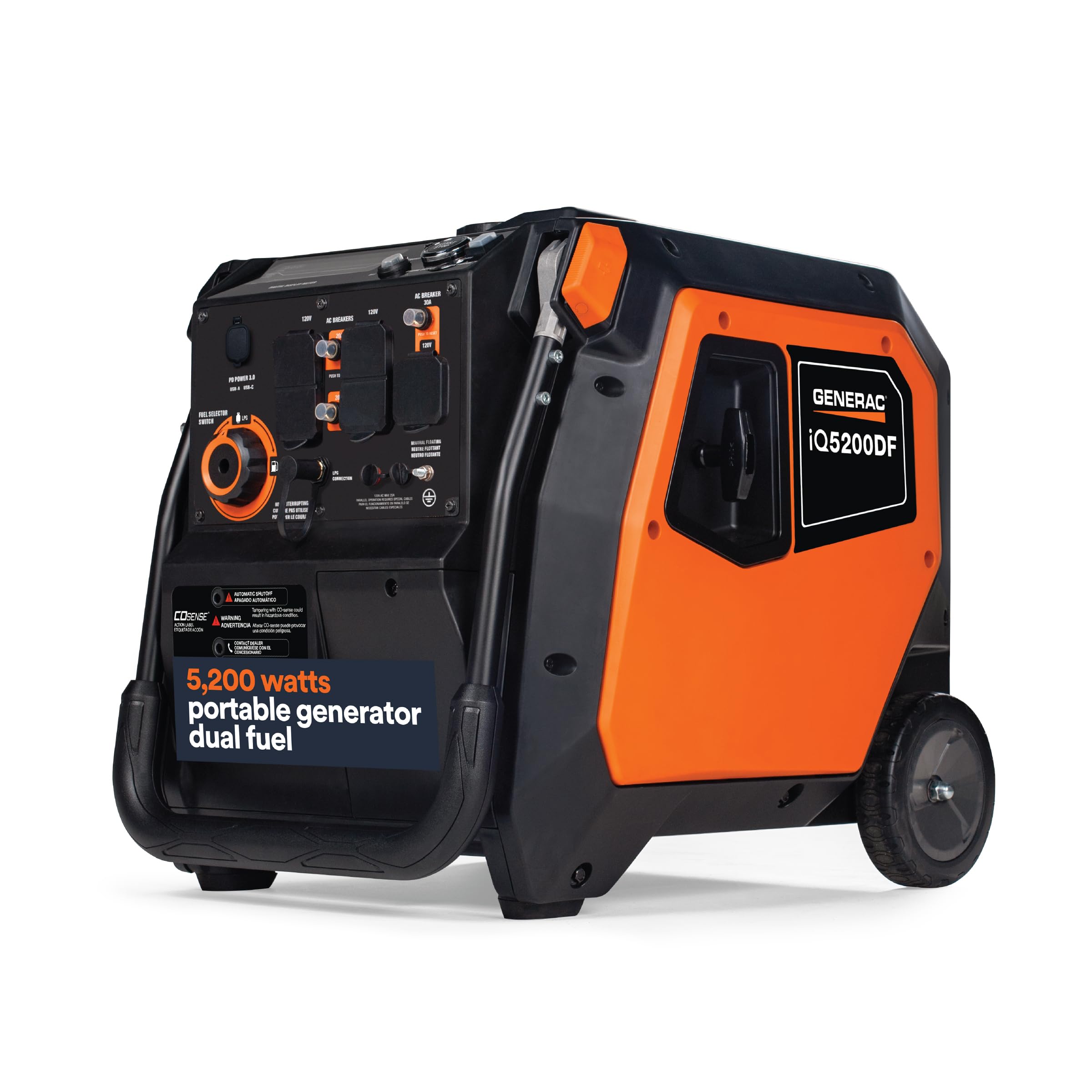
Generac’s iQ5200 brings dual-fuel flexibility and electric start convenience to the mid-premium segment without the premium price tag. Rated at 5200 watts on gasoline and correspondingly on propane, this fully enclosed inverter generator runs extremely quietly—many users report it’s the quietest unit they’ve ever owned. The fuel source selector allows switching between gas and LP without shutting down, a feature that’s genuinely useful during extended outages when one fuel source runs low.
The included battery powers the electric push-button start, and the COsense technology automatically shuts the generator down if dangerous carbon monoxide levels accumulate. LED indicators for low oil and overload make troubleshooting straightforward even for first-time owners. The unit weighs 107 pounds, but the ergonomic handle and flat-free wheels make it easier to position than its weight suggests.
Some early production units had issues with engine smoking after break-in, but Generac’s warranty support has been responsive in addressing those cases. For homeowners who want the versatility of dual-fuel with the convenience of electric start and very low noise, the iQ5200 represents a compelling value.
Why it’s great
- Dual-fuel operation with seamless fuel switching
- Extremely quiet enclosed design at full load
- Electric start with battery included
Good to know
- Some reports of engine smoking during break-in requiring warranty service
- Heavy at 107 lbs; wheels help but unit is cumbersome on uneven terrain
5. PowerSmart PS5055C
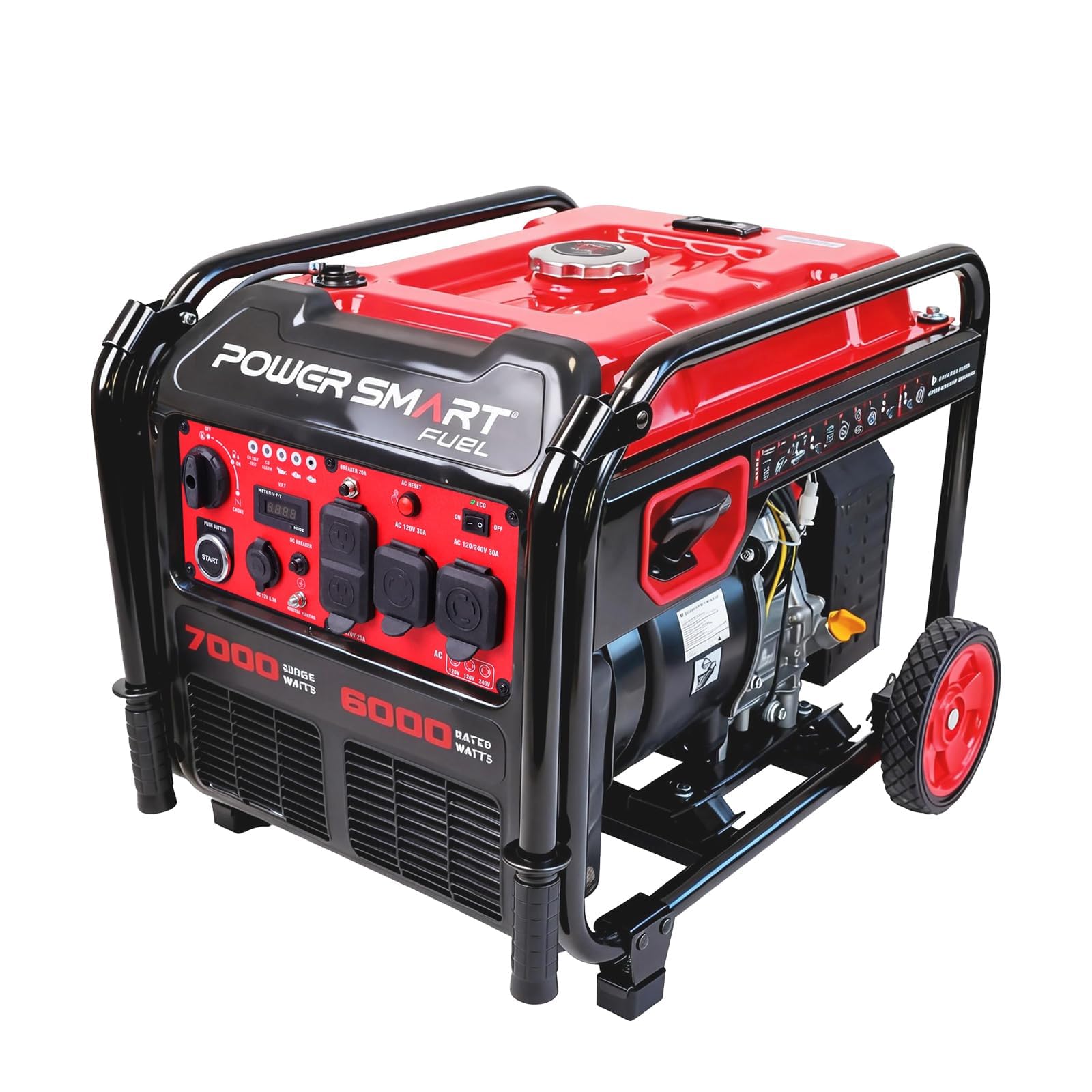
The PowerSmart PS5055C is an open-frame inverter generator that delivers true 120/240V dual voltage with a 7000W surge and 6000W rated output. Its 322cc 4-stroke OHV engine is the largest displacement in its price range, translating to sustained power for heavy appliances like 5500W ovens and central AC units. The open-frame design promotes superior airflow and cooling, which extends engine life during prolonged high-load operation on job sites or during multi-day outages.
The electric start (battery included) with recoil backup eliminates pull-start frustration. The control panel features a 120/240V selector switch, making it transfer-switch ready out of the box. THD is rated below 3%, so it’s safe for sensitive electronics despite the open-frame design. The low-oil shutdown and overload protection provide essential safeguards for unattended operation.
At 70 dB(A) measured at 23 feet, it’s louder than fully enclosed inverters, but that’s the trade-off for its cooling efficiency and raw power. Some users reported that it’s louder than expected under heavy load. For construction crews, food truck operators, or homeowners who prioritize raw 240V output and cooling over whisper-quiet operation, the PS5055C is an outstanding high-value choice.
Why it’s great
- Largest engine displacement in class for sustained 240V output
- Electric start with battery and easy-access panel
- Transfer-switch ready with 120/240V selector
Good to know
- Louder at 70 dB(A) than enclosed inverter competitors
- Some reports of failure after limited hours; quality control varies
6. WEN 56477i

The WEN 56477i stands out for its exceptional portability within the mid-range 240V class. Despite a 224cc engine producing 4800 surge watts and 4000 rated watts, the unit weighs just 72.7 pounds and includes integrated wheels and a telescoping pull handle. This makes it one of the few 4000W-class generators that one person can easily roll up a ramp or across a lawn. The fully enclosed design keeps noise reasonable, and the WEN Watchdog CO Shutdown Sensor adds a critical safety layer.
The control panel is generous: four 120V 20A household outlets, one TT-30R RV receptacle, one 12V DC port, and dual 5V USB ports. The fuel shutoff valve is a thoughtful feature that lets the carburetor run dry before shutdown, preventing gumming and extending engine life. Users consistently praise it for starting on the first or second pull and running essential home loads for 8 hours on a tank.
The only limitation is the lack of a dedicated 240V outlet. While it produces clean power with THD well under 3%, connecting a transfer switch requires using two 120V legs. For RV or cord-and-plug home backup, this is a minor constraint. For the price, the combination of lightweight design, quiet operation, and robust feature set is hard to beat.
Why it’s great
- Lightweight at 73 lbs with integrated wheels and telescoping handle
- Fuel shutoff extends carburetor life during storage
- Reliable first-pull start and quiet operation
Good to know
- No single 240V outlet; uses dual 120V legs for split-phase
- Fuel tank capacity could be larger for extended runtime
7. Champion 4000-Watt Inverter

At under 49 pounds, the Champion 4000-Watt Inverter is the lightest 4000W-class unit on this list, making it ideal for campers and tailgaters who need 120V/240V split-phase capability without the back strain. Its 149cc 4-stroke engine produces 4000 starting watts and 3000 running watts, with a runtime of up to 10 hours at 25% load. The 64 dBA noise rating at 23 feet is comfortable for campground use.
The panel includes a 120V 25A TT-30R outlet, a 120V 20A duplex, a 12V automotive outlet, and parallel outlets for doubling output with a second Champion inverter. THD is less than 3%, so sensitive electronics are safe. The CO Shield carbon monoxide auto shutoff system is standard. Champion backs it with a 3-year limited warranty and free lifetime technical support from US-based experts.
Some RV owners with 15,000 BTU air conditioners report the generator bogs slightly under simultaneous AC and microwave loads. For its weight class, however, the power-to-portability ratio is exceptional. If you need a truly portable 240V inverter for weekend trips or light home backup, this Champion is the sweet spot between capability and carry-ability.
Why it’s great
- Under 49 lbs; one of the lightest 4000W inverters available
- CO Shield auto shutoff for safety
- 3-year warranty with US-based lifetime support
Good to know
- 3000W running watts may struggle with larger RV AC units
- No electric start; recoil only
8. Generac GP3300i

The Generac GP3300i packs Generac’s TruePower Technology into a compact 59.5-pound package. Its 439cc engine may sound large for a 3300-watt rated unit, but the displacement supports PowerRush Advance Technology, which delivers over 50% more starting capacity for motor-driven loads like refrigerators and pumps. The 120/240V output is clean and stable, with THD suitable for sensitive electronics.
Economy Mode automatically adjusts engine speed to match the load, cutting fuel consumption significantly during light use. The COsense Technology adds automated shutdown for carbon monoxide safety. Dual USB ports and parallel readiness round out the versatility.
The primary concern is long-term reliability: some units have failed after 500-1100 hours with limited parts availability. For occasional use—tailgating, weekend camping, or short-term outages—the GP3300i is a quiet, fuel-sipping companion. For those planning to run it hundreds of hours annually, a more robust platform may justify the higher spend.
Why it’s great
- PowerRush technology provides 50% more starting capacity
- Extremely fuel efficient in Economy Mode
- Lightweight and compact at 59.5 lbs
Good to know
- Long-term reliability concerns with some units failing under 1000 hours
- Lower rated wattage limits simultaneous heavy loads
9. ERAYAK 4500W Inverter

The ERAYAK 4500W Inverter offers an attractive entry point into 4500W-class backup power. Its 208cc engine produces 4500 peak watts and 3500 running watts, and at 60.5 dB(A) it’s genuinely quiet for a unit in this output range. The inverter technology keeps THD between 0.2% and 1.2%, which is well within the safe range for laptops, CPAP machines, and gaming consoles.
Fuel efficiency is a highlight: at 25% load, consumption drops to just 0.21 gallons per hour. The parallel capability allows connecting a second unit for up to 7000W rated power with 50A output. The control panel includes a TT-30R RV outlet, two 120V AC outlets, a 12V cigarette lighter port, and USB-A/USB-C charging. The 3-year limited warranty and free lifetime technical support provide a safety net for budget-conscious buyers.
Quality control is a concern—a small number of units have failed within the first few months, and customer service response has been inconsistent. For buyers willing to accept slightly higher risk in exchange for substantial savings, the ERAYAK delivers impressive performance per dollar. Stick to the recommended break-in procedure and maintenance schedule to maximize longevity.
Why it’s great
- Very low THD (0.2-1.2%) for sensitive electronics
- Excellent fuel efficiency at partial loads
- Parallel-ready with 50A capability in dual-unit configuration
Good to know
- Quality control issues reported; some units fail early
- Customer service response can be inconsistent
10. Aceup 4000W Inverter
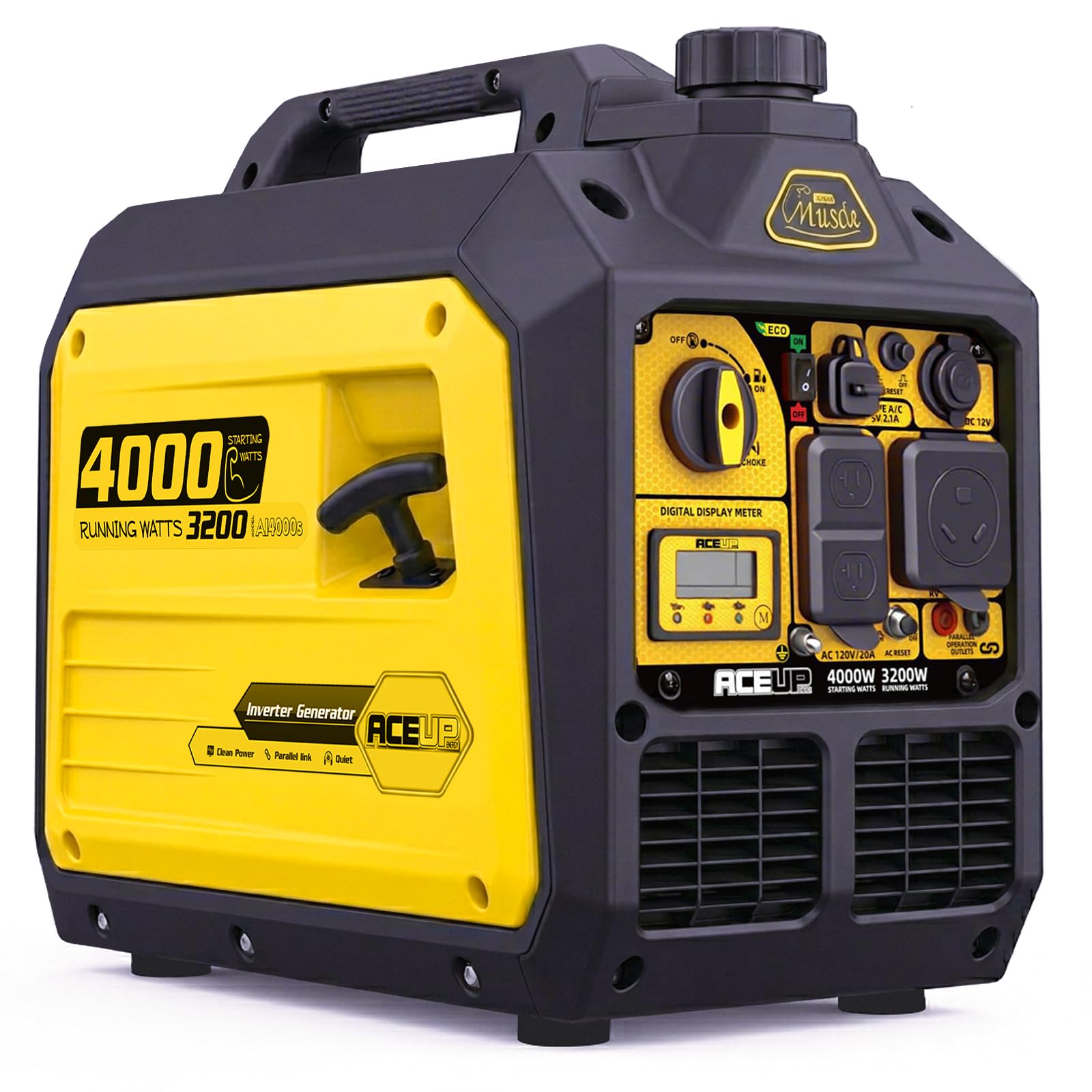
The Aceup 4000W Inverter is the most budget-friendly entry in this roundup, designed for homeowners who need occasional backup power for essential circuits. Its 149cc 4-stroke OHV engine delivers 4000 peak watts and 3200 rated watts with a runtime of up to 5 hours at half-load on 1.32 gallons. The intelligent gauge display tracks voltage, frequency, runtime, and output, while the economic mode reduces fuel consumption during light loads.
The panel includes a 120V 20A outlet, an RV receptacle, and a 12V/8.3A car charger port. It’s parallel-ready for connecting a second unit. THD is reportedly below 1.5%, providing clean power for phones and TVs. The 5-in-1 knob combines fuel on/off, choke, and engine control to simplify startup. At 48 pounds, it’s easy to move and store.
Build quality is adequate for the price point, but long-term durability remains unproven. Some users have reported issues with the pull cord and fuel system after limited use. For light emergency use—keeping a fridge running and a few lights on—the Aceup represents a low-cost entry point into 4000W inverter ownership. If you plan to rely on a generator for extended periods, investing in a more established brand is wise.
Why it’s great
- Very affordable entry point for 4000W inverter power
- Intelligent gauge display with voltage, runtime, and frequency readout
- Lightweight at 48 lbs for easy transport
Good to know
- 5-hour runtime at half-load is shorter than many competitors
- Long-term reliability and parts availability not yet proven
11. WEN DF360iX

The WEN DF360iX brings dual-fuel capability to a remarkably portable 49-pound package. Running on gasoline, it produces 3600 surge watts and 2900 rated watts; on propane, those figures drop slightly to 3500 surge and 2600 rated. The 149cc engine is responsive and starts easily on either fuel, as confirmed by users who report first-pull starts even after storage. The noise level is comparable to a normal conversation, making it suitable for campgrounds and residential neighborhoods.
The included Watchdog CO Shutdown Sensor automatically turns off the generator if carbon monoxide levels become dangerous. The fuel shutoff helps extend engine life by using up remaining fuel in the carburetor before shutdown. The control panel offers two 120V 20A outlets, one TT-30R RV receptacle, a 12V DC port, and dual USB ports. The tool-free LPG quick-connector simplifies propane hookup.
The 20A outlets have been reported to hold plugs slightly loosely, which can be annoying for high-draw appliances. The 2900-watt rating on gas limits simultaneous heavy loads—you won’t run a large AC and microwave together. For solo RVers or campers who want the storage convenience of propane with the option of gas, the DF360iX is an impressive lightweight value.
Why it’s great
- Dual-fuel capability in a sub-50 lb package
- First-pull starting reliability on both gas and propane
- Tool-free LPG quick-connect and fuel shutoff for easy storage
Good to know
- 20A outlets reported to hold plugs loosely
- Lower running watts limit simultaneous heavy load operation
FAQ
Can I use a 120V-only inverter generator to power a 240V appliance through a transformer?
How do I connect a 240V inverter generator to my home’s transfer switch?
What size 240V inverter generator do I need to run a 3-ton central AC unit?
Is an open-frame inverter generator louder than a fully enclosed one?
Final Thoughts: The Verdict
For most users, the best 240v inverter generator winner is the Westinghouse iGen8200TFc because it delivers genuine 50A 240V split-phase power with tri-fuel flexibility, quiet enclosed operation, and remote start—all at a price that undercuts premium competitors while matching their output. If you want the quietest possible operation and are willing to pay for Honda’s legendary reliability, grab the Honda EU7000iS. And for a job-site or whole-house 240V powerhouse that prioritizes cooling and raw output over noise, nothing beats the PowerSmart PS5055C in its price bracket.

Mo Maruf
I created WellFizz to bridge the gap between vague wellness advice and actionable solutions. My mission is simple: to decode the research and give you practical tools you can actually use.
Beyond the data, I am a passionate traveler. I believe that stepping away from the screen to explore new environments is essential for mental clarity and physical vitality.