Our readers keep the lights on and my smoothie glass nicely filled. As an Amazon Associate, I earn from qualifying purchases.
A power outage doesn’t announce itself. When the grid goes dark, the quiet hum of a solar generator means your refrigerator keeps running, your medical devices stay powered, and your family stays comfortable. These aren’t the loud, fume-spewing gas generators of the past—they’re silent, emission-free lithium power stations that store energy from the sun, ready to deploy at a moment’s notice. Finding the right balance of battery capacity, inverter output, and charging speed defines the entire buying process for this category.
I’m Mohammad Maruf — the founder and writer behind WellFizz. I’ve spent months analyzing the chemistry, inverter architecture, and real-world performance data of these portable power stations to separate marketing claims from genuine capability.
Whether you need emergency backup for home essentials or off-grid independence for your RV, this guide breaks down the best options on the market. The best 2000 watt solar generator delivers enough power to run critical appliances without the noise, fuel, or fumes of a traditional gas generator.
How To Choose The Best 2000 Watt Solar Generator
Selecting a solar generator for home backup or off-grid use requires understanding three core specs: battery capacity measured in watt-hours (Wh), continuous AC output measured in watts (W), and solar input capacity measured in watts. A 2000-watt class generator typically offers 2000–3600Wh of storage and 2000–3600W of inverter output, making it capable of running a refrigerator, lights, a sump pump, and several electronics simultaneously. The critical distinction lies in battery chemistry—LiFePO4 (LFP) cells provide 10+ year lifespans and 4000 charge cycles, while older NMC chemistries degrade faster. Solar input rating determines how quickly your panels replenish the battery; higher MPPT voltage ranges and amperage allow faster solar charging even in partial shade.
Battery Capacity and Chemistry
The usable energy storage (watt-hours) dictates how long your appliances run. A 2000Wh unit can power a 150W refrigerator for roughly 13 hours, while a 3000Wh unit extends that to 20 hours. LiFePO4 batteries are the current gold standard—they’re safer, last longer (3000–4000 cycles to 80% capacity), and tolerate temperature extremes better than lithium-ion alternatives. Avoid any unit in this class still using NMC cells unless portability weight is your absolute priority, as cycle life drops to around 500–1000 cycles.
Inverter Type and Surge Capacity
Pure sine wave inverters are non-negotiable for sensitive electronics like CPAP machines, laptops, and refrigerators with variable-speed compressors. Modified sine wave inverters can cause buzzing, overheating, or damage. Pay attention to surge capacity (peak power) too—motors in refrigerators, pumps, and air conditioners draw 2–3x their running wattage for a split second during startup. A 2000W continuous inverter with 4000W surge handles most home appliances; a 3600W unit with 7200W surge covers well pumps and larger AC units.
Solar Input and Charging Speed
The solar charge controller’s maximum input voltage and amperage determine how many panels you can connect and how fast they charge. A unit accepting 500W of solar input charges its 2000Wh battery in about 4–5 hours of full sun; a unit accepting 2000W solar input charges in roughly 1–2 hours. Look for MPPT controllers (not PWM) for 20–30% more efficiency, especially in lower light conditions. Also check input voltage range—higher voltage (48V nominal) systems use thinner cables and suffer less voltage drop over longer distances.
UPS Function and Transfer Speed
If you plan to keep sensitive equipment running during an outage, the unit’s uninterruptible power supply (UPS) transfer speed matters. Units with <20ms switchover keep computers and network gear running without a glitch. Slower switches (over 30ms) may cause a brief flicker or reboot connected devices. UL1778 certification for UPS functionality provides an additional layer of safety validation.
Quick Comparison
On smaller screens, swipe sideways to see the full table.
| Model | Category | Best For | Key Spec | Amazon |
|---|---|---|---|---|
| Jackery HomePower 3000 | Station + Panels | Whole-home backup bundle | 3072Wh, 3600W output | Amazon |
| Anker SOLIX C2000 Gen 2 | Station + Panel | Fastest AC recharge | 2048Wh, 58min full charge | Amazon |
| Jackery Explorer 2000 v2 | Power Station | Lightweight portable power | 2042Wh, 39.5 lbs | Amazon |
| AFERIY P310 | Power Station | Expandable capacity on budget | 3840Wh, expandable to 11.5kWh | Amazon |
| Jackery HomePower 3000 | Power Station | Compact 3kWh home backup | 3072Wh, CTB technology | Amazon |
| EF ECOFLOW Delta 3 Ultra | Power Station | Whisper-quiet home backup | 3072Wh, 25dB under load | Amazon |
| GROWATT HELIOS 3600 | Station + Panels | Whole-house 240V split-phase | 3600Wh, expandable to 36kWh | Amazon |
| EF ECOFLOW DELTA Pro | Station + Panel | Modular expandable system | 3600Wh, expandable stack | Amazon |
| EF ECOFLOW DELTA Pro 3 | Station + Panels | High-capacity whole-home system | 4096Wh, 120/240V output | Amazon |
| OSCAL PowerMax 6000 | Station + Panels | Massive 7200Wh power reserve | 7200Wh, 6000W output | Amazon |
| DuroStar DS13000MX | Gas Generator | High-wattage whole-home backup | 13,000W peak, dual fuel | Amazon |
| DuroMax XP13000EH | Gas Generator | Heavy-duty job site power | 13,000W peak, dual fuel | Amazon |
| Westinghouse Tri-Fuel | Gas Generator | Largest whole-home gas backup | 28,000W peak, tri-fuel | Amazon |
In‑Depth Reviews
1. Jackery HomePower 3000 with 2X 200W Solar Panels
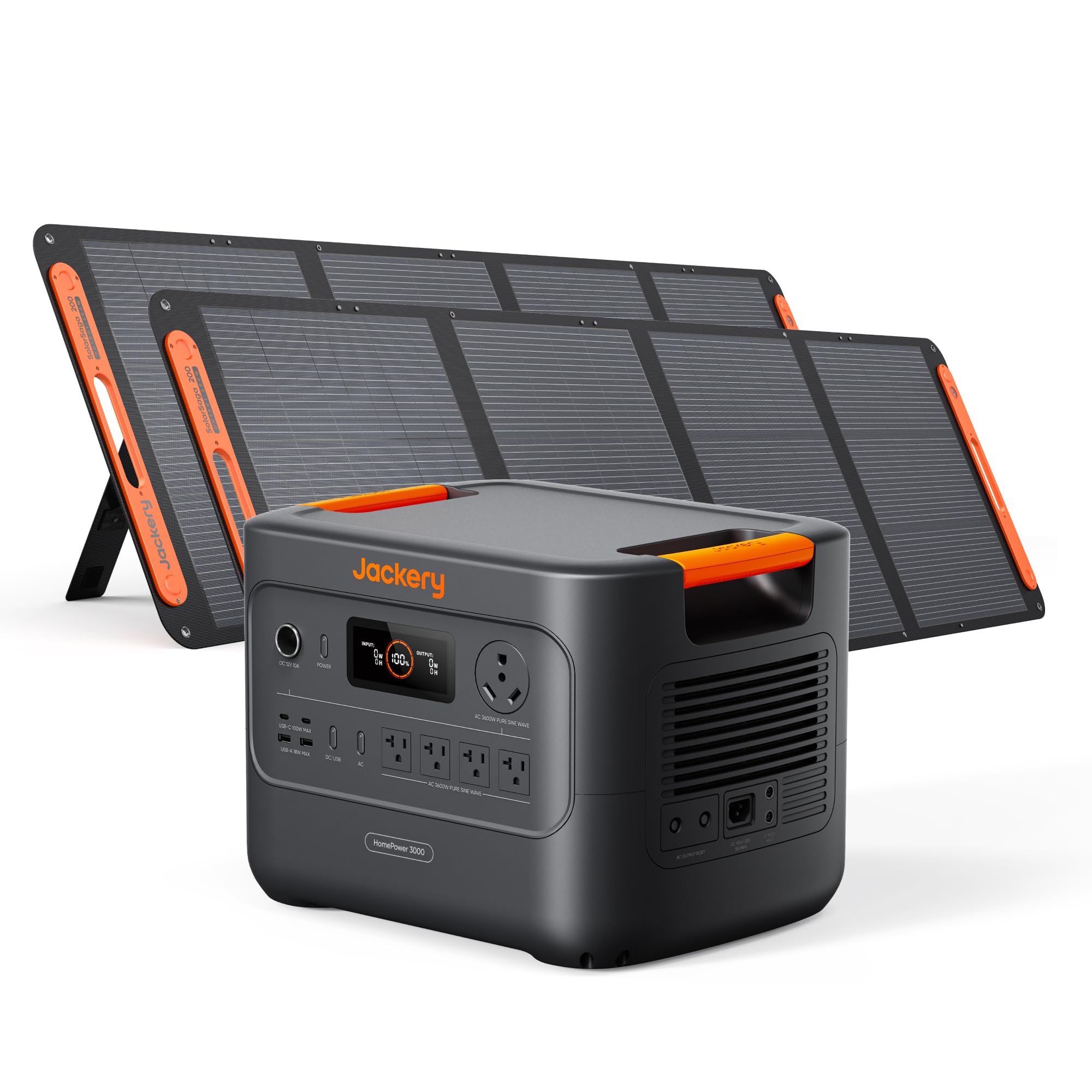
The Jackery HomePower 3000 bundle combines a 3072Wh LiFePO4 battery station with two 200W SolarSaga panels, creating a turnkey solar generator for home backup. The 3600W continuous output (7200W surge) handles a refrigerator, lights, WiFi router, and a microwave simultaneously without breaking a sweat. The built-in TT-30 RV port makes it especially practical for camper and fifth-wheel setups, providing plug-and-play 120V power directly.
ChargeShield 2.0 technology with AI algorithms optimizes charging speeds and extends the battery’s 4000-cycle lifespan, retaining 70% capacity well into a decade of use. The unit recharges fully in 2.2 hours via AC or in about 9 hours with both 200W panels in full sun. Its cellular-to-body (CTB) construction makes it 47% smaller and 43% lighter than comparable 3kWh stations, weighing 59.5 lbs—manageable with the built-in handles.
Real-world testing shows the HomePower 3000 runs a refrigerator for two days and can power an entire RV off-grid except for air conditioning. The solar panels fold for transport, and the station connects to Jackery’s app for remote monitoring. The UPS switchover is UL-certified at under 20ms, ensuring sensitive electronics never miss a beat during an outage.
Why it’s great
- Exceptional 3kWh capacity in a compact, lightweight chassis
- Includes two 200W panels for immediate solar charging
- UL-certified UPS switch under 20ms for sensitive gear
- TT-30 RV outlet for direct camper connection
Good to know
- Battery is not expandable beyond internal 3072Wh
- Wheel kit recommended for easier portability at 60 lbs
- Jackery warranty limited if purchased through third-party sellers
2. Anker SOLIX C2000 Gen 2 with 200W Solar Panel
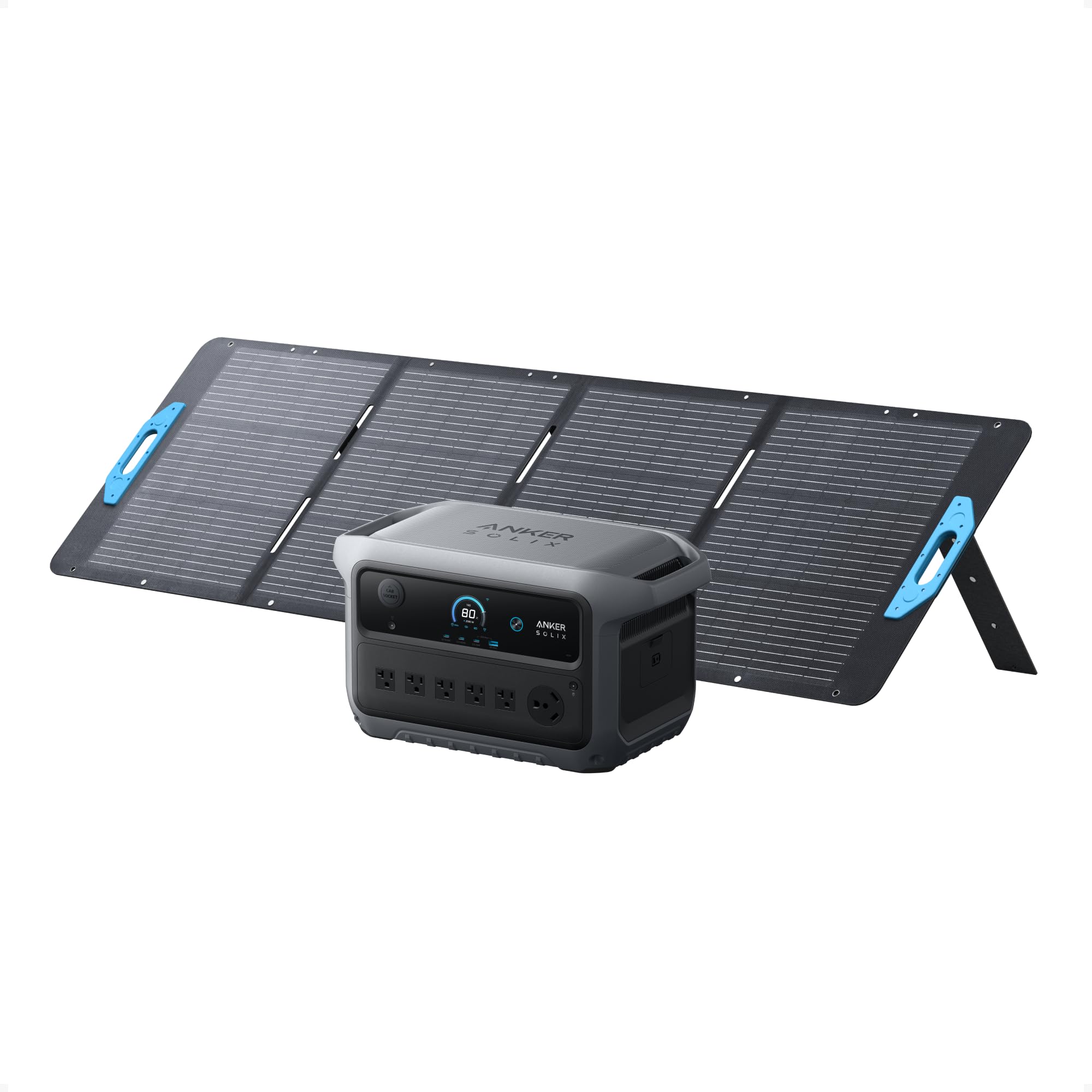
The Anker SOLIX C2000 Gen 2 distinguishes itself with the fastest AC recharge in its class: 80% in 45 minutes and full charge in 58 minutes. This is a massive advantage when you need to top up quickly between outages. With 2048Wh of LiFePO4 capacity and a 2400W pure sine wave inverter (4000W peak), it comfortably powers a dual-door refrigerator for up to 32 hours on a single charge. The bundled PS200 200W solar panel achieves up to 23% conversion efficiency with monocrystalline cells and an IP67 waterproof rating for outdoor durability.
Four adjustable angles (30°, 40°, 50°, and 80°) on the panel frame maximize sunlight absorption throughout the day. The station includes six charging methods, including AC, solar, car, and generator. Its expandable capacity supports adding an extra battery to reach 4kWh, doubling runtime for freezers or medical equipment. The whole bundle weighs 41.7 lbs, making it one of the more portable mid-range systems available.
User feedback confirms the unit runs two CPAP machines for two nights including heated humidifiers, and filmmakers report powering three cameras for two hours with only 10% battery drain. The standby power draw is exceptionally low at 9W, allowing extended storage without draining the battery. The solar charging input accepts up to 600W, though real-world output may peak below the panel’s rated wattage in suboptimal conditions.
Why it’s great
- Full recharge in under one hour via AC—fastest in class
- IP67 waterproof solar panel for all-weather charging
- Expandable to 4kWh with optional extra battery
- Very low standby power consumption (9W)
Good to know
- Solar panel may not reach full 200W in real-world conditions
- Limited to 120V output only—no 240V split-phase
- Station and panel ship separately in two packages
3. Jackery Explorer 2000 v2

The Jackery Explorer 2000 v2 redefines portability for the 2kWh class. Weighing just 39.5 lbs—41% lighter and 34% smaller than typical 2kWh LiFePO4 stations—it uses automotive-grade Cell-to-Body (CTB) technology to integrate the battery cells directly into the structural frame. This eliminates bulky casings and improves safety through better thermal management. The 2042Wh capacity and 2200W inverter handle home essentials like refrigerators, CPAP machines, and multiple electronics simultaneously.
Charging versatility is a highlight: AC fast charging reaches 80% in 66 minutes, and Emergency Super Charging via the app fills the battery entirely in 102 minutes. Solar charging with 400W panels takes about 6 hours in full sun. Silent Charging mode operates below 30dB, barely audible in a bedroom or library setting. The unit includes three AC ports, USB-C PD 100W, USB-A, and a DC carport, covering all common device needs.
Real-world reports confirm the Explorer 2000 v2 runs a refrigerator for over 21 hours straight, powers a coffee maker during outages, and operates seamlessly as a UPS with 20ms switchover (UL1778 certified). The fan noise is minimal during normal operation, though it can ramp up under heavy loads near the 2200W ceiling. The 10-year LiFePO4 battery lifespan makes this a solid long-term investment for emergency preparedness.
Why it’s great
- Lightest 2kWh station at under 40 lbs with CTB construction
- Fast AC recharge—80% in 66 minutes
- UL1778 certified UPS for seamless power transfer
- Nearly silent operation in quiet mode (under 30dB)
Good to know
- No solar panel included—panel sold separately
- Battery capacity not expandable
- Charging slower with small solar panels (200W)
4. AFERIY P310 Portable Power Station

The AFERIY P310 delivers the best capacity-to-cost ratio in this comparison, starting at 3840Wh and scaling up to 11.5kWh with expansion batteries. This makes it a serious contender for whole-home backup without the premium price tag of larger brands. The 3600W continuous inverter (7200W peak) powers multiple large appliances, and the <10ms UPS transfer keeps computers and network gear running through grid interruptions without a flicker.
Charging speed is equally impressive: the unit reaches full charge in just 1.5 hours via AC input, and supports four charging methods including AC+ solar hybrid mode for faster solar replenishment. The smart APP provides remote monitoring of charge/discharge status, battery level, and scheduled charging. With 15 output ports including five 120V AC outlets, USB-C PD 3.0, and a 12V car socket, connectivity is generous.
User experiences highlight the high-quality accessories, rugged wheels, and responsive customer support. Some units shipped with loose display connections, but the manufacturer quickly offered replacements. The 7-year support period and UL listing add peace of mind. At 80.5 lbs, the P310 benefits from a pull handle and wheels for mobility, though moving it upstairs alone remains challenging.
Why it’s great
- Exceptionally low cost per watt-hour for expandable capacity
- Fast 1.5-hour AC recharge time
- Under 10ms UPS for seamless power transfer
- 15 output ports and smart app control
Good to know
- Heavy at 80.5 lbs—wheels included but still cumbersome
- Some units have reported display connectivity issues
- No solar panels included in base package
5. Jackery HomePower 3000 (Station Only)
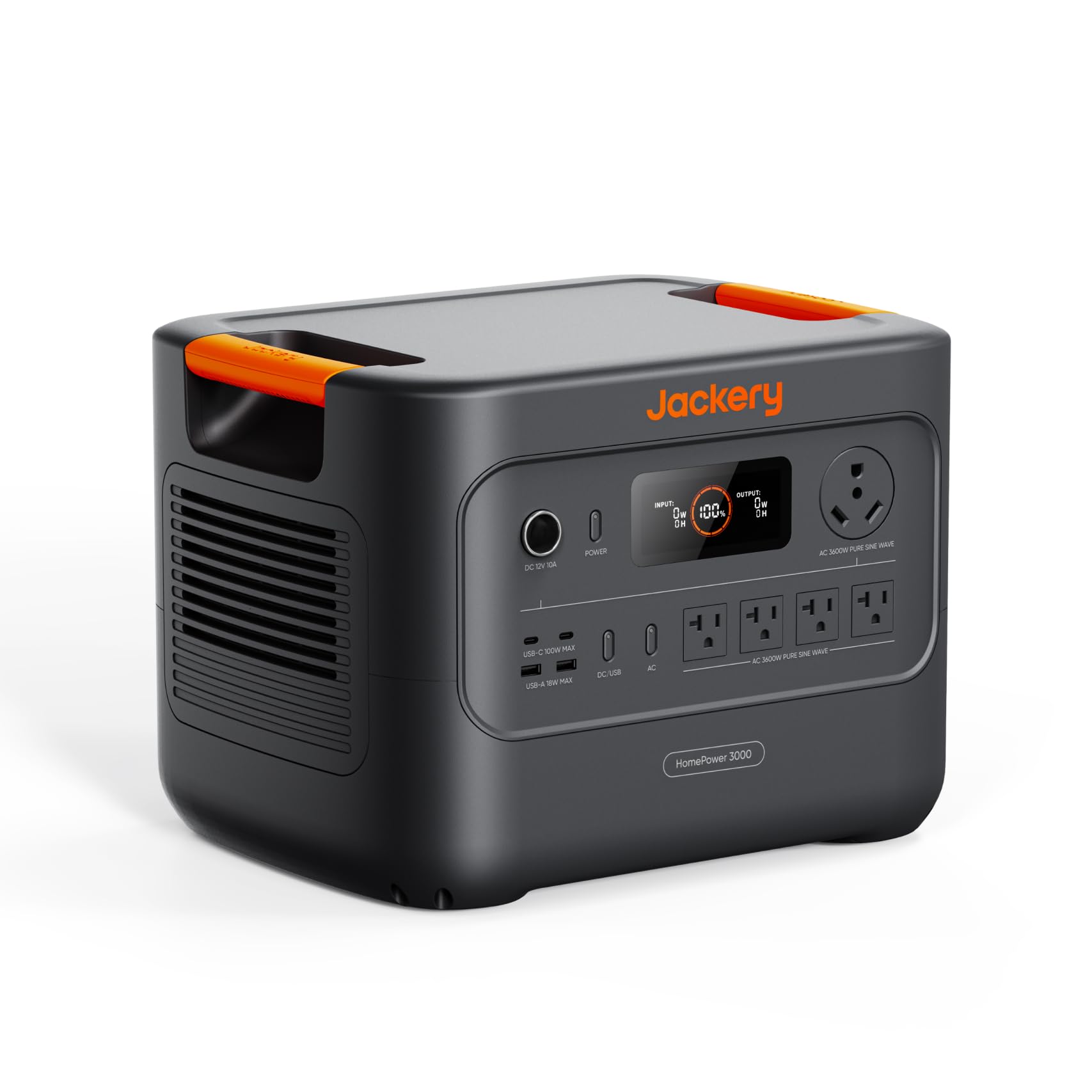
The Jackery HomePower 3000 station-only option gives you the same 3072Wh capacity and 3600W output as the bundle above, without the solar panels, for a lower entry point. Its CTB (Cell-to-Body) technology reduces overall size by 47% and weight by 43% compared to equivalent 3kWh stations, making it one of the most space-efficient units available. Measuring just 16.4 × 12.8 × 12 inches and weighing 59.5 lbs, it fits under counters or in closets for permanent installation.
The dual 100W USB-C PD ports charge laptops and tablets at full speed. A built-in TT-30 RV port allows direct connection to campers. The unit recharges in 1.7 hours via hybrid AC+DC or 2.2 hours via AC alone. ChargeShield 2.0 with AI algorithms extends the LiFePO4 battery to 4000 cycles while retaining 70% capacity, making it a decade-long investment in backup power.
User reviews confirm it powers an RV fridge, microwave, TV, Starlink, and electronics for three days without AC, and recharges quickly with 200W solar panels. The app provides real-time energy monitoring and remote control. Note that Jackery’s warranty policy restricts coverage if the unit is purchased through third-party Amazon sellers—buy directly from Jackery or an authorized reseller.
Why it’s great
- Extremely compact for 3kWh capacity—47% smaller than competitors
- 4000-cycle battery retains 70% capacity over 10 years
- Dual 100W USB-C PD for fast device charging
- TT-30 RV outlet for camper direct connection
Good to know
- Battery not expandable
- No solar panels included
- Warranty restrictions for Amazon third-party purchases
6. EF ECOFLOW Delta 3 Ultra
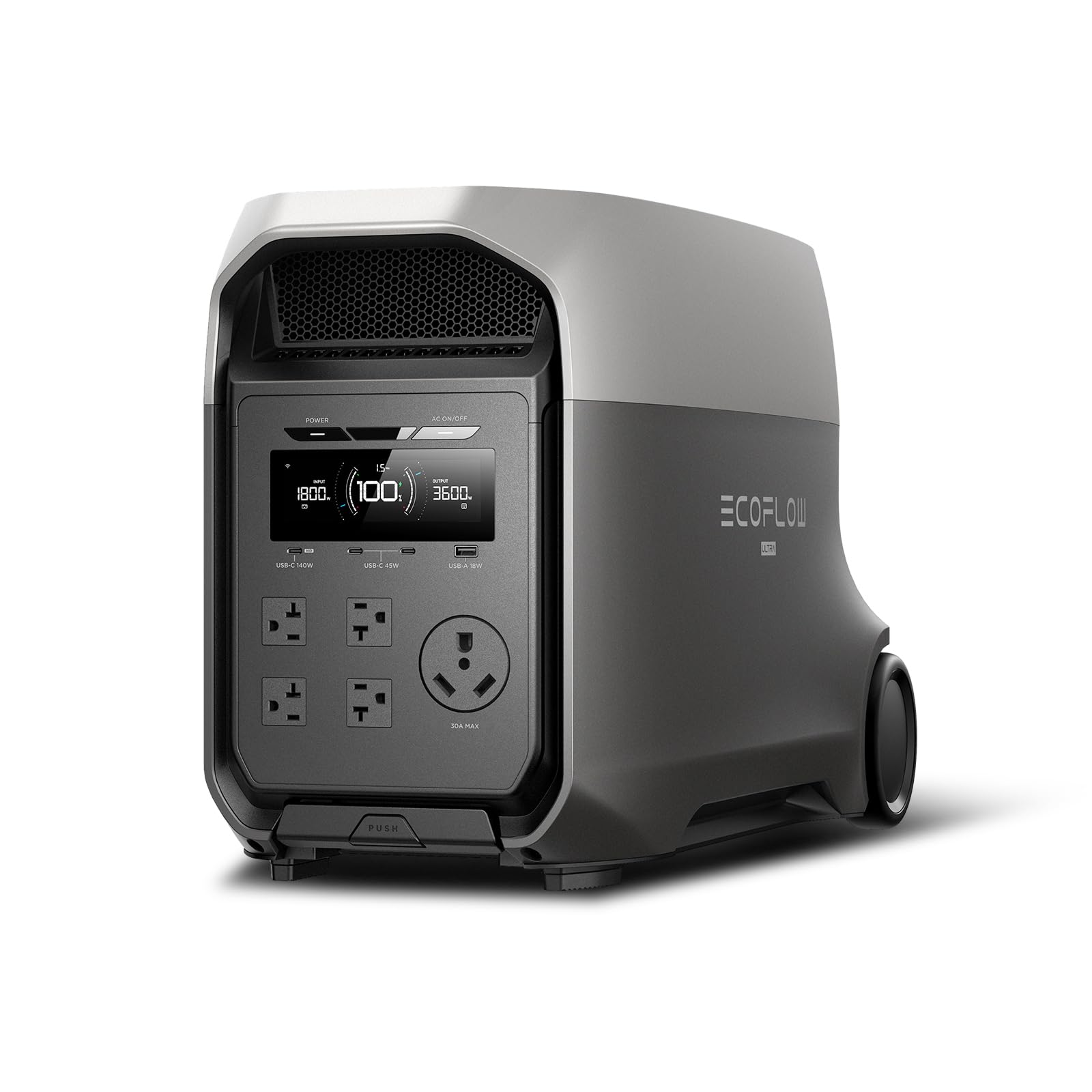
The EF ECOFLOW Delta 3 Ultra sets a new standard for acoustics in the 3kWh class, operating at just 25dB under load—quieter than a library. X-Quiet 3.0 technology uses advanced cooling design to minimize fan noise, making it ideal for apartments, bedrooms, and RVs where noise carries. With 3072Wh LiFePO4 capacity and 3600W continuous output (7200W surge), it powers refrigerators, microwaves, and power tools without audible strain.
The <10ms UPS transfer ensures zero interruption for sensitive electronics. Four charging methods include wall outlet, solar panels, car input, and the EcoFlow Smart Generator. X-Stream technology delivers a full recharge in about 90 minutes from AC. The EV-grade CTC (Cell-to-Chassis) structure and 24/7 battery protection system provide safety in extreme temperatures from -4°F to 140°F.
The unit includes four 20A AC outlets, one 30A RV outlet, four USB ports, and a 12V port. Built-in wheels and a telescoping handle make the 72 lbs manageable to roll across a room. The app tracks usage logs and allows remote shut-off. Note that this model does not support expansion batteries, so capacity is fixed at 3072Wh.
Why it’s great
- Near-silent operation at 25dB under load
- Blazing <10ms UPS transfer for sensitive devices
- EV-grade CTC structure for extreme temperature resilience
- Built-in wheels with telescoping handle for easy mobility
Good to know
- Battery capacity not expandable—no expansion slots
- Heavier than comparable stations at 72 lbs
- Max solar input limited to 800W
8. EF ECOFLOW DELTA Pro (120V/3.6kWh) with 400W Panel

The EF ECOFLOW DELTA Pro is the foundation of a truly scalable backup system. Starting at 3600Wh and 3600W output (7200W surge), it expands with extra batteries to 25kWh and pairs with a smart home panel for whole-house integration. The bundled 400W portable solar panel achieves 22.4% efficiency and folds into a carry case, weighing 35.3 lbs. A full recharge with three 400W panels takes only 3.5 hours.
Fifteen versatile output ports include five AC outlets, two USB-C, four USB-A, and an Anderson port for high-power accessories. Smart app control via WiFi or Bluetooth provides real-time monitoring of charge level, temperature, and discharge times. The unit also supports integration with the EcoFlow Smart Generator for backup charging during extended cloudy periods.
Users in hurricane-prone areas confirm the DELTA Pro powers a refrigerator for 20 hours on a full charge, with enough reserve for phones, lights, and medical equipment. The expandable design allows starting with fridge backup and adding batteries or the smart home panel over time. The unit is heavy at 99 lbs, but the wheel and handle kit makes rolling it to storage manageable.
Why it’s great
- Fully modular design—expandable to 25kWh with extra batteries
- High-efficiency 400W solar panel with 22.4% conversion
- 15 outlets including Anderson port for high-power gear
- Smart home panel compatible for whole-house backup
Good to know
- Heavy at 99 lbs—wheel kit essential for mobility
- Unit shuts off at 25% capacity (2.7kWh usable)
- Solar panel and station ship in separate packages
10. EF ECOFLOW DELTA Pro 3 with 2X 400W Panels
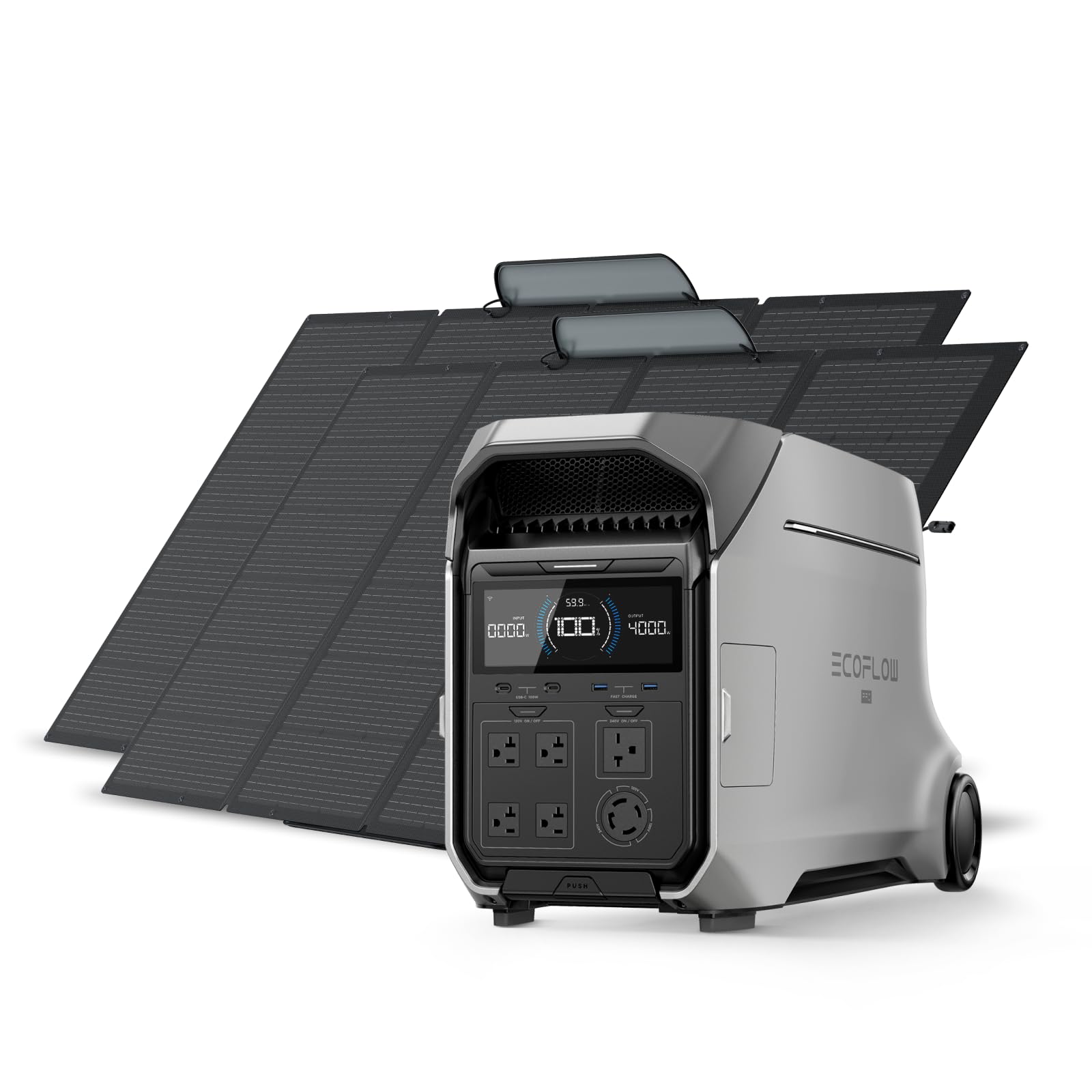
The EF ECOFLOW DELTA Pro 3 is a significant leap forward, offering 120V/240V split-phase output from a single unit. With 4096Wh LiFePO4 capacity and a 4000W inverter (6000W with X-Boost, scalable to 12000W), it can power a 3-ton central AC or a 1 HP well pump—tasks that previously required much larger gas generators. Expandable to 48kWh with extra batteries, it provides 2–4 days of whole-home backup for medium-sized houses.
Seven unique charging methods and 18 combo options include AC wall, solar, gas generator, EV charging piles, and the EcoFlow Smart Home Panel 2. The 10ms UPS switchover keeps NAS systems and servers running without interruption. X-Quiet technology keeps operation at or below 30dB, barely audible in a living room. The IP65-rated CTC battery pack ensures dust and water resistance for long-term reliability.
Users report it powers forced-air furnaces, tankless water heaters, and 12V fridges during road trips. The recharge rate with two 440W panels reaches about 70–80% in 4 hours of good sun. At 115 lbs, the unit includes a handle and wheels, though moving it up stairs requires help. The 5-year warranty is a strong vote of confidence in its engineering.
Why it’s great
- 120/240V split-phase output powers central AC and well pumps
- Expandable to 48kWh for days of whole-home backup
- 18 charging methods including EV charging pile
- Quiet 30dB operation—no louder than a whisper
Good to know
- Heavy at 115 lbs; wheels included but bulky
- Solar charging slower than advertised with single panel
- Second panel and station may ship separately
7. GROWATT HELIOS 3600 with 400W Solar Panels
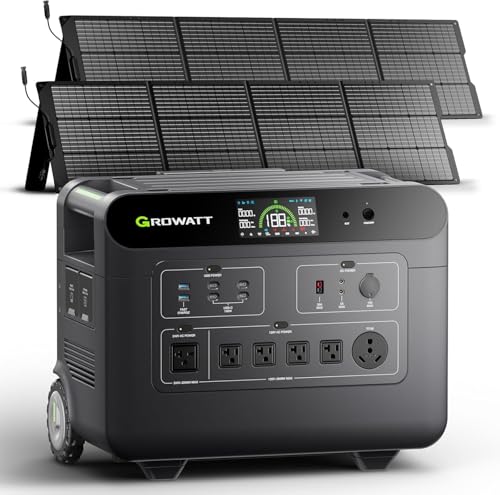
The GROWATT HELIOS 3600 brings mature inverter technology from the residential solar industry to a portable format. This 3600Wh station supports parallel connection of two units to achieve 7200W at 240V split-phase, enabling whole-house backup including well pumps and central air. Expandable to 36kWh with extra batteries, it handles prolonged outages without compromise. The bundled two 200W solar panels provide immediate solar charging out of the box.
Cold start technology allows operation down to -22°F, making it suitable for harsh winter climates. The 2000W high-efficiency solar input dramatically shortens charging cycles compared to 500W-input competitors. A 15ms EPS power switch keeps essential equipment running during grid transitions. The smart APP enables time-of-use scheduling to reduce electricity bills by charging during off-peak hours.
Users confirm the HELIOS 3600 runs an 8,000 BTU AC for about five hours per battery, and with a second unit, powers an entire home including well pump. Some have reported Bluetooth/WiFi connectivity issues with the app, though basic operation doesn’t require it. The unit benefits from Growatt’s reputation in the global inverter market and includes US-based customer support.
Why it’s great
- Parallel two units for 7200W at 240V split-phase output
- Expandable to 36kWh for extended outage coverage
- Cold start technology works down to -22°F
- 2000W solar input for fast off-grid replenishment
Good to know
- Heavy at 149 lbs for the bundle—wheel kit essential
- App connectivity issues reported by some users
- 240V combiner disables EPS transfer switch
13. OSCAL PowerMax 6000 with 4X 400W Solar Panels
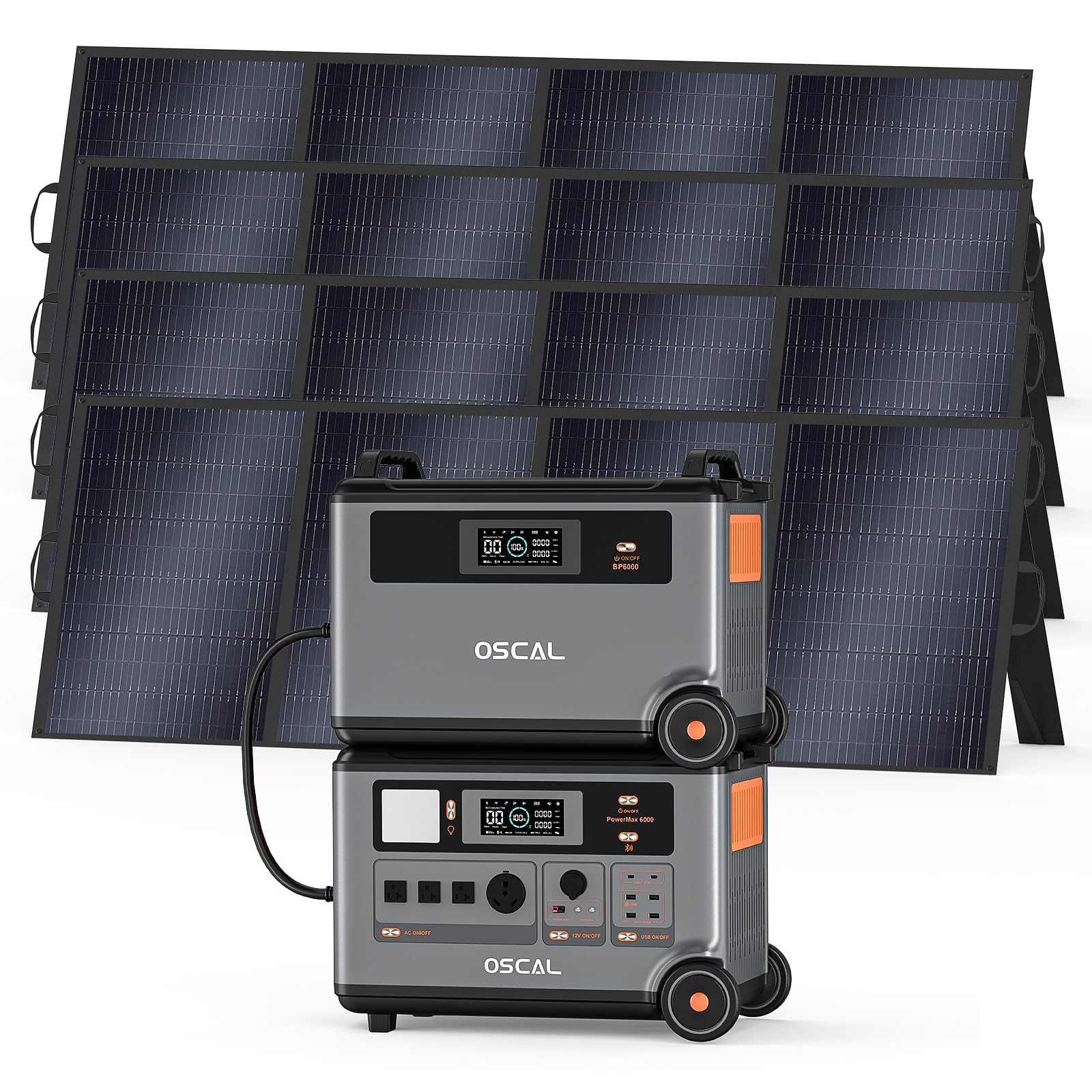
The OSCAL PowerMax 6000 is a true heavy lifter, combining 7200Wh of LiFePO4 storage with a 6000W inverter (9000W surge) and four 400W solar panels. This is enough capacity to run a whole home for a full day or power heavy tools on a job site continuously. The 120/240V split-phase output allows direct connection to a home’s breaker panel, making it a viable substitute for a traditional standby generator.
Charging is exceptionally fast: 2200W AC input refills the battery from empty to full in under 2 hours, while 2400W solar input achieves the same in ideal sun in roughly 3 hours. The 5–8ms EPS transfer switch is among the fastest in this class, keeping network equipment running without any interruption. Smart app control via the ‘Smart Life’ app allows remote monitoring and scheduling.
The 3500-cycle battery lifespan translates to roughly 25 years of daily use at one cycle per day, making this a generational investment. The unit includes 14 output ports across AC, USB-C, and DC outlets. At about 56 lbs for the station plus panels, the bundle is manageable with the included handle and wheels, though moving it up stairs is not a solo endeavor.
Why it’s great
- Massive 7200Wh capacity for whole-day, whole-home operation
- Ultra-fast EPS transfer under 8ms
- 3500-cycle battery rated for 25 years of use
- Includes four 400W panels for high solar input
Good to know
- Very high entry cost for the complete system
- Some users report lower than expected output for heavy loads
- Requires MC4 Y-connectors for panel array wiring
9. DuroStar DS13000MX Dual Fuel Generator

For buyers needing massive power output rather than battery storage, the DuroStar DS13000MX delivers 13,000 watts peak (10,000 running on gasoline) from a 500cc dual-fuel engine. It runs on either gasoline or propane, with a CO Alert sensor for automatic shutdown if carbon monoxide reaches dangerous levels. Push-button electric start and a remote control make operation convenient, while the transfer switch-ready 50A outlet connects directly to home panels.
The all-metal construction with rugged steel frame withstands harsh weather and heavy use. The unit includes never-flat tires and a foldable handle for rolling across uneven terrain. Runtime at 25% load on gasoline reaches about 12 hours with the included fuel tank. The dual-fuel capability lets you switch to propane during extended outages for cleaner, longer-running operation without carburetor gumming.
Owners confirm the DS13000MX easily powers an entire home including a 1.5-ton AC unit, refrigerator, stove, microwave, and lights. The electric start fires up reliably even after storage, though users must follow proper startup procedure (check oil, open gas valve). At 220 lbs, this is a stationary installation that requires a hand truck or dolly for initial placement.
Why it’s great
- 13,000W peak output handles entire home and heavy tools
- Dual fuel (gasoline/propane) for fuel flexibility
- CO Alert safety shutdown protects against fumes
- 50A outlet ready for transfer switch connection
Good to know
- Very heavy at 220 lbs, needs dolly for transport
- Produces noise and exhaust—not suitable for indoor use
- Requires regular maintenance (oil changes, fuel stabilizer)
11. DuroMax XP13000EH Dual Fuel Generator

The DuroMax XP13000EH is a proven dual-fuel generator that has powered homes for years. With 13,000 watts peak (10,000 running on gasoline) from a 500cc engine, it runs on gasoline or propane via a front-facing fuel selector switch. Push-button electric start and a 50A outlet make it transfer-switch ready for whole-home backup. The heavy-duty all-metal frame has no plastic parts, ensuring durability in rough conditions.
Copper windings in the alternator provide better heat dissipation than aluminum, extending generator life. The unit includes never-flat tires, a foldable handle, and a wheel kit for mobility across job sites or yards. The hour meter helps track maintenance intervals. Runtime on a full gas tank at moderate loads (6000W) reaches about 8 hours, with propane offering longer runtime at slightly reduced output.
User reports confirm the XP13000EH handles two HVAC units, fridge, freezers, and electronics simultaneously. Some note the muffler is loud at full load, typical for open-frame generators. The low-oil shutdown prevents engine damage, and the dual-fuel switch lets you extend fuel supplies during extended outages. Assembly requires attaching wheels and installing the battery, which most users complete in under 30 minutes.
Why it’s great
- 13,000W dual-fuel output for whole-home coverage
- All-metal construction with zero plastic parts
- Copper windings for better heat dissipation
- Never-flat tires and foldable handle for easy rolling
Good to know
- Heavy at 234 lbs—needs dolly for delivery
- Noisy operation at full load
- Break-in period required on gasoline before propane use
12. Westinghouse 28000W Tri-Fuel Generator
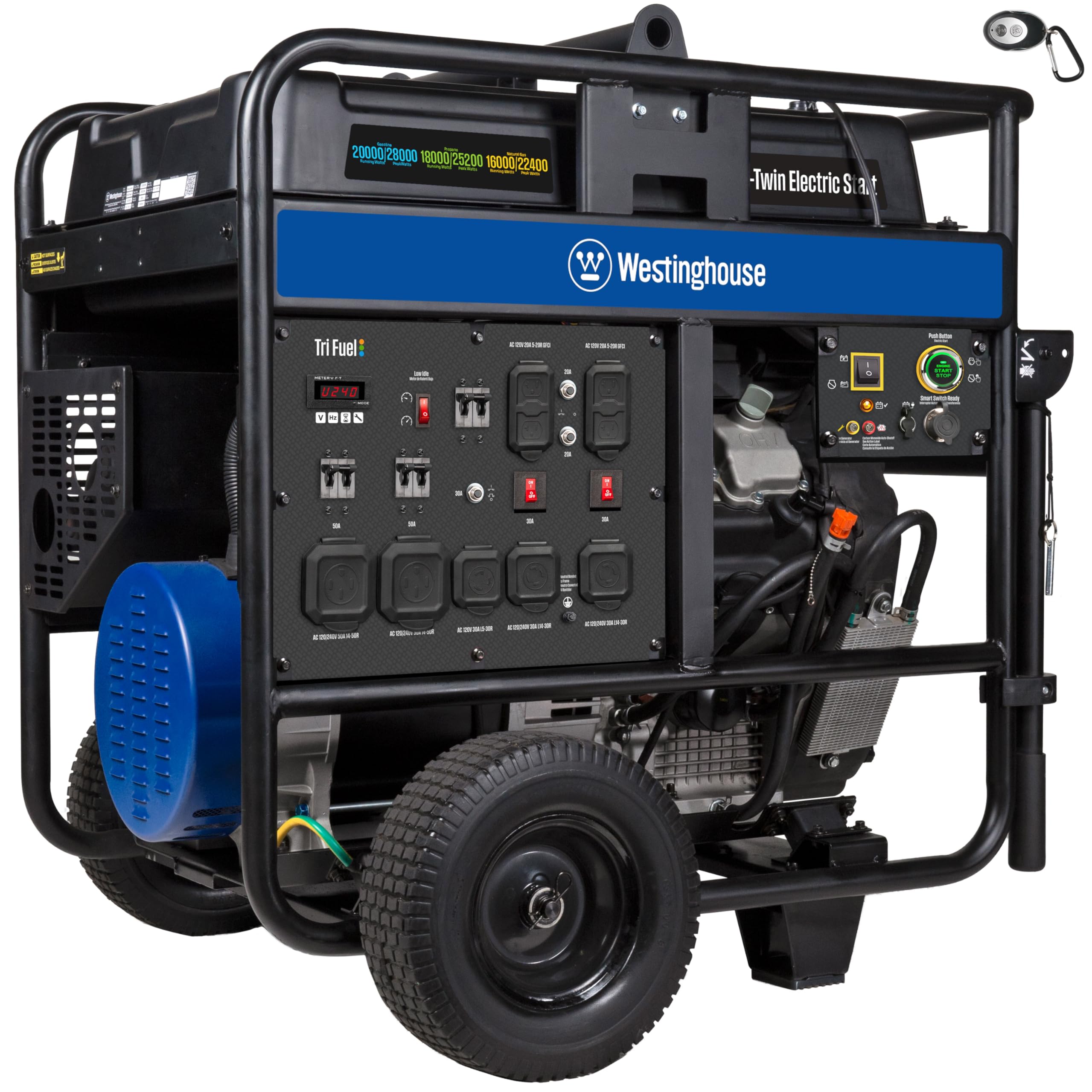
The Westinghouse 28000W Tri-Fuel generator is the most powerful unit in this lineup, producing 28,000 peak watts on gasoline (20,000 running), 25,200 peak on propane (18,000 running), and 22,400 peak on natural gas (16,000 running). Powered by a 999cc V-Twin OHV engine with cast-iron sleeve, it delivers enough power for the largest homes with central AC, well pumps, and multiple appliances running simultaneously. The tri-fuel capability provides maximum fuel flexibility—switch between gasoline, propane, or natural gas depending on availability.
The generator features remote electric start via key fob, a digital readout displaying run hours, volts, and frequency, and automatic low-oil shutdown. The 125A 240V AC terminal block allows direct hardwiring to a home’s electrical panel, bypassing cord limits for full power delivery. Low THD (total harmonic distortion) keeps the output clean enough for sensitive electronics like computers and TVs.
At 557 lbs, this generator is not portable in the traditional sense—it requires a dolly, trailer, or permanent installation. Users report it powers 2,100 sq ft homes including AC without any strain. The 17.2-gallon fuel tank provides up to 15 hours runtime at 25% load. The unit includes never-flat wheels, foldable steel handles, and a lift bracket for maneuvering with a tractor or hitch.
Why it’s great
- 28,000W peak output—enough for the largest homes
- Tri-fuel (gas, propane, natural gas) for ultimate flexibility
- 125A hardwire terminal block for full panel connection
- Low THD protects sensitive electronics
Good to know
- Extremely heavy (557 lbs)—needs trailer or permanent pad
- Noisy compared to inverter generators
- Some units ship with missing bolts; check assembly carefully
FAQ
Can a 2000 watt solar generator run my refrigerator?
How long does a 2000W solar generator take to charge from solar panels?
What’s the difference between a solar generator and a gas generator for home backup?
Do I need a pure sine wave inverter for my appliances?
How do I calculate what size generator I need?
Final Thoughts: The Verdict
For most users, the best 2000 watt solar generator winner is the Jackery HomePower 3000 with 2X 200W Solar Panels because it provides the perfect balance of capacity, portability, and immediate solar charging out of the box. If you want the fastest recharge times and a compact footprint, grab the Anker SOLIX C2000 Gen 2 with 200W Solar Panel. And for whole-house backup including 240V appliances like central AC and well pumps, nothing beats the EF ECOFLOW DELTA Pro 3 with 2X 400W Panels.

Mo Maruf
I created WellFizz to bridge the gap between vague wellness advice and actionable solutions. My mission is simple: to decode the research and give you practical tools you can actually use.
Beyond the data, I am a passionate traveler. I believe that stepping away from the screen to explore new environments is essential for mental clarity and physical vitality.