Our readers keep the lights on and my smoothie glass nicely filled. As an Amazon Associate, I earn from qualifying purchases.
The RTX 20-series marked NVIDIA’s first leap into real-time ray tracing and Tensor Core acceleration, bringing Turing architecture to desktops for a new era of visual fidelity and AI-powered performance. While the market has since marched forward with 30-series, 40-series, and even Blackwell-based cards, the 20-series remains a compelling hunting ground for budget-conscious gamers, workstation builders, and anyone looking to maximize frame rate per dollar on a used or renewed market.
I’m Mohammad Maruf — the founder and writer behind WellFizz. I’ve spent years digging through GPU architecture whitepapers, cross-referencing benchmark data, and analyzing Amazon pricing trends to identify which used and renewed graphics cards actually hold up in modern workloads.
Whether you are building a secondary streaming rig, upgrading an aging GTX system, or assembling a compact office PC capable of light creative work, finding the right balance of CUDA cores, memory bandwidth, and power efficiency is critical. This guide breaks down the best options available today so you can buy with confidence in the 20 series graphics card market.
How To Choose The Best 20 Series Graphics Card
Navigating the secondary market for GeForce 20-series cards requires more than just a price check. You need to match your resolution target, power supply capacity, and desired feature set (ray tracing, DLSS, NVENC) to the right SKU. Below are the three factors that separate a smart buy from a regretful one.
Resolution and VRAM Requirements
For 1080p high-refresh gaming, a 6GB RTX 2060 is sufficient, though 8GB cards like the RTX 2070 Super provide more headroom for texture-heavy titles. If you target 1440p, prioritize cards with 8GB or more, as modern AAA releases can exceed 6GB VRAM usage at high settings. The Quadro K6000 with 12GB is a workstation exception — its older Kepler architecture lacks the hardware acceleration needed for DirectX 12 Ultimate titles.
Condition and Renewed Reliability
Buying renewed or used introduces variability in thermal paste condition, fan wear, and BIOS stability. Look for sellers who offer a minimum 90-day return window and explicitly state that the card has been tested for DisplayPort output, memory integrity, and sustained load temperatures. Cards from major OEMs like ASUS, EVGA, and MSI often have better replacement part availability than off-brand models.
Power Supply and Physical Clearance
RTX 2060 cards typically require a single 8-pin connector and a 500W PSU, while the RTX 2070 Super demands at least a 550W unit with one 8-pin (or 6+2 pin). The Gigabyte RTX 2070 Super Gaming OC is over 11 inches long — always measure your case clearance before purchasing. SFF builders should look at the ASUS PRIME RTX 5070 or compact dual-fan models.
Quick Comparison
On smaller screens, swipe sideways to see the full table.
| Model | Category | Best For | Key Spec | Amazon |
|---|---|---|---|---|
| ASUS RTX 2060 EVO | Mid-range Original | Quiet 1080p gaming with dual monitor setups | 1785 MHz Boost, 6GB GDDR6 | Amazon |
| EVGA RTX 2060 KO Ultra | Mid-range Original | Budget 1080p high-fps streaming | 6GB GDDR6, Metal Backplate | Amazon |
| MSI RTX 2060 Ventus GP OC | Mid-range Original | VR-ready builds on a strict budget | 1710 MHz Boost, 6GB GDDR6 | Amazon |
| NVIDIA RTX 2070 Super FE | Premium Original | Enthusiast 1440p ultra settings | 1770 MHz Boost, 8GB GDDR6 | Amazon |
| ASUS RTX 2070 Super EVO | Premium Renewed | Reliable 1440p with dust-resistant fans | 1845 MHz Boost, 8GB GDDR6 | Amazon |
| GIGABYTE RTX 2070 Super Gaming OC | Premium Original | Cool 1440p gaming with triple fans | 1815 MHz Boost, 8GB GDDR6 | Amazon |
| NVIDIA Quadro K6000 | Workstation Renewed | CAD/3D modeling on a tight budget | 12GB GDDR5, 384-bit Interface | Amazon |
| PNY RTX 5070 Epic-X | Next-gen Premium | 1440p high-FPS with DLSS 4 | 12GB GDDR7, 2685 MHz Boost | Amazon |
| ASUS PRIME RTX 5070 | Next-gen Premium | SFF builds needing Blackwell power | 12GB GDDR7, 2.5-slot Form Factor | Amazon |
| GIGABYTE RTX 5070 Windforce OC | Next-gen Premium | Silent 1440p with triple-fan cooling | 12GB GDDR7, PCIe 5.0 | Amazon |
| GIGABYTE RTX 3080 Ti Gaming OC | High-end Original | 4K gaming and heavy rendering workloads | 12GB GDDR6X, 384-bit Interface | Amazon |
In‑Depth Reviews
1. ASUS GeForce RTX 2060 Overclocked 6G EVO

This ASUS dual-fan RTX 2060 hits a near-perfect sweet spot for 1080p high-refresh gaming and light 1440p use. With a 1785 MHz boost clock out of the box, it comfortably drives most AAA titles at 70+ FPS on ultra settings when paired with a modern CPU. The Wing-Blade fan design keeps acoustic levels low during desktop use thanks to the 0dB mode that stops the fans entirely below 55°C, making it a natural fit for quiet office builds or HTPC setups.
The DVI port is a welcome inclusion for those still using 144Hz monitors without DisplayPort adapters, and the IP5X dust resistance on the fans extends longevity inside dusty cases. The protective aluminum backplate prevents PCB flex during installation — a common risk with large dual-slot cards. Out of the box, the pre-applied overclock saves you from manual tuning while still leaving headroom for additional undervolting via GPU Tweak II.
Owners have reported consistent 70-75 FPS in titles like The Witcher 3 and Cyberpunk 2077 at ultra settings with mods, while ray tracing in Control hovers around 35 FPS without DLSS. If your priority is a proven, reliable card with solid cooling for 1080p gaming, this is the most balanced option in the 20-series stack.
Why it’s great
- 0dB fan mode keeps the system silent during light loads
- DVI port supports older high-refresh monitors
- Dust-resistant fans and aluminum backplate improve longevity
Good to know
- 6GB VRAM may cap texture detail in future AAA titles
- Ray tracing performance is modest without DLSS engaged
2. EVGA GeForce RTX 2060 KO Ultra Gaming

EVGA’s “KO” (Kill Original) series was designed to deliver strong baseline performance at an aggressive price, and the RTX 2060 KO Ultra lives up to that brief. It packs a metal backplate — unusual at this tier — which helps dissipate heat and prevents PCB sag in vertical or horizontal orientations. The dual fans are audible under full load but stay unobtrusive, and the card requires just a single 8-pin power connector, making it compatible with older 500W power supplies.
Real-world gaming performance lands between 60-120 FPS at 1080p, with some lighter esports titles like Valorant and Rocket League pushing toward 200 FPS. The card supports NVIDIA G-Sync, allowing for tear-free gameplay on compatible monitors. Users upgrading from GTX 1650 or 1050 Ti cards report feeling a massive generational uplift, especially in texture loading and shader compilation speeds due to the Turing architecture’s improved cache hierarchy.
One caveat: as a budget-tier SKU, the KO Ultra lacks the RGB lighting and premium VRM cooling found on higher-end EVGA cards like the FTW series. It also ships without a USB-C VirtualLink port, which some VR headset users may miss. For pure 1080p gaming at the lowest total system cost, however, this is a tough card to beat.
Why it’s great
- All-metal backplate included at a budget price point
- Single 8-pin power makes PSU upgrades unnecessary
- G-Sync compatible for tear-free gameplay
Good to know
- No RGB or premium aesthetic features
- Lacks USB-C VirtualLink port for direct VR headset connection
3. MSI Gaming GeForce RTX 2060 Ventus GP OC

MSI’s Ventus GP OC is a no-frills card built for consistent performance in VR environments, where stable frame timing is more important than peak FPS. The 192-bit memory interface combined with 6GB of GDDR6 delivers 336 GB/s of bandwidth, which is sufficient to feed the headset’s dual displays at 90 Hz without stuttering. The card’s 1710 MHz boost clock keeps thermals manageable, with the dual-fan solution running quietly during both seated and standing VR sessions.
User reports show that the card handles demanding VR titles like Half-Life: Alyx and Boneworks at clean 90 FPS, while flat-screen games such as Call of Duty: Cold War reach 135 FPS on high settings. The card includes three DisplayPort 1.4a outputs and a single HDMI 2.0b port, offering flexibility for mixed-use setups with a VR headset and two monitors simultaneously. Its compact 9.1-inch length fits most mid-tower cases without clearance issues.
The Ventus GP OC is not a showpiece — there is no RGB, no dual BIOS switch, and the black shroud is utilitarian. Some users have noted that the stock fan curve is slightly aggressive, but a quick adjustment in MSI Afterburner solves the issue. If your primary use case includes room-scale VR and you want to minimize cost, this card delivers the necessary headroom.
Why it’s great
- Proven VR performance with stable 90 FPS frame times
- Triple DisplayPort outputs for multi-monitor configurations
- Compact 9.1-inch length fits most mid-tower cases
Good to know
- No RGB lighting or premium aesthetic design
- Stock fan curve may run louder than ideal for silent PC builds
4. NVIDIA GeForce RTX 2070 Super Founders Edition

The Founders Edition represents NVIDIA’s reference design, often featuring higher silicon binning quality compared to partner boards. This RTX 2070 Super FE pushes 1770 MHz boost out of the box and closely trails the RTX 2080 in synthetic benchmarks, making it the strongest performer within the 20-series lineup. The dual-axial fan shroud exhausts heat out the back of the case, which is essential for small form factor builds where internal airflow is limited.
Real-world testing shows this card handles 1440p Ultra at a steady 60 FPS in most titles, with dips only in the most demanding ray-traced scenes. It also features a USB-C VirtualLink port, allowing a single-cable connection to VR headsets like the Valve Index — a rare and valuable feature missing from many partner cards. The build quality feels dense and premium, with a magnesium alloy frame that resists flex.
Thermal performance is a known trade-off: the FE card runs noticeably hotter than partner models with triple-fan coolers, with some users reporting GPU temperatures above 80°C under sustained load. The small fan size means higher RPM under load, which translates to audible fan noise. This card is best suited for users who prioritize build quality and reference performance over aggressive cooling, or those planning to install a custom water block.
Why it’s great
- USB-C VirtualLink for single-cable VR headset connection
- NVIDIA reference design ensures high silicon quality
- Exhaust cooling ideal for small form factor cases
Good to know
- Runs hotter than partner cards with triple-fan coolers
- Fan noise is noticeable under sustained gaming loads
5. ASUS GeForce RTX 2070 Super Overclocked 8G EVO (Renewed)

This renewed ASUS RTX 2070 Super EVO delivers nearly the full performance of a brand-new 2070 Super at a significant discount, making it one of the highest-value options in the entire 20-series used market. With a boost clock of 1845 MHz in OC mode and 2560 CUDA cores, it outperforms the standard 2070 Super FE in most gaming scenarios. The Triple Axial-Tech fans with IP5X dust resistance are a thoughtful upgrade for users in dusty environments or those planning long-term use without regular cleaning.
User reviews consistently praise the seller’s refurbishment process, with multiple buyers noting that the card arrived looking like new and functioning flawlessly. One memorable case had the seller upgrading a buyer from an RTX 2070 Super to an RTX 2080 Ti at no extra cost — an outlier, but indicative of the value some renewed sellers provide. The card supports up to four monitors via three DisplayPort 1.4 and one HDMI 2.0 output, making it suitable for productivity-focused multi-monitor workstations.
One buyer reported a fan failure after two months, with the fans becoming louder than a single-fan model before the card eventually crashed during driver updates. This highlights the inherent risk of buying renewed electronics: while most units perform well, the lack of a long factory warranty means you are relying on the seller’s return policy. Always verify that the seller offers at least a 90-day replacement window.
Why it’s great
- Factory overclock reaches 1845 MHz out of the box
- IP5X dust resistance extends fan reliability in dusty environments
- Four video outputs support extensive multi-monitor setups
Good to know
- Renewed unit carries higher failure risk than new-in-box
- Reported fan noise and failure in a small number of units
6. GIGABYTE GeForce RTX 2070 Super Gaming OC 8G

GIGABYTE’s Windforce 3X cooling system makes this RTX 2070 Super one of the coolest-running and quietest options in the 20-series stack. The alternate spinning fan design reduces turbulence, while the large heatsink keeps the GPU below 65°C under typical gaming loads. The 256-bit memory interface paired with 8GB of GDDR6 delivers 448 GB/s of bandwidth, which is particularly beneficial for 1440p ultra-wide monitors running 3840×1600 resolutions.
Benchmarks show consistent 70+ FPS in titles like Gears 5 and Call of Duty: Modern Warfare at 1440p high-max settings, with frame rates occasionally dipping to 60 in open-world ray-traced scenes. The card requires a 650W PSU recommendation and measures 11.26 inches long, so it will not fit compact cases without careful measurement. Users upgrading from a GTX 1050 Ti report night-and-day differences, with 80+ FPS at 1440p highest settings in most modern games.
The AORUS Engine software gives granular control over fan curves, RGB lighting, and core voltage, though some users find the interface less intuitive than MSI Afterburner. The card’s only notable limitation is that it targets 1440p rather than 4K — it can run 4K at low settings and achieve 60 FPS, but this is not its strong suit. For users who prioritize thermal performance and quiet operation at 1440p, this is a top contender.
Why it’s great
- Triple-fan Windforce cooling maintains sub-65°C temperatures under load
- Alternate spinning fans reduce noise and improve airflow efficiency
- 256-bit memory interface maximizes 1440p ultra-wide performance
Good to know
- Large 11.26-inch length may not fit compact or small form factor cases
- AORUS Engine software has a less intuitive interface than competing utilities
7. NVIDIA Quadro K6000 12GB (Renewed)

The Quadro K6000 is not a gaming card — it is a Kepler-based workstation GPU with a massive 12GB framebuffer on a 384-bit bus, designed for CAD, 3D modeling, scientific visualization, and video editing. Its 12GB of GDDR5 memory allows it to load large 3D scenes and complex textures that would exceed the VRAM of consumer cards, making it a strong option for Blender, SolidWorks, or DaVinci Resolve workloads on a tight budget. The dual DVI-I and DisplayPort outputs support up to four monitors.
Be aware of the architectural limitations: the K6000 lacks hardware support for DirectX 12 Ultimate features, including ray tracing and mesh shaders, and its older Kepler architecture runs significantly slower in modern gaming benchmarks compared to even a budget RTX 2060. User reviews mention that NVIDIA has dropped driver support for this card, meaning you will not receive new driver updates or optimizations for recent games. One buyer noted that it took “a bit to get it to show up in POST,” which suggests compatibility quirks with modern motherboards.
This card is a niche pick. If you need 12GB of VRAM for workstation tasks at a mid-range price, and you do not care about gaming performance, the Quadro K6000 delivers. If you plan to play any modern AAA game, look elsewhere. The renewed condition means the card has been tested, but you are relying on limited seller support for any issues.
Why it’s great
- 12GB GDDR5 on a 384-bit bus handles large CAD and 3D modeling files
- Supports multi-monitor setups up to four displays
- Professional driver support ensures ISV certification for workstation apps
Good to know
- Kepler architecture lacks ray tracing, DirectX Ultimate support, and modern driver updates
- Poor gaming performance compared to budget RTX 2060 cards
8. PNY NVIDIA GeForce RTX 5070 Epic-X ARGB OC Triple Fan
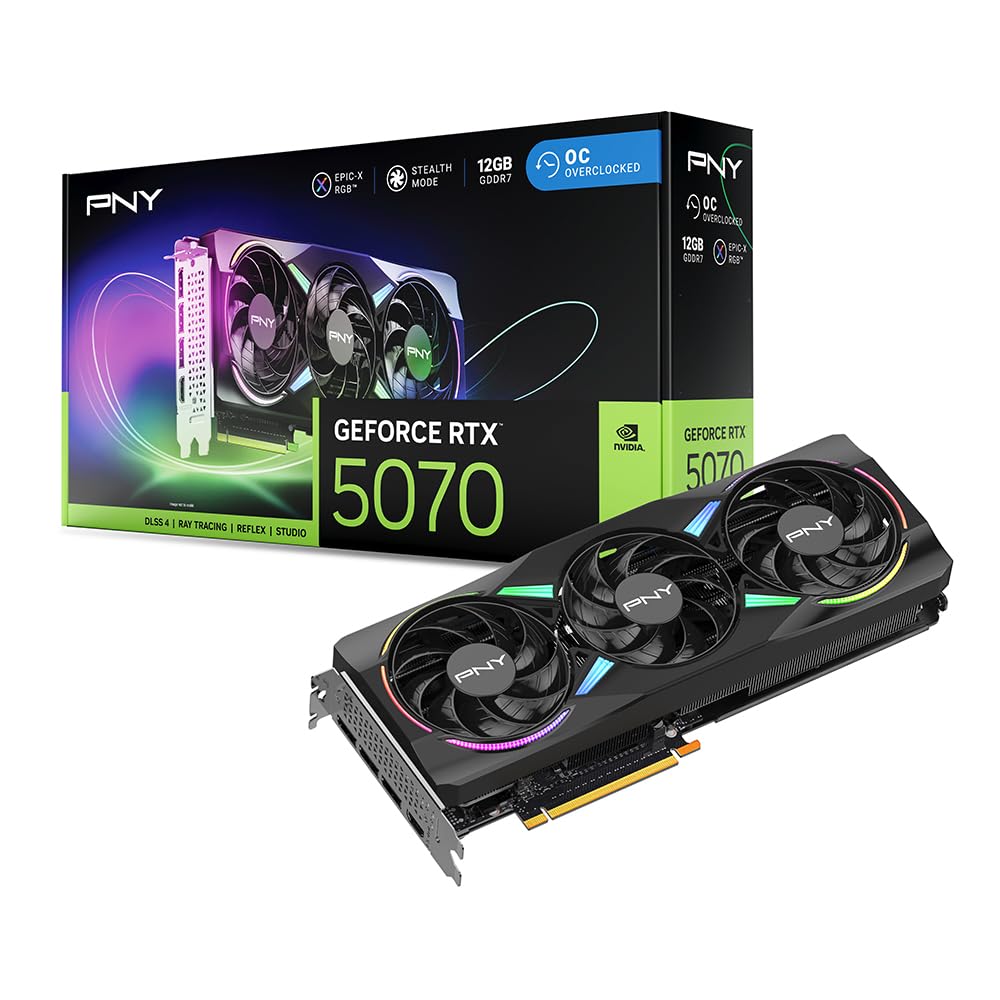
While not a 20-series card by generation, the RTX 5070 Epic-X from PNY represents the modern evolution of the same 70-class value proposition that made the RTX 2070 a hit. Built on the Blackwell architecture with 12GB of GDDR7 memory running at 28 Gbps over a 192-bit bus, it achieves 672 GB/s of bandwidth — over double that of the RTX 2070 Super. The triple-fan cooler keeps noise extremely low even under sustained load, and the small footprint fits mini-tower cases like the HP Z4-G4.
In 1440p gaming, this card absolutely smashes its predecessors. Owners report excellent performance in demanding titles, with one user noting it significantly outperforms the RTX 4070 Super in raw FPS without relying on frame generation. The card includes the full 80 ROPS, ensuring consistent rasterization performance. The dual 8-pin to 12-pin power adapter ensures compatibility with existing modular PSUs, though you will need to ensure your case has 2.4-slot clearance.
At current pricing, this card sits near the top of the mid-range tier, above the entry-level 20-series options but far below the RTX 3080 Ti. It is the best choice for users who want cutting-edge features like DLSS 4, Reflex 2, and DisplayPort 2.1 without paying four-figure sums. The only catch is availability — as a newer SKU, stock can be inconsistent, and pricing floats above MSRP.
Why it’s great
- GDDR7 memory delivers 672 GB/s bandwidth for smooth 1440p gaming
- DLSS 4 and Reflex 2 provide competitive responsiveness and image quality
- Compact design fits a wide variety of case sizes including mini-towers
Good to know
- Pricing may float above MSRP due to early adoption demand
- Requires a PSU with two 8-pin connectors and a 12-pin adapter
9. ASUS SFF-Ready Prime NVIDIA GeForce RTX 5070

The ASUS Prime RTX 5070 is explicitly designed for small-form-factor enthusiasts. At just 2.5 slots thick, it fits compact cases like the Fractal Terra, Cooler Master NR200, and DAN A4-H20 without modification. The Axial-tech fans employ a smaller fan hub that accommodates longer blades, increasing downward air pressure to push heat through a dense aluminum fin array. A phase-change GPU thermal pad ensures optimal heat transfer, keeping the card between 60-65°C under full load during gaming benchmarks.
Performance-wise, this card matches the PNY 5070 in raw throughput, with a slight edge in thermal management thanks to the Dual BIOS feature. The Performance BIOS runs the fans more aggressively for higher boost clocks (peaking at 2542 MHz), while the Quiet BIOS trades a few percent of performance for near-silent operation. User reviews highlight that this card handles 1440p competitive titles like Valorant and Overwatch 2 at very high frame rates, and pairs brilliantly with high-core-count CPUs like the Ryzen 7 7800X3D.
The card’s connectivity is modern, with HDMI 2.1b and DisplayPort 2.1 outputs, but it lacks the DVI or USB-C ports of older cards. If you are building a new SFF system from scratch, this is the best-performing compact card in the list. Just ensure your PSU has the correct 16-pin (12VHPWR) connector or an adapter.
Why it’s great
- 2.5-slot thickness fits virtually all popular SFF cases
- Dual BIOS allows switching between performance and silent fan curves
- Phase-change thermal pad enables excellent heat transfer and low GPU temps
Good to know
- Requires a PSU with a native 16-pin 12VHPWR connector
- Lacks legacy DVI or USB-C ports for older monitors or VR headsets
10. GIGABYTE GeForce RTX 5070 Windforce OC SFF 12G

This GIGABYTE Windforce OC version of the RTX 5070 shares the same Blackwell DNA as the other 50-series cards on this list, but distinguishes itself with a triple-fan cooling solution that is remarkably quiet under load. Users upgrading from an RTX 2080 Super report being surprised by the acoustic performance — the card runs nearly silent even during extended gaming sessions. The SFF-friendly design (11.1 inches long, 2.3-slot thickness) means it fits most modern cases without the extreme space requirements of the RTX 3080 Ti.
The card’s 2600 GHz boost clock is the highest base boost among the 50-series cards reviewed here, though real-world performance differences are marginal compared to the PNY and ASUS variants. The Windforce system uses alternate spinning fans to reduce turbulence, and the entire assembly is engineered for efficient passive cooling at low loads — the fans often stop entirely during desktop use. Multiple buyers noted its sleek, professional aesthetic without RGB, making it suitable for office environments where flashy lighting is unwelcome.
AI and creative users will appreciate the 12GB GDDR7 memory for running local LLMs and rendering in Blender, where the memory bandwidth advantage over 20-series cards is stark. The main limitation is that PCIe 5.0 support is largely future-proofing — current games see negligible gains from PCIe 5.0 over 4.0. If you want a quiet, efficient card for both gaming and productivity in a mid-tower build, this is a strong candidate.
Why it’s great
- Triple-fan Windforce cooler is near-silent under gaming load
- 2600 MHz boost clock is the highest among reviewed 50-series cards
- Professional black design without RGB fits office environments
Good to know
- PCIe 5.0 support is forward-looking but offers no current gaming benefit
- Requires at least an 11-inch clearance inside the case
11. GIGABYTE GeForce RTX 3080 Ti Gaming OC 12G

The GIGABYTE RTX 3080 Ti Gaming OC sits at the absolute top of the performance stack in this comparison, offering 12GB of GDDR6X memory on a 384-bit interface for 912 GB/s of bandwidth. This is more than double the memory bandwidth of the RTX 2070 Super, making it the only card on this list capable of serious 4K gaming without significant compromises. The triple WINDFORCE fan cooling system keeps the Ampere GPU under control, with users reporting thermals in the mid-70s under load after applying an undervolt profile.
Owners report running Cyberpunk 2077 at 2K ultra settings with ray tracing at high frame rates, and obliterating esports titles like Fortnite at maxed-out settings. One user upgrading from an RTX 2070 Super noted consistent high FPS at 2K max settings, with the only “drawback” being that the card’s performance now demands a 4K monitor to fully utilize its potential. The card is enormous at 12.6 inches long — double-check your case clearance and consider a sag bracket for long-term reliability.
The price tag places this clearly in the high-end tier, beyond the reach of budget-conscious buyers. However, for users who demand the best possible ray tracing and rasterization performance without moving to the RTX 4090, this is the card. The only significant risk in the used market is the possibility of receiving a mismatched unit — one buyer reported receiving an RTX 3050 instead of the 3080 Ti, though this appears to be an isolated fulfillment error. Always inspect the core label and VRAM configuration upon delivery.
Why it’s great
- 12GB GDDR6X on a 384-bit bus provides massive bandwidth for 4K gaming
- Triple-fan WINDFORCE cooling handles high thermal loads effectively
- Substantial performance uplift over RTX 2070 Super in ray-traced titles
Good to know
- Excessive 12.6-inch length requires a spacious case and a sag bracket
- 750W PSU minimum is required, ideally with multiple dedicated PCIe cables
FAQ
Is an RTX 2060 still viable for 1440p gaming in 2024 and beyond?
What is the practical difference between the RTX 2070 Super and RTX 3070?
How do I verify a renewed 20-series card is authentic and not tampered with?
Can a Quadro K6000 be used for gaming?
Does the RTX 2070 Super Founders Edition have thermal issues?
Final Thoughts: The Verdict
For most users, the 20 series graphics card winner is the ASUS RTX 2060 EVO because it offers the best balance of quiet cooling, 1080p gaming performance, and build quality at a reasonable entry point. If you want RTX 2070 Super-class performance in a single card, grab the NVIDIA RTX 2070 Super FE for its superior silicon quality and USB-C VirtualLink. And for a true 4K-capable upgrade from the entire 20-series generation, nothing beats the GIGABYTE RTX 3080 Ti Gaming OC.

Mo Maruf
I created WellFizz to bridge the gap between vague wellness advice and actionable solutions. My mission is simple: to decode the research and give you practical tools you can actually use.
Beyond the data, I am a passionate traveler. I believe that stepping away from the screen to explore new environments is essential for mental clarity and physical vitality.