Our readers keep the lights on and my smoothie glass nicely filled. As an Amazon Associate, I earn from qualifying purchases.
A balanced 20-20-20 fertilizer delivers equal parts nitrogen, phosphorus, and potassium, making it the go-to choice for general-purpose feeding across houseplants, vegetable gardens, and flower beds. The challenge isn’t finding one — it’s picking the right formula that dissolves cleanly, feeds consistently, and won’t torch your roots when mixed even slightly off.
I’m Mohammad Maruf — the founder and writer behind WellFizz. To build this guide, I pored over hundreds of verified customer experiences, analyzed mixing ratios, solubility reports, and micronutrient profiles for each formula to separate the true performers from the mediocre mixes.
Whether you’re nursing finicky orchids or fueling a summer vegetable patch, the right 20-20-20 fertilizer delivers steady, visible growth without guesswork when you know which specs matter most.
How To Choose The Best 20-20-20 Fertilizer
A 20-20-20 fertilizer is a balanced, all-purpose plant food, but not all bags are created equal. The differences come down to solubility, additive quality, and how the formula handles different feeding methods.
Mixing Ratio and Solubility
The safest mixes start at 1 teaspoon per gallon for seedlings and sensitive flowers, then ramp to 1 tablespoon per gallon for heavy feeders like tomatoes and cannabis in vegetative growth. Powders that clump or leave sediment increase your risk of uneven feeding and root burn — look for fine-grind formulas that dissolve completely within a minute of stirring.
Micronutrient and Organic Additives
A bare 20-20-20 NPK provides the macronutrients, but the best fertilizers also pack iron, manganese, zinc, boron, copper, and molybdenum. Kelp extract (Ascophyllum nodosum) is a plus: it supplies trace growth hormones and stress reducers that synthetic-only blends lack. Products that skip the micronutrient panel often leave plants looking pale despite proper feeding.
Application Versatility
Some formulas are optimized for foliar feeding, others for root drenching. If you plan to spray leaves, choose a product that specifies a lower foliar dilution rate — usually 1/4 to 1 teaspoon per gallon — to avoid leaf burn. For soil drenching, a stronger mix is safe and effective when applied to moist soil.
Quick Comparison
On smaller screens, swipe sideways to see the full table.
| Model | Category | Best For | Key Spec | Amazon |
|---|---|---|---|---|
| GS Plant Foods All Purpose 20-20-20 | Premium Blend | All-purpose indoor/outdoor feeding | Contains kelp extract + chelated micronutrients | Amazon |
| Fertilome All Purpose 20-20-20 | Mid-Range | Flowers, hanging baskets, perennials | Foliar spray & soil drench dual-rate | Amazon |
| Peter’s Professional 20-20-20 (2 lb) | Mid-Range | Houseplants, orchids, bromeliads | Dissolves fast with chelated micronutrients | Amazon |
| Peter’s Professional 20-20-20 (1 lb) | Entry-Level | Small collections, first-time users | Includes measuring scoop, waterproof pouch | Amazon |
| Schultz All Purpose 20-20-20 | Budget-Friendly | Large gardens, cost-conscious feeding | 5 lb bag with fine-grind solubility | Amazon |
In‑Depth Reviews
1. GS Plant Foods All Purpose Water Soluble 20-20-20
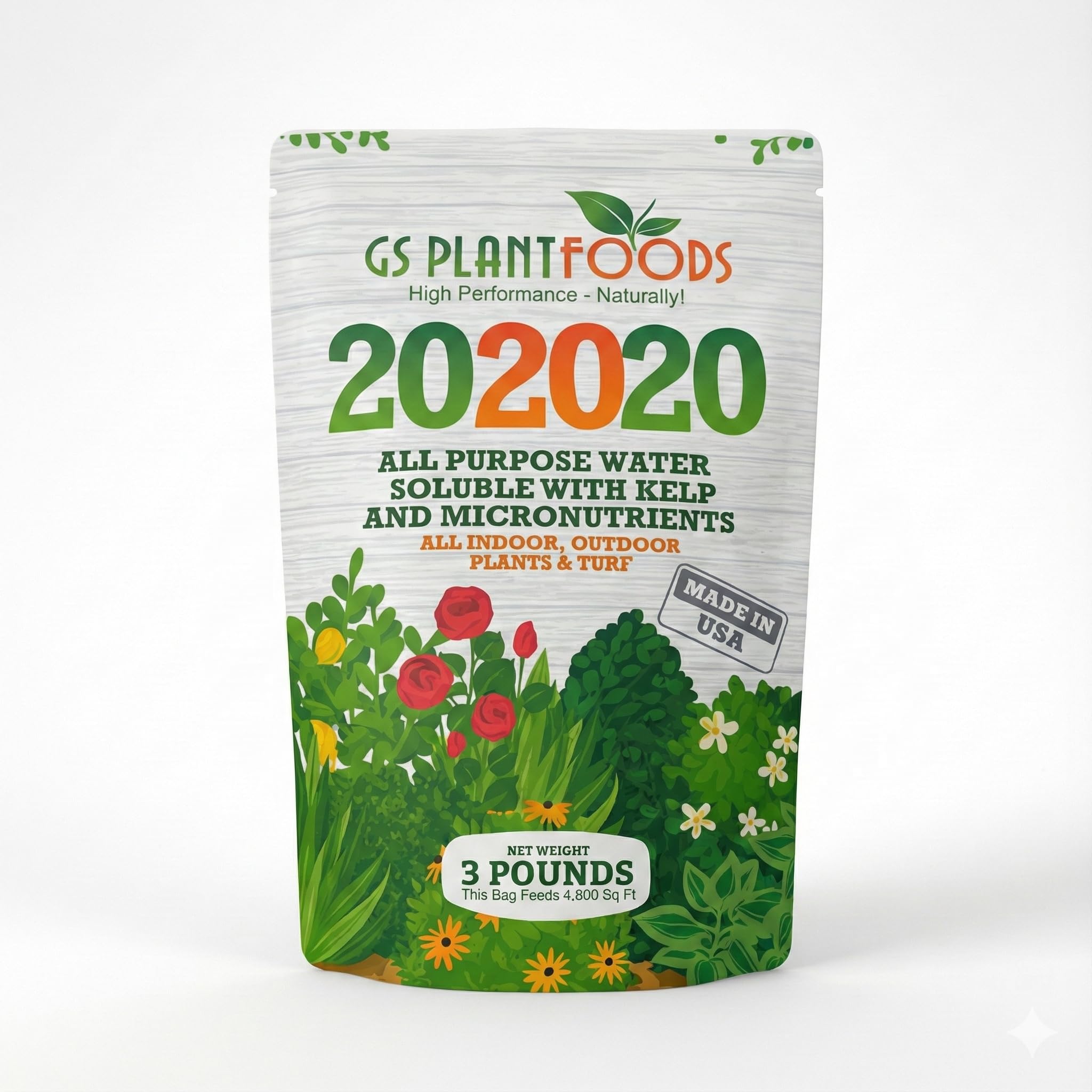
This 3-pound bag from GS Plant Foods stands out because it pairs the classic 20-20-20 NPK with kelp extract (Ascophyllum nodosum) and a full suite of chelated micronutrients including iron, manganese, copper, zinc, boron, and molybdenum. That kelp addition is rare in synthetic balanced blends — it supplies natural growth hormones (cytokinins) that help plants bounce back faster from transplant shock and environmental stress.
The powder dissolves completely with minimal stirring, leaving no sediment at the bottom of the watering can. Users report visible greening within days on both houseplants and raised-bed vegetables. The manufacturer claims one bag covers up to 4,800 square feet of turf, making it economic for larger gardens despite its premium positioning.
A few growers noted that the slightly higher relative nitrogen can push leaf growth at the expense of blooms on some flowering plants. If your primary goal is maximum flower production on annuals like petunias, you may want to supplement with a bloom booster later in the season. But for all-around health and growth, this is the most complete formula in the lineup.
Why it’s great
- Kelp extract adds stress resilience missing from standard blends
- Full micronutrient panel prevents trace-element deficiencies
- Dissolves quickly with no sediment
Good to know
- Nitrogen can slightly dampen bloom output on heavy-flowering annuals
- Must be stored in a completely dry container or it clumps
2. Fertilome All Purpose Water Soluble Plant Food 20-20-20

Fertilome positions itself as a flower-first formula, explicitly recommending rates for foliar sprays (1/4 to 1 teaspoon per gallon) and soil drenches (1 to 2 teaspoons per gallon). This dual-rate design is a strong feature if you grow hanging baskets, petunias, geraniums, or impatiens — plants that respond well to leaf feeding without risking burn.
Users with temperate-climate flower gardens consistently report brighter color saturation and extended continuous blooming after switching to Fertilome. The 3-pound bag lasts a full season for most small- to medium-sized flower patches. A notable detail: several verified buyers mentioned that the product revived dying hibiscus bushes within three weeks after trimming and root-drenching.
The granular texture dissolves more slowly than some premium powders, so it benefits from warm water and a few extra stirs. A few users received leaking packages, though the seller replaced those quickly. If your primary focus is flower color and quantity on ornamentals, this formula is tailored specifically for that use.
Why it’s great
- Optimized dual-rate system for foliar and root feeding
- Strong reviews for reviving stressed flowering plants
- Good value per ounce in the 3 lb size
Good to know
- Grainy texture requires warm water to dissolve fully
- Some reports of damaged packaging in transit
3. Peter’s Professional 20-20-20 General Purpose (2 Pound)

Peter’s Professional has a loyal following among houseplant enthusiasts and cannabis growers, and this 2-pound bag is the sweet spot between value and potency. The fine powder dissolves in seconds with no grit, and the chelated micronutrients — iron, manganese, copper, zinc, boron, and molybdenum — are immediately available to roots and leaves.
Long-term users praise its consistency: African violets bloom continuously, succulents propagate more prolifically, and cannabis plants in vegetative growth show rapid internode expansion. The recommended rate is 1/2 tablespoon per gallon for houseplants every one to two months, making this bag last many feeding cycles. Several buyers with decades of gardening experience call it the best synthetic fertilizer they’ve used.
The lack of added kelp or organic matter is a minor downside if you prefer a soil-building approach. It’s purely mineral-based, so it feeds the plant directly without feeding soil microbes. Some growers also wish the bag had a resealable zipper closure rather than a simple paper pouch.
Why it’s great
- Extremely fine grind dissolves instantly even in cold water
- Chelated micronutrients prevent yellowing between feedings
- Well-documented success with orchids and African violets
Good to know
- No organic additives or kelp — purely mineral
- Paper bag lacks a resealable closure
4. Peter’s Professional 20-20-20 General Purpose (1 Pound)
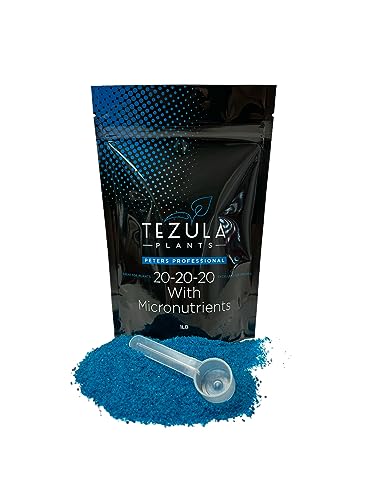
This is the same Peter’s Professional formula in a smaller, entry-friendly 1-pound pouch with waterproof and airtight packaging plus a measuring scoop. For someone with a modest houseplant collection — ten to twenty pots — this bag will last months, and the scoop eliminates the guesswork that leads to overfeeding or underfeeding.
Customer feedback is consistently positive, with many noting that caladiums and bulb plants thrived within weeks. The waterproof pouch is more practical than paper bags when storing in a humid shed or garage. The mixing rate is 1 tablespoon per gallon for outdoor plants and 1 ounce per gallon for lawns, giving you flexibility across different use cases.
The micronutrient profile matches the larger 2-pound bag, so you’re not sacrificing quality for a smaller buy. The main tradeoff is cost per ounce — the 1-pound bag comes at a higher per-ounce rate than the 2-pound or the 5-pound options. If your plant collection is likely to grow, you’ll save money by sizing up.
Why it’s great
- Waterproof, airtight packaging prevents clumping
- Includes a measuring scoop for accurate mixing
- Same high-quality chelated micronutrient formula as the larger bag
Good to know
- Higher per-ounce cost than the 2 lb or 5 lb versions
- Small bag runs out fast for those with many outdoor plants
5. Schultz All Purpose Water Soluble Plant Food 20-20-20

Schultz is the bulk-value king in this lineup — a 5-pound bag of fine-grind powder that dissolves reliably and provides a balanced 20-20-20 NPK for large gardens, turf, and container plantings. The fine grind ensures high solubility even in cold hose water, which is essential when mixing large volumes for drip irrigation or backpack sprayers.
Users in hot, windy, high-UV climates noted that doubling the water volume required halving the fertilizer concentration to prevent salt buildup in containers. This is a sign of potency: Schultz packs enough punch that you must adjust the rate based on your environment. Several growers said their vegetables stayed lush, productive, and noticeably greener compared to when they used cheaper grocery-store fertilizers.
The main drawbacks are the lack of added organic components like kelp and the absence of a resealable bag — the 5-pound packaging is a simple plastic pouch that benefits from being transferred into an airtight bin. Additionally, a few long-term Miracle-Gro users felt that Schultz didn’t boost yields quite as aggressively, though the consensus is that it performs well for the price.
Why it’s great
- Excellent cost per ounce for large-scale feeding
- Fine grind dissolves quickly even in cold water
- Strong results on outdoor vegetables and container plants
Good to know
- No kelp or organic additives
- Bag isn’t resealable — best stored in an airtight container
FAQ
Can I use 20-20-20 fertilizer on seedlings?
Does 20-20-20 fertilizer expire or lose potency over time?
How often should I apply 20-20-20 to my vegetable garden?
Final Thoughts: The Verdict
For most users, the 20-20-20 fertilizer winner is the GS Plant Foods All Purpose 20-20-20 because it combines the full micronutrient panel with added kelp extract for stress resilience, all in a quickly soluble powder. If you want a dedicated flower-focused formula with foliar spray rates, grab the Fertilome All Purpose 20-20-20. And for feeding a large garden on a budget, nothing beats the Schultz All Purpose 20-20-20 in the 5-pound size.

Mo Maruf
I created WellFizz to bridge the gap between vague wellness advice and actionable solutions. My mission is simple: to decode the research and give you practical tools you can actually use.
Beyond the data, I am a passionate traveler. I believe that stepping away from the screen to explore new environments is essential for mental clarity and physical vitality.