Our readers keep the lights on and my smoothie glass nicely filled. As an Amazon Associate, I earn from qualifying purchases.
Choosing a board game that works equally well for two players on a quiet evening and for four players on game night is harder than it sounds. Most games lean heavily toward one group or the other, leaving you with a shelf full of titles that only get played half the time. The sweet spot is a game that scales its tension, strategy, and playtime cleanly across that 2-to-4 player range — and the options below deliver exactly that.
I’m Mohammad Maruf — the founder and writer behind WellFizz. I’ve spent years analyzing tabletop mechanics, component durability, and replayability data to separate the genuinely flexible games from the ones that only work in a single player count.
Whether you need a quick filler for two or a head-to-head showdown for four, this guide breaks down the five strongest contenders currently on the market. After extensive comparison, these are the best 2 to 4 player board games that actually hold up across the full player range without forcing you to compromise on fun.
How To Choose The Best 2 To 4 Player Board Games
The market is flooded with games that claim to support 2–4 players but play drastically differently at each count. Some become lopsided at two, others drag at four. The key is understanding which mechanics scale cleanly and which don’t.
Player scalability and game mechanics
Area control games often play best at 3–4 but feel hollow with two. Cooperative games usually scale well because the difficulty can be adjusted. Dice-racing and push-your-luck games tend to be the most consistent across the range — the core tension stays intact regardless of how many people are rolling. Look for games that are specifically tested at each player count, not just listed as 2–4 as a box-checking exercise.
Playtime and complexity
A 90-minute strategy game can be fantastic with four players but exhausting with two. The best 2–4 player games hit a 20–45 minute sweet spot, allowing you to play multiple rounds without a huge time commitment. If the estimated playtime doesn’t adjust significantly between 2 and 4 players, the game is likely using a simple turn structure that keeps downtime low.
Component quality and setup
Games you return to again and again have components that survive repeated shuffling, rolling, and stacking. Cardstock thickness, dice weight, and board durability directly affect how often the game hits the table. Quick setup and teardown are equally important — if a game takes 15 minutes to prepare, it won’t get played on a weeknight.
Quick Comparison
On smaller screens, swipe sideways to see the full table.
| Model | Category | Best For | Key Spec | Amazon |
|---|---|---|---|---|
| Monkey Palace | Strategy | Family game night with LEGO fans | 45-minute playtime, 231 LEGO elements | Amazon |
| Casting Shadows | Fantasy Strategy | Teens and adults, competitive duels | 60-minute playtime, transformable character mechanics | Amazon |
| Tetris: The Board Game | Puzzle/Blocking | Quick head-to-head puzzle challenges | 20-minute playtime, 152 tetriminos | Amazon |
| Dumpster Dice | Dice Game | Fast-paced family filler, travel | 10-minute rounds, 80 colorful dice | Amazon |
| Shut The Box | Classic Dice | Educational math practice, all ages | Wooden construction, 12 dice, 2-6 players | Amazon |
In‑Depth Reviews
1. Monkey Palace – LEGO Board Game

Monkey Palace redefines the family strategy category by turning the game board into a physical LEGO construction. Instead of placing tokens on a printed grid, players stack interlocking bricks to build towers, then place monkey figures on them to claim territory. When a tower becomes unstable and collapses, the player who caused the fall scores bonus points — it’s a clever risk-reward loop that keeps everyone engaged between turns.
The 231 LEGO elements are genuine bricks, meaning they’re compatible with any existing LEGO collection you already own. The Jungle maps and 84 game cards provide structure, but the real creativity comes from how each player chooses to build. At two players, the game becomes a tight spatial duel; at four, it turns into a chaotic race with towers wobbling constantly. The 45-minute playtime is nearly identical regardless of player count, which is rare for a game this interactive.
Setup takes a few minutes the first time — you’ll want to sort the bricks into bags for easy access. The rules are surprisingly simple once you’ve played one round, but the rulebook itself is on thin paper and could be clearer. For families who already love building together, this is the most natural bridge between construction play and board game strategy available right now.
Why it’s great
- Interlocking bricks create a tactile, spatial challenge that no purely cardboard game can match
- Player count truly scales — 2 and 4 feel equally strategic
- High replayability because no two towers are built the same way
Good to know
- Some players report needing extra bricks from their own collection for longer sessions with 3–4 players
- Colorblind users may have difficulty distinguishing green pieces
- Setup and teardown are longer than a typical card game
2. Unstable Games – Casting Shadows

Casting Shadows comes from the team behind Unstable Unicorns and Here to Slay, and it brings the same sharp fantasy strategy with a darker edge. The core mechanic is the shadow form transformation — each round, players choose whether to stay in their normal form or shift into shadow, which gives different abilities and tactical options. This single decision layer creates meaningful depth without bloating the rules.
The game includes 76 cards, 5 custom resource dice, 7 hex tiles, and 4 player boards. The card art is striking and the printing quality is noticeably better than standard cardstock — reviewers note that sleeved cards fit standard sleeves but won’t fit back into the box compartments cleanly. The hex tiles and meeples are functional but modest; if you want premium miniatures, you’ll need to buy them separately.
At two players, Casting Shadows becomes a tense spell-duel where each shadow-form decision matters enormously. At four, it opens into a multiplayer free-for-all with shifting alliances and more unpredictable resource dice outcomes. The 30–60 minute playtime naturally extends toward the longer end with more players, which feels appropriate rather than tedious. It’s best for ages 12 and up and rewards repeated plays as players learn the spell synergies.
Why it’s great
- Shadow-form mechanic adds genuine strategic depth without complexity creep
- High-quality card art and thick card stock that holds up to frequent shuffling
- Expansions (Ice Storm, Molten Rock) add meaningful new mechanics
Good to know
- Character pieces are simple colored wood cutouts, not miniatures
- Sleeved cards do not fit back in the box organizer
- Best with players who enjoy learning card combos over several sessions
3. Spin Master Games – Tetris: The Board Game
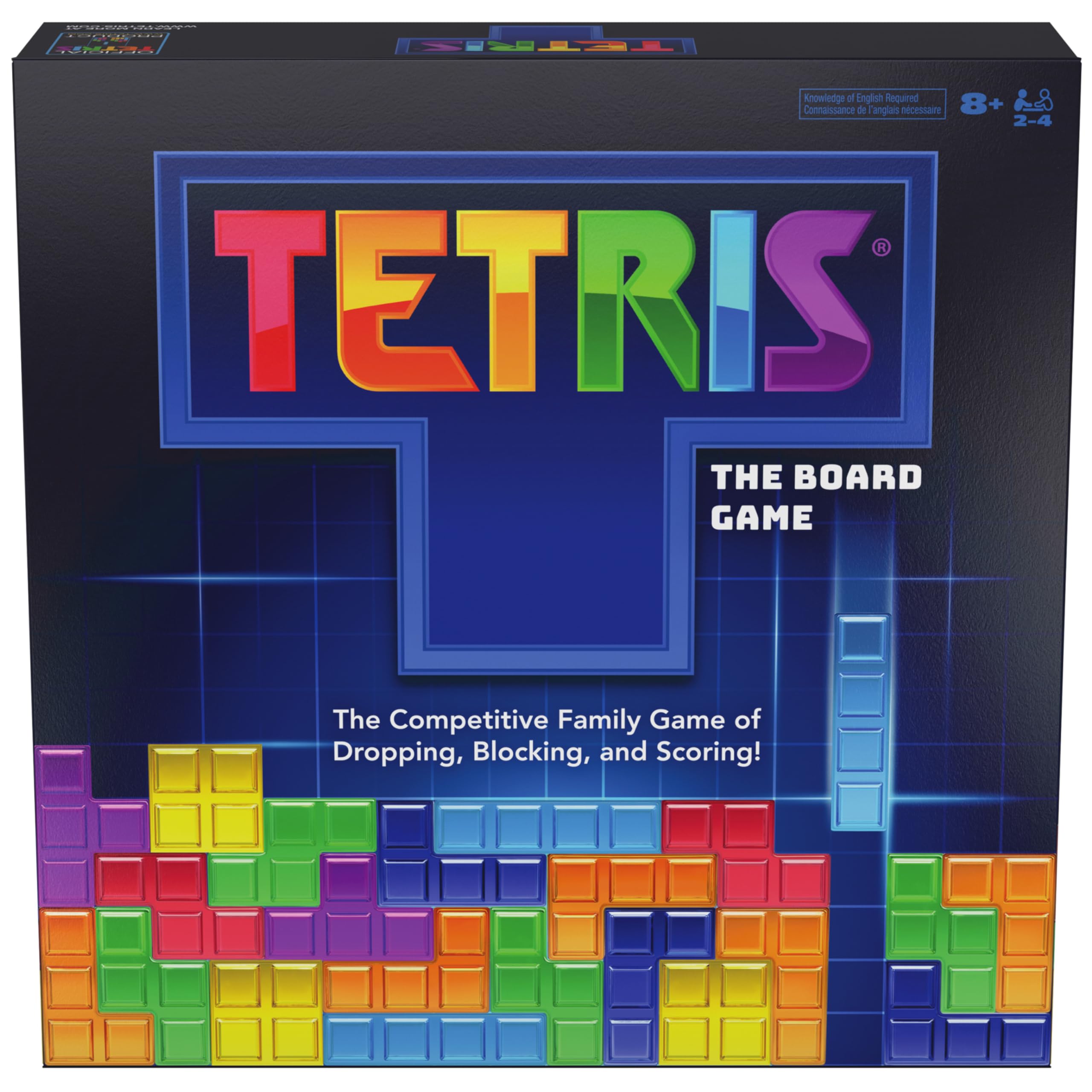
Translating a iconic digital puzzle game into a tabletop experience that actually works is a tall order, but Spin Master pulled it off by focusing on the head-to-head blocking mechanic that made the original competitive. Players drop semi-translucent tetriminos onto their own grid while using Garbage Drop Icons to add pieces to opponents’ grids, effectively recreating the multiplayer mode from the video game in physical form.
The box contains 4 Tetris grids, 4 grid bases, 4 player cards, a gameboard, 24 Tetrimino cards, 128 Tetriminos, and 8 Minos. The semi-translucent pieces are a nice touch — they visually mimic the video game tiles better than opaque plastic would. The 20-minute playtime is perfect for quick rounds between other activities, and the rules are simple enough that an 8-year-old can play alongside adults without frustration.
The main tension comes from the luck-versus-strategy balance. Drawing the right tetriminos matters, but smart placement and well-timed garbage blocks can swing the game. Reviewers consistently note it’s a crowd-pleaser for family game nights, with the caveat that some puzzle pieces have arrived slightly bent in a few units. It works best at 2 or 4 players; at 3, the blocking dynamics can feel uneven.
Why it’s great
- Faithful physical adaptation of the classic Tetris multiplayer experience
- Very fast setup and 20-minute rounds keep the energy high
- Garbage Drop mechanic adds direct player interaction and sabotage fun
Good to know
- Some pieces may arrive slightly bent due to packaging
- Best at 2 or 4 players — 3-player balance is less smooth
- Not much replay variety once you master the basic strategies
4. Big Discoveries – Dumpster Dice
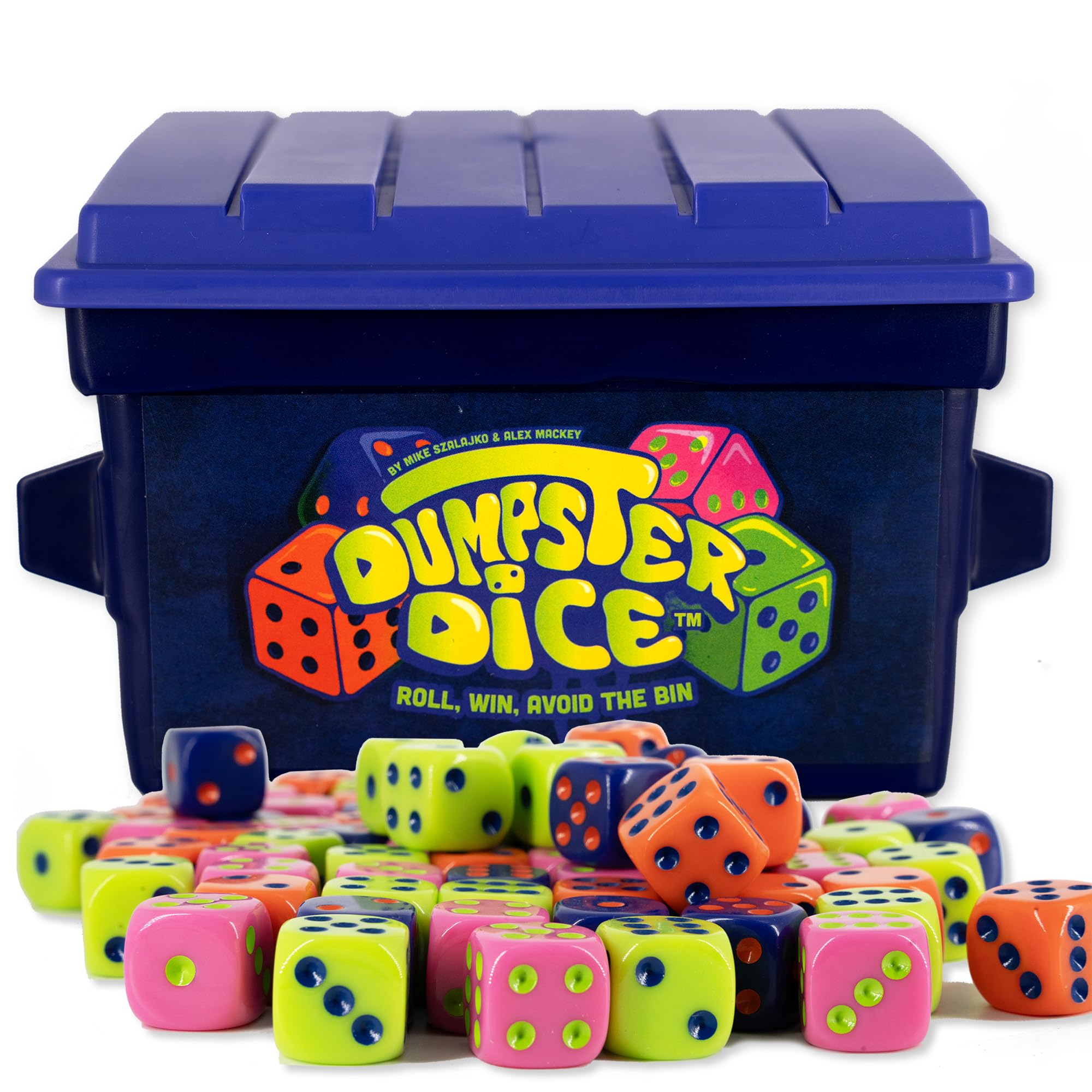
Dumpster Dice is as straightforward as dice games get: roll to collect a complete 1–6 set on your board while avoiding duplicates that send you to the bin. The whole thing comes in a durable tin shaped like a dumpster, with a removable lid that serves as the game board. Inside, you get 80 colorful dice in four colors, a graffiti sticker sheet for customization, and five gameplay variations printed on the instruction sheet.
The physics of the packaging matter here — the tin container doubles as the dice-rolling arena, keeping the dice from scattering across the table. Games last 5–10 minutes, making this a true filler game that slots between longer sessions or works as a warm-up. The rules are simple enough that a 3-year-old can learn in two rolls, yet the push-your-luck element keeps adults engaged. The four-player mode requires the full dice set; for up to 6 players, you can combine it with the separate Trash Dice game.
The dice themselves are sturdy ABS plastic and the colors — red, blue, green, pink — are distinct enough for quick recognition. The educational value is real: kids practice counting and number recognition 1–6 without realizing they’re learning. The main drawback is that the luck factor is extremely high, so strategic players may find it shallow after several rounds. For parties, travel, or family gatherings with mixed ages, though, it’s hard to beat this combination of portability and instant engagement.
Why it’s great
- Extremely portable tin design that doubles as the dice tray and game board
- Rules are so simple that players of any age can join within seconds
- High-quality ABS dice that can withstand being rolled thousands of times
Good to know
- Heavily luck-based — minimal room for strategic decisions
- 5–10 minute rounds may feel too short for players who want deeper sessions
- Requires combining with Trash Dice for 5–6 player games
5. MNYUN – Shut The Box Premium Wooden Dice Game
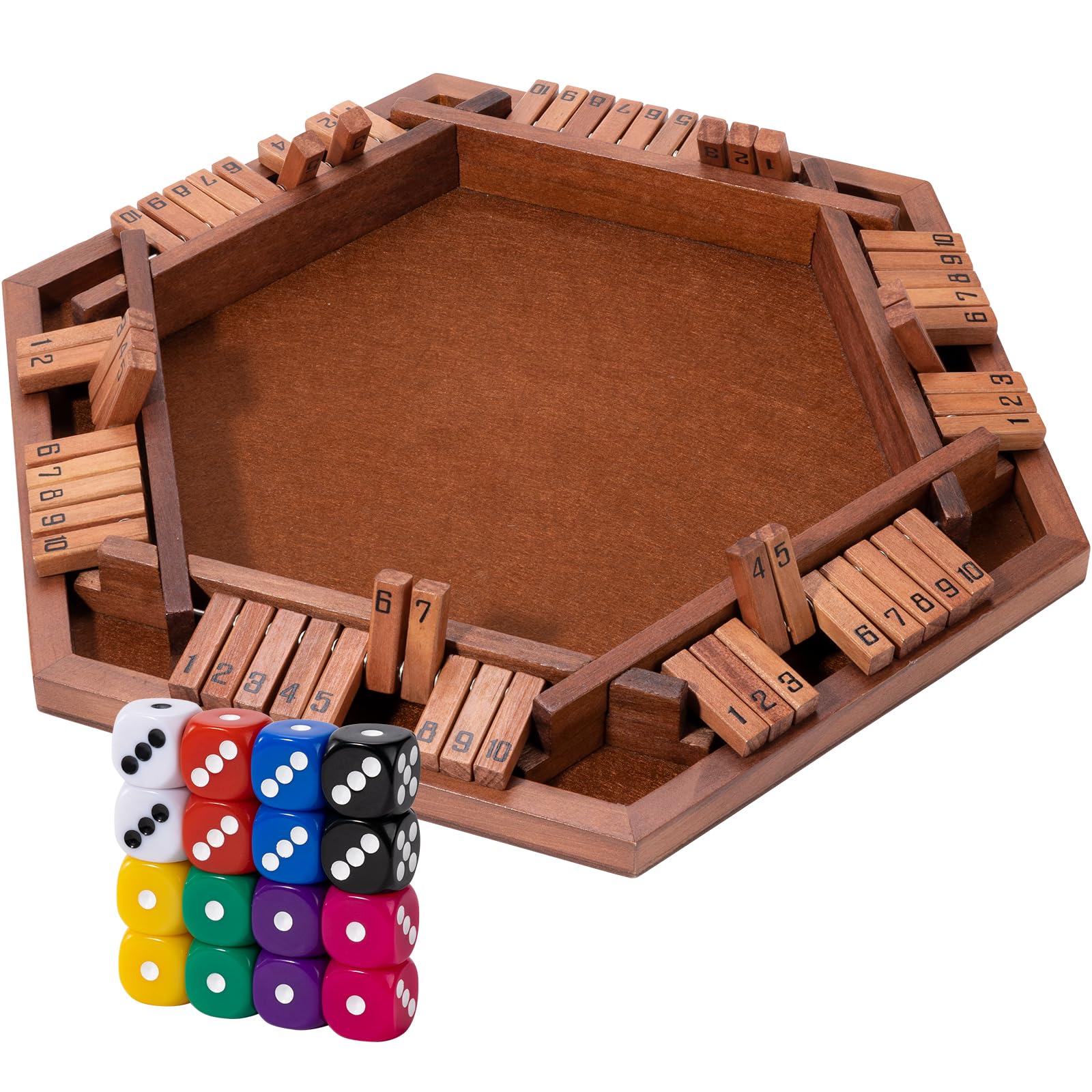
Shut The Box is a centuries-old pub game that has survived because its core loop is near-perfect: roll two dice, then flip down any combination of numbered tiles that add up to your roll. The goal is to flip all tiles down — to “shut the box.” MNYUN’s version brings this classic to a solid wood board measuring 15.7 x 13.2 inches, with a durable finish that feels substantial in hand. The set includes 12 dice, which is generous compared to the 2-dice standard found in most travel versions.
The wood construction is the standout feature here. Unlike flimsy folding boards, this one stays flat on the table and the hinge mechanism is sturdy enough to survive years of play. The numbers are printed clearly and the tile mechanism flips smoothly. At 1.5 pounds, it’s portable enough for camping or bar trips but heavy enough to feel premium. The game supports 2 to 6 players, and each round takes about 10 minutes, making it easy to play multiple rounds in a sitting.
The educational angle is real: kids as young as 4 can practice addition by figuring out which tile combinations match their dice total. Older players can introduce probability strategy — knowing when to flip a 9 versus a 5+4. The main consideration is that the game box is smaller than a full-size board game box, which surprised some buyers, but the actual playing surface is adequate for the tile rows. For families who want a screen-free math activity that genuinely feels like a game, not a lesson, this is the strongest choice.
Why it’s great
- Solid wood construction that feels durable and ages well
- Teaches addition and probability without feeling like homework
- Supports up to 6 players despite being a compact game
Good to know
- Playing surface is smaller than some full-size board games
- Gameplay repetition can set in after many sessions — it’s a simple loop
- Dice are included but the felt lining on the box bottom could be thicker
FAQ
How do I know if a 2–4 player game actually works well at both counts?
What is the ideal playtime for a family game that supports 2 to 4 players?
Should I prioritize dice games or card games for a mixed-age group?
Final Thoughts: The Verdict
For most users, the best 2 to 4 player board games winner is the Monkey Palace LEGO Board Game because it uniquely combines physical construction with strategic gameplay that scales cleanly from 2 to 4 players. If you want deeper fantasy strategy with a darker aesthetic and high-quality components, grab the Casting Shadows. And for a quick, portable filler that works at any gathering with instant fun, nothing beats the Dumpster Dice.

Mo Maruf
I created WellFizz to bridge the gap between vague wellness advice and actionable solutions. My mission is simple: to decode the research and give you practical tools you can actually use.
Beyond the data, I am a passionate traveler. I believe that stepping away from the screen to explore new environments is essential for mental clarity and physical vitality.