Our readers keep the lights on and my smoothie glass nicely filled. As an Amazon Associate, I earn from qualifying purchases.
The tabletop market is crowded with party games that need a crowd, leaving the two-player session feeling like an afterthought. A true duel demands a specific design philosophy — one that balances tension with flow, and strategy with the intimacy of a shared table. The wrong pick leaves one player waiting, the right one sparks a rivalry that lasts for years.
I’m Mohammad Maruf — the founder and writer behind WellFizz. I’ve spent hundreds of hours analyzing game mechanics, production quality, and replayability data to separate genuine two-player experiences from those that merely tolerate a pair of opponents.
This guide cuts through the noise to highlight the titles that prove two is the perfect number. Whether you crave cooperation or competition, here is the definitive list of the best 2-player card games you can bring to the table tonight.
How To Choose The Best 2-Player Card Games
A great two-player game lives or dies by its interaction model. You are not a passive audience; you react to every move. Before you buy, weigh these three factors against your preferred style of play.
Cooperative vs. Competitive: The Core Split
Cooperative games (Sky Team, Fox in the Forest Duet) pit both players against a shared challenge, requiring silent coordination and trust. Competitive games (Splendor Duel, Sequence, Overlap) turn your partner into a direct rival. Think about your relationship dynamic: co-op builds camaraderie while competition fuels replayability through escalating rivalries.
Playtime and Complexity: The Session Fit
A twenty-minute session (Sky Team) fits a weeknight coffee break, whereas thirty minutes (Splendor Duel, Fox in the Forest Duet) suits a dedicated evening. Check the age range too — Overlap works for ages eight and up, while Sky Team targets twelve and older. Matching complexity to your experience level prevents frustration or boredom.
Physical Quality and Portability
Card stock thickness, chip density, and box size matter for longevity. Sequence includes a folding board and 135 chips, making it a heavier set for home use, while Overlap packs sixty-four cards into a 3.5-inch box that slides into a backpack. Travel duos should prioritize compact dimensions and durable coating.
Quick Comparison
On smaller screens, swipe sideways to see the full table.
| Model | Category | Best For | Key Spec | Amazon |
|---|---|---|---|---|
| Sky Team | Cooperative | Intense silent teamwork | 20 minutes, 8 dice, 20 scenarios | Amazon |
| Splendor Duel | Competitive | Head-to-head gem battles | 30 minutes, 25 gem tokens, 67 jewel cards | Amazon |
| Fox in the Forest Duet | Cooperative | Co-op trick-taking for couples | 30 minutes, trick-taking, forest art | Amazon |
| Sequence | Competitive/Team | Family board/card hybrid | 2-12 players, 135 chips, 2 decks | Amazon |
| Overlap | Competitive | Quick strategic shedding | 2-8 players, Uno-meets-Tetris | Amazon |
In‑Depth Reviews
1. Sky Team

Sky Team is not a card game in the classic sense — it uses dice and a cockpit board — but its core interaction of silent, cooperative dice placement creates the purest two-player tension available today. Voted Game of the Year 2024, it tasks you and your co-pilot with landing a plane across twenty escalating scenarios. The catch: once dice are rolled, you cannot discuss your moves. This forced silence eliminates the alpha-player problem and demands genuine trust.
The production quality is exceptional. A control panel, altitude track, approach track, eight dice, and multiple tokens fit into a compact box, and the art direction turns every landing into a cinematic event. Coffee tokens let you mitigate bad rolls, and optional modules (kerosene leaks, a sleepy intern) add variable difficulty without cluttering the rules. Each scenario takes about twenty minutes, making it ideal for a focused weeknight session.
Customer feedback highlights the same core strength: lack of quarterbacking keeps both players fully engaged. Players report that the intro scenario teaches in ten minutes, and the challenge ramp is satisfyingly steep. The only caveat is that it requires a partner who enjoys silent problem-solving over chatting — perfect for couples who already communicate through glances.
Why it’s great
- No quarterbacking — both players stay equally invested
- Twenty unique scenarios for high replayability
- Quick setup and tear-down at 20-minute playtime
Good to know
- Not a traditional card game; uses dice and a board
- Better for players who enjoy silent tense puzzles
- Rated 12+ may be too complex for younger kids
2. Splendor Duel
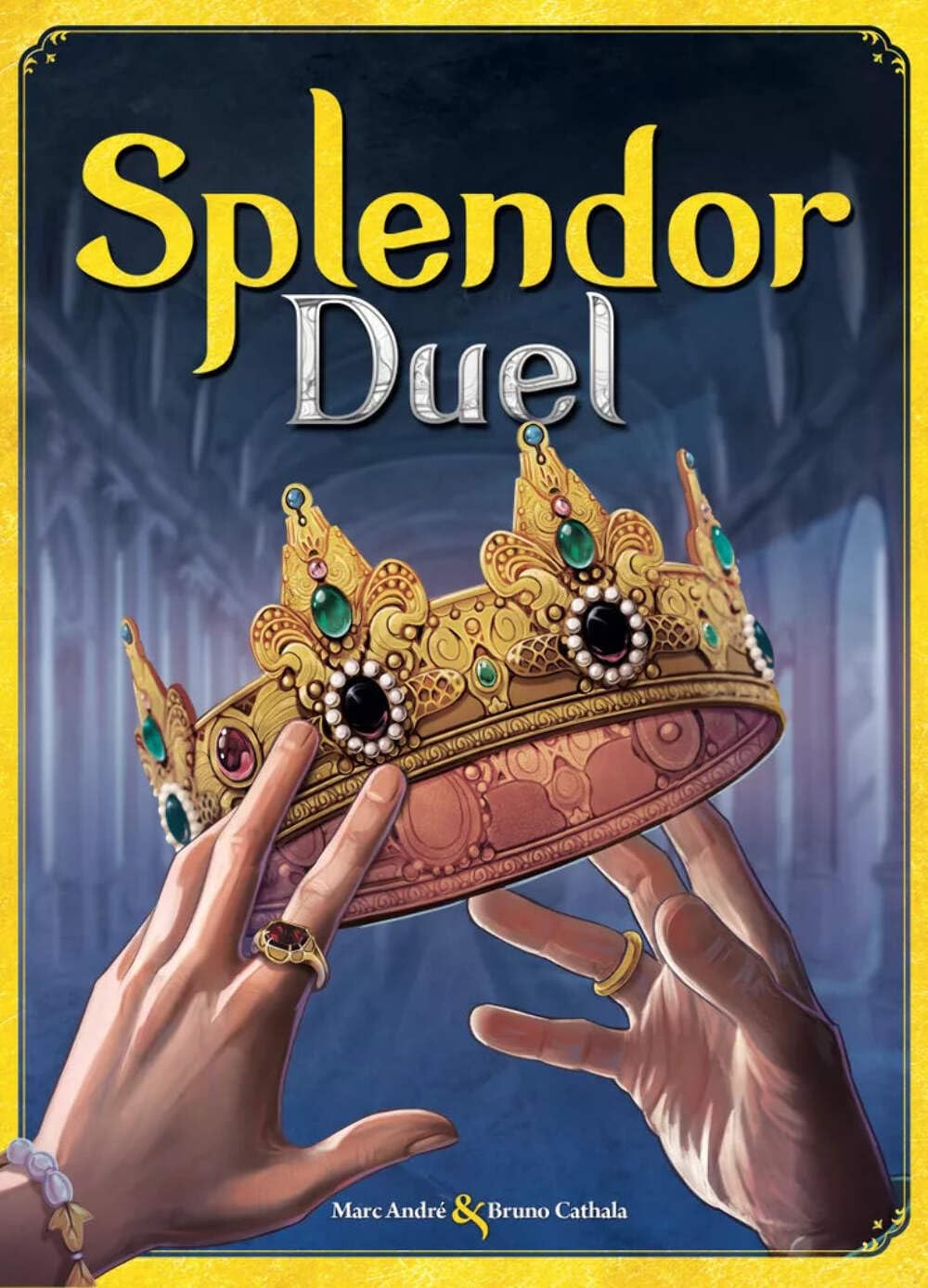
Splendor Duel takes the beloved engine-building mechanics of its parent game and refines them exclusively for two. You race to collect gem tokens and purchase development cards that grant permanent discounts and special powers. The addition of a shared board with limited gem supplies forces direct conflict — every token your opponent takes is one you cannot have.
The physical components are a step up from the original: solid plastic gem tokens that feel substantial in hand, thick card stock, and a double-layered board that holds tiles in place. Alternate win conditions (reaching ten prestige points, collecting four nobles, or hoarding ten gems) add tactical variety. Setup is quick and the thirty-minute playtime maintains urgency without overstaying its welcome.
Reviewers consistently praise the game for being more strategic than the original Splendor when played with two, noting that the pearls and privilege scrolls introduce meaningful asymmetry. The compact box travels well, and the rulebook clarifies the differences from its predecessor in under a minute. Expect deep replayability as you experiment with different noble combinations and purchase paths.
Why it’s great
- Multiple win conditions keep every game fresh
- Premium gem tokens and thick card stock
- Fast setup at 2 minutes for 30-minute play
Good to know
- Best for those already familiar with engine-building
- Not suitable for players seeking a purely social game
- Rules differ enough from original to need a full read-through
3. Fox in the Forest Duet

Fox in the Forest Duet is a cooperative trick-taking game designed entirely for two players. You work together to guide a fox through the forest by collecting gems on a path, using special abilities to swap cards or gain extra tricks. The twist: you cannot directly discuss which tricks you want or need — you must read your partner’s signals through the cards they play.
The art is the star here — hand-illustrated forest scenes with a fairy-tale quality that makes the game feel like a storybook. Cards are printed on sturdy stock with a linen finish that shuffles well and resists wear. The compact box (6.5 x 4.5 x 1.25 inches) fits easily into a purse or carry-on. Playtime sits at a comfortable thirty minutes, and adjustable difficulty modes let you raise the challenge as you improve.
Customer feedback highlights its immediate approachability for anyone who knows basic trick-taking. Veteran card players will appreciate the nuance of the character powers, while novices can jump in after a two-minute rules explanation. The cooperative format makes it a favorite among couples who prefer teamwork over head-to-head conflict, and the lack of hidden information keeps both players engaged every round.
Why it’s great
- True co-op trick-taking — rare and well-executed
- Beautiful, durable card stock
- Easy to learn, adjustable difficulty
Good to know
- May feel too simple for expert trick-takers
- Requires a partner who enjoys reading subtle cues
- Only 2 players — no larger group mode
4. Sequence
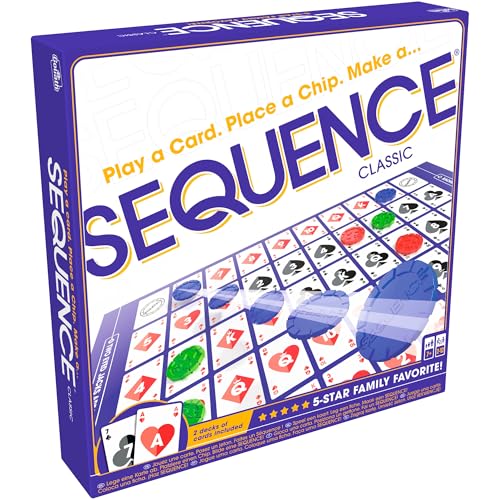
Sequence is a classic that blends card play with a board-and-chip component. You draw a card, find its matching space on the grid, and place one of your colored chips. The goal is to line up five in a row — a sequence — before your opponent does. For two players, each person manages two hands of cards, creating a fast-paced back-and-forth that rewards spatial thinking.
The production is robust: a folding board measuring 19.75 by 15.25 inches, two full decks of playing cards, and 135 chips (50 blue, 50 green, 35 red). The board is thick and lies flat, and the chips are solid plastic that won’t slide around mid-game. While the game supports up to twelve players in teams, the two-player mode is surprisingly strategic — you must block your opponent’s potential sequences while building your own under the constraint of a single shared board.
Reviewers note that the game is easy enough for kids aged seven and up, but adults find meaningful depth in the blocking and positioning choices. The only recurring complaint involves chip counts: some units arrive with fewer red chips than expected, but most players simply use the two larger colors for a two-player game. Overall, Sequence earns its reputation as a gateway game that endures for decades.
Why it’s great
- Blends card luck with board strategy
- Sturdy folding board and thick chips
- Accessible for ages 7 and up
Good to know
- Two-player mode requires managing two hands
- Larger board needs table space
- Occasional chip count inconsistencies
5. Overlap
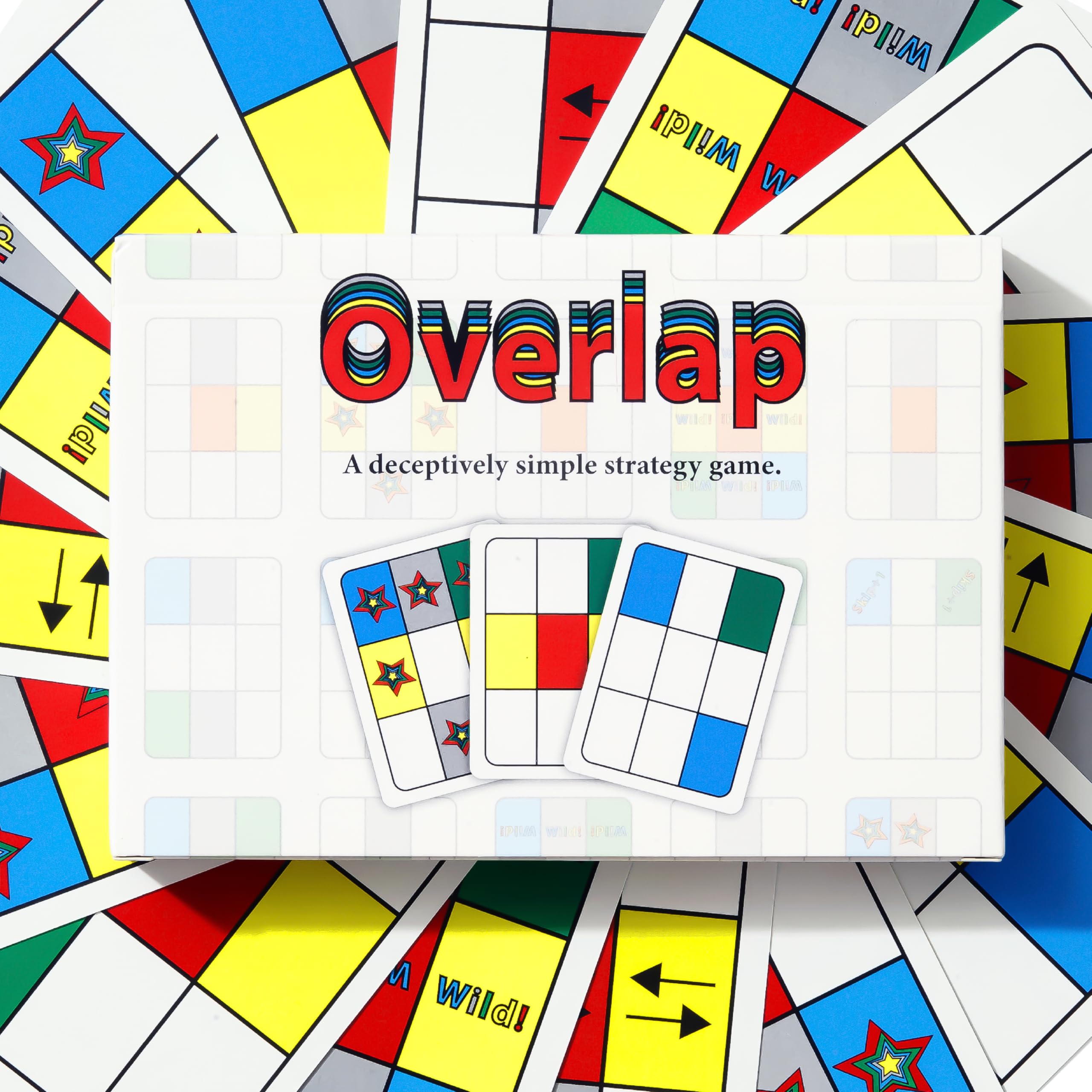
Overlap takes the familiar race-to-shed-your-hand (think Uno) and adds a spatial twist: each card you play must overlap with the card below it, Tetris-style, by matching colored squares. A bad fit forces you to draw, and special action cards shake up the flow. It works with up to eight players, but the head-to-head mode is where the spatial strategy shines — you must anticipate which squares your opponent will target next.
The cards are coated, Uno-sized, and durable. The rules are explained in under two minutes via a QR code video, making it an instant hit at gatherings. The box is compact (3.5 x 2.5 x 0.04 inches) and weighs only 6.4 ounces, which is ideal for travel. Despite its simplicity, the Mensa recommendation and Academics’ Choice award confirm that the spatial reasoning demand adds a layer of genuine brain exercise.
Customer reviews from both seniors and teenagers praise the game’s “easy to learn, hard to master” curve. Younger players enjoy the fast pace, while older players appreciate the mental workout. The only point of caution is that the spatial matching can feel repetitive after many consecutive rounds, but the action cards provide enough variety to keep sessions lively. For a budget-friendly, portable option that sparks quick rivalries, Overlap delivers.
Why it’s great
- Highly portable — fits in a jacket pocket
- Teaches in under two minutes
- Award-winning spatial reasoning mechanic
Good to know
- Can feel repetitive without action cards
- Best with players who enjoy quick, light strategy
- Limited depth for hardcore strategists
FAQ
Can you play these games with more than 2 players?
What is the difference between trick-taking and shedding mechanics?
Which game is best for beginners who haven’t played modern card games?
Final Thoughts: The Verdict
For most users, the best 2-player card games winner is the Sky Team because it delivers unmatched cooperative tension in a quick, replayable twenty-minute package. If you want head-to-head gem-collecting competition, grab the Splendor Duel. And for a cozy trick-taking co-op that fits in a bag, nothing beats the Fox in the Forest Duet.

Mo Maruf
I created WellFizz to bridge the gap between vague wellness advice and actionable solutions. My mission is simple: to decode the research and give you practical tools you can actually use.
Beyond the data, I am a passionate traveler. I believe that stepping away from the screen to explore new environments is essential for mental clarity and physical vitality.