Our readers keep the lights on and my smoothie glass nicely filled. As an Amazon Associate, I earn from qualifying purchases.
A 2-person backpacking tent lives and dies by its packed weight, livable square footage, and seam-sealed waterproofing. Push past the marketing claims of “easy setup” and look at the real specs: trail weight under 5 pounds for legitimate hiking, a true rectangular floor that fits two wide sleeping pads without shoulder overlap, and a rainfly with sufficient hydrostatic head to survive a mountain squall. The wrong choice adds two pounds of misery to every uphill mile — the right choice disappears into your pack and reappears as dry, restful shelter after 15 miles.
I’m Mohammad Maruf — the founder and writer behind WellFizz. I analyze product construction, material specifications, and user-reported durability across dozens of outdoor gear categories to separate what actually works from what simply looks good on a product page.
Whether you are thru-hiking the AT, base camping for a weekend, or splitting gear with a partner, finding the best 2-person backpacking tent means weighing trade-offs between packability, weather resistance, and interior volume that match your specific terrain and season.
How To Choose The Best 2-Person Backpacking Tent
The three-season 2-person backpacking tent is the most competitive category in outdoor gear. Every manufacturer chases the same target — under 5 pounds, over 30 square feet of floor space, waterproof fly, and a packed size that fits inside a 40-liter pack. But small material decisions shift the tent from “good enough for the occasional weekend” to “reliable for a full season of trail use.” Here is what to check before you buy.
Trail Weight vs Packed Weight
Nearly every spec sheet lists a “minimum trail weight” that excludes the stuff sack, stakes, and sometimes the rainfly. Real trail weight includes everything you carry — the inner tent, rainfly, poles, stakes, guy lines, and the bag itself. A tent claiming 3.5 pounds may actually weigh 4.75 pounds fully kitted. For a 2-person shelter, you want a real trail weight under 5 pounds. Every half-pound over that is half a liter of water you are not carrying.
Floor Architecture and Sleeping Pad Fit
Standard 20-inch wide sleeping pads are the baseline, but most adult hikers now use 25-inch wide pads. A tapered floor that narrows at the foot squeezes two 25-inch pads together, leaving no space between you and your partner. Look for a true rectangular floor — or at least a floor width of 52 inches minimum — to accommodate two pads without shoulder-to-shoulder contact. The best tents in this category now explicitly state “fits two 25-inch pads.”
Rainfly Waterproofing and Seam Construction
A 1200mm hydrostatic head on the rainfly is the absolute minimum for reliable rain protection. Tents rated at 1500mm or higher — especially on the floor — offer genuine storm security. Equally important is whether the fly has fully taped or sealed seams. Untaped seams on budget tents leak at the needle holes within the first year. Premium tents use factory-taped seams that do not degrade. Look for “fully seam-taped” in the spec description, not just “seam sealed.”
Quick Comparison
On smaller screens, swipe sideways to see the full table.
| Model | Category | Best For | Key Spec | Amazon |
|---|---|---|---|---|
| Big Agnes Copper Spur HV UL 2 | Premium Ultralight | Thru-hikers wanting maximum packability | 3.0 lb trail weight, 29 sq ft floor | Amazon |
| NEMO Dagger OSMO 2P | Premium Ultralight | Couples wanting vertical sidewalls and big vestibules | 30.6 sq ft floor, 43 in peak height | Amazon |
| MSR Elixir 2 | Mid-Range Durable | Mixed terrain with emphasis on long-term durability | 5 lb 2 oz trail weight, 30 sq ft floor | Amazon |
| OneTigris COSMITTO 2P | Mid-Range Value | Budget-conscious hikers needing strong wind performance | 1500mm HH fly, hexagon shape | Amazon |
| Naturehike Mongar 20D 2P | Mid-Range Ultralight | Weight-conscious hikers on a strict budget | 4.73 lb trail weight, 4000mm floor | Amazon |
| Naturehike Mongar 2P (210T) | Mid-Range Value | Car campers who occasionally hike to the site | 4.7 lb trail weight, 30 sq ft | Amazon |
| Kelty Grand Mesa 2P | Mid-Range Solid | New backpackers wanting foolproof setup | 4 lb 7 oz packed weight, 30 sq ft | Amazon |
| Kelty Discovery Trail 2P | Budget Entry | First-time backpackers on a tight budget | 4 lb 5 oz min weight, 33 sq ft | Amazon |
| Camppal 2-3 Person Tent | Budget Car Camping | Car camping or base camp where weight is not critical | 8.07 lb trail weight, 54 sq ft | Amazon |
In‑Depth Reviews
1. Big Agnes Copper Spur HV UL 2

The Copper Spur HV UL 2 is the benchmark ultralight 2-person tent — it hits the magic 3-pound trail weight while maintaining a free-standing, double-wall design that most sub-3-pound tents sacrifice. The high-volume pole architecture creates nearly vertical sidewalls, giving you usable headroom across the full floor area rather than just a narrow ridge line. Two large doors and two vestibules let both people enter and store gear independently, eliminating the “crawl over your partner” problem that plagues side-entry single-door shelters.
The 29-square-foot floor is tight but honest: it fits two 25-inch wide sleeping pads with zero gap between them. For solo use, the space feels cavernous. The rainfly uses reflective guy lines and storm flaps on the vestibule zippers, small details that matter when setting up in the dark after a long day. The two-tone mesh body balances privacy with stargazing transparency, and the “quick stash” door system lets you roll the door up instead of fighting a zipper in the middle of the night.
On the downside, the thin 20D fabric requires careful site selection — a sharp rock or stray root can puncture the floor without a footprint. The included stake count is stingy for extreme weather setups. Users report that the vestibule-to-rain-roof “awning” conversion flaps violently in high winds and is best left unused. At this price point, it is an investment, but for multi-year thru-hiking use, the weight-to-durability ratio is unmatched in this class.
Why it’s great
- Sub-3-pound trail weight with full double-wall construction
- Two independent doors and vestibules eliminate partner crawl-overs
- Steep sidewalls maximize usable headroom and livable space
Good to know
- Thin 20D floor fabric demands a footprint for rocky sites
- Only 8 stakes included; severe weather setup requires buying 4 more
- Premium price — expect to spend more on a footprint separately
2. NEMO Dagger OSMO 2P
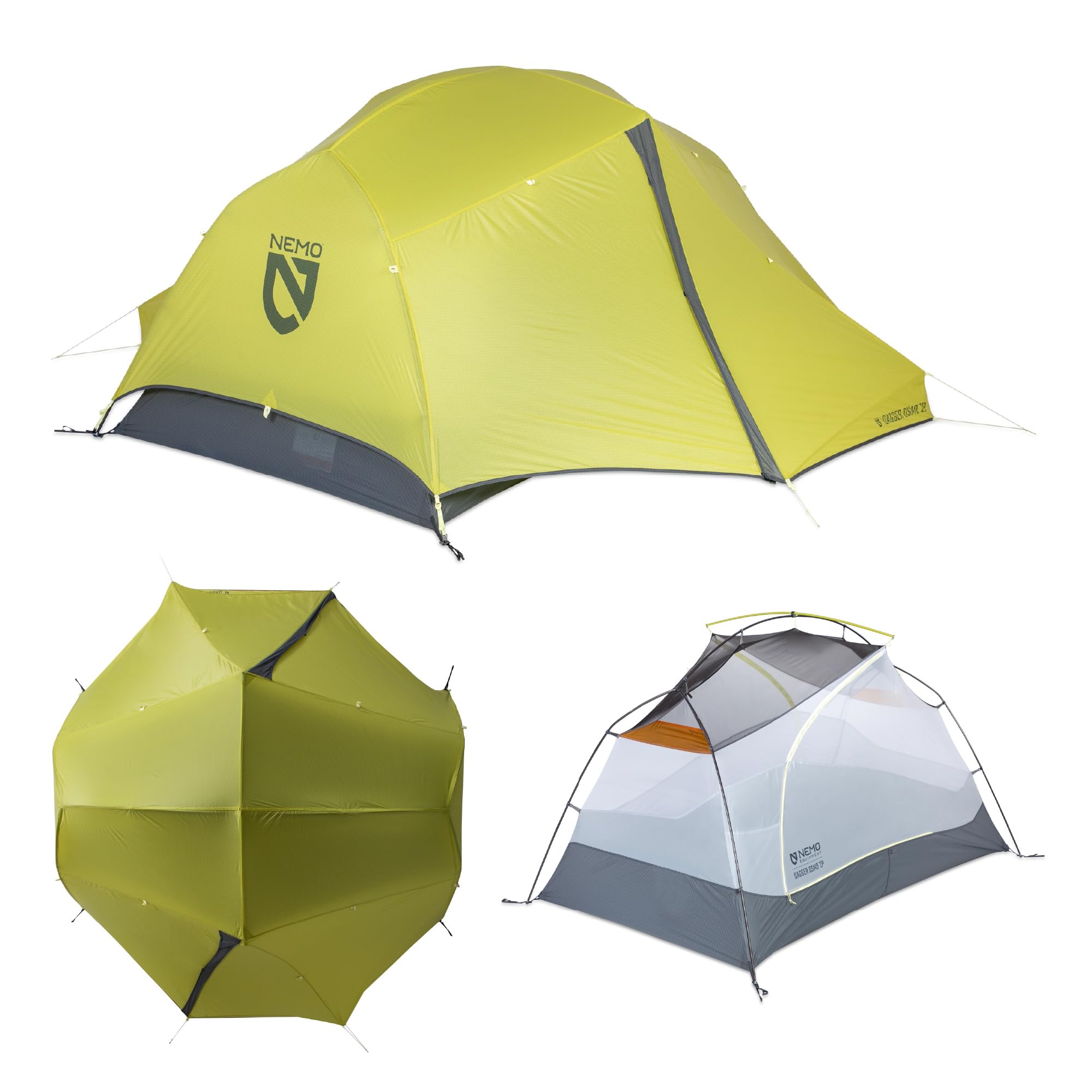
The NEMO Dagger OSMO redefines what “spacious” means in the 2-person ultralight category. With 30.6 square feet of floor area, 43 inches of peak height, and a “volumizing stash” strut that increases vestibule space by 22% over the previous model, this tent feels more like a 3-person shelter. The nearly vertical sidewalls mean two 25-inch sleeping pads fit side by side without any taper at the feet — a rare geometry in this weight class. Both doors open into full-size vestibules that hold 50-liter packs and boots while keeping them protected from the weather.
NEMO’s proprietary OSMO fabric is a poly-nylon ripstop blend that addresses the two biggest complaints about ultralight tents: fabric sag when wet and loss of water repellency after repeated use. OSMO claims 4x longer lasting water repellency and 3x less stretch when saturated compared to standard nylon. The material is also 100% recycled, PFAS-free, and the tent is bluesign certified — meaningful for hikers who prioritize reducing their chemical footprint on the trail. The “Jake’s Foot” hub system simplifies one-handed pole tensioning, though it requires a small learning curve on the first setup.
The trade-offs are subtle but real. The hybrid free-standing design uses a small rear pole that requires staking to achieve full shape — it cannot stand completely alone like a pure free-standing tent. The included stakes are heavy and many users swap them for lighter aftermarket versions. The fabric is thin enough that a footprint is strongly recommended, and the plastic clip hardware feels less confidence-inspiring than metal alternatives. For weight-conscious couples who value livable space above all else, this is the most comfortable 2-person shelter available at this weight.
Why it’s great
- Exceptional interior volume with vertical sidewalls and 43-inch peak height
- OSMO fabric resists sag when wet and maintains DWR performance longer than standard nylon
- Vestibule strut provides best-in-class gear storage for a 2-person tent
Good to know
- Semi-free-standing design requires staking rear for full structural integrity
- Thin fabric demands careful site prep; footprint adds cost and weight
- Pole hub system takes a few practice runs to master
3. MSR Elixir 2
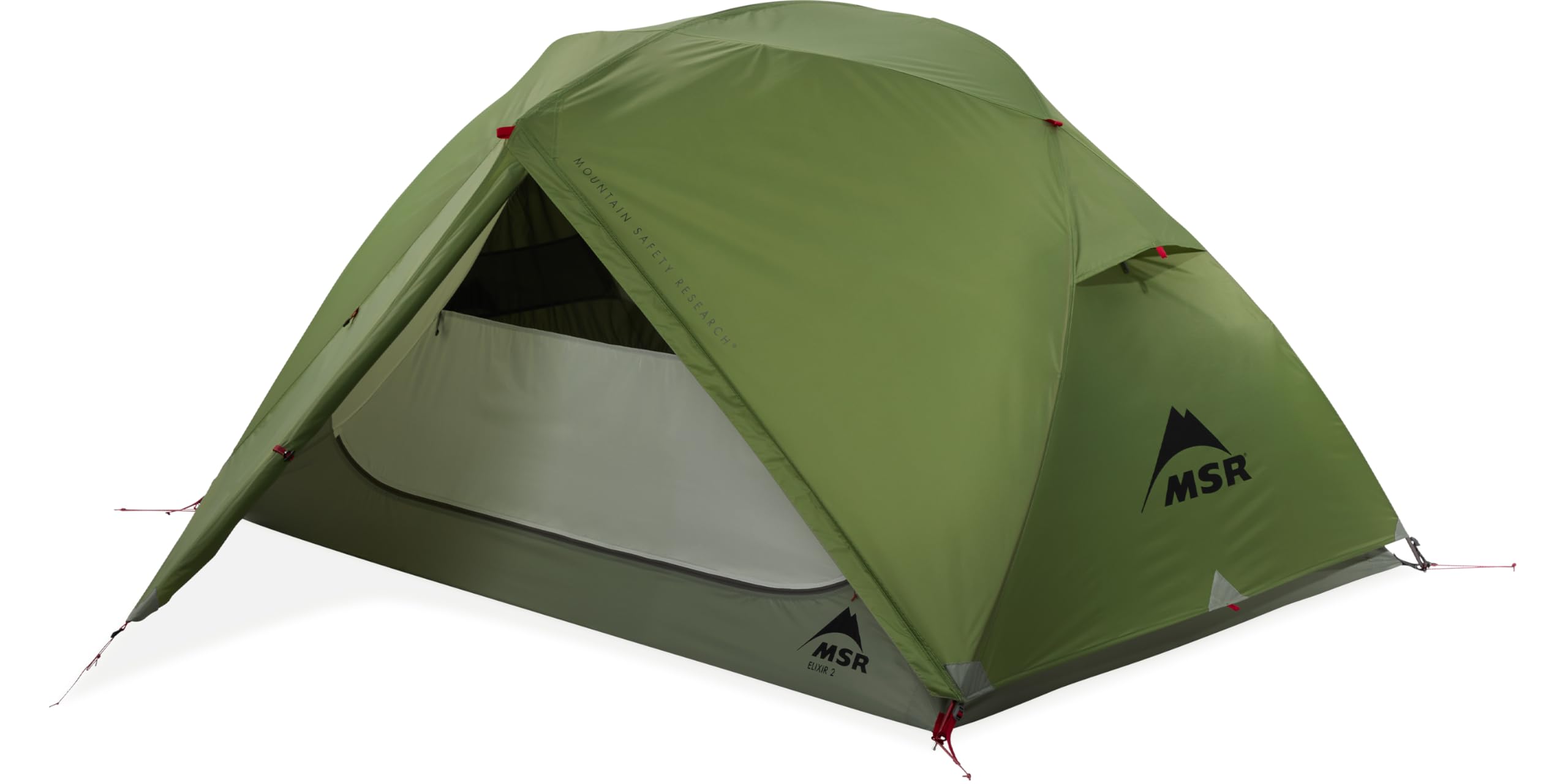
The MSR Elixir 2 is the “no surprises” tent — it is heavier than the ultralight contenders but offers construction that survives seasons of abuse without developing leaks or broken poles. The 75D polyester rainfly and 68D floor fabric are significantly thicker than the 20D nylon found on sub-4-pound tents, making this shelter ideal for rocky alpine sites, sandy beaches, or areas with sharp granite slabs. The true rectangular floor measures 52 x 84 inches — wide enough for two 25-inch pads with a 2-inch gap between them — and the nearly vertical walls mean you can sit upright without brushing the ceiling fabric.
MSR updated this version with all-metal corner hardware and straight-pull zippers, replacing curved zippers that were prone to snagging on earlier iterations. The PFAS-free waterproofing is a meaningful environmental upgrade without sacrificing rain performance. The gear loft and end pockets include cable ports for running electronics, a nice touch for hikers who keep phones or headlamps charging overnight. The included footprint is a dedicated fit that clips directly to the pole system, so you can pitch just the fly and footprint for a fast-and-light shelter option on clear nights.
The packed size is bulky compared to the ultralight competition — this tent will not disappear into the bottom of a 40-liter pack. Some users report that setup is slightly more complex than the previous generation due to the secondary pole above the doors popping out during assembly. At just over 5 pounds, it is a legitimate backpacking tent for shorter trips but feels heavy for multi-day thru-hikes. For weekend warriors and scout groups who prioritize durability over grams, the Elixir 2 is a long-term investment that will outlast three cheaper tents.
Why it’s great
- Thick 75D/68D fabrics provide exceptional puncture and abrasion resistance
- True rectangular floor fits two 25-inch pads without foot taper
- Included footprint enables fast-and-light fly-first setup
Good to know
- Bulky packed size struggles to fit inside smaller overnight packs
- Setup requires more steps than previous generation; pole alignment takes practice
- Trail weight over 5 pounds is heavy for gram-conscious thru-hikers
4. OneTigris COSMITTO 2P

The OneTigris COSMITTO 2P punches above its weight class in wind resistance. The hexagonal dome geometry redirects gusts more effectively than standard dome shapes, and the included guy lines with Line Loc 3 adjusters let you tension the fly taut from inside the vestibule. The 1500mm hydrostatic head rainfly is higher than many tents at this price point, and users report zero leakage after two weeks of continuous Pacific Northwest rain. The inner tent is constructed entirely of no-see-um mesh, offering 360-degree views and superior ventilation — a real advantage for hot, humid nights where condensation inside a solid-walled tent would leave you damp.
Setup takes under 5 minutes solo, with color-coded pole clips and a symmetrical design that eliminates orientation guesswork. The two internal vestibules provide covered gear storage, and the four interior pockets hold phones, glasses, and headlamps within arm’s reach. The included stakes are stronger than typical budget tent stakes and can handle repeated hammer strikes without bending. The packed size of 23.6 x 6.3 inches fits vertically inside most backpacks alongside a sleeping bag.
The rainfly zippers are easy to snag in the fly fabric — a design quirk that requires careful attention when closing. The 20D plaid ripstop fly fabric is light but not as abrasion-resistant as heavier materials, so you want to avoid pitching on gravel or sharp vegetation. The floor area is honest at 30.96 square feet, but the inner width of 4.3 feet is slightly narrower than the best-in-class tents, meaning two 25-inch pads will fit but with zero space between them. For budget-conscious backpackers who face windy conditions regularly, the COSMITTO offers genuinely competitive wind performance at a fraction of the premium tent price.
Why it’s great
- Hexagonal dome geometry provides exceptional stability in gusty winds
- 1500mm HH rainfly and full mesh inner give reliable storm protection with excellent ventilation
- Setup under 5 minutes solo with color-coded clips and symmetrical poles
Good to know
- Rainfly zippers snag easily on fabric; requires careful operation
- Inner width is tight for two 25-inch pads — expect no extra space
- Light fly fabric demands care during setup on abrasive surfaces
5. Naturehike Mongar 20D 2P

The Naturehike Mongar 20D is a direct competitor to the Big Agnes Copper Spur in terms of design philosophy but at a significantly lower entry point. It uses 20D nylon with a 4000mm waterproof coating on both the fly and floor — a spec that exceeds many premium tents that cost twice as much. The Y-frame aluminum pole structure sets up intuitively, and the free-standing design lets you pick up the fully pitched tent and reposition it without collapsing. The floor is a true rectangle that measures 82.7 x 53.2 inches, making it wide enough to accommodate two 25-inch pads with a slim gap between them.
The included footprint is a rare bonus at this price — most budget tents charge separately for ground protection. The two doors and two vestibules provide balanced entry and gear storage for both occupants, and the high-density B3 mesh inner offers excellent bug protection without restricting airflow. Users report surviving violent thunderstorms and gusts up to 50 mph when staked properly. The packed size of 19.7 x 5.9 inches is compact enough for standard 50-liter packs, and the 4.73-pound trail weight is within the acceptable range for multi-day trips.
The included stakes are lightweight but prone to bending on hard-packed soil — upgrading to aftermarket screw stakes is a common recommendation. The 20D nylon floor, while generously waterproofed, is thin and requires a footprint for long-term durability on rocky sites. Some users note that the zipper pulls are small and can be difficult to operate with cold hands. The tent is not the lightest in its class but offers an exceptional balance of weight, weatherproofing, and price that makes it a compelling alternative to tents costing twice as much.
Why it’s great
- Industry-leading 4000mm waterproof rating on both fly and floor
- True rectangular floor easily fits two 25-inch sleeping pads
- Includes footprint at no extra cost — uncommon at this price
Good to know
- Thin 20D floor demands a footprint for durability on rough terrain
- Included stakes bend easily on compacted or rocky ground
- Small zipper pulls can be finicky with cold or gloved hands
6. Naturehike Mongar 2P (210T)

The 210T variant of the Naturehike Mongar shares the same Y-frame architecture and free-standing design as its 20D sibling but uses a different fabric composition that prioritizes durability over absolute weight savings. The 210T polyester ripstop fly is more abrasion-resistant than the 20D nylon version, making this a better choice for hikers who expect brushy trails or who frequently pitch on less-than-ideal surfaces. The floor area measures 30 square feet with a 6.89-foot length and 53.1-inch width — enough for two average-sized adults in mummy bags but tight for side sleepers who sprawl.
Setup remains simple: two crossing aluminum poles, color-coded clips, and a symmetrical design that makes orientation irrelevant. The double-layer construction separates the mesh inner from the rainfly, providing excellent condensation management in humid conditions. The rainfly can be deployed in full-closure mode for storm protection or partially opened and staked out to create an awning for ventilation in fair weather. Users report surviving Tropical Storm Nicole winds — gusting above 50 mph — with the interior remaining bone dry, a testament to the fly’s 4000mm waterproof coating and fully taped seams.
The packed size of 15.7 x 5.1 inches is slightly longer than the 20D model but still packable. The included stakes are adequate for soft soil but struggle in hard-packed campsites — upgrading is recommended. The interior height of 3.28 feet is adequate for sitting up but not for kneeling or changing clothes standing. For hikers who want the Naturehike platform with slightly tougher fabric and do not mind an extra couple of ounces, this is a well-rounded choice that balances affordability with real-world durability.
Why it’s great
- 210T polyester fly offers better abrasion resistance than standard 20D nylon
- Double-layer design manages condensation effectively in humid conditions
- Proven storm performance — survived tropical storm conditions without leaks
Good to know
- Packed size is slightly longer than the 20D variant
- Interior height is adequate for sitting but not for standing or kneeling
- Stakes are weak; plan to upgrade for rocky or hard-packed sites
7. Kelty Grand Mesa 2P

The Kelty Grand Mesa 2P is the tent that experienced backpackers recommend to beginners. Its “Quick Corners” system — pre-bent pole corners that lock into place — makes setup nearly foolproof: color-coded clips attach the inner body to the poles, and the 68D polyester rainfly clips on with the same color coding. The floor measures 85 x 57 inches, giving you a true rectangular shape with 30 square feet of space. The 44-inch peak height is generous for a tent in this weight class, allowing most adults to sit up comfortably without brushing the ceiling mesh.
Weather protection is solid for a 3-season shelter. The fully taped seams and 68D polyester fly have proven reliable in sideways rain, with users reporting bone-dry interiors after overnight storms. The bathtub floor construction — where the floor material extends several inches up the sidewalls — prevents ground water from seeping in even when the tent is pitched on slightly damp terrain. The single vestibule is small but adequate for two pairs of boots and a couple of small packs; for larger gear storage, the matching footprint allows you to pitch the fly alone and create a covered gear porch underneath.
The packed size of 16 x 7 x 7 inches is bulky for ultralight backpacking but manageable for weekend trips. The included stakes are decent quality aluminum, and the “Shark Mouth” stuff sack — a wide-opening bag with a stiff rim — makes packing easier than traditional narrow stuff sacks. Some users note that the zippers are stiff when new and require breaking in, and the small “smoke stack” vent on the fly needs careful positioning to prevent rain entry. For the combination of setup ease, brand reliability, and sub-5-pound weight, the Grand Mesa remains one of the best entry-level serious backpacking tents available.
Why it’s great
- Quick Corners system enables true 3-minute setup even for first-time users
- Bathtub floor construction prevents groundwater seepage in wet campsites
- 68D polyester fabric offers good durability for its weight class
Good to know
- Bulkier packed size than ultralight alternatives
- Single small vestibule limits gear storage for two people
- Zippers are stiff when new and require a break-in period
8. Kelty Discovery Trail 2P

The Kelty Discovery Trail 2P is the gateway tent for backpackers who are not ready to invest hundreds of dollars but still need genuine trail performance. At a minimum trail weight of 4 pounds 5 ounces, it is light enough for short overnight trips and weekend sections without punishing your shoulders. The floor offers 33 square feet — actually larger than many premium tents — and the 42-inch peak height provides adequate sitting room. The single door and single vestibule design keeps weight and complexity low, but limits entry and gear storage to one side, so the person on the far side has to crawl over their partner to exit at night.
Setup is genuinely easy: two press-fit aluminum poles, Kelty’s Quick Corners to lock the pole ends in place, and a pre-attached fly with color-coded clips. The “shark mouth” stuff sack makes repacking significantly less frustrating than traditional narrow sacks. The 68D polyester fly and floor with fully taped seams provide reliable rain protection, and the fly vent — while small — helps manage condensation on cool nights. Users report the tent surviving 50 mph gusts while other shelters collapsed nearby, a testament to the simple dome geometry and well-placed guy lines.
The included stakes are the weakest component — thin aluminum that bends easily in hard soil — and replacing them with aftermarket stakes is essentially mandatory for reliable setup. The single vestibule is small, barely large enough for two small packs if you pack them vertically. The mesh inner is the tent’s most vulnerable point; rough handling or sharp gear can snag it. For the price, the Discovery Trail offers a legitimate opening into backpacking without the frustration of heavy, leaky discount-store tents, but you will outgrow it as your trip duration and weather tolerance increase.
Why it’s great
- 33 square feet of floor space exceeds many premium 2-person tents
- Quick Corners and press-fit poles enable fast, intuitive setup
- Excellent wind performance for the price point — survived 50 mph gusts
Good to know
- Included stakes are flimsy and require immediate replacement
- Single vestibule is too small for two 50-liter packs
- Delicate mesh inner is vulnerable to snags from rough gear
9. Camppal 2-3 Person Tent

The Camppal 2-3 Person tent is best understood as a car-camping shelter marketed as a backpacking tent. At 8.07 pounds trail weight, it is nearly double the weight of a legitimate backpacking tent — that is 3.3 pounds heavier than the Kelty Discovery Trail and almost 5 pounds heavier than the Big Agnes Copper Spur. For any hike longer than half a mile from the trailhead, this weight penalty will make the trip miserable. However, when evaluated as a base camp or car camping tent, the Camppal offers genuinely impressive weather protection and spaciousness for its price.
The rainfly carries a PU 3500mm waterproof rating, and the bathtub floor uses 300D Oxford fabric with a 4000mm coating — numbers that exceed many premium tents. The floor measures 54.12 square feet, which is nearly double the floor space of a standard 2-person backpacking tent, with a 6.89-foot length and 4.27-foot peak height. Two doors and two vestibules give both occupants independent entry and gear storage without cross-crawling. The UPF 50+ certification and CPAI-84 fire retardant compliance are bonuses for families who want additional safety margins when camping with children.
The setup uses only two crossing aluminum poles and is genuinely fast for a tent this size — under 5 minutes solo. The included gear loft and five storage pockets keep small items organized. However, multiple users report a strong ammonia smell from the fabric that persists, and the tent is notoriously difficult to repack into its included stuff sack. The “2-3 person” sizing is generous: two adults with gear fit comfortably, but three adults would be cramped. For dedicated car campers who want bombproof water resistance at a low price, this is a solid value — but do not pack it for a backpacking trip.
Why it’s great
- Heavy-duty 300D Oxford floor with 4000mm waterproofing exceeds most budget tents
- Two doors and two vestibules provide true independent access for both occupants
- Fast 2-pole setup for a tent this size — under 5 minutes solo
Good to know
- 8.07-pound trail weight makes it unsuitable for actual backpacking
- Strong chemical smell from fabric reported by multiple users
- Stuff sack is difficult to repack; expect to roll and compress carefully
FAQ
Can two 25-inch sleeping pads fit side by side in a standard 2-person backpacking tent?
What is the difference between a free-standing and semi-free-standing tent for backpacking?
How important is the rainfly material for condensation management?
What does “3-season” mean for a backpacking tent, and can I use it in snow?
Final Thoughts: The Verdict
For most users, the 2-person backpacking tent winner is the Big Agnes Copper Spur HV UL 2 because it achieves the elusive trifecta of sub-3-pound weight, true free-standing double-wall construction, and two independent doors with vestibules. If you prioritize interior volume over featherweight grams, grab the NEMO Dagger OSMO 2P — its vertical sidewalls and 30.6-square-foot floor feel like a 3-person tent in a 2-person shell. And for budget-conscious backpackers who still want legitimate trail performance, nothing beats the Naturehike Mongar 20D 2P with its 4000mm waterproofing and included footprint at a fraction of the premium price.

Mo Maruf
I created WellFizz to bridge the gap between vague wellness advice and actionable solutions. My mission is simple: to decode the research and give you practical tools you can actually use.
Beyond the data, I am a passionate traveler. I believe that stepping away from the screen to explore new environments is essential for mental clarity and physical vitality.