Our readers keep the lights on and my smoothie glass nicely filled. As an Amazon Associate, I earn from qualifying purchases.
A 1TB hard drive sits at the sweet spot of storage value—enough room for over 250,000 photos, 500 hours of HD video, or dozens of modern games, without forcing you into a premium price bracket. But the market is split between high-speed internals, rugged portables, and ultra-slim backup drives, each using different spindle speeds, cache sizes, and interface standards that dramatically affect real-world performance.
I’m Mohammad Maruf — the founder and writer behind WellFizz. I’ve spent years poring over storage benchmarks, comparing SMR versus CMR platter technologies, and evaluating durability certifications to separate marketing claims from actual usability for the best 1tb hard drive landscape.
To help you make a confident decision, I’ve broken down seven top contenders across internal and external categories, focusing on the specs that actually make a difference: rotation speed, cache size, transfer interface, and physical ruggedness.
How To Choose The Best 1TB Hard Drive
Selecting the right 1TB drive requires matching form factor and performance priorities to your specific use case. A desktop backup drive has very different requirements than a gaming console expansion or a daily-carry portable unit.
Form Factor: 2.5-inch vs 3.5-inch
3.5-inch drives like the WD Blue spin at 7200 RPM and deliver faster sustained transfer rates—ideal for internal desktop use where noise and power draw are secondary. 2.5-inch drives are slimmer, lighter, and often bus-powered, making them the only viable choice for laptops, consoles, and portable external enclosures.
Spindle Speed and Cache Size
7200 RPM drives offer significantly lower access latency and higher sequential read/write speeds than 5400 RPM units—a critical difference if the drive hosts an operating system or active games. Cache memory (8MB versus 64MB) helps buffer small file writes, though the impact is less pronounced than the spindle speed gap.
Interface: SATA III vs USB 3.0
Internal drives connect via SATA III, which caps at 6 Gb/s. External drives use USB 3.0 (5 Gb/s) or USB 3.1 (10 Gb/s). In practice, mechanical hard drives rarely saturate either interface, so a USB 3.0 external drive performs similarly to the same drive connected internally—the bottleneck is the platter speed, not the cable.
Durability and Environment
If the drive moves between locations, prioritize shock resistance (MIL-STD-810G), IP68 waterproofing, and rubberized or aluminum enclosures. Static desktop drives don’t need these features, but a drop from desk height can destroy a bare portable drive’s internal mechanism instantly.
Quick Comparison
On smaller screens, swipe sideways to see the full table.
| Model | Category | Best For | Key Spec | Amazon |
|---|---|---|---|---|
| WD Blue 1TB (WD10EZEX) | Internal 3.5″ | Desktop OS & Gaming | 7200 RPM, 64MB Cache | Amazon |
| ADATA HD710 Pro 1TB | Rugged Portable | Outdoor & Travel Backup | IP68, MIL-STD-810G | Amazon |
| Seagate Portable 1TB | External 2.5″ | Everyday Mac/PC Backup | USB 3.0, 1-Year Rescue | Amazon |
| Maxone 1TB Ultra Slim | Slim Portable | Lightweight Daily Carry | 0.4″ Thick, Aluminum | Amazon |
| Toshiba Canvio Basics 1TB | Portable External | Budget-Conscious Backup | USB 3.0, SMR Platters | Amazon |
| WD Elements Portable 1TB | Portable External | Brand-Trust Backup | USB 3.0, 2.5″ Form | Amazon |
| MaxDigitalData 1TB Gaming | Internal 2.5″ | PS3/PS4 Console Upgrade | 5400 RPM, 9.5mm | Amazon |
In‑Depth Reviews
1. Western Digital 1TB WD Blue (WD10EZEX)

The WD Blue WD10EZEX remains a benchmark for budget-friendly 7200 RPM storage. Its single-platter design delivers linear read speeds between 153 and 178 MB/s across the full capacity—competitive with older WD Black models but without the price premium. Random access averages 15.7ms, making it responsive enough for an OS boot drive or active game library on a desktop.
WD includes free Acronis True Image cloning software, simplifying migration from an older or failing drive. The 64MB cache helps buffer small file writes during everyday multitasking. At 3.5 inches, this drive requires a desktop bay and a SATA power connector—it won’t fit laptops or slim enclosures.
Reviews highlight consistent reliability over years of use, though some note Amazon’s no-return policy on 1TB models adds purchase risk if packaging is inadequate. For a primary internal desktop drive, the balance of speed, capacity, and proven track record is hard to beat at this level.
Why it’s great
- Full 7200 RPM with 64MB cache delivers excellent throughput for an HDD
- Single-platter design runs cooler and quieter than multi-platter alternatives
- Includes Acronis cloning software for easy OS migration
Good to know
- 3.5-inch form factor incompatible with laptops and consoles
- No longer returnable on Amazon for some buyers
- Requires 4KB sector alignment on older OS versions like XP
2. ADATA HD710 Pro 1TB

The ADATA HD710 Pro is built for environments where standard portable drives fail. Its triple-layered construction passes IP68 waterproof and IP6X dustproof certification—meaning it survives submersion beyond one meter and resists fine particle ingress. The MIL-STD-810G 516.6 shock rating assures protection from drops of up to 1.22 meters onto concrete.
Internally, it uses a 5400 RPM 2.5-inch mechanical drive with a USB 3.1 interface. Transfer speeds are adequate for backups and media storage, but the drive’s real value is data security in motion. The rubberized silicone jacket absorbs impact, and the integrated cable management keeps the USB cord secure during transport.
Reviews consistently praise its durability after years of heavy, clumsy use. Some note that large fragmented file transfers are noticeably slower than non-rugged counterparts, and the USB connector design feels tight initially. For students, field workers, or anyone who needs storage that survives real-world abuse, this is the most sensible choice.
Why it’s great
- IP68 waterproof and dustproof certification protects against submersion and debris
- MIL-STD-810G shock resistance handles drops onto hard surfaces
- Rubberized jacket with cable management for tidy, secure transport
Good to know
- 5400 RPM spindle limits burst transfer speeds compared to 7200 RPM drives
- Fragmented small file transfers can be 10x slower than large sequential writes
- USB connector is stiff and requires careful alignment during first uses
3. Maxone 1TB Ultra Slim Portable External Hard Drive

The Maxone Ultra Slim lives up to its name at just 0.4 inches thick, using a full aluminum enclosure that dissipates heat effectively while resisting scratches. It’s a 5400 RPM 2.5-inch drive inside a USB 3.0 bridge, delivering transfer speeds up to 5 Gbit/s in burst conditions—though sustained writes hover closer to 80-100 MB/s depending on file fragmentation.
Plug-and-play simplicity with no external power or software makes it an ideal solution for PC and laptop users who want immediate extra storage. Users report successful expansion on both Xbox One and PlayStation 4, though game load times reflect the 5400 RPM speed profile rather than an SSD-like experience.
Customer feedback highlights the slim profile as a major convenience for daily carry, but several reviews note fragility: one drop can dislodge the internal USB connector, rendering the drive unusable. The included 18-inch cable is short enough to stay tidy but may limit placement options. For stationary backup or light portable use, the value proposition is strong.
Why it’s great
- Ultra-slim 0.4-inch aluminum design is highly portable and scratch-resistant
- True plug-and-play operation with no software or external power needed
- Compatible with PC, Mac, and modern game consoles out of the box
Good to know
- Internal USB connector is fragile; drops can cause permanent connection failure
- 5400 RPM performance is adequate for backups but not OS boot drives
- Short included cable limits desk placement options
4. Seagate Portable 1TB External Hard Drive
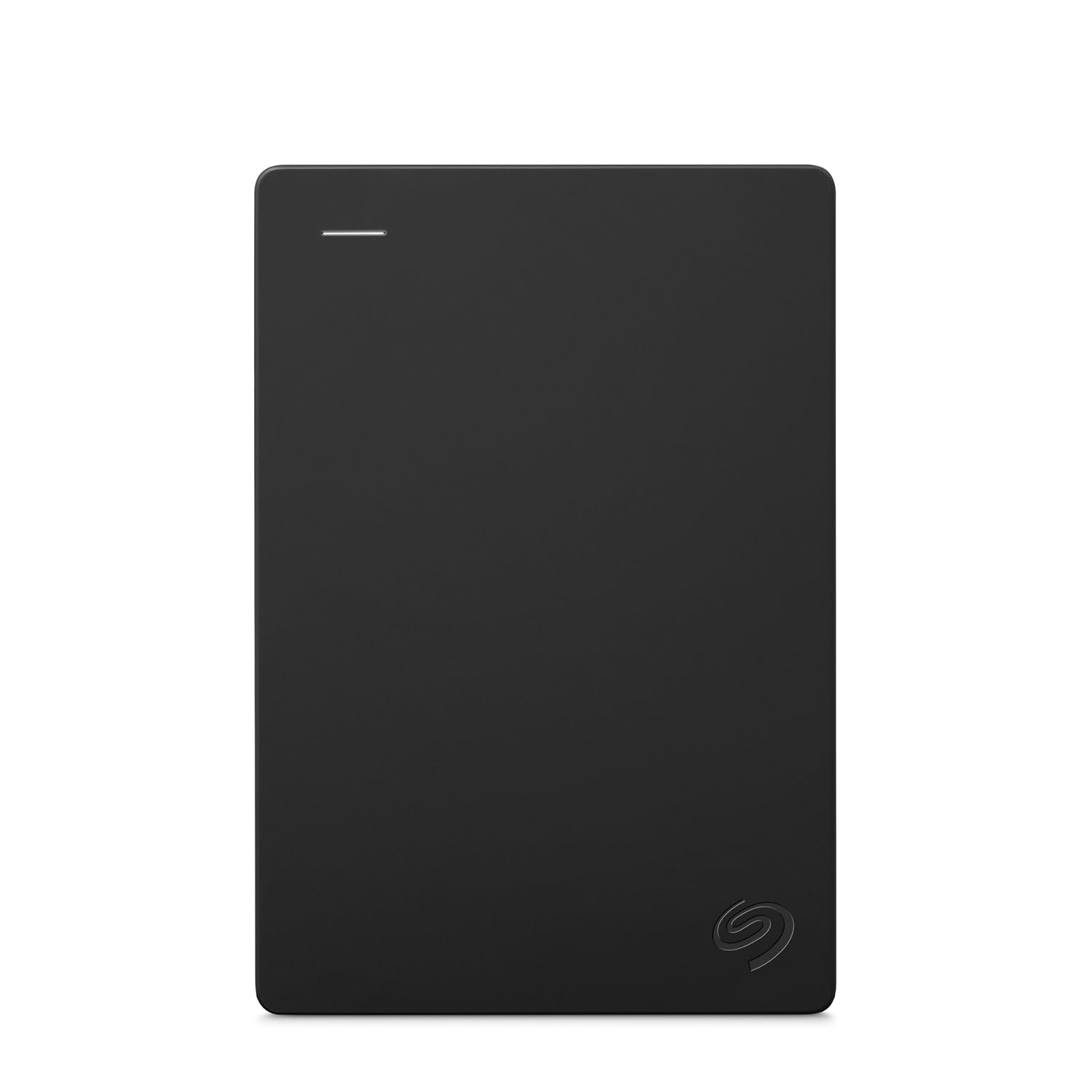
Seagate’s entry-level portable drive focuses on simplicity and reliability for everyday backup. It’s a USB 3.0 bus-powered 2.5-inch drive that auto-recognizes on Windows without setup; Mac users need to reformat via Disk Utility. The included 1-Year Rescue Service provides data recovery in case of mechanical failure—a rare warranty addition at this tier.
With a rated data transfer rate of 20 Gbit/s (interface-limited, not actual sustained throughput), real-world file copies run at typical 5400 RPM speeds. Music producers and creative professionals report it handles sample libraries and project file transfers without noticeable delay, provided the drive isn’t used as a primary scratch disk.
User feedback emphasizes its whisper-quiet operation, lightweight feel, and college-friendly simplicity. Some Linux users note detection issues when antivirus software blocks the device, and the Mac reformatting requirement catches first-time buyers off guard. For a no-fuss portable backup drive with an additional safety net, this remains a top contender.
Why it’s great
- 1-Year Rescue Service provides data recovery coverage—unique at this price level
- Plug-and-play on Windows with no software installation required
- Quiet and lightweight, suitable for daily carry in a backpack
Good to know
- Requires reformatting for Mac; not usable as a Time Machine drive out of box
- Write speeds drop significantly after 100GB of continuous writes due to SMR technology
- Linux detection can be blocked by third-party security software
5. Toshiba Canvio Basics 1TB

The Toshiba Canvio Basics offers a no-frills approach to portable storage. Its matte, smudge-resistant finish keeps the drive looking clean, and the slim profile slides easily into a laptop bag. It’s a USB 3.0 bus-powered unit that works immediately on Windows 10, 8.1, and 7; Mac users must reformat the NTFS file system before use.
Internally, this drive uses SMR (Shingled Magnetic Recording) platters, which boost capacity density but reduce sustained write speeds during large backups. Sequential writes start strong but can drop to around 25 MB/s after the conventional magnetic zone fills. For incremental backups and archival storage, this tradeoff is acceptable; for frequent large file transfers, a CMR-based drive would perform better.
Customer reviews highlight exceptional long-term reliability—multiple users report 4+ years of daily use without failure. The plastic enclosure feels basic compared to aluminum competitors, and there is no hardware encryption included. For budget-focused buyers who prioritize longevity over transfer speed, the Canvio Basics delivers consistent value.
Why it’s great
- Proven reliability with many units operating flawlessly beyond 4 years
- Matte smudge-resistant finish keeps the drive looking clean over time
- True plug-and-play operation on Windows out of the box
Good to know
- SMR platters cause write speeds to slow significantly during sustained backups
- Plastic enclosure feels less premium than aluminum-bodied alternatives
- No hardware encryption or bundled data recovery service
6. WD 1TB Elements Portable External Hard Drive

The WD Elements lineup has been a staple of reliable external storage for years. This 1TB version uses a USB 3.0 interface with backward compatibility to USB 2.0, ensuring it works across older systems. It’s formatted for Windows 8, 7, Vista, and XP out of the box; Mac users can reformat for Time Machine compatibility, though doing so locks the drive for that purpose.
Performance aligns with a standard 5400 RPM 2.5-inch drive—quiet operation with slight warmth during extended use. Sequential reads average around 100-120 MB/s, sufficient for photo libraries, document backups, and media playback. The compact footprint and lightweight build make it a natural fit for laptop users who need occasional offload storage.
Reviews appreciate the drive’s consistent reliability over months of use, with several noting the USB cable is the weakest link and recommending a replacement. Some users expected 3.5-inch desktop performance from the 3.5-inch form factor listed in specs, but this unit is a 2.5-inch portable drive. For buyers who trust WD’s track record and want a simple, durable backup solution, this is a safe bet.
Why it’s great
- WD’s established quality control and widespread availability make replacement easy
- USB 3.0 with USB 2.0 backward compatibility supports legacy systems
- Compact and lightweight for easy portability in laptop bags
Good to know
- Reformatting for Mac locks the drive to Time Machine only unless a new volume is created
- Included USB cable is low quality and often fails before the drive does
- Listed as 3.5-inch form factor but actual unit is a 2.5-inch portable drive
7. MaxDigitalData 1TB 5400RPM Gaming Hard Drive

This MaxDigitalData drive targets a specific niche: internal upgrades for PlayStation 3 and PlayStation 4 consoles. At 9.5mm height, it fits the standard 2.5-inch bay used in Sony’s consoles without modification. The 5400 RPM spindle and 8MB cache are modest by desktop standards but match the console’s internal drive speed, ensuring compatibility with Sony’s system software.
The interface is SATA 3.0 Gb/s—slower than standard SATA III’s 6 Gb/s, but the PS4’s SATA controller is the limiting factor, not the drive. With 1TB capacity, users can store up to 80 × 25GB games, a massive upgrade from the console’s original 500GB. Installation requires a PC and flash drive to download and transfer the PS4 system software.
Reviews confirm it’s a drop-in solution that works reliably once the firmware transfer is complete. The aluminum enclosure aids heat dissipation inside the console’s tight chassis. For PC desktop use, the slower rotational speed and smaller cache make it less competitive than 7200 RPM options. This drive is purpose-built and excels in its intended role.
Why it’s great
- Perfect 9.5mm height and SATA interface for PS3/PS4 internal upgrades
- 1TB capacity stores up to 80 games—double the stock console storage
- Aluminum enclosure helps dissipate heat inside console chassis
Good to know
- 5400 RPM and 8MB cache are slow for desktop PC OS or game use
- SATA 3.0 Gb/s interface is half the speed of modern SATA III
- Requires a PC with flash drive to install the PS4 system software after installation
FAQ
Is 5400 RPM fast enough for gaming on a 1TB hard drive?
What is SMR and why does it matter for a 1TB portable drive?
Can I use a 3.5-inch 1TB internal drive in a laptop?
How long does a typical 1TB hard drive last under daily use?
Does USB 3.0 make a 5400 RPM 1TB drive faster than internal SATA?
Final Thoughts: The Verdict
For most users, the best 1tb hard drive winner is the Western Digital WD Blue WD10EZEX because its 7200 RPM spindle and 64MB cache deliver desktop-class performance at a mid-range investment. If you need portable storage that survives travel and impact, grab the ADATA HD710 Pro with its IP68 and MIL-STD-810G protections. And for a console-specific upgrade, nothing beats the drop-in compatibility of the MaxDigitalData 1TB Gaming Hard Drive for PS3 and PS4 systems.

Mo Maruf
I created WellFizz to bridge the gap between vague wellness advice and actionable solutions. My mission is simple: to decode the research and give you practical tools you can actually use.
Beyond the data, I am a passionate traveler. I believe that stepping away from the screen to explore new environments is essential for mental clarity and physical vitality.