Our readers keep the lights on and my smoothie glass nicely filled. As an Amazon Associate, I earn from qualifying purchases.
An 18650 battery is the workhorse cylinder inside flashlights, vape devices, outdoor solar lights, and emergency gear—but pairing the wrong cell with a slow or unsafe charger turns a reliable power source into a frustrating paperweight. The gap between a battery that delivers consistent voltage and one that sags under load often comes down to the charger’s termination logic and the cell’s internal resistance, two specs most shoppers never check.
I’m Mohammad Maruf — the founder and writer behind WellFizz. I’ve spent hundreds of hours cross-referencing datasheets, analyzing charging curves, and comparing termination accuracy across the most common 18650 hardware on the market to build a guide that focuses on real performance metrics rather than marketing claims.
Whether you need a simple two-bay top-up station or a lab-grade analyzer that measures actual capacity, this roundup of the best 18650 battery and charger bundles will help you match the right hardware to your specific battery chemistry and usage pattern.
How To Choose The Best 18650 Battery And Charger
Not all chargers terminate at the same voltage, and not all cells deliver the same capacity under load. Picking a bundle requires evaluating three key areas: the charger’s independent bay control, the cell’s claimed versus actual mAh, and the safety certifications that prevent thermal runaway during unattended charging.
Independent Bays Versus Shared Charging
Cheaper chargers often run two or four bays in parallel, meaning all batteries receive the same current regardless of their individual state of charge. Premium chargers use independent constant-current/constant-voltage (CC/CV) algorithms per slot, which lets you charge different chemistries (LiFePO4, Li-ion, Ni-MH) simultaneously without under- or over-charging any cell.
Measured Capacity Versus Label Claims
Many budget cell bundles advertise 4200mAh or higher—well above the theoretical maximum for a standard 18650. A charger with a discharge/capacity testing function reveals the true mAh, helping you identify overrated cells before they cause runtime surprises in high-drain devices like flashlights or vape mods.
Termination Accuracy and Safety Protections
Li-ion cells are sensitive to overcharge. A quality charger terminates at exactly 4.20V ±0.05V per cell. Look for UL, CE, or RoHS certification as a baseline indicator of safe construction, plus features like reverse polarity detection, over-temperature shutoff, and flame-retardant housing to minimize risk during overnight charging.
Quick Comparison
On smaller screens, swipe sideways to see the full table.
| Model | Category | Best For | Key Spec | Amazon |
|---|---|---|---|---|
| XTAR Dragon VP4L Plus | Premium | Capacity testing & diagnostics | 2.4A per bay, USB output, battery repair | Amazon |
| EBL PD4 Universal Charger | Mid-Range | Fast charging & cell reactivation | 2000mA per slot on channels 1 & 4 | Amazon |
| 4-Slot MAXLSHALL Charger | Mid-Range | Multi-chemistry & 3-in-1 testing | 4A total, LiFePO4 & Ni-MH support | Amazon |
| DULEX 18650 Charger | Budget | Simple two-bay top-up | 2A total, LCD per-cell voltage | Amazon |
| YSKXOIMA Universal Kit | Budget | Entry-level bundle with cells | Basic overcharge/short-circuit protection | Amazon |
In‑Depth Reviews
1. XTAR Dragon VP4L Plus
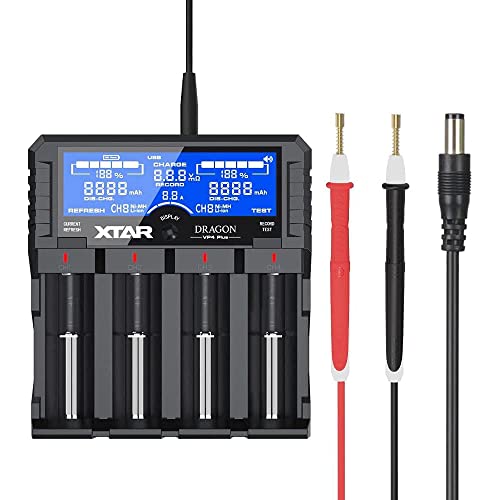
The XTAR Dragon VP4L Plus is a professional-grade charger that doubles as a capacity tester and a USB power bank. Its four independent bays can each deliver up to 2.4A, and the included test leads let you probe battery holders or packs directly—ideal for matching cells in multi-battery flashlights or rebuilding power tool packs. The refresh mode performs a full discharge then recharge cycle to recover capacity from aged cells.
Long-term reliability reports are mixed: while many users report three-plus years of daily service with Tenergy and Eneloop cells, a smaller subset experienced screen flickering or total failure within the first week. The unit cannot charge deeply depleted (0V) cells without a manual serial jump-start, a limitation shared by many advanced analyzers. The display shows only two batteries at once, which requires scrolling through four bays.
For hobbyists, vapers, and workshop users who need to verify actual mAh rather than trusting label print, the VP4L Plus offers depth that budget chargers cannot match. The learning curve is steeper but the data output—discharge curves, exact termination voltage, and capacity in mAh—is worth the investment if you maintain a large battery inventory.
Why it’s great
- Accurate capacity testing with test leads
- USB output functions as a backup power bank
- Refresh mode revives sulfated Ni-MH cells
Good to know
- Cannot charge 0V Li-ion without manual jump-start
- Some units report early failure within warranty window
- Display only shows two bays at a time
2. EBL PD4 Universal Charger
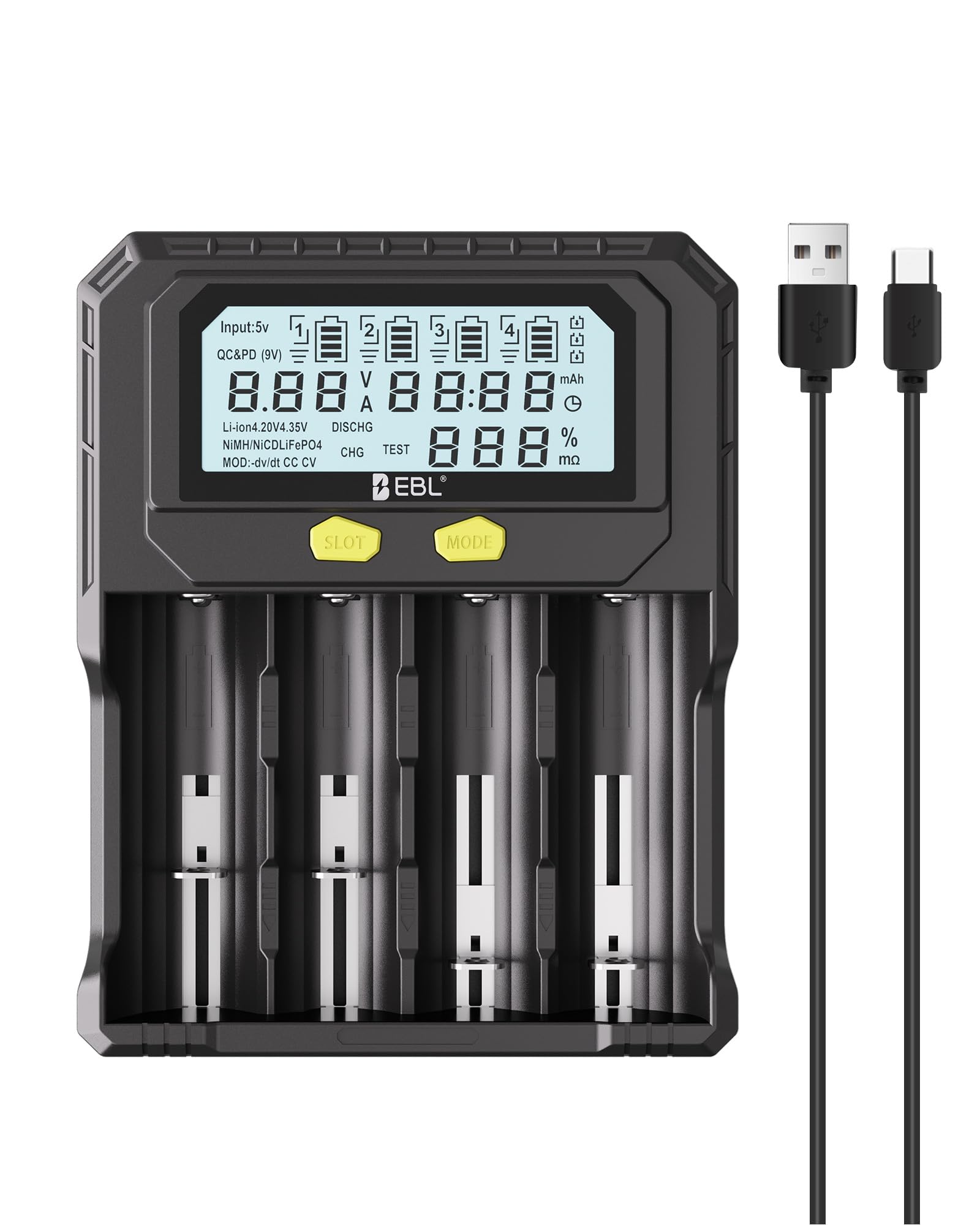
The EBL PD4 brings genuine 0V reactivation technology to the mid-range price tier, meaning it can recover cells that have dropped below the safe voltage cutoff—a feature usually reserved for chargers costing twice as much. Channels 1 and 4 support up to 2000mA each, cutting charge time for a typical 3000mAh 18650 to under two hours when paired with a QC/PD power source.
Users report successfully resurrecting cells from dead power tool packs, with 8 out of 11 cells recovering usable capacity. The automatic chemistry detection handles Li-ion, LiFePO4, and Ni-MH without manual switching. A few owners mention the charger occasionally shuts down mid-cycle and requires a power cycle reboot, though this appears to be an intermittent software glitch rather than a hardware defect.
The LCD screen provides real-time voltage per bay plus estimated remaining charge time. Build quality feels solid, with spring-loaded contacts that grip button-top and flat-top cells equally well. For anyone maintaining a mixed collection of salvaged and new cells, the PD4’s combination of speed, reactivation, and capacity display is a genuine value play.
Why it’s great
- 0V reactivation recovers deeply depleted cells
- Fast 2000mA charging on two independent bays
- Auto-detects LiFePO4, Li-ion, and Ni-MH chemistry
Good to know
- Occasional mid-cycle shutdown requiring reboot
- Requires QC/PD adapter for full speed
- USB-C input, but no included wall adapter
3. MAXLSHALL 4-Slot Fast Charger
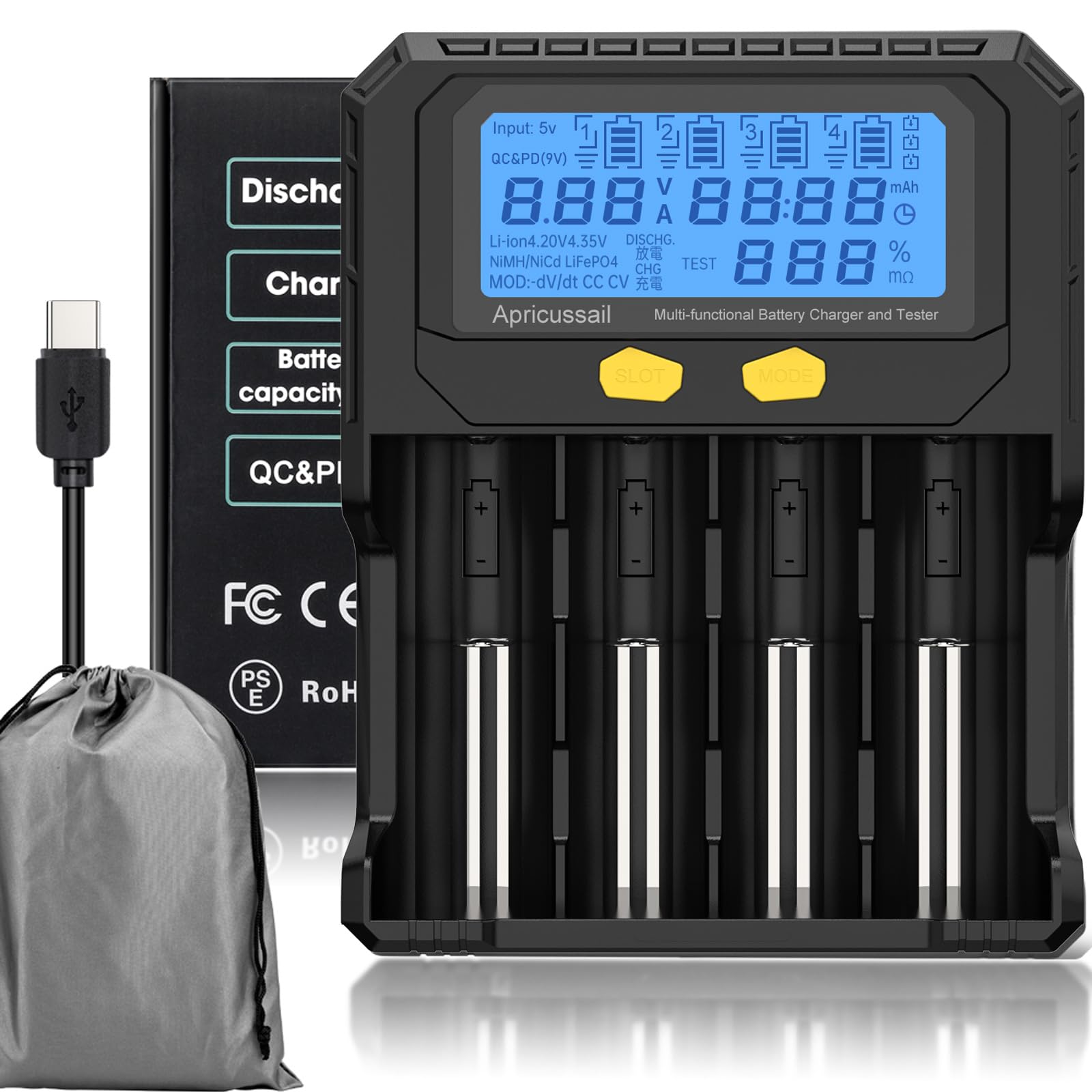
The MAXLSHALL charger covers an unusually wide chemistry range: 3.2V LiFePO4, 3.7V/3.85V Li-ion, and 1.2V Ni-MH/Ni-CD. The fourth slot adds three extra functions—discharge, capacity test, and charge—which lets you run a full cycle to measure actual capacity and then recharge automatically. The total output of 4A is split across four bays at 1A each, or 2A per slot when using only the first and fourth bays.
Users consistently praise the fast charging speed and clear LCD readout that shows voltage, current, and accumulated mAh for each slot. The charger correctly identifies battery types automatically, which eliminates the guesswork when mixing chemistries. Some buyers note that the included power cable feels thin, and the unit is bulkier than a standard two-bay charger at 6.5 inches deep.
For households that switch between Ni-MH AA/AAA in remote controls and Li-ion 18650/21700 in flashlights and power banks, this single unit replaces three dedicated chargers. The capacity test on slot 4 helps identify failing cells before they cause runtime issues, making it a smart pick for family battery management.
Why it’s great
- Supports LiFePO4, Li-ion, and Ni-MH in one device
- Slot 4 provides discharge and capacity test
- Fast charging with 2A on bays 1 and 4
Good to know
- Bulky footprint for a 4-bay charger
- Included power cable feels underbuilt
- No USB power bank output
4. DULEX 18650 Charger
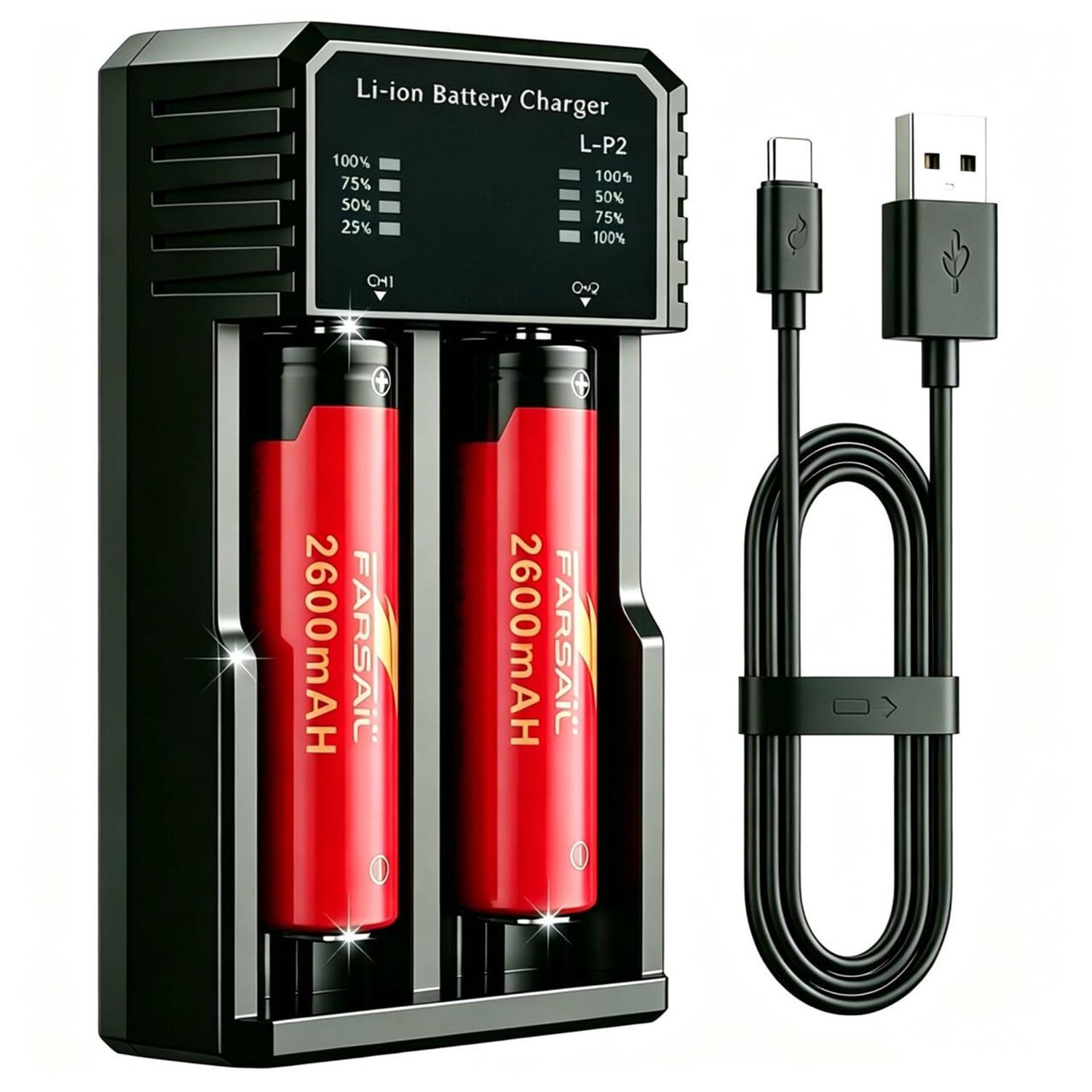
The DULEX two-bay charger prioritizes simplicity and UL certification at a budget-friendly price point. Each bay has an independent LCD indicator showing real-time voltage, and the charger automatically stops when each cell reaches 4.2V. The stainless steel battery rails slide smoothly and accommodate both button-top and flat-top cells without forcing snug fits.
Customer feedback highlights the included 4200mAh batteries as problematic—one user reported electrolyte leakage from a cell fresh out of the box, and others note that the batteries do not always seat properly in the charging bay. The charger itself receives positive marks for its compact footprint and clear display, but the USB-C port lacks Power Delivery support, so charging a pair of 3000mAh cells takes roughly 4 hours.
This kit works best as a backup or travel charger for users who already own quality cells and simply need a UL-listed charging station. Skip it if you need higher charge current or reliable included batteries. The DULEX charger paired with your own premium 18650s is a capable, low-stakes solution for bedside or desk top-up.
Why it’s great
- UL certified for safe unattended charging
- LCD shows per-cell voltage in real time
- Compact and lightweight at 48 grams
Good to know
- Included batteries have quality and safety concerns
- USB-C port lacks PD, limiting charge speed
- Slow charge rate compared to premium chargers
5. YSKXOIMA Universal Kit
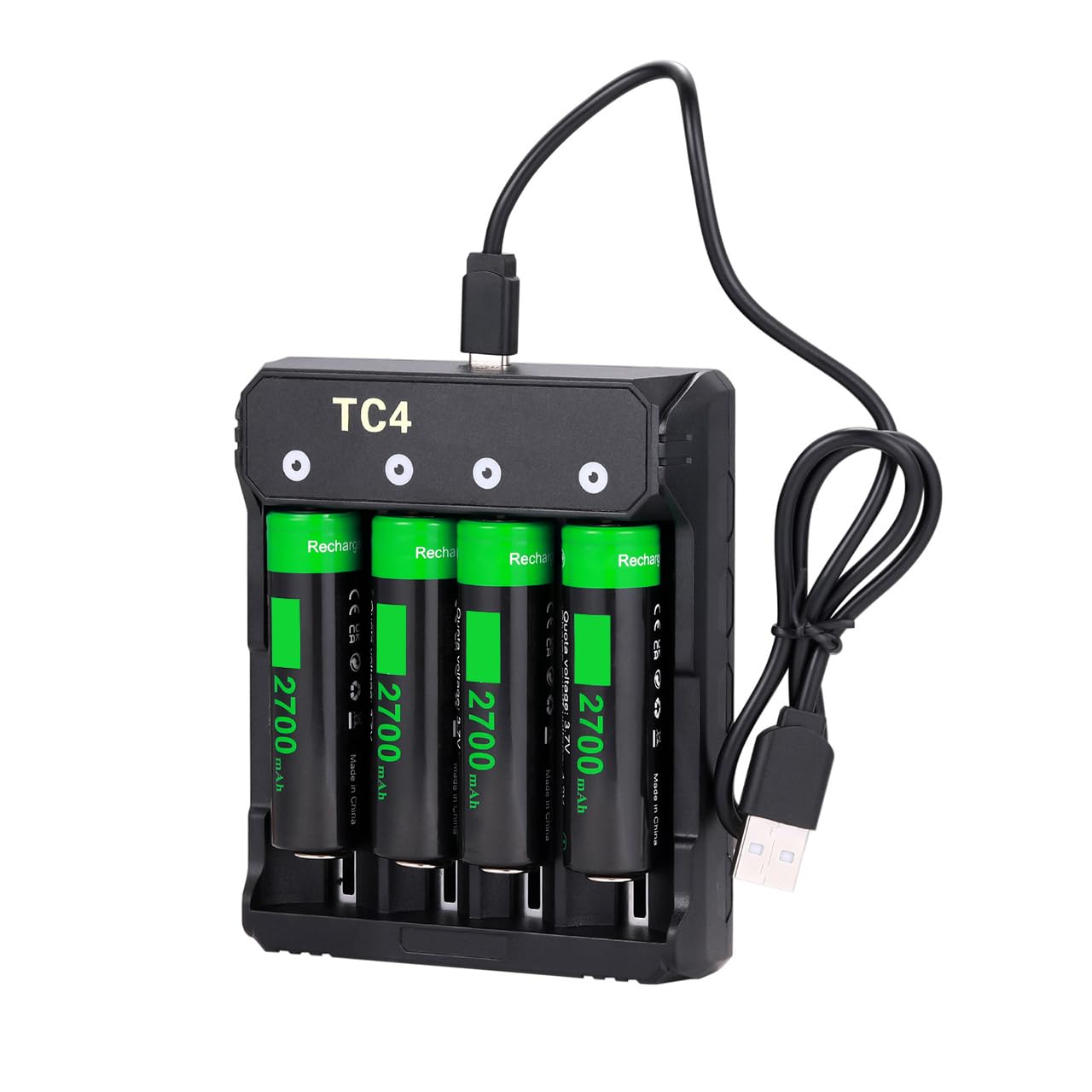
The YSKXOIMA kit targets first-time 18650 users with a simple two-bay charger and a pair of button-top cells. The charger includes overcharge, short-circuit, and overheat protection with CE and UL certification, making it a safe entry point. The red/green LED indicators show charge status without confusing menus, and the compact 6x4x2-inch footprint fits easily into a drawer or camping bag.
Buyers report that the included batteries arrive with a partial charge and hold power reasonably well in flashlights and emergency radios. The charger is not fast—a full charge cycle for a 3000mAh cell takes several hours—but it terminates reliably at the correct voltage. A small batch of customers note that the batteries needed an initial full charge before they delivered usable runtime, meaning the cells ship at a storage voltage rather than full capacity.
This kit suits casual users who need spare power for garden lights, doorbells, or emergency flashlights without diving into chemistry management. For higher-drain devices like vape mods or high-lumen searchlights, upgrade to a faster charger and cells with known discharge ratings. The YSKXOIMA wins on simplicity and safety compliance at a very low entry cost.
Why it’s great
- CE and UL certified for safe operation
- Simple red/green LED status for easy monitoring
- Compact design with included button-top cells
Good to know
- Slow charge rate, not suitable for high-drain users
- Batteries ship at storage voltage, need initial full charge
- No per-bay voltage or capacity data display
FAQ
Can I charge different battery chemistries at the same time?
What does 0V reactivation mean for a dead 18650 cell?
Why does the XTAR Dragon VP4L Plus display only two batteries at once?
Final Thoughts: The Verdict
For most users, the best 18650 battery and charger winner is the EBL PD4 Universal Charger because it balances fast 2000mA charging with 0V cell reactivation and automatic chemistry detection at a mid-range price. If you need a professional tool for capacity testing and cell matching, grab the XTAR Dragon VP4L Plus. And for a simple, UL-certified backup that works with your own quality cells, the DULEX 18650 Charger is a reliable budget choice.

Mo Maruf
I created WellFizz to bridge the gap between vague wellness advice and actionable solutions. My mission is simple: to decode the research and give you practical tools you can actually use.
Beyond the data, I am a passionate traveler. I believe that stepping away from the screen to explore new environments is essential for mental clarity and physical vitality.