Our readers keep the lights on and my smoothie glass nicely filled. As an Amazon Associate, I earn from qualifying purchases.
Sixteen inputs changes everything. Once you outgrow a Scarlett or a small-format rack, you are no longer choosing an interface—you are building the central nervous system of your studio. The difference between a cramped eight-channel workflow and a full 16-channel setup is the difference between tearing down and re-cabling mid-session versus capturing an entire band, a drum kit, or a synth wall in one seamless pass. Every interface on this list handles sixteen discrete analog inputs, but the preamp character, routing flexibility, expandability, and driver stability vary dramatically across the price spectrum.
I’m Mohammad Maruf — the founder and writer behind WellFizz. I have spent years comparing the real-world performance of pro audio hardware, analyzing preamp gain structures, ADAT expandability, DSP ecosystems, and driver reliability across dozens of interfaces in this price tier.
Whether you are running a home studio that books real sessions or a live rig that needs to multitrack to an SD card, this guide identifies the single unit that serves as the strongest hub for your workflow. After evaluating eleven contenders, I can confidently recommend a 16 channel audio interface that balances I/O count with preamp quality and software integration.
How To Choose The Best 16 Channel Audio Interface
Choosing a 16-channel interface is not about picking the unit with the most lights or the lowest price. The decision hinges on three structural factors: how you intend to use the preamps, how you plan to expand the I/O, and what latency standard your sessions require. A bad choice here creates a bottleneck that slows every session for years.
Preamp Quality vs. Channel Count
A 16-channel interface with mediocre preamps forces you to spend additional money on external preamps—defeating the purpose of an all-in-one box. Look for models with at least 60 dB of gain and a noise floor below -128 dBu EIN. Interfaces like the Tascam US-16×08 and the Focusrite Scarlett 18i20 offer clean preamps that handle dynamic microphones without hiss, while premium units like the Universal Audio Apollo x16 add emulation circuitry that replicates classic console channels.
ADAT and Digital Expansion
Not every 16-channel interface actually has 16 analog inputs. Many units achieve their channel count by including ADAT optical ports that require an external preamp with ADAT output. If you need 16 analog inputs today, avoid interfaces that only offer eight analog plus eight ADAT—unless you already own an ADAT expander. The MOTU UltraLite-mk5 and the Focusrite 18i20 both support ADAT expansion, letting you add eight more channels later without replacing the core unit.
DSP Monitoring and Mixer Software
At 16 channels, software monitoring through your DAW introduces enough latency to ruin a live take. A built-in DSP mixer with zero-latency routing is not optional—it is mandatory. Units like the Tascam Model 16 and the Zoom LiveTrak L-20 offer onboard mixing that sends a direct signal to headphones without touching the computer. Check whether the included mixer software allows you to create separate headphone mixes for each performer.
Quick Comparison
On smaller screens, swipe sideways to see the full table.
| Model | Category | Best For | Key Spec | Amazon |
|---|---|---|---|---|
| Focusrite Scarlett 18i20 4th Gen | Semi-Pro | Home/Project Studio Hub | 8 Mic Pres / 69dB Gain / 192kHz | Amazon |
| MOTU UltraLite-mk5 | Compact Pro | Ultra-Low Latency Tracking | 2 Combo Ins / 125dB DNR / 192kHz | Amazon |
| Tascam US-16×08 | Rackmount Value | 16 Analog Inputs on a Budget | 8 XLR/8 Line / 96kHz / USB 2.0 | Amazon |
| Yamaha MG16XU | Analog Mixer | Live Sound + Recording | 10 Mic / 192kHz / SPX Effects | Amazon |
| Mackie Onyx16 | Analog Mixer | British EQ + Multi-Track USB | 60dB Preamps / Sweepable Mid / 96kHz | Amazon |
| Tascam Model 16 | All-In-One | Standalone Recording & Mixing | 10 Mic Pres / SD Recorder / 48kHz | Amazon |
| Behringer X32 Rack | Digital Rack | Live Mixing & FOH Control | 16 Midas Pres / 32×32 USB / 48kHz | Amazon |
| Zoom LiveTrak L-20 | Live Recorder | Band Recording & Monitor Mixes | 20-Channel / 6 Headphone Outs / 96kHz | Amazon |
| Allen & Heath CQ-18T | Touchscreen Digital | Portable Gigging & IEM Mixes | 16 Combi / 7″ Screen / 24×22 USB | Amazon |
| UA Apollo X6 | DSP Premium | Tracking Through UAD Plugins | 2 Unison Pres / HEXA Core / 192kHz | Amazon |
| UA Apollo x16 Heritage | Flagship | High-End Studio Conversion | 16 Analog I/O / 6 DSP Chips / Thunderbolt | Amazon |
In‑Depth Reviews
1. Focusrite Scarlett 18i20 4th Gen
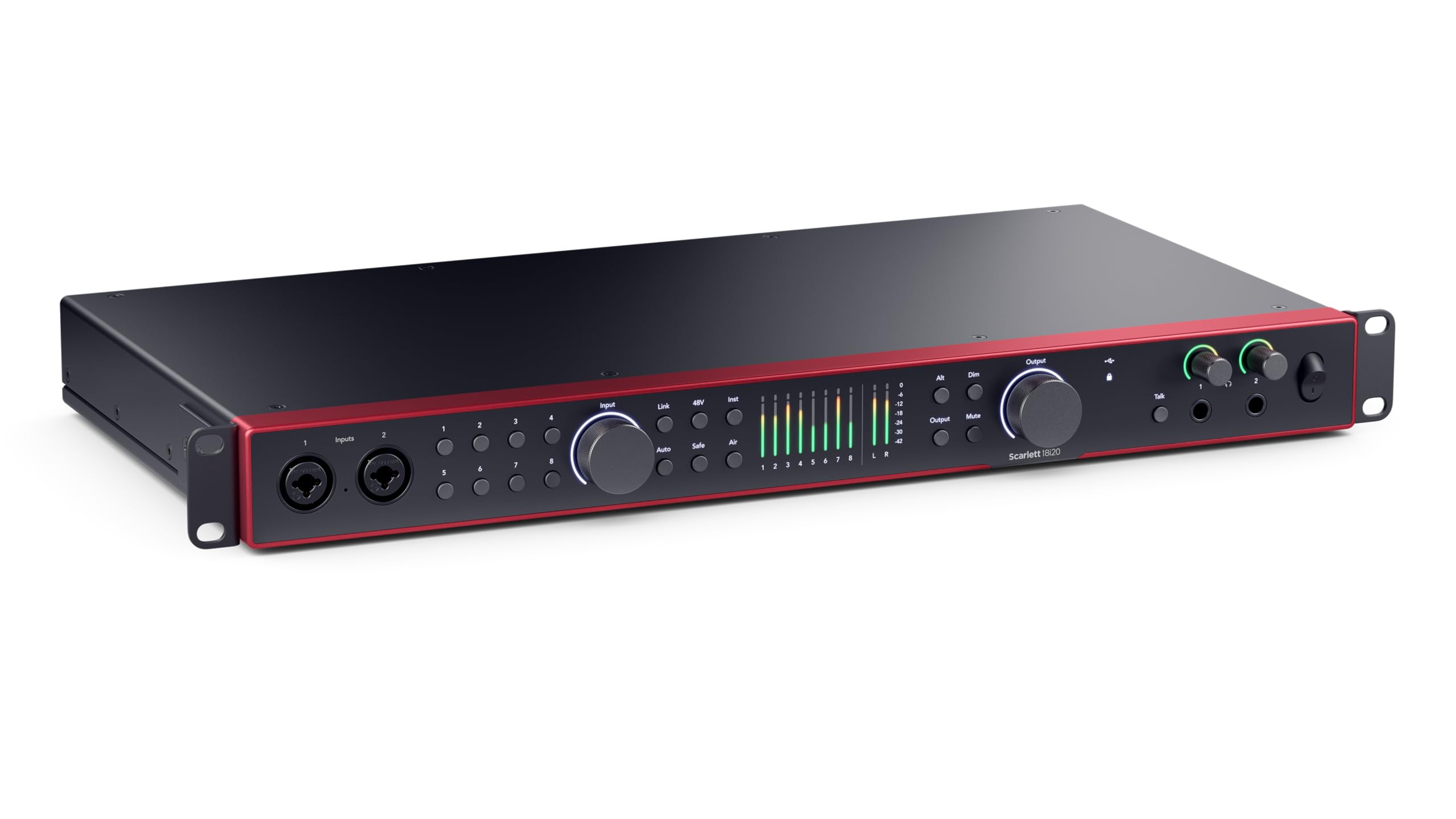
The 4th-generation Scarlett 18i20 is the interface that other 16-channel units have to beat. It delivers 18 inputs and 20 outputs, including eight mic preamps with 69 dB of gain—enough to drive a vintage ribbon microphone without an external booster. The 24-bit, 192kHz conversion borrows from the RedNet line, and the 122 dB dynamic range on the outputs gives you headroom for dense mixes without digital harshness.
Two features fundamentally change the tracking experience: Auto Gain and Clip Safe. Auto Gain sets the input level to an optimal range in seconds, eliminating the old routine of asking the drummer to hit hard while you watch a meter. Clip Safe monitors the signal and adjusts gain in real-time if the source suddenly peaks, which matters when you are recording a live band across eight inputs simultaneously.
The Air mode adds presence and harmonic drive, emulating the transformer saturation of classic consoles. Users report that the included Relab LX480 Essentials reverb is a genuine professional tool, not a throw-in. The 18i20 works seamlessly with Windows 11 and includes Pro Tools Intro+, Ableton Live Lite, Cubase LE, and the Hitmaker Expansion bundle.
Why it’s great
- Auto Gain and Clip Safe drastically reduce setup time during multitrack sessions
- Eight mic preamps with 69dB gain handle ribbons, dynamics, and condensers without an external cloudlifter
- ADAT and S/PDIF expandability allows you to add eight more inputs later
Good to know
- Mixer software has a steeper learning curve for new users compared to previous generations
- The rear-panel layout is dense—cable management requires patience
2. MOTU UltraLite-mk5

The MOTU UltraLite-mk5 squeezes 18 inputs and 22 outputs into a half-rack chassis that weighs under three pounds. This is the interface you grab for mobile sessions where rack space is tight. The analog outputs deliver 125 dB dynamic range—a spec that competes with interfaces costing twice as much. The onboard DSP mixer provides six separate mix busses, each with its own reverb, 4-band parametric EQ, and dynamics processing, all manageable through the CueMix 5 desktop or iOS app.
The connectivity is remarkably complete for the size: two combo XLR/TRS mic inputs with preamps, four balanced line inputs, eight balanced line outputs, S/PDIF digital I/O, and 8-channel ADAT optical I/O. The OLED screen provides detailed metering for all analog channels, though some users note the white display can wash out in bright stage lighting. The USB 2.0 connection runs rock-solid at 32-sample buffer settings with approximately 3ms of round-trip latency.
Users upgrading from Scarlett Solo or 2i2 units report a massive jump in clarity and stereo imaging. The preamps are clean and neutral—no added coloration, which makes the UltraLite-mk5 an excellent choice if you prefer to add character through outboard gear or plugins rather than baked-in analog circuitry. The unit retains its settings in memory and operates as a standalone mixer when not connected to a computer.
Why it’s great
- Extremely low latency at 32-sample buffer (around 3ms round-trip)
- 125dB dynamic range on outputs exceeds many desktop interfaces in this price tier
- Compact form factor is ideal for travel or small desks
Good to know
- Only two combo mic/line inputs—addressing 16 analog inputs requires using the line inputs and ADAT expansion
- The OLED meter display is difficult to read for clipping detection in bright environments
3. Tascam US-16×08

The Tascam US-16×08 solves a specific problem: you need sixteen analog inputs right now, and you do not want to buy an ADAT expander. This is the only interface in this roundup that delivers eight XLR inputs and eight additional ¼-inch line inputs as native analog channels—no digital expansion required. The eight Ultra-HDDA microphone preamps deliver up to 56 dB of gain with a noise floor that users consistently describe as quiet and clean, even for condenser microphones on quiet sources like acoustic guitar or spoken word.
The rackmount form factor (3U) places all the controls on the front panel, making patching and gain-staging straightforward during sessions. The integrated DSP mixer provides zero-latency monitoring with a 4-band EQ and compression on every channel. This is a practical tool for tracking drums with multiple room mics or recording a full band live without relying on DAW monitoring.
Users report that the US-16×08 has been a workhorse for five-plus years with no degradation in sound quality. The unit works plug-and-play with Reaper and other major DAWs on Windows, though the initial driver installation on Windows 10 required a firmware update for some users to eliminate background noise. The preamps are quiet enough that you can boost the gain substantially without introducing hiss, making this a legitimate option for budget-conscious studios that need maximum channel count.
Why it’s great
- 16 analog inputs without needing ADAT expansion—simplest path to 16 channels
- Rackmount form factor keeps the session tidy and organized
- DSP mixer with onboard EQ and compression for zero-latency monitoring
Good to know
- Limited to 96kHz maximum sample rate, not 192kHz
- Driver installation on Windows can be finicky without the correct firmware version
4. Yamaha MG16XU

The Yamaha MG16XU is an analog mixer first and an audio interface second—a distinction that matters if your workflow is rooted in live sound rather than studio tracking. The D-PRE discrete Class-A preamps use an inverted Darlington circuit that delivers fat, natural bass and smooth highs. Users consistently describe the sound as musical and forgiving, with a three-band EQ and high-pass filter on every channel to shape tones before they hit the recorder.
The built-in SPX digital effects engine provides reverb, delay, chorus, and multi-effects that are genuinely usable in a live context. The 1-Knob compressors on channels 1 through 8 allow quick dynamic control during a show without navigating menus. The USB connection streams stereo audio to a DAW, making it a viable option for recording a live set while also running front-of-house mixing.
The MG16XU features a powder-coated metal chassis that withstands the bumps of transport and stage use. The monitor out section can be a little confusing to navigate when setting up separate wedge mixes, but the Aux sends provide enough routing for most live scenarios. The 16-channel mixer delivers 10 microphone inputs, two of which are combi jacks, and includes a stereo line input channel for external playback devices.
Why it’s great
- Class-A D-PRE preamps deliver a warm, musical tone that outperforms many competing mixers
- Built-in SPX effects eliminate the need for external reverb or delay units in a live setup
- Rugged metal chassis is designed for regular transport and stage abuse
Good to know
- The USB interface only streams stereo, not multi-track—not suitable for recording 16 individual tracks
- Only 10 mic inputs despite being labeled as a 16-channel mixer
5. Mackie Onyx16

The Mackie Onyx16 blends analog mixing ergonomics with multi-track USB recording capability. This mixer features the Onyx mic preamps, which provide up to 60 dB of gain, paired with the legendary Perkins British-style EQ with sweepable midrange. The sweepable mid is the headline feature here—it allows you to precisely notch out problem frequencies or boost specific tones in a way that fixed-frequency EQs cannot match.
The USB interface streams up to 18 channels of audio to a Mac or PC at 96kHz / 24-bit resolution, covering the main outputs, all group buses, and the individual channel inserts. The built-in effects engine includes reverbs, delays, and modulation effects, and Bluetooth streaming lets you play backing tracks from a phone or tablet directly through a channel strip. The SD card recording feature is present but works best for stereo capture rather than multi-track archival.
Users highlight the exceptional sound quality and the versatility of having 16 channels with sweepable EQ in a single unit. The mixer defaults to a delay effect on power-up, which catches some users off guard, but the core mixing and interface functionality earns consistent five-star ratings. The Onyx16 is slightly larger than a standard 16-channel analog mixer, so confirm your desk or rack depth before purchasing.
Why it’s great
- Sweepable midrange EQ provides surgical tone shaping unavailable on fixed-EQ mixers
- Multi-track USB recording at 96kHz/24-bit covers 18 channels simultaneously
- Bluetooth input simplifies adding backing tracks during live sets
Good to know
- Defaults to the delay effect every time it powers on—requires manual resetting
- The SD card recording function has auto-naming quirks and laggy control response
6. Tascam Model 16

The Tascam Model 16 is an all-in-one production station that combines a 16-track digital recorder, an analog mixer, and a USB audio interface. The core differentiator is the ability to record up to 16 tracks directly to an SD card at 48kHz/24-bit without a computer. For engineers who dislike being tethered to a DAW during the creative phase, the Model 16 offers punch-in/punch-out recording on up to eight tracks simultaneously.
The analog section provides 10 microphone preamps using Tascam’s Ultra-HDDA technology, known for clean gain and low noise. The routing is straightforward: each channel corresponds to a track on the recorder, with the transport controls laid out on the top panel for quick access. Users describe the sound as thick and punchy, with enough headroom for dynamic drum performances.
The USB audio interface mode allows 16-in/14-out data transfer to a DAW for mixing and editing later. The unit doubles as a standalone mixer with multiple output mixes, making it useful for in-ear monitor systems during rehearsals. Some users note that the Model 16 effectively only provides 12 usable input channels for recording because tracks 15 and 16 are virtual and the Bluetooth input is fixed to channels 13/14 without EQ or aux send capabilities.
Why it’s great
- Records 16 tracks directly to SD card—no computer needed during a session
- Ultra-HDDA preamps deliver clean, musical gain with low noise floor
- Punch-in/out on multiple tracks enables comping without a DAW
Good to know
- Only 10 physical mic preamps despite the 16-channel label
- Limited to 48kHz maximum sample rate, not suitable for high-resolution projects
7. Behringer X32 Rack

The Behringer X32 Rack pulls double duty as a live sound digital mixer and a 32×32 channel USB audio interface. The 16 MIDAS-designed, fully programmable mic preamps are the star of the show—they deliver the same audiophile-grade sound quality found in the larger X32 consoles, with clean gain that handles demanding dynamics like a full drum kit or a brass section without distortion. The 25-bus architecture gives you extensive routing for monitors, subgroups, and matrix outputs.
The 3U rackmount form factor fits in a standard touring rack alongside wireless receivers and power distribution. Remote control via iPad or iPhone apps provides full access to the mixer’s functions without needing a host PC, which is critical for front-of-house engineers who walk the room during sound check. The internal effects processing includes reverbs, delays, and modulation effects that rival standalone rack units.
Users in the sound reinforcement world treat the X32 Rack as the industry-standard compact digital mixer for corporate events, houses of worship, and small-to-medium music venues. The USB interface streams all 32 channels to a DAW for multitrack recording, making it a viable studio interface for projects that require a large channel count. The learning curve is moderate—the X32 ecosystem has multiple apps, and choosing the correct one for your OS is a common source of initial confusion.
Why it’s great
- 16 MIDAS preamps deliver genuine professional-grade sound quality in a rackmount package
- 32×32 USB audio interface streams the entire mix to your DAW for multitrack recording
- Full remote control via iPad/iPhone apps for wireless adjustment during live sets
Good to know
- Limited to 48kHz maximum sample rate in interface mode
- Selecting the correct app for your OS requires some research—documentation is not always clear
8. Zoom LiveTrak L-20

The Zoom LiveTrak L-20 is built for a specific pain point: providing six independent monitor mixes for a six-piece band during rehearsals or live shows. Each of the six headphone outputs has individual volume control and mix assignment, meaning every musician gets their own blend of the stage mix without needing a separate monitoring system. The unit records 22 tracks simultaneously to an SD card at 24-bit/96kHz, acting as both mixer and multitrack recorder in one box.
The preamps deliver -128 dBu EIN with up to +60 dB of gain, providing clean and transparent signal handling across all 20 input channels. The 20 onboard effects include reverb, delay, chorus, and compression, with the compressor being notably effective for controlling vocal peaks. The unit also functions as a 20-channel USB audio interface, routing all channels to a DAW for post-production editing.
Users praise the L-20 for replacing an entire recording studio setup—combining the roles of analog mixer, multitrack recorder, and audio interface into one road-ready unit. The faders and controls are physically laid out in a familiar analog format, minimizing the cognitive shift for engineers who prefer tactile mixing. The onboard effects lack modulation options like flanger and phaser, but the core mixing and recording functionality earns near-universal approval from live sound professionals and home studio owners alike.
Why it’s great
- Six independent headphone outputs with individual mixes for each performer
- Records 22 tracks directly to SD card at 96kHz without a computer
- Works as a standalone mixer, recorder, and USB audio interface simultaneously
Good to know
- Effects engine lacks modulation options like flanger and phaser
- The VU meter shows both recording and live levels on the same meter, which can be confusing
9. Allen & Heath CQ-18T

The Allen & Heath CQ-18T reimagines the digital mixer interface with a large 7-inch capacitive touchscreen as the primary control surface. The user interface is genuinely intuitive—you can set up a full mix, assign effects, and route monitor mixes within minutes of unboxing, even without prior experience with the Allen & Heath ecosystem. The Auto Gain feature automates input level setting, reducing the manual gain-staging chore during busy sound checks.
The hardware provides 16 mic or line inputs (8 combo jacks) plus a stereo line input, with 24×22 USB audio interface capability for multitrack recording. The built-in dual-band Wi-Fi (2.4GHz/5GHz) enables wireless control from tablets, and the Bluetooth stereo input accepts backing tracks from a phone. The four FX engines offer reverb, delay, chorus, and modulation effects that are more than sufficient for most live scenarios.
Users upgrading from traditional analog mixers or even the Focusrite Clarett+ line report that the CQ-18T offers superior reliability—no random audio dropouts during sessions, which was a recurring issue with ADAT-based setups. The preamps are described as clear and warm, with less brightness than the Focusrite Air mode, which some engineers actually prefer for vocal and acoustic sources. The compact size fits in a backpack, making this the most portable full-featured digital mixer in the roundup.
Why it’s great
- Large touchscreen makes the UI immediately accessible and intuitive to navigate
- Built-in dual-band Wi-Fi enables wireless control from a tablet without extra hardware
- Auto Gain and per-channel effects reduce the need for external rack gear
Good to know
- Only 8 combo XLR/TRS inputs—the remaining inputs are line-level
- Warranty is limited to one year, shorter than many competitors
10. Universal Audio Apollo X6

The Apollo X6 represents the entry point into Universal Audio’s DSP-powered ecosystem while still providing the connectivity needed for a 16-channel studio. The interface includes two Unison-enabled mic preamps that emulate iconic console channels from Neve, API, Manley, and SSL with near-zero latency, regardless of the audio buffer size. The HEXA Core processing provides six DSP chips dedicated to running UAD Powered Plug-Ins in real-time during tracking.
The Thunderbolt 3 connection delivers 16 x 22 channels of audio at up to 192kHz with class-leading analog conversion. The front panel provides talkback microphone, alt speaker switching, and assignable dim/mono functions—features typically found on large-format consoles. The unit includes the Realtime Analog Classics Plus plug-in bundle, with additional UAD plugins available for purchase through the UA store.
Users on the Mac platform report flawless operation with seamless integration into Pro Tools, Logic, Cubase, and Ableton Live. The Apollo X6 is specifically designed for engineers who want to track through hardware-quality emulations—compression, EQ, and saturation—while printing the effects directly to the recorded track. Windows users should verify Thunderbolt compatibility with their specific motherboard chipset, as the system is optimized for the Mac ecosystem.
Why it’s great
- Unison preamps allow tracking through authentic Neve, API, and SSL emulations at near-zero latency
- HEXA Core DSP offloads plugin processing from your computer, enabling larger session sizes
- Thunderbolt 3 provides the lowest latency available for a 16-channel interface
Good to know
- Only two built-in mic preamps—expanding to 16 inputs requires ADAT or additional Apollo units
- The full power of the DSP ecosystem requires purchasing additional UAD plugins separately
11. Universal Audio Apollo x16 Heritage Edition

The Apollo x16 Heritage Edition is the pinnacle of the Universal Audio interface line, offering 16 channels of elite-class A/D and D/A conversion with the widest dynamic range and lowest signal-to-noise ratio available at any price point. The Heritage Edition includes a premium suite of award-winning UAD plug-ins valued at over , including the complete collection of vintage compressors, EQs, and reverbs that engineers rely on for Grammy-winning productions.
The interface features 16 analog inputs and 16 analog outputs on DB25 connectors, plus AES/EBU digital I/O. The HEXA Core processing combines six UAD DSP chips, allowing massive session sizes with dozens of UAD plugins running simultaneously without taxing the host computer. The switchable +24 / +20 dBu headroom settings enable easy integration with professional mixing consoles and tape machines without re-calibrating your signal chain.
The Apollo x16 is bundled with the LUNA Recording System, a DAW that integrates deeply with the Apollo hardware for tape-style recording workflows and seamless plugin monitoring. Some users have reported rare hardware issues—a dead analog input on delivery—and the Heritage software bundle can clutter a computer with trial plugins. It is a serious commitment, but for engineers who demand the absolute lowest noise floor and the highest conversion accuracy available in a 16-channel format, the Apollo x16 is the definitive tool.
Why it’s great
- Elite-class conversion with the widest dynamic range in a 16-channel format
- Six DSP chips provide massive UAD plugin processing without taxing the computer
- Included Heritage plug-in bundle is worth over and includes industry-standard emulations
Good to know
- Requires Thunderbolt 3 connection and is optimized for Mac—Windows compatibility is limited
- The bundle installs a large number of trial plugins that require attention to the licensing portal
FAQ
Can I use a 16-channel mixer as a multi-track audio interface?
What does the sample rate specification mean for a 16-channel interface?
Do I need a Thunderbolt 3 connection for 16 channels?
How do I know if an interface has enough microphone preamps for my setup?
Final Thoughts: The Verdict
For most users, the best 16 channel audio interface winner is the Focusrite Scarlett 18i20 4th Gen because it balances eight high-gain mic preamps, reliable ADAT expansion, and professional Auto Gain/Clip Safe features at a price that makes sense for project studios. If you need the absolute lowest latency with Thunderbolt 3 and the ability to track through vintage hardware emulations, grab the Universal Audio Apollo X6. And for live sound engineers who need to multitrack a show while running front-of-house, nothing beats the Zoom LiveTrak L-20 with its six independent monitor outputs and SD card recording.

Mo Maruf
I created WellFizz to bridge the gap between vague wellness advice and actionable solutions. My mission is simple: to decode the research and give you practical tools you can actually use.
Beyond the data, I am a passionate traveler. I believe that stepping away from the screen to explore new environments is essential for mental clarity and physical vitality.