Our readers keep the lights on and my smoothie glass nicely filled. As an Amazon Associate, I earn from qualifying purchases.
Still waking up in a pool of sweat inside your van because that little USB clip-on fan just doesn’t cut it? You’ve moved past the tent, invested in a proper build, and now the single most important comfort upgrade is air movement that actually works with your electrical system. A 12V fan isn’t a luxury add-on; it’s the difference between a restful night and a miserable, oxygen-starved one.
I’m Mohammad Maruf — the founder and writer behind WellFizz. I’ve spent years analyzing the electrical loads, noise profiles, and mounting challenges of 12V DC fans specifically for van dwellers and RV owners, comparing CFM ratings against real-world battery draw rather than marketing hype.
Whether you need a powerful roof-mount exhaust unit to yank out hot cooking air or a compact interior circulator to keep the breeze on your bunk while you sleep, landing on the right 12v fan for camper van comes down to understanding three numbers: your roof cutout size, your battery bank voltage sag, and how much noise you can tolerate at 2 AM.
How To Choose The Best 12V Fan For Camper Van
Choosing the wrong fan usually means one of two outcomes: it doesn’t move enough air to clear the van, or it drains your house battery faster than you can recharge. The right choice balances CFM output with amp draw and fits your actual mounting location.
Roof-Mount vs. Interior Circulator
Roof-mount fans (exhaust) require a 14×14-inch cutout in your roof and are designed to push hot, humid air out of the van physically. Interior circulators like 8.5-inch wall-mount units or compact 7-inch marine-style fans run on the same 12V but recirculate cabin air rather than venting it. If you cook inside or sleep with windows closed, you want a roof-mount exhaust unit. If you just want a breeze across your face while you sleep, an interior fan is quieter and easier to install without cutting a hole in your roof.
Amp Draw and Battery Impact
A typical 12V roof fan draws 0.5–1.5 amps on low speed and 2–4 amps on high. If you’re running a 100Ah lithium battery, a high-speed fan can run for 25–50 hours before needing a recharge. Interior fans with high CFM ratings (like 1900 CFM) often draw more current but only run intermittently. Check the product’s actual power specs rather than marketing claims — a fan that pulls 3A at 12V generates roughly 36 watts of load, which matters when your solar panels are only producing 100W on a cloudy day.
Noise Level and Sleep Compatibility
Decibel (dB) ratings vary widely. A cheap 14×14 roof fan can hit 50–55 dB on high — about the same as a normal conversation — which can be disruptive in a small metal box. Premium options drop to 25–35 dB, which is closer to a whisper. If you’re a light sleeper, prioritize fans with independent speed control and a low-speed dB rating under 40 dB. Interior fans with flexible blades also tend to be quieter than rigid-blade roof units at the same RPM because they produce less harmonic vibration against the van’s sheet metal.
Quick Comparison
On smaller screens, swipe sideways to see the full table.
| Model | Category | Best For | Key Spec | Amazon |
|---|---|---|---|---|
| RVLOVENT 14×14 10-Speed | Premium Roof Mount | Full-time van dwellers wanting rain sensor & remote | 950 CFM / 24W low power | Amazon |
| Comoistar 8.5″ Oscillating | Premium Interior | Wall-mount circulation with timer and remote | 1900 CFM / 4 speeds | Amazon |
| Caframo Ultimate 757 | Compact Interior | Battery-conscious tight spaces, safe blade design | 200 CFM / 2-speed | Amazon |
| Beech Lane Ventilation Fan | Fridge Cooling | Boosting absorption fridge efficiency behind vent | Dual 5.5″ / 25 dB | Amazon |
| BLACKHORSE-RACING Roof Vent | Budget Roof Mount | Quick replacement with zero-leak mounting | 6″ blades / butyl tape included | Amazon |
| Ventline Roof Vent | Budget Replacement | Direct plug-and-play RV bathroom vent swap | 14.25″ x 14.25″ cutout | Amazon |
| HENG’S INDUSTRIES 14″ Vent | Budget Basic | No-frills manual crank vent, universal fit | 14.5″ x 14.5″ rough opening | Amazon |
In‑Depth Reviews
1. RVLOVENT 14×14 10-Speed Roof Vent Fan
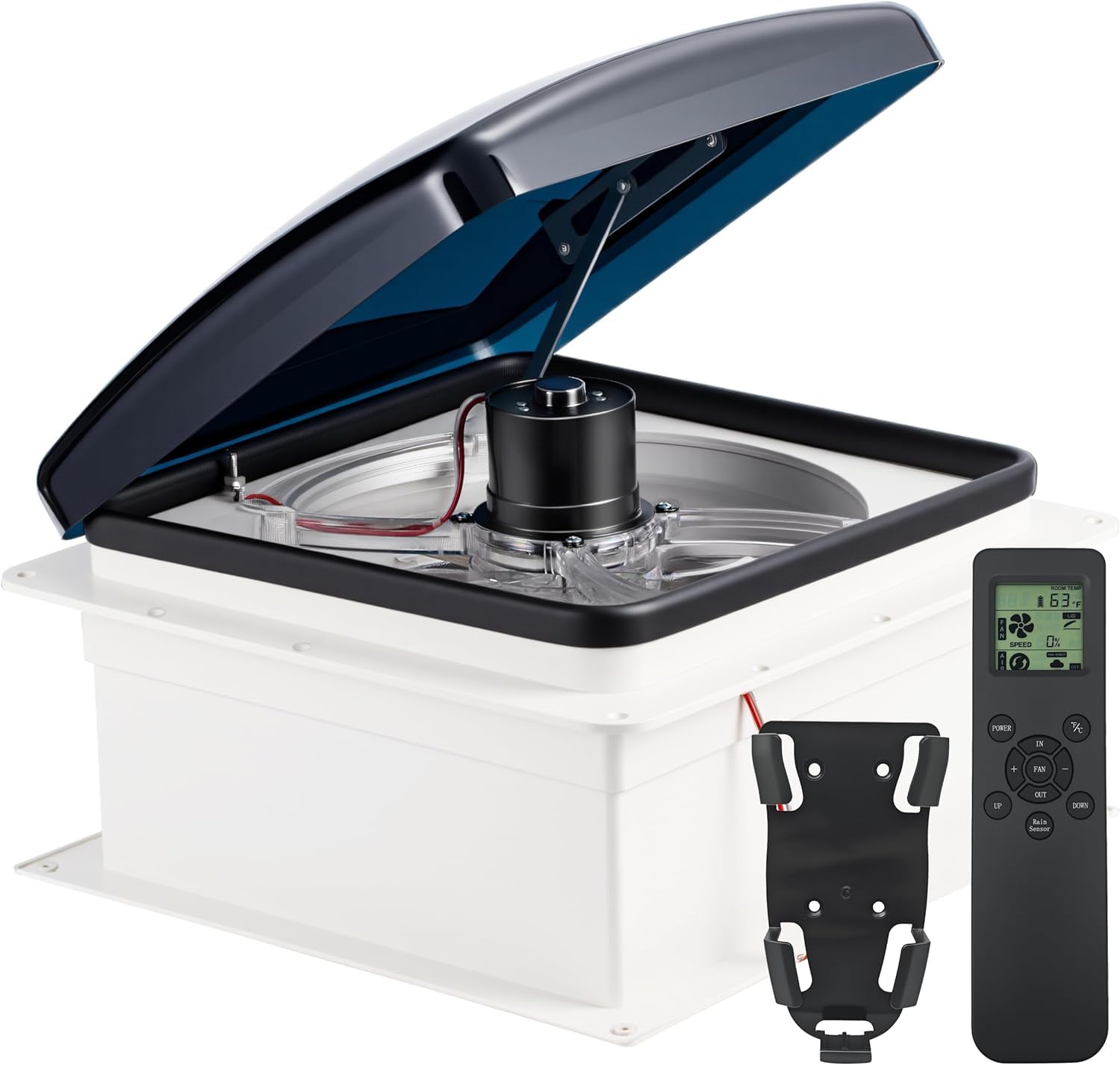
This is the fan that solves the “rush to close the vent when it rains” problem for good. The integrated rain sensor automatically seals the lid when precipitation hits, and with 10 speeds controlled via remote, you can dial in exactly the airflow you need — a gentler low for sleeping or a full 950 CFM blast to clear cooking steam in seconds. The UV-resistant polycarbonate lid holds up better than cheap ABS under direct sun exposure, and the included extra screen frame means you aren’t hunting for a replacement when the original gets grimy.
At 24W on low, it sips power gently enough to run all night on a 100Ah battery without triggering your low-voltage cutoff. Owners consistently report it’s quieter than comparable Fantastic Fan units, with the motor producing a smooth hum rather than a rattling drone. The matte finish doesn’t glare, and the remote (though not backlit) covers full intake/exhaust reversal so you can pull fresh air in on cool mornings.
Installation is straightforward if you have a 14×14-inch rough opening already cut; the unit sits flush against the roof membrane with a foam gasket. The only catch is that the rain sensor must be manually enabled each time you power on — it doesn’t remember your preference between restarts. For full-timers who want smart automation with zero drilling or wiring fuss, this is the most feature-dense roof fan in the sub- bracket by a wide margin.
Why it’s great
- Rain sensor auto-closes without any app or smart-home hub
- 10 speeds offer fine granularity for silent nighttime ventilation
- Extra screen frame saves future replacement cost
Good to know
- Rain sensor must be re-enabled on every power cycle
- Remote is large and lacks backlighting for dark cabins
2. Comoistar 8.5″ Wall Mounted Oscillating Fan

If you don’t want to cut a hole in your roof but still need serious airflow, this wall-mounted unit is the answer. The patented JIWAN motor pushes 1900 CFM — more than most roof fans — and the 90-degree oscillation combined with 120-degree tilt means you can aim the breeze exactly where you need it, whether that’s your bed, the galley counter, or the dinette. The seven-blade design is noticeably quieter than three-blade equivalents at the same speed, producing a soft whoosh rather than a buzz.
The magnetic remote sticks to any metal surface, which is handy inside a van where counter space is limited. Timer settings (0.5, 1.5, 4, and 8 hours) let you set it to run while you fall asleep and then shut off automatically, saving battery overnight. Installation is simple: screw the included bracket into a stud or use the adhesive pad (rated for 40 lb) on smooth walls — but note the box doesn’t include drywall anchors, so you’ll need to grab those separately.
It runs on AC via a 12V adapter, meaning you plug it into a standard household outlet powered by your inverter. That’s fine for vans with built-in inverters, but if you’re running on pure DC, you’ll need to account for the inverter draw. Customer reports mention a slight wobble on a small number of units, but the seller reportedly replaces defective units promptly. For wall-mount circulation with remote convenience, this is the quietest high-CFM option in its price tier.
Why it’s great
- 1900 CFM airflow exceeds most 14-inch roof fans in raw volume
- Magnetic remote prevents losing it inside a small van
- Timer settings allow automatic shutoff for battery preservation
Good to know
- AC-powered via adapter — requires an inverter or wall plug
- No drywall anchors included for wall mounting
3. Caframo Ultimate 757 7-Inch 12V Fan

When every inch of space and every milliamp of battery matters, the Caframo 757 is the smallest footprint solution that actually moves air. The grill-free design relies on patented Finger Safe blades — flexible plastic that stops when it contacts skin — which is a real safety boost if you’ve got children or pets in the van. At just 6 inches of blade length and a 7-inch housing, it fits into nooks where no other fan can go, like above the cab bunk or beside the fridge compartment.
It draws remarkably low current: on low speed it pulls under 0.5A, making it one of the most battery-friendly 12V fans you can hardwire. The two-speed switch is tactile and easy to find in the dark, and the tilting head lets you direct airflow upward toward the ceiling or downward toward a sleeping bag. Owners report the high speed moves surprising air volume for its size — enough to cool a poorly insulated camper on a hot night without draining the house bank.
The permanent mount requires direct wiring (no cigarette plug included), which is ideal for vans with a distribution panel but less convenient for plug-and-play setups. The powder-coated black finish resists corrosion in humid environments. It won’t replace a roof fan for ventilation, but as a personal bunk circulator that runs silently for hours, it’s the most efficient compact unit you can hardwire into a 12V system.
Why it’s great
- Grill-free safe blades eliminate pinch risk in tight van bunks
- Extremely low amp draw — runs all night on minimal battery
- Compact 7-inch size fits in spaces too small for standard fans
Good to know
- Direct-wire design only — no 12V plug adapter included
- 200 CFM is modest; best for personal spot cooling, not whole-van ventilation
4. Beech Lane 12V RV Fridge Ventilation Fan

This isn’t a general cabin fan — it’s a targeted solution for one of the most frustrating 12V problems: an absorption fridge that can’t keep up in hot weather. The Beech Lane unit mounts behind your exterior fridge vent and uses two 5.5-inch fans to pull hot air off the heat exchanger, dropping the interior fridge temperature by 10°F or more in summer conditions. The included temperature probe lets you set a threshold — when the temp behind the fridge rises above it, the fans automatically ramp up from low to high speed.
The remote control supports both manual override and auto mode, so you can run the fans continuously on low if you’re parked in direct sun, or let the probe handle it while you’re away. At 25 dB on low speed, it’s nearly silent — you won’t hear it running inside the van. The custom mounting brackets are designed specifically for American RV side vents, so installation doesn’t require zip ties or drilling new holes, though some owners report the clips don’t fit all Dometic vents, requiring a minor adaptation.
The unit is about 1–1.5 inches thick, so check your vent cavity depth before buying. For vans with absorption fridges — common in older Class B rigs and many towables — this single upgrade can prevent spoiled food and extend fridge life by reducing compressor runtime. It’s a specialty item, not a general fan, but if your fridge struggles in July, nothing else on this list addresses that specific pain.
Why it’s great
- Drops fridge internal temperature by up to 10°F in high heat
- Auto mode with temperature probe eliminates manual guessing
- Very quiet at 25 dB on low — inaudible inside the van
Good to know
- Custom brackets may not fit all Dometic/lower vent widths
- Only useful for fridge ventilation — not a cabin air circulator
5. BLACKHORSE-RACING 14″ RV Roof Vent

If your existing roof vent is cracked or leaking and you need a fast, affordable replacement, this BLACKHORSE-RACING unit delivers a complete swap kit in one box. It includes 70 inches of 3/4-inch butyl tape, mounting screws, and a strong fine-mesh screen — everything except the caulk. The zero-leak mounting system avoids drilling into your roof surface, using surface-mount flanges that seal against the existing hole with the butyl tape forming a watertight gasket.
The 12V fan uses 6-inch plastic blades that move a modest amount of air — enough to exhaust bathroom steam or kitchen odors, but not as powerful as premium units. The manual crank handle opens and closes the lid, and the white wedge-style lid matches standard RV aesthetics. Build quality is all-plastic, which keeps weight down but means the lid may degrade faster under constant UV exposure in desert climates, as some buyers mention. At roughly half the price of a comparable Fan-Tastic Vent replacement, it’s a pragmatic stopgap or build-out starter fan.
Installation took most DIY owners under 40 minutes, and the fit on standard 14×14-inch openings is snug without being too tight. The fan noise is present but not offensive; it’s comparable to a standard bathroom exhaust fan. For a weekend camper or a van build on a tight budget, this unit gets the hot air out without requiring a second mortgage.
Why it’s great
- Complete kit with butyl tape and screws — no extra parts needed
- Zero-leak design avoids drilling into the roof surface
- Budget-friendly price comparable to RV supply store alternatives
Good to know
- All-plastic construction is less durable under intense UV exposure
- Crank mechanism feels less robust than premium metal-gear units
6. Ventline RV Roof Vent with 12V Fan

The Ventline is a no-nonsense direct replacement for any RV or camper roof vent with a 14.25 x 14.25-inch rough opening — most commonly found in bathroom or galley roofs. The wedge-shaped lid is aerodynamic enough to reduce wind drag while driving, and the painted white finish blends seamlessly with standard RV gelcoat. It includes putty tape and screws, so you literally have everything needed to swap out a broken unit in under an hour.
The 12V exhaust fan is controlled by a simple button on the garnish ring — no remote, no timer, no rain sensor. It’s a single-speed manual operation: push to turn on, push again to shut off. Customer feedback confirms it’s surprisingly quiet for a basic unit, which is rare in the budget roof-fan segment. The galvanized mounting flange provides solid structural support, though the edges are sharp — handle with gloves during installation.
The main durability concern is the plastic hinge on the lid; it’s opened and closed by a knob rather than a crank handle, and owners of older models report the hinge can crack after a few years of use. For a weekend camper or as a stopgap until you install a nicer unit, it’s an effective, affordable solution that moves air reliably without electronics to fail.
Why it’s great
- Plug-and-play fit for standard 14.25-inch RV roof openings
- Quieter than expected for a basic single-speed 12V fan
- Includes putty tape and screws for immediate installation
Good to know
- Plastic hinge may crack over time compared to metal-hinged units
- No remote, no variable speed, no rain sensor
7. HENG’S INDUSTRIES 14″ RV Roof Vent Fan

This is the bare-bones option for a standard 14.5 x 14.5-inch roof rough opening — the most common size in older RVs and many van conversions. The white wedge lid is basic but functional, and the manual crank handle opens the lid smoothly without sticking. A mesh screen keeps bugs out while the 12V powered fan runs on a simple button control. No variable speed, no reverse function, no extras — just exhaust air when you need it.
The exterior mounting flange measures 16.5 x 16.5 inches, so it overhangs the opening generously, and the 1-inch garnish ring has a 1.25-inch wide flange that trims out the interior ceiling. The metal flange edges are extremely sharp — multiple reviews mention this caution, so wear gloves during installation. Owners note it’s slightly noisier than higher-end models, but the price point makes the trade-off acceptable for a basic upgrade or replacement.
It does not include any mounting hardware; you must supply your own caulk, putty tape, and screws. For DIY builders who already have sealant and fasteners on hand, this isn’t a problem. If this is your first roof vent install, the lack of instructions might be confusing, but there are plenty of YouTube guides specific to Heng’s vents. For the budget-conscious builder who needs a fan in the roof before summer hits, this is the cheapest reliable option that actually fits standard openings.
Why it’s great
- Universal fit for 14.5 x 14.5-inch roof openings — most common size
- Manual crank lid provides positive seal without electric actuators
- Extremely budget-friendly entry point for van conversion builds
Good to know
- No mounting hardware or instructions included
- Noticeably noisier than mid-range and premium roof vent fans
FAQ
Can I run a 12V roof fan all night without draining my battery?
How do I know if my van roof opening is 14×14 or 14.5×14.5?
Do I need a rain sensor for a camper van fan?
Final Thoughts: The Verdict
For most users, the 12v fan for camper van winner is the RVLOVENT 14×14 10-Speed because it combines rain-sensor automation, 10-speed control, and ultra-quiet 24W operation in a single package that fits the standard 14×14 roof opening — no compromises on features or battery life. If you want wall-mount circulation without cutting into your roof, grab the Comoistar 8.5″ Oscillating Fan for its 1900 CFM output and magnetic remote. And for the tightest nooks with the lowest amp draw, nothing beats the Caframo Ultimate 757 as a personal bunk fan that runs silently all night.

Mo Maruf
I created WellFizz to bridge the gap between vague wellness advice and actionable solutions. My mission is simple: to decode the research and give you practical tools you can actually use.
Beyond the data, I am a passionate traveler. I believe that stepping away from the screen to explore new environments is essential for mental clarity and physical vitality.