Our readers keep the lights on and my smoothie glass nicely filled. As an Amazon Associate, I earn from qualifying purchases.
Choosing a 12V deep cycle battery is no longer a simple choice between a standard lead-acid unit and a premium alternative. The market has split into distinct chemistries and build philosophies, with lithium iron phosphate (LiFePO4) rewriting the rules on lifespan, weight, and usable capacity. Whether you are powering a trolling motor, an off-grid solar shed, or an RV electrical system, the fundamental spec sheet has changed.
I’m Mohammad Maruf — the founder and writer behind WellFizz. I’ve spent years analyzing battery chemistries, BMS architectures, and real-world discharge curves to separate marketing claims from genuine performance gains in the deep-cycle space.
After evaluating capacity tests, cycle-life claims, and user-verified runtime data across dozens of models, I’ve built this guide to help you find the best 12v deep cycle battery for your specific setup, whether that means sticking with tried-and-true AGM or jumping to lightweight lithium.
How To Choose The Best 12V Deep Cycle Battery
Deep cycle batteries are built to discharge a steady current over long periods, unlike starter batteries that deliver short, high-current bursts. The right choice hinges on chemistry, capacity, and how you plan to recharge. Ignoring any of these three factors leads to premature failure or wasted money.
Chemistry: LiFePO4 vs. AGM vs. Flooded Lead-Acid
Lithium iron phosphate (LiFePO4) offers the highest cycle life (4,000 to 15,000 cycles), weighs a third of an equivalent lead-acid battery, and maintains a flat voltage curve until nearly empty. AGM (absorbent glass mat) lead-acid is cheaper upfront, spill-proof, and requires no maintenance — but typically lasts only 300 to 500 cycles. Flooded lead-acid is the least expensive but needs periodic water refills and ventilation. For most modern setups — RV, marine, solar — LiFePO4 pays for itself over its lifetime through longer service and higher usable capacity (80–100% depth of discharge vs. 50% for lead-acid).
Capacity and Usable Energy
Amp-hour (Ah) rating tells you how much energy the battery can store, but usable energy depends on chemistry. With a lead-acid battery, you should only discharge to about 50% depth of discharge (DoD) to avoid damage, cutting usable capacity in half. A 100Ah lead-acid battery gives you roughly 50Ah of usable energy. A 100Ah LiFePO4 battery can be safely discharged to 80–100% DoD, delivering 80–100Ah of usable energy. Always calculate your daily watt-hour consumption and choose a capacity that gives you at least a 20% buffer.
BMS Protection and Temperature Management
A Battery Management System (BMS) is non-negotiable for lithium batteries. It protects against overcharge, over-discharge, short circuits, and overcurrent. For cold-weather use, look for low-temperature charging protection that cuts off charging below freezing (usually around 32°F / 0°C) to prevent permanent cell damage. Some premium models include low-temperature discharging protection as well. Without these features, charging a LiFePO4 battery below freezing can cause irreversible damage.
Physical Size and Terminal Type
Battery group sizes (like Group 24, Group 27, Group 31) standardize dimensions to fit common battery trays. Check your existing compartment depth, width, and height before ordering. Terminal type also matters: F2 terminals are common on smaller batteries, while M6 or M8 threaded posts are standard on larger units. Make sure your cable lugs match the terminal stud size — M8 bolts accept a 5/16-inch ring terminal.
Quick Comparison
On smaller screens, swipe sideways to see the full table.
| Model | Category | Best For | Key Spec | Amazon |
|---|---|---|---|---|
| Litime 100Ah TM | LiFePO4 | Marine & Trolling Motors | 22.16 lbs; 100A BMS; TVS | Amazon |
| Power Queen 100Ah | LiFePO4 w/ Bluetooth | Long Runtime Marine | 24.25 lbs; 15k cycles | Amazon |
| ECO-WORTHY 280Ah | LiFePO4 | High-Capacity RV & Solar | 200A BMS; Bluetooth | Amazon |
| DUMFUME 150Ah | LiFePO4 | Solar & Backup Power | 1920Wh; 100A BMS; 22.05 lbs | Amazon |
| Sefepoder 20Ah 2-Pack | LiFePO4 | Small Electronics & Toys | 7.93 lbs total; 40A BMS | Amazon |
| Goldenmate 20Ah 2-Pack | LiFePO4 | Lightweight UPS & Scooter | 5.3 lbs each; 5000+ cycles | Amazon |
| HRBEENERGY 100Ah | LiFePO4 | Waterproof Solar & Marine | IP67 case; 100A BMS; 19.4 lbs | Amazon |
| WEIZE 100Ah AGM | AGM Lead-Acid | Budget Off-Grid Backup | 63 lbs; Group 31; 1150A max | Amazon |
| Mighty Max 100Ah | AGM Lead-Acid | Affordable Trolling & Solar | 28 lbs; Group 27; UL Certified | Amazon |
In‑Depth Reviews
1. Litime 12V 100Ah Trolling Motor LiFePO4 Battery

The Litime 100Ah trolling motor battery hits the sweet spot between marine-grade durability and everyday usability. Its 100A BMS includes TVS (transient voltage suppression) circuitry that shields connected electronics from voltage spikes, a crucial feature when running sensitive fish finders or GPS units. Weighing just 22.16 pounds in a standard Group 31 footprint, it sheds roughly 40 pounds compared to an equivalent AGM battery, making it far easier to handle in a boat compartment.
Real-world reports from anglers running 45- to 80-pound thrust motors show that a full day on the water — from dawn to dusk — rarely dips below 30% state of charge, thanks to the flat discharge curve typical of LiFePO4 chemistry. The low-temperature protection prevents charging below 32°F, which is a critical safety net for overnight storage in cold climates. The battery also meets ABYC E-13 standards, adding an extra layer of certification for marine use.
One caveat: some units arrive in sleep mode and require a charger with a force/activate mode to wake them, which isn’t clearly documented in the quick-start guide. Once running, however, the battery delivers consistent voltage across the entire discharge band. For demanding marine environments where weight, safety, and spike protection are priorities, this is the most balanced choice on the list.
Why it’s great
- TVS-protected BMS shields electronics from voltage spikes
- 64% lighter than equivalent lead-acid Group 31
- Excellent runtime – less than 20% use per 5-hour fishing trip
Good to know
- May arrive in sleep mode requiring a wake-up charge
- No Bluetooth or app-based monitoring built in
2. Power Queen 12V 100Ah LiFePO4 Battery
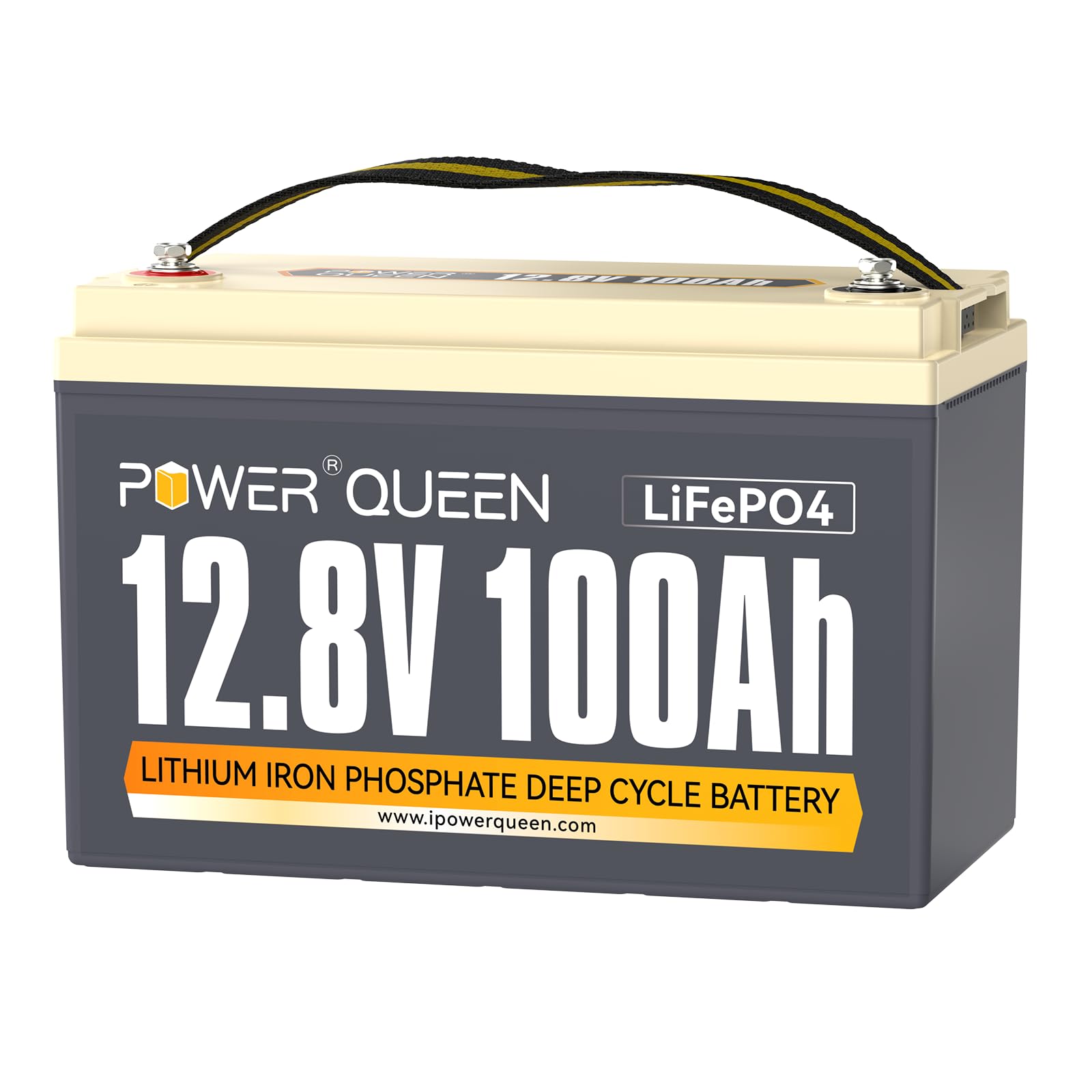
Power Queen’s 100Ah battery distinguishes itself with an integrated Bluetooth module, letting you monitor voltage, current, and state of charge from your phone without needing a separate shunt display. That convenience pairs with exceptional cycle-life claims — up to 15,000 cycles at shallow discharge depths — and a 100A BMS that handles overcharge, over-discharge, and short-circuit protection. At 24.25 pounds, it’s still a fraction of the weight of an AGM equivalent.
Anglers running 55-pound thrust trolling motors alongside Livescope and dual Garmin screens report all-day runtime from 6 a.m. to 6 p.m. at 70% speed, with voltage hovering around 13.0–13.1V after hours of use. Multiple owners have verified that the battery delivers slightly over 100Ah in capacity tests, a reassuring sign that the Grade-A cells are properly matched. The flat voltage plateau means you don’t lose performance until the battery is nearly depleted.
The terminal bolts and included accessories are well-packaged, but the battery lacks the TVS spike protection found on the Litime unit, so sensitive electronics benefit from an inline fuse. Setup is straightforward for anyone familiar with lithium batteries, and the Bluetooth app offers a helpful real-time glance at remaining capacity. For users who want remote monitoring without extra hardware, this is the leading option.
Why it’s great
- Built-in Bluetooth for real-time monitoring
- Rated for up to 15,000 deep cycles
- Verified capacity exceeds 100Ah in independent tests
Good to know
- No TVS protection for voltage spikes
- Slightly heavier than some Group 31 competitors
3. ECO-WORTHY 3584Wh 12V 280Ah LiFePO4 RV Battery
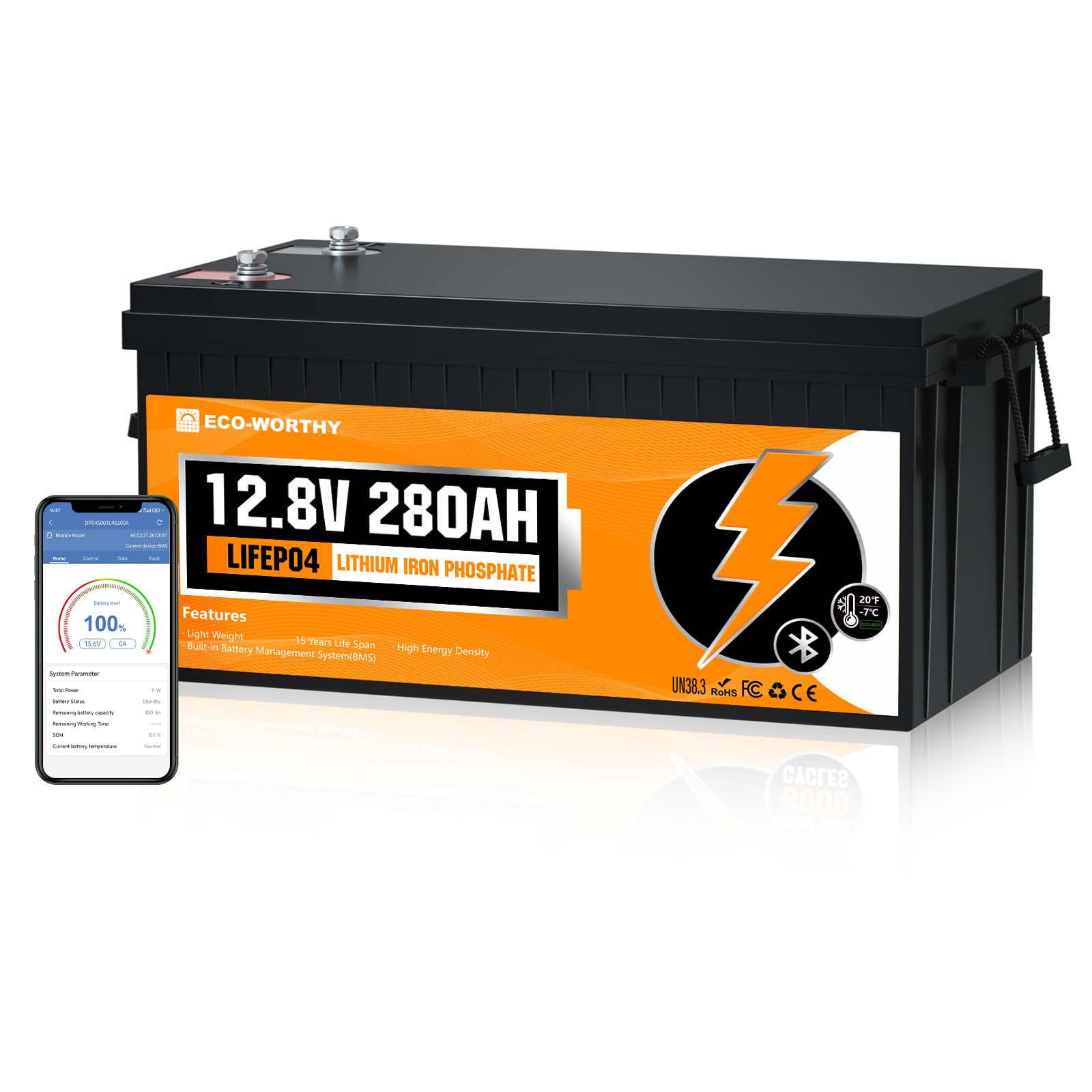
ECOWORTHY’s 280Ah battery is a powerhouse designed for serious off-grid setups. With 3,584 watt-hours of storage and a 200A BMS, it can comfortably run a microwave, induction cooktop, and 2,000W inverter without breaking a sweat. The metal case with an internal compression fixture prevents cell expansion over time — a concern with prismatic LiFePO4 cells — and the front-facing terminals simplify wiring in tight RV compartments.
The built-in Bluetooth module uses a JBD-based BMS that is also compatible with Overkill Solar’s app, giving you granular visibility into cell voltages, balance delta, and temperature. Owners running dual 280Ah units in a travel trailer report weeks of off-grid living without dropping below safe voltage limits, even in snow conditions down to 20°F. The low-temperature cutoff stops charging below 19.4°F, which is a tighter threshold than many competitors’ 32°F cutoff.
The unit weighs 61.7 pounds, roughly the same as a 100Ah AGM, but delivers nearly three times the usable capacity. The app can occasionally disconnect at the maximum Bluetooth range of roughly 15 meters, but reconnection is quick. For RV owners or cabin users who need the highest capacity in a single-battery footprint and value compression-controlled longevity, this battery offers unmatched value-per-amp-hour.
Why it’s great
- Massive 3584Wh capacity in one unit
- Metal case with compression fixture prevents cell swelling
- JBD BMS compatible with advanced monitoring apps
Good to know
- Heavy at 61.7 lbs – similar to lead-acid weight
- Bluetooth range limited to roughly 15 meters
4. DUMFUME 12V 150Ah LiFePO4 Deep Cycle Battery
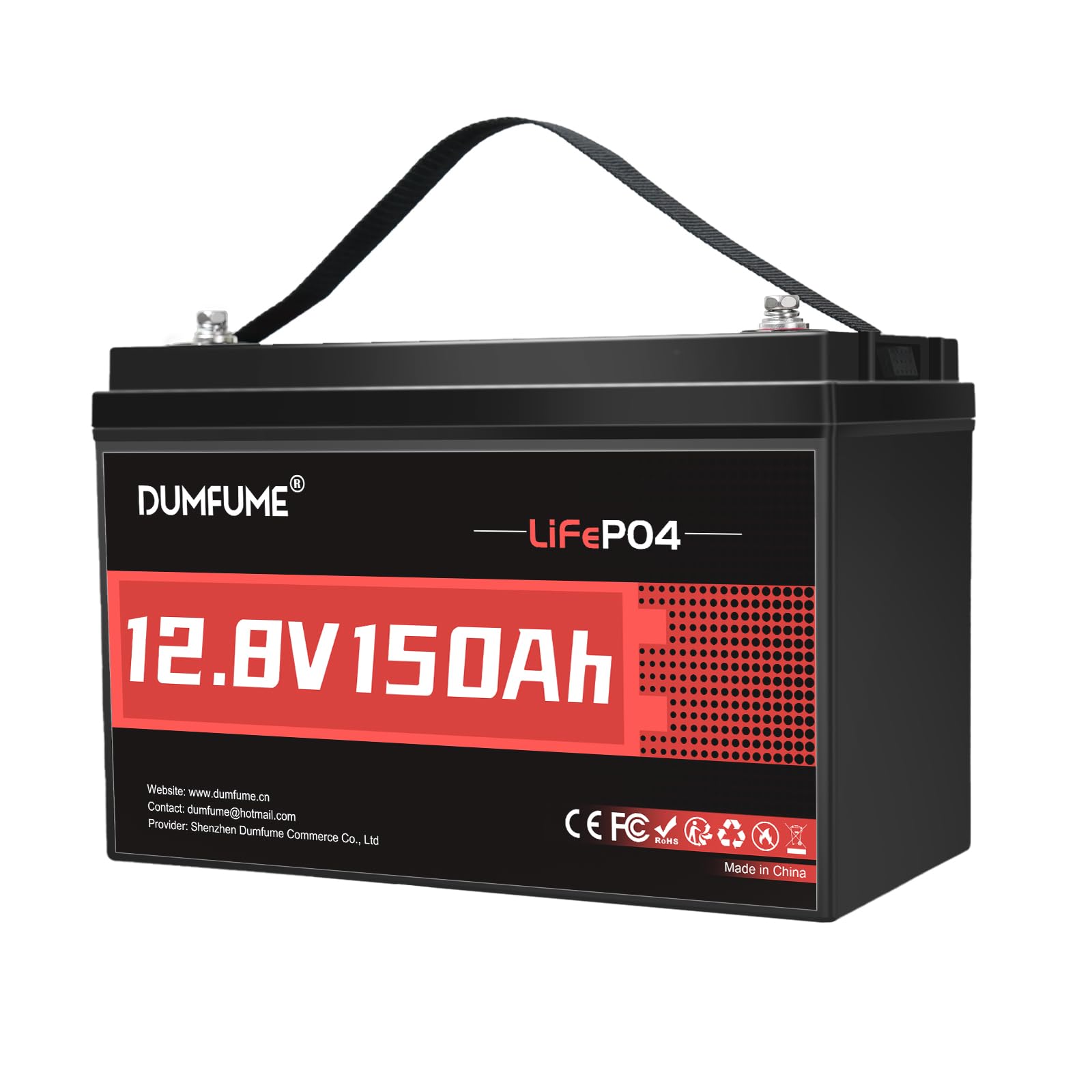
The Dumfume 150Ah battery packs 1,920 watt-hours into a Group 31-compatible footprint weighing just 22.05 pounds. That weight-to-energy ratio is exceptional for a sub- battery at this capacity level, making it a strong candidate for solar-powered sheds, camper vans, and backup power stations where every pound matters. The 100A BMS covers the standard protection suite — overcharge, over-discharge, short circuit, and overheating — with a low-temperature cutoff to prevent charging below freezing.
Independent capacity tests show the battery actually exceeds its 150Ah rating by roughly 7 amp-hours, a pleasant surprise for users who rely on accurate state-of-charge planning. Owners of 36V and 48V golf carts have successfully configured four units in series, reporting that the BMS wakes up with a standard charger after an initial current spike that can cause a shutdown during the first connection. Once cycled, the battery holds stable voltage under continuous 50A loads.
Shipping quality has been mixed — some units arrive at partial charge or with visible box damage — but Dumfume’s customer service has generally responded quickly with replacements. The lack of Bluetooth monitoring means you’ll need an external shunt to track capacity accurately. For a no-frills, high-density lithium upgrade at a competitive price point, this battery delivers where it counts: raw capacity and weight savings.
Why it’s great
- 150Ah capacity at only 22.05 lbs
- Verified to exceed rated capacity in tests
- Supports series and parallel up to 4S4P
Good to know
- No Bluetooth monitoring included
- Some units arrive with low charge or damaged packaging
5. SEFEPODER 12V 20Ah LiFePO4 Battery 2-Pack

The Sefepoder 2-pack delivers two 20Ah LiFePO4 batteries at a combined weight of just 7.93 pounds — roughly the same weight as a single 7Ah lead-acid but with nearly three times the usable capacity. Each unit features a built-in 40A BMS with protection against overcharge, over-discharge, overcurrent, and short circuits, plus the ability to connect up to four units in series or parallel. The F2 terminals make it a direct drop-in replacement for many ride-on toys, electric scooters, and UPS backup systems that originally used sealed lead-acid batteries.
Users running these in 200W inverter setups for shed lighting and security cameras report that the batteries maintain voltage above 13V even after multiple cloudy winter days, never dropping below 75% state of charge. The compact dimensions (5.94 x 3.85 x 3.74 inches per cell) allow flexible placement in tight enclosures. A key detail: the batteries arrive at roughly 30% state of charge and require a LiFePO4-specific charger to reach full capacity — standard SLA chargers may not bring them to 100%.
The 20Ah capacity per battery is best suited for low-draw applications like fish finders, ham radios, or small lighting loads rather than high-current setups like large trolling motors. Some users noted the included manual is basic, so those new to lithium chemistry should plan to research proper charging profiles. For lightweight, small-capacity needs where two batteries are better than one, this kit offers excellent value.
Why it’s great
- Extremely lightweight – 7.93 lbs for 40Ah total
- Direct F2 terminal replacement for SLA devices
- Supports series and parallel connections
Good to know
- Requires a LiFePO4-specific charger for full charge
- Basic documentation – best for experienced lithium users
6. GOLDENMATE 12V 20Ah LiFePO4 Battery 2-Pack

Goldenmate’s 20Ah 2-pack weighs in at only 5.3 pounds per battery, making these some of the lightest 12V deep cycle units available at this capacity. Each battery uses M6 threaded terminals instead of F2 spade connectors, which provides a more secure connection under vibration and supports higher continuous discharge current — verified when a user accidentally blew a 30A fuse due to the battery’s ability to deliver well above its rated current. The 5000+ cycle rating at 80% depth of discharge means these could outlast the devices they power.
These batteries are a popular drop-in upgrade for UPS backup systems originally designed for lead-acid. One user replaced 9Ah SLA batteries in a UPS and saw runtime increase from 396 minutes to 420 minutes at a light load, with a slower voltage sag and faster recharge (5A vs. the old 2.7A rate). The BMS includes the standard protections plus UL1642 and IEC62133 cell-level certifications, adding confidence for safety-conscious buyers.
The primary downside reported by multiple users is slower-than-average shipping and occasional delays in fulfillment. The M6 terminals also require ring terminals rather than the F2 connectors common on smaller SLA batteries, so some buyers need to swap cable ends. For lightweight, high-cycle applications like UPS backup, power wheels, or small security cameras, these batteries deliver performance that far exceeds the weight and size of the lead-acid units they replace.
Why it’s great
- Ultra-lightweight at 5.3 lbs per battery
- 5000+ cycles at 80% depth of discharge
- High current output capability
Good to know
- Slow shipping times reported
- M6 terminals may require ring terminal adapters
7. HRBEENERGY 12.8V 100Ah LiFePO4 Deep Cycle Battery

The HRBEENERGY 100Ah battery is built for wet environments, sporting an IP67 waterproof case that allows direct mounting in marine bilge compartments, open bow areas, or anywhere splashes and rain are a concern. It fits a BCI Group 24 footprint but delivers the capacity of a much larger Group 31 lead-acid, weighing only 19.4 pounds — roughly 40% lighter than a comparable AGM. The 100A smart BMS handles overcharge, over-discharge, overcurrent, short circuit, and low/high temperature cutoffs.
Owners using six of these batteries in a combination of series (for a 36V golf cart) and parallel (for an RV house bank) report consistent performance: three in series run a golf cart for 10 hours, while three in parallel support an RV off-grid for 3–4 days continuously. The 8000+ cycle rating at shallow discharge depths is well above average, and the battery delivers slightly over 100Ah in capacity tests when new. The 10-year manufacturer warranty is one of the longest in this price tier.
Some users noted the low-voltage cutoff shuts down at around 9.5V rather than the more typical 10V, and the BMS re-enables after a few minutes before cutting again — a peculiar behavior that may confuse those unfamiliar with LiFePO4 protection profiles. For marine and outdoor installations where water resistance is a deciding factor, this battery’s IP67 rating and lightweight build make it a compelling choice.
Why it’s great
- IP67 waterproof case for marine/wet conditions
- Only 19.4 lbs – 40% lighter than AGM
- 8000+ cycle rating and 10-year warranty
Good to know
- Low-voltage cutoff behavior can be confusing
- Group 24 size may require tray modification
8. WEIZE 12V 100Ah Deep Cycle Battery

The WEIZE 100Ah AGM battery is a straightforward, no-frills deep cycle option for those who don’t need the cycle life or weight savings of lithium. It uses sealed absorbed glass mat (AGM) technology, meaning it is maintenance-free and spill-proof, and it fits the popular Group 31 footprint. At 63 pounds, it’s heavy, but that weight translates to a robust lead skeleton that handles vibration and moderate discharge loads well. The 1150A maximum discharge current allows it to handle brief high-draw events like starting small generators or powering inverters.
Users running a 300W solar setup with two of these batteries report reliable off-grid RV performance for extended periods, powering a 700W inverter for 120V appliances without issue. The recommended float voltage of 13.8V and cyclic voltage of 14.4V are standard for AGM, and the battery holds charge well with a self-discharge rate of roughly 3% per month. Multiple owners have stacked four units in parallel for a 400Ah (50% usable) backup system feeding a 2000W inverter for whole-room backup during outages.
The main trade-off is the 300–500 cycle lifespan typical of AGM chemistry — you will replace this battery several times over the life of a single LiFePO4 unit. It also delivers only about 50Ah of usable energy (at 50% depth of discharge), whereas a 100Ah lithium battery would give you 80–100Ah. For budget-conscious buyers who need reliable power today and don’t want to invest in a lithium charger or BMS, the WEIZE AGM remains a sensible choice.
Why it’s great
- Durable AGM construction – no maintenance or spill risk
- 1150A peak discharge for inverter starting surges
- Excellent 3% self-discharge rate during storage
Good to know
- Heavy at 63 pounds
- Only 300-500 cycles – shorter lifespan than lithium
9. Mighty Max Battery 12V 100Ah Deep Cycle Battery

The Mighty Max ML100-12 is a long-standing entry in the AGM deep cycle market, offering a 100Ah capacity in a Group 27 case. It is UL certified and uses spill-proof AGM construction that can be mounted in any orientation. At 28 pounds, it is significantly lighter than the WEIZE Group 31 AGM, though still heavier than a comparable Group 27 LiFePO4 battery. The high discharge rate and wide operating temperature range make it a versatile option for trolling motors, solar storage, and backup power.
Owners using this battery with a 44-pound thrust trolling motor report runtime exceeding 8 hours while still retaining 35% capacity, a solid result that beats older lead-acid units by a wide margin. In van conversions, replacing a house battery with the ML100-12 resulted in consistent full-charge readings (4 indicator lights) after overnight use of lights, TV, and a computer — outperforming older batteries that dropped to 2–3 lights. The battery also handles high temperatures without the gassing issues of flooded lead-acid.
The return policy is less forgiving than some competitors: Amazon covers returns for 30 days, after which the 1-year manufacturer warranty applies, but the buyer pays return shipping. Some users have noted minor capacity differences when paralleling multiple units, so matched batteries are recommended for bank setups. For a well-priced, UL-certified AGM with proven long-term performance in solar and marine applications, this battery has a strong track record.
Why it’s great
- UL certified and maintenance-free AGM design
- Lightweight for a lead-acid at 28 lbs
- Proven 8+ hour runtime on trolling motors
Good to know
- Return shipping costs after 30 days
- Capacity variation when paralleling multiple units
FAQ
Can I charge a LiFePO4 battery with my existing lead-acid charger?
What is the difference between CCA and deep cycle rating?
How many years will a LiFePO4 deep cycle battery last?
Can I connect a lithium battery in parallel with a lead-acid battery?
Why does my LiFePO4 battery shut off when I connect a high-draw device?
Final Thoughts: The Verdict
For most users, the best 12v deep cycle battery winner is the Litime 100Ah because its TVS-protected BMS meets ABYC E-13 marine standards, it weighs less than 23 pounds, and certified users report a full day of trolling motor use without recharging. If you want built-in Bluetooth monitoring without an external shunt, grab the Power Queen 100Ah. And for the highest single-unit capacity at the best cost-per-amp-hour, nothing beats the ECO-WORTHY 280Ah with its metal compression case and JBD BMS.

Mo Maruf
I created WellFizz to bridge the gap between vague wellness advice and actionable solutions. My mission is simple: to decode the research and give you practical tools you can actually use.
Beyond the data, I am a passionate traveler. I believe that stepping away from the screen to explore new environments is essential for mental clarity and physical vitality.