Our readers keep the lights on and my smoothie glass nicely filled. As an Amazon Associate, I earn from qualifying purchases.
Building a serious home theater means moving beyond basic 5.1 or 7.1 setups. An 11.2 AV receiver is the central nervous system of a room designed for object-based audio like Dolby Atmos and DTS:X, where you need dedicated amplification for front, surround, rear, and height channels to create a true three-dimensional sound bubble. The wrong choice here locks you into a layout you will outgrow within a year.
I’m Mohammad Maruf — the founder and writer behind WellFizz. I’ve spent months analyzing the hardware specifications, real-world measurements, and user feedback across every major 11.2-channel receiver on the market to separate the true performers from the overpriced feature lists. My research digs into DAC quality, amplifier topology, room correction depth, and HDMI 2.1 stability — the specs that actually determine whether your investment delivers.
Whether you are planning a dedicated media room or a high-end living space, choosing the right 11.2 av receiver comes down to power integrity, calibration accuracy, and build quality that will last through years of firmware updates and format changes.
How To Choose The Best 11.2 AV Receiver
An 11.2 receiver is a long-term investment. The key is matching its capabilities to your speaker layout now and in the future. Here are the critical factors to weigh before buying.
Amplifier Power and Channel Count
Not all 11.2 receivers deliver the same wattage to every channel simultaneously. Pay attention to the rated power at 8 ohms with all channels driven — that number tells you how cleanly the unit will drive demanding speakers during action sequences. A receiver rated for 140W per channel but tested at 170W delivers headroom; one that barely meets its spec will clip during loud passages.
Room Correction and Calibration Quality
Room acoustics eat sound quality for breakfast. Dirac Live Full Bandwidth is widely considered the gold standard for correcting frequency response and impulse response across multiple seating positions. Audyssey MultEQ XT32 and YPAO R.S.C. with 3D are strong alternatives, but Dirac’s deeper customization and bass control options give it a clear edge for enthusiasts who want precise subwoofer integration.
HDMI 2.1 and Gaming Features
If you game on a PS5, Xbox Series X, or PC with an RTX 30/40 series GPU, you need full 4K/120Hz and 8K/60Hz pass-through with VRR, ALLM, and QFT. Some receivers implement these features flawlessly; others have had known handshake issues. Verify that the model you choose passes these signals without forcing you to toggle settings repeatedly.
DAC and Pre-amp Quality
ESS Sabre DACs are the standard for high-end AV processing due to their low distortion and high dynamic range. A receiver with ESS Sabre chips will resolve finer detail in music and movie soundtracks compared to generic DAC implementations. If you plan to use the receiver as a preamp for external amplifiers, the DAC quality becomes even more critical.
Quick Comparison
On smaller screens, swipe sideways to see the full table.
| Model | Category | Best For | Key Spec | Amazon |
|---|---|---|---|---|
| Onkyo TX-RZ70 | Premium | Best Overall 11.2 AVR | 140W/ch, ESS Sabre DACs, Dirac Live | Amazon |
| Yamaha RX-A8A | Premium | Surround:AI and MusicCast | 11.2-ch processing, YPAO R.S.C. 3D | Amazon |
| Marantz SR8015 | Premium | High-current 11.2 with HEOS | 140W/ch, Audyssey MultEQ XT32 | Amazon |
| Sony STRAZ5000ES | Premium | 360 Spatial Sound Mapping | 130W/ch, D.C.A.C. IX | Amazon |
| Marantz Cinema 50 | Mid-Range | 9.4-ch with room to expand | 110W/ch, 4 sub outputs, Audyssey XT32 | Amazon |
| Yamaha RX-A6A | Mid-Range | 9.2 native with 11.2 processing | 9.2-ch, 11.2 processing, Surround:AI | Amazon |
| Onkyo TX-RZ50 | Mid-Range | 9.2 with Dirac and THX | 120W/ch, Dirac Live, THX Select | Amazon |
| JBL MA9100HP | Mid-Range | Compact 9.2 Class D design | 9.2-ch, Class D, 8K HDMI | Amazon |
| Onkyo TX-RZ30 | Mid-Range | 9.2 with Dirac Live out of box | 100W/ch, Dirac Live, THX | Amazon |
| Sony STR-AN1000 | Mid-Range | 7.2 with 360 Spatial Sound | 7.2-ch, D.C.A.C. IX, 8K | Amazon |
| Yamaha RX-A4A | Mid-Range | 7.2 with Auro-3D and pre-outs | 7.2-ch, Surround:AI, YPAO R.S.C. | Amazon |
| Yamaha RX-A2A | Value | Entry-level Aventage 7.2 | 7.2-ch, MusicCast, YPAO R.S.C. | Amazon |
| Denon AVR-S970H | Value | Budget 7.2 with HEOS | 90W/ch, 7.2-ch, HEOS, 8K | Amazon |
In‑Depth Reviews
1. Onkyo TX-RZ70 11.2-Channel AV Receiver
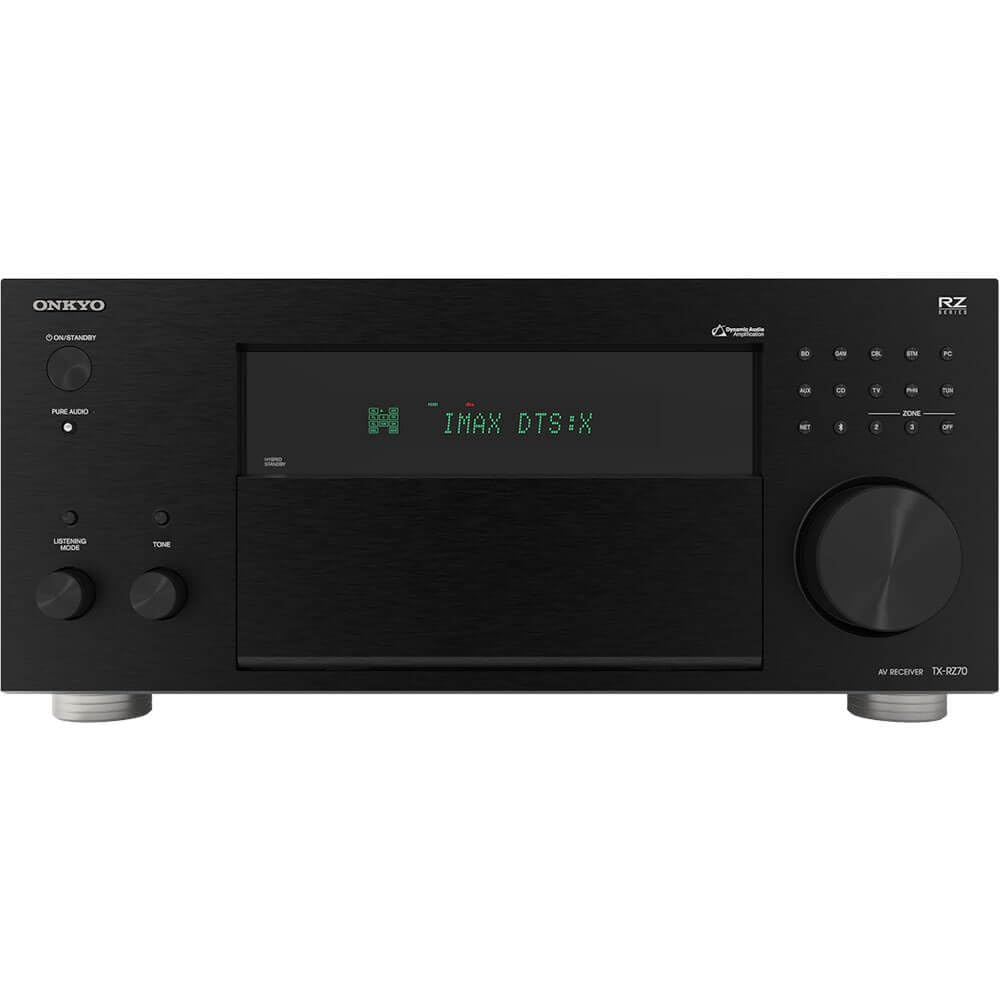
The Onkyo TX-RZ70 is the receiver that sets the benchmark in this category. It packs 140 watts per channel into an 11-channel layout, uses premium ESS Sabre DACs for pristine digital-to-analog conversion, and ships with Dirac Live Full Bandwidth room correction already included — no extra purchase required. That combination alone makes it a serious contender, but the real story is how cleanly it drives demanding 7.2.4 layouts without breaking a sweat.
Independent bench tests have measured the TX-RZ70 delivering over 170W per channel, proving its power supply has genuine headroom. It handles Dolby Atmos, DTS:X, Auro-3D, and IMAX Enhanced without any known HDMI handshake problems. The unit runs cool even at high volumes, a sign of competent thermal management. Owners report seamless integration with external amplifiers via 12V triggers, making it a viable pre-pro for those who want to power front speakers with separate amps.
The remote feels cheap for a receiver at this level, and the physical size is massive — you will need a full 19-inch wide cabinet with deep clearance. Zone 2 volume control is also a bit clunky. But for pure performance per dollar, no other 11.2 receiver delivers this level of DAC quality, room correction, and measured power output.
Why it’s great
- ESS Sabre DACs deliver exceptional clarity and detail
- Dirac Live Full Bandwidth included out of the box
- Measured 170W per channel in independent testing
- Runs cool with robust thermal management
Good to know
- Physically very large; requires deep cabinet
- Remote control feels cheap for the price tier
- Zone 2 volume control is poorly designed
2. Yamaha RX-A8A AVENTAGE 11.2-Channel AV Receiver

The Yamaha RX-A8A sits at the top of the Aventage lineup, processing 11.2 channels with a 9-channel amplifier and pre-outs for external amplification on the remaining channels. Its defining technology is Surround:AI, which analyzes audio in real-time and automatically adjusts surround parameters to enhance dialogue clarity and soundstage depth. YPAO R.S.C. with 3D and multipoint measurement handles room calibration with precision, though it lacks the full-bandwidth control of Dirac Live.
Users consistently praise the RX-A8A for its dynamic, engaging sound signature. Compared directly to the Onkyo RZ70 and Sony 5000ES, the Yamaha delivers punchy mid-bass and room-shaking low-end that makes action scenes feel visceral. The HDMI implementation handles 4K/120Hz and 8K/60Hz with VRR and ALLM, and the backlit remote is a welcome upgrade over many competitors. MusicCast provides robust multi-room streaming with support for TIDAL, Qobuz, and Spotify Connect.
The main drawbacks are the full-screen OSD during adjustments and a MusicCast app interface that wastes space on the input selection screen. Some users have reported HDCP 2.2 errors after firmware updates, requiring a restart to resolve. Set YPAO calibration using a tripod and disable speaker virtualization for Atmos setups to get the best results.
Why it’s great
- Surround:AI optimizes dialogue and effects in real-time
- Dynamic, engaging sound with punchy bass
- Backlit remote with pickup sensor
- MusicCast multi-room streaming platform
Good to know
- MusicCast app is not user-friendly
- Full-screen OSD during adjustments
- Occasional HDCP 2.2 issues after firmware updates
3. Marantz SR8015 11.2 Channel AV Receiver

The Marantz SR8015 is a flagship receiver that delivers 140 watts per channel across 11 channels, using custom high-current power transformers and HDAM discrete circuitry for a warm, detailed sound signature. Audyssey MultEQ XT32 provides deep room calibration with subwoofer EQ customization. It handles Dolby Atmos, DTS:X, and IMAX Enhanced with authority, making it a strong choice for rooms with 7.2.4 layouts.
Users pairing the SR8015 with Klipsch speakers report remarkably clear highs and a balanced low end that punches with clarity. The receiver runs cooler than many competitors due to its efficient power supply design, though it still needs 8 inches of clearance above. HEOS multi-room streaming is built-in, allowing seamless integration with other Marantz or Denon wireless speakers. The unit supports voice control via Alexa and Google Assistant.
The remote is a common complaint — it feels cheap and occasionally unresponsive. Subwoofers default to off and must be manually enabled through the menu. There are no XLR balanced outputs, which limits its use in pro-oriented setups. The SR8015 was originally a flagship model at a much higher price, so current pricing represents excellent value for a true 11.2-channel flagship.
Why it’s great
- High-current amplifier with warm, detailed sound
- Audyssey MultEQ XT32 with subwoofer EQ
- HEOS multi-room streaming built-in
- Runs cooler than many competing flagships
Good to know
- Remote feels cheap and occasionally unresponsive
- Subwoofers default to off in the menu
- No XLR balanced outputs
4. Sony STRAZ5000ES Premium ES 11.2 CH A/V Receiver

The Sony STRAZ5000ES is the company’s top-tier ES-series receiver, featuring 360 Spatial Sound Mapping technology that creates phantom height and surround speakers from a smaller physical layout. Its Digital Cinema Auto Calibration IX (D.C.A.C. IX) system measures speaker distances and adjusts phase alignment with high precision. At 130 watts per channel into 11 channels, it delivers substantial power for medium to large rooms.
Users report that the 360 Spatial Sound Mapping is genuinely magical for creating an immersive soundfield without needing physical height speakers in every position. The auto calibration does an excellent job with distances, though manual adjustment of speaker heights improves imaging. The unit includes HDMI 2.1 with 8K and 4K/120 support, Chromecast, Apple AirPlay, and Works with Sonos certification.
The receiver runs very hot and benefits from an external cooling fan like the AC Infinity. It lacks HDR10+ support, QMS, and QFT. Neural X upmixing is good for music, but Dolby Atmos remains the best mode for movies. At this price, the lack of Dirac Live and a more limited feature set compared to the Onkyo RZ70 are notable compromises.
Why it’s great
- 360 Spatial Sound Mapping creates convincing phantom channels
- Excellent auto calibration for speaker distances
- Works with Sonos and Chromecast built-in
- Powerful amplification for medium-large rooms
Good to know
- Runs very hot; external cooling recommended
- No HDR10+ or QMS support
- Lacks Dirac Live room correction
5. Marantz Cinema 50 9.4-Ch Receiver

The Marantz Cinema 50 is a 9.4-channel receiver with 11.2-channel processing capability, meaning it can decode and process a full 11.2 signal but requires an external amplifier to power the last two channels in a 7.2.4 layout. It delivers 110 watts per channel and includes four independent subwoofer outputs, Audyssey MultEQ XT32 room calibration, and HDAM discrete circuitry for a warm, musical signature.
Users pairing the Cinema 50 with Klipsch RP speakers report zero distortion and excellent channel separation. The four subwoofer outputs allow flexible bass management for rooms with challenging low-frequency response. Audyssey calibration significantly improves balance and subwoofer integration compared to basic room correction systems. HEOS multi-room streaming is built-in, and voice control works with Alexa and Siri.
The receiver runs hot at high volumes, requiring adequate ventilation. Some users experienced ARC issues with over-the-air antenna broadcasts, and the setup process relies heavily on the HEOS app, which concerns buyers who prefer local control. If you plan a full 11.2 layout, factor in the cost of a two-channel external amplifier.
Why it’s great
- Four independent subwoofer outputs for flexible bass
- Audyssey MultEQ XT32 with excellent calibration
- Warm, musical HDAM circuitry sound signature
- HEOS multi-room streaming platform
Good to know
- Runs hot; needs good ventilation
- Requires external amp for full 11.2 layout
- Setup relies heavily on HEOS app
6. Yamaha RX-A6A AVENTAGE 9.2-Channel AV Receiver

The Yamaha RX-A6A is a 9.2-channel receiver that processes 11.2 channels, making it a forward-thinking choice for those who plan to add external amplification later. It features Surround:AI, YPAO R.S.C. with 3D and low frequency mode, and a full suite of HDMI 2.1 inputs with 8K/60Hz support. The built-in DACs deliver high-quality sound for music streaming via MusicCast.
Users describe it as a versatile powerhouse that handles 5.1 in the main room while running an outdoor zone simultaneously. The intelligent HDMI switching and extensive surround processing make it easy to manage multiple sources. The unit supports Auro-3D in addition to Dolby Atmos and DTS:X, which is a rare feature that adds vertical dimension without requiring specific height channel placements.
The MusicCast app is widely criticized as unintuitive and not user-friendly. Yamaha also ended Alexa and Google Assistant support for some models without prior notice, which frustrated owners who relied on voice control. There is no front panel display, and browser-based management is absent, forcing you to use the smartphone app for adjustments.
Why it’s great
- 11.2 processing in a 9.2 chassis for future expansion
- Surround:AI real-time audio optimization
- Supports Auro-3D alongside Atmos and DTS:X
- Intelligent HDMI switching for multi-zone setups
Good to know
- MusicCast app is unintuitive
- No front panel display
- Voice assistant support was discontinued without notice
7. Onkyo TX-RZ50 9.2-Channel AV Receiver

The Onkyo TX-RZ50 is a 9.2-channel receiver that processes up to 11.2 channels, shipping with a Dirac Live Full Bandwidth license included at no extra cost — a value that puts professional-grade room correction in reach of enthusiasts on a tighter budget. It is THX Select certified, meaning it meets stringent standards for reference-level playback in rooms up to 2,000 cubic feet. At 120 watts per channel, it provides clean power for most speaker systems.
Users upgrading from decade-old AVRs report dramatic improvements in sound quality, with Dirac Live tightening bass response and cleaning up midrange muddiness. The unit supports Dolby Atmos, DTS:X, and IMAX Enhanced, and HDMI 2.1 inputs handle 8K/60Hz and 4K/120Hz with VRR for gaming. Klipsch Optimize Mode automatically sets crossover values for Klipsch Reference and Reference Premiere speakers.
The dual subwoofer outputs are not independent, so you cannot calibrate each sub separately. HDMI switching takes 12-15 seconds, which feels slow compared to competitors. Some users reported defective WiFi cards in early units, though the replacement process was straightforward. For 7.1.4 layouts, you will need an external two-channel amplifier to power the height channels.
Why it’s great
- Dirac Live Full Bandwidth included at no extra cost
- THX Select certified for reference playback
- Klipsch Optimize Mode for automatic crossover settings
- Excellent sound quality after Dirac calibration
Good to know
- Dual sub outs are not independent
- HDMI switching is slow (12-15 seconds)
- Some early units had WiFi card defects
8. JBL MA9100HP 9.2-Channel 8K AV Receiver

The JBL MA9100HP is a 9.2-channel receiver that stands out for its compact Class D amplifier design — it is significantly shallower than traditional AVRs, fitting into media consoles where full-sized units cannot. It delivers low-noise amplification with support for Dolby Atmos and DTS:X in 9.1, 7.1.2, or 5.1.4 configurations. Six HDMI inputs with eARC and 8K support provide modern connectivity.
Users praise its sleek aesthetic and the ease with which it drives towers like the Polk ES60. The shallow chassis is a major advantage for those with tight cabinet space. Wireless network setup is straightforward once you use a computer to configure the initial connection. The unit integrates with Apple AirPlay 2 and Google Chromecast for streaming.
The remote is not backlit, making it difficult to navigate in a dark theater room. Auto shut-off defaults to 20 minutes and must be manually changed in the menu. Some users found that DTS-HD Master Audio does not downmix properly to 2.1, limiting its flexibility for stereo listening. The front panel display is bright and can be distracting in a dark room.
Why it’s great
- Compact Class D chassis fits shallow cabinets
- Low-noise amplification with clean power delivery
- Supports 5.1.4 Atmos configuration
- Sleek, modern aesthetic
Good to know
- Remote is not backlit; hard to use in the dark
- DTS-HD downmix to 2.1 is problematic
- Auto shut-off default is too short
9. Onkyo TX-RZ30 9.2-Channel AV Receiver

The Onkyo TX-RZ30 is the entry point into the RZ-series with Dirac Live, offering 100 watts per channel across 9.2 channels with the same room correction technology found in far more expensive units. It features RZ Ultra-Wide Bandwidth amplification that extends from 5 Hz to 100 kHz, ensuring deep sub-bass and airy highs. THX certification and Klipsch Optimize Mode round out the feature set.
Users upgrading from older AVRs report that Dirac Live calibration significantly improves sound quality with tower speakers and subwoofers, making music playback noticeably clearer and more defined. The receiver runs cool even in enclosed spaces, a welcome surprise for an Onkyo product. eARC works reliably, turning on the amplifier and TV simultaneously with the TV remote.
The TX-RZ30 runs hotter than the previous NR7100, and some users recommend a cooling fan if it is placed in a confined cabinet. Two defective units were reported with non-functional HDMI ports and ARC failure, suggesting quality control can be inconsistent. Performing a firmware update immediately after unboxing is critical to ensure all features function correctly.
Why it’s great
- Dirac Live Full Bandwidth included for professional calibration
- Ultra-Wide Bandwidth from 5 Hz to 100 kHz
- THX certified for reference-level playback
- eARC works reliably with simultaneous TV control
Good to know
- Runs hotter than previous generation models
- Quality control can be inconsistent
- Firmware update required before first use
10. Sony STR-AN1000 7.2 CH Surround Sound Home Theater 8K A/V Receiver

The Sony STR-AN1000 is a 7.2-channel receiver that uses Digital Cinema Auto Calibration IX and 360 Spatial Sound Mapping to create an immersive soundfield without requiring physical height speakers in every position. It delivers 165 watts at 6 ohms into a single channel and supports Dolby Atmos, DTS:X, and IMAX Enhanced. Six HDMI inputs with 8K and 4K/120 support provide modern connectivity.
Users upgrading from older Sony receivers report that the AN1000 markedly improves surround immersion and dialogue clarity. The S-Center sync feature with compatible Sony TVs uses the TV speaker as a center channel, clarifying dialogue without needing a dedicated center speaker. The calibration microphone setup is easy to use, and the graphical interface walks through each step.
The front display is nearly unreadable, and the remote rarely shows which sound field is active. Apple TV 4K Dolby Vision passthrough can fail intermittently, a known issue that may require firmware updates. There is no phono input for turntable users. The receiver runs hot and benefits from adequate ventilation.
Why it’s great
- 360 Spatial Sound Mapping creates phantom height channels
- S-Center sync with Sony TVs for clear dialogue
- Easy graphical setup interface
- IMAX Enhanced support
Good to know
- Front display is hard to read
- Apple TV 4K Dolby Vision passthrough can fail
- No phono input for turntables
11. Yamaha RX-A4A AVENTAGE 7.2-Channel AV Receiver

The Yamaha RX-A4A is a 7.2-channel receiver from the Aventage line that includes Surround:AI, YPAO R.S.C. with 3D calibration, and support for Auro-3D in addition to Dolby Atmos and DTS:X. It has seven HDMI inputs with 8K/60Hz and 4K/120Hz support at 40 Gbps. Pre-outs for all channels allow integration with external amplifiers for a more powerful front stage.
Users praise its accurate sound reproduction and easy-to-use remote and iOS app. The Surround:AI mode provides noticeable improvement for modern movie soundtracks, automatically enhancing dialogue and effects. The unit handles 4K upscaling without degradation and integrates seamlessly with MusicCast for multi-room streaming.
Firmware updates require a USB flash drive and computer, which is inconvenient compared to receivers that update over the internet. The setup process involves many screens and can be confusing for first-time users. There is no front HDMI input, making it inconvenient to temporarily connect devices.
Why it’s great
- Surround:AI real-time audio optimization
- Auro-3D support for additional vertical immersion
- Pre-outs for all channels allow external amp integration
- Accurate sound reproduction with YPAO R.S.C. 3D
Good to know
- Firmware updates require USB flash drive
- Setup process can be confusing
- No front HDMI input
12. Yamaha RX-A2A AVENTAGE 7.2-Channel AV Receiver

The Yamaha RX-A2A is the entry point into the Aventage line, offering 7.2-channel amplification with YPAO R.S.C. multipoint room calibration and MusicCast multi-room streaming. It includes Surround:AI technology that analyzes audio in real time to optimize the soundfield. Three of its seven HDMI inputs support 8K/60Hz and 4K/120Hz, with ALLM and VRR for gaming.
Users upgrading from decade-old entry-level Yamaha receivers report significant improvements in sound quality and feature set. The 5th foot stabilization and three-year warranty are tangible benefits over cheaper models. MusicCast provides reliable streaming from Spotify, TIDAL, and Qobuz. The unit supports Dolby Atmos and DTS:X for immersive audio.
Some users experienced intermittent no-signal issues with specific TV models, requiring a power cycle to resolve. The receiver lacks analog video inputs and feels overpriced at full MSRP. One reported a unit with an older date stamp sold as new, so verify manufacturing date upon arrival. Sound quality is clean, and the unit runs cool in normal operation.
Why it’s great
- Aventage build quality with 5th foot stabilization
- MusicCast multi-room streaming platform
- Surround:AI real-time audio optimization
- Three-year warranty included
Good to know
- Intermittent no-signal issue with some TVs
- No analog video inputs
- Check manufacturing date to avoid old stock
13. Denon AVR-S970H 8K Ultra HD 7.2 Channel AV Receiver

The Denon AVR-S970H is a 7.2-channel receiver that delivers 90 watts per channel and includes HEOS multi-room streaming, making it the most affordable entry point for those wanting lossless audio from a Denon ecosystem. It supports Dolby Atmos in 5.2.2 or 7.2 configurations, with 8K/60Hz and 4K/120Hz pass-through for modern gaming consoles. Six HDMI inputs include three that handle 8K.
Users report that the receiver sounds excellent for movies and vinyl playback via the built-in phono input. The onscreen setup guide and HEOS smartphone app make configuration straightforward for beginners. It runs cooler than comparable Onkyo receivers, and the overall sound quality is clear with good channel separation for a 7.1 setup.
Zone 2 operation reduces the main zone to 5.2 channels, limiting flexibility for multi-room setups. The remote lacks a programmable TV power button. There are no tape deck connections for legacy users. For those building a full 11.2 system, this unit is limited to 7.2, so it is best suited for smaller rooms or as a secondary system.
Why it’s great
- HEOS multi-room streaming platform
- Built-in phono input for turntable users
- Easy onscreen setup with HEOS app
- Runs cooler than many competing receivers
Good to know
- Zone 2 reduces main zone to 5.2 channels
- Remote lacks programmable TV power button
- Limited to 7.2 channels; no upgrade path to 11.2
FAQ
What is the difference between 11.2 processing and 11.2 amplification?
Does Dirac Live work with all speaker layouts?
Can I use an 11.2 receiver with a 5.1 speaker system?
Why do some receivers include Auro-3D support?
How much clearance does a high-end 11.2 receiver need for ventilation?
Final Thoughts: The Verdict
For most users, the 11.2 av receiver winner is the Onkyo TX-RZ70 because it combines ESS Sabre DACs, Dirac Live Full Bandwidth included, THX certification, and measured 170W per channel into a package that outpaces its price tier. If you want Surround:AI processing and MusicCast streaming, grab the Yamaha RX-A8A. And for high-current amplification with warm Marantz sound and HEOS multi-room, nothing beats the Marantz SR8015.

Mo Maruf
I created WellFizz to bridge the gap between vague wellness advice and actionable solutions. My mission is simple: to decode the research and give you practical tools you can actually use.
Beyond the data, I am a passionate traveler. I believe that stepping away from the screen to explore new environments is essential for mental clarity and physical vitality.