Our readers keep the lights on and my smoothie glass nicely filled. As an Amazon Associate, I earn from qualifying purchases.
A 10×50 binocular sits at the sweet spot of optical physics: enough magnification to pick out a deer at the tree line, paired with a 50mm objective lens that captures the dying light of dusk. The problem is, the market is flooded with plastic-bodied toys that blur at the edges and fog up after one humid morning. This guide cuts through the haze to identify the units that actually deliver on the promise of bright, edge-to-edge clarity without requiring a second mortgage or a tripod.
I’m Mohammad Maruf — the founder and writer behind WellFizz. I’ve spent the last four years dissecting the internal optical trains and chassis materials of over 70 binocular models, analyzing prism coatings, exit pupil diameters, and diopter adjustment ranges to separate genuine optical instruments from marketing-driven glassware.
After comparing low-light transmission, build tolerance, and real-world durability against a 50mm aperture standard, this is the definitive guide to the best 10×50 binoculars for serious outdoor observation.
How To Choose The Best 10X50 Binoculars
A 10×50 is a specialist tool. The 10x magnification is powerful enough to require a steady hold or tripod, yet the 50mm aperture is large enough to make the unit heavy. Choosing the right one means balancing four core specs against your intended terrain.
Prism Glass and Coating Quality
BaK-4 (Barium Crown) glass is the standard for high-end porro prisms. It delivers a round, fully illuminated exit pupil and superior edge sharpness compared to BK-7 glass. Pair that with a “Fully Multi-Coated” lens surface — not the cheaper “Coated” or “Fully Coated” — to maximize light transmission above 99% per surface. A 10×50 with BaK-4 and FMC will out-see a budget model by a full 30 minutes at twilight.
Exit Pupil and Eye Relief
The 10×50 formula yields a 5mm exit pupil (50mm ÷ 10x = 5mm), which matches the average human pupil dilation in dim light. Eye relief, measured in millimeters, tells you how far your eye can be from the eyepiece while still seeing the full field. If you wear glasses, look for at least 16mm of eye relief. Without glasses, 10–13mm is sufficient and provides a more immersive view.
Build and Environmental Sealing
O-ring sealing and nitrogen purging are mandatory if you plan to use the binoculars in rain, fog, or high-humidity environments. An unsealed 10×50 will fog internally within one season of damp use. Chassis material matters for weight: aluminum and magnesium chassis are lighter and more durable than standard polycarbonate, which is fine for casual use but can flex under extreme cold or impact.
Quick Comparison
On smaller screens, swipe sideways to see the full table.
| Model | Category | Best For | Key Spec | Amazon |
|---|---|---|---|---|
| Steiner Military-Marine 10×50 | Premium Tactical | Extreme durability & quick focus | Sports-Auto-Focus, 11G impact chassis | Amazon |
| Nikon PROSTAFF 5 10×50 | Mid-Range Premium | Lightweight hiking & birding | 19.6mm eye relief, nitrogen-purged | Amazon |
| Celestron Outland X 10×50 | Mid-Range Value | All-around outdoor adventure | BaK-4 prisms, 17.4mm eye relief | Amazon |
| Pentax Jupiter 10×50 | Entry-Level | Stargazing on a budget | Large aperture, 13mm eye relief | Amazon |
| Bushnell PowerView 10×50 | Budget Fixed-Focus | No-fuss sporting events | Perma Focus, fully coated optics | Amazon |
| Sogries 10-30×50 Zoom | Budget Zoom | Versatile variable magnification | 10-30x zoom, 22mm eye relief | Amazon |
| Athlon Midas G2 UHD 10×50 | Premium Optic | Ultra-high-definition birding | ESP Dielectric coating, ED glass | Amazon |
In‑Depth Reviews
1. Steiner Military-Marine 10×50

The Steiner Military-Marine is built to a different standard than consumer-grade optics. Its Makrolon polycarbonate chassis is rated to survive an 11 G impact, and the NBR rubber armoring resists oil and salt spray — a true maritime-ready build. The Sports-Auto-Focus system is a unique differentiator: you calibrate each eyepiece once to your own vision, and then the binoculars stay sharp from 20 yards to infinity without touching a focus wheel. This makes target acquisition in dynamic environments exceptionally fast.
The 50mm objective lenses, paired with multicoated optics, deliver a bright 5mm exit pupil. Reviewers consistently note the crystal-clear image with minimal chromatic aberration even at the field edge. At 16mm, eye relief is adequate for glasses wearers, though the eyecup position is critical to get right for a full field of view. The floating prism system protects internal alignment from drops, a feature you rarely see outside military contracts.
This is not a lightweight hiking companion at roughly 30 ounces, but the weight aids stability. The Steiner Heritage Warranty — a no-questions-asked, transferable lifetime policy — backs up the premium build. If you need a 10×50 that can handle a drop from a truck tailgate or a saltwater splash, this is the pick.
Why it’s great
- Sports-Auto-Focus eliminates constant refocusing in the field
- Extremely rugged 11G-rated chassis and floating prisms
- Transferable lifetime warranty covers any damage
Good to know
- Heavier than most, not ideal for long backpacking trips
- Auto-focus requires initial per-eye setup; not for shared household use
2. Athlon Optics Midas G2 UHD 10×50
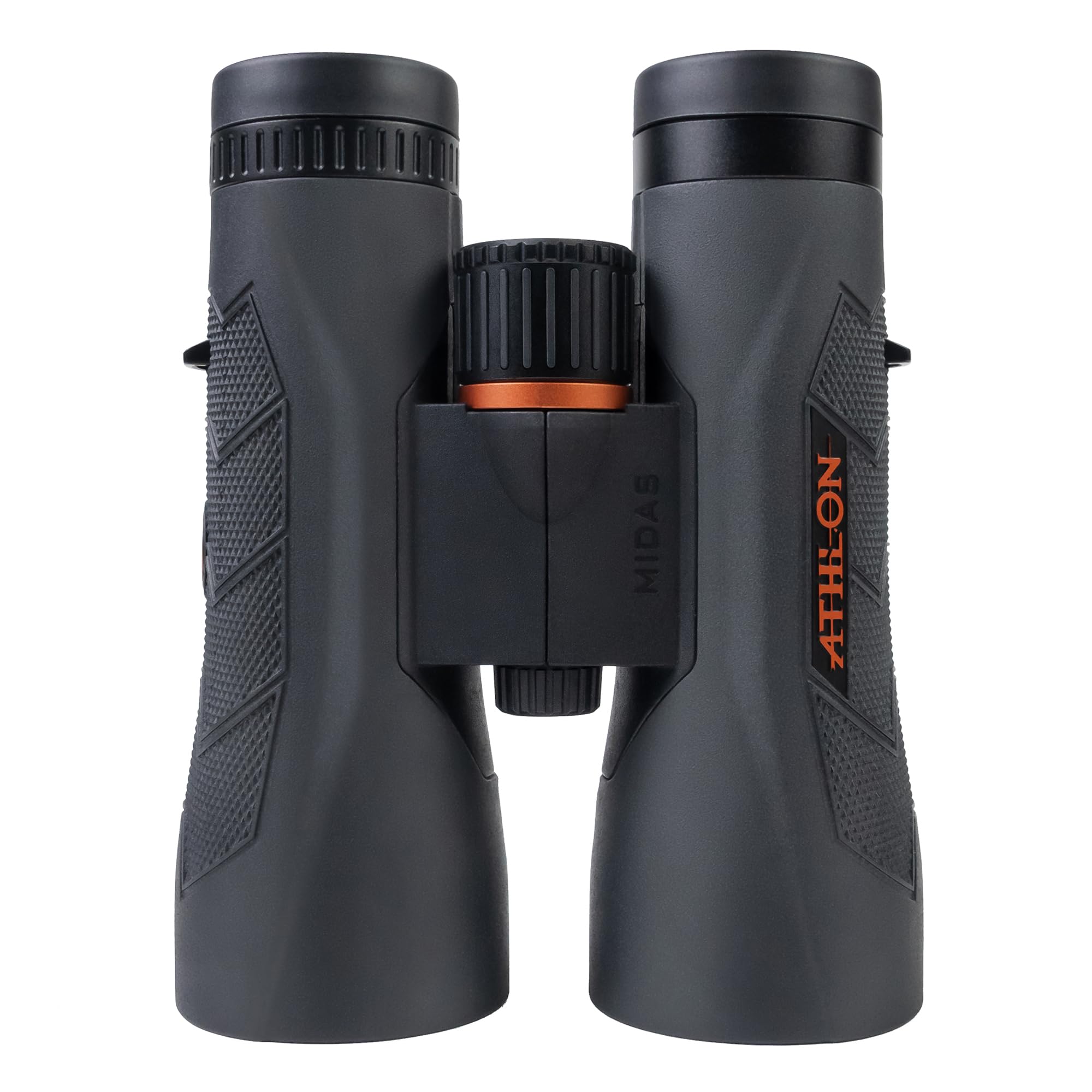
The Athlon Midas G2 UHD is the optical champion of this roundup, leveraging Extra-Low Dispersion (ED) glass to virtually eliminate chromatic aberration. The ESP Dielectric coating on the prisms reflects over 99% of incoming light, resulting in an image that is not just bright but deeply color-accurate — crucial for birding where identifying subtle plumage variations matters. The 65-degree apparent field of view is wide for a 10×50, reducing the tunnel-vision effect common at this magnification.
The magnesium chassis is a standout build feature, cutting weight by up to 35% compared to standard aluminum without sacrificing rigidity. At 16.9mm of eye relief, it’s comfortable for extended sessions, and the twist-up eyecups lock securely in place. The advanced fully multi-coated lenses ensure optimal light transmission across the full spectrum, making this a legitimate twilight performer.
Reviewers with experience in high-end optics consistently remark that the Midas G2 competes with units costing twice as much. The included carry case and cleaning cloth are decent, but the real value is in the glass pathway. If your priority is absolute resolution and color fidelity at dawn and dusk, this is the 10×50 to invest in.
Why it’s great
- ED glass virtually eliminates color fringing in high-contrast scenes
- Magnesium chassis is exceptionally light for a 50mm unit
- Dielectric prism coating delivers over 99% light reflectivity
Good to know
- Close focus is limited; not ideal for butterfly or near-field observation
- Requires careful diopter setup to maximize the flat-field performance
3. Nikon PROSTAFF 5 10×50
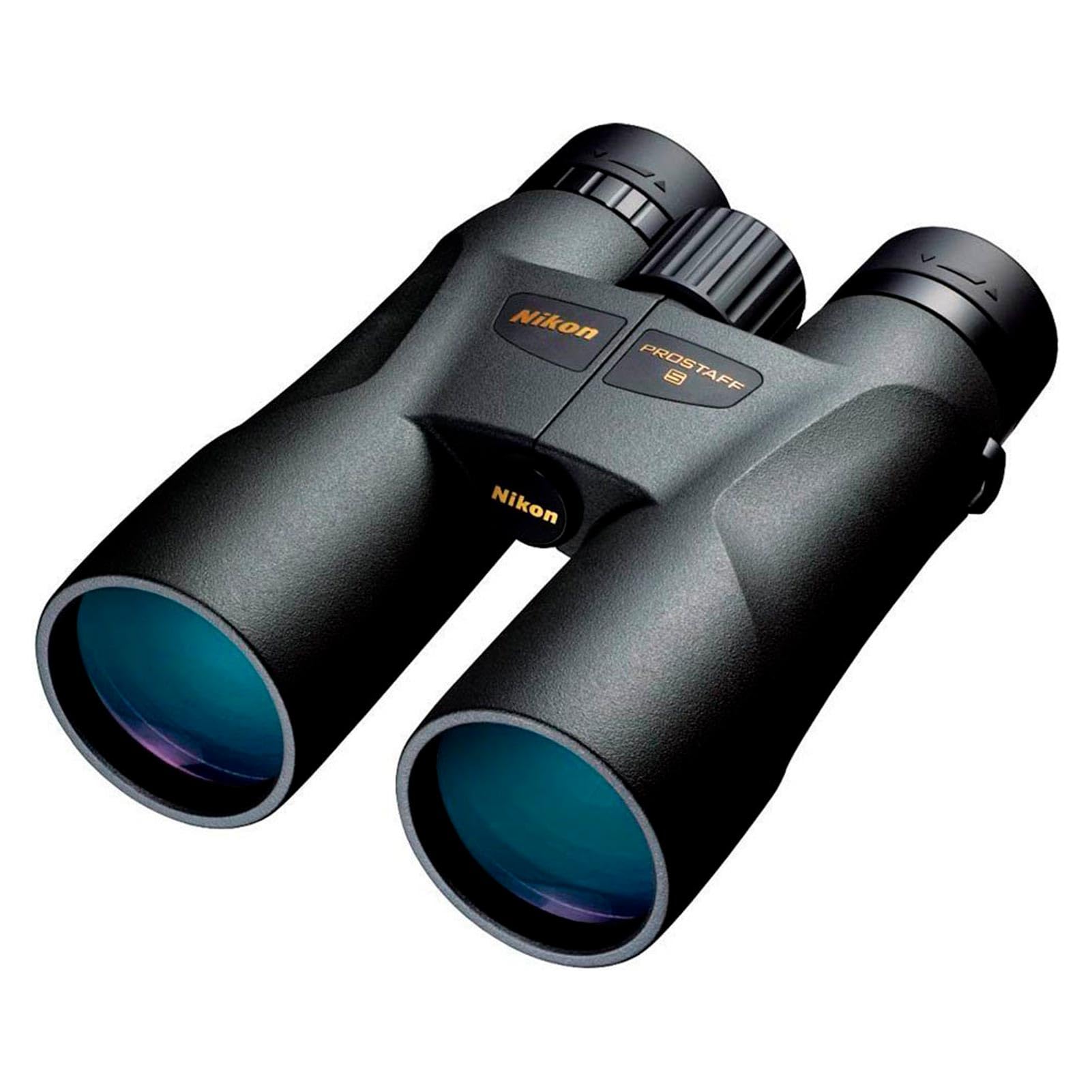
The Nikon PROSTAFF 5 hits the ideal balance of optical quality, weight, and price for most serious outdoor users. It uses multilayer-coated lenses and prisms to boost light transmission and reduce glare, producing vivid, color-accurate views.
Eye relief of 19.6mm is the highest in this roundup, a critical advantage for eyeglass wearers who want to see the full field without squishing their face against the eyecups. The turn-and-slide multi-click rubber eyecups allow fine positioning. Nitrogen-filled and O-ring sealed, this unit is fully waterproof and fogproof, tested against sudden downpours and temperature swings.
Reviewers consistently praise the smooth, precise central focus knob and the reliability over years of use. Some note that the field of view (5.5 degrees) is slightly narrower than premium competition, but the trade-off for the weight savings and comfortable eye relief is worth it for most. This is the mid-range premium pick that truly earns its reputation.
Why it’s great
- Outstanding 19.6mm eye relief for comfortable eyeglass use
- Lightweight fiberglass-reinforced body for long treks
- Nitrogen-purged and O-ring sealed for full waterproofing
Good to know
- Field of view is narrower than some competitors at the same spec
- Not as shock-resistant as the military-grade Steiner
4. Celestron Outland X 10×50

The Celestron Outland X is a well-rounded mid-range contender that delivers BaK-4 prisms and multi-coated lenses at a price that undercuts many competitors. The result is a bright, contrast-rich image with true color reproduction, even in the difficult transition light of early morning. The 5.6-degree angular field of view translates to 289 feet at 1,000 yards, which is generous for a 10×50 and helps with tracking birds or moving wildlife.
Build quality is robust: the rubber-armored polycarbonate housing is waterproof and nitrogen-purged to prevent internal fogging. The 17.4mm of eye relief is adequate for most eyeglass users, and the twist-up eyecups offer positive click stops. At just under 25 ounces, it’s one of the lighter 10×50 options, making it a strong candidate for backpacking where every ounce counts.
Some reviewers note that the field of view, while good, can feel tight compared to lower magnification models, and achieving a perfect focus can require a little more patience at close distances. However, the Celestron Limited Lifetime Warranty and US-based tech support provide peace of mind. This is the value pick for the adventurer who demands both performance and portability.
Why it’s great
- BaK-4 prisms and multi-coated lenses deliver sharp, bright images
- Lightweight and compact design is ideal for hiking and travel
- Waterproof and fogproof with a solid lifetime warranty
Good to know
- Focus can be slightly finicky at close range
- Eye relief is adequate but not generous for thick glasses
5. Pentax Jupiter 10×50

The Pentax Jupiter is an entry-level 10×50 that focuses on the fundamental optical requirement: light-gathering. With a 50mm aperture and multi-coated optics, it delivers a bright image that shines for astronomy and general low-light observation. The porro prism design, with a 50-degree apparent field of view, provides a classic, solid viewing experience without the complexity of zoom systems or auto-focus mechanisms.
The exterior rubber coating provides a non-slip grip, and the overall build feels solid in hand, though it is not advertised as waterproof. Eye relief is a modest 13mm — fine if you don’t wear glasses, but you may struggle to see the full field with spectacles on. The center focus knob is smooth and responsive, and the optional TP-3 tripod adapter is a nice touch for steady astronomical viewing.
Reviewers appreciate the sharp focus and bright image for the price point, particularly for lunar observation. The weight is noticeable but expected for a porro prism 50mm unit. If your budget is tight and your primary use is stargazing or daytime landscape viewing without extreme weather demands, this is a reliable starting point.
Why it’s great
- Bright, clear image with good low-light performance for the price
- Ergonomic rubber coating provides a secure, comfortable grip
- Compatible with optional tripod adapter for stable astronomy
Good to know
- Not waterproof or fogproof; limits use in wet conditions
- 13mm eye relief is restrictive for eyeglass wearers
6. Bushnell PowerView 10×50

The Bushnell PowerView is a budget-centric 10×50 with a unique twist: Perma Focus technology. This fixed-focus system eliminates the focus knob entirely, keeping everything beyond a certain distance automatically sharp. For sporting events, concerts, or any scenario where you need to rapidly shift your gaze between far subjects without fiddling, this is a genuine convenience. The wide-angle design and fully coated optics provide a bright, clear view for the price.
The ergonomic rubber housing offers a secure grip, and at 25 ounces the weight is standard for the category. However, the lack of multi-coating and BaK-4 prisms means the image will not compare favorably to mid-range models in low light or against high-contrast edges. The fixed focus also means close-up subjects under 20 feet may appear soft.
Reviewers praise the value and clarity for the cost, but durability concerns are a consistent theme — a drop onto concrete can be catastrophic due to the lack of a floating prism system. The included case is flimsy. This is the “grab-and-go” binocular for casual use where you don’t want to think about focus, but it will not survive a rough field season.
Why it’s great
- Perma Focus system is ideal for quick, no-fuss sporting event use
- Wide-angle design and fully coated optics offer good clarity for the tier
- Ergonomic rubber housing provides a secure, shock-resistant grip
Good to know
- Fixed focus limits close-up observation to 20+ feet
- Durability is questionable; not built for hard drops or rough terrain
7. Sogries 10-30×50 Zoom Binoculars
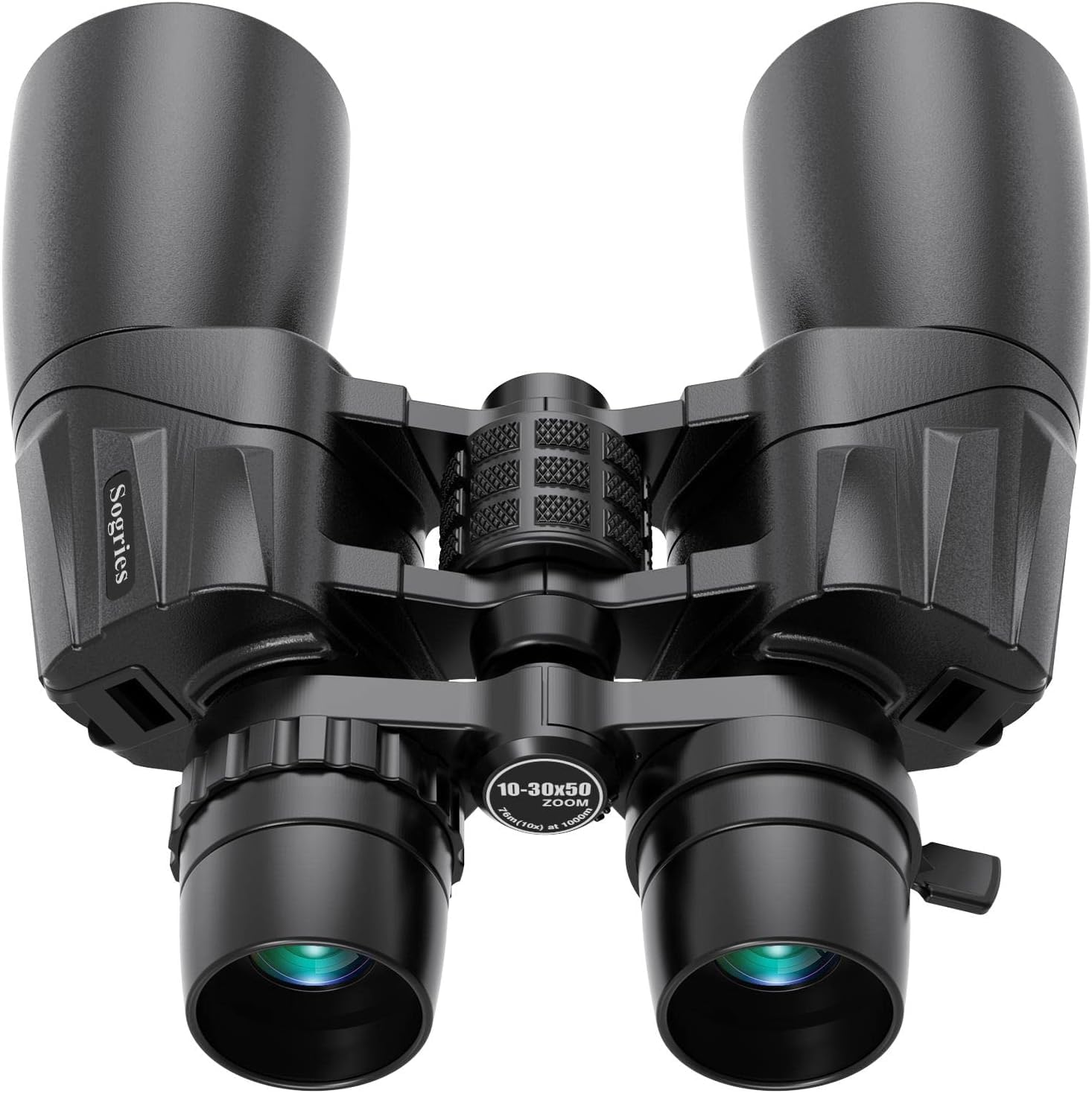
The Sogries 10-30×50 Zoom offers a versatile variable magnification system that lets you dial in the exact power for each situation — 10x for wide scanning, 30x for detail. The BAK-4 prisms and fully multi-coated broadband green film achieve a light transmittance of up to 99.5%, producing crisp, high-contrast images even in low light. Eye relief is a generous 22mm, making it very friendly for glasses wearers.
The downside of a zoom system in a 10×50 form factor is stability. At 30x magnification, any hand tremor is amplified significantly, and the manufacturer explicitly recommends tripod use for high-power viewing. The metal barrel construction adds weight, and the unit is not designed to be truly portable for long hikes. The smooth zoom joystick is a nice touch for gradual power adjustments.
Reviewers note that at the 10x setting, the view is bright and clear, and the adjustable diopter range of +/-5 diopters is generous. The included case and padded strap are decent. This binocular fills a niche for those who want the ability to zoom in for detail (reading signs, identifying distant birds) without carrying two separate optics, but it is best paired with a tripod.
Why it’s great
- Variable 10-30x magnification covers scanning and detailed observation
- BAK-4 prisms and FMC optics produce bright, high-contrast images
- Very generous 22mm eye relief for comfortable eyeglass use
Good to know
- High center of gravity and weight; tripod recommended for 30x use
- Zoom mechanism is not waterproof, limiting its weather resistance
FAQ
Is a 10×50 binocular too heavy to hold steady without a tripod?
What does “fully multi-coated” mean for my 10×50 binoculars?
Why should I care about BaK-4 prisms vs standard BK-7?
Final Thoughts: The Verdict
For most users, the best 10×50 binoculars winner is the Nikon PROSTAFF 5 because it nails the critical metrics — 19.6mm eye relief, nitrogen-purged waterproofing, and a lightweight fiberglass chassis — without demanding a premium price. If you need absolute optical purity and edge-to-edge sharpness for birding, grab the Athlon Midas G2 UHD. And for extreme durability in maritime or tactical environments where dropping the unit is a real risk, nothing beats the Steiner Military-Marine and its 11G-rated chassis.

Mo Maruf
I created WellFizz to bridge the gap between vague wellness advice and actionable solutions. My mission is simple: to decode the research and give you practical tools you can actually use.
Beyond the data, I am a passionate traveler. I believe that stepping away from the screen to explore new environments is essential for mental clarity and physical vitality.