Our readers keep the lights on and my smoothie glass nicely filled. As an Amazon Associate, I earn from qualifying purchases.
Choosing a 100-watt solar panel seems straightforward until you’re faced with dozens of options, each promising superior efficiency and durability. The real difference lies in the cell technology, frame construction, and real-world performance that the marketing sheets don’t always show. Having the right panel is the foundation of any reliable off-grid or backup power system.
I’m Mohammad Maruf — the founder and writer behind WellFizz. For over a decade, I’ve specialized in dissecting the technical specifications and long-term performance data of wellness and sustainable living products, separating genuine innovation from clever marketing.
This guide cuts through the noise by analyzing engineering, durability, and actual user feedback to match you with the ideal panel for your specific setup, whether it’s a van, a cabin, or a portable power station. The most important step is finding the best 100w solar panel for your unique energy needs and environment.
How To Choose The Best 100W Solar Panel
Your choice hinges on more than just a wattage number. It’s about aligning the panel’s core characteristics with your application’s demands for mounting, weather exposure, and power consistency.
Rigid vs. Portable Foldable
Rigid panels with aluminum frames are for permanent or semi-permanent installations on RV roofs, cabins, or ground mounts. They’re built to withstand decades of weather. Portable foldable panels, often made with an Oxford cloth backing, are for camping, emergencies, or setups where you need to move and angle the panel daily. They prioritize lightweight convenience over a 25-year lifespan.
Cell Technology & Efficiency
Monocrystalline is the standard for high efficiency. Look for advanced features: PERC cells boost low-light performance, 9-Busbar (9BB) or 16BB designs reduce electrical resistance and micro-crack risk, and Bifacial panels can capture reflected light from the rear for up to 15% extra output when mounted off a reflective surface.
Durability & Weatherproofing
For rigid panels, check the IP65 or IP68 rating of the junction box, the strength of the tempered glass, and the anodized aluminum frame. Ratings for wind load (e.g., 2400Pa) and snow load (e.g., 5400Pa) indicate structural robustness. For portable panels, look for IP65 or IP67 ratings on the fabric and a protective coating like ETFE on the cells.
Compatibility & Connectors
Most rigid panels use standard MC4 connectors, making them universally compatible with solar charge controllers. Portable panels often come with a bundle of adapters (Anderson, XT60, DC5521, etc.) for specific power station brands. Always verify your power station’s maximum solar input voltage and wattage to ensure a match.
Quick Comparison
On smaller screens, swipe sideways to see the full table.
| Model | Type | Best For | Key Feature | Amazon |
|---|---|---|---|---|
| Renogy 100W | Rigid | Premium permanent install | 16BB N-Type, 25% efficiency | Amazon |
| MHPOWOS 110W | Foldable | High-output portability | 23.5% efficiency, IP67 waterproof | Amazon |
| GRECELL 100W | Foldable | Portable power station pairing | Integrated cable pouch, 23.5% efficient | Amazon |
| Newpowa 100W | Rigid | Budget bifacial performance | Refreshed bifacial design | Amazon |
| HQST Bifacial 100W | Rigid | Maximizing ground-reflected light | Bifacial, 9BB, PERC technology | Amazon |
| Traver Force 100W | Rigid | Balanced mid-range quality | 10 Busbar cells, IP68 connectors | Amazon |
| Luvknit 100W | Foldable | Versatile device charging | 24% efficiency, USB-C & USB-A ports | Amazon |
| MARBERO 100W | Foldable | All-weather portable use | IP68 fabric, >23% efficiency | Amazon |
| ECO-WORTHY 100W | Rigid | Reliable entry-level DIY | 23% PERC efficiency, compact size | Amazon |
| HQST 100W | Rigid | Budget-conscious value | 9 Busbar, high conversion rate | Amazon |
| DOKIO 100W Foldable Kit | Foldable | Ultra-portable camping | Includes PWM controller, dual USB | Amazon |
In‑Depth Reviews
1. Renogy 100W Solar Panel

The Renogy 100W panel represents the premium end of the spectrum, engineered for those who prioritize long-term performance and superior specifications. Its standout feature is the use of N-Type monocrystalline cells arranged with 16 busbars, a configuration that minimizes electrical losses and significantly reduces the risk of micro-cracks and hot spots over time. This translates to a panel that’s not only more efficient at the outset but is also designed to maintain that high output for decades.
Beyond the advanced cells, Renogy has made this panel remarkably compact and lightweight compared to previous generations, a major advantage for RV or van installations where roof space is at a premium. The low temperature coefficient of -0.29%/°C is a technical detail with real-world impact, meaning it loses less power on blisteringly hot summer days compared to conventional panels. Users consistently report real-world outputs exceeding the rated 100 watts under ideal conditions, a testament to its quality.
This panel is an investment in a permanent or semi-permanent setup. It comes with the industry-standard MC4 connectors and is built with an IP65-rated junction box, corrosion-resistant frame, and high-strength tempered glass to withstand harsh weather. It’s the clear choice if your goal is to build a reliable, high-yield solar array for your off-grid cabin, RV, or backup power system where you don’t want to compromise on materials or future-proofing.
Why it’s great
- Industry-leading 25% efficiency from advanced N-Type 16BB cells.
- Superior build quality with a compact, lightweight footprint for easier installation.
- Excellent high-temperature performance and long-term durability promises.
- Consistently meets or exceeds its power rating in user testing.
Good to know
- A premium option positioned at the higher end of the market.
- Like most rigid panels, mounting hardware is typically sold separately.
2. MHPOWOS 110W Portable Solar Panel
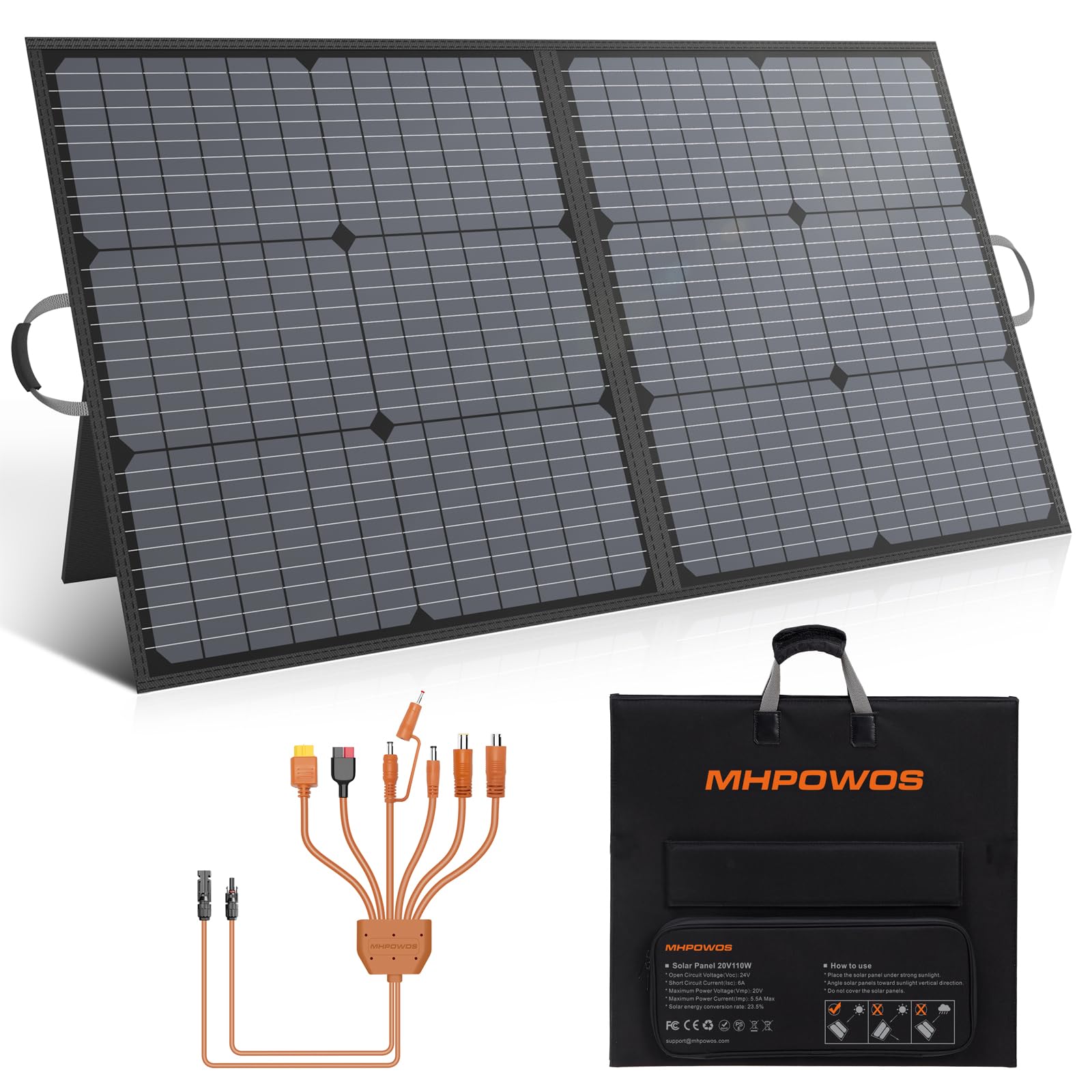
The MHPOWOS 110W panel pushes the boundaries of what a foldable solar charger can deliver, offering a higher wattage and robust waterproof rating in a portable format. With a stated 23.5% conversion efficiency from its monocrystalline cells, it’s engineered to capture more sun, faster—a critical factor when you’re trying to recharge a large power station during a limited camping day. The IP67 rating for the entire panel is a significant step up from simple water resistance, giving genuine peace of mind in rainy or dewy conditions.
This panel is designed for the user who needs serious portable power without sacrificing durability. The inclusion of a comprehensive cable with Anderson, XT60, DC7909, and DC5521 adapters means it’s ready to plug into virtually any major brand of power station right out of the box. The built-in kickstands are sturdy and allow for quick angle adjustment to chase the sun, a simple feature that can dramatically increase daily energy harvest compared to a panel laid flat on the ground.
Feedback from users highlights its effective performance, with many noting it reliably delivers 80-90 watts in good sunlight, effectively living up to its “110W” naming (which often indicates peak potential). The thickened handles and one-piece foldable design make it easier to carry and deploy than some bulkier competitors. For campers, overlanders, or preppers who need a tough, high-output, and truly weather-ready portable solution, this panel strikes an impressive balance.
Why it’s great
- High 23.5% efficiency and IP67 waterproofing in a portable form.
- Includes a versatile adapter cable for universal power station compatibility.
- Sturdy kickstands and robust construction for outdoor use.
- Reports of strong, consistent real-world wattage output.
Good to know
- The higher wattage is beneficial, but always check your power station’s input limit.
- As with all portable panels, the attached electronics box is not submersible.
3. GRECELL 100W Portable Solar Panel
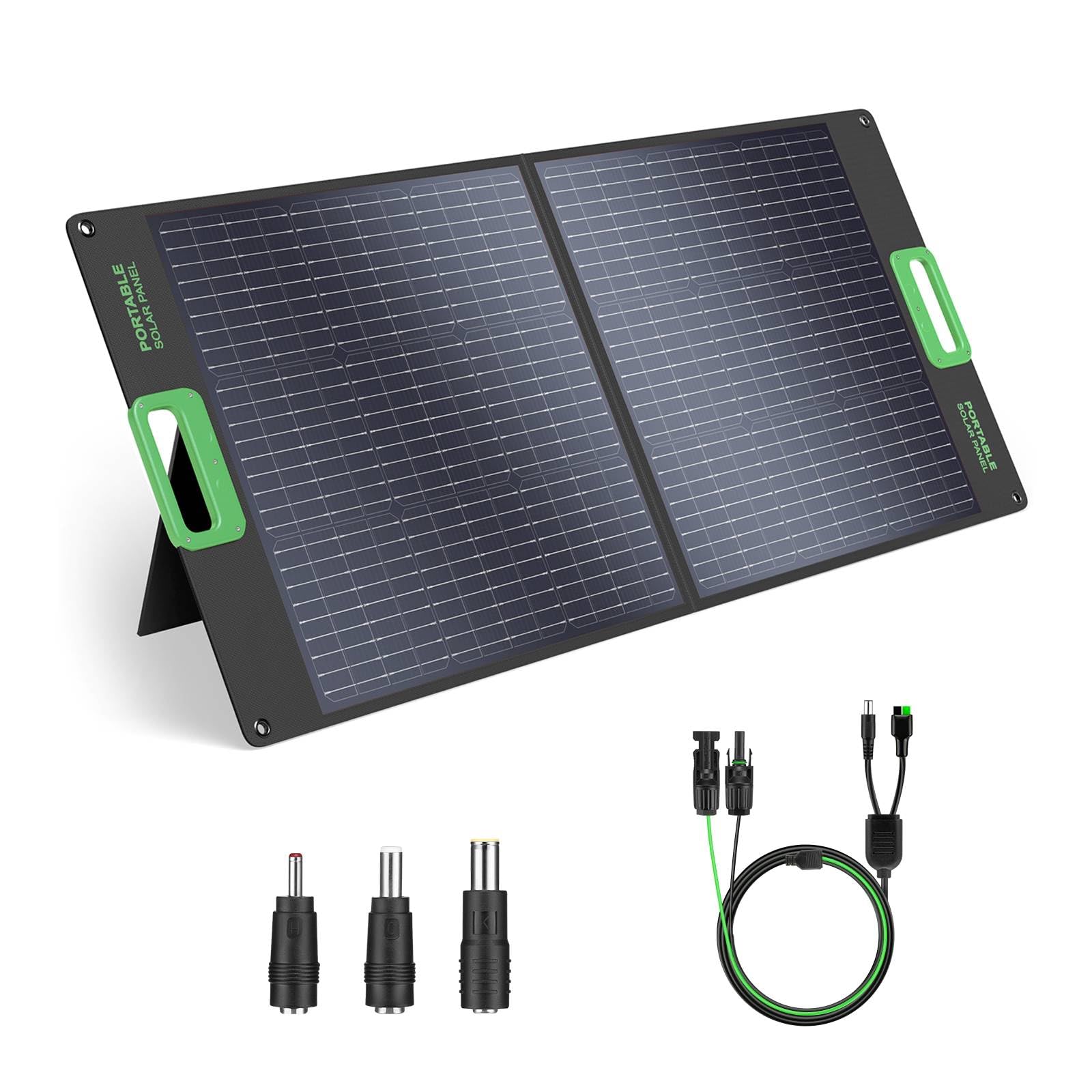
The GRECELL 100W panel excels in thoughtful, user-centric design for the portable power enthusiast. Its most notable feature is the well-integrated zippered accessory pouch on the back, which neatly stores the included array of adapter cables and any extension cords you might own. This eliminates the frustrating “bag of cables” scenario and ensures you have everything you need in one spot. The magnetic clasps that keep the unit closed are a premium touch that adds convenience and security during transport.
Functionally, it leverages high-efficiency monocrystalline cells and a smart chip to optimize charging for connected devices and power stations. The panel supports series and parallel connections, allowing you to easily pair two together to double your input for faster charging times—a feature often sought by users expanding their systems. The bifold design with sturdy, velcro-secured kickstands makes setup quick and stable, even in mild wind.
Users praise its all-in-one portability and the quality of its output, with many reporting it meets or approaches its rated wattage in good sun. The design clearly takes cues from leading brands but offers the versatility of standard MC4 connectivity (with included adapters), making it less proprietary and more flexible. It’s an ideal choice for someone who values organization, clean design, and the ability to seamlessly integrate the panel into a growing portable solar setup.
Why it’s great
- Excellent integrated storage pouch keeps all cables organized and attached.
- High-quality construction with convenient magnetic clasps and sturdy kickstands.
- Supports pairing with a second panel for expanded power.
- Provides reliable, high-efficiency charging for power stations.
Good to know
- The fabric and design are robust but, like all portable panels, require care to avoid puncture or excessive bending.
4. Newpowa 100W Monocrystalline Solar Panel
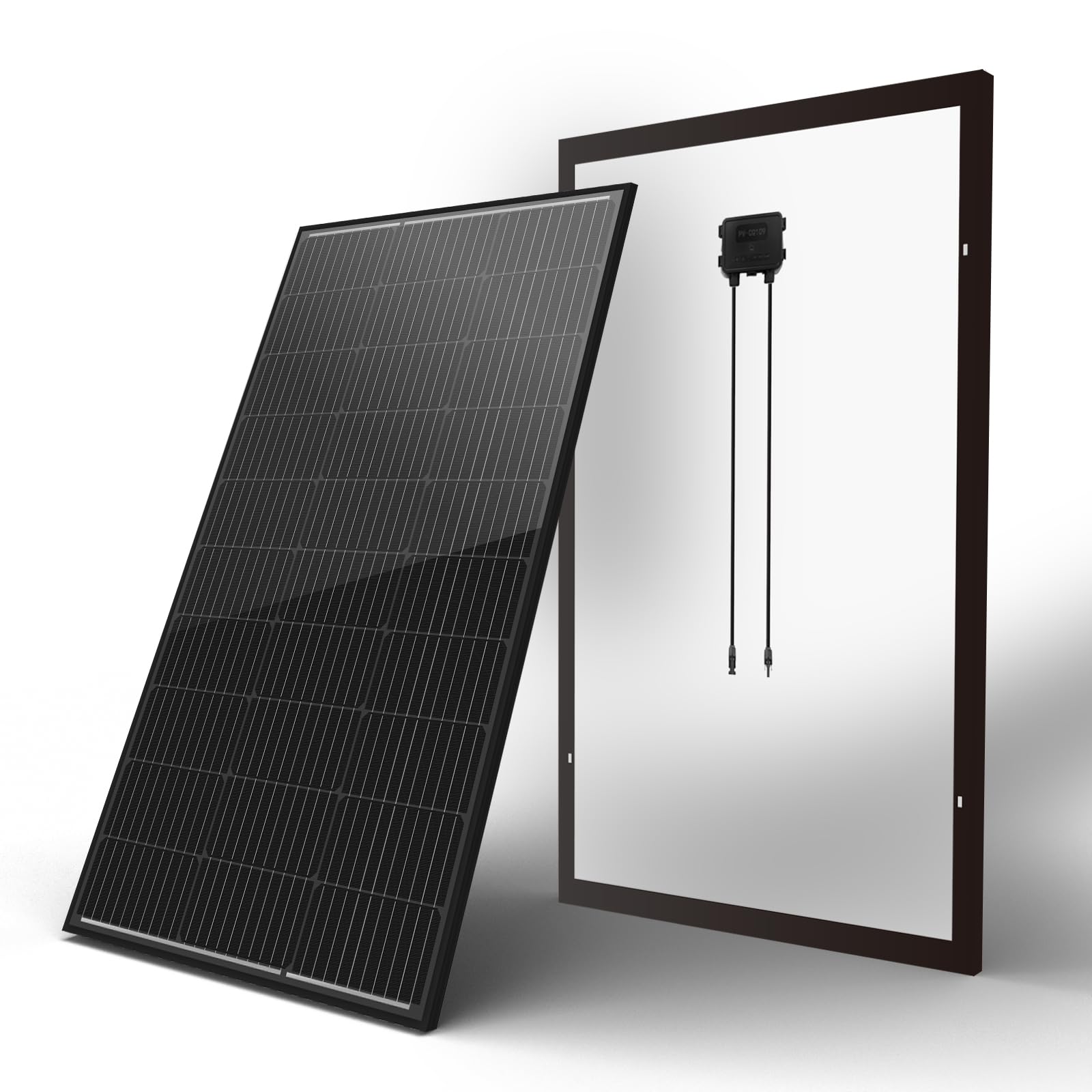
Newpowa’s 100W panel offers a compelling blend of advanced features at a mid-range point, most notably its refreshed bifacial design. This means the panel can generate power from both sides, capturing reflected sunlight (albedo) from the ground or a mounting surface. When installed correctly—raised about 0.7 to 1.3 meters above a reflective surface like light-colored gravel, concrete, or snow—this can yield a significant boost in total energy harvest, potentially getting more than 100W from the nominal rating.
The panel doesn’t compromise on durability to achieve this. It’s built with a robust frame capable of withstanding 2400Pa of wind pressure and 5400Pa of snow load, making it suitable for permanent outdoor installations in most climates. It comes with pre-installed bypass diodes to minimize power loss from partial shading and pre-attached MC4 connectors for a plug-and-play installation experience. Users frequently comment on the solid packaging and the panel’s ability to deliver strong performance even in less-than-ideal light angles.
This is an intelligent choice for someone setting up a ground-mounted array, a pergola, or an RV roof where you can create an air gap beneath the panel. It provides a pathway to higher energy yield without stepping into the premium price tier, representing strong value for the performance-oriented DIYer who understands how to leverage its bifacial nature.
Why it’s great
- Bifacial design offers the potential for above-rated power output in optimal setups.
- Strong, weather-resistant construction with high wind and snow load ratings.
- Consistently good reviews regarding real-world power delivery and packaging.
- Offers advanced technology at a competitive mid-range point.
Good to know
- To realize the bifacial gain, thoughtful mounting above a reflective surface is required.
- As with many value brands, warranty terms should be reviewed carefully.
5. HQST Bifacial 100W Solar Panel
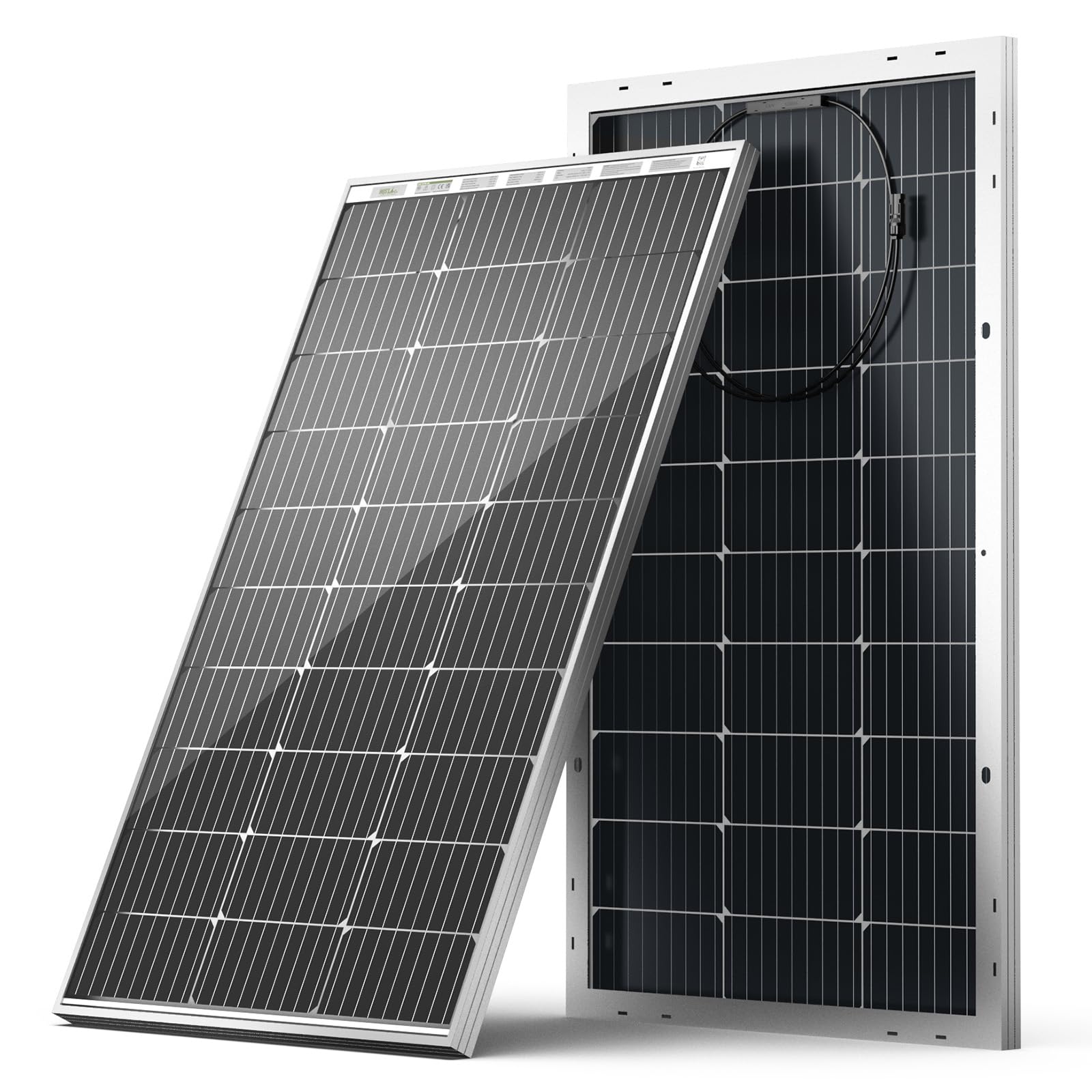
The HQST Bifacial panel is engineered specifically to maximize energy capture by combining two key technologies: bifacial cells and PERC (Passivated Emitter and Rear Cell) design. This dual approach allows it to absorb direct sunlight on the front and reflected light on the rear, while the PERC layer boosts efficiency by reflecting unused light back into the silicon cell. HQST claims this can result in up to 15% extra energy, effectively offering up to 115W from a 100W panel in ideal reflective environments.
It’s built with the same ruggedness as the standard HQST panel, featuring an IP68-rated junction box (superior dust/water resistance) and a sturdy aluminum frame rated for high wind and snow loads. The use of Grade A+ 9-busbar monocrystalline cells ensures a reliable foundation for this advanced design. This panel shines in installations over snow, sand, white roofs, or light-colored gravel where ground reflection is high.
User experiences are generally positive, with many DIYers and enthusiasts reporting excellent performance, especially when the panels are angled and elevated. It’s a favorite for custom projects where maximizing watts per dollar is key. If your installation site has high reflectivity and you can mount the panel with an air gap underneath, this model represents a smart, efficient upgrade over a traditional monofacial panel at a very accessible price point.
Why it’s great
- Combines bifacial and PERC tech for potentially significant energy gains.
- High-grade 9BB cells and an IP68 junction box for durability.
- Excellent performance in snowy or highly reflective environments.
- Great value for tech-savvy users looking to maximize output.
Good to know
- To achieve the bifacial boost, proper installation above ground is crucial.
- As with any panel, individual performance can vary based on exact conditions and setup.
6. Traver Force 100W Solar Panel

The Traver Force panel is a strong contender in the mid-range segment, offering modern cell technology and solid construction without a premium price tag. Its defining feature is the use of larger 182mm monocrystalline cells arranged with 10 busbars. This 10BB design is a step above the older 5BB standard, providing better conductivity, reduced risk of micro-cracking, and improved performance in varying temperatures.
Durability is addressed with an IP65-rated junction box and notably, IP68-rated solar connectors. The IP68 rating on the connectors themselves is a thoughtful detail, offering extra protection at the connection points where water ingress is a common failure point. The anti-corrosion aluminum frame is standard for long outdoor life. Users report that this panel frequently meets or exceeds its rated output in testing, with some seeing peaks over 105 watts in cool, bright conditions.
This panel is an excellent “no-surprises” option for someone building a reliable RV, shed, or cabin system who wants modern cell technology and trustworthy weatherproofing. It doesn’t have the bifacial or N-Type exotic specs of higher-end models, but it delivers proven, high-efficiency monocrystalline performance in a well-built package that represents a very sensible balance of cost and quality.
Why it’s great
- Modern 10-busbar cell design for improved efficiency and reliability.
- High-quality weatherproofing with IP68-rated connectors.
- Consistently delivers at or above its rated power in user reviews.
- Strong value for a well-built, efficient rigid panel.
Good to know
- A newer brand on the market, so long-term track record is still being established.
- Mounting hardware is typically not included.
7. Luvknit 100W Portable Solar Panel

The Luvknit panel stands out in the portable category by boasting a high 24% conversion efficiency and a versatile built-in power controller with multiple direct-output options. Beyond the standard DC output for power stations, it features a QC3.0 USB-A port and a PD3.0 USB-C port capable of delivering up to 54W. This allows you to directly charge laptops, phones, tablets, and other USB devices without needing a power station as an intermediary, adding tremendous flexibility.
Its foldable design uses IP65 water-resistant material, and it includes a handy carry handle for transport. The package is comprehensive, including a controller and a wide array of DC adapters to fit nearly any power station on the market. Users appreciate its performance, with many noting it reliably powers devices and provides solid input to their generators, even mentioning its usefulness in keeping a battery charged during all-day outdoor events.
The inclusion of direct, smart USB charging addresses a key need for campers and travelers who want to keep personal electronics powered during the day without draining their central power bank. If you want a single portable panel that can either feed a large power station or directly charge your gear, the Luvknit’s combination of high efficiency and versatile outputs makes it a highly practical and user-friendly choice.
Why it’s great
- High 24% efficiency and direct USB-C/USB-A charging for devices.
- Comprehensive set of adapters for broad power station compatibility.
- IP65 water-resistant fabric and convenient carry handle.
- Eliminates the need for a power station to charge phones/laptops.
Good to know
- The built-in kickstands are noted by some users as being less sturdy in wind.
- The attached power controller unit should be kept dry and shaded.
8. MARBERO 100W Portable Solar Panel

The MARBERO 100W panel is built for users who won’t let the weather interrupt their power supply. It features an IP68 waterproof rating on its Oxford fabric exterior, a significant claim that suggests it can handle heavy rain or snow far better than simply “water-resistant” panels. This is complemented by an ETFE coating on the solar cells themselves, which enhances performance and provides an extra layer of environmental protection.
It maintains a high efficiency rating of over 23% and comes with a very complete kit: four adapter connectors, carabiners for hanging, and both USB and DC outputs on its control box. The four-fold design makes it compact when stored, about the size of a laptop. Users find it delivers reliable power in the 70-90 watt range in full sun and note that it continues to perform usefully on cloudy days, which is a critical real-world advantage.
This panel is ideal for serious campers, boaters, or anyone in frequently wet climates who needs a portable solar solution they can trust in adverse conditions. The IP68 rating provides a tangible sense of security. While the control box itself isn’t submersible, the panel’s overall construction is geared towards durability and consistent performance, rain or shine.
Why it’s great
- High IP68 waterproof rating on the fabric for superior weather resistance.
- ETFE-coated monocrystalline cells for enhanced efficiency and durability.
- Very complete kit with multiple adapters and hanging carabiners.
- Consistent performance reported in both sun and cloudy conditions.
Good to know
- The output control box is not waterproof and should be protected.
- Some users note the panel can feel slightly delicate when handling; care is advised.
9. ECO-WORTHY 100W Solar Panel

The ECO-WORTHY 100W panel is a long-standing, reliable choice for entry-level solar DIY projects and smaller off-grid systems. It utilizes PERC (Passivated Emitter and Rear Cell) technology, which boosts its efficiency to around 23% by reflecting unused sunlight back into the cell. This makes it particularly effective in low-light or cloudy conditions, helping to squeeze more energy out of less-than-perfect weather.
This panel is known for its compact dimensions and relatively lightweight frame, making it easier for a single person to handle and mount. It comes with pre-drilled holes and pre-installed MC4 connectors for straightforward setup. The build quality includes an IP65 junction box, impact-resistant tempered glass, and the standard corrosion-resistant aluminum frame, promising a long service life for a budget-friendly option.
User reviews over many years affirm its reliability, with many reporting that it consistently delivers its rated power when paired with a proper charge controller. It’s a common sight in small cabin setups, RV installations, and as an expansion to existing arrays. For someone taking their first steps into solar or needing a dependable, no-frills panel for a basic charging system, the ECO-WORTHY offers proven performance and good value without overwhelming complexity.
Why it’s great
- Reliable PERC technology for better low-light and overall efficiency.
- Compact and lightweight design simplifies handling and installation.
- Strong track record of performance and durability in user reviews.
- Excellent entry-level option for first-time solar installers.
Good to know
- Positioned as a value option, with a corresponding warranty period.
- While robust, it may not have the advanced cell tech of newer premium panels.
10. HQST 100W Monocrystalline Solar Panel

The standard HQST 100W panel is a cornerstone of budget-friendly solar, offering solid performance and essential features at a very accessible point. It incorporates modern 9-busbar cell technology, which improves conductivity and reduces the risk of micro-cracks compared to older 5-busbar designs. This focus on a key reliability feature, even at this price, shows a thoughtful engineering approach.
It’s built to handle the outdoors with an IP65-rated junction box, bypass diodes for shade tolerance, and a frame rated for significant snow and wind loads. Users frequently highlight its impressive out-of-the-box performance, with many reporting measurements at or above 100 watts during testing. The consistent praise in reviews for its “great value” and “good output” underscores its reputation as a workhorse panel.
This is the go-to panel for cost-conscious projects where every dollar counts but you still need dependable power: charging small battery banks, maintaining RV batteries, or running a shed light. It forgoes the extra features of bifacial or N-Type panels to deliver the core promise of a 100W monocrystalline panel reliably and durably. For straightforward, bulk purchasing for larger arrays on a tight budget, it’s incredibly difficult to beat.
Why it’s great
- Exceptional value, offering modern 9BB tech at a budget-friendly point.
- Consistently meets or exceeds power expectations in user testing.
- Robust weatherproofing and construction for long-term outdoor use.
- Ideal for scaling up arrays where multiple panels are needed.
Good to know
- An entry-level price point, which is reflected in the warranty structure.
- Lacks some of the advanced efficiency features of higher-tier models.
11. DOKIO 100W Portable Foldable Solar Panel Kit

The DOKIO kit is designed for maximum portability and simplicity, ideal for the casual camper or as an emergency backup charger. Weighing only about six pounds and folding down to a slim profile, it’s exceptionally easy to pack in a vehicle or store in a closet. The included separate PWM charge controller is a key feature, providing basic protection for 12V batteries (overcharge, short-circuit) and making the kit instantly usable for direct battery charging without additional purchases.
The panel comes with a generous cable length, allowing you to place it in the sun while keeping your battery or power station in the shade. It also includes dual USB ports on the controller for directly charging small devices. DOKIO is upfront about managing expectations, clearly noting that many power stations have input limits (e.g., 60W), which will cap the panel’s output—a helpful clarification for new users.
Long-term user reviews indicate that while the panel fabric may show UV degradation over several years of heavy use, the solar cells themselves remain functional. It’s a practical, lightweight solution for someone who needs occasional portable power for camping trips, tailgating, or keeping a car battery topped up, and appreciates having a complete, simple kit ready to go right out of the box.
Why it’s great
- Extremely lightweight and portable with a complete kit (panel, controller, bag).
- Separate PWM controller offers basic charging safety for 12V batteries.
- Long cable and USB ports add convenience for various uses.
- Honest communication about power station input limits.
Good to know
- The included PWM controller is basic; an MPPT controller would harvest more energy.
- The fabric and construction are designed for portability, not decades of harsh weather.
Understanding the Specs
Conversion Efficiency
This percentage tells you how effectively the panel converts sunlight into electricity. A 100W panel with 25% efficiency will be physically smaller than a 100W panel with 20% efficiency. Higher efficiency is always better, especially when roof or storage space is limited, and it often indicates more advanced (and durable) cell technology.
Bypass Diodes
These are crucial electronic components usually installed in the junction box on the back of rigid panels. If part of the panel is shaded (by a branch, vent, or dirt), bypass diodes prevent that shaded section from becoming a power sink that drags down the output of the entire panel. They help maintain useful output even in imperfect, partially shaded conditions.
Temperature Coefficient
Expressed as a negative percentage per degree Celsius (e.g., -0.29%/°C), this spec indicates how much power the panel loses as its temperature rises above 25°C (77°F). A smaller negative number is better, as it means the panel is less affected by heat. This is a key factor for summer performance or installations in hot climates.
Wind & Snow Load
Measured in Pascals (Pa), these ratings (e.g., 2400Pa wind, 5400Pa snow) indicate the mechanical strength of the panel frame and glass. A 5400Pa snow load rating means the panel can support over 110 pounds per square foot of snow. These are critical specs for permanent installations in areas with heavy snow or high winds.
FAQ
Will a 100W solar panel actually give me 100 watts?
What is the difference between PWM and MPPT charge controllers?
Can I connect different brands or wattages of solar panels together?
How do I clean and maintain my solar panel?
Final Thoughts: The Verdict
For most people, the best 100w solar panel winner is the Renogy 100W because it combines top-tier N-Type 16BB efficiency with a compact, durable build that will deliver reliable power for years. If you want a high-performance, weather-ready portable panel, grab the MHPOWOS 110W. And for maximizing value in a rigid, permanent installation, nothing beats the HQST 100W for its proven performance and accessible price point.

Mo Maruf
I created WellFizz to bridge the gap between vague wellness advice and actionable solutions. My mission is simple: to decode the research and give you practical tools you can actually use.
Beyond the data, I am a passionate traveler. I believe that stepping away from the screen to explore new environments is essential for mental clarity and physical vitality.