Our readers keep the lights on and my smoothie glass nicely filled. As an Amazon Associate, I earn from qualifying purchases.
Choosing the right 10-inch blade is the single most important factor between a flawless tile installation and a project riddled with frustrating, chipped edges and wasted material. The wrong blade can turn a simple cut into a headache.
I’m Mohammad Maruf — the founder and writer behind WellFizz. Over the past decade, my research has focused on deconstructing tool specifications and consumer data to identify which features translate to real-world performance and longevity, separating marketing claims from measurable results.
This guide is built from analyzing dozens of data points across the most popular blades, from diamond matrix composition to arbor compatibility, so you can match the perfect tool to your specific tile, saw, and project goals. The right choice saves time, material, and ensures a professional finish for your best 10 inch tile saw blade.
How To Choose The Best 10 Inch Tile Saw Blade
Selecting a blade isn’t just about diameter; it’s about engineering. The core considerations—blade thickness, segment design, and core stability—determine everything from cut cleanliness to how long the blade will last under pressure.
Primary Material & Blade Type
First, identify your most common material. A continuous-rim “turbo” blade is ideal for porcelain and ceramic, delivering clean, chip-free cuts. Segmented blades are better for aggressive material removal on stone, brick, or concrete but will leave a rougher edge. Many blades now offer a hybrid “X-turbo” segment design that aims for a balance of speed and finish.
Blade Thickness & Core Stability
Thinner blades (around 1.4mm to 2.0mm) remove less material, reduce drag, and can minimize chipping on delicate glazes. However, they require a stable saw arbor and a steady feed rate to avoid deflection. Thicker blades and those with a “tensioned steel core” resist bending, offering straighter cuts in dense materials but may generate more heat and friction.
Compatibility & Usage
Always verify the arbor size (5/8″ is most common for tile saws; 7/8″ often requires a reducer bushing). Confirm if the blade is rated for wet use, dry use, or both. Wet cutting dramatically extends blade life and keeps dust down. For handheld angle grinder use, a dry-rated or universal blade is essential, but always prioritize safety with appropriate PPE.
Quick Comparison
On smaller screens, swipe sideways to see the full table.
| Model | Type | Best For | Key Feature | Amazon |
|---|---|---|---|---|
| EZARC Super Thin | Turbo Mesh | Precision tile work | Ultra-thin, chip-free design | Amazon |
| DEWALT DW4764 | Premium Continuous | High-volume porcelain | Stable, low-vibration core | Amazon |
| Alpha Porcellana | Professional Wet | Showroom-quality edges | Exceptional runout precision | Amazon |
| GoYonder Super Thin | Turbo Rim | Handheld grinder work | 1.4mm thickness, versatile | Amazon |
| Casaverde Diamond | X-Turbo Rim | General DIY tile projects | Thick center reduces wobble | Amazon |
| diapro 10″ (B0BJCKR3ST) | Super Thin | Porcelain on a wet saw | X-teeth for smooth cutting | Amazon |
| OSTEK Super Thin | X-Turbo | Dry cutting with grinders | 10mm rim height for life | Amazon |
| Bosch DB1043S | Continuous Rim | Ceramic & stone | Consistent diamond distribution | Amazon |
| Kingthai Segmented | Segmented | Masonry & concrete | Hot-pressed sintered diamond | Amazon |
| diapro Super Thin (B08JPKQ1KW) | Super Thin | Entry-level tile work | Wet or dry, dual arbor | Amazon |
| PANFREET Diamond | Turbo Segment | Budget-friendly value | Cuts cool, increased speed | Amazon |
In‑Depth Reviews
1. EZARC 10 Inch Super Thin Diamond Saw Blade
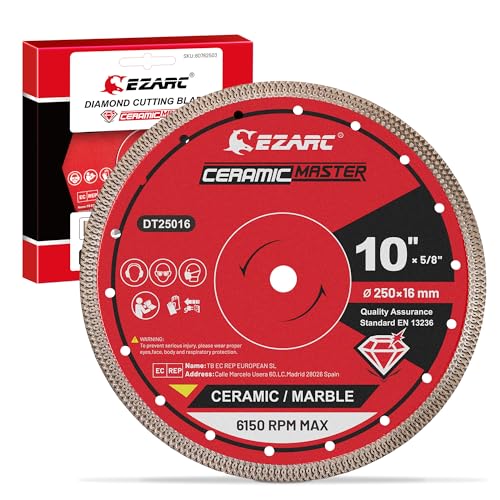
The EZARC stands out in the mid-range category by delivering a performance profile that rivals premium options. Its engineering focuses on the “super thin” principle, utilizing an advanced diamond matrix and heat-pressed sintering to create a blade that’s both durable and precise. The X-teeth turbo mesh rim is designed specifically to minimize chipping, a critical factor when working with expensive porcelain or decorative ceramic tiles.
Feedback consistently highlights its ability to handle demanding materials like granite countertops and large-format porcelain with a clean, efficient cut. Users report completing entire tile projects with a single blade, noting the smooth operation and lack of burn marks even during extended use. The dual arbor compatibility (5/8″ and 7/8″) ensures it fits a wide array of tile saws and handheld grinders.
This blade represents a strategic balance. It doesn’t carry the premium price tag of top-tier professional blades, but it incorporates the key design features—a thin kerf, a stable core, and a high-quality diamond edge—that DIYers and pros alike need for reliable, chip-free results. It’s a versatile workhorse that performs predictably across a range of materials.
Why it’s great
- Exceptional cut quality with minimal chipping on delicate materials.
- Robust construction suggests good longevity for its category.
- Wide compatibility with both wet saws and appropriate handheld tools.
Good to know
- As a thin blade, it requires a stable saw arbor to prevent potential deflection.
- Long-term durability under constant professional use is less documented than premium brands.
2. DEWALT Diamond Blade for Tile (DW4764)

The DEWALT DW4764 is a trusted name for contractors and serious DIYers who need a blade that can handle high-volume porcelain cutting without faltering. It’s engineered as a wet-cutting blade with a focus on a stable, vibration-resistant core, which is essential for making straight, true cuts through dense, modern porcelain tiles. The consistent diamond distribution is a hallmark of its design, aiming for uniform wear over a long service life.
Experienced users emphasize the importance of “dressing” this blade—cutting into a brick or abrasive stone initially—to expose the sharpest diamonds and achieve its cleanest cut from the start. Once conditioned, it’s known for producing smooth edges with minimal chipping, especially when feed rates are managed properly. Its durability is well-documented, with users reporting success over hundreds of square feet of tile.
This blade sits at a higher investment point, justifying it with proven reliability and performance consistency. It’s less about flashy thinness and more about solid, predictable execution job after job. For someone who regularly tackles tile projects or has a large single job, the DEWALT offers peace of mind and reduced risk of mid-project blade failure.
Why it’s great
- Excellent durability and long life for high-volume work.
- Stable core design reduces wobble for straighter cuts.
- Trusted brand reputation for consistent manufacturing quality.
Good to know
- Requires an initial dressing process to achieve optimal cut quality.
- Primarily designed for wet use; not ideal for dry cutting applications.
3. Alpha Porcellana 10″ Wet Diamond Blade
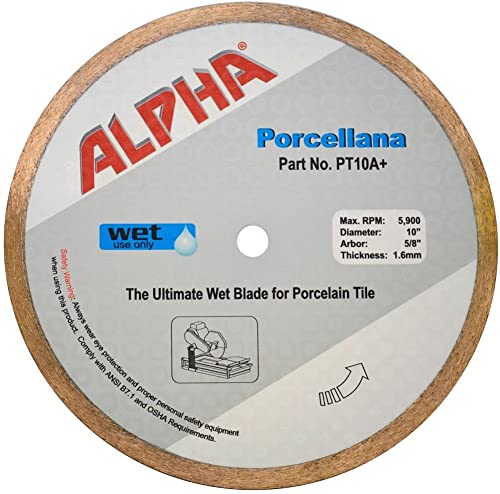
The Alpha Porcellana is the uncompromising choice for professionals and discerning DIYers where the cut edge quality is paramount. This is a specialist blade designed explicitly for wet saws to produce edges on porcelain and stone that are so clean they often require little to no additional polishing. The standout feature, as noted by craftsmen, is its exceptional rotational trueness (minimal runout), which directly translates to smoother cutting action and drastically reduced chipping.
Reviews from tile setters working on high-end projects praise this blade for making cuts that are nearly indistinguishable from factory edges, which is critical for exposed edges in niches, shelves, or trimless installations. It handles dense, brittle porcelain with a level of finesse that cheaper blades struggle to match, allowing for faster feed rates while maintaining quality.
This investment is aimed at a specific user: someone for whom material cost and finish quality outweigh tool cost. For a large, visible project where every cut matters, the Alpha Porcellana can save hours of edge-finishing labor and eliminate the risk of ruining expensive tile. It’s a tool that pays for itself in results, not just longevity.
Why it’s great
- Produces the cleanest, near-polished cut edges available.
- Extremely low blade runout for smooth, vibration-free operation.
- Highly efficient on dense porcelain, allowing faster work.
Good to know
- Premium investment; overkill for basic back-splashes or hidden cuts.
- Designed for wet saw use only, not for handheld grinders.
4. GoYonder 10 Inch Super Thin Diamond Saw Blade
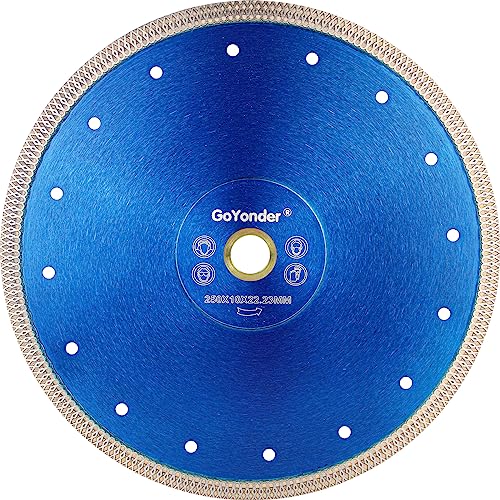
The GoYonder blade distinguishes itself with an exceptionally thin 1.4mm profile, making it a top contender for use with handheld angle grinders. This thinness reduces drag and friction, which is crucial when using a tool that doesn’t have the inherent stability of a table saw. The turbo rim design incorporates diamond grains for efficient cutting, and its build aims to be thin enough to minimize material waste yet rigid enough to resist drifting during freehand cuts.
Users who frequently employ grinders for tile work—whether for notching, cutting curves, or making straight cuts where a wet saw is impractical—report excellent results. The blade is noted for producing clean cuts with very little chipping, even on porcelain, when used carefully. The inclusion of a removable center ring for dual arbor size (5/8″ and 7/8″) adds to its versatility across different grinder models.
This blade addresses the unique challenges of handheld cutting. Its design prioritizes control and a clean kerf in a scenario where the operator bears the full responsibility for guidance. For renovation work, custom fits, or any task requiring a grinder, the GoYonder provides a specialized tool that outperforms standard masonry blades for tile.
Why it’s great
- Ultra-thin design is ideal for controlled cutting with angle grinders.
- Effective for both wet and dry applications, offering flexibility.
- Produces surprisingly clean cuts for a blade intended for handheld use.
Good to know
- The extreme thinness requires a very steady hand to avoid blade walk.
- Not the best choice for a table saw where a thicker, more stable blade may be preferable.
5. Casaverde 10 Inch Diamond Porcelain Cutting Blade

The Casaverde blade is a well-rounded option that brings a “super thin turbo mesh” design to a competitive price point. It emphasizes a thicker center core, which is engineered to dampen vibrations and reduce wobble—a common issue with cheaper thin blades. This makes it a more forgiving choice for DIYers whose saws might not have industrial-grade arbors, as it helps maintain cut straightness.
Feedback from users indicates reliable performance on standard porcelain and ceramic tile projects, with many noting clean cuts and good value. The blade is marketed for both wet and dry use, offering flexibility for different tools and situations. Its design aims for a balance: fast cutting from the turbo segments and a degree of stability from the reinforced center.
This blade sits as a competent all-rounder in the upper-mid range. It doesn’t necessarily excel in one extreme (like the Alpha’s finish or the GoYonder’s thinness) but delivers consistent, above-average performance across a variety of common home improvement tasks. It’s a sensible choice for someone who wants a step up from entry-level without stepping into professional-tier pricing.
Why it’s great
- Reinforced center helps stabilize the blade for straighter cuts.
- Versatile for wet or dry cutting on various materials.
- Provides good cut quality for general DIY and contractor use.
Good to know
- Some users report variability in long-term durability between batches.
- May not handle the hardest porcelain as effortlessly as premium blades.
6. diapro 10″ Diamond Porcelain Tile Saw Blade (B0BJCKR3ST)
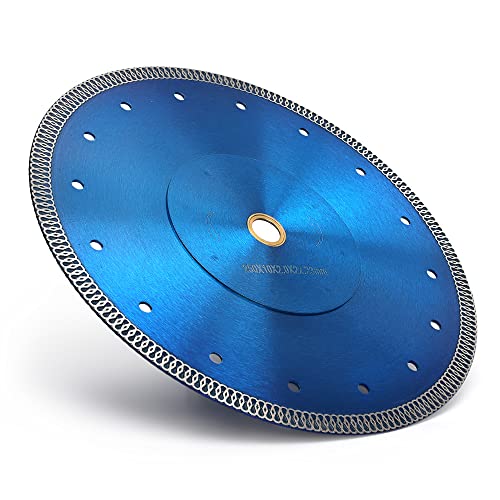
This diapro model is another strong contender in the super-thin category, featuring an X-teeth design on its rim intended to offer both fast and smooth cutting action. With a 2.0mm thickness and a 10mm segment height, it’s built to provide a clean kerf while maintaining enough body for repeated use on a wet tile saw. Users frequently pair it with budget-friendly saws and note a significant improvement over the factory blades that often come with such tools.
The blade receives praise for cutting porcelain tile effectively on wet saws, producing straight lines with minimal chipping when used with care. Its dual arbor compatibility adds to its utility. Contractors have mentioned using it for multiple shower projects, indicating it holds up well under moderate professional demand, though it may eventually show wear on very large jobs.
It represents the practical side of tile cutting: a tool that does its job well without unnecessary complexity or cost. For the homeowner retiling a bathroom or the handyman tackling occasional jobs, this diapro blade offers reliable performance that exceeds its price tier, making it a smart, value-conscious upgrade.
Why it’s great
- Greatly improves cut quality over basic factory-installed blades.
- Effective on porcelain and ceramic with a wet saw setup.
- Good balance of thin kerf and durability for its class.
Good to know
- Performance can be inconsistent on very hard or dense stone.
- Like all thin blades, requires proper saw alignment for best results.
7. OSTEK 10 Inch Super Thin Wet Diamond Porcelain Saw Blade
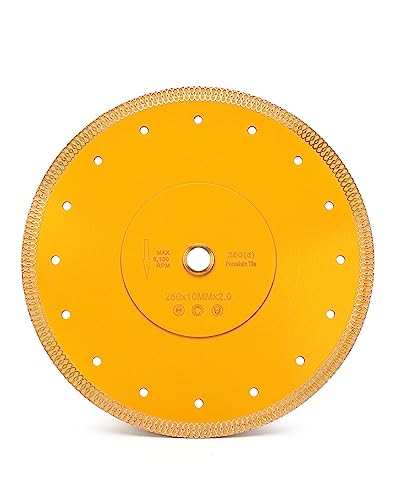
The OSTEK blade utilizes a higher tooth count (24) on its turbo segment design, which can contribute to a smoother cutting feel, especially on ceramic and standard porcelain. The 10mm rim height is designed to provide a longer service life, giving more diamond material to wear through before the blade is spent. It’s explicitly noted for compatibility with handheld machines, making it a candidate for dry cutting with grinders when necessary.
DIYers and some professionals appreciate its ability to “cut tile like butter,” particularly on glazed ceramic subway tiles and similar materials. The blade performs well in both wet and dry scenarios, though wet use is always recommended for longevity. Its design aims for chip-free cutting, and many users achieve this with proper technique.
This blade is a solid workhorse for someone who might use it on a variety of tools—perhaps a wet saw for one project and an angle grinder for another. Its design parameters suggest a focus on user-friendly performance and adaptability rather than pushing the limits on a single specification.
Why it’s great
- Higher tooth count can yield a smoother cut on certain materials.
- Tall rim segment promises extended usable life.
- Works effectively in both wet and dry applications.
Good to know
- May not be the fastest blade for very dense porcelain.
- Dry cutting will significantly reduce its overall lifespan.
8. Bosch DB1043S 10 in. Standard Continuous Rim Diamond Blade
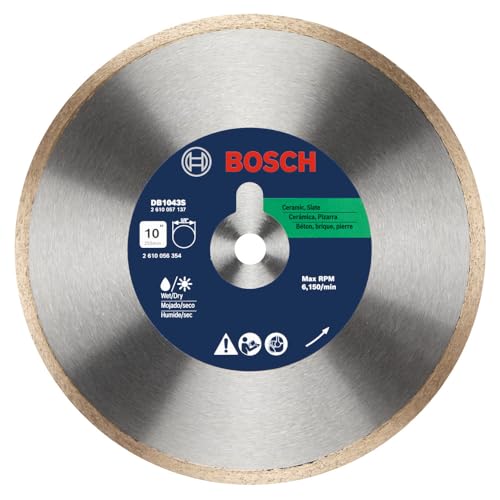
The Bosch DB1043S is a classic continuous-rim blade from a major tool manufacturer. Its design philosophy is centered on consistency and smooth, clean cuts in most tile and stone materials. The tensioned steel core is a key feature, providing enhanced stability to resist bending under load, which promotes accuracy. The consistent diamond content and distribution aim for even wear and predictable performance.
Users report that this blade holds up well over time, making hundreds of cuts in bathroom renovations. It’s known to handle marble and softer stone beautifully, and many find it a reliable upgrade for their tile saw. Some use it dry on small trim cuts with a grinder for convenience, though it’s primarily designed for wet use.
This blade represents the reliable, name-brand option for those who prioritize trust in engineering and manufacturing consistency. It may not have the thinnest kerf or the most aggressive cut, but it offers a proven track record of doing a specific job—clean cutting of standard materials—very well. It’s a safe, dependable choice.
Why it’s great
- Excellent stability from the tensioned core for accurate cuts.
- Predictable performance and even wear from consistent diamond matrix.
- Strong brand reputation for quality control and durability.
Good to know
- Some users report chipping on very hard, textured porcelain tiles.
- Continuous rim design can cut slower than turbo or segmented blades.
9. Kingthai 10 Inch Wet Dry Segmented Concrete Diamond Saw Blade

The Kingthai is a fundamentally different tool, designed not for fine tile work but for aggressive material removal on masonry. Its segmented design with deep gullets is engineered to clear debris quickly when cutting brick, block, concrete, and stone. The hot-pressed sintering technology creates a dense, durable diamond matrix meant to withstand the abrasiveness of these materials.
This blade excels in its intended role. Users cutting bricks for patios or fireplaces, or notching concrete blocks, report clean, fast cuts and impressive longevity for the cost. It can be used wet or dry, though wet use is always advised for dust control and blade life. It’s important to understand that this blade will leave a rough, chipped edge on tile; it’s not for finish work.
Including this blade highlights a crucial aspect of selection: matching the tool to the material. For anyone whose project list includes hardscape work alongside tiling, having a dedicated masonry blade like the Kingthai is essential. It prevents premature wear and damage to your finer tile blades.
Why it’s great
- Highly effective and long-lasting for cutting masonry and concrete.
- Excellent value for heavy-duty, abrasive material cutting.
- Segmented design clears material rapidly, reducing binding.
Good to know
- NOT for cutting porcelain, ceramic, or stone where a clean edge is needed.
- Will chip and destroy the glaze and edges of tile.
10. diapro 10″ Diamond Tile Saw Blade Super Thin (B08JPKQ1KW)

This earlier diapro model is a testament to the value available at the entry-level. It incorporates the key features desired in a tile blade: a super-thin design for reduced chipping, compatibility for wet or dry cutting, and dual arborsize. It achieves this at a very accessible price point, making it a low-risk option for someone trying a tile project for the first time or needing a backup blade.
Feedback highlights its capability to cut cleanly without chipping on standard ceramic and porcelain when used correctly. The thin profile is noted as a benefit for getting into tight areas or making precise cuts. However, users also caution that its thinness makes it more susceptible to deformation if dropped or handled roughly.
This blade is about proving that basic competence doesn’t require a major investment. For a small bathroom project, a handful of cuts for a backsplash, or as a spare, it delivers functional performance. It manages expectations well, offering decent results for occasional use rather than promising professional-grade endurance.
Why it’s great
- Extremely budget-friendly entry point into diamond blade cutting.
- Super thin design works for detailed cuts and reduces material waste.
- Universal wet/dry and dual arbor compatibility maximizes flexibility.
Good to know
- Thin construction is more fragile and prone to damage from mishandling.
- Longevity is limited; best for small to medium projects.
11. PANFREET 10″ Diamond Porcelain Cutting Blade

The PANFREET represents the most budget-conscious option on the list, designed to provide core diamond blade functionality for the casual user. It features turbo segments intended to provide chip-free cutting and is built for use with wet or dry cutting on a variety of materials including ceramic, granite, and marble. The inclusion of dual arbor sizes (5/8″ and 7/8″) ensures it can fit many common saws.
Users report that for the cost, it performs adequately, cutting through tile and even being used for grinding concrete in some cases. It serves as a proof-of-concept that a diamond blade can be accessible. However, experiences are mixed, with some units failing prematurely, which is a noted risk at this price tier. It’s a tool where careful handling and modest expectations are key.
This blade is for the infrequent user on a tight budget—perhaps for a one-time patio project or a few tile replacements where buying a more expensive blade feels unnecessary. It gets the job done for basic cuts, but reliability and longevity are its trade-offs. It’s the definition of a disposable blade for disposable projects.
Why it’s great
- Most affordable option for trying diamond blade cutting.
- Covers a wide range of basic materials (ceramic, granite, marble).
- Provides functional performance for very occasional use.
Good to know
- Higher risk of premature failure or inconsistent quality.
- Not suitable for precision work or demanding materials.
Understanding the Specs
Continuous Rim vs. Segmented vs. Turbo
A continuous rim has a smooth, unbroken edge with diamonds embedded throughout. It provides the cleanest, chip-free cut but cuts slower. A segmented rim has deep grooves (gullets) separating the diamond segments. It cuts faster and clears debris better but leaves a rougher edge—ideal for masonry, not tile. A turbo or X-turbo rim is a hybrid, with a slightly serrated or notched continuous edge. It aims to balance cutting speed with a clean finish, making it a popular choice for porcelain and ceramic.
Kerf, Arbor, and Compatibility
The kerf is the width of the cut the blade makes. A thinner kerf (e.g., 1.4mm) removes less material, reduces strain on the motor, and can minimize chipping. The arbor is the center hole that mounts the blade to the saw. The 5/8-inch arbor is standard for most North American tile saws. Many blades include a removable reducer bushing to also fit a 7/8-inch arbor. Always verify this compatibility before purchasing.
FAQ
Can I use a tile saw blade on my angle grinder?
Why is my new diamond blade not cutting well?
How do I know when to replace my tile saw blade?
What is the difference between a porcelain blade and a general tile blade?
Final Thoughts: The Verdict
For most people, the best 10 inch tile saw blade winner is the EZARC Super Thin because it masterfully balances premium cut quality, chip-free performance, and mid-range value for both DIYers and pros. If you want uncompromising, showroom-edge precision on high-end porcelain, grab the Alpha Porcellana. And for versatile, controlled cutting with a handheld angle grinder, nothing beats the ultra-thin profile of the GoYonder.

Mo Maruf
I created WellFizz to bridge the gap between vague wellness advice and actionable solutions. My mission is simple: to decode the research and give you practical tools you can actually use.
Beyond the data, I am a passionate traveler. I believe that stepping away from the screen to explore new environments is essential for mental clarity and physical vitality.