Our readers keep the lights on and my smoothie glass nicely filled. As an Amazon Associate, I earn from qualifying purchases.
The difference between a rough, splintered edge and a glass-smooth cut lies entirely in the blade spinning on your miter saw. Choosing the right one transforms your tool from a simple cutter into a precision instrument.
I’m Mohammad Maruf — the founder and writer behind WellFizz. My process involves deep analysis of market data, manufacturer specifications, and thousands of customer experiences to decode what truly makes a saw blade perform.
After scrutinizing geometry, carbide formulations, and real-world results, I’ve organized this research to cut through the confusion. Our analysis of blade geometry, tooth count, and carbide quality ensures you find the ideal best 10 inch miter saw blade for precise woodworking.
How To Choose The Best 10 Inch Miter Saw Blade
Selecting a blade isn’t about finding the most expensive option; it’s about matching the tool’s capabilities to your most common tasks. Focus on these core specifications to make an informed decision.
Tooth Count and Geometry
This is the most critical factor. Blades with fewer teeth (24-40) cut faster and are ideal for ripping lumber or rough cuts. Higher tooth counts (60-80) provide slower, smoother cuts perfect for crosscuts, trim, and finish work where minimal sanding is desired. The tooth shape—like Alternate Top Bevel (ATB) for clean crosscuts or a combination grind for versatility—also dictates the cut quality.
Kerf Width
Kerf is the width of the material removed by the cut. A thin kerf (around 0.098″) creates less friction and waste, making it easier on smaller motors. A full kerf (around 0.125″) is more stable and durable for heavy-duty use on powerful cabinet saws. For most miter saws, a thin kerf offers a great balance of efficiency and clean cutting.
Carbide Quality and Coating
The teeth are typically tipped with tungsten carbide. Higher-density carbide blends stay sharper longer, especially in hardwoods. Coatings like Perma-SHIELD or non-stick treatments reduce heat buildup, resist pitch accumulation, and help prevent corrosion, extending the blade’s life between cleanings.
Arbor and Compatibility
Nearly all 10-inch miter saws use a 5/8-inch arbor hole. Always double-check your saw’s manual to confirm. The blade must also be rated for a maximum RPM equal to or higher than your saw’s no-load speed to ensure safe operation.
Quick Comparison
On smaller screens, swipe sideways to see the full table.
| Model | Type | Best For | Key Feature | Amazon |
|---|---|---|---|---|
| Diablo D1060X | Carbide | Ultra-Smooth Finish Cuts | Hi-ATB Teeth & Perma-SHIELD | Amazon |
| Makita A-93681 | Micro-Polished | Precision Fine Woodworking | ATAF Grind, Ultra-Thin Kerf | Amazon |
| Freud LU84R011 | Combination | Versatile Ripping & Crosscutting | TiCo Carbide, Laser-Cut Slots | Amazon |
| DEWALT DWA11040 | Carbide | Reliable General Purpose | Optimized Tooth Geometry | Amazon |
| WEN BL1080 | Carbide | Ultra-Fine Finish Work | 80-Tooth, Thin Kerf | Amazon |
| Luckyway 2-Pack | TCT | High-Value Bulk Purchase | Two 80T Blades | Amazon |
| DEWALT DW3112 | Thin Kerf | Fast Ripping & Framing | 24-Tooth, Wedge Shoulder Design | Amazon |
| WEN BL1032-2 Set | Carbide Set | Starter Kit for Multiple Tasks | 32T & 60T Blade Combo | Amazon |
| WEN BL1060 | Carbide | Budget-Friendly Finish Cuts | 60-Tooth Fine Finish | Amazon |
| Luckyway 80T | TCT | Entry-Level Fine Cutting | 80-Tooth, Ultra-Thin Kerf | Amazon |
| WEN BL1040 | Carbide | General Purpose Woodcutting | 40-Tooth, 6000 RPM | Amazon |
In‑Depth Reviews
1. Diablo D1060X Fine Finish Saw Blade
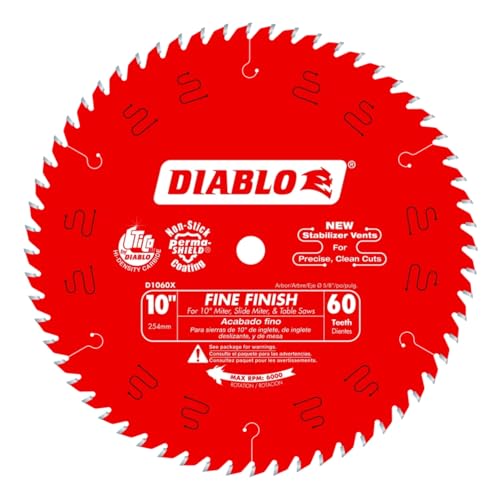
The Diablo D1060X represents the sweet spot in the premium blade category, delivering exceptional cut quality that rivals blades costing significantly more. Its 60 high-alternate-top-bevel (Hi-ATB) teeth are designed to slice rather than chop, producing a remarkably smooth surface that drastically reduces the need for post-cut sanding. The thin 0.098-inch kerf minimizes waste and motor strain without sacrificing rigidity.
What sets this blade apart for consistent, high-volume work is its intelligent construction. The Perma-SHIELD non-stick coating is a game-changer, actively resisting the pitch and resin buildup that can cause friction, heat, and premature dulling. This means you spend less time cleaning the blade and more time making clean cuts. The carbide tips are shock-resistant, helping them withstand the occasional accidental contact with fasteners or hardened wood.
User feedback consistently highlights its transformative effect on both miter and table saws, turning rough-cutting tools into precision instruments. It’s the go-to recommendation for woodworkers who want professional-grade results without venturing into the most expensive tier. The balance of smooth cutting, durability, and heat management makes it a reliable workhorse for demanding finish carpentry and fine woodworking projects.
Why it’s great
- Produces exceptionally smooth, sanding-ready cuts on crosscuts and trim.
- Perma-SHIELD coating significantly reduces gumming and corrosion.
- Thin kerf design is efficient and easy on saw motors.
- Widely praised for its outstanding value in the premium segment.
Good to know
- As a finish blade, it’s not designed for fast, aggressive ripping of thick hardwoods.
- The non-stick coating can wear over time with heavy use and repeated cleanings.
2. Makita A-93681 Micro-Polished Miter Saw Blade

Makita’s A-93681 is a precision instrument engineered for the discerning woodworker who prioritizes flawless cut quality above all else. The blade employs an ATAF (Alternate Top Alternate Face) tooth grind, a sophisticated geometry that creates an incredibly fine, shearing action. When combined with teeth that are micro-polished to a mirror-like finish, the result is a cut surface that often needs no further preparation.
The ultra-thin kerf is a standout feature, one of the thinnest on the market. This design minimizes drag on the saw motor and reduces material waste to an absolute minimum, which is crucial when working with expensive hardwoods. The blade plate is hand-tensioned, a meticulous process that ensures it runs perfectly true with minimal vibration, contributing directly to accuracy and a quieter operation.
This blade excels in a miter saw application for crosscutting moldings, trim, and fine furniture components. Professionals note its ability to handle delicate materials without tear-out and its impressive edge retention. While it’s a specialist for crosscutting, its performance is so refined that many users dedicate it to their miter saw and wouldn’t use anything else for finish work.
Why it’s great
- Delivers arguably the smoothest possible cut finish straight from the saw.
- Ultra-thin kerf maximizes efficiency and preserves expensive wood stock.
- Hand-tensioned plate ensures exceptional balance and reduces vibration.
- Ideal for finish carpenters and cabinetmakers requiring glue-ready edges.
Good to know
- Its specialized thin kerf and fine teeth make it less suitable for heavy ripping.
- The premium performance comes at a higher cost than general-purpose blades.
3. Freud LU84R011 Combination Saw Blade
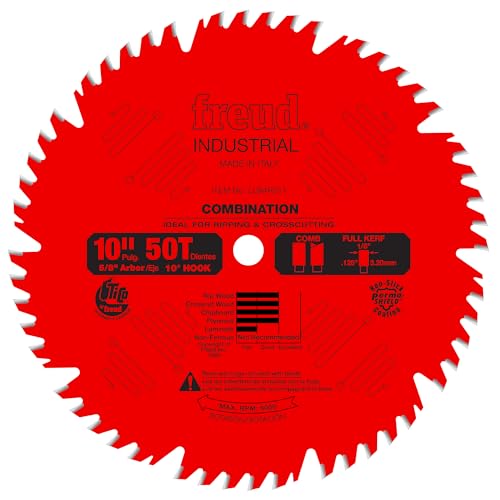
The Freud LU84R011 is the definitive “one-blade-fits-most” solution for woodworkers who demand high performance across both ripping and crosscutting without constantly changing blades. Its unique 50-tooth combination grind cleverly alternates groups of four ATB teeth with a single flat-top raker tooth. This design allows it to crosscut smoothly while the raker efficiently cleans out the kerf and leaves a flat-bottomed cut ideal for joinery.
Built as a full-kerf blade, it’s substantial and designed for stability on cabinet-style table saws with 3HP or more. The premium TiCo Hi-Density carbide is formulated for maximum durability and long life between sharpenings. Laser-cut anti-vibration slots in the blade body dampen harmonic noise and prevent sideways movement, contributing to a crisp, splinter-free finish even on challenging materials.
This is the blade you leave on your primary table saw for all-around shop work. It handles sheet goods, hardwoods, and dimensional lumber with authority, producing results that are far superior to a basic blade. For those who want top-tier versatility and are willing to invest in a long-term tool, the LU84R011 is a benchmark in the combination blade category.
Why it’s great
- Exceptionally versatile, performing well for both rip cuts and crosscuts.
- Flat-top raker teeth create a clean, flat-bottomed kerf useful for joinery.
- Full kerf and laser-cut slots provide maximum stability and reduce vibration.
- Premium carbide ensures a long service life and holds an edge well.
Good to know
- Full kerf requires a saw with ample power (3HP+ recommended).
- The Perma-Shield coating can sometimes transfer or wear in the arbor area.
- It’s a significant investment compared to entry-level options.
4. DEWALT DWA11040 Fine Finish Blade
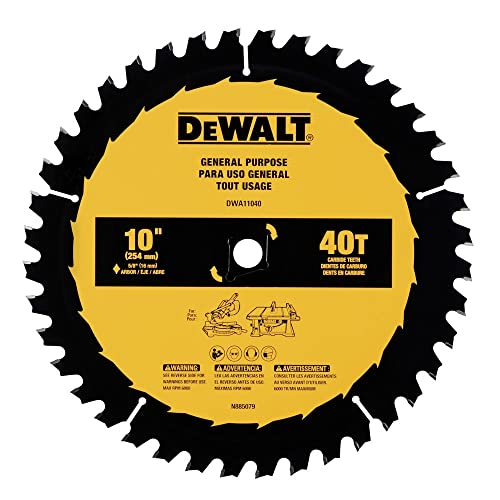
DEWALT’s DWA11040 offers the reliability and consistent performance expected from a major tool brand at a mid-range point that makes it accessible for serious DIYers and professionals alike. With 40 teeth, it sits in a versatile sweet spot, capable of handling general crosscutting duties while still cutting efficiently enough for some ripping tasks, producing a notably cleaner finish than a basic 24-tooth framing blade.
The blade features DEWALT’s optimized tooth geometry, which is engineered for increased accuracy and a cleaner cut path. The use of “ultra-sharp carbide” isn’t just marketing; users report the blade arrives sharp and retains its edge through extended use on plywood, hardwoods, and softwoods. It’s a robust, well-balanced option that installs easily and runs true on a wide variety of 10-inch miter and table saws.
For someone who wants a step up in quality from the most budget-friendly options but doesn’t need the ultra-fine specialization of an 80-tooth blade, the DWA11040 is a perfect compromise. It’s a trustworthy, go-to blade for project builds, workshop tasks, and finish work where a very smooth edge is desired but absolute perfection isn’t critical.
Why it’s great
- Excellent balance of cut speed and finish quality from a trusted name.
- Stays sharp remarkably well, offering good value over its lifespan.
- Versatile 40-tooth design handles a wide array of common woodworking tasks.
- Provides a noticeable upgrade over the blade that likely came with your saw.
Good to know
- As a mid-range blade, it won’t match the polished finish of a dedicated 80-tooth blade.
- Some users note it can produce more sawdust kickback than thinner-kerf blades.
5. WEN BL1080 Ultra-Fine Finish Blade
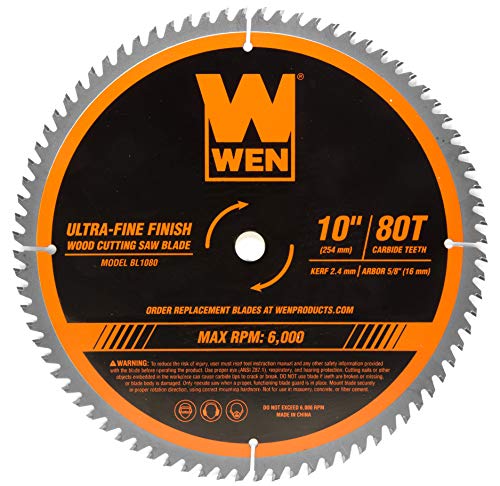
The WEN BL1080 punches far above its weight class, delivering ultra-fine finish performance at a point that makes it accessible for hobbyists and professionals watching their tooling budget. The 80 carbide-tipped teeth are configured to create a very fine, shearing cut that leaves minimal tear-out on crosscuts, even in plywood and delicate moldings. The thin 1/10-inch kerf ensures efficient cutting without bogging down the saw.
What’s most impressive is the reported longevity. Many users, expecting a disposable blade at this point, are shocked at how many linear feet of material it cuts while maintaining its sharpness. It runs true with minimal vibration, a sign of good balancing in manufacturing. This blade is an ideal choice for trim installers, DIY remodelers, or anyone who needs a dedicated finish blade for their miter saw without a major financial commitment.
It demonstrates that you don’t always need to pay a premium for specialized performance. For occasional fine woodworking or a dedicated trim job, the BL1080 provides a spectacular return on investment, producing results that easily rival more expensive brands for a fraction of the cost.
Why it’s great
- Provides genuine ultra-fine cut quality at an entry-level cost.
- Surprisingly durable, staying sharp longer than many anticipate.
- Thin kerf design makes it suitable for lower-powered saws.
- Perfect for DIYers who need occasional finish-grade results.
Good to know
- While durable for its class, it may not withstand daily professional abuse as well as premium brands.
- Lacks advanced coatings like Perma-SHIELD to resist pitch and heat.
6. Luckyway 80T 2-Pack Saw Blades
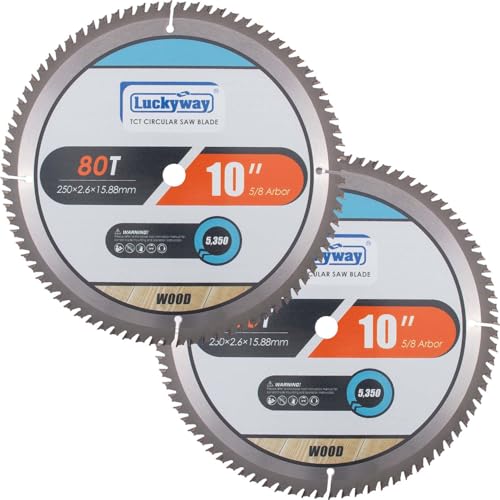
This Luckyway two-pack is the ultimate value proposition for the woodworker who goes through blades or wants to dedicate one blade to the miter saw and another to the table saw without breaking the bank. Each blade features 80 tungsten carbide-tipped teeth designed for a fine finish cut on wood, plywood, and laminate. Getting two capable blades for the cost of one mid-range option changes the economics of blade ownership.
The performance is consistently reported as strong for the category. Users find the blades are sharp out of the package, cut cleanly with minimal splintering, and fit standard 5/8-inch arbors properly. The thin kerf helps with cutting efficiency. This pack is ideal for contractors on a tight budget, workshop environments where blades are shared, or for tackling a large one-off project like installing flooring or trim throughout a house.
Having a spare on the shelf also means no downtime. When one blade eventually dulls, you can immediately swap in the second and order a replacement at your leisure. This strategy turns blade wear from an urgent expense into a planned, manageable cost.
Why it’s great
- Incredible value, providing two serviceable finish blades for a low total cost.
- Eliminates workshop downtime by ensuring you always have a sharp spare.
- Cuts cleanly and accurately enough for most general and finish work.
- Great for high-volume, less-precise tasks where blade longevity is less critical.
Good to know
- Blade longevity and edge retention are not on par with more expensive, branded options.
- Quality control can be variable; always inspect a new blade for damage or imperfections.
- Packaging and branding are utilitarian.
7. DEWALT DW3112 Thin Kerf Rip Blade

The DEWALT DW3112 is a specialized tool designed for one job: fast, aggressive cutting. With only 24 teeth and a thin 0.07-inch kerf, this blade is built for speed and efficiency. It’s the ideal choice for ripping dimensional lumber, breaking down sheet goods quickly, framing, or any task where cut speed is more important than a polished finish. The thin kerf removes less material, reducing strain on the saw motor and allowing for faster feed rates.
DEWALT incorporates its wedge shoulder design, which puts more steel behind each carbide tip. This increases durability and helps maintain accuracy even during demanding cuts. The computer-balanced plate reduces vibration, which is essential for both safety and cut quality when running at high speeds. Don’t expect a mirror-smooth edge from this blade; expect it to power through material with minimal effort.
This is an essential part of a multi-blade setup. It’s the blade you reach for at the start of a project to quickly rough-cut parts to size before switching to a finer blade for final, precise cuts. For contractors or DIYers who regularly work with 2x4s and plywood, having a dedicated rip blade like the DW3112 can save a significant amount of time and effort.
Why it’s great
- Cuts through wood rapidly with minimal motor strain thanks to the thin kerf.
- Extremely durable construction withstands the demands of ripping and framing.
- Reduces sanding time on rip cuts by leaving a relatively clean, flat kerf.
- A vital blade for anyone who processes a lot of rough lumber.
Good to know
- Leaves a rough surface on crosscuts; not suitable for finish work.
- The aggressive cut can be more prone to kickback if used improperly.
- Loud operation is typical for a low-tooth-count blade.
8. WEN BL1032-2 Two-Blade Set

For the woodworker looking to build a foundational blade collection in one purchase, the WEN BL1032-2 set is a brilliantly practical solution. This pack includes two purpose-built blades: a 32-tooth general-purpose blade for faster ripping and crosscutting, and a 60-tooth fine-finish blade for smooth crosscuts and trim work. Together, they cover 90% of what a home shop or job site requires.
Both blades share WEN’s quality hallmarks: a thin 1/10-inch kerf for efficiency, carbide-tipped teeth, and a 5/8-inch arbor with a 6000 RPM rating. The value here is in the flexibility. You can keep the 60-tooth blade on your miter saw for finish cuts and the 32-tooth on your table saw for dimensioning, or swap them as needed. It’s an economical way to stop compromising with a single “do-it-all” blade that doesn’t excel at anything.
This set is highly recommended for new saw owners looking to immediately upgrade from the stock blade, or for anyone wanting to organize their workflow more efficiently. It demonstrates that having the right tool for the job doesn’t require a large investment, and it establishes a smart, two-blade system that will improve the quality and ease of your projects immediately.
Why it’s great
- Provides immediate versatility with dedicated blades for rough and finish work.
- Exceptional value, offering two quality blades for the price of one mid-range option.
- Eliminates the need for constant blade changes for different tasks.
- Perfect starter pack for new woodworkers or as reliable backup blades.
Good to know
- The 32-tooth blade is a generalist; for heavy ripping, a dedicated 24T blade is faster.
- The 60-tooth blade is excellent but not an “ultra-fine” 80-tooth specialist.
9. WEN BL1060 Fine-Finish Blade

The WEN BL1060 is the single-blade embodiment of the brand’s value proposition: delivering reliable, better-than-expected performance at a very accessible point. With 60 carbide-tipped teeth, it’s squarely aimed at the woodworker who needs clean crosscuts for trim, furniture, and general projects without breaking the bank. It produces a noticeably smoother finish than a 40-tooth blade, with significantly less tear-out on plywood and moldings.
Users consistently praise its performance in real-world conditions, noting it cuts “like butter” and leaves edges “smooth enough to impress.” The thin kerf ensures it doesn’t overload smaller miter saws or jobsite table saws. For the hobbyist or occasional remodeler, this blade represents a smart upgrade that dramatically improves results over a stock blade, making it feel like you’ve unlocked new potential in your tool.
It’s a classic example of the law of diminishing returns. While a more expensive blade might offer marginally better performance or longer life, the BL1060 provides 90% of the benefit for a fraction of the cost, making it an incredibly sensible choice for non-professional use.
Why it’s great
- Offers excellent fine-finish cutting performance for very little money.
- A perfect, cost-effective upgrade from the basic blade that came with your saw.
- Thin kerf design is efficient and user-friendly on all saw types.
- Highly regarded as a “disposable premium” blade for occasional fine work.
Good to know
- Edge life, while good for the cost, is not comparable to premium carbide blends.
- Lacks vibration-damping slots or advanced coatings found on more expensive blades.
10. Luckyway 80T Ultra Finish Blade

As a standalone option, the Luckyway 80T blade is the most affordable entry point into the world of high-tooth-count finish cutting. It provides the basic geometry needed for smoother cuts—80 tungsten carbide-tipped teeth and an ultra-thin kerf—without any frills. For the user on an extremely tight budget or someone who needs a blade for a single, specific project, it gets the job done.
Feedback indicates it cuts cleanly when new, handling trim, thin stock, and sheet goods adequately. It’s a viable option for the DIYer who might make a few dozen critical crosscuts for a project and then put the saw away for months. The value proposition is straightforward: maximum tooth count for minimum investment.
It’s important to set realistic expectations. This is a commodity blade. While it can produce good results initially, consistency, longevity, and ultimate cut quality are not its strengths compared to even slightly more expensive branded options. However, for its intended role as an ultra-budget finish solution, it fulfills a need in the market.
Why it’s great
- The lowest-cost way to get an 80-tooth finish blade.
- Cuts cleanly and accurately when first installed.
- Useful for one-off projects or as a beater blade for questionable materials.
- Packaged securely and typically arrives in good condition.
Good to know
- Dulls relatively quickly with regular use on hardwoods.
- Quality control is variable; check for arbor fit and tooth alignment.
- Not recommended for long-term professional or heavy-duty use.
11. WEN BL1040 General Purpose Blade

The WEN BL1040 is the definition of a reliable, no-frills workhorse. With 40 teeth, it sits in the classic general-purpose range, capable of handling everything from crosscutting 2x4s to ripping plywood with reasonable efficiency and a decent finish. It’s the ideal replacement for the worn-out or low-quality blade that came with your saw, offering a significant upgrade in cut quality and durability at a minimal cost.
This blade is for the user who wants one blade to handle a bit of everything without swapping. It won’t rip as fast as a 24-tooth blade or crosscut as smoothly as a 60-tooth, but it provides a very competent middle ground. The thin kerf and 6000 RPM rating make it compatible with virtually any 10-inch miter or table saw on the market. Users often describe it as “sharp,” “precise,” and a “no-brainer” for the cost.
For the casual user, the homeowner who tackles occasional projects, or as a reliable backup blade in a professional’s trailer, the BL1040 delivers exceptional utility. It’s the blade you can install and forget about, knowing it will perform admirably across a wide range of tasks without any fuss or special consideration.
Why it’s great
- Extremely cost-effective upgrade over stock blades.
- Versatile 40-tooth design competently handles most common shop tasks.
- Runs true and fits standard arbors without issue.
- A perfect “set it and forget it” blade for the occasional user.
Good to know
- As a generalist, it doesn’t excel in any single area (ripping or fine crosscutting).
- The finish, while good, will show tear-out on veneers and delicate moldings.
Understanding the Specs
Tooth Count (TPI)
Think of teeth per inch as a measure of cut refinement. Low count (24-32) means faster, rougher cuts ideal for framing and ripping. High count (60-80) means slower, smoother cuts for finish work and crosscutting. A 40-50 tooth blade is a versatile compromise. The tooth geometry (ATB, ATAF, Combination) further refines whether the blade is optimized for crosscutting, ripping, or both.
Kerf Width
Kerf is the width of the cut itself. A thin kerf (under 0.1″) removes less wood, reducing waste and requiring less motor power, which is great for jobsite saws. A full kerf (about 0.125″) is thicker, more stable, and less prone to deflection during heavy cuts, making it the choice for powerful cabinet saws. The right kerf maximizes your saw’s efficiency and cut quality.
FAQ
How often should I replace my miter saw blade?
Can I use a table saw blade on my miter saw?
What causes a saw blade to burn the wood?
Is a more expensive blade always better?
Final Thoughts: The Verdict
For most people, the best 10 inch miter saw blade winner is the Diablo D1060X because it delivers a flawless, sanding-ready finish, excellent durability, and game-changing non-stick coating at a reasonable premium cost. If you want unmatched precision and a mirror-like cut, grab the Makita A-93681. And for versatile, heavy-duty performance that masters both ripping and crosscutting, nothing beats the Freud LU84R011.

Mo Maruf
I created WellFizz to bridge the gap between vague wellness advice and actionable solutions. My mission is simple: to decode the research and give you practical tools you can actually use.
Beyond the data, I am a passionate traveler. I believe that stepping away from the screen to explore new environments is essential for mental clarity and physical vitality.