Our readers keep the lights on and my smoothie glass nicely filled. As an Amazon Associate, I earn from qualifying purchases.
Specs are compiled from manufacturer listings and verified buyer reviews and can change over time — please confirm the key details on the product page before buying.
Choosing a Fan For Office really depends on one trade-off: how much air you need versus how much noise you can tolerate while you concentrate. The picks below balance a strong breeze with a low hum, so your calls stay clear, your papers stay put, and your corner of the office stays comfortable without a rattling motor distracting you.
I’m Mohammad Maruf — the founder and writer behind WellFizz. This guide is built by comparing the manufacturers’ published specifications and the patterns across verified customer reviews, so you get each pick’s real strengths and trade-offs instead of marketing spin.
The best desk fans deliver strong airflow, quiet operation, and adjustable angles that fit a workspace without covering the whole desk. This lineup of top Fan For Office models is ranked by the features that actually keep you cool and focused.
Our Picks at a Glance


How To Choose The Best Fan For Office
Picking an office fan means matching the machine to your desk, your room size, and the noise level your colleagues will tolerate. A fan that roars may cool you down but will make video calls awkward, while a whisper-quiet one might not push enough air to actually help.
Match the airflow to your space
For a single desk, a compact model with a 5.5-inch to 7-inch blade is usually plenty. For a larger office or an open-plan floor, you want a pedestal or tower design that moves a bigger column of air across the room.
Check the noise number, not just the promise
Look for a decibel (dB) rating. A fan rated around 20 to 30 dB at its lowest setting is roughly as loud as a whisper, so it will not break your focus or bleed into your microphone during calls.
Consider oscillation and tilt
A fan that sweeps side to side (oscillation) spreads the breeze across a desk, while one that tilts up and down lets you aim the air where you need it most. More movement means more flexibility, especially if the fan serves more than one workstation.
Quick Comparison
| Model | Best For | Airflow (CFM) | Noise Level | Oscillation | Amazon |
|---|---|---|---|---|---|
| IRIS USA WOOZOO Medium Desk Fan★ Best Overall | Quiet desk cooling | — | 29 dB | 65° | Amazon |
| DR.PREPARE Air Circulator FanBest Value | Compact circulation | 900 CFM | Whisper-quiet | 70° | Amazon |
| Amazon Basics 16″ Pedestal FanRoom Coverage | Whole-room airflow | — | Quiet operation | Yes | Amazon |
| DREO Smart Fan | App and voice control | 950 CFM | 20 dB | 90° + 90° | Amazon |
| DREO Tower Fan | Quiet standing power | 1158 CFM | 20 dB | 90° | Amazon |
| IRIS USA WOOZOO Circulator with Remote | Remote convenience | — | Quiet motor | Up, down, left, right | Amazon |
| Lasko Oscillating Tower Fan | Long-lasting value | 262 CFM | Quiet | 60° | Amazon |
| Vornado VFAN Petite Alchemy | Retro style statement | — | Whisper-quiet low | No | Amazon |
In-Depth Reviews
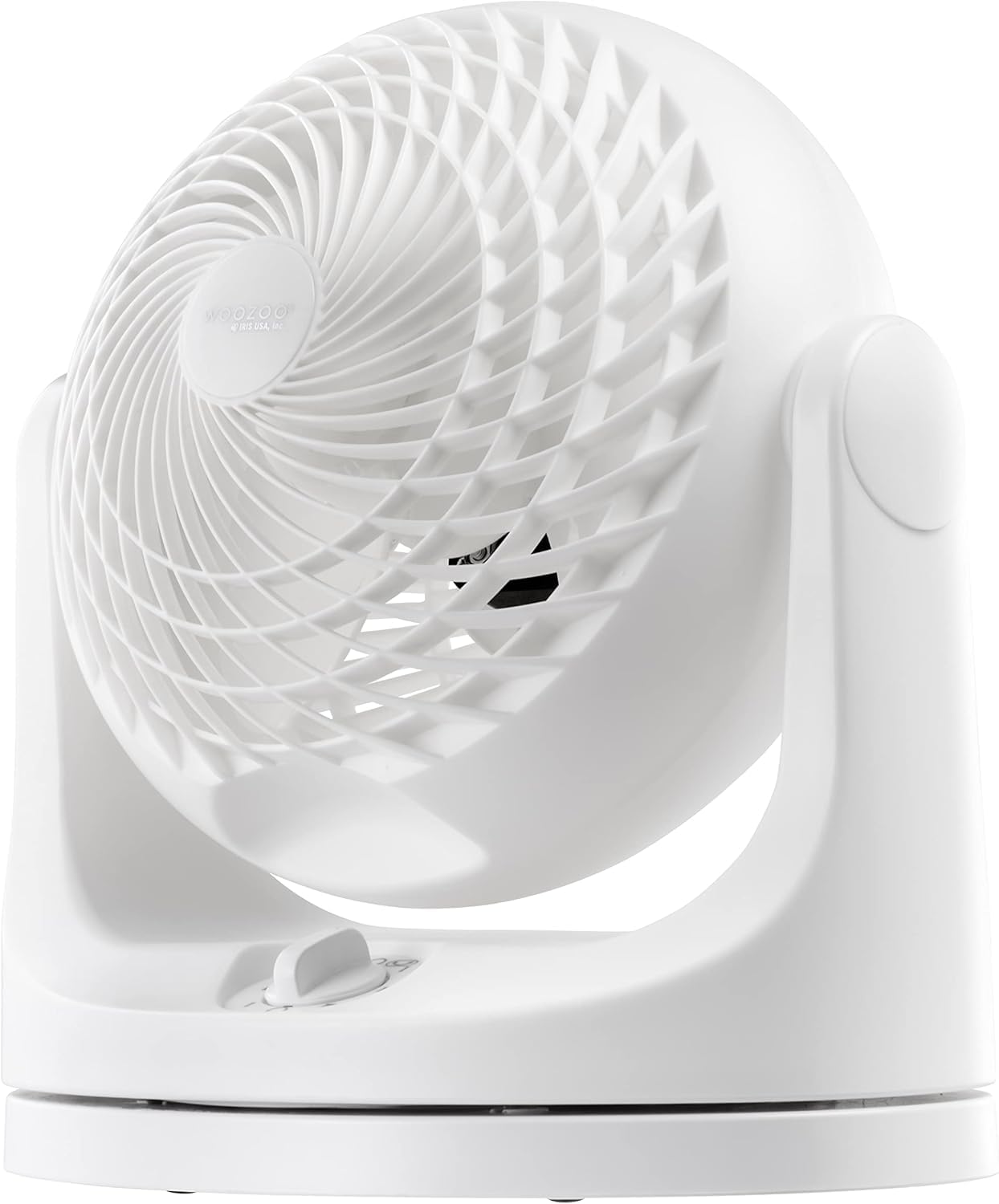
1. IRIS USA WOOZOO Medium Desk Fan
Our pick — over 4.5★ from 700+ verified ratings; the strongest balance of quality and price.
The whisper-quiet desk companion that keeps calls clear and your workspace cool.
If your office is a desk, this is the fan to beat. It earns the top spot because it runs at just 29 dB on its lowest setting — roughly a soft whisper — so it won’t drown out your voice on a Zoom call or break your focus. It holds a 4.8-star average across 700+ owners who praise its quiet operation and strong airflow.
The thing everyone raves about is the noise level, but the power gets nearly as much praise. Three speeds take you from a light breeze to a “powerful stream of air” that reaches across the room, and the 65° auto-oscillation spreads that air through the whole space. The built-in handle and 4.63 lb weight make it easy to move from your desk to a countertop or nightstand when you need it elsewhere.
Buyers report the two lowest settings are pretty quiet, which sums up exactly why this works for an office: it cools without becoming a distraction. The main trade-off, as a few owners found, is that the color you order may not always be the color that arrives — an Amazon shipping mix-up rather than a fan flaw. For a desk-sized model that handles 244 ft² of coverage, this is the most balanced pick on the list.
Why it wins the desk
- 29 dB lowest setting protects video-call audio
- 65° oscillation pushes air across the whole desk area
- Built-in carry handle and 4.63 lb weight for easy moves
- 112° tilt lets you aim the breeze precisely
The honest trade-offs
- No remote control, so you adjust on the unit itself
- Occasional color mix-up in shipping
Your desk pick: This suits anyone who works at a single desk and wants cool air without a noisy motor in the mic.
Think twice if: You need to control the fan from across the room — this one is touch-button only.
2. DR.PREPARE Oscillating Air Circulator Fan
The small-footprint powerhouse that moves way more air than its size suggests.
Do not let the 11.3-inch height fool you — this compact circulator pushes up to 900 CFM of air, enough to refresh a modest office without hogging your desk. Its 6.5-inch airfoil blades move a bigger volume of air per rotation than the 5.5-inch blades on the IRIS USA model above, and a 70° sweep is noticeably wider than the 65° on that same desk fan.
Owners consistently describe it as quiet and powerful. One buyer bought it for houseplants and ended up using it for themselves because, as they put it, it’s “so quiet and powerful—even though it’s small.” The controls are refreshingly simple: a dial that turns right for oscillation or left for static airflow, plus three speeds — high, middle, and low.
The size is the most-mentioned praise, and it makes sense: at 7.7″D x 13.1″W x 11.3″H, it tucks into a tiny corner of your desk. It also sips power at just 33W compared to the 60W of the Amazon Basics pedestal fan below, so it costs less to run across a full workday. For an office that needs efficient personal cooling without a big footprint, this is the smart money pick.
Real-world read: The 3-speed dial and tilting head cover everyday desk needs, and the 10% airflow boost over 6-inch blades puts this ahead of other small circulators its size.
One limitation: To aim it further downward you may need a small wedge under the base, since the downward tilt stops at 10°.
3. Amazon Basics 16″ Pedestal Fan with Remote
Tower-height cooling for open offices, with a remote you will actually use.
When the desk fans above are too small for your space, this pedestal model steps in. Standing 53.15 inches tall with a 16-inch dual-layer blade design, it moves a serious column of air across medium to large rooms — the kind of coverage a single-desk fan simply cannot match. The 60W AC motor delivers that airflow using only 60 watts, so it stays efficient while pushing a strong breeze.
The remote is the reason this works so well in an office. You can adjust speed, mode, and timer without leaving your chair, which matters when the fan sits across the room. Three speeds and three modes — nature, sleep, and normal — give you fine control, with nature and sleep modes simulating a natural breeze rather than a constant blast. Tool-free assembly is another real perk: most owners have it standing in minutes without hunting for a screwdriver.
The catch is durability. It holds a 4.5-star average across thousands of owners, but some report breakdowns after a month, making it a value pick, not a lifetime buy. It also stands 15.75 inches deep, roughly 2.0x the depth of the compact DR.PREPARE model above, so it needs floor space. If you want whole-room airflow in a shared office and the reliability odds of a mass-market favorite, this delivers.
Who it fits: Offices and larger rooms where a desk fan’s reach just is not enough, and where a remote is worth the extra footprint.
Know before buying: The second blade screws on counter-clockwise, which the instructions do not make obvious — a detail note during setup.
4. DREO Smart Fan for Bedroom
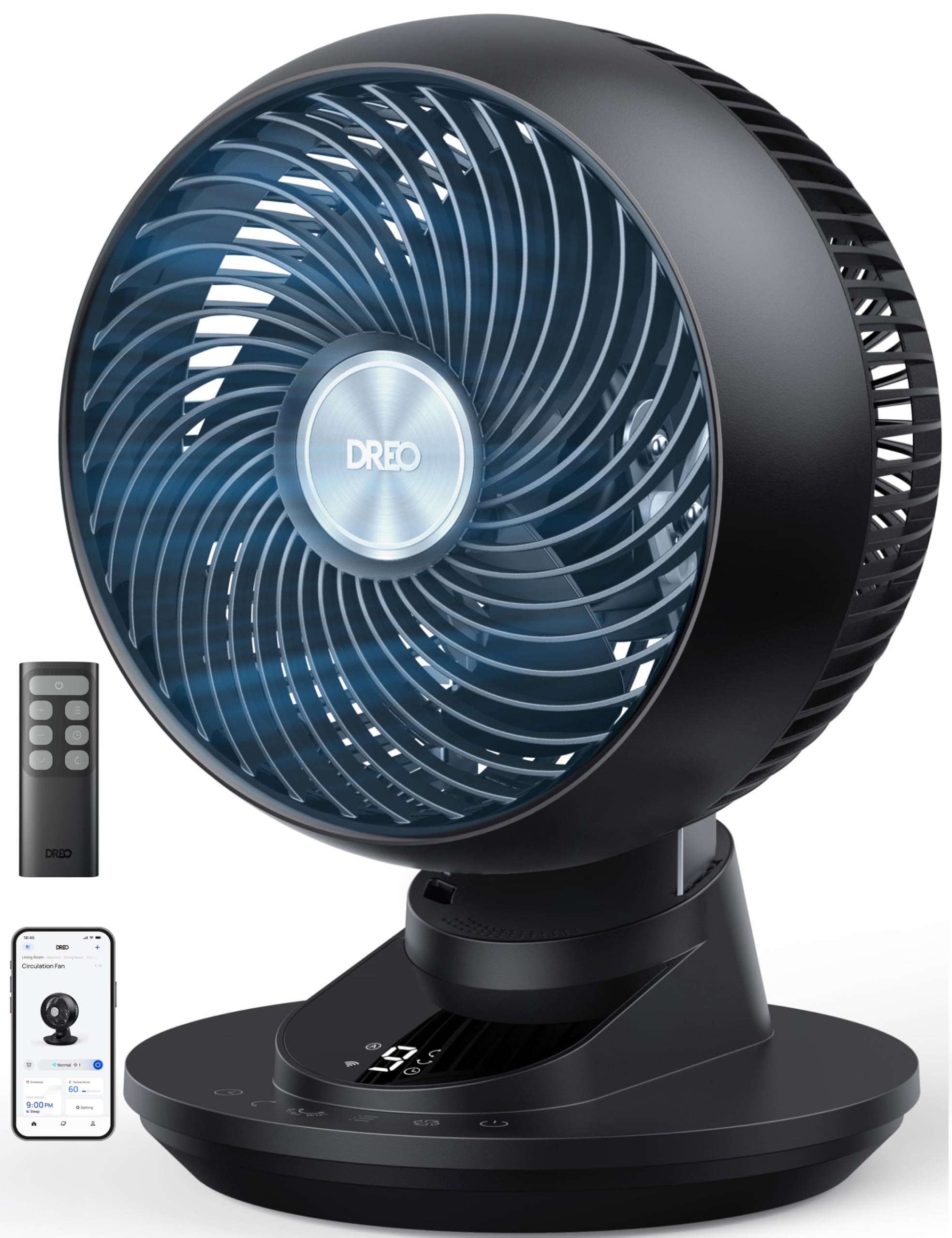
A 20 dB smart fan that takes voice commands and cools your whole desk zone.
This is the fan for the tech-forward office. It runs as low as 20 dB — quieter than the IRIS USA pick above — so it is essentially inaudible during calls and deep-focus work. But the real draw is control: the DREO app works with Alexa and Google Home, so you can adjust the fan from your phone or with your voice without reaching across your desk.
Airflow is serious for a 12-inch desk fan, delivering up to 950 CFM over an 85-foot throw. It beats the DR.PREPARE model above on raw CFM — 950 versus 900 — and it reaches further at 85 ft. The 90° vertical plus 90° horizontal oscillation is the standout: it sweeps both up-and-down and side-to-side, which means no dead spots in the room, unlike single-plane oscillators.
Nine speeds and six airflow modes give you granular control, and the 12-hour timer, child lock, and power-off memory are thoughtful extras. Owners note it is whisper-quiet on speeds 1 through 3, which is exactly the range you will live in at a desk. The catch: at 1.8 kg it is heavier than most table fans, and the full smart feature set is overkill if you just want a breeze. But if app control and true 360° circulation matter to you, this is the one.
Why it leads on smarts
- 20 dB lowest setting is barely audible in a quiet office
- 950 CFM casts air up to 85 feet
- 90° + 90° two-axis oscillation covers the whole room
- App, voice, remote, and touch controls
Considerations
- Heavier than typical desk fans at 1.8 kg
- Smart features cost more than basic models
Reach for this if: You want a fan you can command from your phone or smart speaker and need coverage that goes beyond your immediate desk.
Look elsewhere if: A simple dial and a lower price matter more than app connectivity.
5. DREO Tower Fan for Bedroom

A slim tower that throws a massive 1158 CFM while holding a 20 dB whisper.
If you have floor space next to your desk but not much of it, this tower fan is the answer. It pushes 1158 CFM — the most airflow of any fan on this list, beating even the DREO Smart Fan’s 950 CFM above — and projects wind up to 34 feet. That kind of reach makes it a genuine whole-office cooler, not just a personal breeze.
It stays quiet while doing it. The 20 dB rating matches the smaller DREO desk fan, and the upgraded brushless DC motor is the reason wind speeds reach 28 ft/s without a loud whine. Four modes (Normal, Natural, Sleep, Auto) and eight speeds cover everything from a gentle background breeze to a strong gust, and the 90° oscillation spreads it across the room.
Owners rate the noise level as the top feature, with performance a close second. Assembly is genuinely tool-free, and the remote stores on the unit so you will not lose it. A few note that high speeds get louder and large rooms need the upper settings, so it shines best in small to medium offices. For a floor fan that looks sleek and sounds like a whisper, this is a strong pick.
Where it fits: A home office corner or a small shared space where you want tower-height airflow without a bulky footprint.
Trade-off: Higher speeds are louder, and very large rooms will need the fan on its strongest settings.
6. IRIS USA WOOZOO Air Circulator Fan with Remote
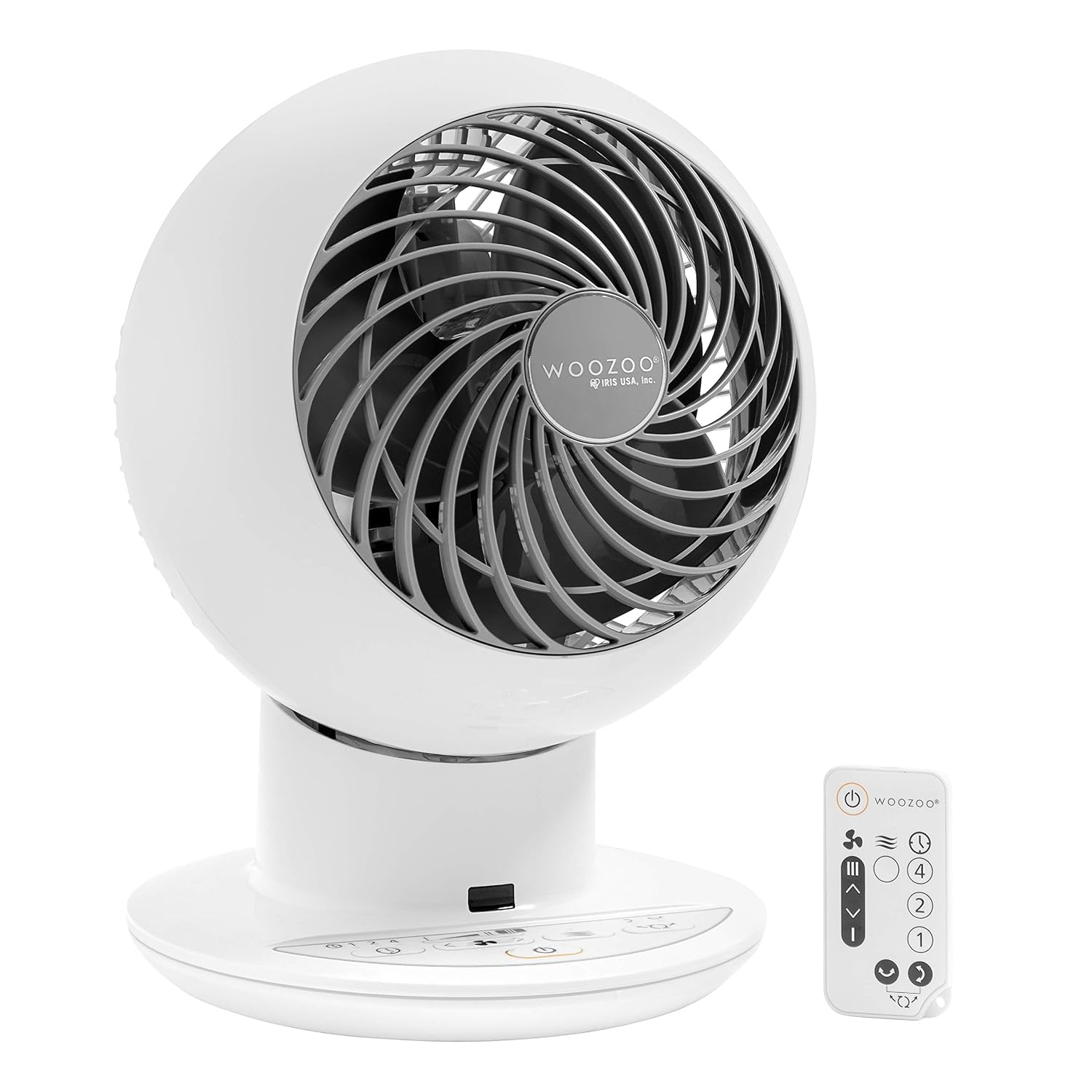
A desktop circulator that oscillates up, down, left, and right with remote control.
For an office where you want to adjust the fan without leaning over your keyboard, this is the desktop pick. It oscillates in four directions — left, right, up, and down — which is a real step up from the single-plane sweep of the basic WOOZOO model above. The included remote handles power, speed, and the auto-off timer, so you can fine-tune the airflow from your chair.
Five speeds plus natural breeze settings give you more granular control than the three-speed models on this list. The 4-pound weight and compact 8.27″ x 8.27″ footprint make it easy to reposition around the office, and the quiet motor keeps it unobtrusive during focused work. Owners call it a “serious powerhouse” that moves air well around a room.
The trade-off is value: some buyers find it a little costly for a desk fan, and the size is the thing people mention most — it is smaller than it looks in photos. The auto-off timer (1, 2, or 4 hours) is a nice touch for leaving the office without worrying about leaving the fan on. For remote convenience on a compact footprint, this is the one to beat.
Standout feature: The four-way oscillation genuinely separates it from most desk fans, which only sweep side to side.
Who should skip: Budget-focused buyers who are happy with manual controls and a lower price.
7. Lasko Oscillating Tower Fan with Remote

The 42-inch tower that keeps humming years after other fans quit.
Owners mention daily use for three-plus years in hot climates, with some buying a second unit only because the first never quit. That durability is the standout trait for a 42-inch tower fan. The 60° oscillation and 262 CFM of airflow cover small to medium rooms, which matches most home offices and small shared spaces.
The nighttime setting dims the LED controls and slows the fan automatically, which also makes it a decent choice for a nap room or a screen-light-sensitive office. The remote handles power, three speeds, oscillation, and the 7.5-hour programmable timer, so you can set it in the morning and forget it. Assembly takes seconds, and the carry handle makes repositioning easy.
There is no app control here — just solid, basic performance. Customers note it is not for large spaces, so if your office is a big open floor, the DREO Tower Fan’s 1158 CFM will reach further. But for a durable, quiet workhorse in a small office, this one delivers exactly what it promises, year after year.
Real durability read: The recurring owner story is years of daily use, rare in this category.
Not for: Large rooms that need maximum throw — this is a small-to-medium space cooler.
8. Vornado VFAN Petite Alchemy

A 12-inch retro metal fan that looks like a design piece and moves real air.
If your office aesthetic matters as much as the breeze, this is your fan. The retro design with a gunmetal finish and copper accents makes it a conversation piece rather than an appliance, and the all-metal construction gives it a premium, built-to-last feel. The appearance is the thing owners praise most, and it is easy to see why — this is a fan you leave out on the desk, not one you hide.
Under the vintage looks, it still delivers serious Vornado circulation. The 12-inch size fits neatly on a desk or nightstand, the 3-speed dial gives you manual control, and the tilt head lets you aim the airflow where you need it. On low speed it is whisper-quiet, making it a solid choice for calls and focused work. The metal build also means it can be fully disassembled for cleaning, a real advantage over sealed plastic fans.
The honest trade-offs: it does not oscillate, and noise feedback is genuinely split — some find it whisper-quiet while others report a clank at higher speeds, and a few owners had units stop working within weeks. It also carries a higher price than most desk fans. But for anyone who wants their cooling to double as decor, the Vornado delivers style and circulation in one small package.
Design verdict: The metal body and retro look make it the only fan on this list you will proudly display.
Who should skip: Buyers who need oscillation — this fan is fixed, so you aim it manually.
Understanding the Specs
CFM, or how much air it really moves
CFM stands for cubic feet per minute, and it measures the volume of air a fan pushes. The higher the number, the more air it moves across the room. A compact desk fan might deliver around 900 CFM, while a tower fan can reach over 1,000 CFM. For a single desk, 900 CFM is plenty; for a whole office, you want the higher end.
Decibels, or how much it will annoy you
Decibels (dB) measure sound level. A fan rated at 20 dB is about as loud as a whisper, while 30 dB is closer to a quiet library. For video calls and deep focus, aim for a fan rated at or below 30 dB on its lowest setting — that keeps the motor out of your microphone and out of your head.
Oscillation and tilt
Oscillation means the fan sweeps side to side automatically to spread airflow across a wider area. Tilt means you can angle the fan head up or down to direct the breeze precisely. Some fans — typically the premium ones — oscillate both horizontally and vertically, which eliminates dead spots in a room.
Wattage, or what it costs to run
Wattage measures how much electricity the motor draws. A 33W fan costs noticeably less to run all day than a 60W model, which matters if the fan stays on for your entire workday. Lower wattage also usually means the motor is more efficient, though it does not always mean weaker airflow.
FAQ
How loud is too loud for an office fan?
What does CFM mean for an office fan and why does it matter?
Is oscillation worth paying extra for?
Can a desk fan cool a whole office or just one person?
Are tower fans better than desk fans for an office?
How does a remote control change daily office use?
What is the difference between a desk fan and an air circulator?
How much electricity does an office fan use?
Final Thoughts: The Verdict
For most people, the fan for office winner is the IRIS USA WOOZOO Medium Desk Fan because it pairs a genuinely quiet 29 dB motor with strong airflow and an easy-to-move design — everything a desk worker needs. If you want smart control and true two-axis coverage, grab the DREO Smart Fan. And for a whole-room breeze in a shared office, the DREO Tower Fan with its 1158 CFM is the one to reach for.
How We Picked
We do not accept paid placement. Every pick is matched to a real buyer and a real use-case; we do not hands-on test units.
Sources & Methodology
Specifications: manufacturer listings and product documentation. Review insights: verified customer reviews, as of August 2026. Pricing: not shown on this page (it changes often); check the current price via the retailer link.
As an Amazon Associate, WellFizz earns from qualifying purchases. This does not affect which products we feature.
Related Guides

Mo Maruf
I created WellFizz to bridge the gap between vague wellness advice and actionable solutions. My mission is simple: to decode the research and give you practical tools you can actually use.
Beyond the data, I am a passionate traveler. I believe that stepping away from the screen to explore new environments is essential for mental clarity and physical vitality.