Our readers keep the lights on and my smoothie glass nicely filled. As an Amazon Associate, I earn from qualifying purchases.
Specs are compiled from manufacturer listings and verified buyer reviews and can change over time — please confirm the key details on the product page before buying.
If your home stereo sounds dull or harsh, the missing link is often a graphic equalizer. It lets you shape the sound to fit your room and your taste. A good unit can tame boomy bass, smooth harsh treble, and reveal detail in your records. A poor unit can inject hiss or hum that masks the music you’re trying to enhance.
I’m Mohammad Maruf — the founder and writer behind WellFizz. This guide is built by comparing the manufacturers’ published specifications and the patterns across verified customer reviews, so you get each pick’s real strengths and trade-offs instead of marketing spin.
Every option here has been checked for stereo compatibility, channel count, and connection type to help you find the best equalizer for home stereo for your system and listening space.
Our Picks at a Glance


How To Choose The Best Equalizer For Home Stereo
An equalizer sits between your source (like a turntable or streamer) and your amplifier. It lets you boost or cut specific frequency bands. Before you buy, you need to think about how many bands you want, what connections you need, and how much noise the unit itself adds.
Count your bands
More bands give you finer control over specific frequencies. A 7-band EQ handles basic tone shaping, while a 15-band unit offers finer slices for room correction. A 31-band pro unit provides surgical control over problem frequencies but demands more skill to use effectively.
Check your connections
Home gear often uses RCA cables, while professional equipment uses XLR or 1/4-inch TRS. If your amplifier accepts RCA, you may need a unit with RCA jacks, or buy adapter cables. Some high-end units are XLR-only, which can mean extra cables for a typical home setup.
Watch for noise
A low-quality equalizer can introduce hiss or hum into your signal path. Seek models that owners consistently describe as quiet and clean. A low-cut filter removes rumble from your room or turntable, keeping the bass tight.
Quick Comparison
| Model | Best For | Bands | Input / Output | Weight | Amazon |
|---|---|---|---|---|---|
| Behringer FBQ1502HD★ Best Overall | Hiss-free home systems | 15 | XLR, USB | 1.7 kg | Amazon |
| MIZISNR EQX-215SBest Value | Budget flexibility | 15 | XLR, 1/4″ TRS | 2.29 kg | Amazon |
| Generic 15 Band EQ-215Budget Champion | Value pick | 15 | XLR, 1/4″ TRS | 3.36 lb | Amazon |
| Douk Audio T7 | Desktop and headphone users | 7 | XLR, RCA | 1.54 lb | Amazon |
| Behringer FBQ3102HD | Deep tonal shaping | 31 | USB 2.0 | 2 kg | Amazon |
| Schiit Loki Mini+ | Simple tactile tone control | 4 | RCA | 2.14 lb | Amazon |
| Behringer FBQ6200HD | Room tuning with test tones | 31 | XLR | 2.3 kg | Amazon |
| dbx 215s | Studio-grade 15-band control | 15 | XLR, 1/4″ TRS | 4.8 lb | Amazon |
| dbx 231s | Serious room correction | 31 | XLR, 1/4″ TRS | 7.9 lb | Amazon |
In‑Depth Reviews
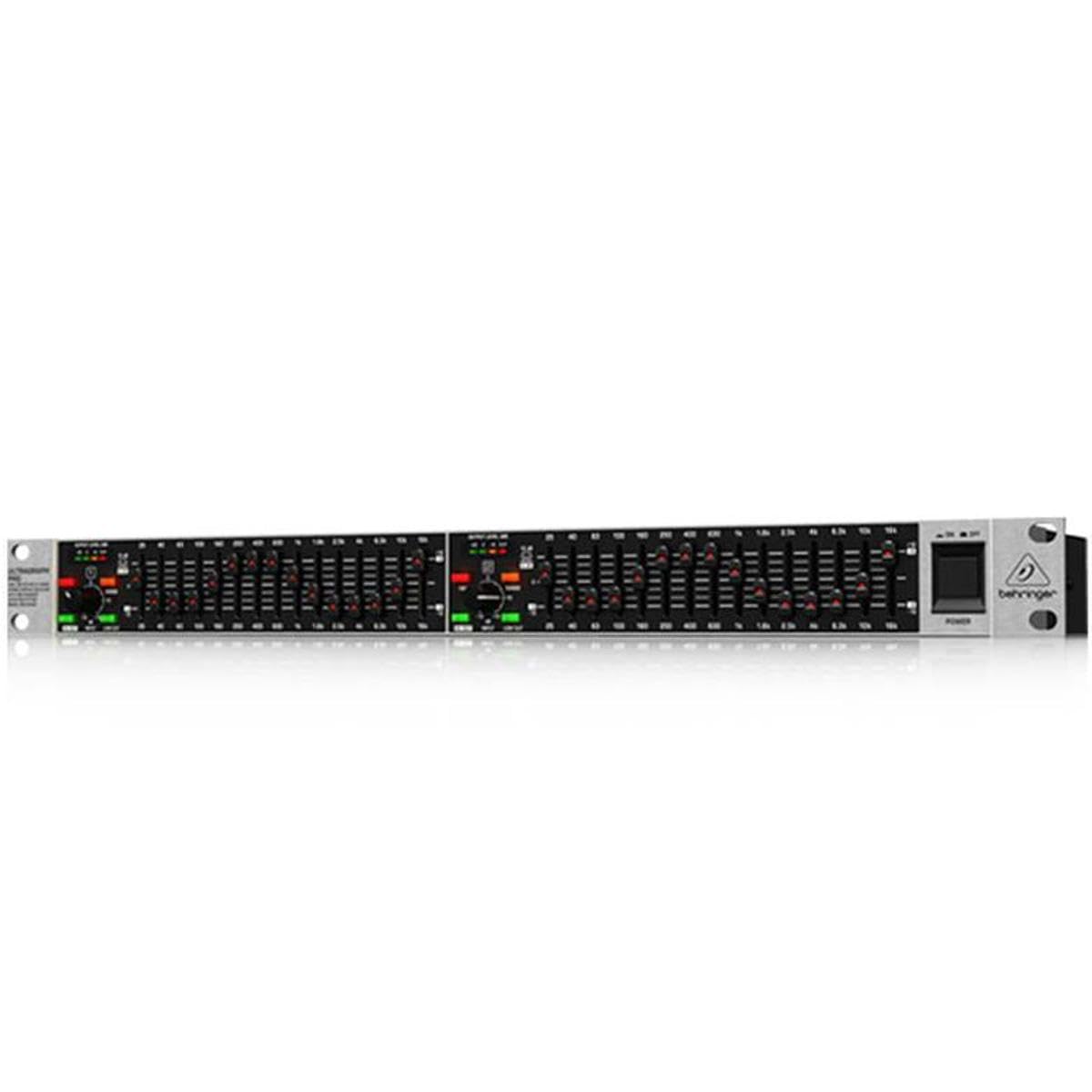
1. Behringer FBQ1502HD
Our pick — 4.5★ from 650+ verified ratings; the strongest balance of quality and price.
The 15-band Stereo Graphic Equalizer that silences hum and hiss for a clean home audio path.
This Behringer unit is the crowd favorite — rated 4.5 out of 5 across 663 ratings. Its defining feature is the FBQ Feedback Detection system, which reveals the critical frequencies causing problems. You can also use it as an audio analyzer, making setup less guesswork.
It comes with a dedicated mono subwoofer output with an adjustable crossover frequency. This means you can route low bass to your sub and keep your main speakers from straining. An additional low-cut filter removes unwanted frequencies like floor rumble.
Owners consistently report it is “EXTREMELY quiet and hum-free,” with one buyer telling how it solved a hum problem from a high-end Pro-ject turntable. Buyers report it works well for both DJ setups and home audiophile systems. Unlike cheaper units, this one stays clean and transparent.
What wins people over
- FBQ feedback detection locates problem frequencies instantly
- Extremely quiet and hum-free operation
- Dedicated subwoofer output with adjustable crossover
- Low-cut filter removes floor rumble
Compatibility notes
- No RCA jacks on the back; you may need XLR-to-RCA cables for home gear
- Barrel jack and USB connections may need adapters for your setup
Ideal for you if: you want studio-grade quiet operation and a tool that reveals trouble frequencies automatically, even if your amplifier is RCA-based.
Think twice if: you need a simple plug-and-play RCA connection with no thought about adapters or pro-style cables.
2. MIZISNR Stereo Graphic Equalizer (EQX-215S)
A pro dual-channel EQ with subwoofer control that survives where others failed.
This MIZISNR unit is a budget-friendly workhorse. It offers a 15-band design per channel with ±12dB adjustment on each band. A low-cut feature with a rotary knob lets you dial out unwanted low-end noise.
Its XLR balanced and 1/4-inch TRS unbalanced inputs give you flexible connections for different gear. A dedicated bass output with adjustable frequency gives you precise low-end control. It is rated 4.6 out of 5, though from a smaller pool of 78 ratings.
Owners mention it is a reliable, reasonably priced EQ — a 40+ year radio pro praised it and said it survived where two others failed. The sub out is a favorite for reducing distortion in the mains. The recurring advice is to use the XLR inputs, as the 1/4-inch TRS jacks can be picky.
Reliability first: The core functionality earns the most praise — 13 buyers single it out as dependable. Even a veteran radio engineer gives it his stamp of approval.
Honest trade-off: A few note the sound quality is mixed and you might get what you pay for. The manual lists 220V but the unit may be 110V only; plugging into 220V caused a malfunction for someone.
Reach for this if: you need reliable subwoofer management on a budget and you have XLR cables on hand.
Look elsewhere if: you want a dead-simple RCA home setup or you need consistent performance from the TRS inputs.
3. Generic 15 Band Graphic Equalizer (EQ-215)
An entry-level dual-channel 15-band EQ that delivers clean sound without the premium price.
This is a simple, affordable equalizer that gets the job done. It offers 15 bands per channel with ±12dB adjustment and a LOW-CUT switch to eliminate low-frequency noise. A BYPASS switch is there for easy machine debugging. It uses a standard 1U rack-mount design.
Functionality leads the praise here — 15 buyers highlight it as solid for the money. The noise level gets mixed feedback: some report low noise, while one mentions it adds a lot of noise to their system. It is rated 4.4 out of 5 across 183 ratings.
Customers note that “there is almost no audible hiss or background noise with no signal” in one unit. Another owner notes one of the low-cut buttons doesn’t push in and hold, though they weren’t planning to use it anyway.
The strength here
- Almost no audible hiss with no signal for many owners
- Low-cut filter cleans up low-frequency noise
- BYPASS switch simplifies A/B comparison
- Good value for money
Watch out for
- Noise level is truly mixed across units
- Possible build-quality issues like a sticky low-cut button
Good for: the budget-conscious buyer who wants a 15-band dual-channel EQ with a standard rack form factor.
Not for: the perfectionist who cannot tolerate any chance of added noise or occasional button issues.
4. Douk Audio T7 7-Band Equalizer

A tiny 4.94-inch tone shaper with XLR and RCA for desktop and headphone setups.
This Douk Audio T7 is not a rack-mount unit; it is a desk-friendly box. Its 7-band equalizer covers 64Hz, 125Hz, 250Hz, 500Hz, 2KHz, 4KHz, and 8KHz, with a -6dB to +6dB range. This makes it a great fit for headphone and desktop setups.
A key advantage is its dual output: it has both XLR and RCA inputs and outputs. This works well with Denon preamps, as reviewers point out. It delivers high-fidelity sound with an SNR exceeding 104dB and distortion as low as 0.003%. The frequency response is 20Hz-20kHz.
Owners love that it is transparent and well made, with one calling it the “best upgrade for my system.” The main criticism is that its band range is too narrow for some stereo use cases — some want lower and higher frequencies for a proper room EQ.
Desktop darling: Quality and sound quality lead the praise here — 14 and 11 owners respectively. It is especially noted for being quiet with no noise, a major win for near-field listening.
Know the limit: It lacks a volume knob and outputs at a fixed rated level. It does not include RCA cables, which is an extra purchase.
Grab this if: you are on a desktop, use headphones, or value a transparent not-too-warm EQ that works with both XLR and RCA gear.
skip it if: you need a 15-band rack unit for full home stereo room correction.
5. Behringer FBQ3102HD 31-Band
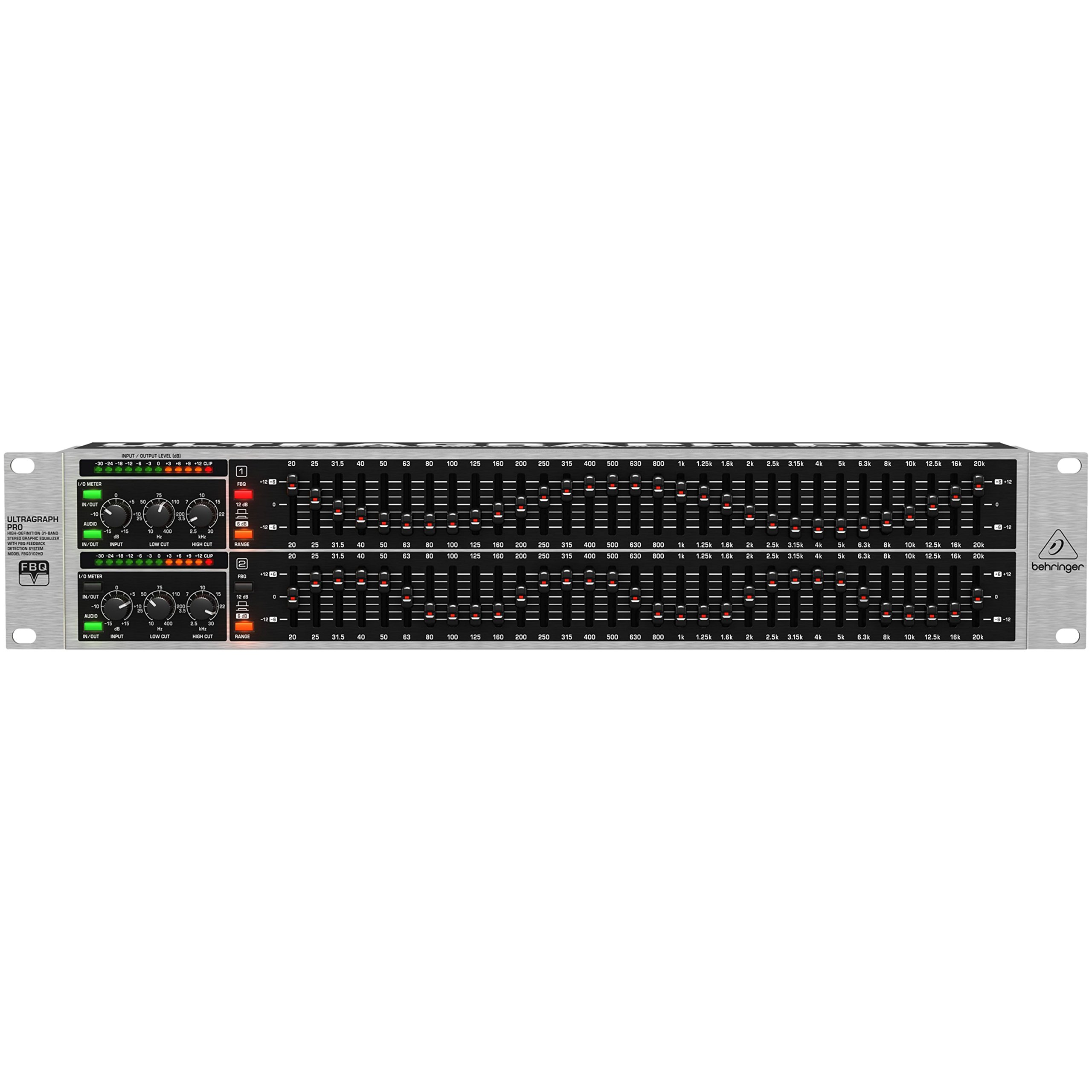
A high-definition 31-band Graphic EQ for precise tonal surgery in a home system.
This Behringer packs 31 bands, giving you the finest control in its price range. It includes sweepable high and low-cut filters per channel to strip out floor rumble and hiss. A dedicated mono subwoofer output with adjustable crossover is also onboard. Plus, the FBQ Feedback Detection system reveals critical frequencies.
It is rated 4.5 out of 5. Owners use it between a computer and stereo to fix tinny sound that software EQ could not correct. One audiophile boosts 31.5Hz and cuts 8kHz to take harshness out of the upper midrange.
It connects via USB 2.0 and weighs 2 kg. Shoppers say it is a “very clean equalizer” that works well with high-end amps.
Why it wins
- 31 bands for pinpoint frequency control
- Sweepable high and low-cut filters
- FBQ feedback detection doubles as an audio analyzer
- Dedicated subwoofer output
Consider this
- Some owners found the directions lacking; you may need to search online for a manual
Pick it for: precise home listening where you need to correct specific problem frequencies.
Leave it if: you are a beginner needing a simple setup with included instructions.
6. Schiit Loki Mini+ 4-Band
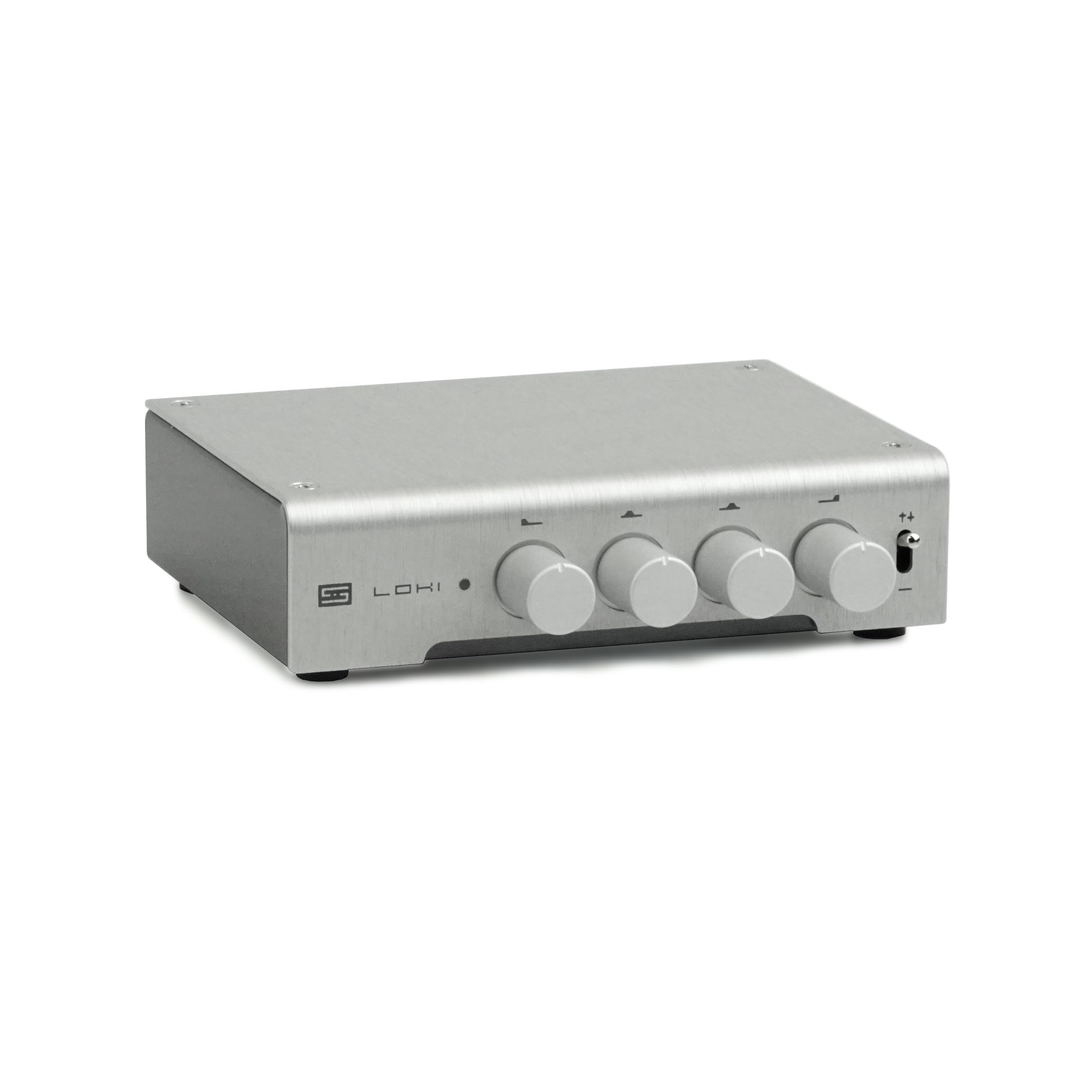
A discrete, made-in-USA 4-band Tone Control for audiophiles who want simple but perfect adjustments.
This Schiit is different from the rack units here. It uses a single, discrete, current-feedback gain stage with passive LC filters. It adjusts at four bands: 20Hz, 400Hz, 2kHz, 8kHz. The bass and treble get ±12dB, the mids get ±6dB.
It is designed and built in the USA. The units sound quality gets the highest praise, with 38 owners mentioning it. That makes it the most-discussed positive aspect. It includes a 100% passive bypass for transparency. It comes with a USA power adapter for 115VAC wall voltage only.
Owners like that it warms the sound at low-to-middle volumes and works particularly well with HD-6XX headphones. A note of caution: the inductors may pick up hum from other electronics. One used it to cut the mids and add “lower end and crisp highs” to their vinyl.
Build and tone: Sound adjustment earns praise from 18 owners. The hardware feels premium and the appearance is a hit. It gets hot, but owners say not to worry about it.
The catch: It is a tone control, not a full graphic EQ. One critical review calls it “not worth -200” and recommends a 10-band PEQ instead, so know your needs before buying.
Buyers who will love it: Those with simple systems who want quick, high-quality bass and treble tone shaping without menus.
Consider alternatives if: you need surgical frequency cuts for room-correction problems; this is too coarse for that.
7. Behringer FBQ6200HD 31-Band
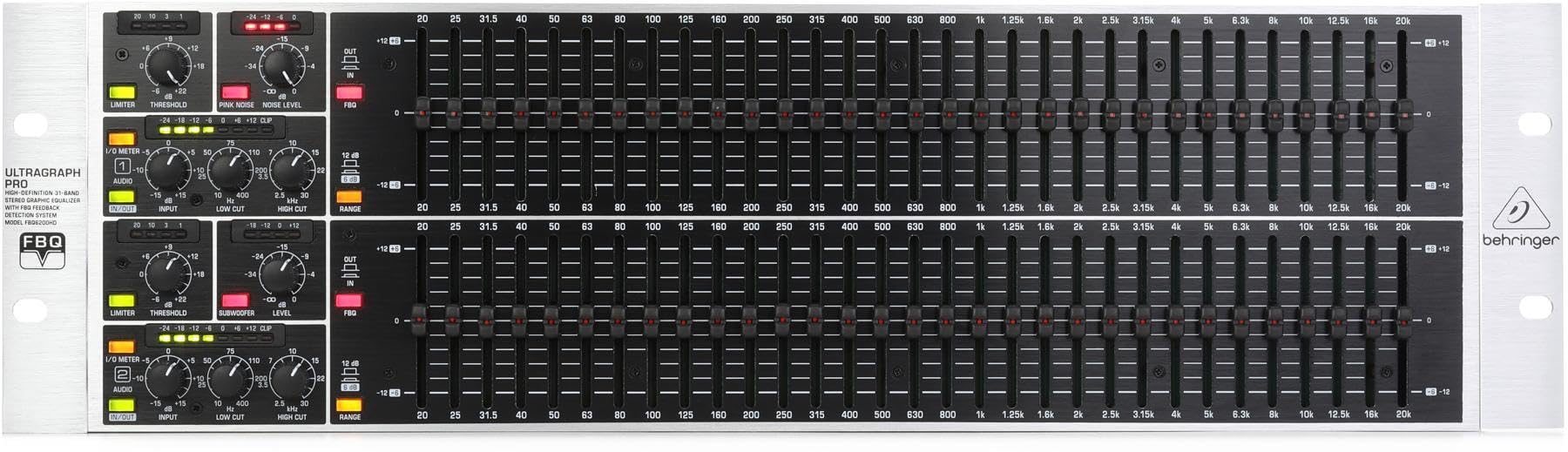
A 31-band equalizer with a built-in pink noise generator for tuning your room’s acoustics.
Behringer’s FBQ6200HD stands out with features for serious sound tuning. The built-in pink noise generator provides test signals to adapt your system to any room acoustics. The FBQ feedback detection system highlights critical frequencies and doubles as an audio analyzer.
It also includes dedicated limiters with gain reduction meters for each channel. This protects your system from overload and distortion. It is rated 4.4 out of 5 across 353 ratings, a healthy sample size.
Owners praise its sound quality and quality. However, a few report a decent amount of distortion noise in the system, though they accept it at the price point. One buyer notes it was not qualified for their Onkyo system, illustrating set-up challenges with home gear.
Tuning tools: The pink noise generator directly leads to its highest praise — impressive frequency cutters and enhanced audio performance.
Home setup caution: While it works well for home use, the XLR connection may require adapters for RCA-based amplifiers. A few find the noise level acceptable given the price.
Choose this for: deep room-tuning capability with pro features like limiters and test tones.
Not for: listeners who are sensitive to occasional noise or want a purely RCA-based home plug-and-play unit.
8. dbx 215s Dual Channel 15-Band

A pro 15-band equalizer with constant Q filters for phase-pure home audio.
This dbx 215s uses dual 15-band, 1/3-octave constant Q frequency bands. It has switchable boost/cut ranges of 6 or 12 dB. A front panel bypass switch and 12 dB input gain range give you full control. It uses 4-segment LED ladders so you can see your output levels.
It is rated 4.5 out of 5. The thing owners rave about is the sound quality — 16 people highlight it. It keeps wave phase perfectly aligned at all frequencies, making it feel transparent. It works well with old-school three-way speakers.
High-end users with Levinson and NHT systems call it “signal processing perfection, incredible for the price.” It has XLR and 1/4-inch TRS inputs and outputs, so you may need adapters for some home gear.
What impresses
- Phase-pure sound with no imaging change
- Switchable 6 or 12 dB boost/cut
- Easy install and solid build
- Clean and quiet operation
What to plan for
- XLR connectors likely require RCA-to-XLR adapters for home stereo
Reach for it if: you are serious about home audio and want pro-grade, phase-accurate 15-band control.
Leave it on the shelf if: you want a simple unit without professional connections or bypass switches.
9. dbx 231s Dual Channel 31-Band

The 31-band 7.9 lb heavy hitter that eliminates hum and brings thrilling clarity.
This is the top-tier 31-band equalizer in our lineup, a stainless steel pro unit. It offers switchable boost/cut ranges of 6 or 12 dB and 12 dB input gain. A front panel bypass switch simplifies A/B testing.
This is the unit for serious room correction. It uses XLR and 1/4-inch TRS, so plan for adapters. It is rated 4.5 out of 5. The review pages sum it up: “YOU CAN FEEL THE QUALITY.” Buyers report it eliminated hum and buzz from cheaper EQs and is “super quiet on pause.”
One buyer used it to reduce a high-pitch squeak at 3.15kHz from soprano, tenor, and violin without losing sound integrity. It is praised for excellent analog cut/boost of frequencies and is called a “must-have for FOH racks.”
Why it is top-tier
- Eliminated hum/buzz from cheaper EQs, super quiet on pause
- 31 bands for surgical correction of problem frequencies
- Solid build with firm sliders, best of 5 brands tried by one owner
- Excellent analog cut/boost of frequencies
Setup planning
- XLR-only; needs adapters for RCA home stereo
- No power button on the back, per one review
For the purist: This is the highest level of control for a home stereo, with quality and sound quality each praised by 28 owners.
It is overkill when: you only want a small tone adjustment and don’t need 31 sliders or XLR connections.
Understanding the Specs
How many bands do you really need?
Bands are the sliders on the front. Each one controls a specific slice of the audio frequency range. A 7-band EQ gives you general tone control. A 15-band EQ gives you room correction. A 31-band EQ gives you surgical control over problem frequencies, but it takes more time to set up.
What are XLR and 1/4-inch TRS connections?
These are professional audio connections. XLR is a three-pin connector, often used in studios. 1/4-inch TRS is a larger version of a headphone plug. Home stereo gear usually uses RCA jacks, so you will need adapter cables if your amp is RCA-only.
What is a low-cut filter?
This filter removes the very lowest audio frequencies, like the rumble from a turntable or your room’s air conditioner. By cutting this mud, the rest of your music sounds cleaner. It is a great feature to have if you are using a turntable with your system.
Why does the bypass switch matter?
A bypass switch sends your audio through the unit untouched, without any EQ. It is the easiest way to A/B test your settings. Flip it on and off to hear your changes in isolation. It is also handy for troubleshooting if your system is acting up.
FAQ
Will an XLR-only equalizer work with my RCA home stereo?
Will a 15-band graphic equalizer fix hum from my turntable?
Are more bands always better for home stereo?
What is the difference between a graphic equalizer and a tone control?
Do I need a power button on the back of the equalizer?
Will adding an equalizer degrade my sound quality?
Can I use an equalizer with headphones?
What does the bypass switch on an equalizer do for my setup?
Final Thoughts: The Verdict
For the majority of shoppers, the equalizer for home stereo winner is the Behringer FBQ1502HD because its 15-band control plus FBQ feedback detection delivers quiet, transparent sound. If you want a compact and simple tone control, grab the Douk Audio T7. And for the absolute best in surgical room correction, the dbx 231s is the one to reach for.
How We Picked
We do not accept paid placement. Every pick is matched to a real buyer and a real use-case; we do not hands-on test units.
Sources & Methodology
Specifications: manufacturer listings and product documentation. Review insights: verified customer reviews, as of August 2026. Pricing: not shown on this page (it changes often); check the current price via the retailer link.
As an Amazon Associate, WellFizz earns from qualifying purchases. This does not affect which products we feature.
Related Guides

Mo Maruf
I created WellFizz to bridge the gap between vague wellness advice and actionable solutions. My mission is simple: to decode the research and give you practical tools you can actually use.
Beyond the data, I am a passionate traveler. I believe that stepping away from the screen to explore new environments is essential for mental clarity and physical vitality.