Our readers keep the lights on and my smoothie glass nicely filled. As an Amazon Associate, I earn from qualifying purchases.
Specs are compiled from manufacturer listings and verified buyer reviews and can change over time — please confirm the key details on the product page before buying.
When the grid goes dark, the first question isn’t about specs — it’s whether your fridge stays cold and your lights stay on. The real answer lives in two numbers: wattage (how much power it can push out at once) and capacity (how long it can keep pushing). This guide sorts through the serious contenders so you can pick the one that matches your home’s actual needs.
I’m Mohammad Maruf — the founder and writer behind WellFizz. This guide is built by comparing the manufacturers’ published specifications and the patterns across verified customer reviews, so you get each pick’s real strengths and trade-offs instead of marketing spin.
You need an emergency solar generator for home that matches your outage reality, not just the biggest battery on a shelf.
Our Picks at a Glance


How To Choose The Best Emergency Solar Generator For Home
This guide pairs real-world owner experiences with hard technical specs to help you match a generator to your home’s needs.
Match the Battery to Your Appliances
First, figure out what you must keep running during an outage — fridge, lights, router, maybe a CPAP machine — and add up their wattage. Then match that to a battery capacity (measured in watt-hours, or Wh) that can carry that load for the time you expect to be dark. A 2048Wh battery is a common balance, keeping the basics alive for 10-15 hours, while a 3600Wh+ unit can stretch that to days.
Check the Inverter’s Continuous Output
Every unit lists a continuous wattage (like 2400W or 3600W) and often a surge rating for those first few seconds when a fridge compressor kicks in. Pay attention to the continuous number — that’s what tells you whether your microwave or space heater will actually run.
Know Your Recharge Pathways
You can recharge from the wall, from solar panels, or from a car outlet. The solar input speed (measured in watts) tells you how fast those panels top you up — a higher input like 1200W means a full charge in under two hours on a sunny day, while a 200W panel gives a slower trickle.
Quick Comparison
| Model | Best For | Capacity | AC Output | Weight | Amazon |
|---|---|---|---|---|---|
| BLUETTI AC200L★ Best Overall | Whole-home circuits via 30A | 2048Wh | 2400W | 61.4 lbs | Amazon |
| BLUETTI Elite 100 V2Compact Pick | Portable, easy lifting | 1024Wh | 1800W | 25 lbs | Amazon |
| AFERIY P210Best Value | High-wattage appliances | 2048Wh | 2400W | 54 lbs | Amazon |
| DABBSSON 2000L | Long runtime, easy carry | 2048Wh | 2200W | 41 lbs | Amazon |
| Jackery Explorer 2000 Plus | Heavy loads, expansion | 2042Wh | 3000W | 62 lbs | Amazon |
| PECRON F3000LFP | Days of home essentials | 3072Wh | 3600W | 63.3 lbs | Amazon |
| Anker SOLIX C2000 Gen 2 | Fast recharge, fridge runtime | 2048Wh | 2400W | 41.7 lbs | Amazon |
| EF ECOFLOW DELTA Pro | Serious whole-home capacity | 3600Wh | 3600W | 99 lbs | Amazon |
| Jackery HomePower 3000 | Kit with 2x200W panels | 3072Wh | 3600W | 59.5 lbs | Amazon |
| Anker SOLIX F3800 | 120V/240V dual voltage | 3840Wh | 6000W | 132.3 lbs | Amazon |
| EF ECOFLOW DELTA Pro + 400W Panel | All-in-one solar kit | 3600Wh | 3600W | 99 lbs | Amazon |
In‑Depth Reviews
1. BLUETTI AC200L Portable Power Station
Our pick — over 4.5★ from 500+ verified ratings; the strongest balance of quality and price.
The home-backup anchor that powers actual circuits, not just a few outlets.
The standout here isn’t just the 2048Wh capacity — it’s the 30A RV port that lets owners feed power into home circuits through a transfer switch. Buyers report running their whole setup this way, with one owner powering home circuits for about 10 hours using the AC200L plus two B300 expansion batteries (8,192Wh total).
Charging speed matters in an emergency, and this one tops up from 0-80% in 45 minutes at a max 2400W AC input, or in 1.7-2.2 hours via up to 1200W of solar. The 61.4-pound weight is the honest trade-off — as one buyer put it, “It’s sort of heavy but heavy duty,” which sums up the trade-off perfectly.
The battery is rated for 3000+ cycles, and owners across two years of use report it handles everything from a 1500W kettle to a 12000 BTU air conditioner for four hours on solar. The app controls work over Wi-Fi and Bluetooth, and the UPS backup switchover under 10ms keeps sensitive electronics safe. Owners mention excellent customer service, though a few note that the proprietary power cord is a vulnerability if lost.
What Owners Rave About
- Reliability and build quality are the most-praised traits, with dozens of owners highlighting both
- Fast 45-minute recharge to 80% keeps downtime short
- Expansion to 8192Wh with extra batteries makes it future-proof
The Weighty Catch
- At 61.4 pounds, moving it between rooms is a workout
- The proprietary power cord is hard to replace quickly if lost
Your best bet: If you want to power real home circuits during an outage and don’t mind the weight, this is the one.
Think twice if: You need to carry it up and down stairs regularly — this is a set-it-down-and-plug-it-in machine.
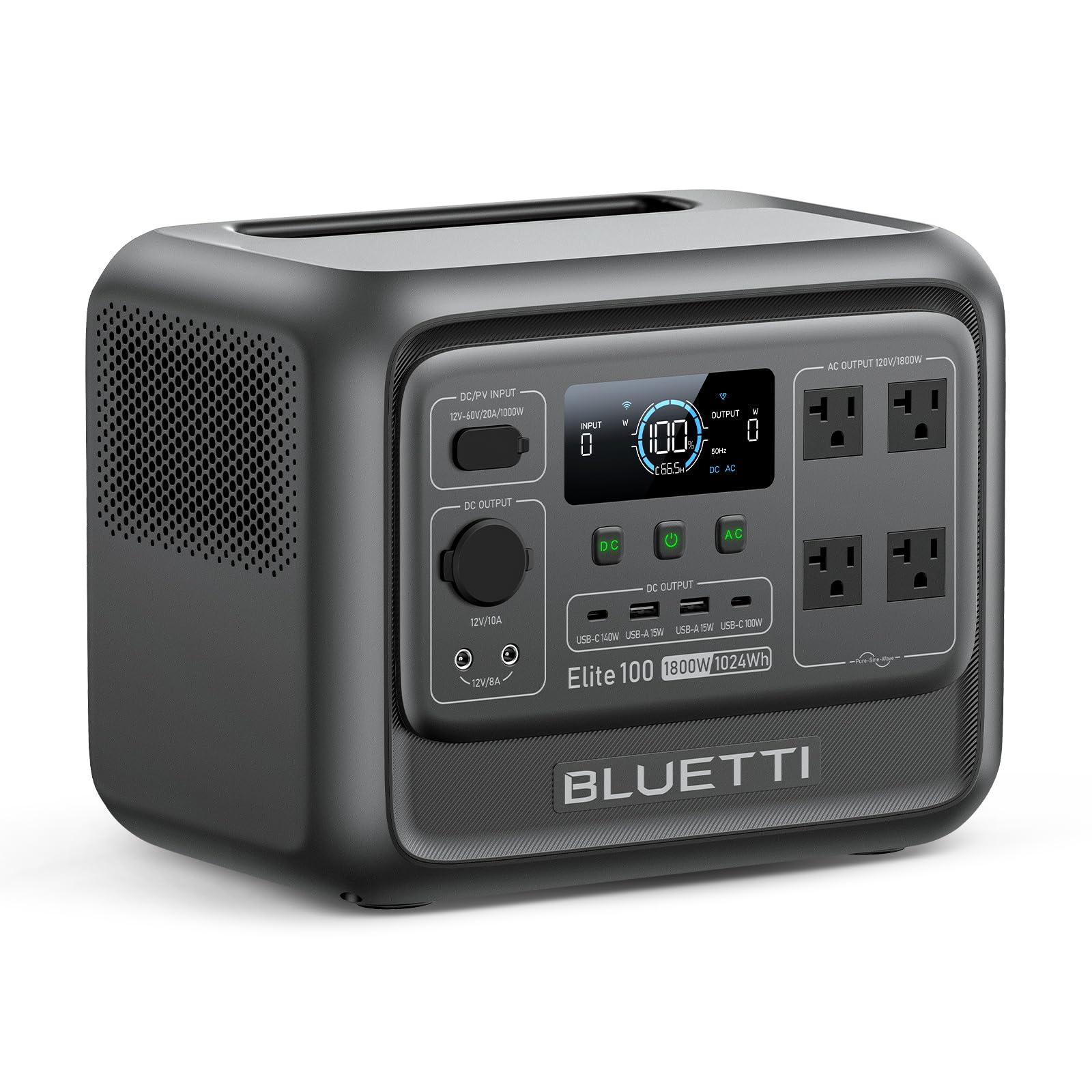
2. BLUETTI Elite 100 V2 Portable Power Station
The featherweight that goes where the big stations can’t.
At just 25 pounds, this is the grab-and-go option for when an outage might send you upstairs, downstairs, or out to the car. It’s 35% smaller than comparable units, yet still delivers 1800W of AC power (3600W surge) from a 1024Wh battery — a 2.0x capacity gap versus the AFERIY P210’s 2048Wh, but enough for essentials like a router, lights, and a fan.
The LiFePO4 battery is rated for over 4,000 cycles to 80%, which the manufacturer translates to a 10-year lifespan. It recharges to 80% in 45 minutes, and the 10ms UPS switchover keeps a Wi-Fi router and PC running through flickers. In silent mode, customers note it runs at just 30dB — quiet enough for overnight camping or a bedroom during an outage.
Reviewers point out real-world endurance: a week-long camping trip with a fan running one night and small devices left the battery at 39% after four days. The catch is that pushing past 500W draws makes the fan audible — fine for essentials, not ideal if you hoped for dead silence under heavy load. It’s “portable” in the sense that you can lift it with one hand, but at 25 pounds it’s still a solid brick.
Why it wins: The most manageable weight-to-power ratio here makes it the easiest station to keep close when the grid flickers.
3. AFERIY 2048Wh Portable Power Station P210
The 2400W workhorse that undercuts the big names on price.
That extra headroom handles appliances with heavy startup draws, like a fridge compressor or a power tool, without tripping. Owners praise its power output more than anything else, with it being the most-mentioned positive aspect.
The LiFePO4 battery is rated for 3500+ cycles, and the 7-year warranty is two years longer than the industry standard. It recharges from 0-100% in about 90 minutes to 2 hours, and the <10ms UPS response keeps a home-lab or router running through blips. One owner noted it maintains 117V under load, which is better than older 110V models.
The trade-off is setup: owners say the app is finicky (BrightEMS app is needed, not the Aferiy one), and the default AC auto-off after 8 hours requires a settings change. Solar input is limited to 500W via the DC-50 connector, which is slower than rivals. At 54 pounds, it’s heavy but manageable, and the build quality earns consistent praise.
The real-world verdict: For the capacity and surge power, this is the budget champion — just budget some time for initial tinkering.
4. DABBSSON Portable Power Station 2000L
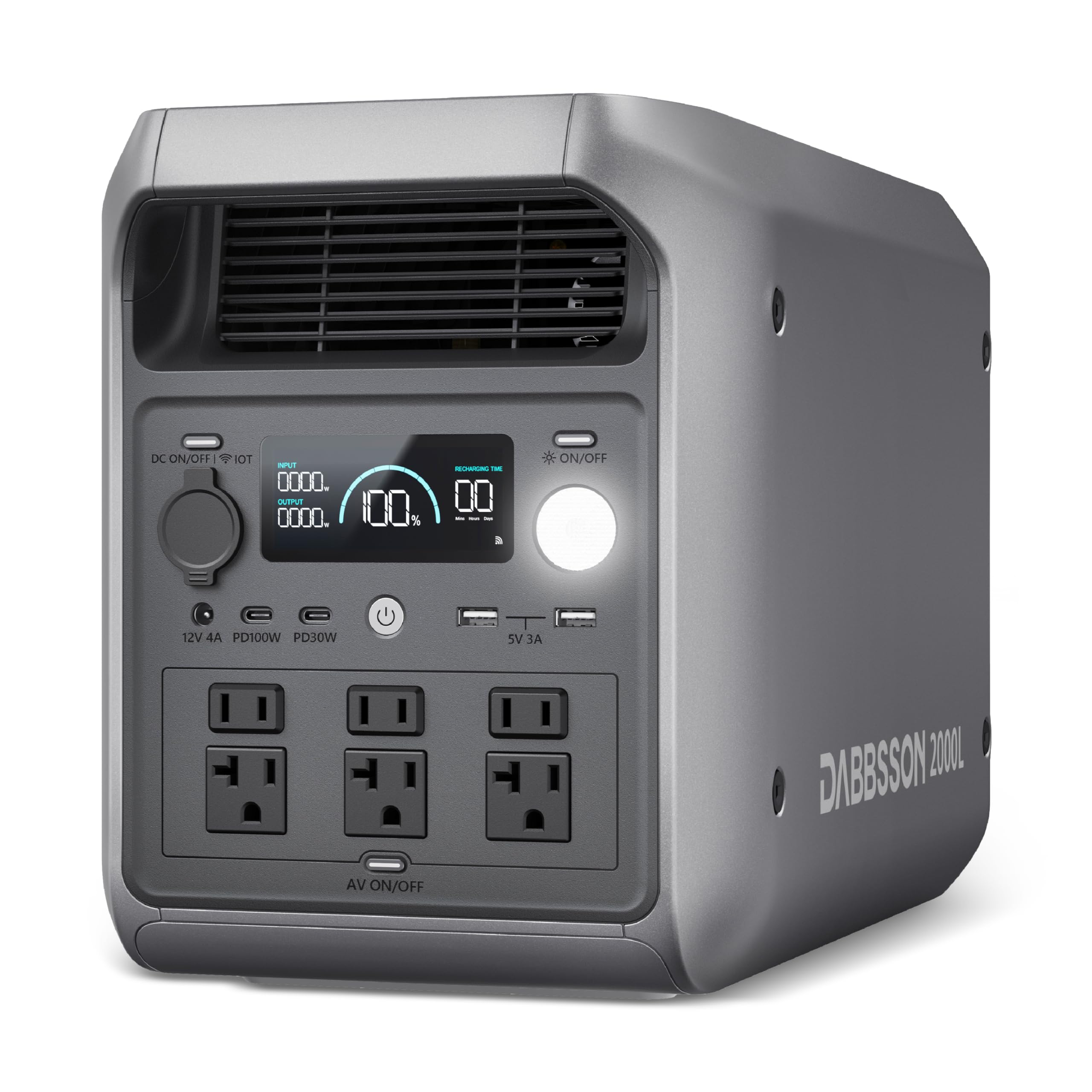
Semi-solid cell tech that shaves 20 pounds off a 2kWh station.
DABBSSON uses semi-solid LiFePO4 cells to hit 2048Wh at just 41 pounds — noticeably easier to lift and store than the 61.4-pound BLUETTI AC200L with the same capacity. The manufacturer claims 1.3x longer runtime than comparable 2048Wh stations, and the 4000+ deep-cycle rating supports a 10+ year lifespan.
Output is 2200W continuous with a 3300W surge boost, and the six AC outlets let you spread power across a fridge, a heater, and power tools at once. Shoppers say it powered a refrigerator and recharged in under 2 hours, and the <10ms EPS switch keeps computers and NAS drives safe during outages. The UL94-V0 flame-retardant housing adds a layer of home safety.
The honest drawbacks: some buyers report Wi-Fi pairing is finicky (Bluetooth works after some effort), and the fan can cycle loudly even with zero load. It ships without a solar panel, so an optional 200W Renogy panel is a popular pairing. For the weight savings alone, this is a compelling mid-range pick.
The Payoff
- 41 pounds is the lightest 2048Wh station here — easier to move mid-storm
- Six AC outlets spread power across many devices at once
- 4000+ deep cycles mean a decade of daily use
The Annoyances
- App pairing can be a hassle, especially Wi-Fi
- Fan noise cycles on even at idle for some owners
Reach for this if: You want real 2kWh capacity but need to carry it up stairs or fit it in tight storage.
Look elsewhere if: You need dead-silent indoor operation — the idle fan may bug you.
5. Jackery Explorer 2000 Plus Portable Power Station

The 3000W output king that can scale to power a whole property.
The defining spec is 3000W of continuous AC output from a 2042Wh battery — more raw power than the 2400W from the AC200L or AFERIY P210. Owners mention it runs a DeWalt rotary hammer at full power for hours and even charges a Tesla at about 10 miles per 3kWh, replacing gas tools entirely.
Expansion is the real strategy here: up to 5 expansion packs scale it to 12kWh, and two units in parallel hit 24kWh at 6000W. The LiFePO4 battery is rated for 4000 cycles to 70%, and ChargeShield tech is claimed to boost battery life by 50%. It goes from empty to full in about 2 hours via wall or six 200W solar panels.
At 62 pounds with a telescopic handle, it’s heavy — as one owner noted, it’s too heavy for a woman to carry downstairs easily, though the wheels help. The telescopic handle is also described as flimsy. Charging is the most-praised aspect, with owners loving the speed, though reliability gets mixed feedback. It hits a quiet 30dB when running.
The takeaway: The highest output-per-capacity ratio here makes it the go-to for anyone who needs to run serious tools or appliances mid-outage.
6. PECRON Portable Power Station F3000LFP
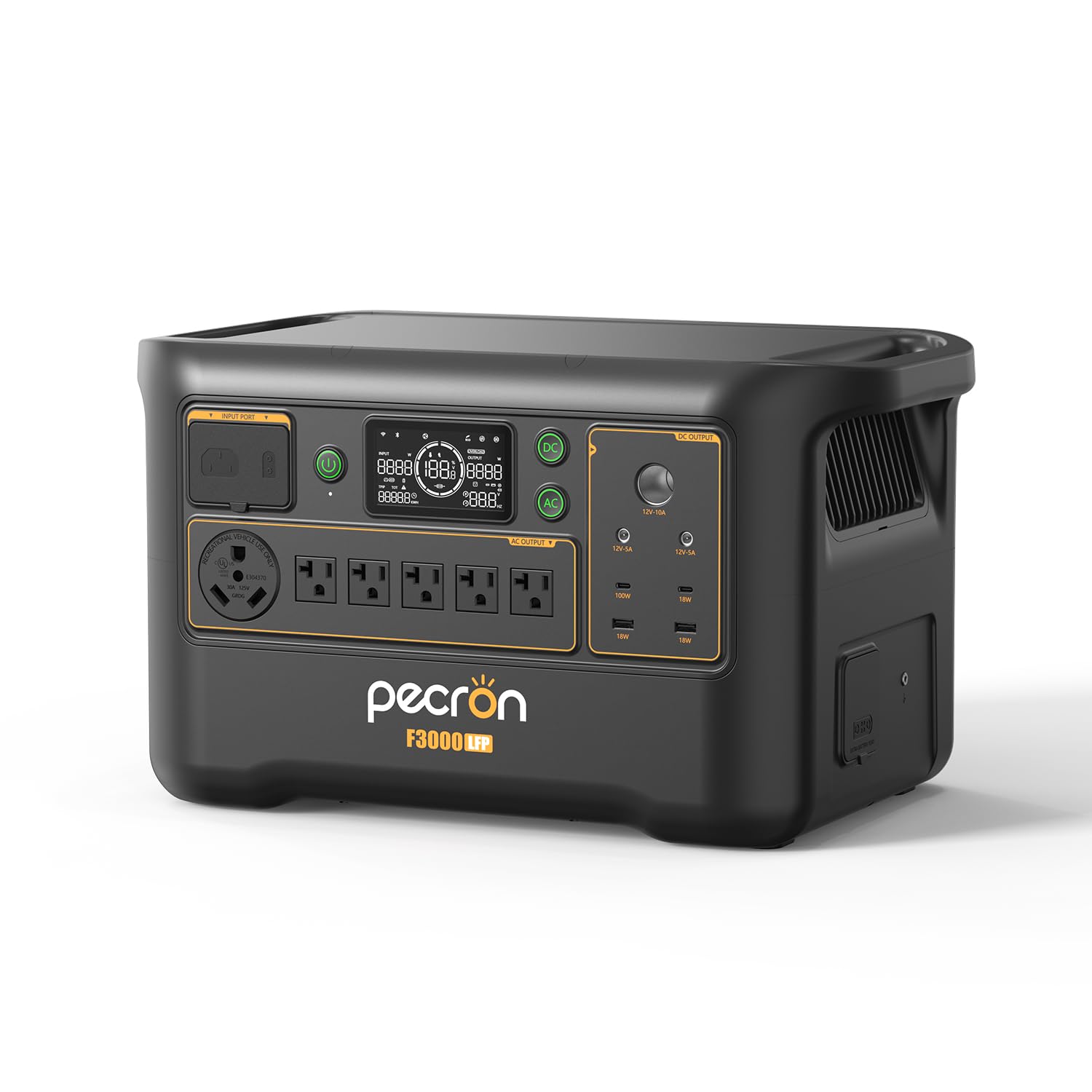
A 3072Wh reserve that stretches emergency power to two or three days.
With 3072Wh of LiFePO4 capacity and 3600W of pure sine wave output, this station pushes into the territory of keeping home essentials alive for 2-3 days. It powers 13 devices simultaneously — six AC outlets, two USB-C at 100W PD for laptops, two USB-A, a carport, and two DC outputs. Owners use it to run fridges, freezers, and e-bike charging.
Recharge hits 0-100% in just 2 hours at 1800W AC input, with solar input up to 1600W. The UPS switch (8-20ms) protects computers and medical devices during outages, and the app provides real-time power monitoring via Bluetooth. It can expand to 10752Wh with the proprietary EP3800-48V battery and a separately-sold XT120-M cascade cable.
The recurring themes from owners: heavy at 63.3 pounds (though considered compact), and the app requires a login while the manuals are poor. One owner ran 40+ outages averaging 4 hours with zero issues. The fan is audible during charging — not silent — and the charge controller drops to 0W below 100W solar input under heavy shading. Customers note the inverter draws some power on its own, so turning it off saves battery.
Where it shines: The capacity-to-price ratio is excellent for a unit that can run a fridge for a full day and still have power left for lights and phones.
7. Anker SOLIX C2000 Gen 2 Portable Power Station
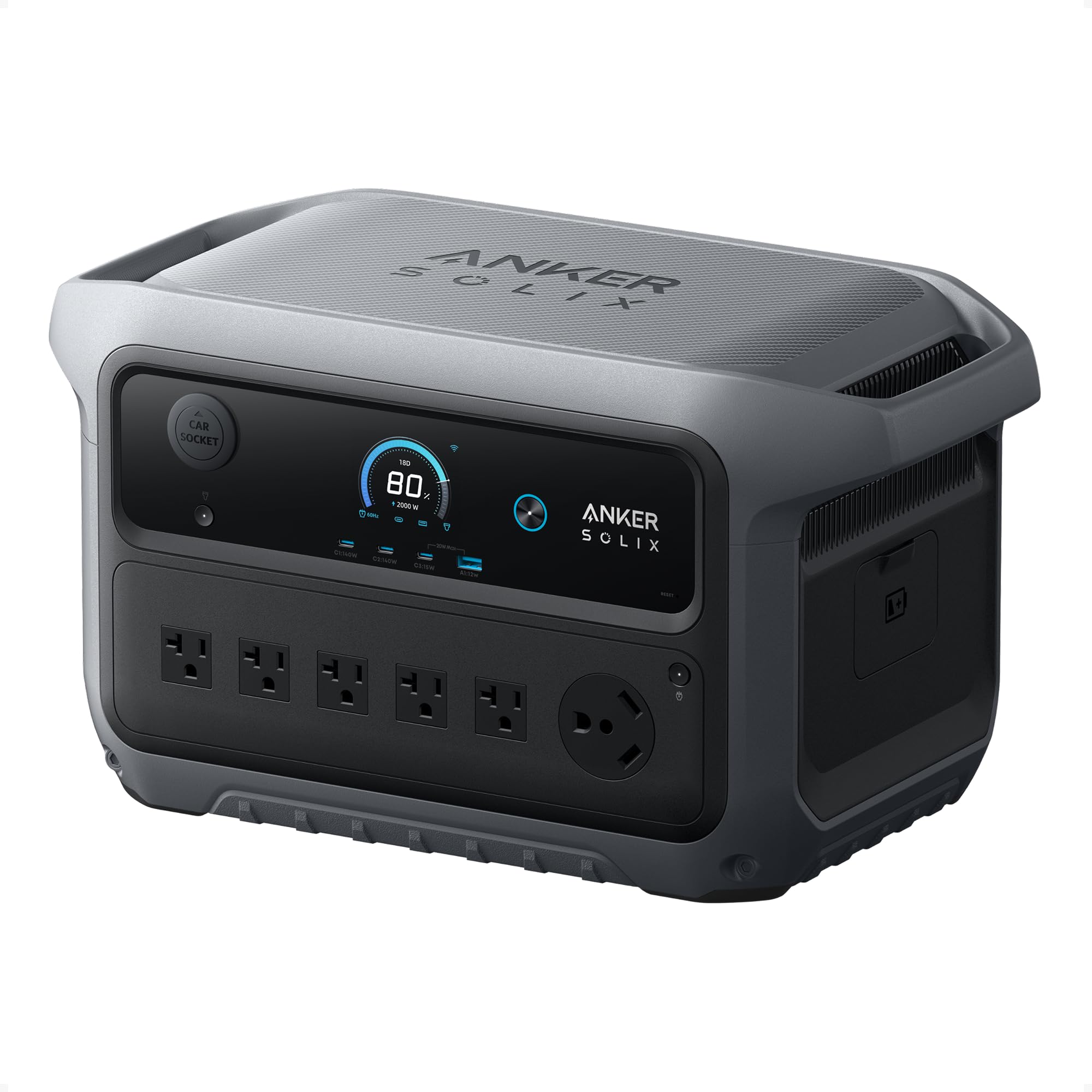
Full charge in 58 minutes — the fastest way back to full readiness.
The headline spec here is the 58-minute full recharge from AC or solar, making this the quickest unit to top back up between outages. It pairs a 2048Wh LiFePO4 battery with 2400W rated output and a 4000W peak, and Anker’s standby draw is just 9W — enabling a dual-door fridge to run for up to 32 hours on a single charge.
At 41.7 pounds, it’s 25% lighter than similar-capacity rivals and compact enough to slide under a counter, which owners specifically noted. Power output is the most-praised aspect by far, with owners running 1800W microwaves, miter saws, drills, and portable ovens. The UPS function works for home protection, and the five 3-prong outlets are handy in older homes.
Reviewers point out a few quirks: AC input limits output to 1800W while charging, ignoring charge settings, which some found misleading. One owner kept a 45-quart fridge cold for 5 days while overlanding with no additional charging. The weight gets mixed feedback — 41.7 pounds is manageable but not light.
Standout trait: The 58-minute recharge means you can top up during the day and be ready for whatever the night brings.
8. EF ECOFLOW DELTA Pro Portable Power Station
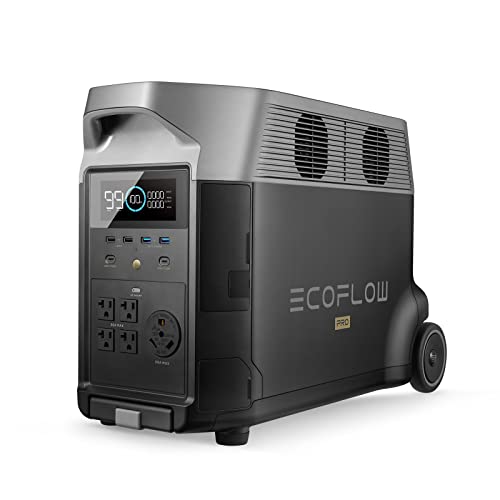
A 3600Wh fortress that turns your home into a mini-off-grid.
This is where an Emergency Solar Generator For Home stops being an appliance and becomes infrastructure. With 3600Wh capacity and 3600W AC output (expandable to 4500W with X-Boost), the DELTA Pro powers 99.99% of household devices, and pairing two units hits 7200W. Shoppers say running a commercial freezer and a 24/7 oxygen machine for about 7 hours.
Charging is versatile: 1.8 hours via 240V outlet, 2.7 hours via 1800W wall outlet, or 2.8 hours from four 400W solar panels at up to 23% conversion efficiency. Expand to 25kWh with extra batteries, and you can even charge an EV in a pinch. The 15 output methods cover everything from USB-C to an Anderson port.
At 99 pounds, it’s a beast with wheels, not a carry-around unit. Owners praise the fast 2.7-hour recharge and whisper-quiet fans, and one runs a heat press at vendor markets flawlessly. The app works well but won’t power the unit on remotely. For whole-house use, you’ll need a transfer switch and likely a second unit.
What You Get
- 3600Wh means a fridge and essentials can run for over a day
- X-Boost pushes output to 4500W for heavy-draw appliances
- Pair with another unit for 7200W of home-scale power
The Real Cost
- 99 pounds with wheels — it stays where you park it
- Premium price reflects the capacity, not portability
The serious choice: If you want a genuine home battery backup, not a large power bank, this is the benchmark.
The honest caveat: At this weight and size, plan your placement and don’t expect to move it mid-storm.
9. Jackery HomePower 3000 with 2x200W Solar Panels
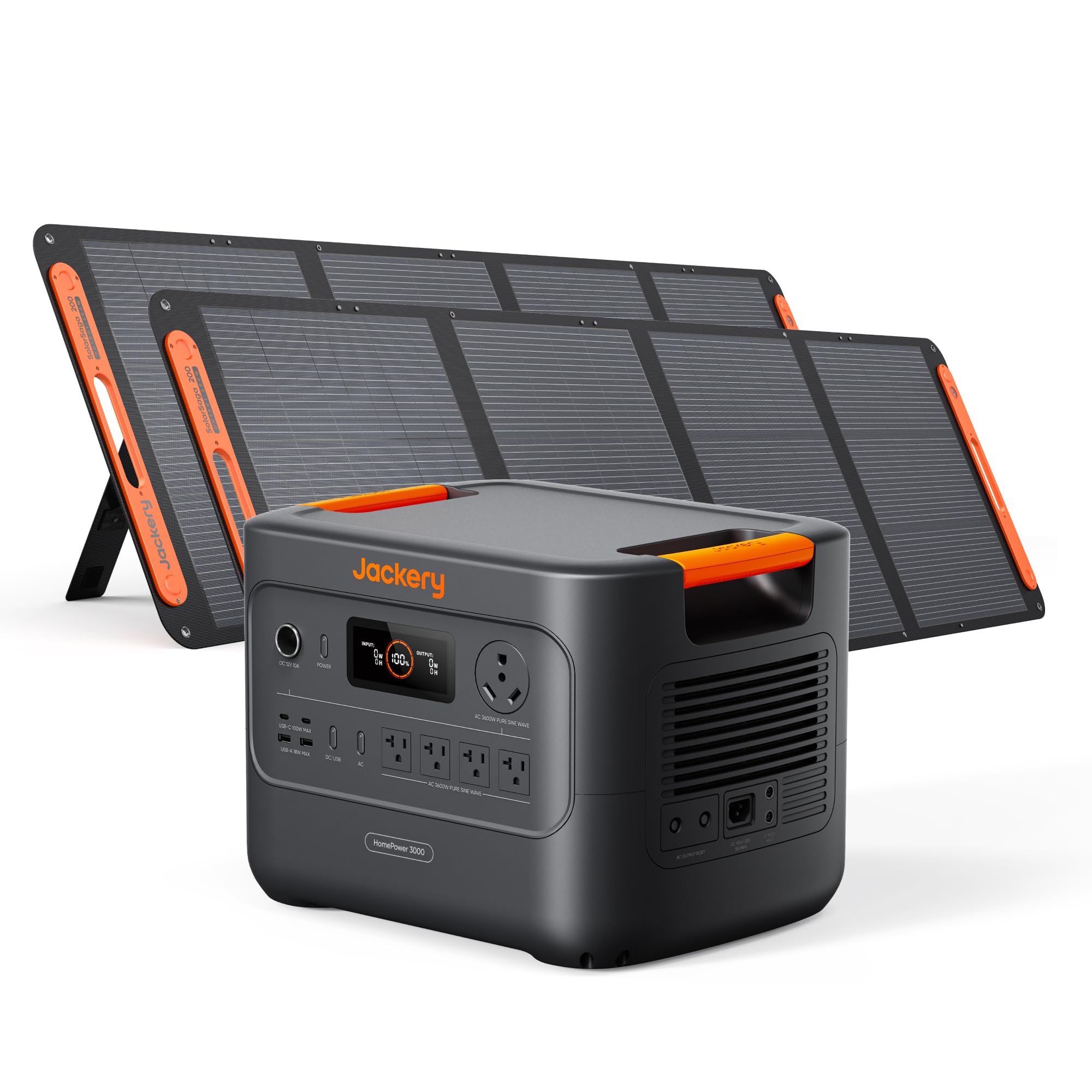
A ready-to-run solar generator bundle that takes the guesswork out.
This is the only pick that ships with solar panels included — two 200W SolarSaga panels paired with a 3072Wh station that puts out 3600W (7200W surge). That’s enough to keep a household running for up to 15 hours, or a refrigerator for 1-2 days, according to Jackery. Owners confirm: a fridge running for 2 days on a charge is a realistic scenario.
The <20ms UPS is UL-certified, keeping security cameras, medical refrigerators, and Zoom calls running without a hiccup during outages. The dual 100W PD ports fast-charge phones and drones, and the built-in TT-30 RV port offers plug-and-play for campers. It recharges fully in 1.7 hours via hybrid AC+DC or 2.2 hours via AC alone.
The trade-offs are real: at 59.5 pounds, owners consistently call it significantly heavier than expected, and the 400W of included solar takes about 11 hours to fully recharge the station. Owners recommend a wheel kit or dolly to move it. Charging below 15°C was reported as failing despite a 0°C spec, which matters for cold-weather outages.
The buy-it-for: If you want a complete solar setup with zero extra pieces to order, this kit delivers value and confidence.
10. Anker SOLIX F3800 Portable Power Station

The only station here that can run your dryer — 120V and 240V in one box.
This is the top-tier brute: 3840Wh capacity with 6000W AC output at both 120V and 240V, meaning it can power essentially everything in a standard home, including a dryer that a 120V-only station can’t touch. The NEMA 14-50 port even lets you charge an EV directly at 6000W, and RV owners can plug straight into their rig’s power inlet.
Owners replaced their gas generator with this during a 6-hour outage, keeping a fridge, lights, hot water inducer, and radon motor running while the battery only dropped from 100% to 66% with 70-105W of solar input. It expands to 26.9kWh with up to 6 battery packs, and two units paired hit 12,000W max output.
At 132.3 pounds with wheels and a handle, it’s the heaviest unit here — impressive power, but it stays put. Owners note solar input is limited and the MPPT is tune for Anker’s own panels, plus a firmware update is needed for simultaneous AC and solar charging. The BMS limits charging to about 710W DC below 50°F. The 5-year warranty and 10-year lifespan are reassuring.
The real take: If you need whole-home power including 240V appliances, this is the only serious option on this list.
11. EF ECOFLOW DELTA Pro with 400W Solar Panel

The premium all-in-one bundle for off-grid readiness, panel included.
This bundle pairs the 3600Wh DELTA Pro with a foldable 400W solar panel rated at 22.4% conversion efficiency and IP68 waterproofing. With a single panel, a full recharge takes 11 hours; add two more 400W panels and it drops to 3.5 hours. The panel weighs 35.3 pounds and packs into an adjustable carry case.
The station itself delivers 3600W from 15 outputs: five AC outlets, four USB-A, two USB-C, two DC ports, a car output, and an Anderson port. Buyers report running a fridge for 20 hours on a full charge and powering an 1800W induction cooker. The fan kicks in above 70W load, which some find audible but acceptable.
The honest reality: this is a 99-pound system that needs to be wheeled, not carried, and owners note it must be recharged every 90 days to maintain the battery. The first unit from one owner arrived defective, though support eventually sent a replacement. For disaster readiness over daily portability, this is a solid investment.
The premium call: If you want a complete solar generator rig from the start and the budget allows, this is the easy path to outage readiness.
Understanding the Specs
Watt-hours (Wh) vs Watts
Watt-hours tell you how much energy the battery holds — think of it as the fuel tank size. Watts tell you how much power it can deliver at once — think of it as the engine size. A 2048Wh unit can run a 100W fridge for roughly 20 hours, but it can’t start a 2000W microwave if its AC output is only 1800W. Always check both numbers.
LiFePO4 Battery Chemistry
LiFePO4 (lithium iron phosphate) is the modern standard for home backup. It’s safer than older lithium-ion types, tolerates more charge cycles (typically 3000-4000+ before degrading to 80%), and holds up better over a decade of occasional use. It’s heavier than other chemistries, which is why you’ll see 40-130 pound weights on high-capacity units.
FAQ
Can a solar generator power my whole house?
How long will a solar generator keep my fridge running?
What is the difference between watts and watt-hours?
Can I charge a solar generator from a wall outlet?
What is a UPS and why does it matter?
How many solar panels do I need for a fast recharge?
Are solar generators safe to use indoors?
How long do the batteries last before needing replacement?
Final Thoughts: The Verdict
For the majority of shoppers, the emergency solar generator for home winner is the BLUETTI AC200L because it’s the best balance of capacity, output, and expansion for real home backup. If you want portability and lighter weight, grab the BLUETTI Elite 100 V2. And for serious whole-home power or 240V appliances, the Anker SOLIX F3800 is the one to reach for.
How We Picked
We do not accept paid placement. Every pick is matched to a real buyer and a real use-case; we do not hands-on test units.
Sources & Methodology
Specifications: manufacturer listings and product documentation. Review insights: verified customer reviews, as of August 2026. Pricing: not shown on this page (it changes often); check the current price via the retailer link.
As an Amazon Associate, WellFizz earns from qualifying purchases. This does not affect which products we feature.
Related Guides

Mo Maruf
I created WellFizz to bridge the gap between vague wellness advice and actionable solutions. My mission is simple: to decode the research and give you practical tools you can actually use.
Beyond the data, I am a passionate traveler. I believe that stepping away from the screen to explore new environments is essential for mental clarity and physical vitality.