Our readers keep the lights on and my smoothie glass nicely filled. As an Amazon Associate, I earn from qualifying purchases.
Specs are compiled from manufacturer listings and verified buyer reviews and can change over time — please confirm the key details on the product page before buying.
Choosing the right educational toys for an 18-month-old is about finding the *one* thing that clicks with their newfound independence and rapid language growth. The best options here focus on fine motor skills—those tiny hand muscles that lead to holding a crayon and, eventually, a pencil—and early language, with zero screen time required. You want toys that respond to their touch with a satisfying click, a sound, or a shape fitting perfectly into place, turning their natural curiosity into a learning moment.
I’m Mohammad Maruf — the founder and writer behind WellFizz. This guide is built by comparing the manufacturers’ published specifications and the patterns across verified customer reviews, so you get each pick’s real strengths and trade-offs instead of marketing spin.
You need educational toys for an 18-month-old that actually grow with them, engaging little hands and curious minds through play-based learning.
Our Picks at a Glance


How To Choose The Best Educational Toys For An 18-Month-Old
At 18 months, your toddler is a whirlwind of movement and discovery. They are not just playing—they are learning cause and effect (I press this, that happens!), building hand strength, and soaking up language like a sponge. The right toys channel this energy into skill-building without feeling like a lesson.
Prioritize Fine Motor Skill Builders
This is the prime window for developing the small muscles in hands and fingers. Look for toys that require pinching, pushing, pulling, or stacking. These actions build the dexterity needed for self-feeding, drawing, and dressing later on. A toy that is too passive—just something to look at—won’t offer this crucial physical development.
Language and Sound Interactivity
Vocabulary grows rapidly between 18 and 24 months. Toys that name objects, play sounds, or introduce words in different languages offer a huge advantage. The key is that the toddler initiates the learning by pressing a button or touching a page, making it active engagement rather than passive listening. This back-and-forth interaction is vital for speech development.
Durability Meets Safety
An 18-month-old’s play is enthusiastic, involving dropping, throwing, and sometimes chewing. Solid wood with smooth, rounded edges and non-toxic paint is ideal. For plastic toys, check for sturdy construction that won’t crack or create sharp edges. Large pieces are non-negotiable to prevent choking hazards, so always check the age recommendation on the box.
Quick Comparison
| Model | Best For | Primary Skill | Key Feature | Material | Amazon |
|---|---|---|---|---|---|
| LeapFrog 100 Words Book★ Best Overall | Language & Bilingual Learning | Vocabulary, Reading | 100+ Words, English/Spanish | Plastic | Amazon |
| Learning Resources Spike Tree HouseFine Motor Star | Fine Motor & Sensory Play | Fine Motor | 5 Textures, 7 Pieces | Plastic | Amazon |
| Learning Resources Carlos the CactusCrowd-Pleasing Value | Counting & Color Matching | Fine Motor, Counting | 14 Pop-in Pieces | Plastic | Amazon |
| KMTJT Magnetic Fishing Game | Hand-Eye Coordination | Motor Skills, Color | 2 Wooden Poles, 10 Fish | Wood | Amazon |
| VTech Pull and Sing Puppy | Gross Motor & First Words | Gross Motor, Language | Light-up Nose, 3 Buttons | Plastic | Amazon |
| LUCKFUTURE Spinning Stacker | Visual & Color Recognition | Hand-Eye Coordination | Rainbow Spinning Rings | Plastic | Amazon |
| KMTJT Wooden Shape Sorter | Shape & Color Sorting | Shape Recognition | 50 Blocks, 14 Cards | Wood | Amazon |
| Fisher-Price Ice Cream Truck | Pretend Play & Sorting | Shape Recognition | Push-along, 7 Pieces | Wood | Amazon |
| KMTJT Wooden Activity Cube | Versatile All-in-One Play | Multiple Skills | 7 Games in 1 | Wood | Amazon |
In‑Depth Reviews
1. LeapFrog Learning Friends 100 Words Book
Our pick — over 4.5★ from 95,500+ verified ratings; the strongest balance of quality and price.
The toddler vocabulary booster that turns page-touching into a bilingual language lesson.
If you want to supercharge your child’s vocabulary, this is the pick that stands above the rest. Each page is filled with age-appropriate words chosen by learning experts across categories like pets, animals, food, colors, and opposites. Touching the pages plays the word, sound effects, and fun facts—making the book a “staple in our house,” as buyers report—and a light-up star button plays the Learning Friends theme song and “My Favorite Word.”
The standout here is the full bilingual experience. Words, songs, and instructions can be heard in both English and Spanish, which is a massive value-add if you want to introduce a second language early. It’s incredibly durable and has “held up well to daily use,” a common theme among owners who’ve had it for months. At 1.5 pounds, it’s a solid, chunky size for little hands to manage independently.
The only thing to note is that it needs 2 AA batteries, included only for demo purposes, so you will want fresh ones on hand for regular play. The sound is clear and easy for little hands to activate, which keeps them engaged and returning to it again and again, a huge win for independent play. This is the one that keeps on giving as they grow from recognizing pictures to naming them.
Why it wins
- Bilingual (English/Spanish) adds a second language layer
- Teaches words, sounds, and fun facts in one interactive format
- Durable construction that survives daily toddler handling
Keep in mind
- Requires 2 AA batteries for operation
- Some children may outgrow the fixed word list by age 3
The language pick: for parents who want a screen-free, hands-on way to build vocabulary and start early bilingual learning.
A small caveat: you’ll want fresh AA batteries on hand from day one, as the included ones are just for trying it out.
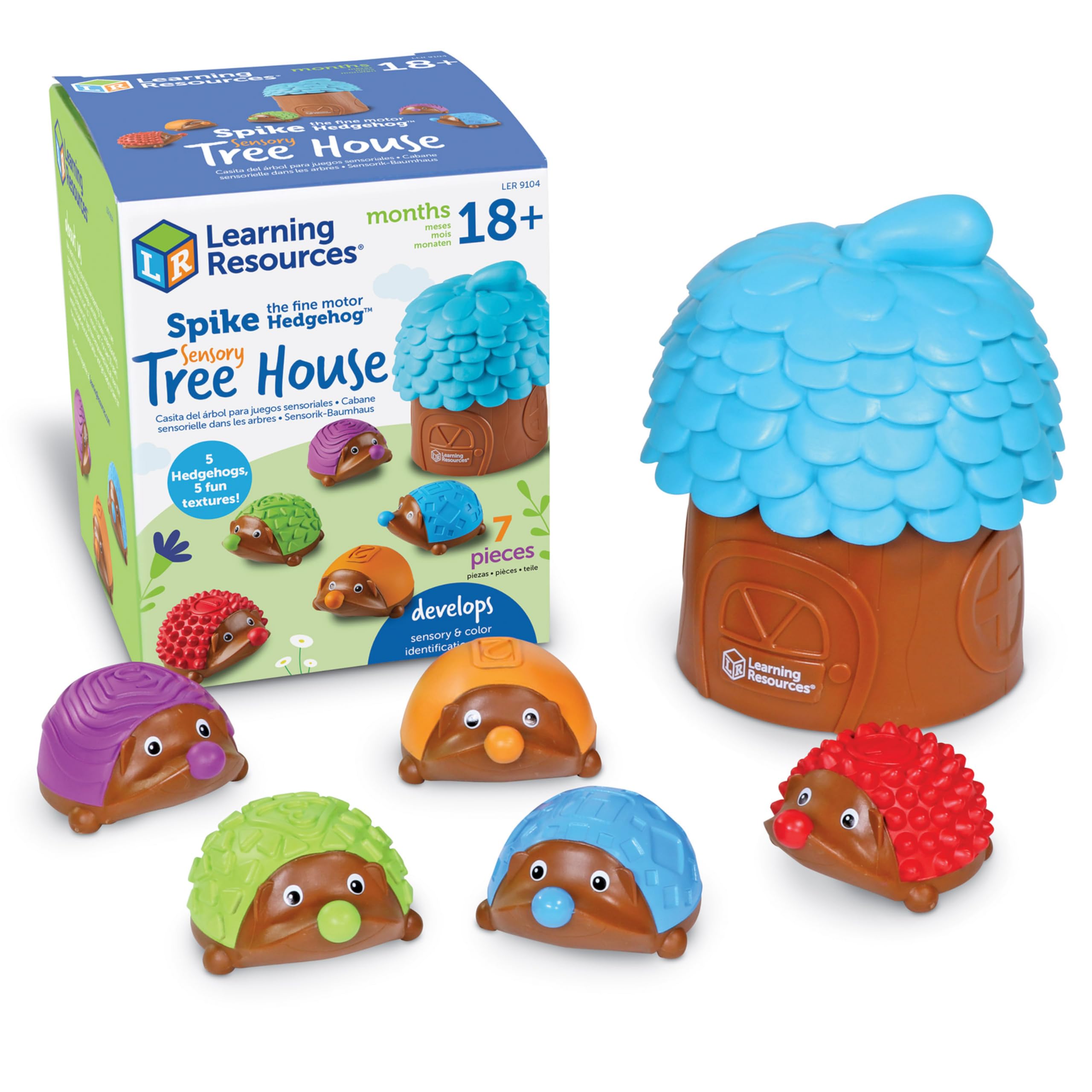
2. Learning Resources Spike the Fine Motor Hedgehog Sensory Tree House
A hide-and-seek sensory house that strengthens tiny fingers with every textured piece.
Your toddler will build hand strength and coordination while playing with this sensory tree house—so much so that parents report having to hide it because their child will “sit there & play with it all day.” It targets 5 distinct skills in one toy: shapes, colors, numbers, plus fine motor and sensory skills. The 5 unique hedgehog textures give the tactile variety that keeps little hands exploring and learning.
The quality is the thing everyone raves about—it’s built to withstand heavy, enthusiastic play. Note that 12 months is often too early, but around 14-15 months, most children “picked up on it,” making it perfect for your 18-month-old. The back removes for easy storage of all pieces, it snaps securely, and it’s completely silent and battery-free, which makes it a win for parents seeking quiet, mess-free play.
This Montessori-style toy excels at independent play, holding attention for 10+ minutes at a time, which is an eternity for a toddler. A few owners mention the base can slide on hard floors during play, but adding a non-slip pad easily fixes that. This is a grab-and-go learning toy that feels less like a lesson and more like a fun game.
What stands out
- 5 unique textures for rich sensory exploration
- Builds fine motor skills, shapes, colors, and numbers
- Quiet, battery-free, and easy to clean
The small print
- Base can slide on slick floors during play
- Best for kids 14+ months who’ve developed a bit more grip
Reach for this if: you want a silent, tactile toy that turns alone-play into a fine motor skills workout.
Look elsewhere if: your toddler still mouths everything and you need something larger and less textured.
3. Learning Resources Carlos the Pop & Count Cactus
Meet Carlos, the counting cactus obsessed with helping toddlers pop, count, and learn.
Carlos the Cactus is designed to keep a toddler “occupied for hours”—the top praise from owners. Kids pop the 14 colorful spikes and flowers into the cactus, then count them up, building hand strength and coordination with every push. The pieces are easy enough for small hands to hold and remove, which is the core of the fine motor skill development.
The thick plastic feels safe, and the pieces are large enough that you won’t worry about choking hazards. A unique bonus: the pot itself doubles as storage for all 14 pieces, so clean-up is quick and it fits neatly into your toy rotation. The tactile textures encourage imaginative play as your child picks Carlos’s flowers and explores.
One small note: the flower spikes require a strong grip to insert and remove, so some toddlers may need help at first. But this also means the toy grows with them, offering a challenge that extends its play value past the first few weeks. It’s an excellent, self-contained activity that works perfectly for travel or quiet time at home.
Why it’s a hit
- 14 pieces to pop, count, and sort for extended play
- Pot doubles as storage, making clean-up easy
- Thick, safe plastic that’s easy to wipe clean
Consider this
- Flower spikes need a firm push, may require initial help
- Focuses on fine motor and counting, less on language
The storage-savvy choice: for toddlers who love to sort and count, with a built-in home for every piece.
Who might skip: those after a language-focused toy rather than a pure motor-skills builder.
4. KMTJT Magnetic Wooden Fishing Game

A splash-free fishing adventure that reels in hand-eye coordination with a magnetic twist.
The KMTJT fishing game swaps screens for a classic, tactile challenge. It includes 2 real wood magnetic poles and 10 vibrant fish figures, perfect for teaching colors, counting, and sequences. The visual appeal is huge, and the game keeps a 19-month-old playing “repeatedly” as they learn to line up the magnet and catch their prize, building crucial hand-eye coordination.
Safety is clearly a focus here. Each fish measures over 1.77 inches high and each pole over 6.6 inches long—sized specifically for toddlers 1-3 to prevent any choking hazard. The wood is well-polished with rounded edges, protecting sensitive skin, and it’s completely free of chemical smells. This is a genuinely durable set that can handle the tumbles of daily play.
There is a trade-off, though. Some owners find the set “smaller than expected,” particularly the fish, which are compact even if they’re perfectly sized for tiny hands. The strong magnets are a hit, though some wish the piece animals were color-matching specific. This is an excellent Montessori-style gift for quiet, focused play and turn-taking.
The highlights
- Strong magnets make catching fish satisfying and easy
- Choking-resistant sizing with smooth, rounded wooden edges
- Teaches colors, counting, and sequences in a fun game
The lowdown
- Set is more compact than some pictures suggest
- Not a color-matching game, just magnetic catching
The quiet-time winner: for toddlers who need practice with focus, precision, and hand-eye coordination.
Manage expectations: the small size is intentional for little hands, but seasoned shoppers note it’s daintier than it appears online.
5. VTech Pull and Sing Puppy

A pull-along pup whose light-up nose and songs get little legs walking and talking.
This is the toy for the toddler on the move. The VTech Pull and Sing Puppy uses a cord—which kids pull to activate music, words, and sounds while building gross motor skills (the big muscle groups used for walking and running). It’s become a “best friend immediately” for many, with one-year-olds pulling it along with them “throughout the day.” The sound is a major plus: it’s engaging but “not obnoxious.”
Language development is baked into the design. Three colorful buttons introduce numbers, colors, and parts of the body, while the light-up nose flashes along with voice, sound, and musical responses. This cause-and-effect feedback teaches responsive behavior and is a massive attention-grabber. It’s designed for kids from 6 to 36 months, making it a toy that grows with your child for years.
If there’s a gripe, it’s the pull string, which many find too short to comfortably walk with. It also requires 2 AAA batteries, which are included but meant for demo only. Despite the short leash, its durability is undisputed—it “survives daily use” and keeps a 4-year-old, 20-month-old, and 10-month-old all engaged at once, which speaks volumes about its cross-age appeal.
Why it delights
- Silent motor-skill development via pull-along action
- Teaches numbers, colors, and body parts with songs
- Light-up nose and clear sound keep attention locked in
Worth knowing
- The pull string is on the shorter side
- Requires 2 AAA batteries for use
For the walker: this durable buddy turns every stroll into a lesson in language and balance.
One heads-up: the short leash may frustrate taller toddlers who want to lead the walk.
6. LUCKFUTURE Educational Spinning Stacking Toys

A rainbow tower that hypnotizes toddlers with spinning rings, teaching size and speed as it falls.
The LUCKFUTURE spinner is all about cause and effect. Kids rotate the colorful disks down the rod to complete a stack, then pull the rod out and watch the rings spin and tumble down. For a sensory-seeking 18-month-old, this is pure magic—it “captures her attention and interest for a long amount of time,” and is frequently called a “most-used toy” in the house.
This isn’t just entertainment; it’s a lesson in physics and perception. As kids stack and spin, they learn about relative sizes, colors, and even the speed of the spin. The concave and convex edges of the rings offer a unique gripping challenge, promoting fine motor skill development and hand-eye coordination. For special needs or sensory-seeking kids, one owner notes it’s “great for sensory seeking kiddos.”
The main caveat is stability. While many find it sturdy, a recurring theme is that the tower “constantly falls over” during play, which can frustrate some toddlers. The plastic is easy to clean and bright, but this one benefits from a stable surface. It’s a classic, simple toy that relies on gravity, making it endlessly fascinating for this age group.
The appeal
- Mesmerizing spin-down action teaches cause and effect
- Educational for sizes, colors, and hand-eye coordination
- Easy to clean and store, with 1-2 player options
Watch out
- Can topple over easily if the base isn’t on a stable surface
- Plastic construction may not survive rough play as well as wood
Best for curious minds: perfect for kids who love watching things move and understanding how they fall.
Think twice if: your toddler is rough on toys, as the plastic tower can be knocked over more easily than wooden options.
7. KMTJT Wooden Color & Shape Sorting Matching Toys

A shape-sorting box that starts simple with 50 blocks and scales up to complex pattern cards.
This isn’t just a pegboard—it’s a full curriculum disguised as a toy. The KMTJT sorter includes 50 solid wood building blocks in 5 bright colors and 5 common shapes, plus 14 heavy-duty, spill-resistant answer cards. The box has a reversible lid: flip it one way to sort by shape, flip it the other to sort by color, giving you two distinct games in one.
As your 18-month-old grows, the complexity grows with them. The cards range from easy patterns to advanced “missing shape” problems that exercise logical thinking, meaning this toy stays relevant from simple color recognition up to early math. The wood is high quality, sanded smooth with no splinters, and the finish is excellent—it’s even a favorite among teachers for sensory breaks. An 18-month-old can “sort & stack with mom’s help,” building the foundations for independent play later.
The only caution is the lid’s narrow slots, which require supervision for young toddlers to ensure pieces go in safely. The pieces come in Ziploc-style bags for easy storage inside the box. This is a dense, versatile, and long-lasting toy that offers excellent value for its price point, surpassing toys half its size.
Where it shines
- 50 blocks and 14 cards offer years of escalating challenges
- Reversible lid sorts by color OR shape for two games in one
- Smooth, splinter-free wood that’s built to last
Be aware
- Narrow lid slots need supervision for safe play
- Weight and density may be surprising for a tiny toddler
The grow-with-me pick: ideal for parents who want a single toy to evolve with their child’s cognitive leaps.
skip it if: you need a grab-and-go toy; this one invites focused, sit-down parent-child interaction.
8. Fisher-Price Wood Ice Cream Truck Shape Sorter Set
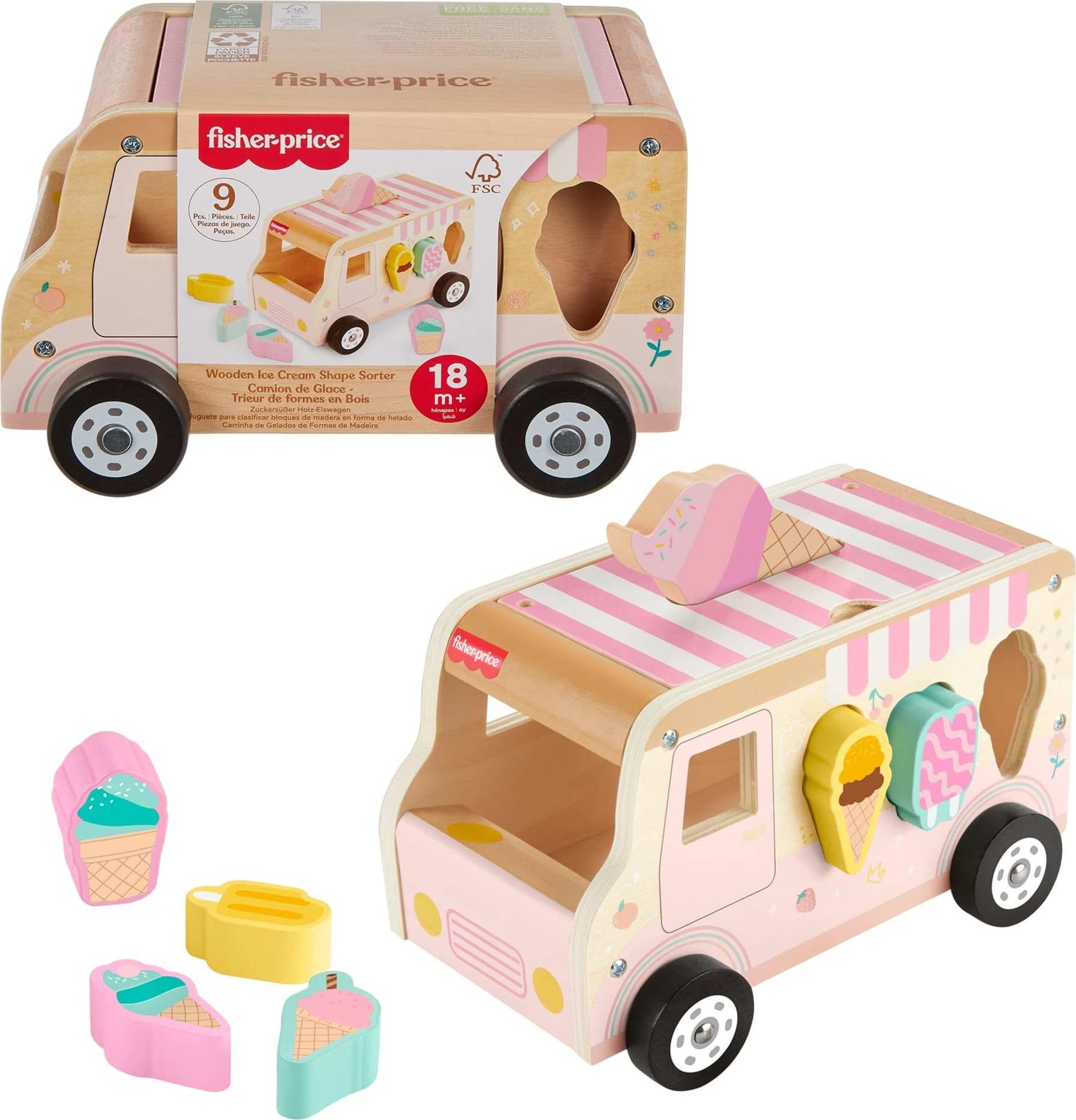
A push-along ice cream truck that serves up sorting skills with a side of imagination.
This toy bridges the gap between classic sorting and imaginative pretend play. Young kids push the little ice cream truck along, then flip the removeable lid to sort the 7 ice cream-themed shape pieces. It’s a double-duty developmental tool: sorting the shapes builds fine motor skills, while pushing the truck along supports gross motor development, giving you full-body learning in one adorable package.
The build quality separates it—it’s real, durable wood from Forest Stewardship Council-certified sources (FSC-N004566), finished with non-toxic, water-based paints. That matters for a toy that will inevitably get chewed on and dropped. One owner bought it just to test durability and returned weeks later to report it’s “still going on,” proof of its solid construction.
The main feedback is about size—it’s slightly “smaller than the picture make it look,” and the ice cream pieces are small enough that supervision is recommended for kids under 3 who still mouth objects. While one reviewer snagged it on sale, its standard price reflects the wood quality. This is a charming, heirloom-quality toy that encourages creativity and fine motor skill development for 18-month-olds and beyond.
Why it’s special
- FSC-certified wood with non-toxic, water-based paints
- Combines push-along gross motor play with shape sorting
- Sturdy, soft edges built to last through rough play
A note on size
- Smaller footprint than photos suggest, perfect for shelves
- Pieces are small; supervise little ones who mouth toys
The heirloom-quality choice: for parents who value sustainable wood and classic toys that outlast trends.
Mind the size: this is a compact truck, not a large playset, so adjust expectations on physical footprint.
9. KMTJT Wooden Activity Cube

A single wooden cube packing 7 distinct games to keep a busy toddler exploring for hours.
This is the ultimate problem-solver for a toddler who gets bored easily. The KMTJT Activity Cube packs 7 games into one toy: a bead maze, baby xylophone, learning clock, shape sorter, spinning gears, animal matching, and word cards. Every side (and the top) offers something new, so when your little one tires of one activity, they simply rotate the cube and discover a fresh challenge. A preschool learning lab even uses it, with teachers noting “all the parts go back in easily.”
It’s crafted from natural rubber wood with rounded edges and smooth, non-toxic water-based paint that won’t splinter, making it a genuinely safe choice for 12+ month-olds. The bead maze on top flips over for a shape sorter game, and all pieces and cards store neatly inside the box, transforming this from a bulky toy into a compact, carry-on-friendly travel companion. A parent of an 18-month-old confirms it’s “PERFECT for an 18 month old!”
However, with a 4.5-star rating from fewer owners, the feedback is slightly more mixed than the top picks. While quality and engagement are praised, some find the cube “smaller than expected” and a few report durability concerns with the bead maze string over time. It’s best for focused, seated play, offering exceptional variety for the price, but it may not be the indestructible workhorse that the LeapFrog book is.
What makes it invaluable
- 7 games in 1: maze, xylophone, clock, sorter, gears, matching, cards
- Compact and stores all parts inside; great for travel
- Smooth natural rubber wood with non-toxic paint
Consider this
- Smaller footprint than many activity centers
- Some owners mention bead maze durability issues over time
The variety king: the single best answer for toddlers who flit between activities and need constant novelty.
Not for the roughest play: durability is good but not flawless; it prefers engaged sitting play over heavy throwing.
Understanding the Specs
Fine Motor vs. Gross Motor
These two terms describe different muscle groups. Fine motor skills involve the small muscles in hands and fingers, used for picking up a single piece, stacking rings, or turning a page. Gross motor skills involve larger body movements like walking, pulling, or pushing. At 18 months, the best toys build both: a shape sorter exercises fine motor precision, while a pull-along puppy builds gross motor strength.
Battery-Free Peace
Toys that run on batteries—like the LeapFrog book or VTech puppy—offer audio feedback that’s excellent for language, but they require power. Battery-free options like the wooden cubes and sorters are silent, mess-free, and never die at the worst moment. Consider what you value more: interactive audio cues (language) or independent, noise-free manipulation (motor skills). Often, a mix of both is ideal.
Receptive Language Growth
At 18 months, your toddler understands far more words than they can speak—this is called receptive language. Interactive books and toys that name objects and play sounds are crucial here. They build the vocabulary bank your child will start drawing from when they begin speaking in 2-3 word sentences. Even if they can’t say “elephant” yet, hearing it and associating it with a picture is a critical learning step.
Material Matters: Wood vs. Plastic
Wooden toys are typically heavier, more durable, and feel more substantial in little hands, offering a satisfying sensory experience. They often have a classic, timeless appeal. Plastic toys are lighter, can be more colorful, and are easier to mold into complex shapes with buttons and sounds. Both are safe—look for non-toxic finishes—so choose based on the specific skill you want to target and your home’s aesthetic.
FAQ
What are the most important skills to target at 18 months?
Is a bilingual learning toy confusing for an 18-month-old?
Are wooden educational toys better than plastic ones for toddlers?
How many toys does an 18-month-old actually need to learn effectively?
My toddler gets bored of toys quickly. How can I encourage independent play?
What should I do if my child chews or mouths their toys?
Is a shape sorter too advanced for an 18-month-old?
Can these toys help with a toddler’s speech delay?
Which toys offer the most value for building multiple skills at once?
Are lights and sounds essential in educational toys for this age?
Final Thoughts: The Verdict
For most families, the educational toys for an 18-month-old winner is the LeapFrog Learning Friends 100 Words Book because it masterfully turns active page-touching into a vocabulary-building, bilingual experience that captivates toddlers for years. If your priority is building fine motor strength, the Spike the Hedgehog Tree House is the silent, tactile powerhouse parents rave about. And for the toddler who needs constant novelty, the KMTJT Wooden Activity Cube packs 7 separate games into one compact, travel-friendly station.
How We Picked
We do not accept paid placement. Every pick is matched to a real buyer and a real use-case; we do not hands-on test units.
Sources & Methodology
Specifications: manufacturer listings and product documentation. Review insights: verified customer reviews, as of August 2026. Pricing: not shown on this page (it changes often); check the current price via the retailer link.
As an Amazon Associate, WellFizz earns from qualifying purchases. This does not affect which products we feature.
Related Guides

Mo Maruf
I created WellFizz to bridge the gap between vague wellness advice and actionable solutions. My mission is simple: to decode the research and give you practical tools you can actually use.
Beyond the data, I am a passionate traveler. I believe that stepping away from the screen to explore new environments is essential for mental clarity and physical vitality.