Our readers keep the lights on and my smoothie glass nicely filled. As an Amazon Associate, I earn from qualifying purchases.
Specs are compiled from manufacturer listings and verified buyer reviews and can change over time — please confirm the key details on the product page before buying.
When the lights go out, a portable electric power station is the difference between a minor inconvenience and a real problem. You want something that can keep your fridge cold, your phones charged, and your Wi-Fi router humming without the noise, fumes, and fuel juggling of a gas generator.
I’m Mohammad Maruf — the founder and writer behind WellFizz. This guide is built by comparing the manufacturers’ published specifications and the patterns across verified customer reviews, so you get each pick’s real strengths and trade-offs instead of marketing spin.
When the power goes out or you head off-grid, you need a station that keeps your devices running without a hitch. This roundup of the best electric power station options focuses on capacity, output, and real-world reliability so you can pick the right one for your situation.
Our Picks at a Glance

How To Choose The Best Electric Power Station
Before you buy, ask yourself three things: how much power you need at once, how long you need it to last, and how you plan to recharge it. Your answers will guide you to the right capacity and output, so you don’t overspend on features you won’t use.
Match capacity to your real load
Capacity, measured in watt-hours (Wh), tells you how long the battery can feed your devices. A 500Wh unit can run a 60W fan for hours, but it won’t keep a full-size refrigerator going for days. If you want whole-home essentials during an outage, look at models with 2,000Wh or more.
Understand continuous vs. surge power
The continuous wattage is what the unit can sustain, while surge covers the brief spike needed to start motors in fridges or power tools. A station rated at 2,600W continuous but with 3,900W surge can start appliances that briefly demand more, then settle back down.
Prioritize battery chemistry for longevity
Lithium Iron Phosphate (LiFePO4) batteries last far longer than older lithium-ion chemistries, often rated for thousands of charge cycles. If this is a multi-year investment for emergency backup, the longer lifespan of LiFePO4 is worth the premium.
Quick Comparison
| Model | Best For | Capacity | Continuous Power | Weight | Amazon |
|---|---|---|---|---|---|
| BLUETTI Elite 200 V2★ Best Overall | Whole-home backup & high draw | 2073.6Wh | 2600W | 53.4 lbs | Amazon |
| GRECELL 500W (EB500)Best Value | Entry-level camping backup | 519.48Wh | 500W | 14.1 lbs | Amazon |
| GRECELL 500W GreenBest Features | Budget camping with wireless charging | 519.48Wh | 500W | 13.4 lbs | Amazon |
| GRECELL 500W Green (B0B6V2P9JW) | Reliable value for small outages | 519.48Wh | 1000W | 14.1 lbs | Amazon |
| LIBRIDS C600 | UPS for sensitive electronics | 640Wh | 600W | — | Amazon |
| BLUETTI Elite 100 V2 | Mid-size portable power | 1024Wh | 1800W | 25 lbs | Amazon |
| DJI Power 2000 | Quiet high-output camping | 2048Wh | 3000W | 47.9 lbs | Amazon |
| Jackery HomePower 3000 | Heavy home backup | 3072Wh | 3600W | 59.5 lbs | Amazon |
| Jackery Explorer 2000 v2 | Lightweight 2kWh portable | 2042Wh | 2200W | 39.5 lbs | Amazon |
| EcoFlow DELTA Pro | Expandable home backup | 3600Wh | 3600W | 99 lbs | Amazon |
| Anker SOLIX F3800 | Max power, dual-voltage | 3840Wh | 6000W | 132.3 lbs | Amazon |
In-Depth Reviews
1. BLUETTI Elite 200 V2 Portable Power Station
Our pick — over 4.5★ from 600+ verified ratings; the strongest balance of quality and price.
The 53.4-pound powerhouse that runs your microwave, coffee maker, and air fryer from a campsite or during an outage.
If your list includes high-draw appliances, this is the one to measure everything else against. It packs a 2073.6Wh capacity and a 2600W inverter that buyers confirm runs a microwave, coffee maker, and air fryer with headroom to spare. That’s double the capacity of the GRECELL 500W at 519.48Wh, so you’re comparing a full-day home backup to a small-device companion.
Its automotive-grade LiFePO4 battery is rated for over 6,000 cycles, giving it a 17-year lifespan. It recharges fast too — from 0 to 80% in 50 minutes using dual AC and DC charging, with a full charge in about 1.5 hours. When the grid blips, a 10ms UPS mode (a switchover that happens in 10 milliseconds) keeps your Wi-Fi, computer, and TV running smoothly — a feature buyers relying on it for home backup specifically praise.
Owners also love the app control, which lets you pick between Turbo, Standard, and Silent charging modes to balance speed against noise. At 53.4 pounds and 13.78″L x 9.84″W x 12.74″H, it’s not a one-hand carry like the 14.1-pound GRECELL units, but buyers describe it as the smallest, most powerful 2kWh station they’ve owned.
What wins people over
- 2600W continuous and 3900W lifting power handles heavy appliances
- 6000+ cycle LiFePO4 battery rated for 17 years of use
- Fast 0-80% recharge in 50 minutes with dual AC and DC input
Who should think twice
- At 53.4 lbs it’s a two-hand lift, not a grab-and-go unit
- There’s no 30A RV port for large camper hookups
Reach for this if: you want one station that powers kitchen appliances, tools, and home backup in a single 2073.6Wh package.
Look elsewhere if: your priority is carrying a station in a backpack — this needs a vehicle and a strong back.
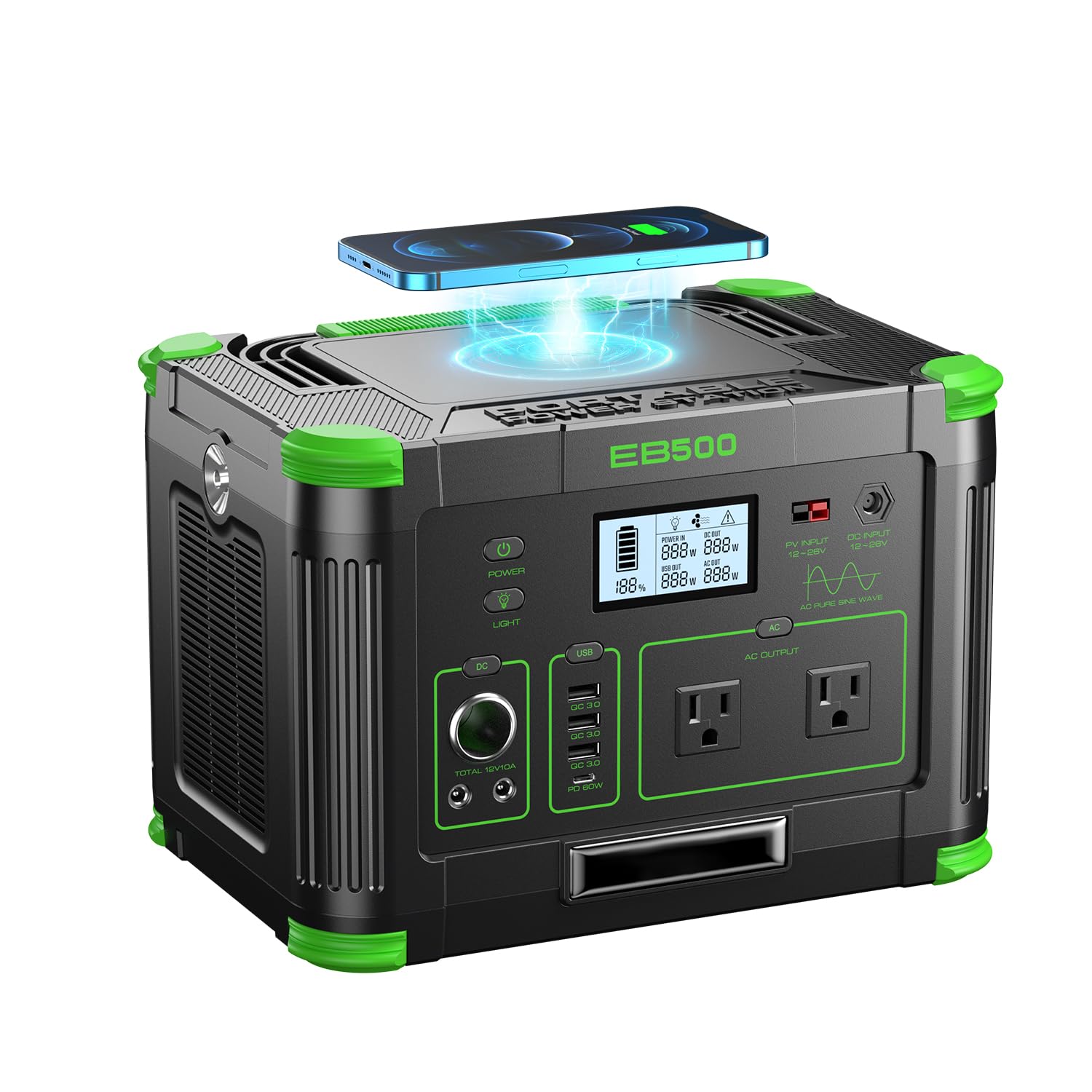
2. Portable Power Station 500W (GRECELL EB500)
The 14.1-pound budget champion that keeps a street vendor’s cash registers running all day and still has 50% left.
If you need reliable power without a big investment, this is the entry-level balance. With 519.48Wh capacity and 500W pure sine wave output (a clean power signal that’s safe for sensitive electronics like laptops and CPAP machines), it handles phones, laptops, lights, fans, and even a small car refrigerator. One buyer running a street vendor business confirmed it lasted a full day with 50% battery remaining.
It’s genuinely portable at 14.1 pounds, which is about 3.8x lighter than the BLUETTI Elite 200 V2, making it an easy grab for camping trips, tailgates, or everyday bag use. You get 10 output options — 2 AC ports, 3 USB-A, 1 USB-C PD at 60W, 2 DC ports, a car port, and a wireless charger — so you can power up to 10 devices at once. The USB-C PD 60W output charges phones and laptops more than twice as fast as a standard USB-C charger.
Owners consistently highlight the sturdy build and the pass-through charging, which means you can power your devices from the wall while the station charges — a key feature for home outages. The honest trade-off is that a 519.48Wh battery isn’t meant for large appliances or long off-grid stretches; buyers frame it as a short-term backup, not a whole-home solution.
The smart-buy angle: For the money, you get a reliable, versatile station that does everything a first-time buyer actually needs — small electronics, overnight essentials, and confidence during outages.
Pick this up if: you want an affordable, carry-anywhere station for camping and light home backup.
skip it if: you’re planning to run a refrigerator or power tools — step up to a 1,000Wh+ model.
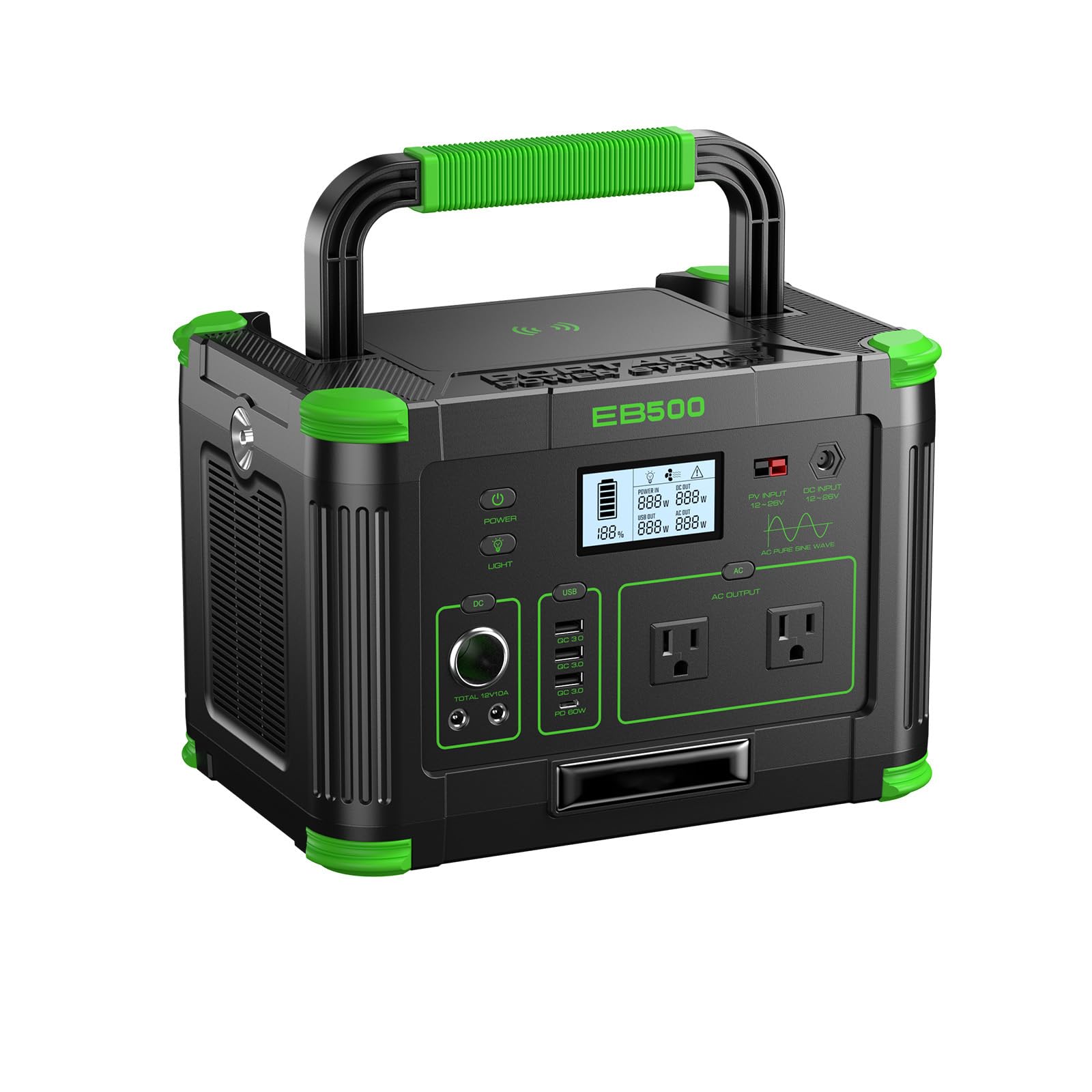
3. Portable Power Station 500W (GRECELL Dark Green)
The 13.4-pound all-in-one that throws in a wireless charger and an SOS flashlight for campsite convenience.
This GRECELL model punches above its weight with features usually found on pricier units. The 519.48Wh capacity and 500W pure sine wave output are identical to its sibling, but you also get a 10W wireless charging pad on top, plus a built-in LED flashlight with light-strobe-SOS modes for emergencies. At 13.4 pounds, it’s the lightest of the three GRECELL 500W models, making it the easiest to toss in a camping bag.
Buyers using it for small camper setups reported impressive efficiency — three nights of TV use left 97% battery, and a night with a fan running left 73%. The functionality is the most-praised aspect, with owners highlighting how it recharges lights, phones, and a Nintendo Switch for multiple families on Cub Scout camping trips without breaking a sweat.
There are a few honest caveats. Some buyers report the wireless charging pad can be finicky depending on your phone’s camera placement, and a single review reported an AC output failure after months of heavy use. For a budget-priced unit, the consensus is strong: this is a capable, feature-rich companion for short outages and outdoor trips, not a heavy-duty off-grid workhorse.
The standout extras
- Wireless charging pad adds convenience without an extra cable
- LED flashlight with SOS modes for emergencies
- Lightweight 13.4-lb design carries easily
The honest limits
- Some found the wireless pad picky about phone placement
- An occasional unit has shown durability issues after months
Go for it if: you want camping convenience and emergency lighting in one light, affordable package.
Reconsider if: you need a station for daily heavy use — this is built for occasional trips, not constant load.
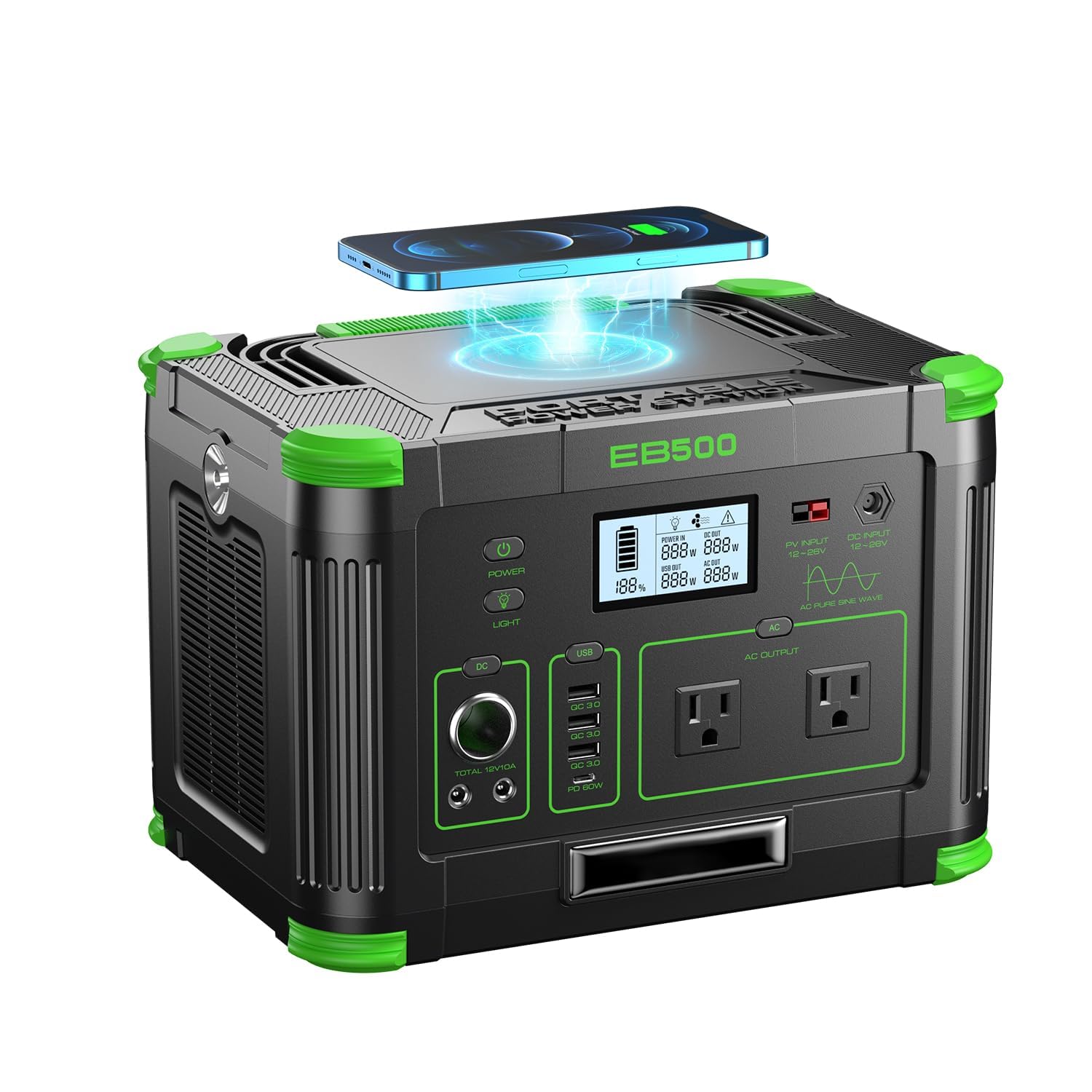
4. 500W Portable Power Station (GRECELL Green, B0B6V2P9JW)
The reliable 14.1-pounder that one buyer on 24/7 oxygen trusts to keep their equipment running during PG&E outages.
For emergency backup, reliability is everything, and this GRECELL variant earns high marks for it. With 519.48Wh capacity and 500W rated output (with a 1000W peak for startup surges), it powers phones, laptops, small appliances, and even a CPAP machine. The built-in Battery Management System (BMS) adds overvoltage, overcurrent, and short circuit protection for confidence.
What sets this apart is the owner consensus on trustworthiness. One buyer on oxygen 24/7 described it as a must-have for every household after relying on it during utility outages. Another noted it works great with a 100W folding solar panel for tent camping, charging tech, laptops, and lights while running appliances under 300W. The reliability is the most-praised aspect, with battery life close behind — one owner reported fully charging a mini fridge for four days.
It’s physically identical to the other GRECELL 500W units at 14.1 pounds and 11.57″L x 7.95″W x 7.95″H, so you’re getting the same portable form factor. The value story is strong: buyers who paid quadruple for their first station with less wattage found this one surprisingly economical. The limitation is the same across this class — 519.48Wh won’t run large appliances for extended periods.
Why it earns its spot: When the heaviest praise in the data is “reliable” from owners using it for medical-critical backup, that’s a stronger signal than any spec sheet.
Choose this if: trust and dependable backup for essential devices matter more than raw capacity.
Pass if: you expect to run a full-size fridge or power tools — this is a small-appliance station.
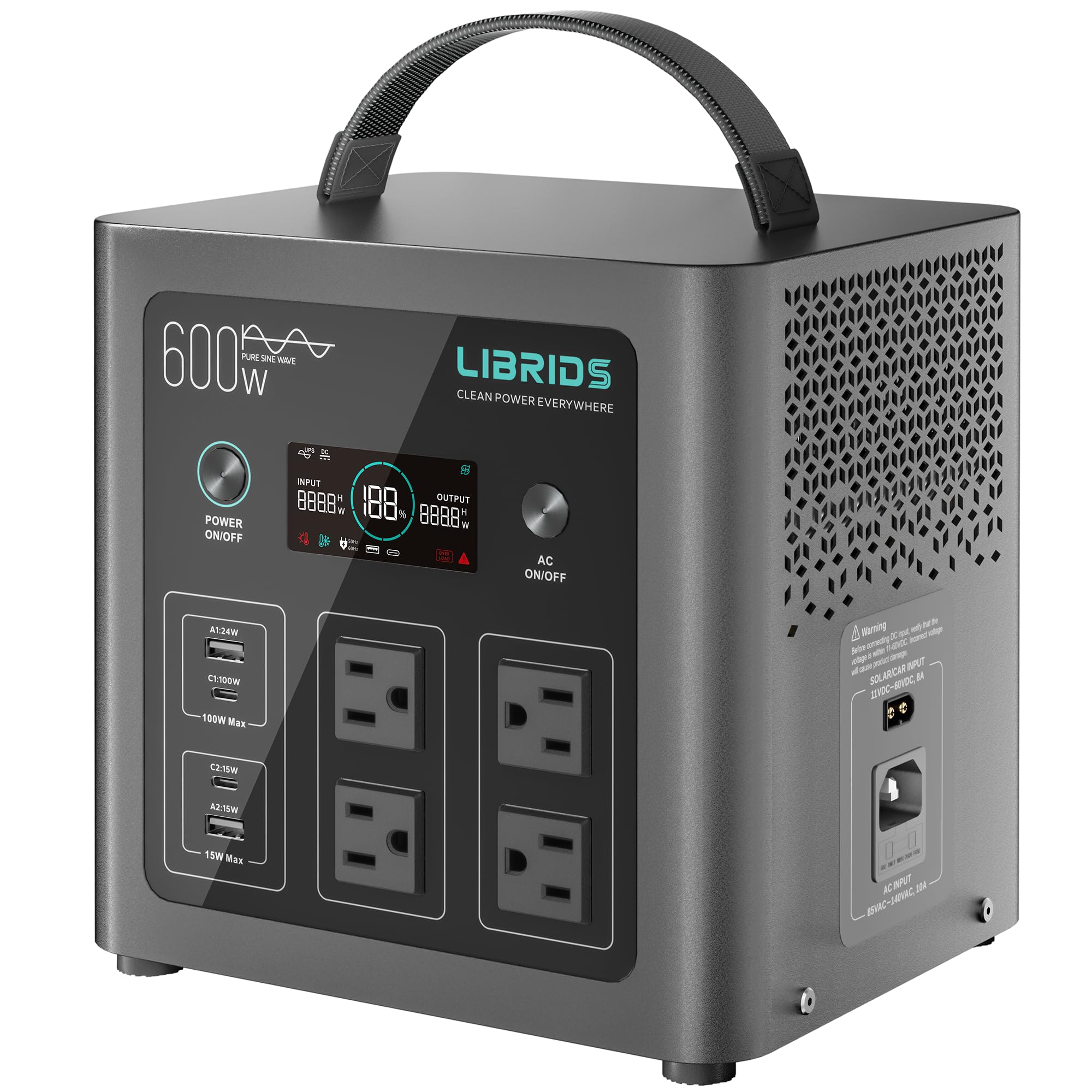
5. LIBRIDS C600 Portable Power Station
The 640Wh metal-clad unit that keeps a saltwater aquarium’s pumps running through outages with instant switchover.
If you have a device that can’t tolerate even a second of downtime, this compact station is built for you. The 10ms UPS (uninterruptible power supply) switchover automatically swaps to battery power in 10 milliseconds during an outage — fast enough to keep Wi-Fi routers, CPAP machines, and even sensitive aquarium equipment running without interruption. One reef tank owner uses it specifically to keep their pumps safe during power failures.
The 640Wh LiFePO4 battery is rated for 4000+ cycles and sits inside a durable metal enclosure for better heat dissipation — a design choice that owners mention feels premium and sturdy. It delivers 600W continuous output with a 1200W peak using PowerRaise technology to handle appliance startup loads. The full charge time of 1.5 hours from AC is impressive for this class, and the smart LCD screen shows real-time battery percentage and input/output power.
At 8.3″L x 6.9″W x 8.2″H, it’s noticeably more compact than the 11.57″ GRECELL units, which makes it easy to tuck into a camper or shelf. One buyer measured the capacity at 610Wh versus the 640Wh rating — close enough to call honest — and confirmed it holds a 560W load very well. The main caveat: this is labeled “Indoor Use Only” for UL safety, so it’s not meant for rainy outdoor conditions.
Built for sensitive gear
- 10ms UPS keeps routers and medical devices running smoothly
- Metal enclosure improves durability and heat management
- 1.5-hour full recharge from AC
The practical catches
- Indoor-only rating limits outdoor wet-weather use
- 600W output won’t run larger kitchen appliances
Reach for it if: you need a dependable UPS-style backup for electronics, aquariums, or medical gear in a small footprint.
pass on it if: your station will live outside in the elements — the indoor rating is a real constraint.
6. BLUETTI Elite 100 V2 Portable Power Station
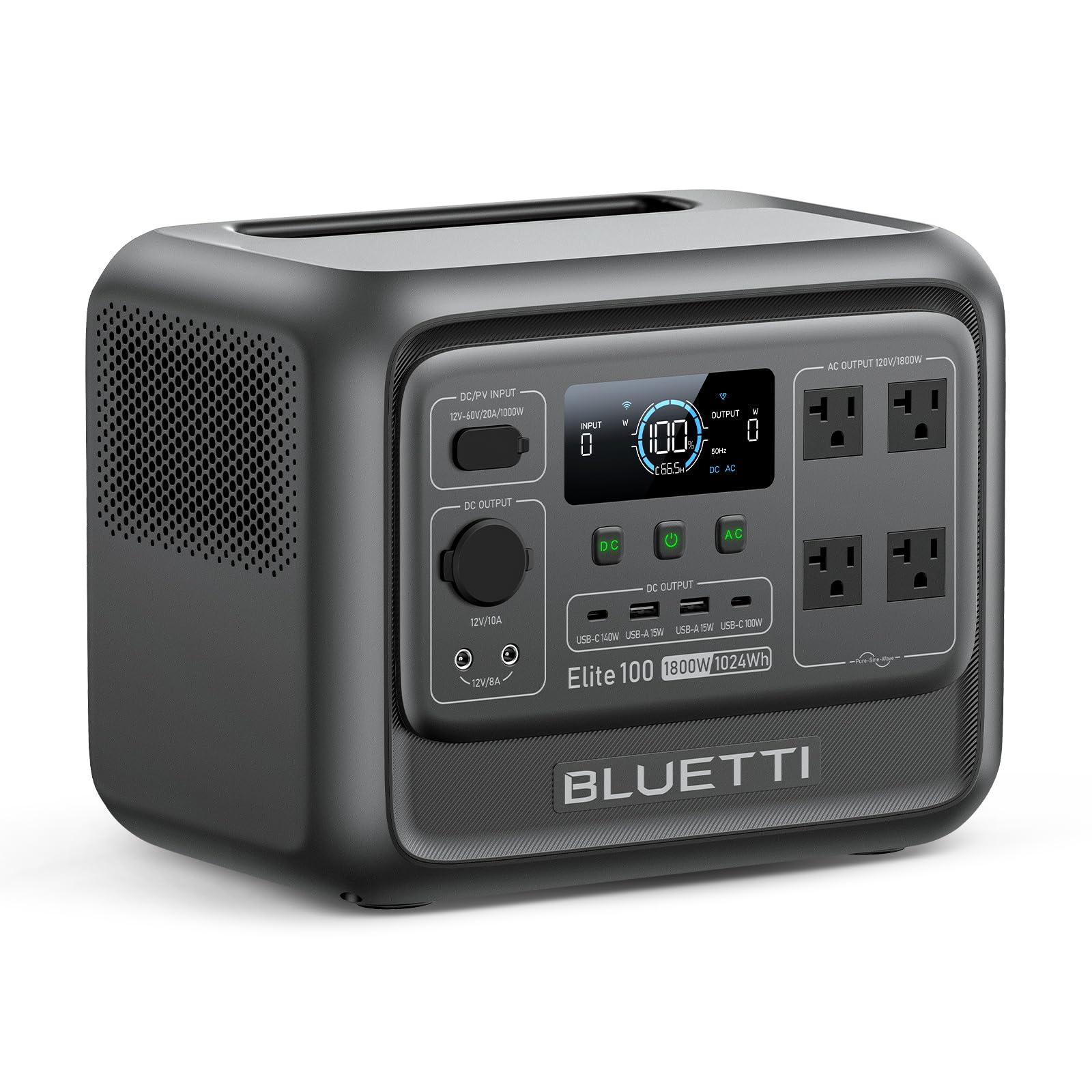
The 25-pound mid-size unit that’s 35% smaller than rivals, yet powers 90% of everyday appliances with 1800W.
This is the just-right option for buyers who find 500W units too weak but don’t need the 53-pound behemoth. The 1024Wh capacity and 1800W rated AC output (with 2700W Power Lifting) handle most home appliances, and the 11 ports let you charge multiple devices simultaneously. Mobile notary professionals specifically praised it for powering laptops, printers, hotspots, and phones reliably during off-site work.
The portability story is compelling: at 25 pounds with a compact 17L design, it’s 30% lighter than typical 1kWh stations, and customers note it’s easy to carry one-handed by the hidden handle. That said, some owners still found it heavier than expected despite the size reduction — the “portable” label has limits when you’re walking any distance. It also runs at just 30dB in silent mode, which buyers describe as whisper-quiet for overnight camping.
Smart app control via Wi-Fi and Bluetooth gives you remote monitoring, and the LiFePO4 battery is rated for over 4,000 life cycles — roughly a 10-year lifespan. Recharging is quick, hitting 80% in 45 minutes via AC. The 10ms UPS switchover keeps Wi-Fi and computers running during outages, which is a standout feature at this price tier.
The balanced take: It splits the difference between the 519.48Wh budget units and the 2073.6Wh home-backup stations — enough power for most needs, light enough to actually move.
Pick this if: you want 1kWh-class power without lugging a 50-pound station.
Look elsewhere if: you’re powering a full kitchen during long outages — the 1024Wh capacity will run out.
7. DJI Power 2000 Portable Power Station
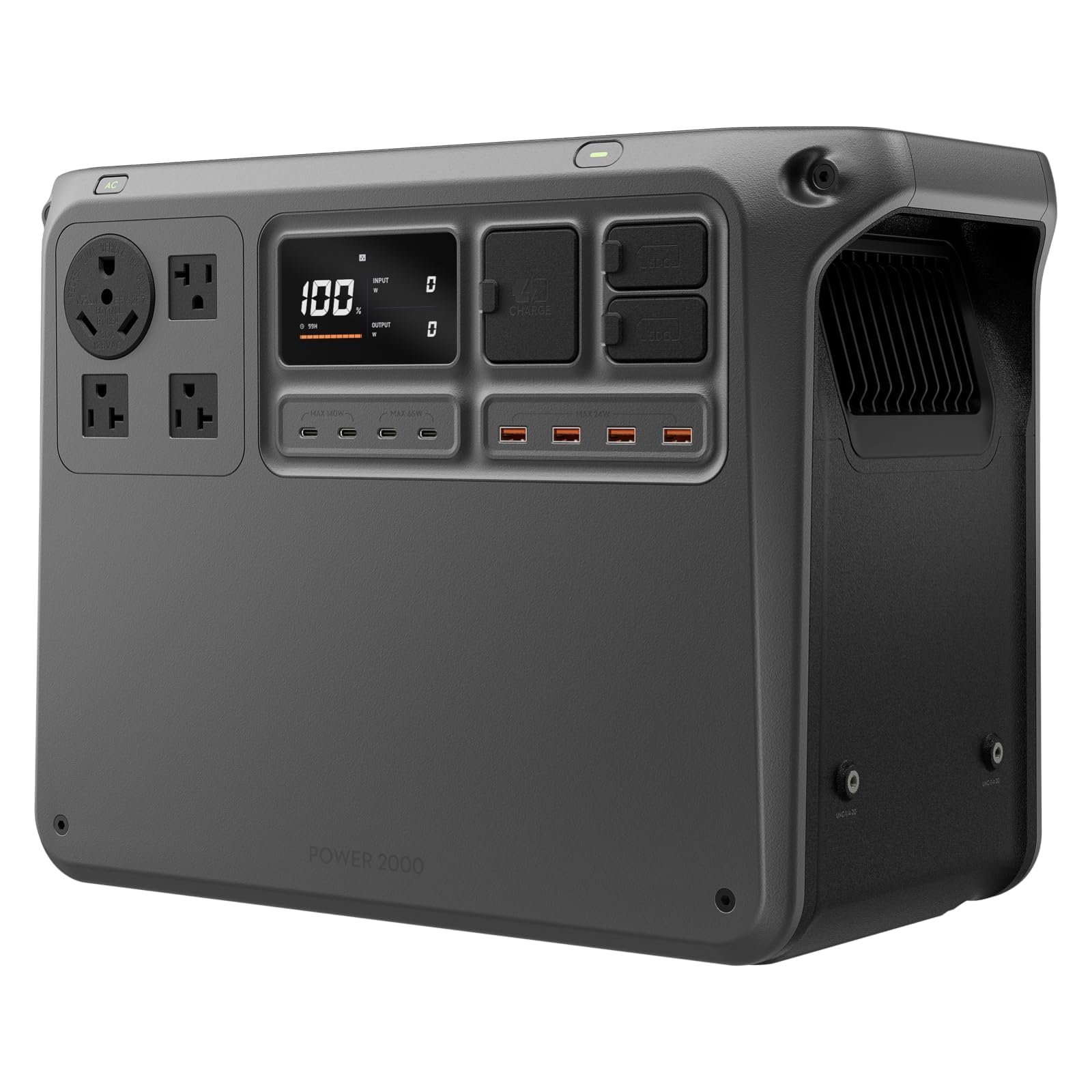
The 2048Wh station that replaces a noisy gas generator for camper owners who want total silence at night.
DJI brings its drone-grade engineering to the power station world, and the result impresses where it counts. The 2048Wh LFP battery delivers 3000W stable output, which buyers confirm can power everything in a camper — one owner replaced their gas generator entirely and reported roughly 40 hours of runtime with completely silent operation. The sturdy build quality is the most-praised aspect, with a rugged marine-style construction and flame-retardant housing rated for wet or rugged conditions.
Recharging is fast: 0-80% in just 55 minutes from AC. The 10ms UPS switchover is twice as fast as the DJI Power 1000, keeping devices running through outages without a flicker. You get 15 ports — including 4 AC, 4 USB-C, and 4 USB-A — enough for 4-5 people to charge phones, lights, fans, and laptops together. The DJI Home app adds wireless remote control without needing a separate dongle.
The expansion story is ambitious — it supports up to 22.5kWh with add-on batteries (sold separately) for 4-6 days of essential home backup. However, there’s a catch: the proprietary SDC ports and solar peripherals have been out of stock, frustrating some buyers who wanted to expand. Charging speed also drew mixed feedback, with some noting it’s slower than expected. At 47.9 pounds with no wheels, it’s not the easiest to move around.
Built like a tank
- 3000W stable output handles camper and tool loads
- Runs as low as 30dB for silent nighttime use
- 2048Wh LFP battery rated for 4000 cycles
The friction points
- Proprietary SDC ports limit third-party accessories
- Some expansion peripherals have been hard to source
Choose this if: you want premium build quality and silent operation for RV or home backup in a mid-size package.
Reconsider if: you plan to expand capacity soon — check accessory availability first.
8. Jackery HomePower 3000 Portable Power Station
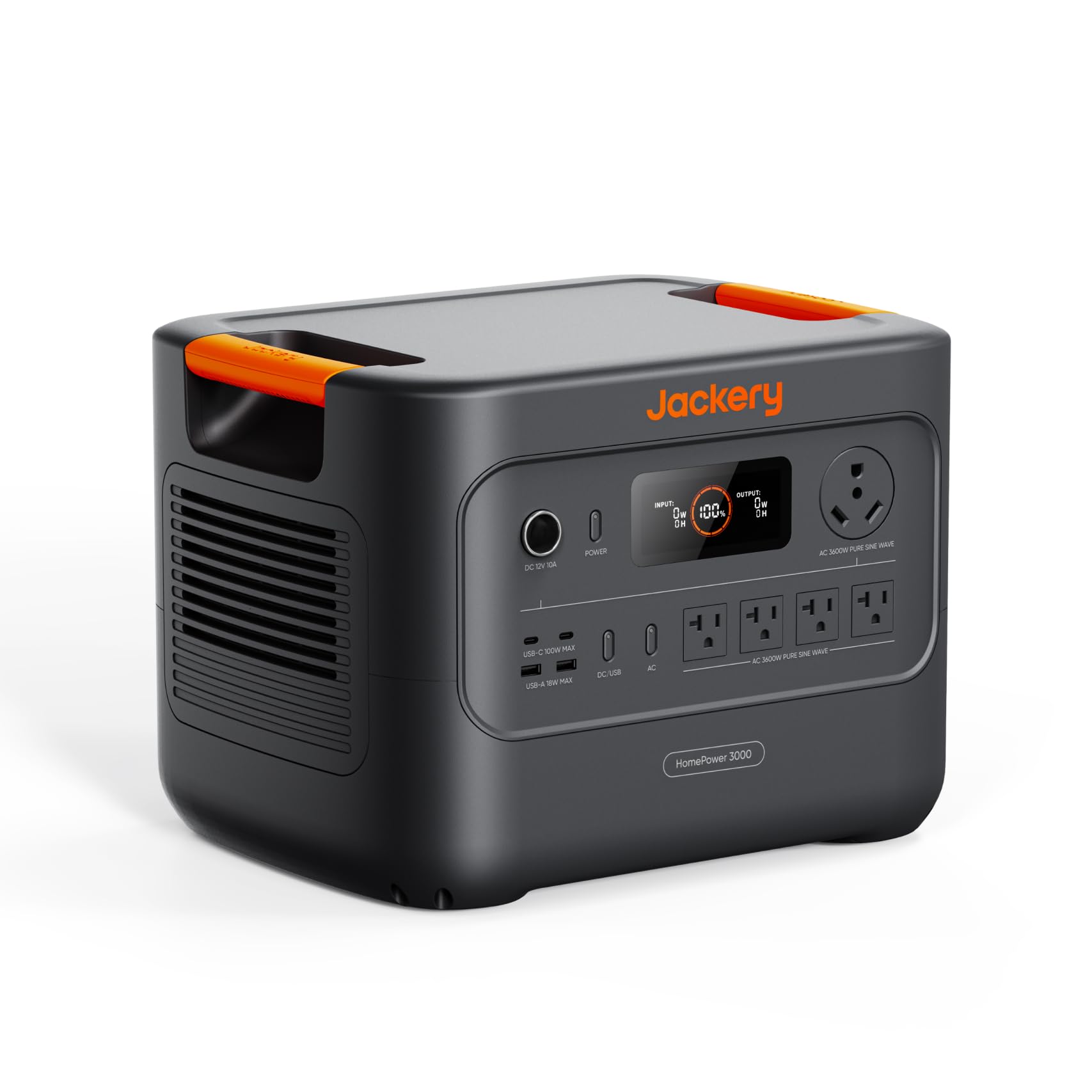
The 3072Wh home essential that runs a 30-foot travel trailer for over three days without shore power.
Jackery built its name on reliable backup, and the HomePower 3000 is the flagship of that reputation. The 3072Wh capacity and 3600W output (7200W surge) keep a household running for up to 15 hours — a fridge for 1-2 days — making it a genuine whole-home essential backup rather than a camping accessory. One owner ran a 30-foot travel trailer for 3+ days without AC and powered a fridge, microwave, TV, Keurig, and Starlink simultaneously.
The ≤20ms UL-certified UPS (uninterruptible power supply) is the standout feature for outage protection. It switches to battery so smoothly that security cameras, medical refrigerators, Zoom calls, and pet feeders keep running through storms without interruption. The dual 100W PD ports charge phones, tablets, and drones fast, and the built-in TT-30 RV port provides plug-and-play power for your camper.
Recharging is flexible and quick — full charge in 1.7 hours via hybrid AC and DC, or 2.2 hours via AC alone. The ChargeShield 2.0 technology uses AI algorithms to boost charging speed and extend battery lifespan, with the LiFePO4 cells rated for 4,000 cycles while retaining 70% capacity. At 59.5 pounds with dual side grips, it’s heavy but manageable — owners note it’s easier with two people or a dolly, and a few joke about building one.
The confidence builder: Owners with multiple Jackery units keep coming back, and the HomePower 3000’s ability to run a house “almost fully” during outages is the recurring headline.
Reach for this if: you want a serious home backup that handles a fridge, router, and lights for days, plus RV capability.
Consider the weight: At 59.5 pounds, plan where it lives — you won’t want to move it often.
9. Jackery Explorer 2000 v2 Portable Power Station

The 39.5-pound 2kWh station that’s 41% lighter than typical rivals, with a hair-dryer-proof 2200W output.
If 2kWh capacity is your target but your back disagrees with heavy gear, this Jackery is the answer. It weighs 39.5 pounds — 41% lighter and 34% smaller than typical 2kWh LiFePO4 stations — thanks to the same Cell-to-Body (CTB) technology used in EVs, which integrates cells directly into the structure for a more compact, stable design. Buyers confirm the weight difference is real, with several noting it’s far easier to move than competing units.
The 2200W AC output across 3 ports runs most home appliances, including a hair dryer without issues, as one buyer confirmed. The 2042Wh capacity held a refrigerator running for 21.3 hours in one owner’s test, and the USB-C PD 100W port charges laptops and devices fast without an extra adapter. For remote-work scenarios, it’s proven — one buyer in off-grid Belize kept Wi-Fi running for 2-3 days of rain outages.
Charging is rapid: 0-80% in 66 minutes via AC, or a full charge in 102 minutes using Emergency Super Charging mode through the app. Silent Charging mode delivers a full charge in 5 hours at just 30dB, letting you recharge while you sleep. The 20ms UPS switchover is UL1778 certified, and with a 10-year LiFePO4 lifespan, this is built as a long-term investment. Some owners did find the Bluetooth app connection occasionally unreliable, and the solar barrel ports flex slightly when plugged in.
The portability win
- 39.5 lbs is genuinely easier to move than other 2kWh stations
- 2200W output runs most home appliances
- 66-minute 0-80% AC fast charge
Minor annoyances
- Bluetooth app connection can be unreliable for some
- Solar input ports feel slightly flexible under strain
Pick this if: you want a true 2kWh station that you can actually lift and move without a dolly.
it’s not for you if: you need more than 2200W continuous for heavy tools or appliances.
10. EF ECOFLOW Portable Power Station DELTA Pro
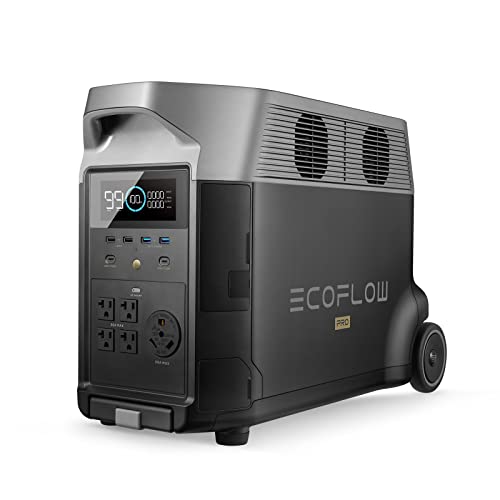
The 3600Wh expandable unit that runs a commercial freezer and a vendor-market heat press without voltage drops.
For buyers who think in terms of “what if I need more later,” the DELTA Pro is the growth-friendly choice. It starts at 3600Wh and expands to 25kWh with extra batteries, giving you a path from everyday backup to serious whole-home coverage. The 3600W AC output (expandable to 4500W with X-Boost) powers heavy-duty devices — one vendor-market owner runs a heat press flawlessly with no voltage drops, and another powers a commercial freezer reliably.
The 15 output methods are the most flexible in this roundup: 5 AC outlets, 2 USB-A, 2 USB-A Fast Charge, 2 USB-C at 100W, 2 DC outlets, a car power outlet, and an Anderson port. You can charge it five ways — EV station, solar, wall, smart generator, or car outlet — and the X-Stream fast charging refills the LiFePO4 battery in 1.8 hours with a 240V outlet. Solar conversion efficiency up to 23% means 4x400W panels can fully charge it in 2.8 hours.
Owners consistently describe it as quiet, well-built, and practical for outages. One buyer running a 24/7 oxygen machine got about 7 hours of runtime, which highlights the limits of even 3600Wh for medical-critical loads. At 99 pounds, this is a “set it in place” station, not a carry-around unit. The smart app control via Wi-Fi or Bluetooth lets you monitor charge level, temperature, and customize settings remotely.
The scalability story: No other station in this list offers a clearer upgrade path from 3.6kWh to 25kWh, making it the smart pick for future-proofing.
Choose this if: you want a powerful station today with the option to expand into whole-home backup tomorrow.
Pass if: you need portability — at 99 pounds, this lives where you put it.
11. Anker SOLIX F3800 Portable Power Station

The 3840Wh, 6000W dual-voltage titan that can power an entire home — including your dryer — or charge your EV.
This is the closest thing to a whole-home generator that runs on batteries. The 3840Wh capacity with 6000W AC output at both 120V and 240V handles every appliance in your house, including high-voltage ones like dryers that most stations can’t touch. You can even charge your EV directly through the NEMA 14-50 port at 6000W, and plug it into your RV’s power inlet via NEMA 14-50 or L14-30 ports for full camper power.
The expandability is extreme: add up to 6 battery packs to reach 26.9kWh, or pair two F3800 units with 12 packs for roughly two weeks of power. During a real 6-hour outage with a 260-450W load, one owner kept a fridge, lights, a hot water inducer, and a radon motor running while the battery only dropped from 100% to 66% with solar input. The build quality is outstanding, with wheels and a handle to help move the 132.3-pound unit.
There are meaningful quirks to know. The firmware needs an update for simultaneous AC and DC charging, and solar input is tune for Anker’s own panels — third-party rooftop setups may not work. Below 50°F, the battery management system limits charging to about 710W DC and 685W AC. Some buyers also noted that charging via a generator disables the AC outlets. The 5-year warranty and 10-year lifespan on the EV-class LFP batteries are solid reassurances for the investment.
class-leading capability
- 6000W dual-voltage output runs a whole house including dryers
- Direct EV charging via NEMA 14-50 port
- Expandable to 26.9kWh for multi-day backup
What to know first
- 132.3 lbs — plan for a permanent location
- Firmware update needed for best charging performance
- Solar input is picky about third-party panels
Reach for this if: you want maximum power, dual-voltage capability, and the option to charge your EV or run your whole house.
Reconsider if: you need portability or plan to use non-Anker solar panels — this is a stationary power plant.
Understanding the Specs
Battery Capacity (Wh)
Watt-hours (Wh) is the total energy stored, like the size of a fuel tank. A 519.48Wh unit can run a 100W device for roughly 5 hours, while a 2073.6Wh unit runs it for about 20 hours. Match this to how long you need your essential devices powered.
Continuous Output (W)
Continuous watts is what the station can sustain indefinitely — the number that matters for daily use. Surge watts (or “power lifting”) covers the brief spike needed to start motors in fridges, pumps, or tools. A 2600W station with 3900W surge can start a fridge that briefly draws more, then settle down.
Battery Chemistry: LiFePO4 vs NCM
Lithium Iron Phosphate (LiFePO4) batteries last far longer — often rated for 4,000 to 6,000+ charge cycles — and handle heat better, but they’re heavier. Nickel Cobalt Manganese (NCM) batteries are lighter and cheaper but typically last only 500 to 800 cycles. For a multi-year investment, LiFePO4 is the better value.
UPS Switchover Time
A UPS (uninterruptible power supply) switchover is how fast the station swaps to battery when the grid fails. Measured in milliseconds (ms), a 10ms switch is essentially smooth for computers, routers, and medical gear. Slower switches can cause a brief flicker or reboot on sensitive electronics.
FAQ
What size power station do I need for a refrigerator?
Can I run a CPAP machine overnight on a power station?
What does pure sine wave output mean for my devices?
How long does a power station battery last before needing replacement?
Can I charge a power station with solar panels?
What is the difference between continuous and surge wattage?
How do I maintain a power station that sits unused for months?
Can a power station run power tools like drills or saws?
What does UPS mode do and why does it matter?
Final Thoughts: The Verdict
Across the board, the winner is the BLUETTI Elite 200 V2 because it delivers the best balance of raw capacity, high-draw capability, and fast recharging for whole-home backup and serious camping. If you want a lightweight portable for occasional trips, grab the GRECELL 500W — it covers the essentials without the bulk. And for maximum whole-home power with dual-voltage capability, the Anker SOLIX F3800 is the one to reach for, provided you have a permanent spot for its 132.3-pound frame.
How We Picked
We do not accept paid placement. Every pick is matched to a real buyer and a real use-case; we do not hands-on test units.
Sources & Methodology
Specifications: manufacturer listings and product documentation. Review insights: verified customer reviews, as of August 2026. Pricing: not shown on this page (it changes often); check the current price via the retailer link.
As an Amazon Associate, WellFizz earns from qualifying purchases. This does not affect which products we feature.
Related Guides

Mo Maruf
I created WellFizz to bridge the gap between vague wellness advice and actionable solutions. My mission is simple: to decode the research and give you practical tools you can actually use.
Beyond the data, I am a passionate traveler. I believe that stepping away from the screen to explore new environments is essential for mental clarity and physical vitality.