Our readers keep the lights on and my smoothie glass nicely filled. As an Amazon Associate, I earn from qualifying purchases.
Specs are compiled from manufacturer listings and verified buyer reviews and can change over time — please confirm the key details on the product page before buying.
You want a budget camera that shoots sharp, usable video—not one that brags about specs it can’t deliver. Many cheap models claim “88MP” sensors that blur in daylight, 8K modes that stutter at 15 frames per second, and digital zooms that turn distant subjects into pixel soup. The real question isn’t which camera has the biggest number on the box; it’s which one actually delivers for how you’ll shoot, whether that’s vlogging, family events, or wildlife.
I’m Mohammad Maruf — the founder and writer behind WellFizz. This guide is built by comparing the manufacturers’ published specifications and the patterns across verified customer reviews, so you get each pick’s real strengths and trade-offs instead of marketing spin.
Here’s how to pick a budget video camera that delivers real value, not just impressive numbers.
Our Picks at a Glance


How To Choose The Best Economical Video Camera
The most economical camera isn’t the cheapest—it’s the one that fits your shooting style and lasts. Match the camera to your subject: wildlife needs optical zoom, vlogging needs a flip screen and mic port, family events need long battery life and simple controls.
The Zoom Truth Test
Optical zoom uses glass to magnify the scene, which preserves detail all the way out. Digital zoom crops into the image and then enlarges the remaining pixels, which creates soft, blocky results as you push further. A camera advertising “18x digital zoom” is effectively admitting it has a fixed lens; a camera with even 8x optical zoom brings distant subjects into frame with genuine sharpness that no digital trick can match.
Sensor Size Beats Megapixels
Megapixels describe how many tiny light-catchers are on the chip, but the physical size of that chip determines how well it performs in low light. A 1-inch sensor with 15.2MP will capture cleaner, more colorful video in a dim room than a tiny 88MP sensor that packs the same number of pixels into a fraction of the space. For video, the sensor’s physical size is the spec that silently dictates your image quality when the sun goes down.
Quick Comparison
| Model | Best For | Sensor / Still Res | Max Video | Stabilization | Amazon |
|---|---|---|---|---|---|
| Canon EOS Rebel T7★ Best Overall | Real interchangeable-lens quality | 24.1MP CMOS | 1080p Full HD | None (lens-based) | Amazon |
| KODAK PIXPRO AZ528The Long Ranger | Wildlife & long-distance reach | 16MP BSI CMOS | 1080p Full HD | Optical Image Stabilization | Amazon |
| Canon PowerShot V10Pocket Creator | Pocket vlogging & streaming | 15.2MP 1″ CMOS | 4K (30fps) | 3-Mode IS | Amazon |
| MWIRB 8K 88MP Camcorder | Kit-laden beginner vlogging | 88MP | 8K (15FPS) / 4K30 | 6-Axis Anti-Shake | Amazon |
| Yollner 8K 64MP | Complete ready-to-shoot kit | 64MP | 8K | Handheld Stabilizer | Amazon |
| FJFJOPK 5K 64MP | Live streaming & product work | 64MP | 5K | 6-Axis EIS | Amazon |
| SJCAM C400 | Action & outdoor POV | — | 4K UHD | 6-Axis Gyro + EIS | Amazon |
| TryTalk 5K 64MP | All-in-one starter bundle | 64MP | 5K | Anti-Shake | Amazon |
| DJI Osmo Pocket 3 | Gimbal-stable creator footage | 9.4MP 1″ CMOS | 4K/120fps | 3-Axis Mechanical | Amazon |
In‑Depth Reviews
1. Canon EOS Rebel T7 DSLR Camera with 18-55mm Lens (Renewed)
Our pick — 4.5★ from 250+ verified ratings; the strongest balance of quality and price.
A true interchangeable-lens DSLR that outshines phones and fixed-lens compacts.
Its 24.1MP CMOS sensor delivers DSLR-grade sharpness in tricky light, without the pro price. Nearly 300 owners rate it 4.5 stars, calling it a steal versus pro rigs costing 20 times more.
You get a 9-point autofocus system with AI Servo AF to track moving subjects, plus built-in Wi-Fi and NFC so you can push photos to your phone and straight to social media. The 3.0-inch LCD and Scene Intelligent Auto mode handle the exposure decisions for you, which makes this a genuinely friendly first camera rather than an intimidating brick of buttons.
The bundled 18-55mm lens is versatile but short on reach—distant wildlife needs extra glass. It’s also a renewed (refurbished) unit, so while the seller’s packaging earns praise, the occasional unit arrives with minor scuffs — a fair trade-off for the price, and one buyers report is worth it.
What wins people over
- Quality is the #1 praise — 34 owners single it out, with 18 more calling out image sharpness
- All-day battery life, so you aren’t hunting for a charger mid-event
- Easy auto mode for beginners, with customizable controls as you grow
Where it asks something of you
- Kit lens has limited telephoto reach; expect to add lenses later
- Renewed condition means some units show light scratches
- Photo transfer isn’t smooth — owners recommend an SD card reader
Reach for it if: you want a genuine first DSLR with a lens system you can grow into, all-day battery, and image quality that routinely beats the smartphones in your house.
Look elsewhere if: your priority is long-range zoom or tiny pocket portability — this is a full-size camera that needs a bag.
2. KODAK PIXPRO AZ528 16MP Digital Camera
Fifty-two times optical zoom puts birdwatching and bleacher seats within genuine, sharp reach.
When your subject is far away, this KODAK brings it close: a 52x optical zoom lens (which uses glass to magnify, not software guessing) captures distant birds, wildlife, and athletes with real sharpness. The 24mm wide-angle end handles sweeping landscapes, and the 16MP BSI CMOS sensor (a backside-illuminated chip that catches light more efficiently) improves low-light shots. Optical Image Stabilization works at every zoom level, so you can shoot handheld telephoto without a tripod and still get crisp footage.
Wildlife shooters will find the 6fps burst mode (six frames per second) ideal for capturing peak action, and you can review each burst on the 3-inch LCD to pick the sharpest keeper. Built-in Wi-Fi lets you move photos to your phone for instant sharing, while the rechargeable li-ion battery and support for Class 10 SD cards up to 512GB keep you shooting all day.
Owners note the zoom demands steady hands—at full reach, any shake shows—so a tripod helps. The body scuffs easily and battery life runs short, but the fast USB-C charging and the sheer reach of that lens make it a favorite for beginners and a surprising stand-in for far pricier gear.
Sharp where it counts: The 52x optical zoom is the headline act, and owners confirm it reaches birds at feeders and subjects across a field with impressive clarity—if you hold steady.
The trade-off: Budget construction means a scratch-prone body and modest battery, but the reach and 1080p video quality keep it a value standout.
3. Canon PowerShot V10 Compact Vlogging Camera
A fanny-pack-sized vlogger with a 1-inch sensor that punches far above its palm-sized frame.
This V10 packs serious imaging into a tiny body: its 15.2MP 1-inch back-illuminated CMOS sensor (a larger chip that captures more light) delivers low-light performance that fixed-lens budget cams can’t match, and it records 8-bit 4K video at up to 30fps. The retractable front-facing screen flips up for self-recording, and the built-in stand folds from front or back, so you can set it down hands-free on any table.
The fixed 19mm wide-angle lens (35mm equivalent) handles landscapes and tight interiors beautifully, while three image stabilization modes—IS Off, IS On, and IS Enhanced—let you dial in the steadiness you need. A pair of stereo microphones plus a third center mic to reduce background noise means your voice comes through clearly, and the micro-HDMI output plus USB-C charging keep it production-friendly.
Owners love that it slips into a pocket or fanny pack and delivers great quality in good light. But the fixed lens means no zoom while filming, and battery life is the recurring trade-off—expect roughly 1 to 2.5 hours, though USB-C makes topping up easy. Without a lens cover, the exposed front element picks up fingerprints, so a small pouch is wise.
Best for: vloggers and streamers who want genuine image quality and a flip screen in something truly pocketable, not a bag-filling rig.
The compromise: no optical zoom and modest battery runtime, both of which owners accept for the size and sensor quality.
4. DJI Osmo Pocket 3
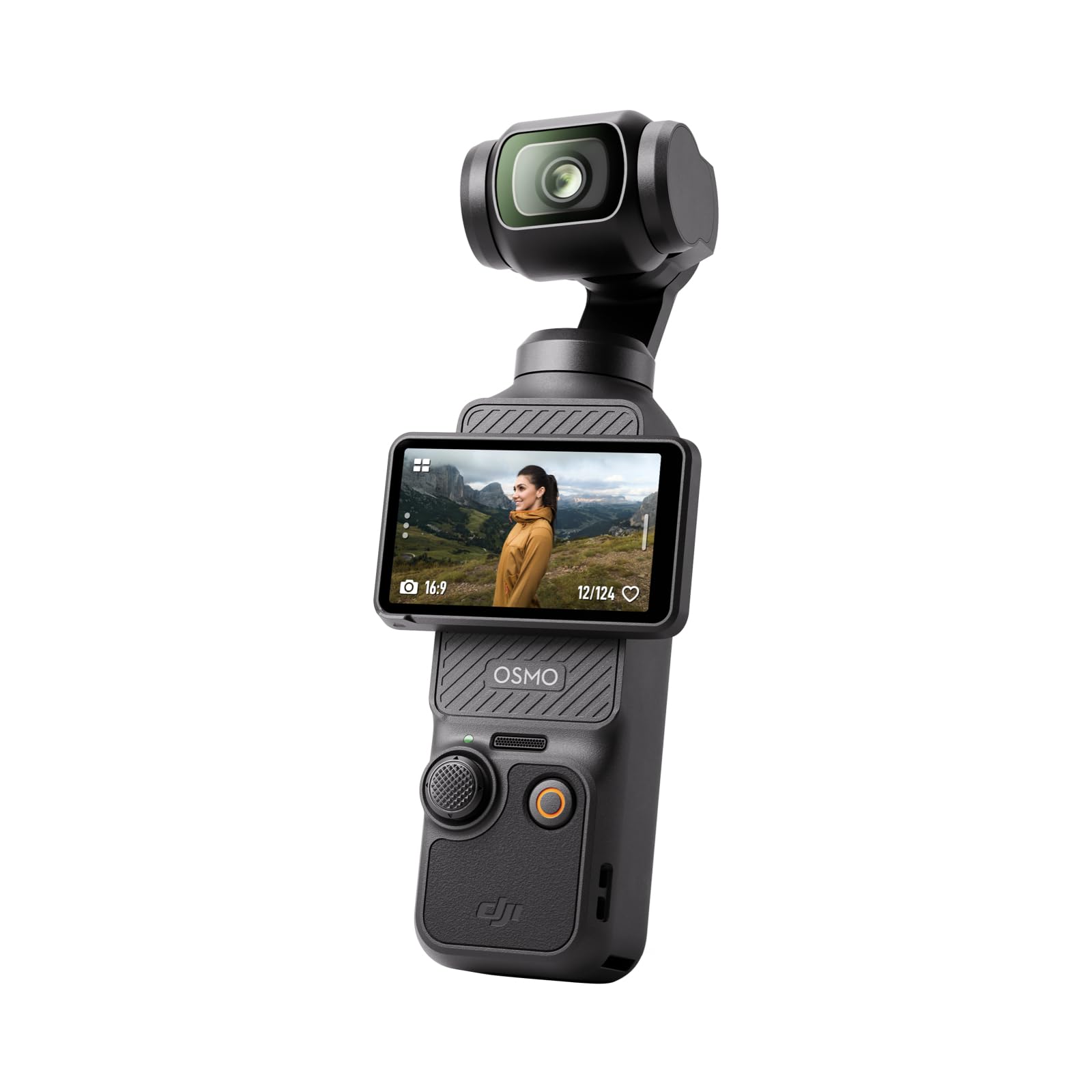
A 3-axis gimbal in your palm makes every walking shot look like it was on rails.
This Osmo Pocket 3 feels anything but economical: its 1-inch CMOS sensor records 4K at up to 120fps, so you can slow action down to buttery slow-motion. A 3-axis mechanical gimbal physically counteracts your hand movements for servo-smooth footage. The 2-inch touchscreen rotates for both horizontal and vertical framing, so you can shoot a landscape scene then flip to a vertical Reel without changing your grip.
ActiveTrack 6.0 keeps you centered in frame as you move—set it on a tripod, jump, dance, or spin, and the camera follows. Fast autofocus locks onto subjects for sharp results, while D-Log M and 10-bit color depth capture up to one billion colors for serious grading in post-production. Stereo audio records clean sound, and it can connect wirelessly to two DJI Mic 2 or Mic Mini transmitters for interviews and livestreams.
Owners describe it as “full-scale production power in a tiny device,” praising the stabilization and low-light quality that rivals much larger cameras. The trade-offs: it’s a fragile, non-waterproof unit that demands care, the wide FOV is narrow with no fisheye, and the built-in mic is a bit weak—though a DJI Mic fixes that. At 166 minutes of battery, it’s an all-day companion for creators who value smooth, portable footage.
The magic here
- Gimbal-smooth footage with no extra rig — the key reason it outshines fixed-lens cams
- 4K/120fps slow-motion and 10-bit color for real post-production headroom
- Rotating screen makes vertical and horizontal content easy
Handle with care
- Not waterproof and physically fragile — this needs a case, not a pocket toss
- Built-in audio is basic; owners pair it with a DJI Mic for quality sound
- Narrow field of view, no fisheye or optical zoom
Grab this for: creator footage that looks professionally stabilized straight from the start — the standout is the gimbal, and nothing else at this price moves like it.
Think twice if: you need optical zoom, waterproofing, or rugged durability, because this pocket camera trades all three for smoothness.
5. FJFJOPK 5K 64MP Live Streaming Camera
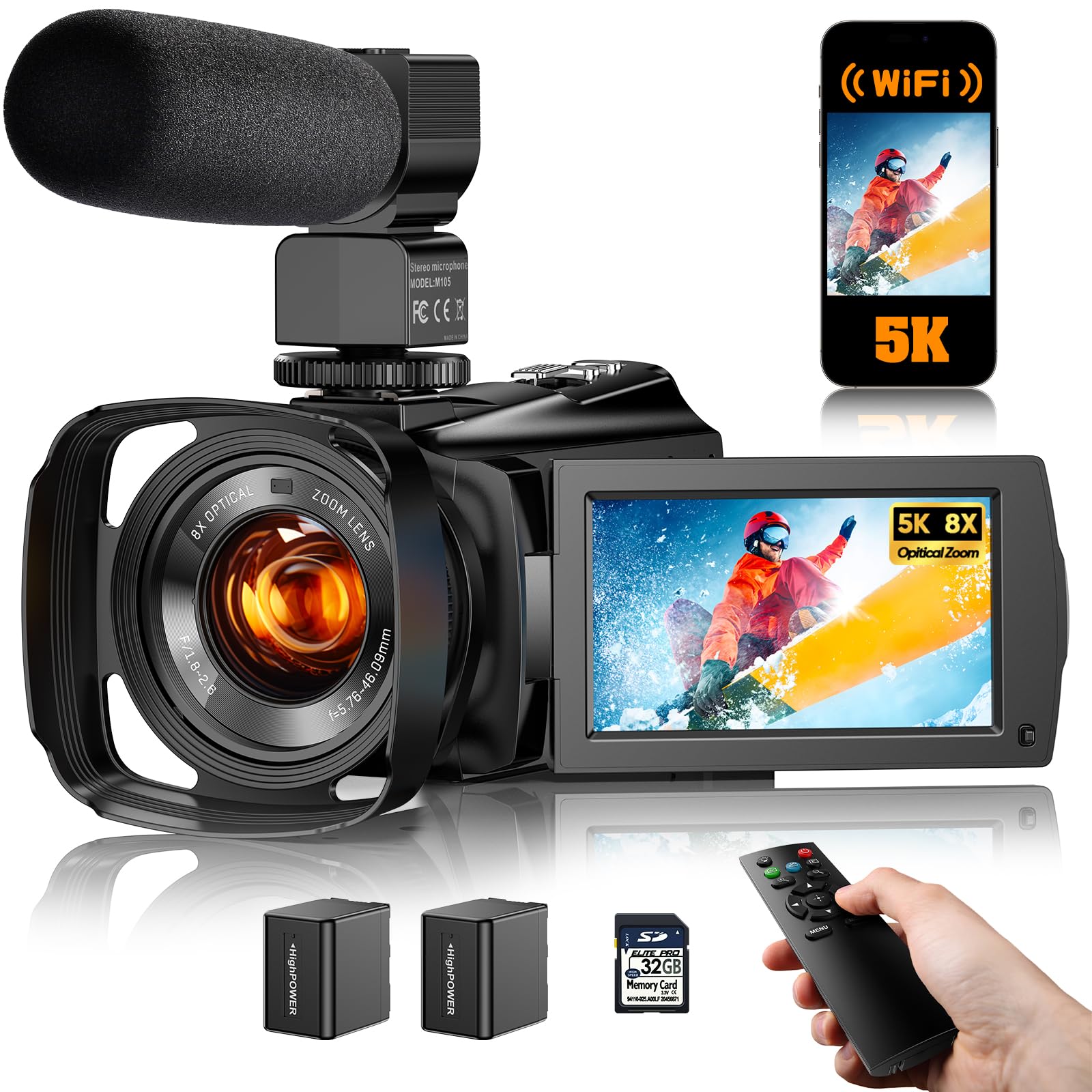
A rare budget cam with true 8x optical zoom, built for product streams and detail shots.
Real optical zoom is the rarest find at this price, and the FJFJOPK 5K delivers 8x of it—letting you pull in details from across a room without the softness of digital cropping. You get UHD 5K video with 64MP stills, plus customizable zone autofocus with three modes (manual, single-shot, continuous) and a TOF laser assist that helps lock focus fast even in dim scenes.
Streamers get four scene modes—Default, Beauty, Jewelry, and Clothing—that tune the image for specific products and live broadcasts, while the 3.6-inch IPS touchscreen rotates 270 degrees for self-framing. Six-axis EIS (electronic image stabilization combining a 3-axis gyroscope and 3-axis accelerometer) keeps handheld footage steadier, and full-color night vision shoots clearly even in pitch black. The kit includes a microphone, remote control, 2 rechargeable batteries, a 32GB SD card, and a camera bag.
Owners mention the video quality runs clearly ahead of phone cameras, with good value for the money and strong image stabilization. The catch: audio sync is the most-discussed caveat—using an external lapel mic limits you to 1080p, and one buyer hit a USB-C transfer snag on Windows 11. If you stick with the built-in mic at 4K, it’s a solid streaming workhorse.
The strengths
- 8x optical zoom — genuine reach that most budget cams fake with digital tricks
- Video quality is the top praise: 21 owners call it out, with 10 more on picture quality
- Full-color night vision and 3.6″ rotating touchscreen
The caution
- Audio sync is mixed — external mics may force 1080p
- A few report USB-C transfer issues on Windows 11
- Built-in audio is only okay without an external mic
Pick it for: live selling, product streams, and detail work where 8x optical zoom and preset scene modes give you a real edge over phone footage.
Note the catch: audio sync quirks with external mics make the bundled mic or 1080p operation the safer path.
6. SJCAM C400 4K Vlogging Camera
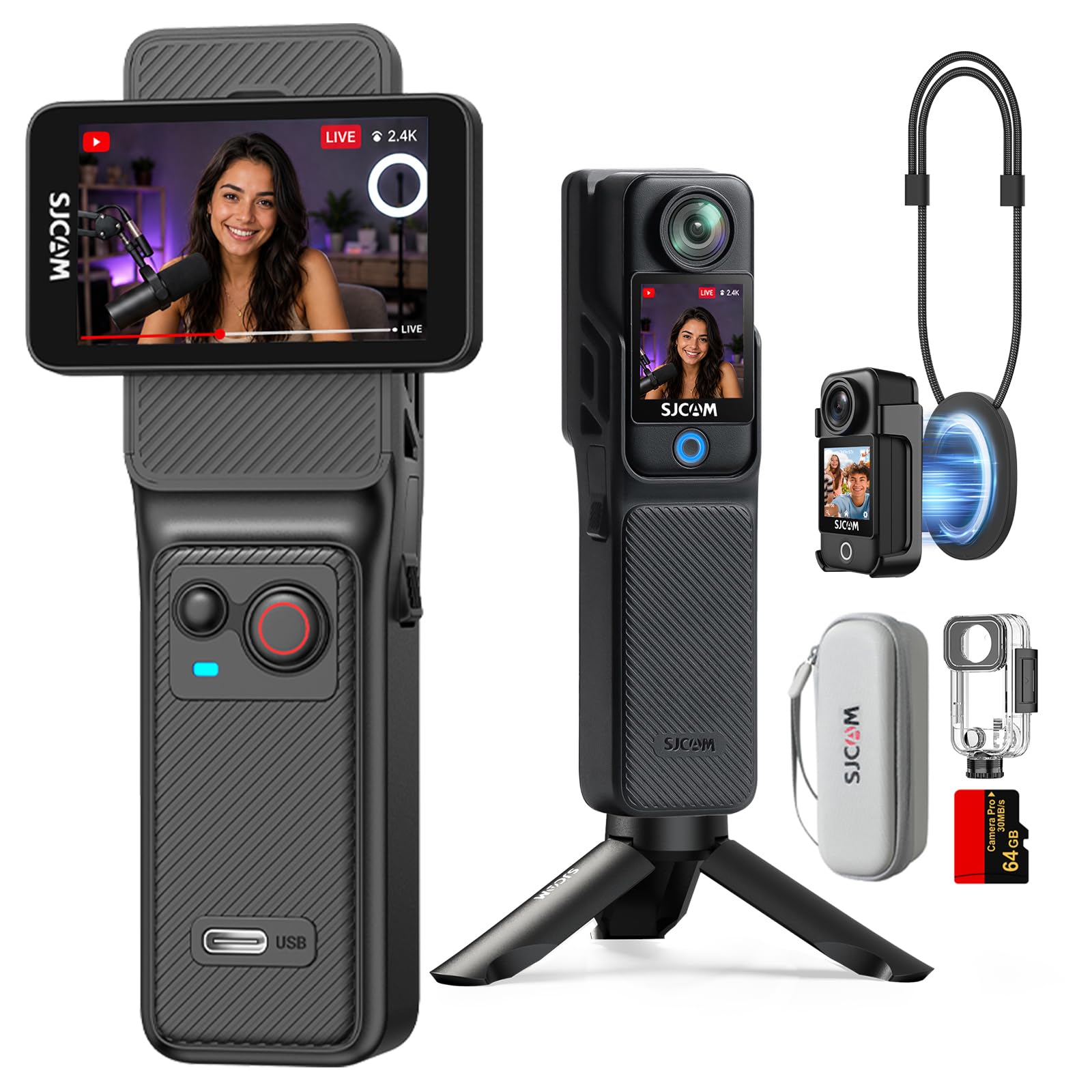
An all-day 7-hour battery and 30-meter waterproofing for creators who film outdoors, not indoors.
This SJCAM C400 solves the two biggest outdoor-creator pains: dead batteries and weather. It runs 7 hours (460 minutes) of continuous shooting from a single charge, and with the included waterproof housing it dives to 30 meters—so surfers, skiers, and mountain bikers can capture hands-free adventures without worrying about a splash or a dying pack. The 4K UHD resolution pairs with a 154° distortion-free wide-angle lens and an f/2.0 aperture (a large opening that lets in more light) for better low-light shots and a shallow depth-of-field effect.
The 6-axis gyro plus EIS stabilization (electronic image stabilization) smooths out intense action, while horizon correction keeps your footage level. A removable handheld controller detaches from the body so you can preview footage and adjust settings from a distance, and the blazing-fast 5G WiFi transfers large 4K files to your phone for quick posting. The kit arrives with a waterproof housing, handlebar mount, helmet base, and more.
First-time vloggers praise it as a great starter device that exceeded expectations, with good built-in audio and a huge accessory bundle. The quirks: there’s a 15-minute video file limit that requires editing long sessions together, no pause button, and one owner found the SD card needs a firm push to click in. The SD card itself was tucked in a case zipper—easy to think it’s missing.
Made for: outdoor and action shooters who need all-day endurance, waterproofing, and stable POV footage in one affordable kit.
Expect to adapt: the 15-minute file limit and no-pause design mean longer sessions need a quick edit—a minor cost for the price.
7. Yollner 8K 64MP Camera Camcorder
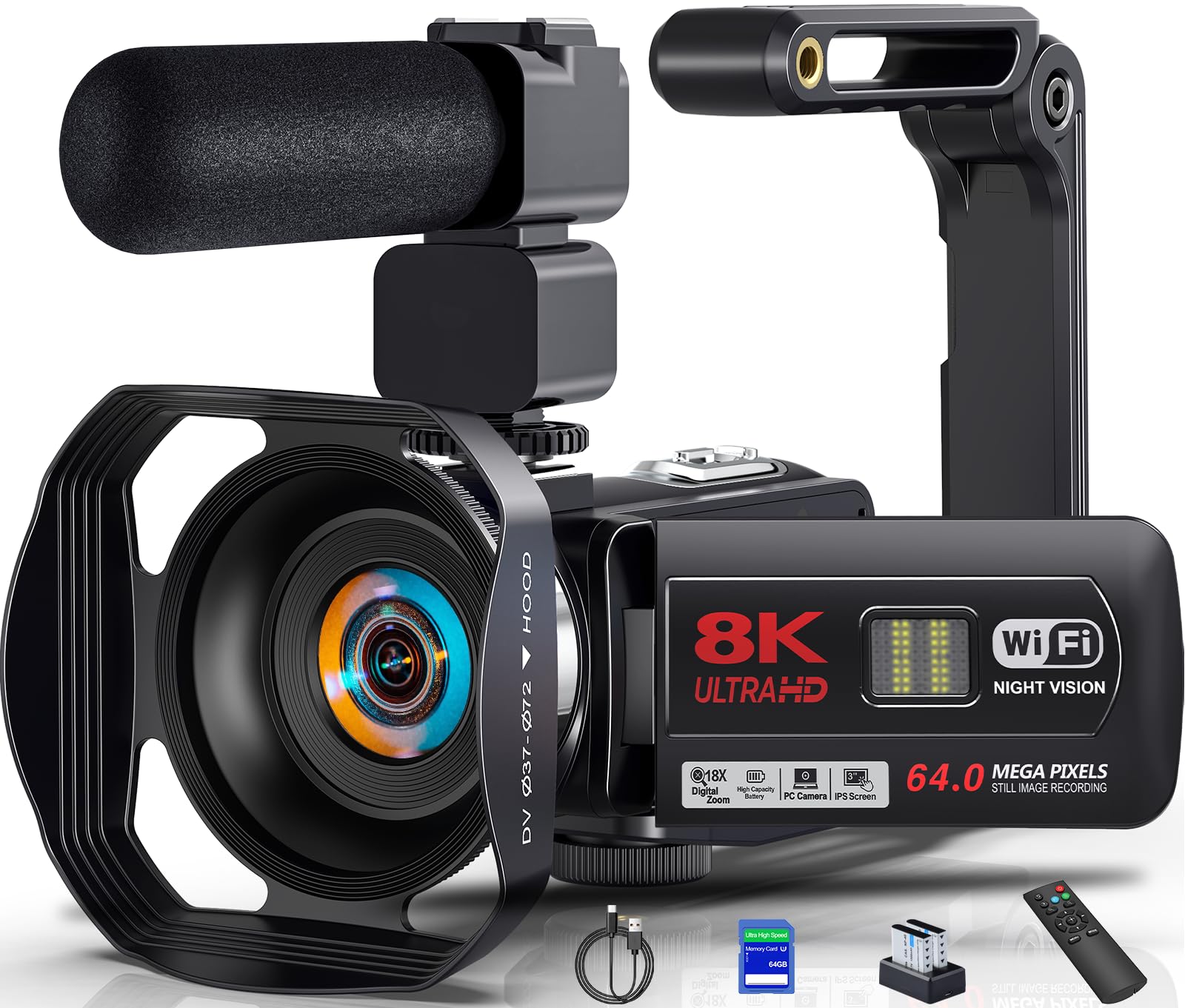
Everything in the box, including the 64GB card, so you’re filming in the first five minutes.
The Yollner is the rare budget camcorder that arrives genuinely ready to shoot: it includes a 64GB high-speed SD card (with support up to 256GB), two NP-40 lithium batteries, a charging cradle, a 2.4G remote control, a handheld stabilizer, and a lens hood. That’s a complete kit where other brands make you spend more before you can record. The camera itself shoots 8K resolution with 64MP stills and an 18x digital zoom on a 3-inch 270-degree rotating IPS touchscreen.
It works as a webcam for YouTube and Skype or live streaming, connects to your phone via the HDV Cam app, and plays back on an HDTV through HDMI (cable not included). The IR night vision captures clear black-and-white footage in low light, and the 2.4G remote gives you 360° control from up to 50 feet away—handy for group shots and company meetings. The external X-Y stereo microphone filters background noise for cleaner audio.
Owners are consistently impressed—video quality is the single most-praised feature, with 10 buyers calling it out and 9 more on ease of use—and night vision gets its own shout-outs. The setup isn’t flawless: a few report needing to watch a tutorial to fix a blue tint from the start, and while the video trails an entry-level SLR in pure depth, the ease, features, and complete package win people over.
What’s in the win column
- Video quality is the top praise — crisp footage that impresses owners
- Everything’s included: 64GB card, 2 batteries, remote, mic, stabilizer
- Night vision captures clear video in low light
What needs patience
- Some units need a manual or YouTube setup to fix a blue tint
- Video quality trails an entry-level SLR
- No HDMI cable in the box
Go here for: the easiest start-to-shoot experience — the complete bundle plus strong video quality makes it ideal for beginners and kids learning photography.
Don’t expect: SLR-level depth or a flawless out-of-box tint; the ease and features more than balance that out.
8. MWIRB 8K 88MP Video Camera Camcorder
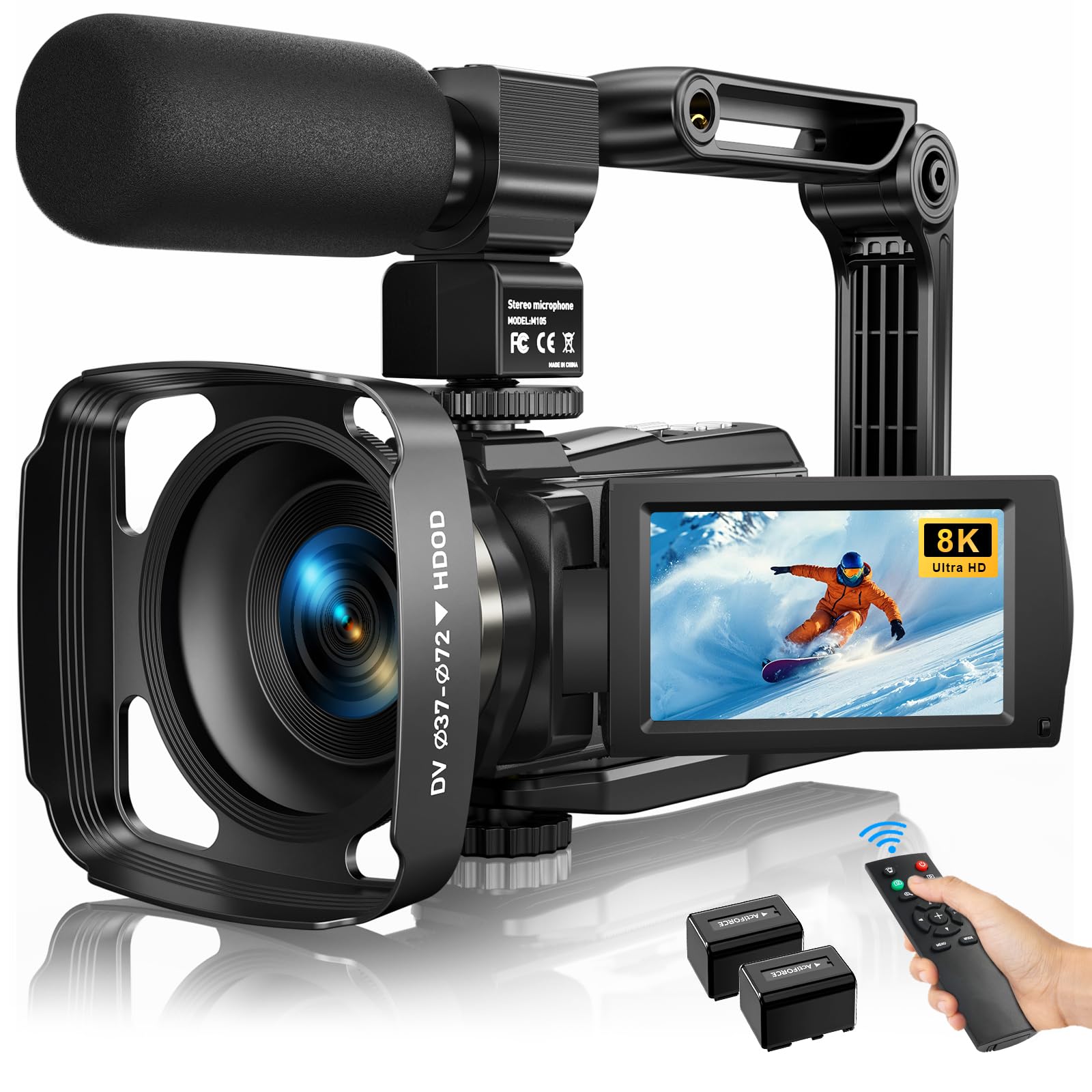
A spec-sheet giant that’s actually best served at 1080p or 4K30, where the footage really shines.
This camcorder gives you the biggest headline numbers of the list—8K resolution and 88MP stills—but smart owners in the reviews found its balance is 1080p at 60fps or 4K at 30fps, where the sharp video quality genuinely impresses. The 88MP still resolution leads the 64MP of the Yollner above by a wide margin, giving you more cropping room in photos. It’s priced lower than most of its feature-sheet rivals, which makes it a tempting first vlogging camera.
The kit is generous: an external X-Y stereo microphone, handheld stabilizer, lens hood, remote control, two rechargeable batteries, a USB cable and adapter, and a camcorder bag. The 3-inch 270-degree rotatable touch screen makes self-framing easy, 6-axis anti-shake steadies handheld shots, and infrared night vision captures clear black-and-white footage in complete darkness. It doubles as a webcam via USB for live streaming and online teaching, and the iSmart DV2 app handles WiFi transfers to social media.
Owners call it excellent for vlogging and recording important moments, praising the picture and audio quality—the external mic captures sound notably better than built-in options. The practical catches: there’s no memory card included now, the battery must stay in the camera to charge, and there’s a 20-minute file limit at 1080p that makes long events a hassle.
The smart play: pick it for the 88MP stills headroom and complete accessory kit, and shoot at 1080p/4K30 where it visibly shines.
The fine print: buy a card, expect to charge with the battery inside, and plan around the 20-minute file cap for long recordings.
9. TryTalk 5K 64MP Video Camera Camcorder
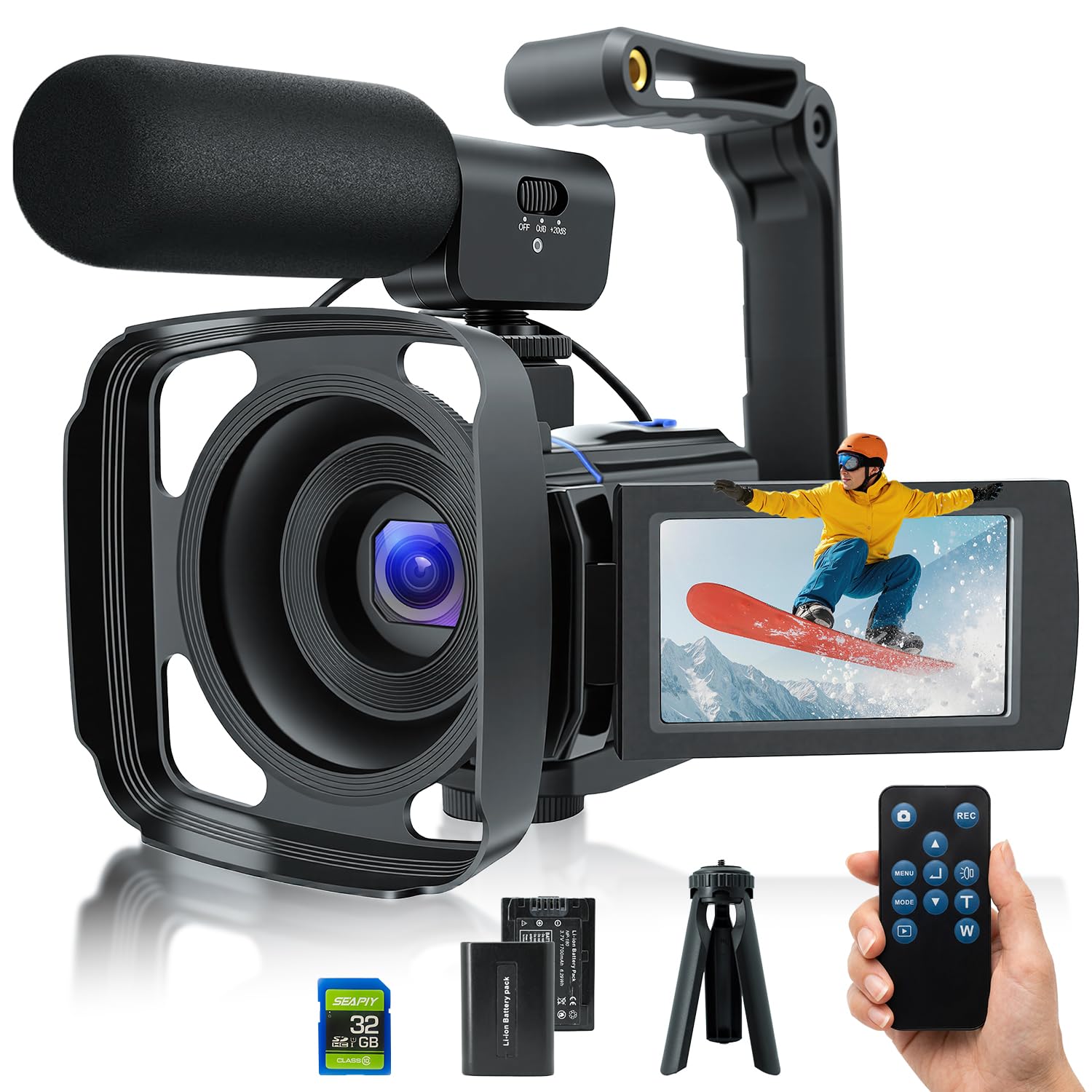
A full creator bundle with two batteries and a tripod, plus night vision for dad’s new hobby.
Marketed as a “gift for dad,” this TryTalk camcorder lives up to the fatherly vibe—it’s straightforward, complete, and reliably gets the job done. The 5K ultra-HD recording with 64MP photos rides on an upgraded high-sensitivity CMOS sensor, and the 3.0-inch touch screen rotates 270 degrees for selfie-style vlogging. The 16x digital zoom and image stabilization keep distant subjects steady, while a built-in fill light and IR night vision cover low-light scenes.
The creators’ bundle is the real story: a 32GB SD card, two 1800mAh batteries, a tripod, an external noise-reducing microphone, a remote control, a lens hood, and a stabilizer. You genuinely have everything needed to start shooting the moment the box opens. Four video modes (normal, time-lapse, slow motion, loop) and four photo modes (normal, auto picture, burst, self-timer) give beginners room to experiment.
Customers note clear video in good light, working night vision in dark rooms, a responsive screen, and quickly-charging batteries—with more accessories than expected for the price. The warm tips in the manual are the honest limits: this is a fixed-focus camera that’s sharpest beyond 0.6 meters, and it’s not compatible with Mac computers, which can affect file recognition and playback.
Best as: an all-in-one first camcorder or a thoughtful gift bundle where the accessories outnumber the surprises.
Know before you buy: fixed focus means close-up sharpness falls off under 0.6m, and Mac users should look elsewhere.
Understanding the Specs
Optical vs. Digital Zoom
Optical zoom uses physical glass elements to magnify a scene, which preserves full detail at every step of the range. Digital zoom crops into the image the sensor already captured and enlarges the remaining pixels, which produces soft, blocky results as you push further. When a box advertises “18x digital zoom,” read that as a fixed lens with a cropping trick; when it says “52x optical zoom,” that’s genuine reach that brings distant subjects into sharp frame.
Sensor Size & Low-Light Video
The physical size of the imaging chip matters more than the megapixel count. A larger sensor (like a 1-inch CMOS) has bigger individual pixels that catch more light, so it produces cleaner, more colorful footage in dim conditions. A tiny sensor cramming 88MP into a small space will look fine in bright sun but turn noisy and muddy at dusk. For video, a modest megapixel count on a big sensor beats a huge megapixel count on a small one.
Frame Rate & Resolution
Frame rate (measured in fps, or frames per second) dictates how smooth motion appears. Standard video runs at 30fps, while 60fps captures smoother movement for fast action, and 120fps enables slow-motion playback. A camera that advertises 8K at a choppy 15fps may actually deliver less usable footage than the same camera at 4K30 or 1080p60. Always check what the top resolution costs in smoothness before choosing your shooting mode.
Stabilization Types
Stabilization keeps your footage from looking shaky. Optical Image Stabilization (OIS) physically moves lens elements to counteract hand movement, and mechanical gimbals (like 3-axis systems) physically hold the camera steady—both preserve full image quality. Electronic Image Stabilization (EIS) crops into the frame and uses software to smooth motion, which works well but slightly reduces the field of view. For walking shots, the standout is a mechanical gimbal; for distant birding, optical stabilization is essential.
FAQ
Why does an 8K camera look worse than a 4K camera?
Is digital zoom ever worth using?
Do I need a 4K camera or is 1080p enough?
What is a good battery life for an economical video camera?
Why is a 1-inch sensor better than a 1/2.3-inch sensor?
Can I use these cameras as a webcam for streaming?
What accessories actually matter for video recording?
Is a refurbished camera a safe budget choice?
Final Thoughts: The Verdict
For most buyers, the economical video camera winner is the Canon EOS Rebel T7 because it delivers genuine interchangeable-lens image quality and all-day battery life at a price that undercuts pro gear by a staggering margin. If you want long-distance reach for wildlife, grab the KODAK PIXPRO AZ528 with its 52x optical zoom. And for butter-smooth creator footage straight from the start, the DJI Osmo Pocket 3 is the one to reach for—the built-in gimbal alone justifies the leap.
How We Picked
We do not accept paid placement. Every pick is matched to a real buyer and a real use-case; we do not hands-on test units.
Sources & Methodology
Specifications: manufacturer listings and product documentation. Review insights: verified customer reviews, as of August 2026. Pricing: not shown on this page (it changes often); check the current price via the retailer link.
As an Amazon Associate, WellFizz earns from qualifying purchases. This does not affect which products we feature.
Related Guides

Mo Maruf
I created WellFizz to bridge the gap between vague wellness advice and actionable solutions. My mission is simple: to decode the research and give you practical tools you can actually use.
Beyond the data, I am a passionate traveler. I believe that stepping away from the screen to explore new environments is essential for mental clarity and physical vitality.