Our readers keep the lights on and my smoothie glass nicely filled. As an Amazon Associate, I earn from qualifying purchases.
Specs are compiled from manufacturer listings and verified buyer reviews and can change over time — please confirm the key details on the product page before buying.
When the ground starts shaking, you will not have time to think about what is missing from your emergency supplies. The right earthquake kit is the one you can grab in the dark, carry for miles if you have to, and trust to keep your family fed, hydrated, and patched up for three full days. That is what this guide sorts out — the real contents, the real weight, and the real trade-offs of nine ready-to-go kits.
I’m Mohammad Maruf — the founder and writer behind WellFizz. This guide is built by comparing the manufacturers’ published specifications and the patterns across verified customer reviews, so you get each pick’s real strengths and trade-offs instead of marketing spin.
Find out which ready-made survival backpacks actually deliver on food, water, first aid, and shelter when you need them most — the best earthquake kits for your family, car, and home are ranked here by real owner experience.
Our Picks at a Glance

How To Choose The Best Earthquake Kits
An earthquake kit is a promise you make to yourself before the ground moves. The best one balances enough supplies to survive, light enough weight to carry, and simple enough organization to use under stress. Here is what separates a good kit from a fancy backpack.
Match the kit size to your household
Kits are built for a specific number of people over a specific number of days. A 2-person kit stretched across four people leaves everyone short on food and water. Count the people in your home first, then check the kit’s stated capacity — most quality kits cover 2 or 4 people for 72 hours.
Check the food and water math
Emergency food bars are calorie-dense and need no cooking, which is exactly what you want when utilities are down. Look for a 5-year shelf life so the kit stays ready for years. Water is the heavier problem — you need roughly a gallon per person per day, and most kits supplement pouches with purification tablets or a filter straw to extend your supply.
Weigh the bag before you commit
A fully loaded emergency kit gets heavy fast, and the weight determines whether anyone can actually carry it to safety. If the kit serves kids or older family members, look for a lighter load. If it stays in the car or by the door for a quick grab, a heavier, more complete kit is a fair trade.
Quick Comparison
| Model | Best For | Capacity | First Aid | Food & Water | Amazon |
|---|---|---|---|---|---|
| Emergency Zone 72 Hour Kit★ Best Overall | Families needing a complete grab-and-go | 2 or 4 people, 72 hours | 121-piece kit | 3600-calorie bars, water pouches | Amazon |
| Ready America 70285 BackpackCompact Value | Couples wanting a compact, portable kit | 2 people, 72 hours | 33-piece kit | 2 x 2400-calorie bars, 6 water pouches | Amazon |
| Essentials Complete Deluxe KitBest Water Filter | Buyers who want a filter straw included | 2 or 4 people, 72 hours | 53-piece kit | SOS rations, 30-gallon filter straw | Amazon |
| Ready America 70385 4-Person | Larger families on a budget | 4 people, 72 hours | 107-piece kit | 4 x 2400-calorie bars, 4 water cartons | Amazon |
| Redfora Complete Earthquake Bag | Single adults who want expert-curated gear | 1 person, 72 hours | First aid in 40+ supplies | 3600-calorie bars, 12 water pouches | Amazon |
| 72 HRS Deluxe Survival Kit | California residents prepping for quakes | 4 people, 72 hours | First aid in 56 pieces | 12 water packs, food with 5-year life | Amazon |
| EVERLIT STORM II Kit | Families wanting military-grade toughness | 3 people, 72 hours | 200-piece kit with CAT tourniquet | 3 x 3600-calorie bars, 36 water packs | Amazon |
| Sirius Survival Pre-Packed Bag | Couples who want premium gear throughout | 2 people, 72 hours | First aid in 175 pieces | 7200-calorie rations, multiple filtration | Amazon |
| Sirius Survival Premium Bug Out Bag | Serious preppers wanting the most complete kit | 2 people, 72 hours | First aid in 232 pieces | Food and water with filter bladder | Amazon |
In‑Depth Reviews
1. Emergency Zone 72 Hour Survival Kit
Our pick — over 4.5★ from 650+ verified ratings; the strongest balance of quality and price.
The family-sized grab-and-go that pairs a 121-piece first aid kit with real shelter gear.
This is the kit that keeps a 4-person household covered for three days without making you piece together a dozen separate purchases. The 121-piece first aid kit covers minor injuries, while the included multitool knife, flashlight, whistle, duct tape, and rope handle the practical jobs. You also get sleeping bags, a tube tent, ponchos, and hand warmers, so staying warm and dry is handled rather than hoped for.
You get 3600 calories from SOS bars and water pouches made in the USA, all with a 5-year shelf life, so your family stays fed and hydrated during a quake. Buyers report it is a “good starter kit, compact but roomy,” and the storage capacity is among the most-praised traits — owners like that there is plenty of space to add personal items like medications or extra tools. The bag itself is nylon and sized at 18 x 12 x 12 inches, which is substantial but manageable for a family emergency bag.
The recurring honest caveat is the straps — some owners found they may tear with regular use, so treat the bag gently and consider reinforcing before a long carry. Quality is the single most-discussed positive, with owners consistently impressed by the construction and completeness for the price. It is a starter kit, not a professional mountaineering pack, and it shines exactly in that role.
What wins owners over
- 121-piece first aid kit covers more than most competitors
- 3600-calorie food bars with a 5-year shelf life
- Sleeping bags and tube tent included for shelter
- Roomy nylon bag leaves space for personal gear
The honest trade-offs
- Straps may tear with heavy regular use
- Basic first aid scissors are good but tweezers are weak
- No MOLLE straps for attaching extra pouches
Reach for this if: you want a complete, roomy 4-person kit that needs little added before it is ready.
Look elsewhere if: you plan to carry it long distances regularly — the straps deserve care.
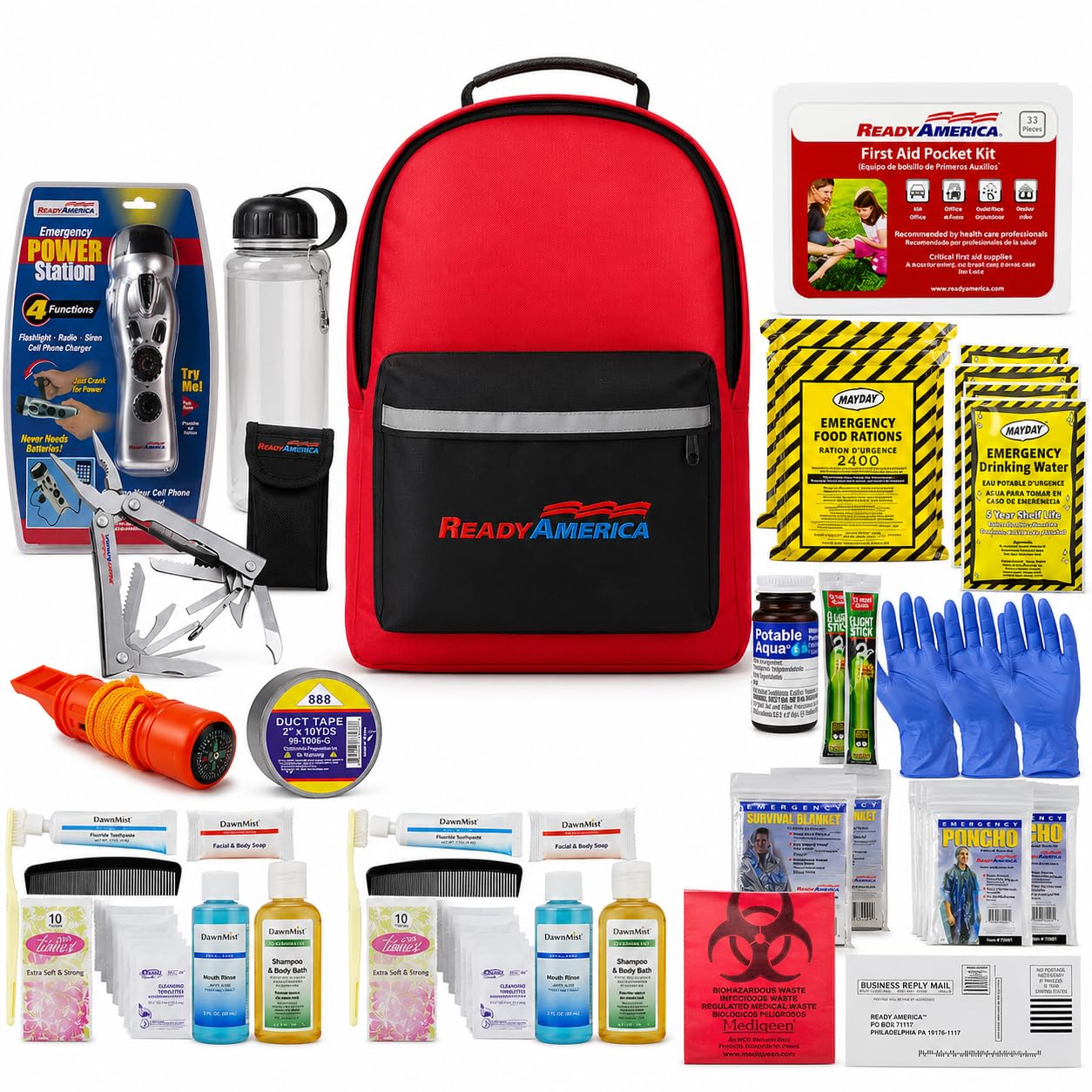
2. Ready America 70285 2-Person 3-Day Deluxe Backpack
A compact 2-person backpack that slips under the bed and still powers a phone.
This kit slides under a bed or into a closet thanks to its 10 x 8 x 15-inch size, so it stays out of the way until a quake hits. The 33-piece first aid kit covers minor injuries, and the included stainless steel multi-function pocket tool adds a screwdriver, pliers, and knife for practical repairs.
The standout is the 4-function hand-crank power station that works as a flashlight, AM/FM radio, siren, and phone charger. Owners confirm the “works for 3 days for 2 people” claim, and the two 2400-calorie U.S. Coast Guard approved food bars plus six 4.225oz water pouches carry a 5-year shelf life. A BPA-free water bottle and purification tablets extend the hydration story.
At roughly 9.2 lbs total, the weight is light enough that owners say kids and smaller adults can carry it — a real advantage if evacuation means walking. The trade-off is minimal spare room; this is a tightly packed kit, so you will not fit much extra beyond documents, cash, or a few personal items. Owners mention the food bars taste good, which matters more than you would think in a crisis.
Compact and capable: the hand-crank radio plus phone charger is a feature usually found in far pricier kits, making this a smart value pick.
Space reality check: minimal extra room means personalizing requires swapping items, not just adding them.
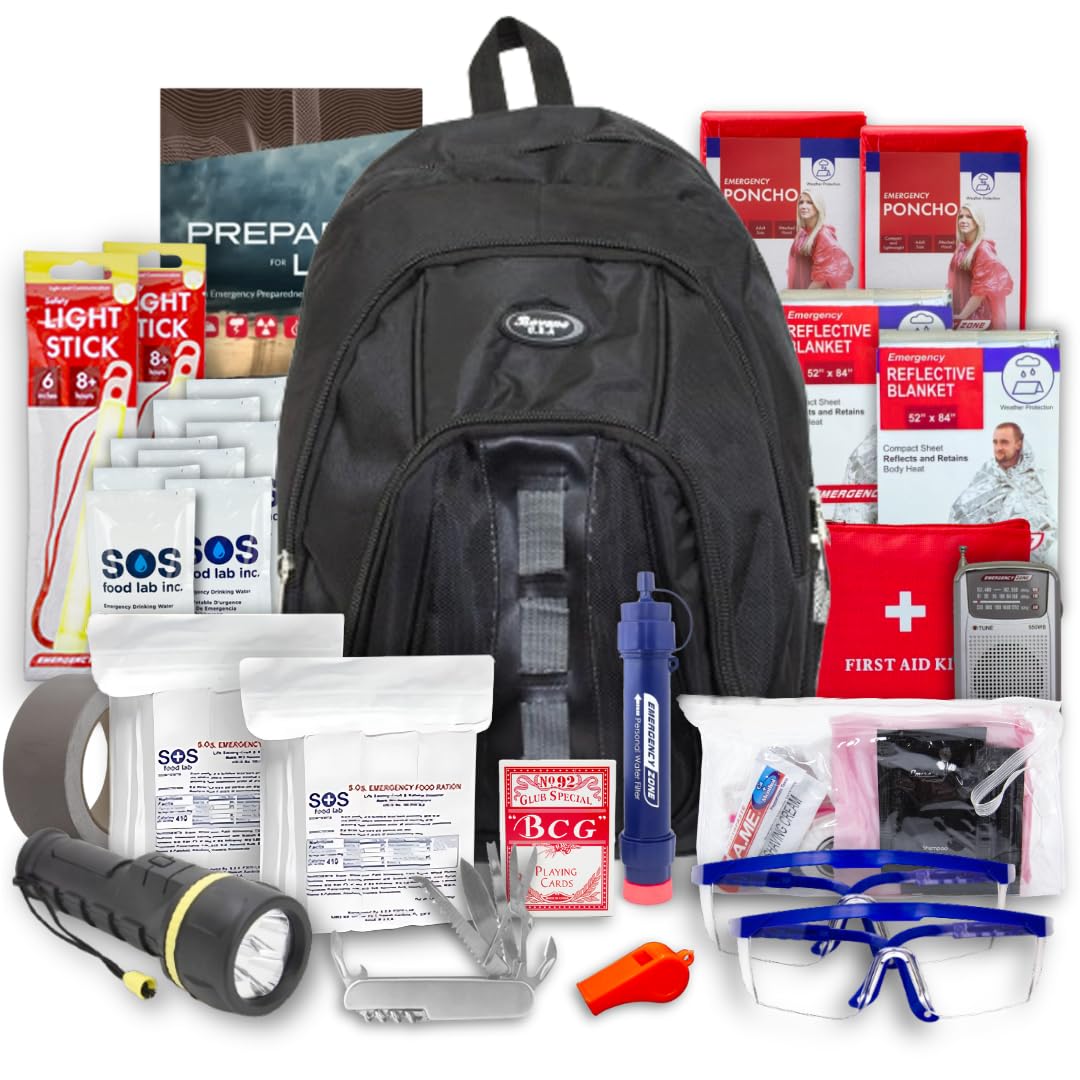
3. Essentials Complete Deluxe Survival Kit
The kit that turns any nearby water source into drinking water with a Frontier Straw Filter.
What sets this Emergency Zone kit apart is the Frontier Straw Filter, which lets you drink from streams, taps, or collected rainwater — filtering up to 30 gallons before it needs replacing. That is a genuine step up from kits that rely only on pouches and purification tablets, and it directly addresses the biggest weakness of fixed water supplies: running out.
The 53-piece first aid kit covers minor emergencies, and the SOS brand food rations are US Coast Guard approved with a 5-year shelf life. Owners who bought this kit years ago report it is still in good shape, needing only the meal bars and water packets replaced over time. The discreet design is a deliberate feature — the bag does not scream “emergency supplies,” which owners appreciate for staying under the radar.
The bag is well made with strong zippers, and at 15 x 11 x 7 inches it is compact enough to store easily. Owners note it is not jam packed, which leaves useful space to add your own items. The recurring praise centers on the bag’s durability and the value of getting a filter straw that other kits skip entirely.
Filter-first design: the 30-gallon Frontier Straw Filter is the single biggest reason to choose this over comparable kits.
Built to last: customers note the bag surviving years of storage, with only consumables needing replacement.
4. Ready America 72 Hour Deluxe Emergency Kit 4-Person
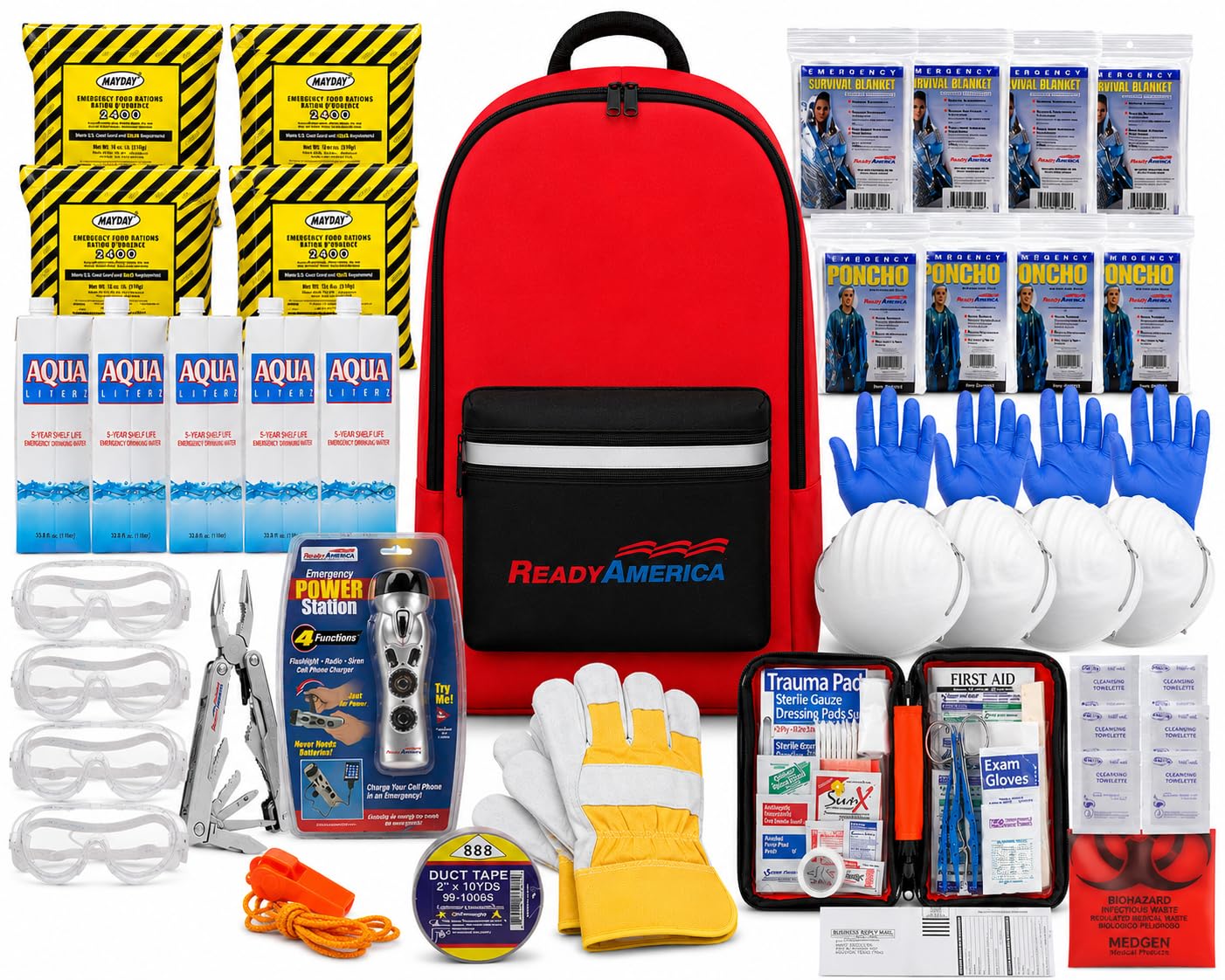
A 4-person kit with a 107-piece first aid kit that stays compact enough for a child to carry.
This Ready America kit covers a family of four with a 107-piece first aid kit that goes well beyond bandages — it includes N95 dust masks, safety goggles, nitrile gloves, and leather work gloves for heavier tasks. The four 2400-calorie food bars and four 1-liter Aqua Literz water cartons provide the core survival calories.
Owners consistently call out the value and comprehensiveness, with quality being the most-praised aspect by a wide margin. The included 4-function power station — flashlight, AM/FM radio, siren, and phone charger — is a favorite feature, and the duct tape, emergency whistle, and multi-tool round out the practical kit. At 12 x 9 x 16 inches, owners note it is compact enough for a child to carry, which is a meaningful detail for family evacuation plans.
The honest trade-offs come down to weight and extras. At 9.44 kg, this is not a light bag, and the included water may run short for a full three days — owners recommend adding water tablets and extra supplies. The safety goggles draw some criticism as bulky, and the basic medical kit benefits from personal additions. It is a great value starting point, not a do-not-touch final answer.
Why families pick this
- 107-piece first aid kit with masks and goggles
- 4 x 1-liter water cartons plus purification tablets
- Hand-crank power station with radio and charger
- Compact enough for a child to carry
What needs attention
- Weight is substantial for longer carries
- Water supply may not stretch a full 3 days
- Safety goggles are bulky and of limited use
Best for: families who want maximum coverage per dollar and plan to store the kit at home or in the car.
Think twice if: you need a lightweight kit for long-distance evacuation — this one is heavy.
5. Redfora Complete Earthquake Bag
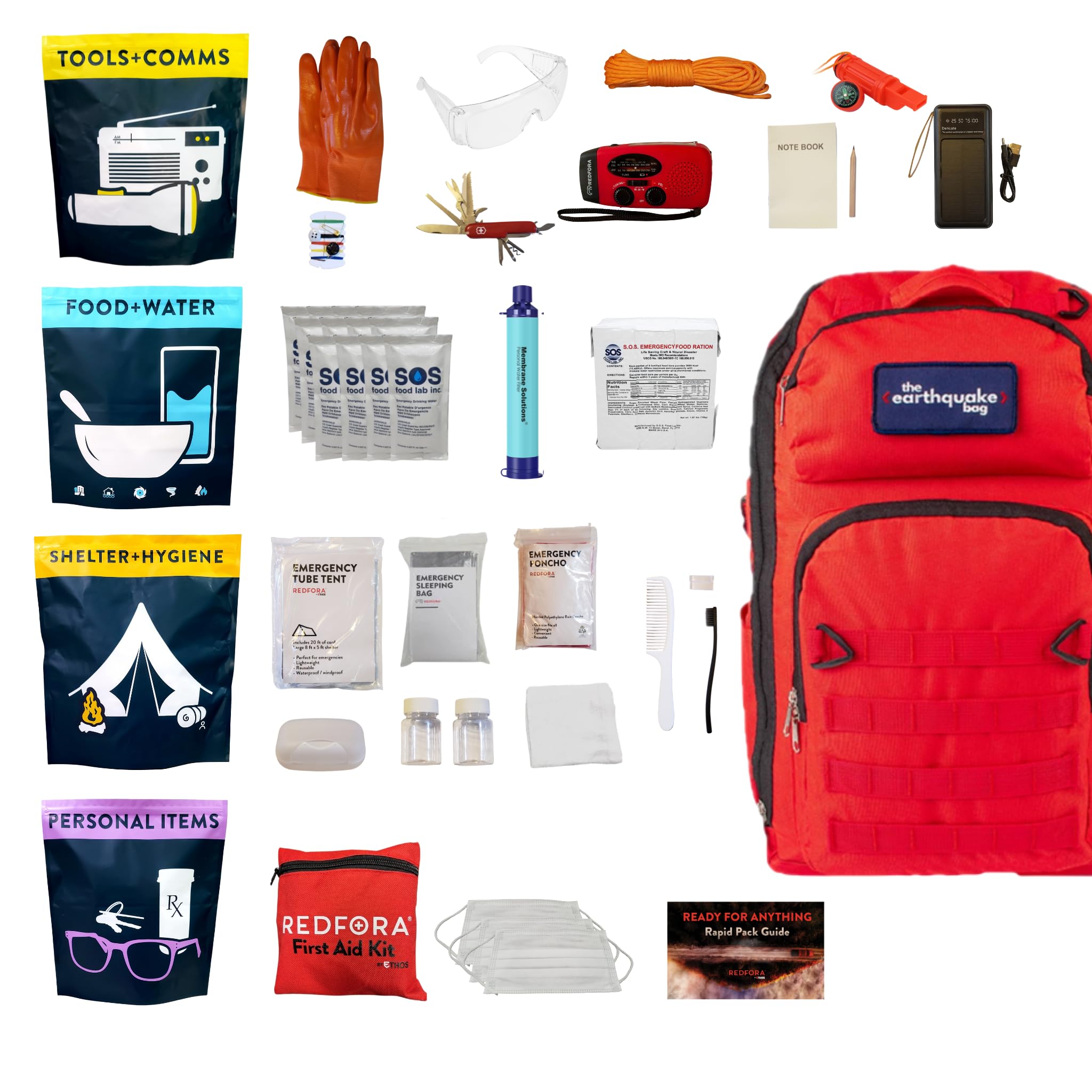
A single-person kit organized in color-coded waterproof packs, built around a NOAA hand-crank radio.
Designed for one person over three days, this Redfora bag stands out for its organization system — every supply lives in re-sealable waterproof packs, so you are not digging through a jumble when seconds count. The 3600-calorie food bars carry a 5-year shelf life, and the 12 water pouches plus 10 purification tablets extend your hydration well beyond the first day.
The gear list reads like a prepper’s checklist: a NOAA hand-crank flashlight/radio/phone charger, first aid kit, multi-tool, sleeping bag, tube tent, 30-ft nylon rope, and a 5-in-1 whistle. Owners consistently praise the comprehensiveness and the fact that the kit is cheaper than buying each item separately. A video guide covering each category of supplies is a thoughtful touch for first-time preppers.
The recurring weakness is the zipper quality — some reviewers point out the zippers failing, so treat the bag gently. At 11 pounds and sized 10 x 18 x 24 inches, it is too bulky for car storage but works well as a home evacuation bag. Owners note it is heavy for smaller carriers, though the durability has held up for years in real use. The organization is the reason most people pick this over comparable single-person kits.
Organization first: color-coded waterproof packs make this the easiest kit to use under stress.
Handle with care: the zipper is the weakest link, so avoid overstuffing and rough handling.
6. 72 HRS Deluxe Emergency Survival Kit
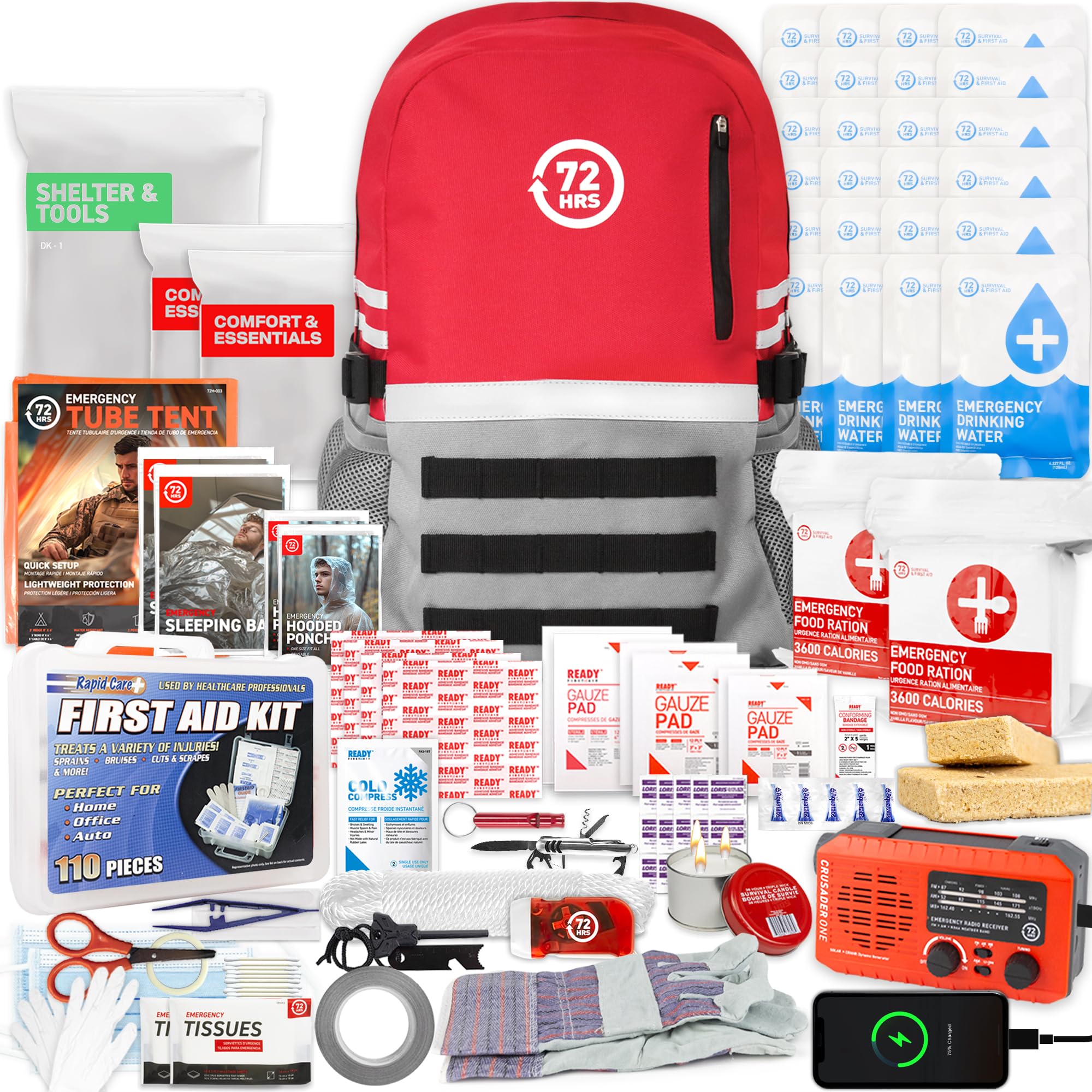
A reflective red-and-gray pack built for California quake and fire prep, with molle straps for expansion.
This 72 HRS kit comes in a reflective backpack that is easy to spot in low light — a real advantage if you evacuate in the dark or need to identify your gear among scattered debris. The 56 pieces include 12 water packs, a radio, sleeping bag, poncho, gloves, and knife, all organized in labeled ziplock-type bags that owners praise for keeping everything findable.
The bag itself earns consistent praise for build quality, with padded straps, side pouches, and molle straps (the webbing loops that let you attach extra pouches) for customizing. Owners describe it as a solid insurance policy for fire and earthquake emergencies, recommending it specifically for California residents. Food and water carry a 5-year shelf life, and a 36-hour candle is a thoughtful addition for power outages.
The trade-offs are honest but manageable. Some owners found the zippers questionable and the first aid kit flimsy, and the radio may not charge a phone despite being a power station. At 18 x 14 x 8 inches, it is a substantial bag, though the padded straps make it comfortable to carry. Owners recommend adding a few personal items, and the room to do so is one of the kit’s strengths.
Built for visibility: the reflective backpack and organized pouches make this a standout for dark evacuations.
Add before you rely: upgrade the first aid kit and confirm the radio’s phone charging before you depend on it.
7. EVERLIT STORM II Emergency Survival Kit
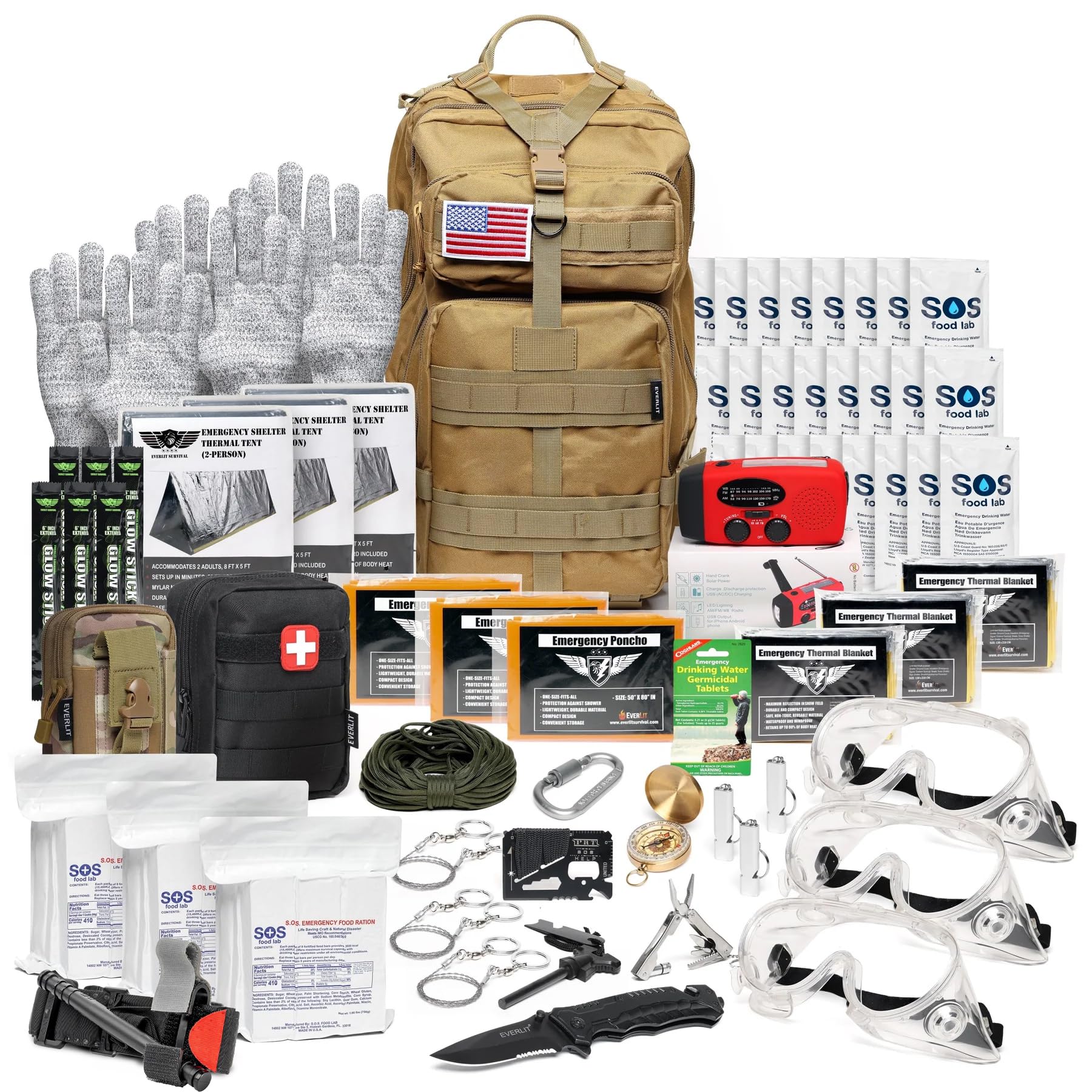
A family kit with a 200-piece medical setup and a real CAT tourniquet for serious bleeding.
Designed for three people over 72 hours, the EVERLIT STORM II is the most medically capable kit on this list. The 200-piece medical supply kit includes a CAT tourniquet for traumatic wound control — a level of bleeding-control gear you will not find in most competitors. That alone makes this the kit to choose if you want genuine trauma response, not just bandages.
The food and water story is equally strong: three 3600-calorie food bars and 36 packs of 125ML emergency drinking water, all with a 5-year shelf life and US Coast Guard approval. Water purification tablets that treat up to 25 quarts extend your supply further. The whole load sits in a 1000D polyester tactical backpack with four main compartments, molle panels, and adjustable waist and shoulder straps — built to survive harsh conditions.
The honest trade-off is weight. At 25 pounds, this is the heaviest kit here, and owners note it is “slightly heavy for a smaller individual” — though most of that weight is the water packets you will be glad to have. An occasional unit arrives with water bags that popped in shipping, so unpack and inspect yours on arrival. The organization and completeness win consistent praise, with owners calling it well-curated and easy to access.
The medical edge
- 200-piece kit with CAT tourniquet for trauma
- 36 water packs plus 25-quart purification tablets
- 1000D polyester tactical bag with molle panels
- Four main compartments for organization
Before you commit
- 25 pounds is heavy for smaller carriers
- Water bags can pop during shipping — inspect on arrival
- Comfortable but requires torso strength
Choose this for: the most serious medical coverage and a battle-ready bag that shrugs off harsh conditions.
skip it if: weight is your main constraint — this is a strong, heavy kit.
8. Sirius Survival Pre-Packed Bug Out Bag
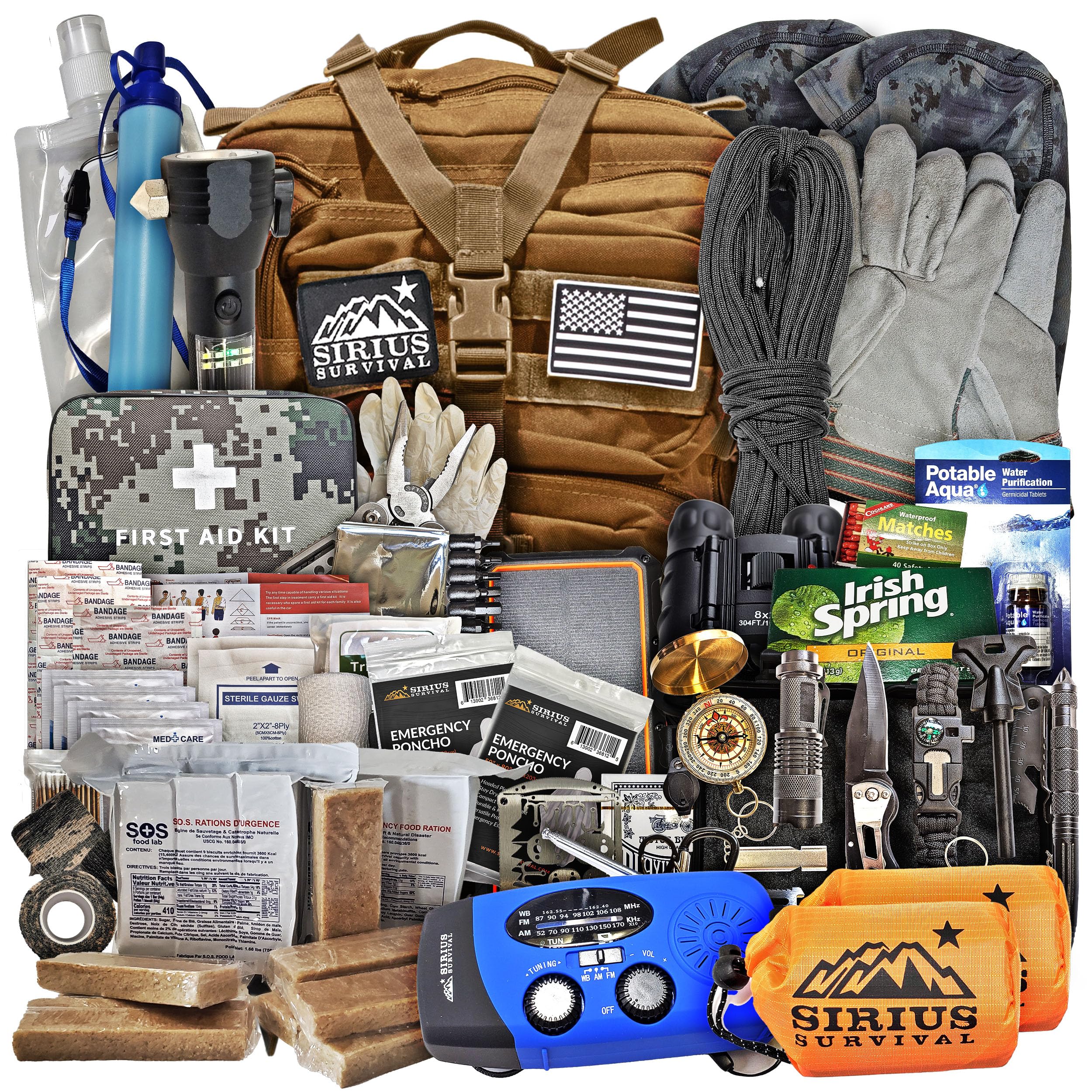
A premium 50L bag with 7200 calories of food and solar-powered electronics built for two.
This Sirius Survival kit is the pick for people who want premium gear throughout, not just adequate basics. The 50L 900D Oxford tactical backpack is the foundation — durable, water resistant, and comfortable with a padded back and shoulder straps. Owners consistently call out the quality as the standout feature, praising the bag for carrying comfortably over long distances with room to spare.
This kit flexes with 7200 calories of US-made food rations for two people, multiple water filtration methods, a solar AM/FM/NOAA radio (a radio that picks up weather alerts), a solar power bank, first aid, shelter and warmth gear, multiple fire starters, paracord, a stainless multi-tool, and a compass. The solar radio and solar power bank mean you are not dependent on the grid to stay informed and charged. Shoppers say nothing is missing and the pack arrives neatly organized with a thorough contents list.
At 13 pounds and 20 x 14 x 6 inches, it is a manageable weight for a 72-hour kit, and the 50L capacity leaves ample room for personal items like clothes, medications, and documents. The price reflects the quality, and owners consistently say it is worth it for the confidence. It ships with advice on what else to include, and the Buffalo, NY-based company has over a decade of experience building these kits.
Premium throughout: the 900D Oxford bag and solar electronics justify the higher cost with genuinely better gear.
Room to grow: the 50L capacity lets you personalize with your own essentials, not just store what is included.
9. Sirius Survival Premium Bug Out Bag
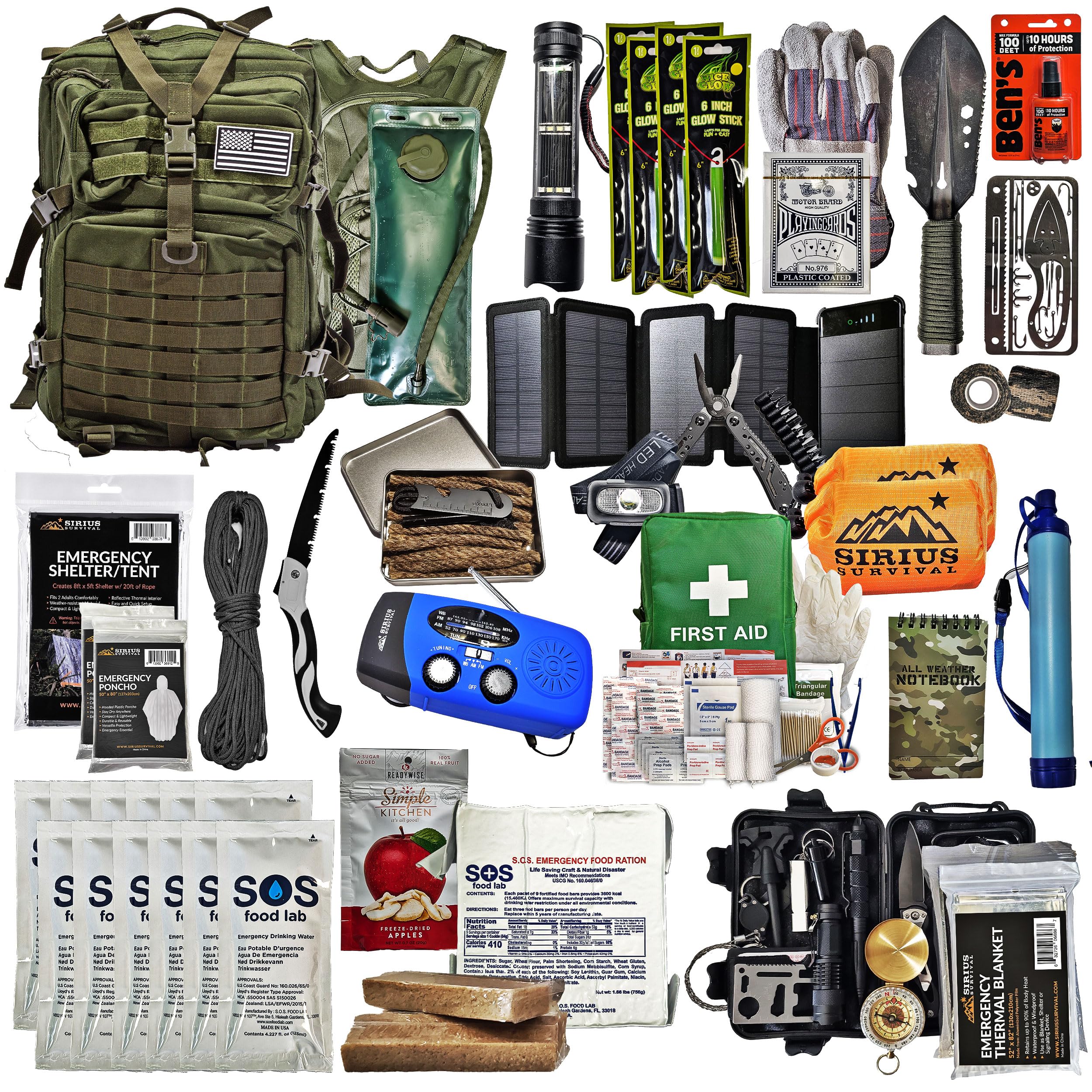
The most comprehensive kit on this list — 232 pieces covering everything from first aid to fishing.
This is the kit for serious preppers who want the closest thing to a complete survival system in one bag. At 232 pieces, it is the largest kit here, and the contents go beyond the basics — owners mention fishing supplies, a water filter straw with bladder, and a full first aid and medical kit alongside the expected food, water, shelter, and tools. The maker claims it “far exceeds the Red Cross recommended items.”
The food and water story is strong, with generous rations and a water filter straw bladder that lets you carry and purify water on the move. The backpack is a heavy-duty nylon 50L model with room to add personal items, and owners praise it as high-grade and solidly built. The kit ships in a hard case, and the 90-day money-back guarantee reflects the maker’s confidence — they build these kits in Buffalo, NY.
Owners consistently rate the quality and completeness as the top strengths, noting it is not too heavy despite the extensive contents. The water pouch is slightly oversized but owners consider that a benefit. If you want to buy one kit and not wonder what is missing, this is the one. It is the highest-rated kit in this guide, and the review pattern backs that up — quality and included items are the two most-discussed positives by a wide margin.
The complete package: 232 pieces including fishing supplies and a water filter bladder make this the definitive grab-and-go.
Set and forget: with a 90-day guarantee and fully pre-packed design, this is the closest to buy-once-and-trust.
Understanding the Specs
Shelf Life
Emergency food bars and water pouches are designed to last, but not forever. Most quality kits carry a 5-year shelf life from the date of manufacture, which means you can store the kit and mostly forget about it. Check the dates when your kit arrives and put a reminder on your calendar to rotate the consumables before they expire. A kit with expired food is just a heavy backpack.
Calorie Density
Food bars are rated by total calories, and that number tells you how many people the kit truly feeds. A 3600-calorie bar provides roughly 1200 calories per day for three days — the minimum FEMA recommends for an adult. Two people sharing one kit need at least double that. When comparing kits, multiply the calories by the number of bars and divide by your household size to see if the math works.
FAQ
How much water does one person actually need in a 72-hour kit?
Will a 2-person kit work for a family of four?
How long does emergency food actually last?
What is the difference between a bug out bag and an earthquake kit?
Are the food bars in these kits actually edible?
Can a child carry these emergency kits?
What should I add to a pre-packed emergency kit?
Is a hand-crank radio really necessary in an earthquake kit?
How do I know if the first aid kit in an emergency bag is good enough?
Should I buy one big family kit or several smaller ones?
Final Thoughts: The Verdict
Across the board, the earthquake kits winner is the Emergency Zone 72 Hour Survival Kit because it pairs a 121-piece first aid kit with genuine shelter gear and a roomy bag — all backed by the highest praise for quality in this guide. If you want the most complete system money can buy, the Sirius Survival Premium Bug Out Bag with its 232 pieces is the definitive grab-and-go. And for a compact, portable option that stores under the bed and still powers a phone, the Ready America 70285 Backpack is the smart value choice — the crowd favorite with thousands of owners confirming it delivers on its 72-hour promise.
How We Picked
We do not accept paid placement. Every pick is matched to a real buyer and a real use-case; we do not hands-on test units.
Sources & Methodology
Specifications: manufacturer listings and product documentation. Review insights: verified customer reviews, as of August 2026. Pricing: not shown on this page (it changes often); check the current price via the retailer link.
As an Amazon Associate, WellFizz earns from qualifying purchases. This does not affect which products we feature.
Related Guides

Mo Maruf
I created WellFizz to bridge the gap between vague wellness advice and actionable solutions. My mission is simple: to decode the research and give you practical tools you can actually use.
Beyond the data, I am a passionate traveler. I believe that stepping away from the screen to explore new environments is essential for mental clarity and physical vitality.