Our readers keep the lights on and my smoothie glass nicely filled. As an Amazon Associate, I earn from qualifying purchases.
Specs are compiled from manufacturer listings and verified buyer reviews and can change over time — please confirm the key details on the product page before buying.
If you are shopping for kid-safe headphones or radiation-conscious earbuds, the single most important number is the volume cap — it decides whether those drivers can ever reach a level that harms young hearing. The safest picks hold output at or near 85dB, which is the level hearing experts point to as the ceiling for extended listening. Some of these models skip volume limiting entirely, so checking the spec is not optional — it is the entire point of the category.
I’m Mohammad Maruf — the founder and writer behind WellFizz. This guide is built by comparing the manufacturers’ published specifications and the patterns across verified customer reviews, so you get each pick’s real strengths and trade-offs instead of marketing spin.
Here is the short version: choose the earphones for ear health that fits how you actually listen — wired school use, wireless jobsite safety, or EMF-conscious air-tube designs.
Our Picks at a Glance


How To Choose The Best Earphones For Ear Health
Your hearing stays safe when three things work together: the device caps how loud sound can get, it blocks outside noise so you don’t crank the volume, and it fits your ear comfortably. Each of those has a spec you can check before you buy, so you know what you’re getting.
Volume Limiting Is The Real Safety Feature
A hard volume cap means the headphone physically cannot exceed a set loudness, no matter how the child pushes the controls. Look for an explicit number like 85dB or 93dB in the listing. A 93dB cap is louder than 85dB — roughly a 9% bigger sound-pressure gap — so if protecting young ears is your priority, the lower number is the safer choice.
Passive Noise Reduction Beats Turning The Volume Up
In a noisy room, kids and workers instinctively crank the volume to hear over the racket. Earbuds with a high noise reduction rating, like 29dB NRR, block the outside sound so you do not need to raise the volume in the first place. That is how hearing protection actually works — by lowering the background noise, not just capping the output.
Air-Tube vs. Traditional Drivers
Standard earbuds place the speaker driver right at your ear canal. Air-tube designs move the driver away from the head and carry the sound through a hollow tube, which is the main approach for buyers concerned about EMF exposure near the brain. The trade-off is durability — the tube junction is a common failure point on several of these models.
Quick Comparison
| Model | Best For | Volume Cap | Connectivity | Battery / Cable | Amazon |
|---|---|---|---|---|---|
| LilGadgets Connect+ Pro★ Best Overall | School & shared listening | 93dB | Wired, 3.5mm | 4-ft braided cable | Amazon |
| ibrain Air TubeSafe Design | EMF-conscious earbuds | — | Wired, 3.5mm | Metal-shielded wire | Amazon |
| Belkin SoundForm MiniWireless Pick | Wireless toddler use | 85dB | Bluetooth 5.3 + Aux | 30 hours / USB-C | Amazon |
| MIPEACE Neckband | Jobsite hearing protection | 29dB NRR | Bluetooth 5.4 | 20+ hours | Amazon |
| Symphonized Airtube | Wood-housed EMF earbuds | — | Wired, 3.5mm | Tangle-free cable | Amazon |
| Qozybuds Jobsite | All-day shift earbuds | 29dB SNR | Bluetooth 5.4 | 70 hours w/ case | Amazon |
| DefenderShield EMF | Premium air-tube build | — | Wired, 3.5mm | 42.5-in cord | Amazon |
| AILIHEN Classroom 10-Pack | Classroom bulk buying | 85dB | Wired, 3.5mm | Braided cable | Amazon |
| AXIL XCOR PRO | Shooting & enhancement | 85dB+ | Bluetooth 5.2 | 12 hours | Amazon |
In‑Depth Reviews
1. LilGadgets Connect+ Pro Wired Kids Headphones
Our pick — 4.5★ from 23,500+ verified ratings; the strongest balance of quality and price.
The classroom-tested over-ear that lets two kids share one screen without splitting the volume limit.
SharePort is a second jack that lets a child plug in a friend’s headphones to the same device, so two kids hear the same show at the same safe volume. That makes it the natural pick for siblings on a road trip or a teacher running a small-group listening station. Thousands of buyers praise the quality and fit most, according to reviews.
You get a volume limit of 93db, which is louder than the strictest pediatric 85dB standard — meaning it caps the output but still allows a fairly strong signal for audiobooks and games. The 40mm dynamic drivers sit behind SoftTouch padding on an adjustable headband, and the detachable 4-foot braided nylon cable resists tangling, which is exactly what a school bag does to cheap cords. The whole thing connects through a universal 3.5mm jack to smartphones, iPads, and Chromebooks, and the built-in microphone covers the calls and online classes.
Buyers report the biggest weakness is the cord extender, with some seeing it break after about three months — though the maker’s support team replaced it quickly and moved owners to a metal-reinforced version. Owners also love that the headphones look more expensive than they are and stay comfortable for hours on a first grader’s head. If your child has nerve pain sensitivity to firm circular padding, note that this rounded design can feel hard, which is the one scenario where it is not the right fit.
Why Owners Stick With It
- SharePort lets two kids listen from one device
- 93db volume cap protects hearing while staying loud enough to enjoy
- Detachable braided cable and foldable build survive daily use
Watch Out For
- Volume limit sits above the stricter 85dB mark
- Cord extender broke for some owners around the 3-month mark
Reach for this if: you want a wired school headset with a mic, a real volume cap, and the ability to share audio between two kids.
Think twice if: you want the absolute lowest volume ceiling for a very young child — the 93db cap is higher than the 85dB limit on other picks here.
2. ibrain Air Tube Headphones EMF Free
The patented air-tube earbud that moves the speaker away from your head to cut EMF exposure.
Instead of putting a driver (the tiny speaker) at your ear canal, this design keeps the stereo speakers inside a sonic concentrator a set distance from your ears and carries the sound through hollow air tubes. The result is a wired earbud with a metal-shielded wire that the maker says reduces cell phone radiation to the head — the core idea behind the “EMF-free” subcategory — while still delivering clear sound through the standard 3.5mm jack.
The maker has specialized in this product for over 20 years, and the air-tube tech holds invention patents in numerous countries, which explains its worldwide sales. One frequent buyer’s report captures the split personality: they purchased it four separate times, with the tube wire disconnecting from the base every 3 to 4 months, yet the sound stayed good enough that they kept coming back. The 30-day warranty is short given the recurring tube-junction failures., and several owners say the tubes pull out at the junction — a know-it-before-you-buy durability caveat.
On the other side, at least one owner reports their pair still looks like new after two years of use, with no tangling and clear sound, and the rose gold finish drew compliments. Comfort is consistently praised, which matters for anyone who wants to wear earbuds for long stretches. The catch is that durability is a lottery here — half the owners get a long-lived pair, and half are super-gluing the connections pre-use to make them survive.
Comfort-first design: the air-tube layout earns consistent praise for all-day wear, and the sound quality is good enough that owners keep replacing rather than abandoning the design.
Durability warning: repeated failures at the tube junction are the most common complaint — treat this as a delicate instrument, not a gym beater.
Best for: anyone specifically worried about EMF near the head and willing to accept a fragile tube connection for that confidence.
Skip if: you need a hard-wearing daily earbud — the air-tube junction is the first thing to give out.
3. Belkin SoundForm Mini Bluetooth Kids Headphones
The wireless toddler headphone with a true 85dB limiter and a 30-hour battery that outlasts movie marathons.
This is the wireless alternative to the wired school picks — and it nails the two things parents actually care about. The 85dB limiter is one decibel stricter than the LilGadgets’ 93dB cap, making it the safest on this list., and Belkin’s signature sound is EQ’d for young ears rather than just copying an adult tuning. The 30-hour battery means a full charge covers multiple days of school and travel without hunting for a cable.
Bluetooth 5.3 pairing connects to iPads, iPhones, and Samsung devices up to 30 feet away, and there is a built-in mic for video calls. The USB-C fast charging is the genuinely clever feature — just 10 minutes plugged in buys 3 hours of playtime, so a kid who forgot to charge can still get through a car ride. An optional 3.5mm aux port and included 4-foot cable let it work fully wired when the battery dies or a school bans wireless.
Sound quality is what owners praise most, and the fit earns strong marks too — parents describe the on-ear design as comfy even on 10-hour drives, with the headband adjusting to larger heads. The battery genuinely holds a charge that outlasts an iPad’s. The mixed notes are on Bluetooth connectivity with specific Kindles, and durability, with some units failing after five months while others get sat on, stepped on, and rained on for two years and keep working. A protective case is included, which the tough-crowd reviews still found worth having.
The Parent-Friendly Stuff
- True 85dB limiter — the strictest cap on this list
- 30-hour battery with 10-minute fast charge for 3 hours of play
- Wired aux option plus Bluetooth 5.3
Keep In Mind
- Bluetooth pairing is hit-or-miss with Kindle devices
- Durability varies — some units stop working around 5 months
The verdict: this is the best wireless option for parents who want the strictest volume cap and a battery that genuinely lasts.
The caveat: if your household runs on Amazon Kindles, the Bluetooth connection may frustrate — use the aux cable instead.
4. MIPEACE Bluetooth Earplug Headphones Neckband
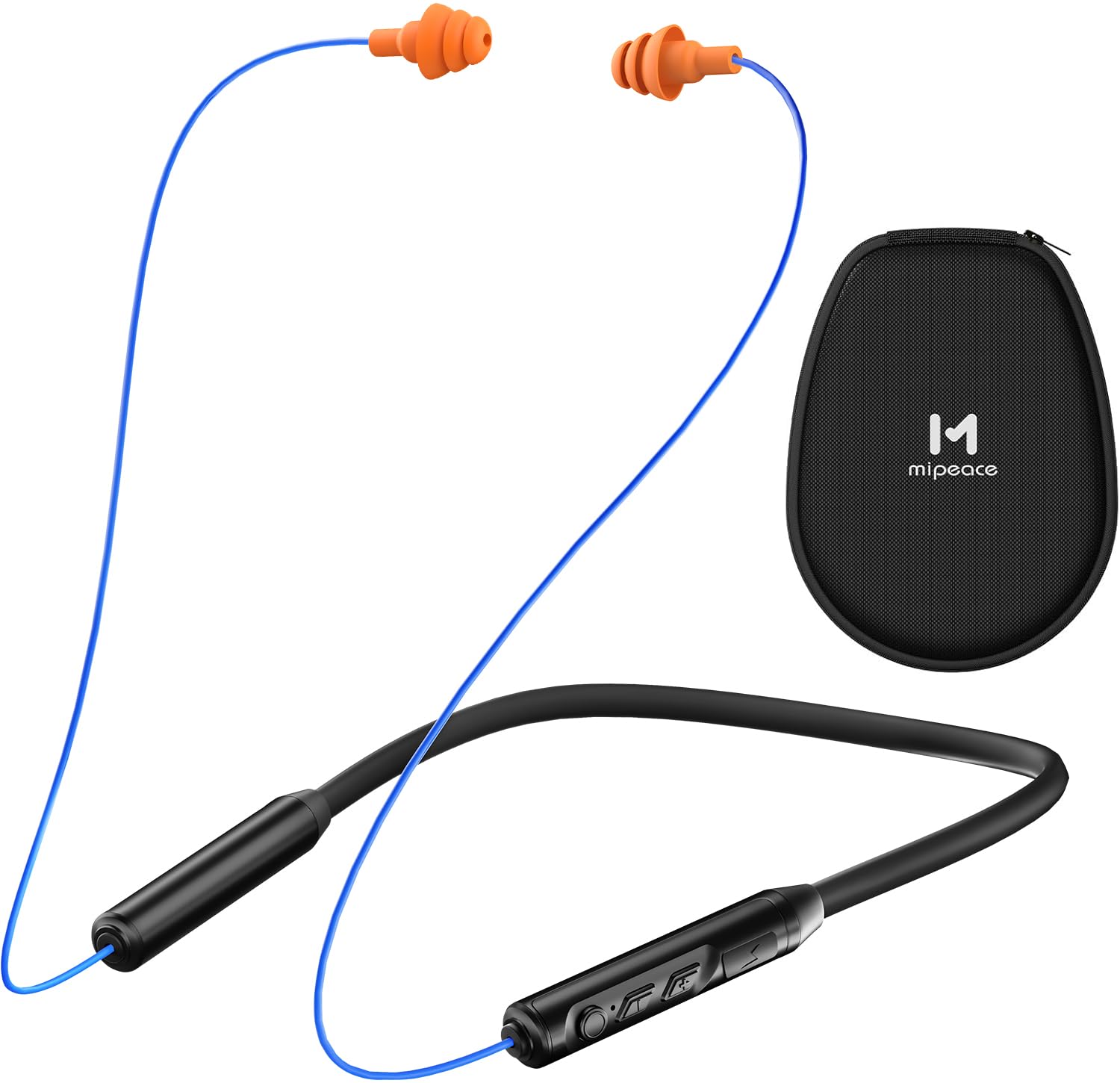
The OSHA-rated neckband that passes as PPE earplugs while streaming music through a full work shift.
This is a hearing-protection device first and a music player second. The 29dB NRR is OSHA-certified for hearing protection in construction and manufacturing noise. — and owners confirm it blocks noise better than standard consumer earbuds and lasts a full 8-hour shift on one charge. The neckband design weighs only 30g, and the hidden in-ear fit slips discreetly under a collar so it passes as proper protective equipment on site.
Bluetooth 5.4 gives you a stable connection up to 20 meters (66 feet) away, so you can move around a job site without your music cutting out, and the IPX6 sweat and water resistance shrugs off gym sessions and outdoor work. The 20+ hour battery covers back-to-back shifts and then some — owners mention 1.5 to 2 days of use from a charge, which beats far pricier earbuds. A compact carrying case is included for the truck or the toolbox.
The trade-off is that this much isolation can be a problem: some owners say they must pull an earbud out to hear a coworker talk because the blocking is so thorough. The buttons also draw criticism, with calls and song-skip controls described as unreliable. Durability is the recurring worry — a few owners lost pairs to blown speakers and Bluetooth sync issues within months, though newer USB-C versions are reported to charge and pair faster. If you need to hear your surroundings and your music, this is a strong safety-value pick at its tier.
What wins people over: the hearing protection is genuinely effective in 90-100dB environments, and the battery life is outstanding for the money.
The honest catch: the isolation can be too good for conversation, and the controls and long-term build are the weak points.
Reach for these if: you work a loud job and want protection plus audio in one discreet neckband that lasts a full shift.
Look elsewhere if: you need reliable on-ear controls or expect years of heavy labor — treat these as a solid-value workhorse, not an heirloom.
5. Symphonized Premium Wooden Airtube Headphones
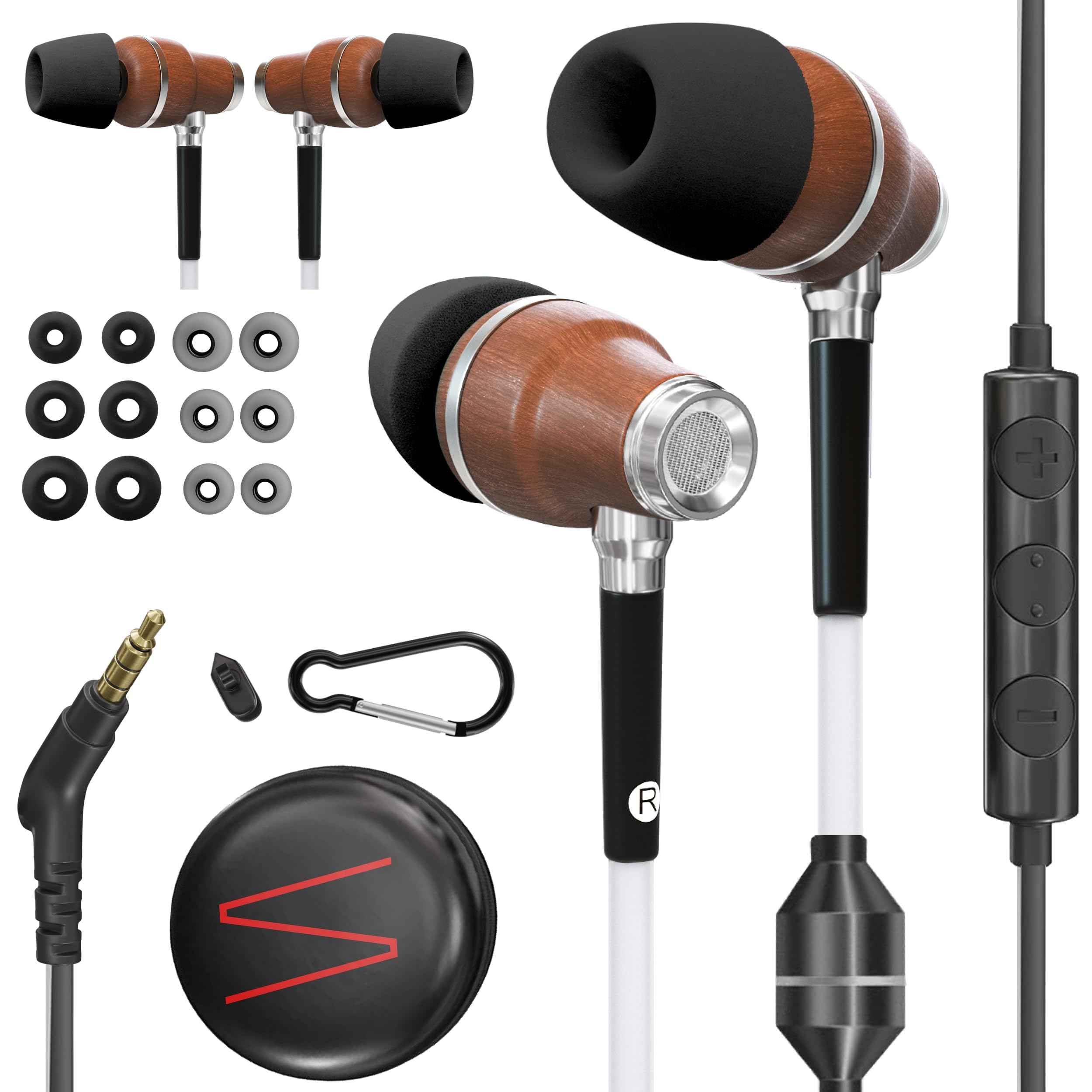
The bamboo-housed air-tube earbud that pairs EMF-conscious design with genuinely rich, 3D-style sound.
Air-tube earbuds usually force you to choose between safety and audio quality — this one is the exception. The real wood housing gives the sound an acoustic signature that owners describe as rich 3D audio with deep bass and crisp highs, with several noting the bass needs no EQ tweaking from the start. One owner liked them so much they bought a second pair for the piano. That makes this the pick for someone who wants EMF-reducing tech but refuses to downgrade their music.
The design uses advanced air-tube technology to reduce EMF exposure, and it comes with both foam and silicone tips in multiple sizes so you can find a secure all-day fit. The 3.5mm jack works with anything that has a headphone port, and the in-line mic and volume control cover calls and playback without touching your phone. The tangle-free cable is a small but real quality-of-life win.
Reliability is where the reviews split — the sound, fit, and build are praised as excellent value, but a few customers note the left side giving out, often around the two-year mark. One careful owner had to saw the earbuds apart to fix a wire, which tells you the housing is not easily repairable. Noise cancellation is effective enough that a hearing-impaired user found them great for isolating highway noise. This is the budget-conscious air-tube choice that sounds far more premium than its tier suggests — just know the electronics may not outlast the wood.
The standout: real wood housing that delivers surprisingly strong bass and clarity — the rare EMF-conscious earbud that audiophiles on a budget actually enjoy.
The balance: expect around two years of life before a wire may give out, and factor in that repairs require cracking the housing open.
Choose this if: you want air-tube EMF protection without sacrificing sound quality, especially for music listening.
Skip if: you need guaranteed multi-year durability from a single pair — the left-side wire failure is the known weak spot.
6. Qozybuds Bluetooth 5.4 Jobsite Earbuds
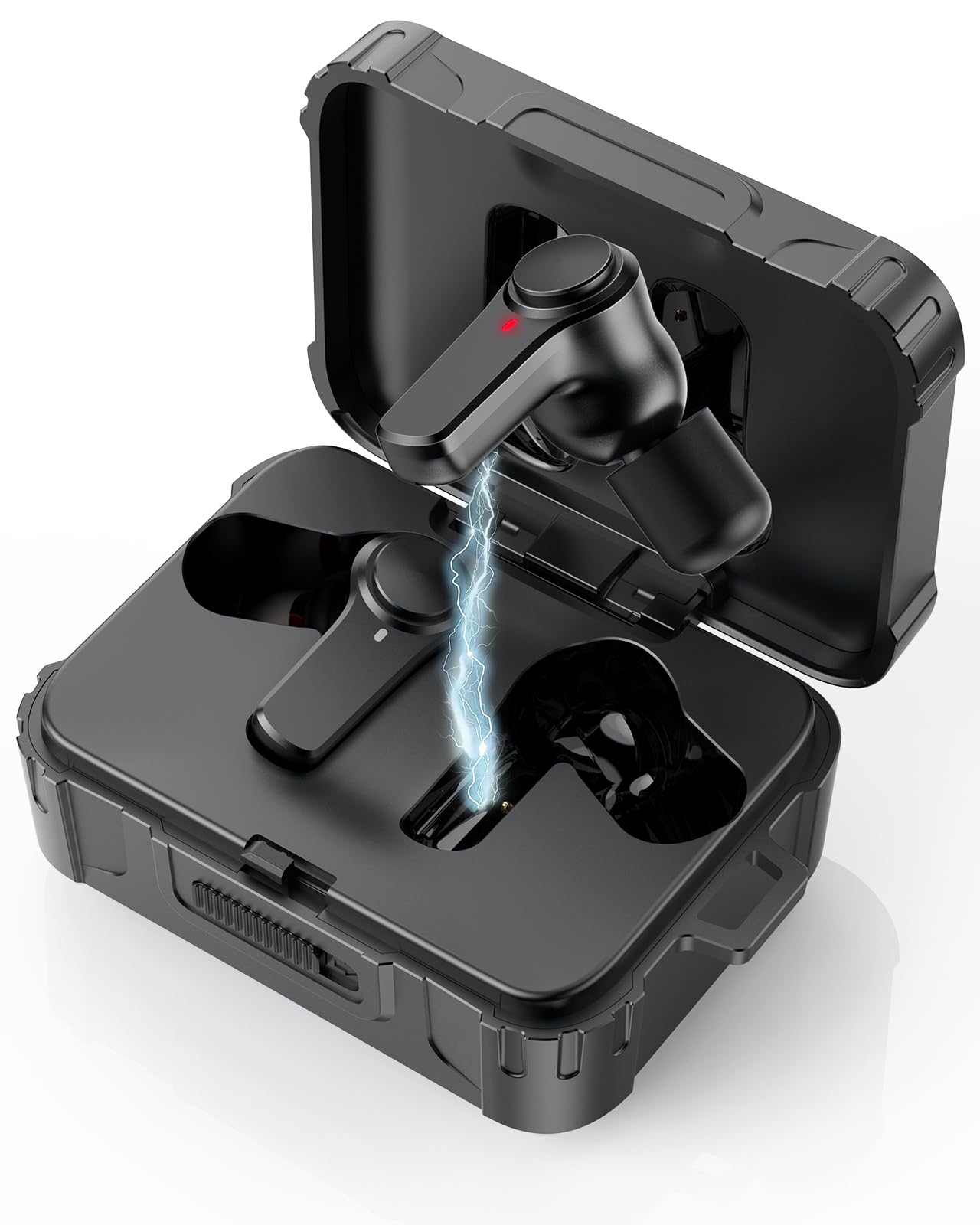
The true-wireless jobsite earbud with 70 hours of total playtime and memory-foam tips that lock out power-tool din.
This is the MIPEACE’s true-wireless cousin, built for the same loud environments but without the neckband. The headline spec is the battery: 7 hours from the earbuds alone and a massive 70 hours combined with the charging case, which means a full week of construction shifts without touching a charger. The 29dB SNR rating comes from contoured memory-foam earplugs in S, M, and L sizes that adapt to your ear canal and physically block loud noise from tools and machinery.
Bluetooth 5.4 keeps a stable connection up to 20 meters away, and the IPX6 rating shrugs off water, dust, and sweat across landscaping, welding, and gym use. The touch controls and a multifunction button let you switch listening modes without pulling an earbud out, and the ENC microphone (environmental noise cancellation) is designed to amplify the human voice for clear calls — useful when a coworker needs to talk mid-task.
Here is the honest split: owners who use them in the shop love that they work as both hearing protection and music earbuds, calling them high quality for the money. But a meaningful chunk of reviewers expected active noise cancellation and found this is purely passive — just earplugs with Bluetooth speakers inside, no ANC — and they describe the charging case as large and toy-like. If you understand this is passive protection, it is a strong value; if you are expecting ANC-style silence, it will disappoint.
What The Loud-Shop Crowd Loves
- 70-hour combined battery covers a full work week
- Memory-foam tips adapt to your ear canal for real passive blocking
- IPX6 rated for water, dust, and sweat
Set Expectations
- No active noise cancellation — this is passive earplug protection
- The charging case is bulky and feels cheap to some
Best for: workers who want true-wireless freedom, week-long battery life, and solid passive protection without paying for ANC they do not need.
Not for: anyone who expects active noise cancellation to silence a room — this physically blocks sound, it does not cancel it.
7. DefenderShield EMF Radiation-Free Earbuds

The premium air-tube earbud with a copper-infused braided cord for extra ELF mitigation and impressively clear audio.
This is the higher-end air-tube option, and the extra money buys a few real upgrades. The copper-infused braided cord is engineered for additional ELF mitigation — that is extremely low frequency electromagnetic field reduction — on top of the standard air-tube design, and the build quality gets genuine praise. The sound is the most consistent compliment: owners describe surprisingly good fidelity, with one saying it outperforms standard wired earbuds and another listening to podcasts all day on a farm. There is no active noise cancellation, which is a deliberate choice to keep electrical components away from your head.
The kit is generous — it includes six different ear-tip fits, two clips to fasten the wire to clothing, a drawstring pouch, and a protective case. The 42.5-inch cord gives you real freedom from your device, and the in-line volume control and mic handle calls without reaching for your phone. No battery means it works all day, every day, which is the quiet advantage over wireless when you are mid-task.
The durability data here is the honest counterweight. Sound quality is the most-praised aspect by a large margin, but reliability and durability are the most-discussed negatives — reviewers point out speakers failing entirely, with some pairs breaking within months and one lasting about a year before the cord covering unraveled. Fit is the other strike, with complaints that the earbuds pop out when leaning or chewing. The 1-year warranty is only in the case, not the listing, frustrating some buyers.. This is a product you buy for the audio and the EMF design, knowing the electronics may need replacement sooner than you would like.
The strength: genuinely clear, rich sound in an air-tube design, backed by a thorough accessory kit and a 42.5-inch tangle-resistant cord.
The price of the design: durability is the recurring complaint — speakers can die within months, so this is a sound-first purchase, not a set-and-forget one.
Buy it for: the best audio fidelity you can get from an EMF-conscious air-tube earbud, with a full kit of tips and clips included.
Pass if: you need a rugged daily driver — the failure reports make this better for careful, desk-based listening.
8. AILIHEN Classroom Headphones Kids 10-Pack

The teacher-tested 10-pack with an 85dB WHO-compliant limiter and cables built to survive 8,000 insertions.
For a classroom, individual volume limiting is non-negotiable — and this pack delivers the strictest standard in the category. The integrated limiter caps output at 85dB, meeting WHO safe-listening guidelines., and the materials carry CPC, CPSIA, FCC, ROHS, and CE certifications, so a school can buy them with compliance confidence. That is why teachers call them great for third-graders and report students actually requesting them over other options.
The durability engineering is the real story. The plug and cable joints survive 8,000 insertions and 44 lbs of pull force., which matters when a class of kids yanks cords daily. The reinforced nylon-braided cable resists the tangling that kills cheap school headsets, and the flexible headband bends and springs back rather than snapping. SharePort lets up to three students listen from a single device — the same multi-listener idea as the LilGadgets pick, but built into a classroom bulk package.
Each of the 10 vibrant colors comes with 50+ bonus stickers so kids personalize their pair, which teachers say cuts down on mix-ups and ownership arguments. The limited lifetime warranty gives schools a real safety net for bulk procurement. The honest trade-off: the ear pads detach easily and need glue to reattach, and the expected lifespan is around two years of daily classroom abuse. An occasional pair is described as not strong enough, but the overall durability picture is strong for the price tier, and the built-in mic and soft cushioned earmuffs cover the K-5 brief completely.
Why Teachers Reorder
- Strict 85dB WHO-compliant limiter in every pair
- Cables rated for 8,000 insertions and 44 lbs of pull
- 10 colors plus 50+ stickers for ownership management
The Classroom Reality
- Ear pads can detach and need gluing back
- Realistic lifespan is about 2 years under daily use
Buy this if: you run a classroom or need a bulk set of kid-safe headphones with the strictest volume cap and a lifetime warranty backup.
Consider the alternative if: you only need one or two pairs — the 10-pack only makes sense at classroom scale.
9. AXIL XCOR PRO Wireless Bluetooth Earbuds
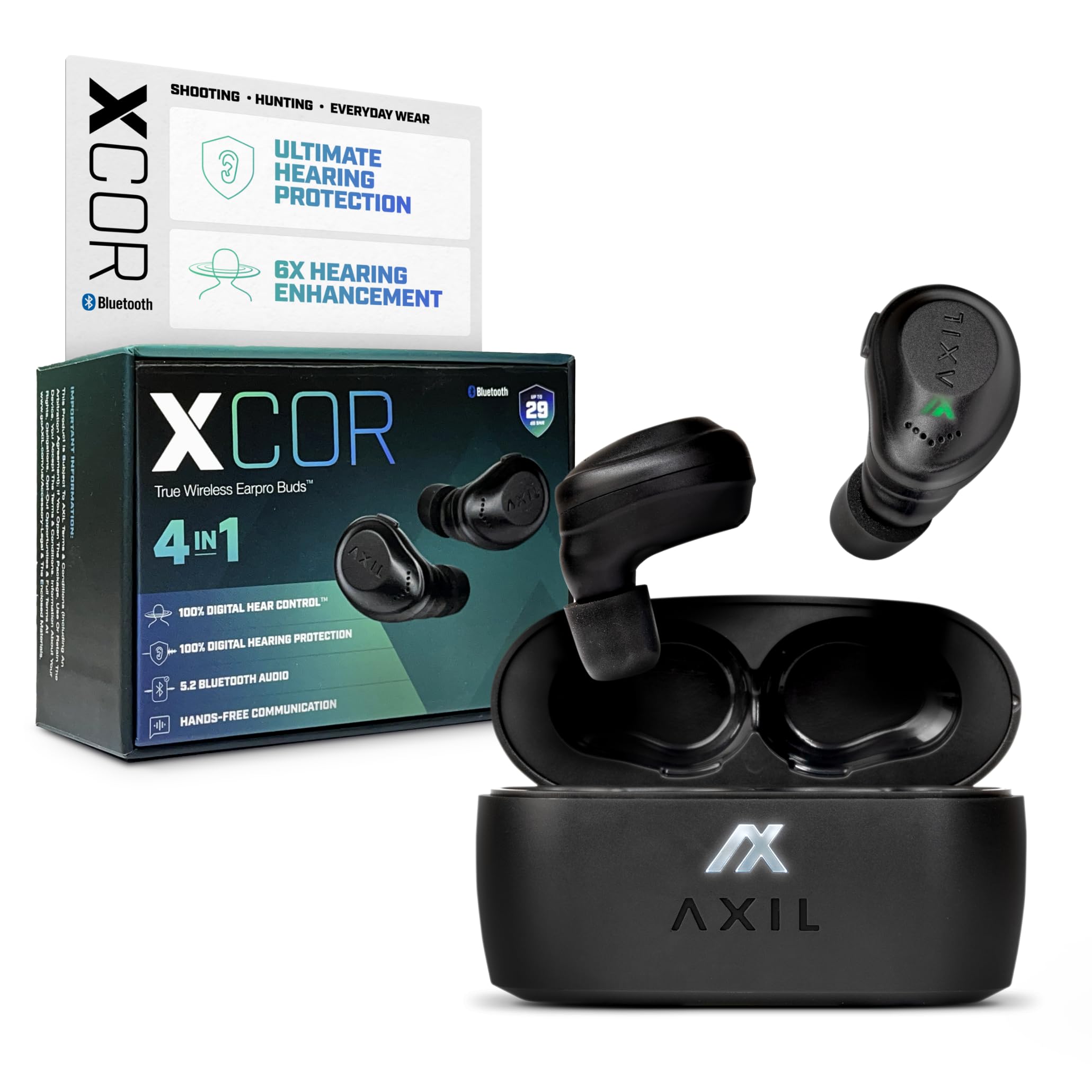
The shooter’s earbud that compresses gunfire over 85db instead of cutting off the world around you.
This is the most specialized pick on the list, built for people who need to hear clearly while protecting their hearing from sudden loud noises. The key feature is digital hearing protection that compresses loud sounds rather than shutting them out — so a gunshot or power tool noise over 85db gets automatically squashed, while normal conversation passes through. Owners confirm this works: gunshots are muffled safely while they still hear range commands and coworkers clearly. That makes it a different safety philosophy from the passive earplugs above — this one enhances rather than isolates.
Bluetooth 5.2 streams music and calls wirelessly, and the 12-hour battery covers a long day at the range or on the mower. The true-wireless design with touch controls and the included multiple ear tips keeps a secure fit during movement, and the case charges the buds multiple times. It is dust and water resistant, and owners have run these for three years across shooting, mowing, and power-tool work without issues.
This is the top-tier price on the list, and the reviews reflect that it is not a mass-market earbud. Sound quality for music is described as good but not great, and the pass-through transparency mode draws mixed feedback — some love it, while others report wind noise and a treble-heavy tone. The microphone is the recurring weakness, with callers saying they cannot hear the wearer clearly. A small number of owners describe severe battery drain and mediocre amplification, though the majority of shooters report excellent durability and call it better than traditional earmuffs. If your priority is situational awareness plus hearing protection, this is the most capable tool here — just know the music quality and mic trail the comfort factor.
The standout capability: loud-noise compression that lets you hear conversation while safely muffling gunfire — a genuine hearing-safety tool, not just an earbud.
The trade-off: the mic disappoints callers, wind noise can annoy in transparency mode, and music quality is good but not audiophile-grade.
Choose this if: you shoot, mow, or run power tools and want digital protection that keeps you aware of your surroundings.
Look elsewhere if: your main use is phone calls or critical music listening — the mic weakness makes this a specialist tool, not an everyday earbud.
Understanding the Specs
Volume Limit (85dB vs 93dB)
This is the number that actually protects hearing. A hard cap like 85dB means the headphone physically cannot produce louder sound, which matches what hearing experts consider safe for extended listening. A 93dB cap is louder — roughly a 9% bigger sound-pressure gap — so it is safer than no limit but not as strict. For young kids, go for the lower number; for older children who complain a strict cap sounds muffled, a higher one keeps them happy while still capping output.
Noise Reduction Rating (NRR / SNR)
This measures how much outside noise the earbud physically blocks. A 29dB NRR (noise reduction rating) means it reduces incoming sound by that amount, which is why it matters for loud environments — if the background racket is blocked, you do not need to turn the volume up to hear your music over it. Higher numbers mean better blocking, and ratings like this are what make a product count as real hearing protection rather than just an earbud.
FAQ
What does a 93db volume limit mean compared to 85dB for a child’s hearing?
Do air tube earbuds actually reduce EMF exposure?
Can kids headphones be used with an iPad or Chromebook?
Is passive noise reduction the same as active noise cancellation?
How long do air-tube earbuds typically last?
What does IPX6 waterproof rating mean for workouts or outdoor work?
Can two kids listen to one device with share-port headphones?
Are there wireless options that still offer volume limiting?
How does the battery life compare between the wireless picks?
What is the difference between the MIPEACE and Qozybuds jobsite earbuds?
Final Thoughts: The Verdict
For most families, the earphones for ear health winner is the LilGadgets Connect+ Pro because it pairs a real volume cap with the shared-listening SharePort that makes it the most versatile kid headphone on this list. If you want the strictest volume ceiling for a young child, grab the Belkin SoundForm Mini, which holds at 85dB and still delivers 30 hours of wireless play. And for loud jobsites or the range, the MIPEACE Neckband is the hearing-protection value pick that blocks 29dB of noise while streaming music through a full shift.
How We Picked
We do not accept paid placement. Every pick is matched to a real buyer and a real use-case; we do not hands-on test units.
Sources & Methodology
Specifications: manufacturer listings and product documentation. Review insights: verified customer reviews, as of July 2026. Pricing: not shown on this page (it changes often); check the current price via the retailer link.
As an Amazon Associate, WellFizz earns from qualifying purchases. This does not affect which products we feature.
Related Guides

Mo Maruf
I created WellFizz to bridge the gap between vague wellness advice and actionable solutions. My mission is simple: to decode the research and give you practical tools you can actually use.
Beyond the data, I am a passionate traveler. I believe that stepping away from the screen to explore new environments is essential for mental clarity and physical vitality.