Our readers keep the lights on and my smoothie glass nicely filled. As an Amazon Associate, I earn from qualifying purchases.
Specs are compiled from manufacturer listings and verified buyer reviews and can change over time — please confirm the key details on the product page before buying.
Most family videos don’t fail because of a bad camera — they fail because of motion blur, shaking hands, and audio that sounds like a wind tunnel. What actually matters in a family video camera is frame rate for capturing fast-moving kids, optical zoom so you aren’t standing on the sidelines, and a stabilizer that smooths out your steps. From pocket gimbals to cinema rigs, the right pick depends on your budget and filming habits.
I’m Mohammad Maruf — the founder and writer behind WellFizz. This guide is built by comparing the manufacturers’ published specifications and the patterns across verified customer reviews, so you get each pick’s real strengths and trade-offs instead of marketing spin.
Each pick is matched to a real family scenario, so you choose based on needs, not price.
Our Picks at a Glance



How To Choose The Best Family Video Camera
Before you compare prices, you need to understand the three pillars of family filming: how smooth the footage looks, how close you can get to the action, and how well it performs when the sun goes down. A miss on any of these makes footage unwatchable, regardless of megapixels.
Stabilization is your best friend
Shaky 4K footage is unwatchable. Look for a 3-axis gimbal for the smoothest results — perfect for chasing toddlers — or a strong optical sensor-shift stabilizer. In-camera stability eliminates the need for editing software fixes.
Zoom: Don’t get fooled by digital
Digital zoom just crops the picture, making it blurry. You want a long optical zoom range, which physically moves the lens — 20x or 30x gets you right to the front row at a school play. If you’re filming at home, a wide-angle lens for capturing everyone around the living room is more useful than a huge telephoto.
The sensor is a bigger deal than you think
A larger sensor (like a 1-inch or a full-frame type) physically captures more light, which brings two huge benefits: less grainy footage in dim rooms and a blurred-background “cinematic” look that separates your subject from a messy playroom. Smaller sensors struggle in low light but often get you more zoom for the money.
Quick Comparison
| Model | Best For | Video Resolution | Stabilization | Optical Zoom | Amazon |
|---|---|---|---|---|---|
| Sony FX30★ Best Overall | Cinema-grade family films | 4K (from 6K oversample) | Sensor-shift (IBIS) | Interchangeable lens | Amazon |
| DJI Osmo Pocket 3Also Great | Travel & everyday vlogging | 4K / 120fps | 3-Axis Gimbal | Digital only | Amazon |
| Xtra MuseBest Value | Action & hobby filming | 4K / 120fps | 3-Axis Gimbal | Digital only | Amazon |
| Canon EOS R8 | Photos & high-end video | 4K / 60p | Digital lens IS (no IBIS) | Interchangeable lens | Amazon |
| Sony FDR-AX43 | School plays & sports | 4K UHD | Balanced Optical SteadyShot | 20x optical | Amazon |
| Canon VIXIA HF G70 | Versatile home camcorder | 4K UHD | Advanced image stabilization | 20x optical | Amazon |
| Yollner 8K | First camera for kids | 8K (7680×4320) | Handheld stabilizer | 18x digital only | Amazon |
| FlyFrost 8K (B0GRH9X7R7) | YouTube & beginners | 8K (7680×4320) | Stabilizer accessory | 18x digital only | Amazon |
| FlyFrost 8K (B0F3J48B7N) | Budget-friendly starter | 8K / 15fps | Stabilizer accessory | 18x digital only | Amazon |
In‑Depth Reviews
1. Sony Cinema Line FX30
Our pick — over 4.5★ from 500+ verified ratings; the strongest balance of quality and price.
A serious cinema body that turns family documentaries into art-house films.
For the family that takes its “home movies” seriously, the Sony FX30 is a genuine cinema camera hiding in a compact body. It shoots with a 20.1 MP Exmor R APS-C sensor (a larger-than-average sensor that excels in low light) and uses S-Cinetone, a built-in color profile that gives footage a filmic look straight out of the camera — no editing skills required to get that “movie” tone. Owners describe the image quality as “legendary,” with fast, accurate autofocus and a rugged build that feels pro-grade.
This camera wins on flexibility. The flexible ISO (light sensitivity) and dual base ISO settings give you clean, low-noise images even in dim living rooms. Owners mention it handles hour-long 4K recording without overheating — a common killer on cheaper cameras — and the dual card slots let you record to two different memory cards for instant backup, so you never lose a moment. The 6K oversampled 4K output (shooting extra-wide then downsizing to 4K) produces detail that’s noticeably sharper than standard 4K cameras.
The catch is honesty about the battery: customers note it gets 1-2 hours of use per charge and requires an external pack for all-day events. It’s also an interchangeable-lens camera (Sony E/FE mount), meaning you’ll need to budget for lenses on top of the body. With a rating that’s been consistently praised across hundreds of owners, this earns its spot for enthusiasts, not casual point-and-shoot families.
The pro-family filmmaking kit
- Cinema-grade S-Cinetone color science for a beautiful look with zero editing
- Dual Base ISO captures clean footage in low light
- Dual card slots for instant backup of precious memories
- No overheating even during hour-long recording sessions
The professional caveats
- Battery life is weak at 1-2 hours — plan for an external pack
- You’ll buy lenses separately, adding to the total cost
Worth it for: Parents who love filmmaking as a hobby and want a camera that grows with their skills.
skip it if: You want a grab-and-go camcorder without learning lenses and manual settings.
2. DJI Osmo Pocket 3 Creator Combo
A pocket gimbal camera that turns chaotic moments into smooth, cinematic clips.
The DJI Osmo Pocket 3 is the closest thing to a “magic wand” for family filming. It records 4K resolution at 120fps (frames per second), which means fast-moving action — a kid’s soccer goal, a dog catching a frisbee — comes out smooth and sharp, not blurry. The footage is so steady that walking feels like gliding, all thanks to a built-in 3-axis mechanical gimbal (small motors that physically hold the camera level as you move).
It is also a complete kit from the start. The combo includes a DJI Mic 2 transmitter (a tiny wireless microphone) for clear voice, a wide-angle lens for getting everyone in the frame, a battery handle for longer shoots, plus a mini tripod and carrying bag. Battery life averages 166 minutes, which is a full afternoon of birthday party coverage on a single charge. The rotating 2-inch touch screen flips to vertical in a second, so clips are ready for social media without any extra work.
Owners praise its low-light performance, which outshines most compact cameras. The trade-off is the digital zoom: at just 2x (2 times magnification), it will not reach the back of a school auditorium. Buyers also note the battery handle and mic need their own charging, adding one more step to your routine.
What wins families over
- Gimbal-stabilized 4K/120fps footage straight from the start
- Excellent in low light thanks to a 1-inch CMOS sensor (a sensor physically large enough to soak up light)
- Included DJI Mic 2 transmitter makes audio crisp — no separate mic purchase needed
- Accessories included: wide-angle lens, mini tripod, battery handle, and carrying bag
Worth knowing before you buy
- Only 2x digital zoom, so zooming in on distant subjects degrades quality
- Pocket-sized design is great for travel, but the small body may feel cramped for large hands
Your best bet if: You want a grab-and-go camera that delivers pro-level smoothness without a learning curve, perfect for vacations and every-day moments.
Look elsewhere if: You primarily need massive zoom for stage events or professional sports games.
3. Xtra Muse Vlogging Camera
A 4K gimbal camera offering DJI-level smoothness at half the price.
If the DJI Osmo Pocket 3 is your dream camera but the price tag hurts, this is the pick that scratches the same itch for less. The Xtra Muse also records 4K/120fps (4K resolution at 120 frames per second) on a 1-inch CMOS sensor, so you get that same silky-smooth slow-motion action when the kids are running wild. It has a 3-axis gimbal (three motorized pivots that hold the camera steady) that owners say makes walking footage look nearly identical to a competitor’s premium pocket camera.
It’s built for follow-focus moments too. The camera includes face and object tracking, so it can lock onto your child and keep them centered in the frame while you move around — ideal for dance recitals or backyard races. The 2-inch touch screen makes switching between horizontal and vertical filming easy, and the 10-bit color mode (a color depth that holds more tones) records up to one billion colors, giving you vivid sunsets and sunrises that look better than real life.
Battery life is a mixed bag, however. Some buyers report a solid 161 minutes of average life, while others find it drains quickly, so packing a spare is wise. Microphone connectivity also took a software update to work smoothly with certain external mics. Still, the core quality — 65 buyers single out the build quality, with video quality the second most-praised feature — makes this a serious budget champion.
Why it’s a steal
- 4K/120fps on a 1-inch sensor for smooth slow-motion and less grain
- Built-in 3-axis gimbal means no extra rigs or handles
- Fast autofocus and reliable face/object tracking for moving subjects
- Compact pocket design with a handy 1/4-inch thread for tripods
The honest trade-offs
- Battery life gets mixed reviews — carry a spare for long outings
- Some external microphones required a software update to connect
Reach for this if: You want 90% of the pocket-gimbal experience without the premium price tag.
Think twice if: You need long event coverage and hate managing extra batteries.
4. Canon EOS R8

Full-frame magic that captures dimly-lit holiday dinners without a flash.
The Canon EOS R8 delivers what many photographers call the gold standard: a full-frame CMOS sensor (a sensor the size of a traditional 35mm film frame) that physically takes in more light than smaller sensors. With 24.2 megapixels, it produces stunningly crisp images. This is a hybrid star — brilliant for both family snapshots and video, shooting uncropped 4K at 60fps (4K resolution at 60 frames per second) that’s oversampled from 6K for extra detail.
Its Dual Pixel CMOS AF II autofocus is the family hero here. Using deep learning, it can automatically detect and track people, animals, and even vehicles like trains and horses — so it stays locked on your kids as they run, no matter what’s happening in the background. It covers 100% x 100% of the frame with 1,053 AF zones, meaning the focus point can be anywhere the action is. The 0.39-inch OLED viewfinder with a 120fps refresh rate gives a smooth, real-time view.
There are honest limitations. It has no in-body image stabilization (IBIS), so your lens must carry the stabilization. The battery is on the smaller side — reviewers point out roughly 500 shots or about an hour of video — and 4K60 recording can overheat at around 30 minutes. But for low-light performance, owners upgrading from older DSLRs describe it as “magic in your hands.” This is a camera for the family that wants professional-level photos AND video.
What makes it a family champion
- 24.2 MP full-frame sensor for exceptional low-light photos
- 4K 60p video oversampled from 6K for sharp detail
- Deep-learning autofocus tracks people, animals, and vehicles
- 40 fps continuous shooting for capturing the perfect action shot
What to plan around
- No in-body stabilization — you need stabilized lenses for smooth video
- Battery life is modest; a spare is essential for a full day out
Choose this when: You want one device that excels at both family photography and serious video creation.
Pass if: You want a dedicated camcorder with a long built-in zoom lens.
5. Sony FDR-AX43 4K Handycam

The classic camcorder that reaches the stage from the very back row.
This is the camera for parents who live at school plays, dance recitals, and soccer fields. The Sony FDR-AX43 packs a true 20x optical zoom lens that physically reaches out to the action, so you aren’t stuck with blurry crops. It even has a 30x Clear Image Zoom for 4K and 40x for HD — using the center of the sensor to magnify further while keeping quality high — plus an extreme 250x digital zoom if you’re brave enough to use it.
Your footage stays smooth thanks to the Balanced Optical SteadyShot image stabilizer, which physically floats the lens unit to counteract your hand’s movement. This is a big deal for long zoom lengths, where tiny shakes become massive wobbles. The 26.8mm wide-angle ZEISS lens is wide enough for a big family group shot around the tree, while the Fast Intelligent AF (autofocus) tracks moving subjects to keep them sharp as they run toward the camera.
It’s a camcorder, not a mirrorless camera, so it’s built to be used by pointing and shooting. Owners praise its sturdy build and beautiful video quality, noting it’s “very easy to operate.” The notable downsides: the 1/2.5-inch sensor is smaller than mirrorless rivals, making it weaker in dim gymnasiums, and there’s no viewfinder — you’ll rely on the screen. Also, it boots into a “date/time reset” quicker than expected after battery removal, which is a minor annoyance.
Built for the sidelines
- Real 20x optical zoom (30x in 4K, 40x in HD) puts you front-row from the bleachers
- Balanced Optical SteadyShot keeps 40x footage stable
- Fast Intelligent AF tracks running kids
- Wide 26.8mm lens covers big family groups
Know the limitations
- Smaller sensor means grainer footage in low-light venues
- No viewfinder and a bulky battery that sticks out
Your pick if: You attend recitals and games and need to see the subject’s face clearly from a distance.
Not ideal if: You mostly film inside at parties where a large sensor camera would shine.
6. Canon VIXIA HF G70 Camcorder

A feature-packed camcorder that doubles as a webcam and adds timestamps to your memories.
The Canon VIXIA HF G70 is a great option for families who want a flexible camcorder for more than just vacation. It records crisp 4K UHD on a 1/2.3″ CMOS (a standard camcorder sensor) and processes images with a DIGIC DV6 processor for sharp, natural-looking footage. The 20x optical zoom lens paired with advanced image stabilization handles the classic family camcorder duties with plenty of reach for stage events.
This G70 stands out for its extra features. It has a built-in “Time Stamp” On-Screen Display, letting you embed the date and time directly into the video file — perfect for archivists who film family history and want the timeline recorded forever. It also supports UVC Livestreaming, so you can plug it into a PC or Mac via USB and use it as a high-quality webcam for family video calls or a parent’s work meetings.
Among camcorders, it offers strong customization: adjustable focusing speeds and a Hybrid AF system with face detection for fast, reliable focus. Buyers buying it for outdoor adventures like filming a moose hunt praise the build quality and easy menus. The main knock in reviews is low-light performance — it gets noticeably soft when the lights go down, and owners suggest manual focus to avoid a twitching background. This is an “outdoor and daylight” champion rather than a dusk specialist.
Versatility wins
- 4K UHD with 20x optical zoom and image stabilization
- Built-in Time Stamp records the date and time permanently
- Works as a UVC webcam for streaming and calls
- 8-blade aperture creates cinema-style soft backgrounds
Set expectations
- Low-light footage is soft and grainy compared to mirrorless cameras
- Gimbal-handling requires careful technique to avoid shake
Get this if: You want a reliable hybrid tool for day trips, family projects, AND a high-quality webcam.
Consider others if: Most of your filming happens at night or in dim, indoor spaces.
7. Yollner 8K Video Camera
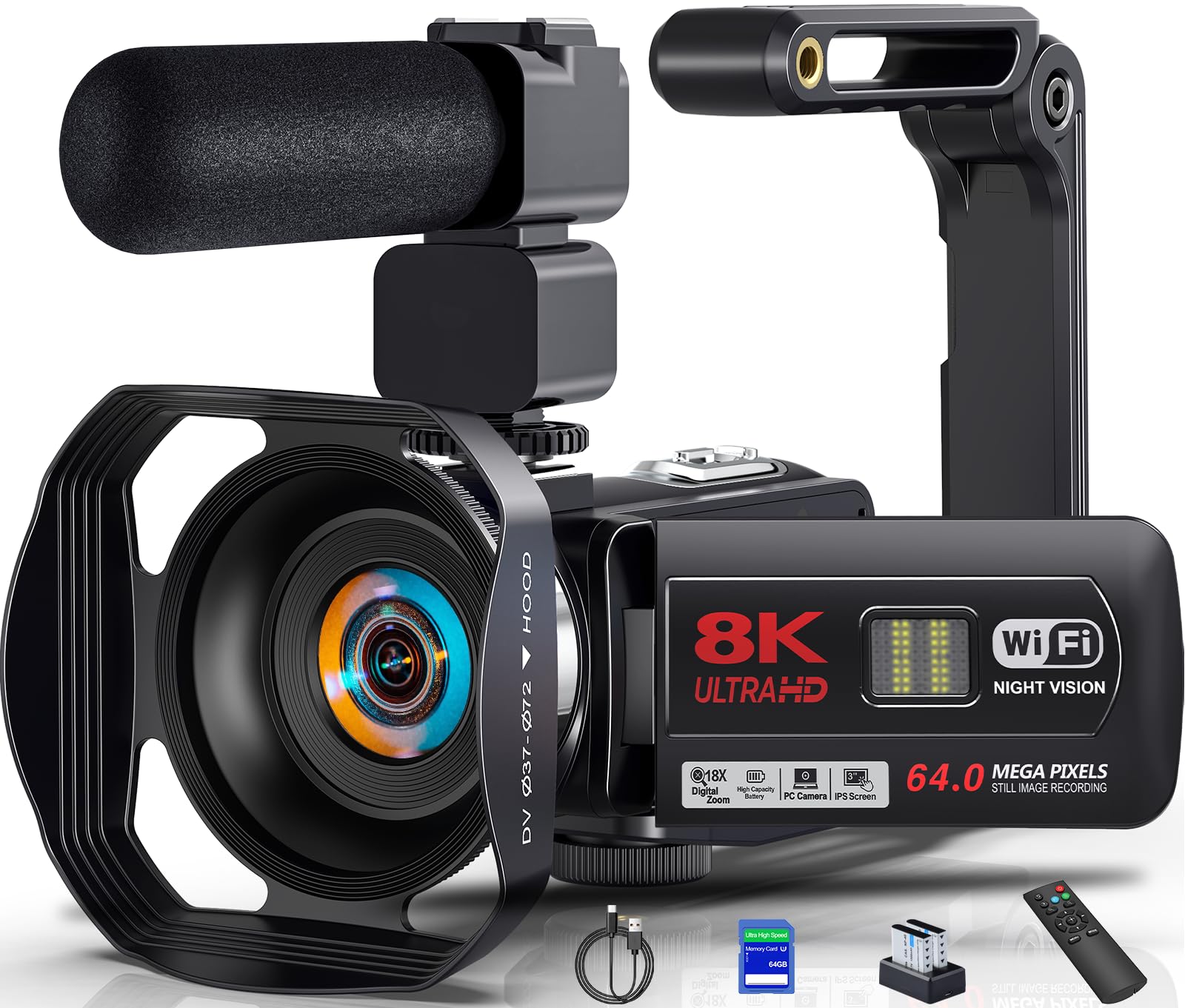
An 8K starter camcorder that survives the backpack and the enthusiasm of a young creator.
If the goal is handing a camera to your 12-year-old and letting them discover a passion, this 8K camcorder from Yollner is designed for exactly that. It records up to 8K resolution (7680×4320 pixels) and snaps 64 MP still photos, giving young creators a massive resolution to play with. The 3-inch touch screen flips 270 degrees (nearly all the way around) so a kid can easily frame a selfie-style vlog. It comes with a 64GB memory card in the box, so it’s ready to go straight out of the packaging.
Buyers describe it as “kids friendly” and “age appropriate,” with one celebrating a gift to a young blogger after she passed her exam. The bundle is impressive: two NP-40 lithium batteries, a 2.4G remote control for family group shots, a handheld stabilizer, a lens hood, and a charging cradle. It even has IR night vision, allowing for black-and-white shots in the dark — a fun feature for a kid exploring the backyard after sunset.
The honest caveat is in the “8K” claim. At this price, the 18x zoom is digital, meaning it just crops the image, and the sensor is much smaller than those in the premium cameras above. It’s great for bright daylight and well-lit rooms, but don’t expect cinema-grade low-light footage. Also, owners note it may require a quick manual setup to fix a blue tint in certain light. This is a brilliant first camera, not a rival to the DJI or Sony.
Perfect for young creators
- Includes a 64GB SD card and two batteries so it runs right away
- 270-degree rotating touch screen is ideal for selfie-style vlogs
- Simple menu and WiFi transfer make sharing easy
- IR night vision adds a fun twist for dark environments
Set realistic expectations
- The 18x zoom is digital, so it hunts and loses quality at high magnification
- Results are better in good light than in dim conditions
Ideal gift for: A child or teen taking their first steps into vlogging and video editing.
Not the one if: You’re a parent wanting serious, high-end footage for your own archival films.
8. FlyFrost 8K Video Camera (B0GRH9X7R7)
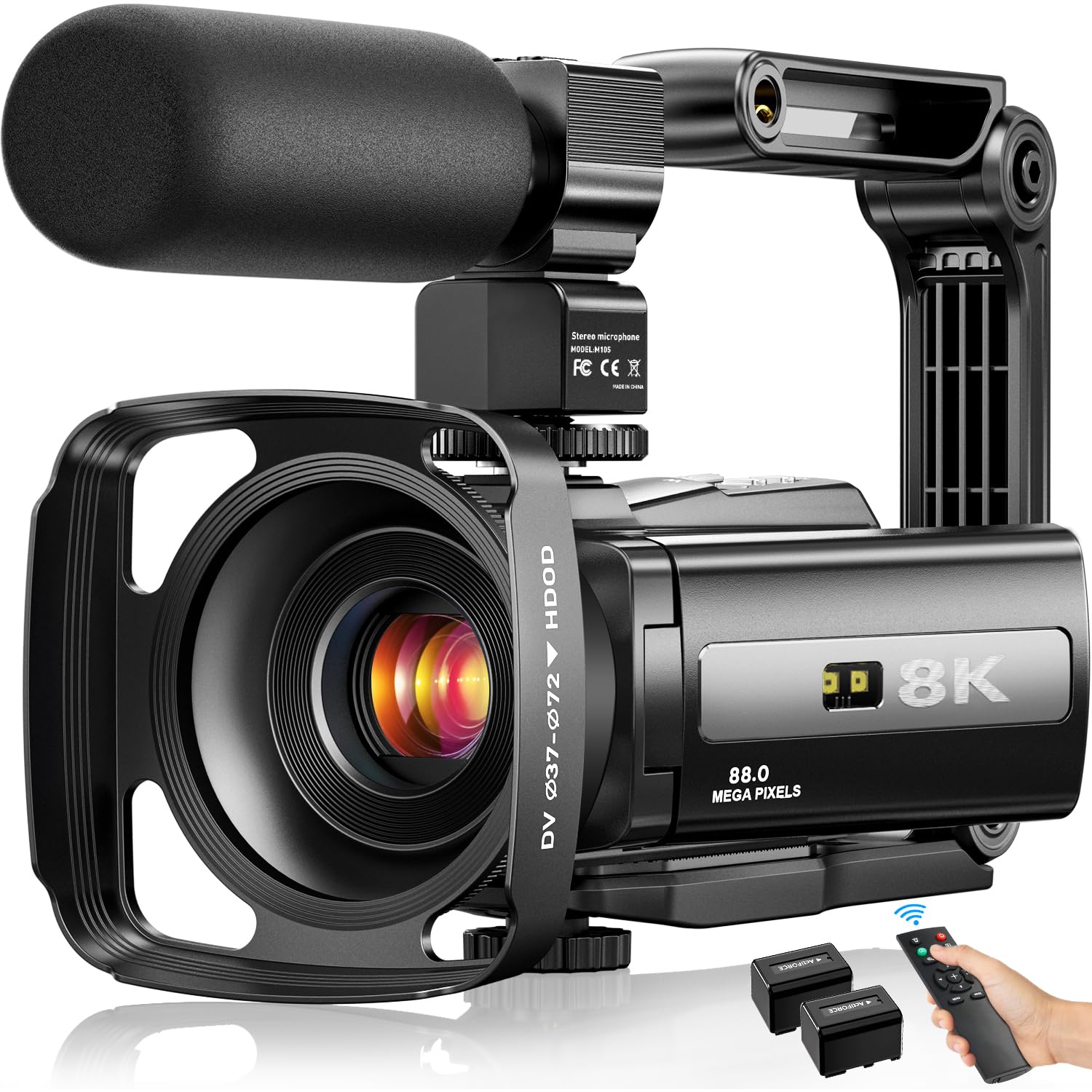
A complete YouTube starter studio in a box, with every accessory you can imagine.
This FlyFrost 8K camcorder is the quintessential “everything included” bundle, making it a popular family starter kit. It shoots video up to 8K resolution, and the package includes an external microphone to improve audio, a lens hood, a handheld stabilizer, a remote control, a camera bag, AND two batteries. For a family that just wants to start filming without buying bits separately, this is a very comfortable place to begin.
Owners are genuinely charmed by it. One describes giving it to their daughter to record family trips, noting the good image quality, easy handling, and a touch screen that helps the audio sound much better. Another emphasizes the “generous bundle” and responsive touchscreen. For beginners and vloggers, the menu is simple enough to learn quickly, and the WiFi transfer to a phone makes sharing clips to social media painless.
You should read the “8K” spec with a skeptical eye at this price point. The lens has a fixed focus, so it’s not a professional cinema camera, and the 18x digital zoom degrades picture quality the deeper you zoom. The IR night vision offers basic black-and-white shots, not full-color darkness capture. But taken for what it is — a fun, feature-rich beginner camcorder — it delivers high satisfaction. The external mic is a big step up from the tinny speakers most cameras in this class have.
The bundle wins
- Comes with mic, stabilizer, lens hood, remote, bag, and 2 batteries
- 8K capture with an 88 MP still resolution
- Easy menu and WiFi transfer got a thumbs-up from beginners
- External microphone clearly improves audio quality
The entry-level truth
- Fixed-focus lens means you must move the camera to refocus
- 18x digital zoom lowers image quality as you zoom in
Best for: A family that wants one box with all the starter accessories and zero separate purchases.
Pass it by if: You expect true 8K sharpness and manual lens control.
9. FlyFrost 8K Video Camera (B0F3J48B7N)

The accessible all-rounder that gets you filming on a tight budget with a box full of gear.
This is the most budget-friendly entry into the 8K world, and it’s a solid choice if you’re testing the waters of family filmmaking. It captures video at 8K resolution at 15fps (15 frames per second) and stills at 88MP. Like its sibling, it’s a complete kit: you get a lens hood, a handheld stabilizer, an external microphone, two batteries, a USB cable, a 2.4G remote control, and a cleaning cloth. A 32GB SD card is included, so you can start recording before you even buy extra memory.
The main selling point is the feature list and value for money. It includes face detection, slow motion, time-lapse, self-timer, date stamp, and recording while charging — so you never run out of battery mid-moment. The 3-inch touch screen rotates 270 degrees for selfie-style framing, and the 6-axis gyroscope autofocus helps keep things sharp in good light. Owners call it easy to learn and praise the simplicity of the menu.
Be careful with the file transfer. While many shoppers say the WiFi works flawlessly with iPhones, some users have serious issues getting files off the camera via USB cable — the connection can crash, and the Android app has known glitches. The workaround is simple: remove the SD card and plug it straight into your computer. Also, note the 15fps limit at 8K, which is not smooth for fast action; you’ll want to drop to a lower resolution for proper frame rates.
Ease & access
- Complete kit with two batteries, mic, stabilizer, remote and case
- 8K video and 88MP still photos on a budget
- Face detection and slow-motion modes make shooting simple
- Records while charging so you never miss the moment
Handle with care
- USB file transfer can crash — use the SD card instead
- 8K is capped at 15fps, so stick to 4K/1080p for smooth motion
Reach for this if: The budget is tight but you want a full starter kit to learn the ropes.
Choose a pricier model if: Smooth 8K motion or easy wireless file transfer are deal-breakers.
Understanding the Specs
Frame Rate (fps)
Frame rate, measured in frames per second (fps), is how many individual pictures the camera snaps every second. A standard video is 30fps, which looks smooth for everyday moments. But for action, 60fps or 120fps is a standout: it captures fast motion — a bouncing toddler, a dog shaking, a soccer kick — without blur, and it lets you slow footage down to a smooth 25% speed in editing. Check this number before you check megapixels; a high frame rate does more for family video clarity than most specs.
Optical vs. Digital Zoom
Optical zoom is what you want, and it’s a physical lens movement that magnifies the image without losing quality. Digital zoom just crops the center of the picture and stretches it, which makes footage blurry and pixelated fast. The rule of thumb: a 20x optical zoom is far more valuable than a 250x digital zoom. If a camera only lists a digital zoom number, treat it as a marketing figure, not a real-world reach.
Sensor Size & Low Light
The image sensor is a camera’s “eye” — the bigger it is, the more light it catches. A 1-inch sensor (found in the DJI and Xtra Muse), an APS-C sensor (the Sony FX30), or a full-frame sensor (Canon R8) all deliver cleaner, less grainy footage in dim rooms than the tiny sensors inside budget camcorders. The physical size difference is the biggest single reason “cheap” cameras look great outside and terrible inside at dusk. If you film mostly indoors, prioritize sensor size over zoom range.
Stabilization Systems
Stabilization keeps your handheld footage from looking shaky. The three types are: a mechanical gimbal (motorized arms that physically counter your movement — the smoothest of all), optical/sensor-shift stabilization (the lens or sensor moves to cancel shake — great in camcorders), and digital stabilization (software crops the image to reduce wobble — least effective). For chasing kids, a gimbal is king. For long zoom shots, optical stabilization is essential.
FAQ
Should I buy a camcorder or use my smartphone for family videos?
Is an 8K budget camcorder better than a 4K premium camera?
How much zoom do I really need for school plays and recitals?
What does a gimbal actually do for my videos?
Will a budget camera record good video indoors at a birthday party?
What is the difference between a full-frame, APS-C, and 1-inch sensor?
What memory card do I need for a 4K family video camera?
How long do the batteries last on these cameras for a full day out?
Can I plug these cameras into a TV to watch family videos?
Which is better for family films, a Sony FX30 or a Canon EOS R8?
Final Thoughts: The Verdict
For most families, the family video camera winner is the DJI OsOsmo Pocket 3 because it delivers that legendary 4K/120fps smoothness and true phone-free simplicity in a pocket-sized body. If you want the most cinematic home movies that look like they came from a film studio, the Sony FX30 is the one to reach for, as long as you can manage its battery with an external pack. And for days at the ballpark or school stage where reach matters most, the Sony FDR-AX43 with its 20x optical zoom is the undisputed zoom king.
How We Picked
We do not accept paid placement. Every pick is matched to a real buyer and a real use-case; we do not hands-on test units.
Sources & Methodology
Specifications: manufacturer listings and product documentation. Review insights: verified customer reviews, as of July 2026. Pricing: not shown on this page (it changes often); check the current price via the retailer link.
As an Amazon Associate, WellFizz earns from qualifying purchases. This does not affect which products we feature.
Related Guides

Mo Maruf
I created WellFizz to bridge the gap between vague wellness advice and actionable solutions. My mission is simple: to decode the research and give you practical tools you can actually use.
Beyond the data, I am a passionate traveler. I believe that stepping away from the screen to explore new environments is essential for mental clarity and physical vitality.