Our readers keep the lights on and my smoothie glass nicely filled. As an Amazon Associate, I earn from qualifying purchases.
Specs are compiled from manufacturer listings and verified buyer reviews and can change over time — please confirm the key details on the product page before buying.
A healthy tall fescue lawn in spring is actually grown the previous fall — that is the single most important feeding window of the year. While summer heat and foot traffic wear down your grass, the cooler months are when fescue builds the deep root system it needs to survive winter and bounce back when temperatures rise. The right fall fertilizer gives you the specific balance of nitrogen (which drives leaf growth) and potassium (which strengthens roots) to fuel that root development, not just a quick green top-dressing that fades by December.
I’m Mohammad Maruf — the founder and writer behind WellFizz. This guide is built by comparing the manufacturers’ published specifications and the patterns across verified customer reviews, so you get each pick’s real strengths and trade-offs instead of marketing spin.
Choosing the best fall fertilizer for tall fescue depends on matching nitrogen-to-potassium ratios, coverage area, and release speed to your yard’s specific schedule.
Our Picks at a Glance

How To Choose The Best Fall Fertilizer For Tall Fescue
Tall fescue is a cool-season grass that does its heaviest root building when soil temperatures dip below 70°F. A fall application that leans on potassium (K) and slow-release nitrogen gives it the fuel it needs for winter hardiness and a head start in spring. Here is what to look for.
Focus on the Third Number in the N-P-K Ratio
The three numbers on a fertilizer bag stand for nitrogen (N), phosphorus (P), and potassium (K). For tall fescue in the fall, the third number — potassium — is the most important. High potassium, often between 10 and 25, strengthens cell walls and helps the grass store carbohydrates, essentially winter-proofing each blade. A formula like 24-0-14 or 30-0-12 gives you nitrogen for steady feeding and potassium for root density, with zero phosphorus that established lawns rarely need.
Choose Slow-Release Nitrogen for Steady Feeding
Fast-release nitrogen gives you a dramatic green flash that fades in two weeks, leaving the grass hungry before the first frost. Slow-release nitrogen — sometimes labeled controlled-release or polymer-coated — breaks down gradually over weeks or months. A product that claims to feed for 8 to 16 weeks means one application can carry your tall fescue through fall and into early winter without a second round.
Match the Coverage to Your Lawn Size
Bag sizes vary dramatically — some cover 4,000 square feet while larger bags handle 15,000 square feet. Buying a bag that covers too little means you will run short mid-application; buying a massive bag for a small lawn leaves you storing half-opened fertilizer that can absorb moisture and clump. Measure your lawn once, then pick the bag that covers it in one pass or a clean fraction (two half-applications two weeks apart).
Quick Comparison
| Model | Best For | N-P-K Ratio | Coverage | Item Weight | Amazon |
|---|---|---|---|---|---|
| Scotts Turf Builder WinterGuard★ Best Overall | All-grass-type reliability | Not listed on bag | 4,000 sq. ft. | 10 lbs | Amazon |
| Simple Lawn Solutions 0-0-25 LiquidValue Pick | Spot-treating potassium deficiency | 0-0-25 | 3,200 sq. ft. | 2 lbs | Amazon |
| Green Thumb GT58105 Winterizer | Extended 16-week slow feeding | 32-0-10 | 5,000 sq. ft. | 12.6 lbs | Amazon |
| The Andersons Premium Fall Lawn Food | Fast green-up with deep roots | 24-0-14 | 5,000 sq. ft. | 18 lbs | Amazon |
| GreenView Fairway Formula Fall | Longest single-bag reach (7,500 sq. ft.) | 30-0-12 | 7,500 sq. ft. | 22.5 lbs | Amazon |
| GreenView Fall Lawn Food 48 lb | Large-acreage economy (15,000 sq. ft.) | 22-0-10 | 15,000 sq. ft. | 48 lbs | Amazon |
| Jonathan Green Winter Survival | Extreme cold-weather protection | 10-0-20 | 15,000 sq. ft. | 45 lbs | Amazon |
In‑Depth Reviews
1. Scotts Turf Builder WinterGuard Fall Lawn Food, 10 lbs.
Our pick — over 4.5★ from 13,500+ verified ratings; the strongest balance of quality and price.
The crowd-favorite bag that builds deep roots through a shady, short-sun fall.
Scotts WinterGuard is the name most tall fescue owners reach for first, and the owner feedback backs up the reputation. The 10-pound bag covers 4,000 square feet — enough for a standard suburban front lawn in one pass. What wins people over is how it handles recovery from summer stress: the formula pushes nutrients toward root development rather than just top growth, so the grass enters winter with deeper storage. As owners put it, “This stuff obviously worked for my freshly grown lawn that only gets a few hours of sun a day” — a scene that resonates with anyone fighting shade and compacted soil.
The granular form spreads easily through a broadcast or drop spreader, and the instructions let you apply to either a wet or dry lawn without worrying about burn. It is labeled for any grass type, which means it works equally well on a straight tall fescue lawn or a fescue-bluegrass mix. The trade-off is coverage reach: at 4,000 square feet, the bag runs short if your yard is larger than a quarter-acre, pushing you toward a second bag or a bigger alternative.
What Owners Love
- Proven results on shade-stressed and freshly seeded lawns.
- Simple, no-mix granules that work on wet or dry grass.
- Strong root-building focus that preps fescue for winter dormancy.
The Practical Limit
- 4,000 sq. ft. coverage means larger yards need two bags.
Reach for it if: you want a dependable, shade-tolerant fall feed from the most trusted name in lawn care.
Think twice if: your lawn is larger than 5,000 square feet — you will get better value from a bigger bag.
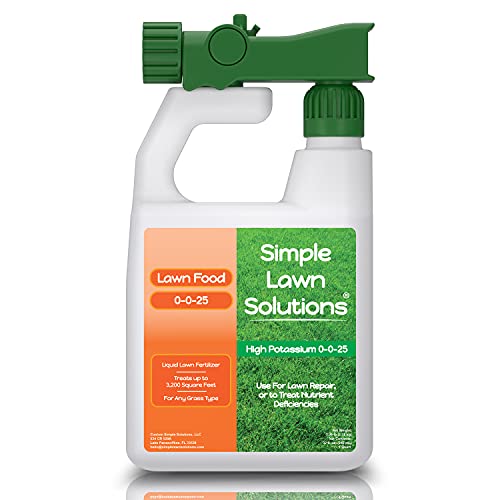
2. Simple Lawn Solutions 0-0-25 High Potassium Lawn Food Liquid Fertilizer
The pure-potassium booster that targets root hardiness without pushing leaf growth.
Every other product on this list delivers a blended N-P-K, but Simple Lawn Solutions goes all-in on one job: potassium. The 0-0-25 ratio is the highest potassium concentration here, and it is designed specifically for lawns that show deficiency signs — weak stems, poor winter color, or stress after a dry summer. The ready-to-use hose-end sprayer makes application quick: set the dial and walk, covering up to 3,200 square feet per bottle. At just 2 pounds of liquid weight, it is far lighter than any granular bag — The Andersons bag weighs 18 pounds.
The feedback is realistic: buyers report that it does not deliver the dramatic green flush of a high-nitrogen feed. One reviewer noted, “Application is straight forward, however I didn’t see a lot of difference in the yard overall” — which makes sense because potassium’s work happens below the soil line. What owners do praise is the effect on root systems, especially coming out of winter. The liquid form also works well in a backpack sprayer for those who prefer spot-treating.
Best Use Case
- Pure 0-0-25 potassium targets root storage and winter hardiness.
- Hose-end sprayer applies evenly with no spreader needed.
- Works on all grass types including tall fescue.
Keep in Mind
- No nitrogen means you will not see a visible greening effect.
Ideal for: targeting a potassium deficiency in your fescue without adding extra nitrogen.
Not for: anyone who wants a visible green-up — pair this with a nitrogen-rich feed if appearance matters.
3. Green Thumb GT58105 Winterizer Lawn Fertilizer, 32-0-10
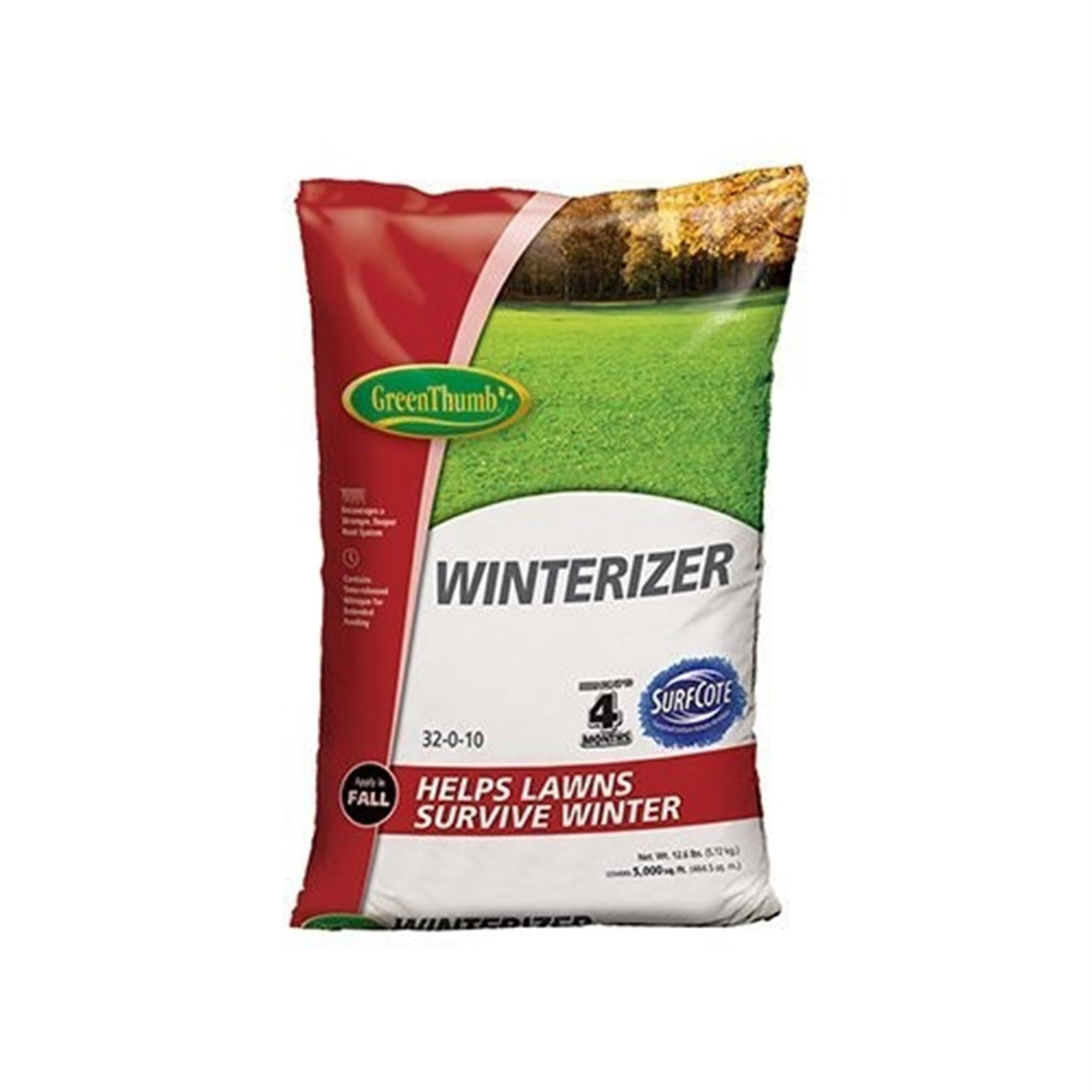
A 32-0-10 winterizer that feeds tall fescue for up to 16 weeks on one application, avoiding the surge-and-crash cycle of quick-release feeds.
Green Thumb positions this as a dedicated winterizer, and the formula backs it up: 32% total nitrogen (half of it controlled-release) plus 10% potassium and 2% iron for deep greening. The controlled-release nitrogen means the grass gets steady nutrition across the entire fall and into early winter. One owner applied it in late November and reported that “springtime green up was just as promised,” which is exactly the long-game approach tall fescue needs.
The bag covers up to 5,000 square feet and weighs 12.6 pounds, sitting right between the smaller Scotts bag and the heavier GreenView options. The 32-0-10 ratio is high-nitrogen compared to the others here, so it is best applied after the lawn has stopped growing vigorously in late fall. The powder form spreads cleanly through a rotary spreader, and the 2% iron gives a visible color boost that helps the lawn look healthy even as temperatures drop.
Why It Stands Out
- 50% controlled-release nitrogen delivers steady feeding for 16 weeks.
- 2% iron provides visible greening without extra nitrogen burn.
- One bag covers a 5,000 sq. ft. lawn completely.
The Catch
- High nitrogen means you need precise fall timing — apply too early and you push leaf growth instead of roots.
Great for: owners who want a single fall application that carries the lawn through winter with minimal follow-up.
Skip if: you prefer a lower-nitrogen, higher-potassium ratio for root-specific feeding.
4. The Andersons Premium Fall Lawn Food 24-0-14 Fertilizer, 5,000 sq ft Bag
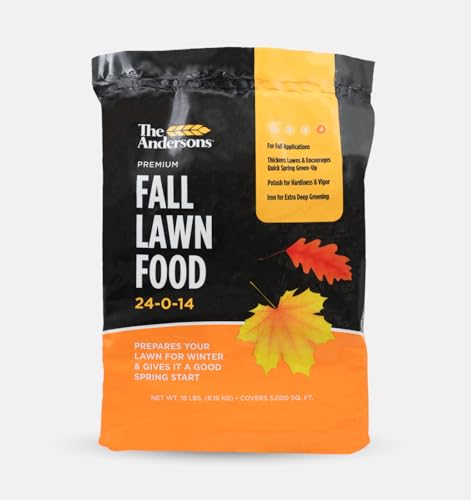
The three-speed nitrogen system that greens up fast and keeps feeding for months — one owner saw results in three days.
The Andersons uses a unique blend of quick-, intermediate-, and slow-release nitrogen in its 24-0-14 formula. That means you get visible green within days — something owners consistently rave about, with one reporting their lawn greened up in three days — but the feeding does not stop there. The slower-release beads keep delivering nutrients across the season, so the grass builds root depth for winter while still looking healthy in the moment. “This is the best fertilizer I have ever used” is a common refrain in the feedback, with multiple owners calling the results superb.
The 18-pound bag covers 5,000 square feet, the same footprint as the Green Thumb but noticeably heavier because of the dense granular blend. The 24-0-14 ratio gives you a solid 14% potassium, which is higher than the Green Thumb’s 10% and more aligned with what cold-weather root prep needs. The added iron deepens the green without pushing excessive top growth. It is safe for all turf types, so it blends into any tall fescue stand without worry.
What Shines
- Triple-release nitrogen: fast green in days plus extended feeding.
- Higher potassium (14%) supports strong winter root storage.
- Owners consistently rate it the best fertilizer they have used.
Consider This
- 18 lb bag is heavier than most competitors for the same 5,000 sq. ft. coverage.
Best for: the detail-oriented owner who wants immediate visible results AND season-long root feeding from one bag.
Think twice if: you need more than 5,000 sq. ft. of coverage from a single bag — the GreenView options stretch further.
5. GreenView Fairway Formula Fall Lawn Fertilizer, 22.5 lb

The 22.5-pound bag that covers 7,500 square feet with a phosphate-free, slow-release formula — compared to the Scotts WinterGuard’s 4,000 square feet.
GreenView Fairway Formula brings the largest single-bag coverage here at 7,500 square feet, making it the right choice for quarter-acre and larger tall fescue lawns. The 30-0-12 ratio delivers high nitrogen (30%) backed by 12% potassium, and 59% of that nitrogen is slow-release — one of the highest controlled-release percentages in this roundup. That means the feeding window stretches to 12 weeks, bridging the gap between a late-October application and early-spring green-up. The formula contains zero phosphate, which is an environmentally conscious choice for lawns near waterways.
Owners who switched from Scotts to GreenView report dramatic improvements: one owner noted that a single fall application produced a “deep green color within 2 weeks, lasting through winter into late spring.” The moisture-proof packaging also gets consistent praise — the granules pour without the clumping that plagues some other brands when stored in humid conditions. At 22.5 pounds, it is heavier than most, but you are carrying one bag covering 7,500 sq. ft. versus a typical 4,000 sq. ft. bag.
Top Strengths
- 7,500 sq. ft. coverage from a single bag — best for larger lawns.
- 59% slow-release nitrogen feeds up to 12 weeks without burn risk.
- Moisture-proof bag prevents the clumping that frustrates owners.
Trade-Off
- Premium price point reflects the higher coverage and controlled-release technology.
Grab this for: a larger tall fescue lawn where one-and-done coverage and steady winter feeding matter most.
Not ideal if: your yard is under 4,000 sq. ft. — you will have leftover product to store.
6. GreenView Fall Lawn Food, 48 lb Bag, Covers 15,000 sq. ft.

The 48-pound bag that covers 15,000 square feet — compared to the Scotts WinterGuard’s 4,000 square feet.
When your lawn stretches beyond 10,000 square feet, carrying multiple small bags is a chore. GreenView solves that with a 48-pound bag that covers 15,000 square feet — compared to 4,000 sq. ft. for Scotts WinterGuard and 7,500 sq. ft. for Fairway Formula. The 22-0-10 NPK ratio is slightly lower in nitrogen than the Fairway Formula, but the GreenSmart Enhanced Efficiency coating extends the feeding window to 8 weeks, which is plenty for a fall-to-early-winter schedule. The potassium sits at 10%, which supports root building without going overboard.
Owner feedback highlights the GrassSmart technology as a real advantage: the coating releases nutrients in response to soil temperature and moisture, so the lawn gets fed when it can actually use the nutrients. “Works great! Easy to apply, thickens lawn with great appearance,” one long-time buyer reports. The 48-pound weight is significant — you will want a wheeled spreader or a strong shoulder for this one — but the per-square-foot cost is lower than buying two smaller bags of comparable quality.
The Big Advantage
- 15,000 sq. ft. coverage handles large properties in one bag.
- Temperature-responsive coating releases nutrients only when grass is actively growing.
- Consistent owner ratings highlight good quality and effectiveness.
The Weight Reality
- 48 pounds is physically demanding — you need a sturdy spreader.
Perfect for: owners with half-acre or larger tall fescue lawns who want the best cost per square foot.
Overkill for: small urban lawns under 5,000 sq. ft. where a lighter bag is easier to store and handle.
7. Jonathan Green Winter Survival Fall Lawn Food, 45 lbs, 10-0-20

The highest-potassium formula here at 20% K, built specifically for extreme winter survival — it flips the typical fall fertilizer script.
Jonathan Green’s Winter Survival is the specialist of this list. The 10-0-20 ratio flips the typical fall fertilizer script — instead of leading with high nitrogen, it puts potassium front and center at 20%. For tall fescue heading into a harsh winter, that high potassium content drives deep rooting and nutrient storage like nothing else here. An owner who applied it in early November in the Northeast US reported that by mid-December the treated front lawn was “significantly healthier than untreated back yard.” The 45-pound bag covers 15,000 square feet, matching the largest GreenView bag but with a completely different nutrient strategy.
The feedback is split in an honest way: owners love the appearance and quality, but growth results are more mixed — because the formula prioritizes root storage and winter hardiness over pushing new leaf blades. One buyer mentioned that “newer grass died off anyway,” which can happen when high potassium is applied without enough nitrogen to sustain young seedlings. This is a product for established tall fescue that just needs to survive and store energy, not for overseeding projects where you want fast top growth.
The Standout Feature
- 20% potassium — the highest in this guide — for maximum winter root storage.
- 45 lb bag covers 15,000 sq. ft., ideal for large established lawns.
- Owners consistently rate it better than big-brand alternatives for cold-weather prep.
Who Should Pause
- Low nitrogen (10%) means it is not the best choice for lawns that need leaf growth or overseeding recovery.
Reach for it when: you have an established tall fescue lawn heading into a freezing winter and root hardiness is your #1 priority.
Skip it for: a spring overseeding project where young grass needs higher nitrogen to establish.
Understanding the Specs
N-P-K Ratio and What the Numbers Mean
The three digits on any fertilizer bag stand for the percentages of nitrogen (N), phosphorus (P), and potassium (K) inside. Nitrogen drives leaf and blade growth — the green you see within days of application. Phosphorus supports root development in new seedlings, but most established lawns do not need extra phosphorus. Potassium strengthens cell walls, improves disease resistance, and helps the grass store carbohydrates for winter. For tall fescue in the fall, you want a higher third number (10 to 25) and a moderate first number (20 to 30). The products here range from 10-0-20 (low N, high K) to 32-0-10 (high N, moderate K), so your choice depends on if you need blade growth or root storage more.
Slow-Release vs. Quick-Release Nitrogen
Quick-release nitrogen dissolves immediately in water and gives the lawn a fast green flush — useful for a quick cosmetic boost but risky if applied too late in the season (the grass cannot use it all before dormancy, and the excess washes away). Slow-release nitrogen, sometimes labeled as controlled-release, polymer-coated, or sulfur-coated, breaks down gradually over weeks or months as soil bacteria or moisture activate each granule. The Green Thumb GT58105, for example, has 50% controlled-release nitrogen and feeds for up to 16 weeks. The GreenView Fairway Formula uses 59% slow-release nitrogen for a 12-week window. A higher slow-release percentage means fewer applications and less risk of burning the lawn.
FAQ
When should I apply fall fertilizer to tall fescue?
Can I use a regular lawn fertilizer on tall fescue in the fall?
How much fall fertilizer do I need per 1,000 square feet of tall fescue?
Should I water after applying fall fertilizer to tall fescue?
What is the difference between a winterizer and a standard fall fertilizer?
Will high-potassium fertilizer turn my tall fescue dark green?
Can I apply fall fertilizer to newly seeded tall fescue?
How do I store an opened bag of fall fertilizer for tall fescue?
Is the GreenView Fairway Formula better than the Scotts WinterGuard for tall fescue?
Can I mix liquid and granular fall fertilizers for my tall fescue lawn?
Final Thoughts: The Verdict
For most owners, the fall fertilizer for tall fescue winner is the Scotts Turf Builder WinterGuard because it combines proven root-building results, simple granular application, and a trusted formula that works on any grass type — including shade-stressed fescue. If you want a longer feeding window with high slow-release nitrogen for a larger lawn, grab the GreenView Fairway Formula. And for extreme winter protection on an established lawn where root storage matters more than blade growth, the Jonathan Green Winter Survival is the specialist to reach for.
How We Picked
We do not accept paid placement. Every pick is matched to a real buyer and a real use-case; we do not hands-on test units.
Sources & Methodology
Specifications: manufacturer listings and product documentation. Review insights: verified customer reviews, as of July 2026. Pricing: not shown on this page (it changes often); check the current price via the retailer link.
As an Amazon Associate, WellFizz earns from qualifying purchases. This does not affect which products we feature.
Related Guides

Mo Maruf
I created WellFizz to bridge the gap between vague wellness advice and actionable solutions. My mission is simple: to decode the research and give you practical tools you can actually use.
Beyond the data, I am a passionate traveler. I believe that stepping away from the screen to explore new environments is essential for mental clarity and physical vitality.