Our readers keep the lights on and my smoothie glass nicely filled. As an Amazon Associate, I earn from qualifying purchases.
Specs are compiled from manufacturer listings and verified buyer reviews and can change over time — please confirm the key details on the product page before buying.
Plugging in at home should be as simple as parking, not a project. The real headache isn’t the car — it’s wading through amps, connector types, and confusing “hardwired versus plug” debates when all you want is a full battery by morning. This guide skips the marketing noise and focuses on what matters: how fast your EV actually charges, whether the thing survives rain or snow, and which models owners are happiest with long-term.
I’m Mohammad Maruf — the founder and writer behind WellFizz. This guide is built by comparing the manufacturers’ published specifications and the patterns across verified customer reviews, so you get each pick’s real strengths and trade-offs instead of marketing spin.
Whether you drive a Tesla, a Ford F-150 Lightning, or a Hyundai Ioniq 5, the best electric vehicle charger for your home balances raw charging speed with build quality and smart features you’ll actually use.
Our Picks at a Glance

How To Choose The Best Electric Vehicle Charger
Buying your first Level 2 charger is a big step — it’s a piece of equipment you’ll likely use every single day for years. Getting the wrong one means slow top-ups, frustrating app glitches, or a unit that can’t handle the weather outside your garage. Here are the three specs that cut through the confusion.
Amperage: 40A vs 48A
This single number controls how fast your car fills up. A 40-amp charger (9.6 kW) gives you about 30 miles of range per hour. A 48-amp charger (11.5 kW) pushes that closer to 46 miles per hour. The catch: 48A requires a hardwired installation on a dedicated 60-amp breaker, which means hiring an electrician. Many people are perfectly happy with 40A over a NEMA 14-50 plug — it’s simpler and still charges most EVs fully overnight.
Connector Type: J1772 vs NACS
Almost every non-Tesla EV in North America uses the J1772 connector. Teslas use the NACS (North American Charging Standard) port. Many chargers come in one flavor or the other, and you can always use a small adapter to cross over. If you own a Tesla now and might buy a Ford or Chevy later, a J1772 charger with a Tesla adapter (sold separately) gives you the most flexibility.
Weatherproofing and Build
A charger mounted outside your house faces rain, snow, sun, and dust. Look for an NEMA 4 or IP66 rating — that means the electronics are sealed against hose-directed water and ice. A metal enclosure (like the ones from Grizzl-E or EVIQO) dissipates heat better and won’t crack in freezing temperatures. A plastic case may be fine inside a garage, but it’s risky for exposed outdoor walls.
Quick Comparison
| Model | Best For | Max Amperage | Connector | Weather Rating | Amazon |
|---|---|---|---|---|---|
| EVIQO EVIPOWER-2★ Best Overall | All-around top pick | 48 A (50 A selectable) | NACS | IP66 / NEMA 4 | Amazon |
| VEIPHLOX UC101Best Value | Simple plug-and-charge | 40 A | J1772 | IP65 | Amazon |
| NexCyber ZB04-U011KBH-F017Top Performer | 48A with touchscreen | 48 A | J1772 | NEMA Type 3 | Amazon |
| LENZ EVSE-W1-40-A | No-app simplicity | 40 A | J1772 | NEMA 4X / IP67 | Amazon |
| ApexCharger Mach 1 | Universal with Tesla adapter | 40 A (48 A hardwire) | J1772 + NACS adapter | Outdoor enclosure | Amazon |
| Grizzl-E Classic Connect | Rugged outdoor metal case | 40 A | NACS | NEMA 4X | Amazon |
| WOLFBOX E50(48) | Feature-dense display | 48 A | J1772 | NEMA 4 | Amazon |
| Sapphire Pro ICACH50-S | Native NACS or J1772 | 40 A (48 A hardwire) | NACS / J1772 selectable | NEMA 4 | Amazon |
| EMPORIA EMEVSE1 | Smart integration & cost tracking | 48 A | J1772 | Indoor / outdoor (no rating listed) | Amazon |
| ChargePoint CPH50-HARDWIRE-L23-NACS | Network + app ecosystem | 50 A | NACS | Indoor / outdoor with cold-resistant cable | Amazon |
| Autel Maxi US AC W12-H | Highest-spec home charger | 50 A | J1772 | NEMA Type 4 | Amazon |
In‑Depth Reviews
1. EVIQO EVIPOWER-2 Level 2 EV Charger NACS 48A
Our pick — over 4.5★ from 300+ verified ratings; the strongest balance of quality and price.
The hardwired champ that charges a VW ID.4 in 5-7 hours without a second thought.
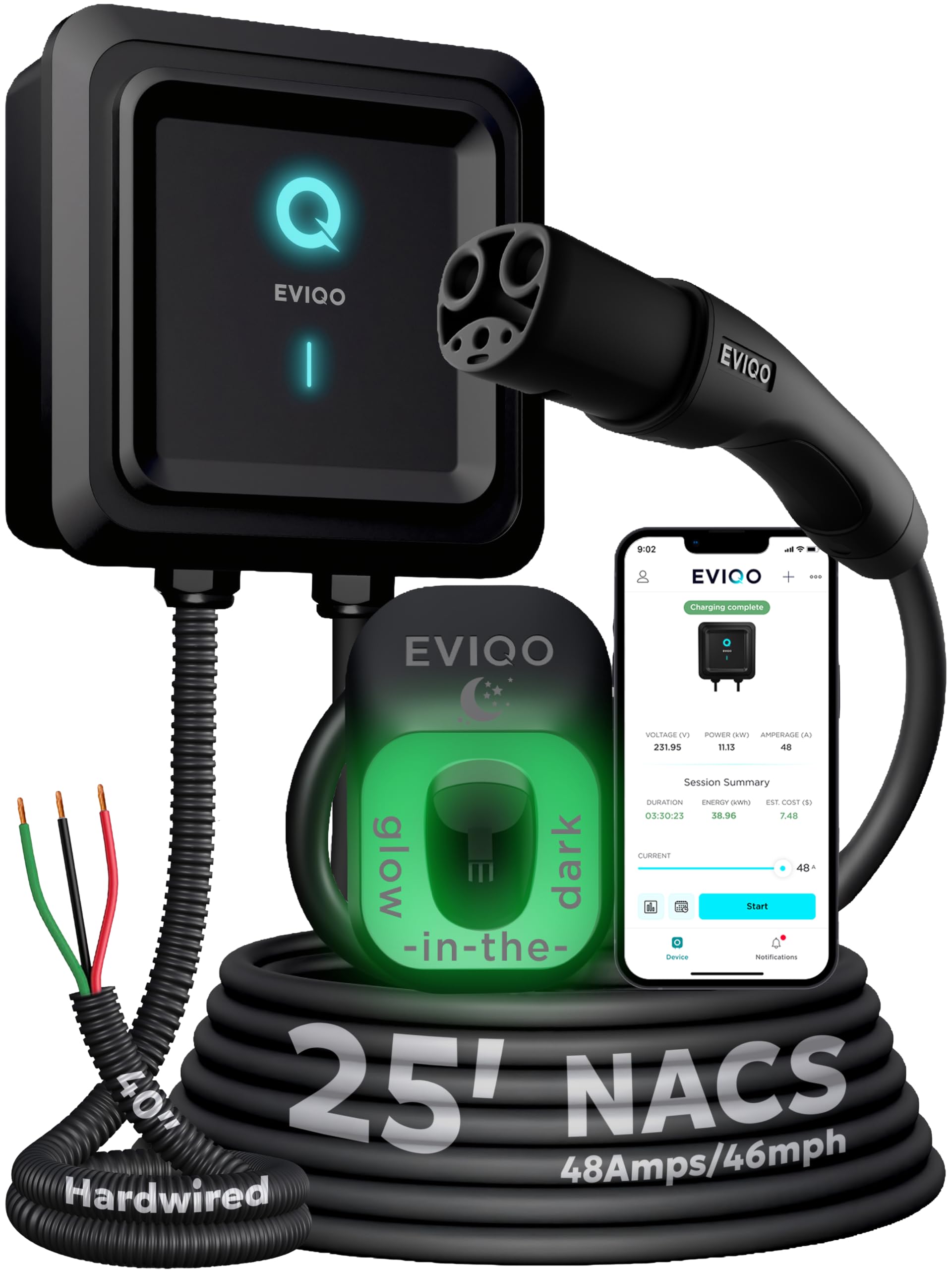
This is the unit owners rave about most — functionality and quality are the two most-discussed aspects by a wide margin. The EVIQO delivers up to 48 amps on a dedicated 60-amp circuit, and if you flip the DIP switches to positions 4 and 5, it open up 50 amps on a 70-amp circuit. That’s enough headroom to handle the next EV you buy. The glow-in-the-dark fluorescent holster is a thoughtful touch: it absorbs light for about 10 minutes and stays bright enough to find the connector in a dark garage.
What wins people over is the app. It tracks your consumption and cost per charge, lets you adjust the current from 6 to 48 amps, and connects to 2.4 GHz WiFi reliably even from a basement. Owners say the interface is intuitive and the charger stays online without dropouts. At 18.86 pounds, it’s substantially heavier than the 15-pound plug-in models — that extra mass comes from the steel mainboard shielding and the IP66/NEMA-4 weatherproof enclosure, which handles rain, snow, and dust without complaint.
The trade-off: this is a hardwired unit, which means you must hire a licensed electrician. It’s also built for NACS (Tesla-native) ports. If you own a J1772 vehicle, you’ll need an adapter. But for a Tesla owner who wants the fastest possible home charging in a package that looks and feels premium, this is the one.
What wins people over
- Adjustable 6-48A output with a 50A DIP-switch option for future-proofing
- App tracks kWh and cost per charge smoothly
- Fluorescent holster makes late-night plug-ins easy
- UL, ETL, FCC, and Energy Star certified
The honest downsides
- Hardwired only — requires an electrician and a 60A or 70A breaker
- Native NACS connector (Tesla); J1772 vehicles need an adapter
- Soft plastic on the connector scratches easily with rough handling
The surest bet for Tesla owners: If you want the fastest overnight charging with a rock-solid app and a weatherproof shell that will outlast your current car, this is the pick to beat. Think twice if: you have a non-Tesla EV and don’t want to mess with adapters, or you prefer a simple plug-in install you can do yourself.
2. VEIPHLOX UC101 J1772 Level 2 EV Charger 40 Amp
The no-fuss 40-amp unit that turns your existing dryer outlet into a charging station in 5 minutes.
Some people want an app, scheduling, and a dashboard. Others just want to plug in and walk away. This VEIPHLOX is for the second group. It connects to a standard NEMA 14-50 outlet (the same one your electric range or RV uses) and delivers a full 40 amps at 9.6 kW without any configuration whatsoever. The color-coded LED ring tells you the status at a glance: blue means ready, green blinking means charging, solid green means done. That’s it.
Owners consistently praise the build — the NEMA 14-50 plug stays cool even after three hours of continuous use, which is a sign of solid internal engineering. The 25-foot cable is flexible enough to coil neatly on the integrated holder, and the whole unit weighs 15 pounds, making it much lighter than the hardwired EVIQO. The IP65 waterproof housing means it’s fine outdoors, though most owners recommend keeping it under cover for longevity.
The catch is the intentional simplicity. There’s no app, no WiFi, no scheduling. If you want to charge during off-peak hours, your car’s built-in timer must handle that. And the J1772 connector means Tesla owners will need an adapter. But for anyone with a J1772 EV who just wants fast, reliable charging at the lowest possible price, this is the most straightforward option on the list.
Satisfyingly simple: Plug it into a 14-50R outlet, mount it on the wall with two screws, and you’re charging at 40 amps in under 10 minutes. The one limitation: No app means no remote start/stop or cost tracking — you trade smart features for bulletproof simplicity and a lower entry price.
3. NexCyber ZB04-U011KBH-F017 Level 2 EV Charger 48A
A 48-amp workhorse with a built-in touchscreen that works even without the app.
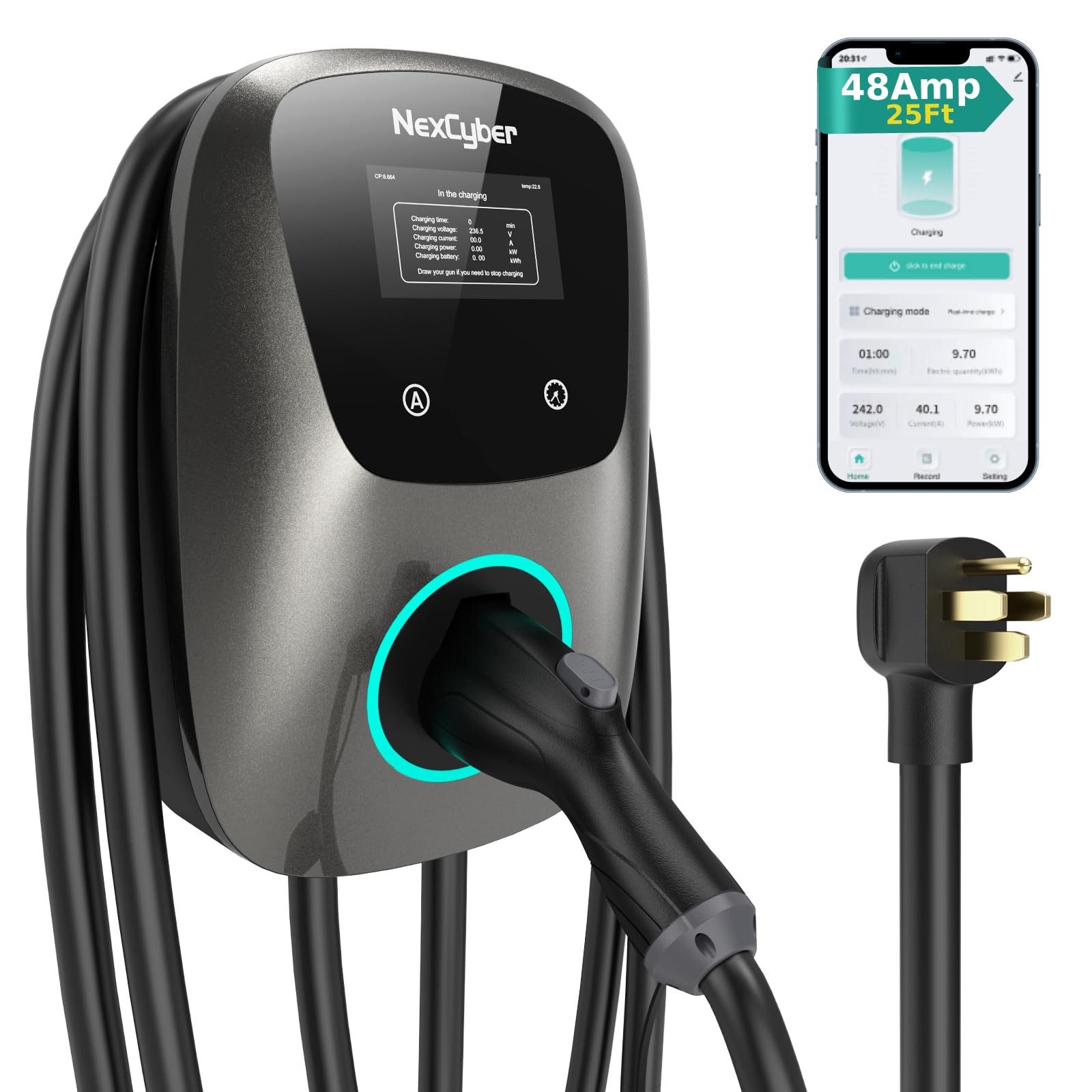
What sets the NexCyber apart is its on-device display. You don’t need a phone to set the amperage (16 to 48 amps), schedule a delayed start, or see real-time charging speed — you do it all on the 4.3-inch LCD screen. That’s a genuine advantage if your garage has weak WiFi or you just don’t want another app on your phone. The unit also comes with a WiFi app for those who want remote monitoring, cost tracking, and push notifications.
You get reliable, easy charging here. Owners say the plug-and-play NEMA 14-50 (a standard 240-volt outlet) installs in under an hour, and the 40-amp charging (up to 38 miles per hour) fills most EVs overnight. The ETL, FCC, and Energy Star certifications (safety and efficiency standards) give you confidence, and the 3-year warranty matches better-known brands. The 25-foot military-grade cable is rated for over 10,000 insertions, so it should outlast the charger itself.
The downside: the app isn’t the most polished. Owners find it functional for monitoring and scheduling but note the user interface could be cleaner. The NEMA Type 3 weatherproofing (a basic weather-resistance rating) is less sturdy than the IP66 (dust-tight and water-jet resistant) of the EVIQO — the maker doesn’t recommend direct sunlight or rain exposure. It’s best suited for a covered garage installation.
Where it shines
- On-unit touchscreen eliminates phone dependency
- Plug-and-play with NEMA 14-50, but configurable down to 16A
- 25ft cable rated for 10,000+ charge cycles
- ETL, FCC, and Energy Star certified
Where it compromises
- NEMA Type 3 rating: keep it out of direct rain
- App interface feels basic compared to EVIQO or Emporia
- J1772 only — Tesla needs an adapter
Reach for this if: you want a 48-amp charger with a physical display so you can adjust settings without pulling out your phone. Look elsewhere if: the charger will live in an uncovered outdoor spot, or you want the most polished app experience.
4. LENZ EVSE-W1-40-A Level 2 Home EV Charger 40A

A rugged, no-app-needed 40-amp charger with an IP67 rating that shrugs off the worst weather.
If the VEIPHLOX is the simple indoor option, the LENZ is its weather-ready cousin. The NEMA 4X and IP67 enclosure means it’s fully sealed against corrosion, dust, and hose-directed water — it can even survive temporary submersion. That makes it the ideal choice for a charger mounted on an exterior wall with no overhang. The operating temperature range of -22°F to 122°F means it works in Canadian winters and Arizona summers alike.
Installation is the single most-praised aspect: owners say it takes about five minutes to wall-mount, and the unit is pre-set to 40 amps (about 39 miles per hour) right from the start. There’s no app, no WiFi, no RFID — just a J1772 connector and a 24-foot cable that coils easily even in cold rain, as one owner noted after a 3.5-hour session in 36°F weather. The LENZ also includes a wall-mounted holster for the handle, keeping it tidy when not in use.
The 15-pound weight is identical to the VEIPHLOX, but the LENZ feels denser because of the corrosion-resistant metal build. The trade-off is the same as the VEIPHLOX: no smart features. If time-of-use scheduling and cost tracking matter to you, this isn’t the right unit. But for pure, reliable charging in harsh conditions, it’s tough to top.
The outdoor specialist: IP67 and NEMA 4X mean it’s the most weather-sealed charger on this list — rain, snow, and dust are non-issues. The trade-off: Zero smart features — no app, no scheduling, no notifications. Your car handles everything.
5. ApexCharger MACH 1 Level 2 EV Charger 48A
One charger that speaks both J1772 and NACS right from the start — no adapter hunting.
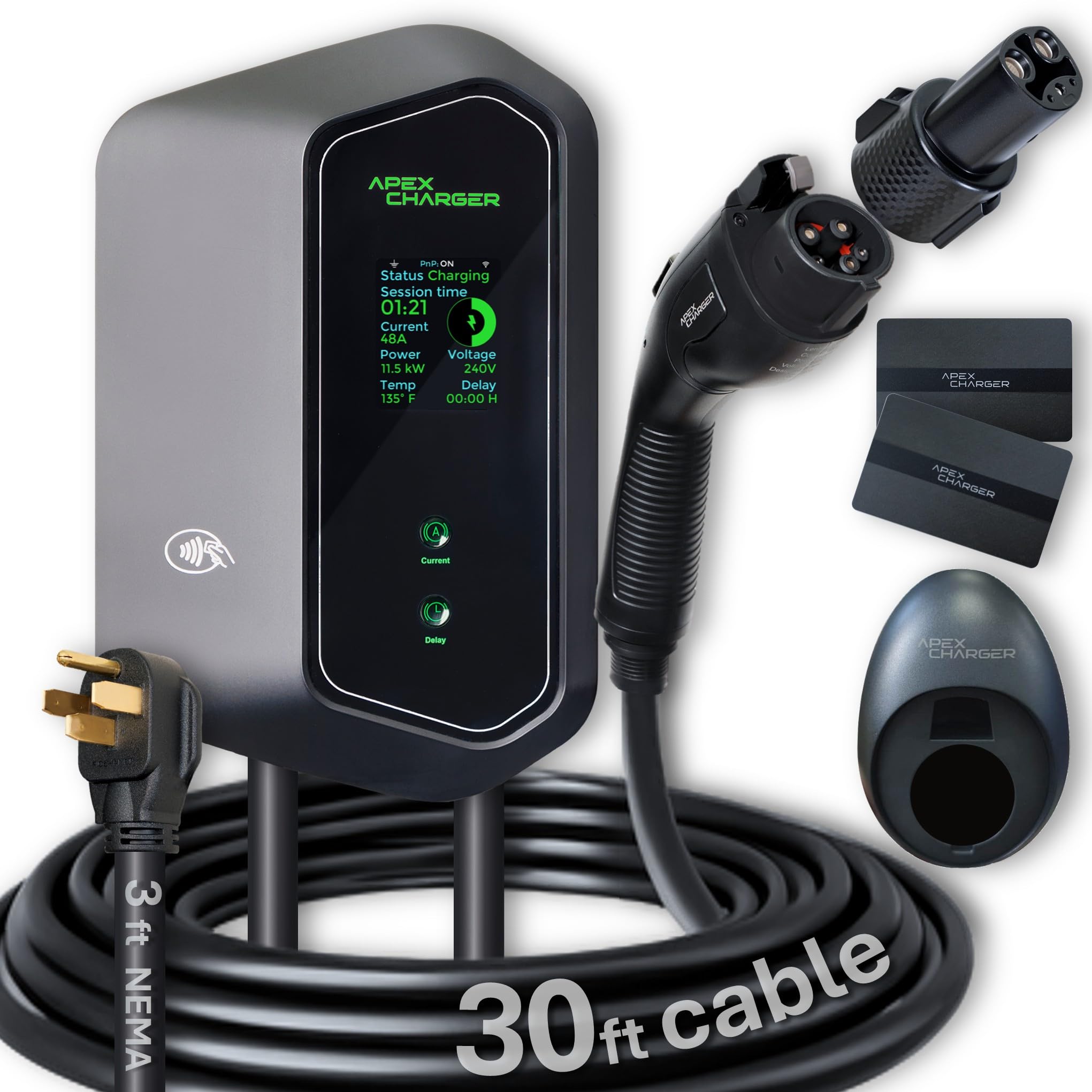
The MACH 1 solves the connector confusion by including both a J1772 cable and the exclusive PRO 1 NACS adapter in the box, along with a boutique carrying bag for the adapter. That means a Tesla owner can plug in directly, and a Rivian or Ford owner can do the same. The unit also comes with two RFID cards for access control — useful if you’re installing it in a shared driveway or rental property and don’t want random charging.
What owners really appreciate is the customer support. Multiple reviews describe getting email responses within an hour on a Sunday, and firmware updates that fix issues like “relay error” messages. The charger itself is adjustable from 0 to 48 amps, and the 30-foot cable is longer than most competitors — helpful for awkward garage layouts. The 2.4-inch LED display shows charging status and energy usage at a glance.
The main limitation is that the 40-amp version (NEMA 14-50 plug) tops out at 40 amps unless you hardwire it. The hardwire kit is included, so you can have an electrician install it for the full 48 amps on a 60-amp breaker. Some owners also note that the time-of-day scheduling in the app can’t select individual days, which is a minor annoyance for weekly scheduling.
Strengths
- Includes NACS adapter for Tesla — no separate purchase needed
- 30ft cable is the longest in this roundup
- RFID cards add access control for shared use
- Responsive US-based customer support praised by owners
Weaknesses
- App scheduling lacks individual day selection
- 40A plug-in limited; full 48A requires hardwire install
- Some initial firmware bugs that required updates
Ideal for multi-EV households: If you own a Tesla and a J1772 car, this one charger covers both without adapters. Consider another pick if: you need granular daily scheduling in the app, or you want to avoid any initial setup quirks.
6. Grizzl-E Classic Connect 40A Level 2 EV Charger

The legendary Canadian-built metal box that survives snow, sleet, and being run over by a truck.
The Grizzl-E name has a cult following for one reason: the NEMA 4X heavy-duty metal enclosure is virtually indestructible. This isn’t a plastic box — it’s a die-cast aluminum case that’s water-tight, fire-resistant, and rated for any outdoor condition. The “Classic Connect” version adds WiFi and the Grizzl-E Connect software, which gives you real-time monitoring, charging schedules, and energy consumption stats through the app. A one-time activation fee applies for the OCPP premium features.
Owners say the charger itself is rock-solid. The 25-foot cable is thinner than previous Grizzl-E models, making it easier to coil, and the heavy-duty EasyEvPlug holster holds the connector securely. The adjustable amperage (16 to 40 amps) means you can dial it down if your home’s electrical panel can’t handle the full load. It’s CSA certified and eligible for federal rebate programs in the US.
The app, however, is the weak link. Multiple buyers report difficulty connecting to WiFi — one review notes the app rejects passwords with spaces, requiring a separate SSID. Another owner found the power cord is only 18 inches long, which made placement difficult if the outlet wasn’t perfectly positioned. If you want a charger that works flawlessly without the app, the Grizzl-E delivers. If you need the app features, you might find it frustrating.
class-leading durability: The NEMA 4X metal enclosure (a weatherproof and corrosion-resistant housing) is the toughest on this list — it’s built for commercial-grade outdoor use and shrugs off physical abuse. The catch: The WiFi setup is finicky; expect to spend some time getting the app connected, or just use it as a dumb charger and let your car handle scheduling.
7. WOLFBOX E50(48) Level 2 EV Charger 48A

A 48-amp hardwired charger with a big screen, voice control, and a price that undercuts the competition.
The WOLFBOX packs more features per dollar than almost any other charger here. The large 4.3-inch LCD screen shows charging rate, time, voltage, and total energy delivered — and it’s easy to read from across the garage. The app integrates with Alexa and Google Assistant, so you can start or stop charging with a voice command. It also supports Google account login and device sharing, so everyone in the house can control it.
At 13.45 pounds, it’s noticeably lighter than the 18.86-pound EVIQO, yet it delivers the same 48-amp (11.5 kW) output, adding 46 miles of range per hour. The CSA certification and NEMA 4 waterproof housing mean it’s safe to install outdoors. Owners with Rivian R1S and Chevy Equinox EV report consistent performance, with one noting the charger temperature maxed out at 117°F — well within safe limits.
The WiFi connectivity receives mixed feedback. Some owners had to reset the breaker to get the app to connect initially. The hardwire cable is short, which may complicate placement if your electrical panel isn’t nearby. And the price has increased by about since launch, which narrows the value gap with more established brands. Still, at this feature level, it’s a compelling option.
What stands out
- Large 4.3-inch LCD shows all charging data at a glance
- Alexa and Google Assistant voice control
- Lightweight at 13.45 lbs compared to 18.86 lbs for the EVIQO
- Configurable via DIP switches to 40A
Potential drawbacks
- WiFi setup can be glitchy; may require a breaker reset
- Hardwire cable is short — plan placement carefully
- App lacks detailed cost/range calculation instructions
Best for tech enthusiasts: If you want voice control, a big display, and device sharing at a mid-range price, this is a strong contender. Pass if: you want a set-and-forget charger — the WiFi setup may need troubleshooting.
8. Sapphire Pro ICACH50-S Level 2 EV Charger 40A
A future-proofed charger you can order with either a NACS or J1772 connector — no adapters necessary.
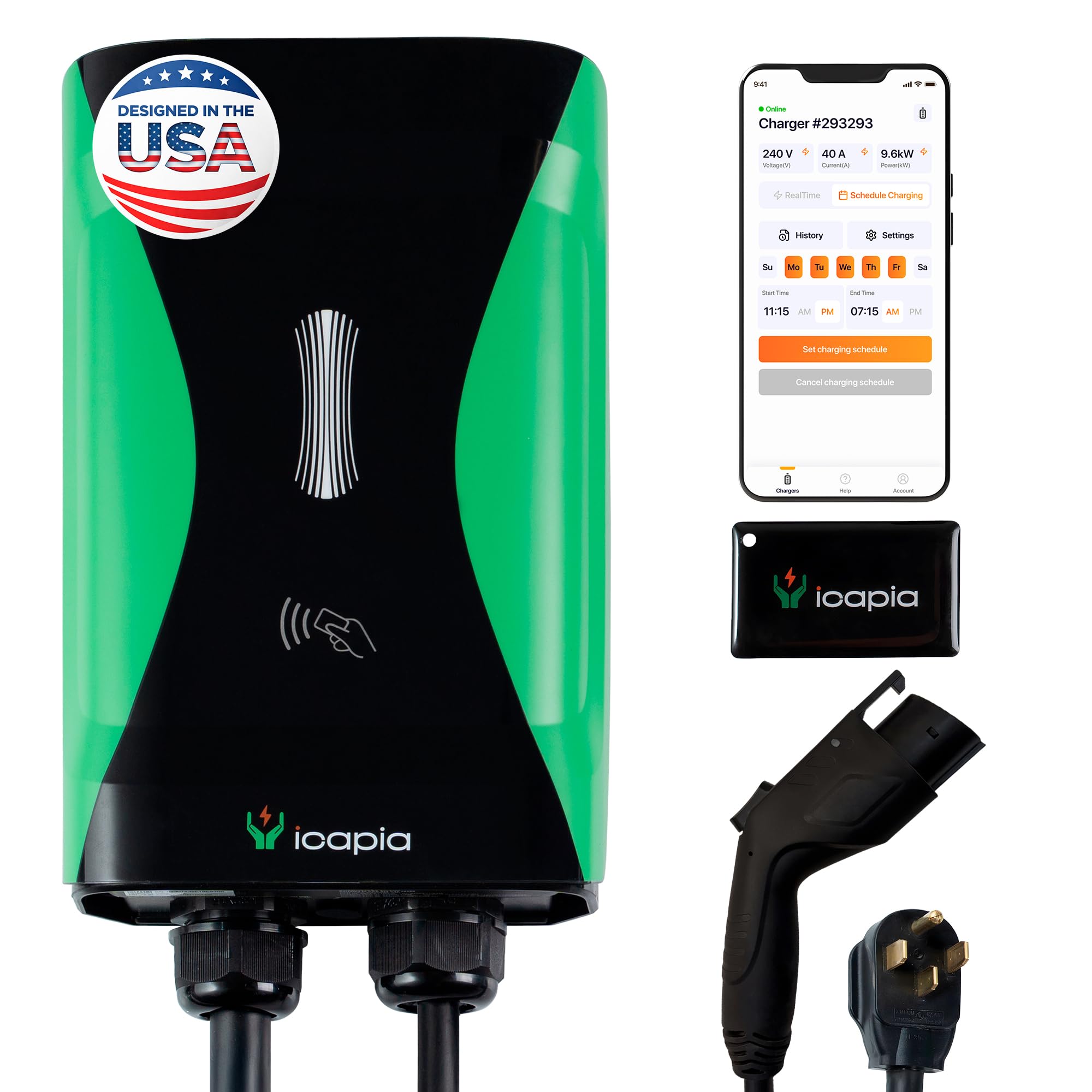
The Sapphire Pro is designed for buyers who want a single charger that works perfectly with their specific vehicle from day one. You choose the connector at purchase — native NACS for Tesla or native J1772 for everything else — so there’s no adapter to lose or forget. The unit is OCPP 1.6 compliant, which is the industry standard for advanced charging networks, meaning it can integrate with utility demand-response programs and third-party management software.
Owners consistently praise the build quality and the responsive customer support from ICAPIA. The NEMA 4 weatherproof enclosure handles temperatures from -22°F to 122°F, and the 25-foot cable reaches most parking spots comfortably. The multi-color LED status indicator lets you check the charging status from across the driveway. Connectivity is the most-discussed positive aspect, with the WiFi and Bluetooth pairing described as reliable once the initial setup (which may require holding the A button for 10 seconds to reset) is complete.
The main caveats are minor but worth noting. Some units ship with the mounting plate missing — owners had to improvise. And a small number of users report the charger occasionally gets stuck in delayed-start mode, requiring a reboot. The 3-year warranty and responsive support team mitigate these issues, but it’s not as polished out-of-the-box as the Emporia or EVIQO.
Future-proof and flexible: OCPP 1.6 compliance makes it compatible with utility rebate programs and smart grid integration. The early-adopter pinch: A few owners mention missing parts or software glitches that require a support call — nothing deal-breaking, but worth knowing.
9. EMPORIA EMEVSE1 Level 2 EV Charger 48A
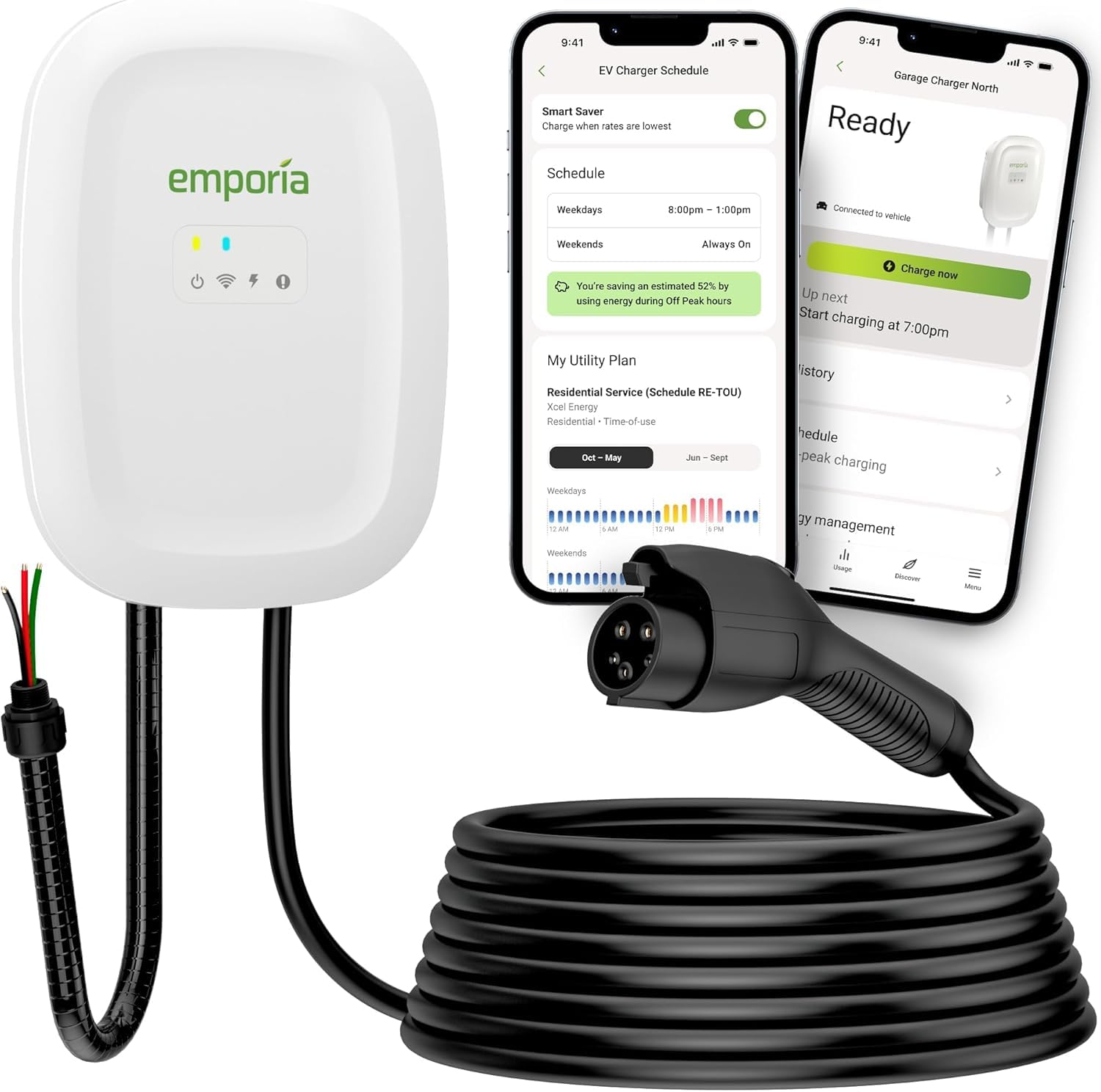
The 48-amp charger that doubles as a whole-home energy monitor when paired with the Emporia Vue.
This is the charger for data nerds and energy optimizers. The Emporia app doesn’t just track charging — it shows you kWh and dollars spent per charge and per month. If you also install the Emporia Vue energy monitor (sold separately), the system can enable solar-only charging (charge your EV exclusively from solar panels), demand limiting, and load control. One commercial owner reported saving in demand fees over three years using this system.
On its own, the Emporia is a strong 48-amp hardwired charger. It’s UL listed and ENERGY STAR certified (safety and efficiency standards). Customers note full charges in 4-5 hours for an Ioniq 5 and about 1 hour for a Sportage PHEV (plug-in hybrid electric vehicle). The 25-foot cable and wall-mounted holster keep things organized. The app allows current throttling (adjusting the charging speed), time-of-use scheduling, and smooth reconnection after power outages.
The one notable gap is the lack of a specific outdoor weather rating published in the specs. While many owners install it outdoors, the Emporia doesn’t carry an explicit NEMA or IP rating. For a charger installed inside a garage, it’s perfect. For an exposed outdoor wall, the EVIQO or LENZ are safer bets.
Why owners love it
- Integrates with Emporia Vue for solar-only charging and load management
- App tracks dollars spent per charge and per month
- UL listed and ENERGY STAR certified
- Scheduling and current throttling are smooth
Considerations
- No explicit IP or NEMA weather rating — best for indoor garage use
- Does not support 277V for some commercial Tesla installations
- Hardwired only; requires an electrician
Perfect for the energy-conscious: If you have solar panels or want to track your charging costs to the penny, the Emporia ecosystem is class-leading. skip it if: the charger needs to live outside where rain and snow are daily realities.
10. ChargePoint HomeFlex CPH50-HARDWIRE NACS Level 2 EV Charger

The network-backed 50-amp charger from America’s largest public charging provider.
ChargePoint’s biggest advantage isn’t the hardware — it’s the network. The app gives you access to over 274,000 charging stations across North America and Europe, plus 565,000 roaming partner stations. You can start a charge on your home unit, then find and activate a public charger on the same app when you’re on the road. It’s a smooth experience that standalone chargers can’t match.
The HomeFlex is hardwired for NACS (Tesla) and rated at 50 amps, giving you about 37 miles of range per hour. The cold-resistant cable stays flexible in freezing temperatures, and the UL certification ensures safe operation. Owners say the installation is straightforward for an electrician, and the LED color codes are intuitive: green for power, blue blinking for charging, blue solid for done.
The glaring problem is WiFi reliability. A significant number of reviewers point out that the WiFi drops after a week or two, requiring a replacement unit. ChargePoint’s customer service has been criticized for long hold times (30+ minutes) and slow responses. The charger still works without WiFi, but you lose the app features. The newer Rev 5 units seem to fix the issue, but make sure you get fresh stock.
Best network integration: If you regularly use public charging stations and want one app for everything, ChargePoint’s ecosystem is unbeatable. The hard truth: WiFi reliability is a real gamble — if you get a bad unit, the replacement process can be frustrating.
11. Autel Maxi US AC W12-H Level 2 EV Charger 50A
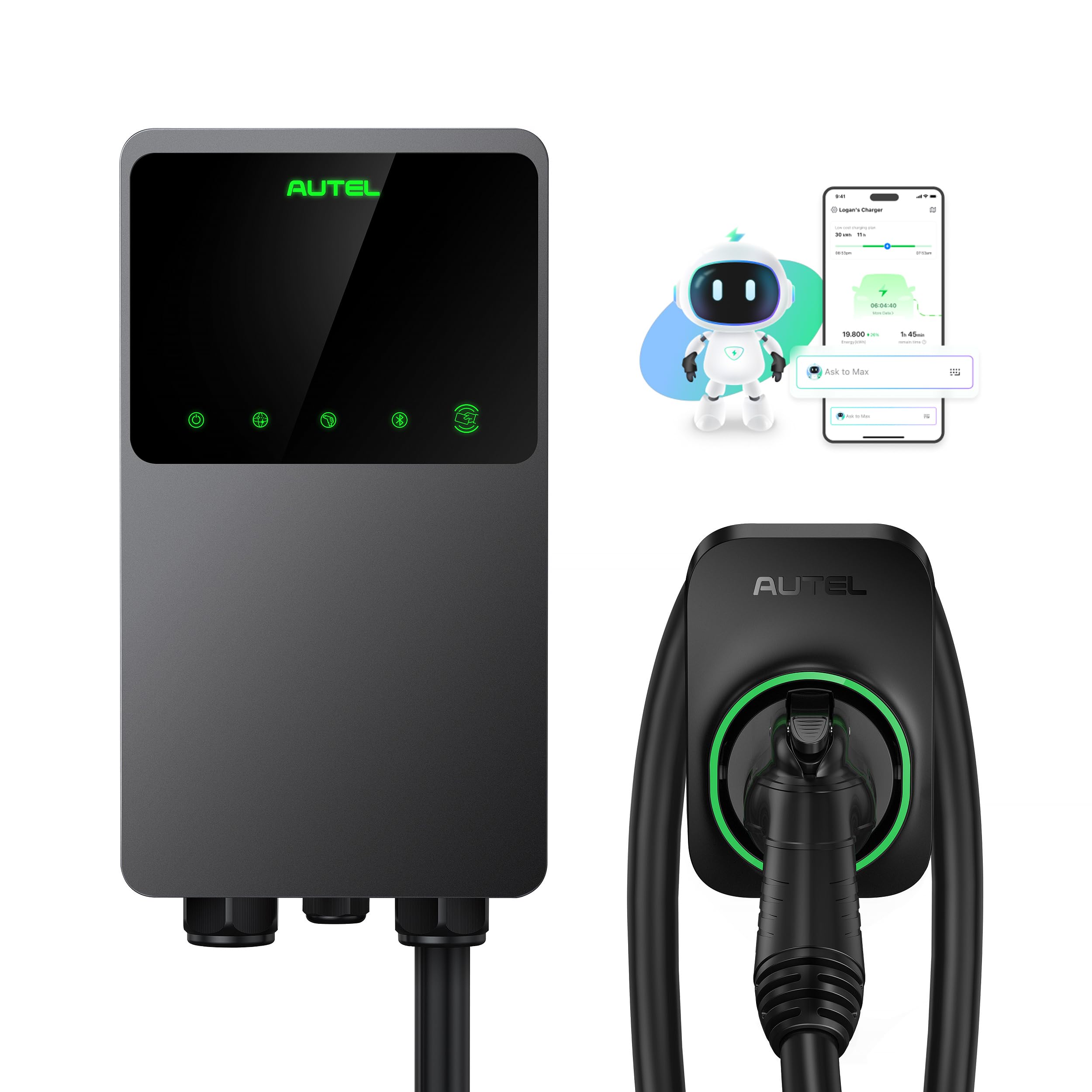
The 50-amp Autel that charges faster than almost any other home unit on the market.
At 50 amps and 12 kW, the Autel MaxiCharger AC Home is the most powerful charger in this roundup. It adds 37 miles of range per hour, and the cable is engineered to stay flexible even at -40°C (-40°F) — the same temperature rating as professional-grade commercial units. The NEMA Type 4 weatherproofing means it’s safe to install outdoors in rain, snow, and sleet. It’s CSA certified for safety and eligible for the federal rebate program.
The Autel Charge app is one of the best in the category. Owners praise its ability to configure the plug type, set the maximum current via a physical dial inside the unit, and then fine-tune it through the app. It supports WiFi, Bluetooth, and Ethernet connectivity, and over-the-air firmware updates (software updates sent wirelessly) ensure you get the latest features without a service visit. The 3-year warranty and around-the-clock support from Autel’s service team add significant confidence.
The main trade-off is the weight and bulk. At 50 amps, the unit is physically larger and heavier than most competitors, which can make mounting more challenging. Also, the physical amperage selector inside the unit is a great safety feature but can be confusing if you change it without checking the app. A small number of owners had an initial issue where the app limited the amperage to 32A despite the dial being set to 40A — resolved with tech support.
Strengths
- 50-amp, 12 kW output — the fastest Level 2 home charging available
- Cable stays flexible at -40°F, making it ideal for extreme cold
- Physical amperage dial + app control for dual-layer safety
- WiFi, Bluetooth, and Ethernet connectivity options
Weaknesses
- Physically larger and heavier than 40-amp chargers
- Amperage selector dial can conflict with app settings if not configured together
- No native NACS version — J1772 only (Tesla needs adapter)
For the speed seeker: If you have a 60-amp or 70-amp circuit available and want the absolute fastest home charging, the Autel is the top choice. Think again if: you have a Tesla and don’t want to use an adapter, or your breaker panel can’t handle a 50-amp continuous load.
Understanding the Specs
NEMA 14-50 vs Hardwired
A NEMA 14-50 outlet is the same 240-volt receptacle your electric range or RV uses. A plug-in charger connects directly to it. Hardwired means the charger’s wires connect directly to your electrical panel through a dedicated breaker. Hardwiring is safer for 48-amp continuous loads because there’s no plug to overheat — and it’s required by electrical code for circuits above 50 amps. A plug-in install is cheaper and portable; you can take the charger with you if you move.
J1772 vs NACS (Tesla)
The J1772 connector is the standard for every non-Tesla EV in North America — it’s a five-pin round plug that dates back to 2009. NACS (North American Charging Standard) is Tesla’s proprietary connector, now adopted by Ford, Rivian, GM, and others. Many new chargers let you choose which connector you want at purchase. If your next car might be a different brand, buy the J1772 version and use a small adapter for Tesla — it gives you the most future flexibility.
FAQ
Can I install a Level 2 EV charger myself?
What size breaker do I need for a 48-amp charger?
Does every Level 2 charger work with every EV?
How long does a Level 2 charger actually last?
What does “UL certified” mean for an EV charger?
Can I use a Level 2 charger outdoors in the rain?
What is the difference between 40A and 48A charging speed?
Does a smart charger really save money?
Can I share one charger between two EVs?
Final Thoughts: The Verdict
For most people, the best electric vehicle charger is the EVIQO EVIPOWER-2 because it combines the fastest 48-amp hardwired charging with a polished app, a glow-in-the-dark holster, and a fully weatherproof IP66 enclosure (dust-tight and protected against powerful water jets) that handles any climate — backed by the highest owner satisfaction in this lineup. If you want a simpler plug-in with no app fuss, the VEIPHLOX UC101 is the best value. And for energy optimizers with solar panels or off-peak rates, the EMPORIA EMEVSE1 is the one to reach for — its cost tracking and smart home integration are class-leading.
How We Picked
We do not accept paid placement. Every pick is matched to a real buyer and a real use-case; we do not hands-on test units.
Sources & Methodology
Specifications: manufacturer listings and product documentation. Review insights: verified customer reviews, as of July 2026. Pricing: not shown on this page (it changes often); check the current price via the retailer link.
As an Amazon Associate, WellFizz earns from qualifying purchases. This does not affect which products we feature.
Related Guides

Mo Maruf
I created WellFizz to bridge the gap between vague wellness advice and actionable solutions. My mission is simple: to decode the research and give you practical tools you can actually use.
Beyond the data, I am a passionate traveler. I believe that stepping away from the screen to explore new environments is essential for mental clarity and physical vitality.