Our readers keep the lights on and my smoothie glass nicely filled. As an Amazon Associate, I earn from qualifying purchases.
Specs are compiled from manufacturer listings and verified buyer reviews and can change over time — please confirm the key details on the product page before buying.
When the lights go out and the cell towers get quiet, an emergency radio becomes the single most important piece of gear in your house. The problem is that most radios on the shelf look the same but perform wildly differently when you actually need them — weak reception, fake battery claims, cranks that snap on the second turn. This guide cuts through the noise to find the emergency radios that actually keep you informed, powered, and safe when it matters most.
I’m Mohammad Maruf — the founder and writer behind WellFizz. This guide is built by comparing the manufacturers’ published specifications and the patterns across verified customer reviews, so you get each pick’s real strengths and trade-offs instead of marketing spin.
Whether you are prepping for hurricane season, building a bug-out bag, or just want confidence during a winter storm, you need an emergency radio that locks onto NOAA alerts, keeps its battery alive for days, and can charge your phone in a pinch — all without needing a wall outlet.
Our Picks at a Glance


How To Choose The Best Emergency Radio
Picking the right emergency radio depends on three things: how it gets power, how well it pulls in signals, and whether it can double as a backup battery for your phone. Here is what to focus on.
Battery Capacity — The Real Number That Matters
Look for the mAh (milliamp-hour) rating — this tells you how much energy the internal battery holds. A 4000mAh battery can charge a modern smartphone about halfway, while a 12000mAh unit can fully charge most phones two or three times and keep the radio running overnight. Some brands inflate this number, so stick to radios with verified customer feedback confirming the real-world run time.
Solar Panel vs. Hand Crank — Which is More Reliable?
A large monocrystalline solar panel (like an 8500mm² panel) charges noticeably faster than small decorative ones, even on cloudy days. Hand cranks are your fallback when there is no sun at all, but not all cranks are built the same — look for reinforced crank arms and smooth rotation. The fastest units can deliver a few minutes of radio time from just one minute of cranking.
NOAA Weather Band and Alerts
This is the main reason to buy an emergency radio instead of a regular portable. The NOAA (National Oceanic and Atmospheric Administration) weather band broadcasts live alerts for hurricanes, tornadoes, floods, and other disasters. A good radio lets you tune into all seven NOAA channels and may include a loud audible alarm that triggers automatically when a warning is issued for your area.
Quick Comparison
| Model | Best For | Battery Capacity | Charging Methods | Lighting | Amazon |
|---|---|---|---|---|---|
| Roxicosly CR1030★ Best Overall | Best Overall / Long Outages | 12000mAh | Solar, Hand Crank, USB-C, AAA | 5W Flashlight + 12-LED Lamp | Amazon |
| Rychi 10000mAhHigh-Value Pick | High Capacity for the Price | 10000mAh | Solar, Hand Crank, USB-C, AAA | 3W Flashlight + LED Lamp | Amazon |
| RunningSnail MD-090PFan Favorite | Best Value / Most Popular | 4000mAh (14800mWh) | Solar, Hand Crank, Micro USB, AAA | 3-Mode Flashlight + Motion Sensor Lamp | Amazon |
| RunningSnail 091G | DSP Chip / Clear Reception | 22200mWh | Solar, Hand Crank, USB, Battery | 3-Mode Flashlight + SOS Siren | Amazon |
| QAUYYW 74000mWh | Largest Battery Capacity | 20000mAh | Solar, Hand Crank, USB-C | 3W Flashlight + 3.5W Reading Lamp | Amazon |
| Raynic 12000mAh | Best Sound Quality | 12000mAh | Solar, Hand Crank, USB-C, USB | 5W Flashlight + Reading Lamp | Amazon |
| Mesqool 12000mAh | Premium Build / Feature Rich | 12000mAh | Solar, Hand Crank, USB-C, USB, AAA | Flashlight + Reading Lamp | Amazon |
| Eton Odyssey | All-Band / Bluetooth Speaker | 2000mAh | Solar, Hand Crank, USB-C, AAA | 3-Mode LED Flashlight + SOS | Amazon |
In‑Depth Reviews
1. Roxicosly CR1030
Our pick — over 4.5★ from 400+ verified ratings; the strongest balance of quality and price.
The one that stayed on for 18 hours straight with lights and radio running full blast.
This is the radio you grab when a multi-day power outage is forecast and you need to stay informed without rationing battery life. Its genuine 12000mAh battery — at 12000mAh versus the RunningSnail MD-090P’s 4000mAh — means you can run the flashlight and FM radio all night and still have juice left to charge a phone the next morning. Buyers report exactly that: “Ran 18 hours on full lights and FM before low battery.”
The large 8500mm² monocrystalline solar panel is a standout feature — it captures enough indirect sunlight to keep the radio topped up between uses. One owner noted that three hours of solar charging delivered 1.5 hours of run time, which is genuinely useful for a backup device. The hand crank is reinforced and efficient too, needing just a minute of cranking to power calls or lighting. The reception is solid across AM, FM, and all seven NOAA weather bands, and the 5W adjustable-beam flashlight plus a soft 12-LED reading lamp cover both emergency signaling and reading in the dark. At 824 grams it has a reassuring heft, and the IPX6 waterproof rating means it survives heavy rain.
The only real catch is a minor build quirk — the rubber flap covering the charge ports can feel loose from the start; a few owners simply secured it with a small piece of tape. The tuning isn’t the most sensitive on weak stations, but it pulls in strong broadcasts clearly. For the crowd that has tested it through actual storm seasons, this radio performs as advertised without the inflated claims you see on less honest listings.
What wins people over
- Genuine 12000mAh battery runs 18+ hours with lights and FM on high
- Large 8500mm² monocrystalline solar panel charges faster in low light
- IPX6 waterproof rating holds up in heavy rain during a storm
- Clear NOAA weather band reception with a loud 9-second alert alarm
The honest trade-offs
- Rubber port flap can be loose from the start
- Not the most sensitive tuner on very weak stations
- At 824g, it is heavier than ultra-compact competitors
Reach for this if: you live in a hurricane or storm zone and need a radio that keeps running all night, charges your phone, and survives a soaking.
Think twice if: you want the absolute smallest radio for a pocket-sized bug-out bag — this has a substantial footprint.
2. Rychi 10000mAh Emergency Radio
A massive 10000mAh battery pack that also happens to be a very capable radio.
This one punches well above its price tier with a 10000mAh rechargeable battery that delivers up to 25 hours of radio playback at medium volume, 30 hours of reading lamp, and 40 hours of flashlight use. That is enough reserve to keep a smartphone charged through a multi-day outage and still have the radio running for updates. At just 1.2 pounds and measuring 6.69 x 2.83 x 3.26 inches, it slips into a gear bag without hogging space.
The extended 7-section antenna does an excellent job locking onto AM, FM, and NOAA weather bands, and the LCD display makes tuning straightforward even in dim light. Owners find the reception on AM and NOAA to be particularly strong. The hand crank is smooth and charges effectively, and the 3W super bright flashlight plus an LED reading lamp cover both signaling and close-up tasks. With four charging methods — solar, hand crank, USB-C, and AAA batteries — it is among the most versatile radios in this lineup.
The honest downside is that the solar panel is not a powerhouse; a few owners noted it struggled to charge effectively and one reported it failed after about a year of use. The sound quality is described as “so-so” by some — adequate for news and alerts but not rich for music. It is also a bit heavy for backpacking at 1.2 pounds. For a home emergency kit or car bag, however, the sheer battery capacity at this price point is tough to beat.
Why you want it: 40 hours of flashlight runtime and enough mAh to fully charge a phone several times over — all from a radio that costs about the same as a portable battery alone.
Grab it for: a budget-conscious emergency kit where battery capacity is the top priority and you can park it in a closet between storms.
Pass if: you need a radio that lives off solar alone — the panel here is more of a backup trickle than a primary charge source.
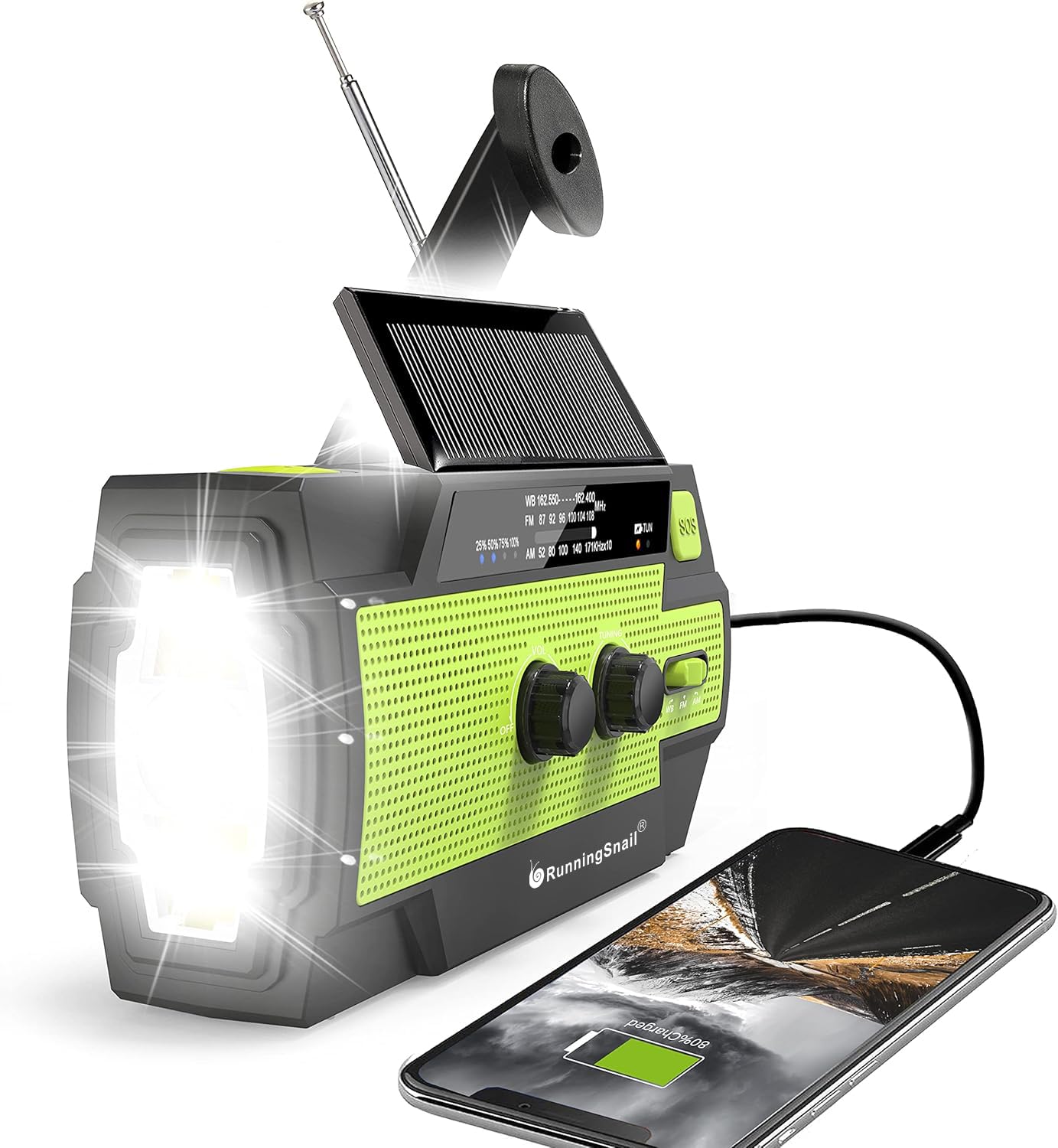
3. RunningSnail MD-090P Emergency Crank Radio
The best-selling emergency radio on the market for a reason — it just works, year after year.
This is the radio that has helped over 10 million Americans through hurricane seasons, and the review count backs up its reputation. It packs a 14800mWh (4000mAh) rechargeable battery that can charge more than one smartphone, and the three-mode flashlight reaches beyond 10 meters — farther than most competitors in this price range. The motion sensor reading lamp is a surprisingly thoughtful touch: wave your hand near it at night instead of fumbling for a switch in the dark.
The hand crank is comfortable and smooth, and the solar panel helps maintain the charge when left in sunlight. Reception across AM, FM, and all seven NOAA weather stations is clear, with an external antenna that pulls in stations reliably. At just 395 grams (about 0.87 pounds) and measuring 6.23 x 1.8 x 3.19 inches, it is noticeably slimmer and lighter than the bigger-capacity units above. Owners consistently praise the bright flashlight, the loud speaker, and the overall value for money.
A fair trade-off is that the hand crank recharges more slowly than expected — one minute of cranking gives only about 3-5 minutes of radio time. It also uses a micro-USB port rather than the modern USB-C standard, so you will want to keep a dedicated cable with the radio. The battery capacity at 4000mAh is modest compared to the 12000mAh leaders, meaning you will lean more on the crank and solar between phone charges. For daily use, a car kit, or a beginner emergency stash, this remains the most proven pick.
Why it is the crowd favorite
- Proven track record with millions of units in use
- Very compact and lightweight at 395g
- Motion sensor reading lamp is genuinely useful at night
- Brightest flashlight in its class at 10m+ range
What to know before buying
- Uses micro-USB instead of USB-C
- Hand crank recharges slowly — 3-5 min radio per 1 min crank
- 4000mAh battery is small compared to 12000mAh options
Ideal for: building a first emergency kit on a budget where proven reliability and compact size matter more than max battery life.
Consider another: if you live off-grid and need a radio that can go days without cranking — the 12000mAh units are better for extended blackouts.
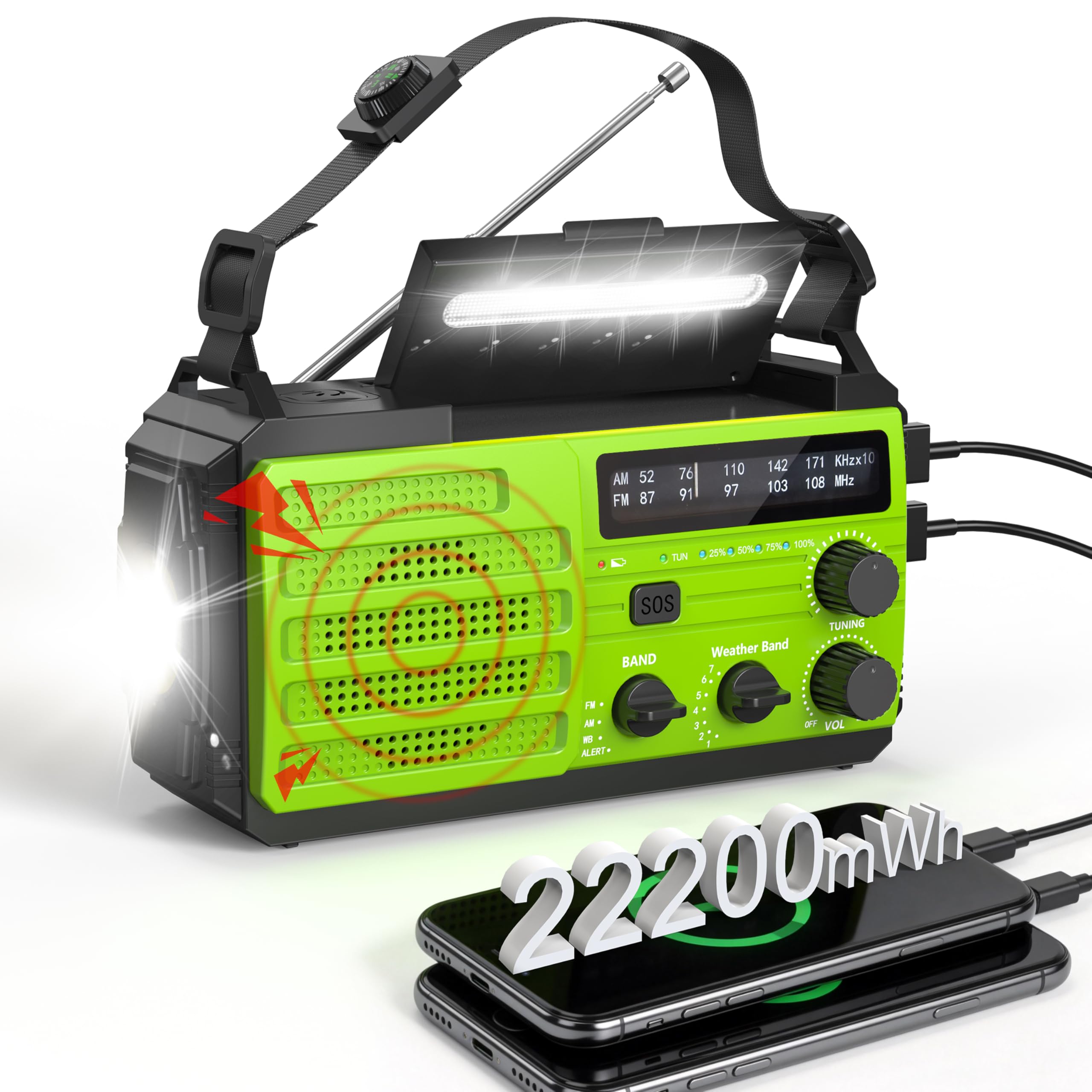
4. RunningSnail 091G Emergency Weather Radio
Built for places where the signal is weak and the weather is mean.
If you live in a valley, a remote rural area, or a concrete apartment where most radios struggle to find a station, the upgraded DSP (Digital Signal Processing) chip inside this RunningSnail model makes a real difference. It locks onto AM, FM, and all seven NOAA weather bands with noticeably less static than standard analog tuners, even when the telescopic antenna is only partially extended. The 22200mWh battery keeps the radio running through extended outages, and the three-mode ultra-bright flashlight adapts to whatever darkness you are navigating.
Owners consistently praise the sound clarity — “loud and clear” is a recurring theme — and the SOS siren is piercing enough to be heard over wind and rain. The rugged ABS (acrylonitrile butadiene styrene) enclosure is built to survive drops on concrete or rocks, and at 524.5 grams it has a solid, confidence-inspiring feel without being too heavy for a backpack. The multiple power options — solar, hand crank, USB, and included batteries — mean you always have a fallback.
The honest limitation is that the carrying strap and compass are basic, and some owners found the solar panel less effective in deep shade. The 22200mWh capacity is respectable but falls short of the 12000mAh leaders when you need to charge a phone multiple times. For anyone whose main concern is simply hearing the weather alert clearly when the signal is marginal, this is the one that delivers.
Why it stands out: the DSP chip pulls in NOAA alerts in areas where other radios only produce static — a genuine advantage for rural and basement shelters.
Best for: campers, rural homeowners, and anyone who has struggled with weak reception in the past.
skip it if: your top priority is phone-charging capacity — the 12000mAh options beat this on reserve power.
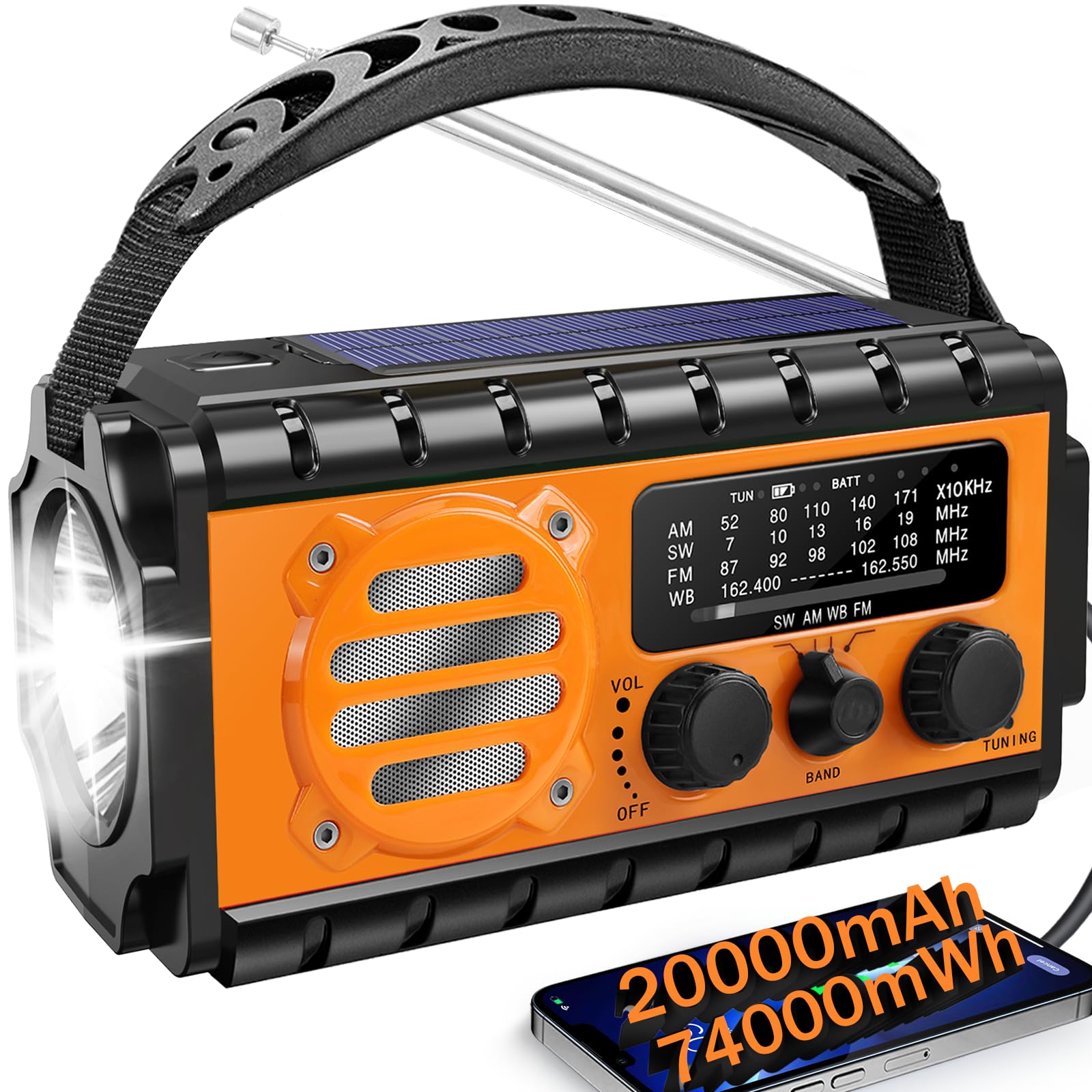
5. QAUYYW 74000mWh Emergency Radio
A 20000mAh battery that shrinks the entire radio down to just 10.88 ounces.
This is the most energy-dense radio on the list — a 20000mAh internal battery (advertised as 74000mWh) that can play for up to 35 hours at medium volume, run the reading lamp for 50 hours, and keep the flashlight going for even longer. It is also impressively compact for that capacity: at 6.2 x 2.2 x 2.8 inches and weighing just 10.88 ounces, it is lighter than many 4000mAh radios. The 52 cm (about 20.5 inch) extended antenna folds out to pull in AM, FM, NOAA, and shortwave bands with good clarity.
The 3W integrated flashlight and a 3.5W reading lamp are bright enough for navigating a dark house or setting up camp, and the SOS alarm adds an extra layer of safety. Owners highlight the sound quality and functionality, with the compact size being a frequent point of praise — it fits easily into a go-bag pocket. The USB-C input is a welcome modern touch, and the IPX6 waterproof rating means it can handle rain without issue.
The catch is that the solar panel, while present, is not the primary charge source — it works best as a maintenance trickle. The single speaker is adequate for alerts and talk radio but less enjoyable for music. And the 12-month warranty is shorter than the 18-month coverage on some competitors. For anyone who wants maximum battery capacity in the smallest possible package, this is a remarkable piece of engineering.
What makes it special
- 20000mAh battery in a 10.88 oz frame — best power-to-weight ratio
- 35 hours of radio at medium volume on a single charge
- USB-C charging and IPX6 waterproof for modern kit compatibility
- Compact enough for a jacket pocket or bug-out bag
Things to know
- Solar panel is more of a trickle charge than a primary source
- Single speaker is fine for news, not rich for music
- 12-month warranty is shorter than some rivals
Reach for this if: you need the most battery capacity per ounce for a hiking or bug-out bag and are willing to rely on USB-C recharging between trips.
Look elsewhere if: you want a radio that can live indefinitely on solar alone — the panel here is a backup, not a primary source.
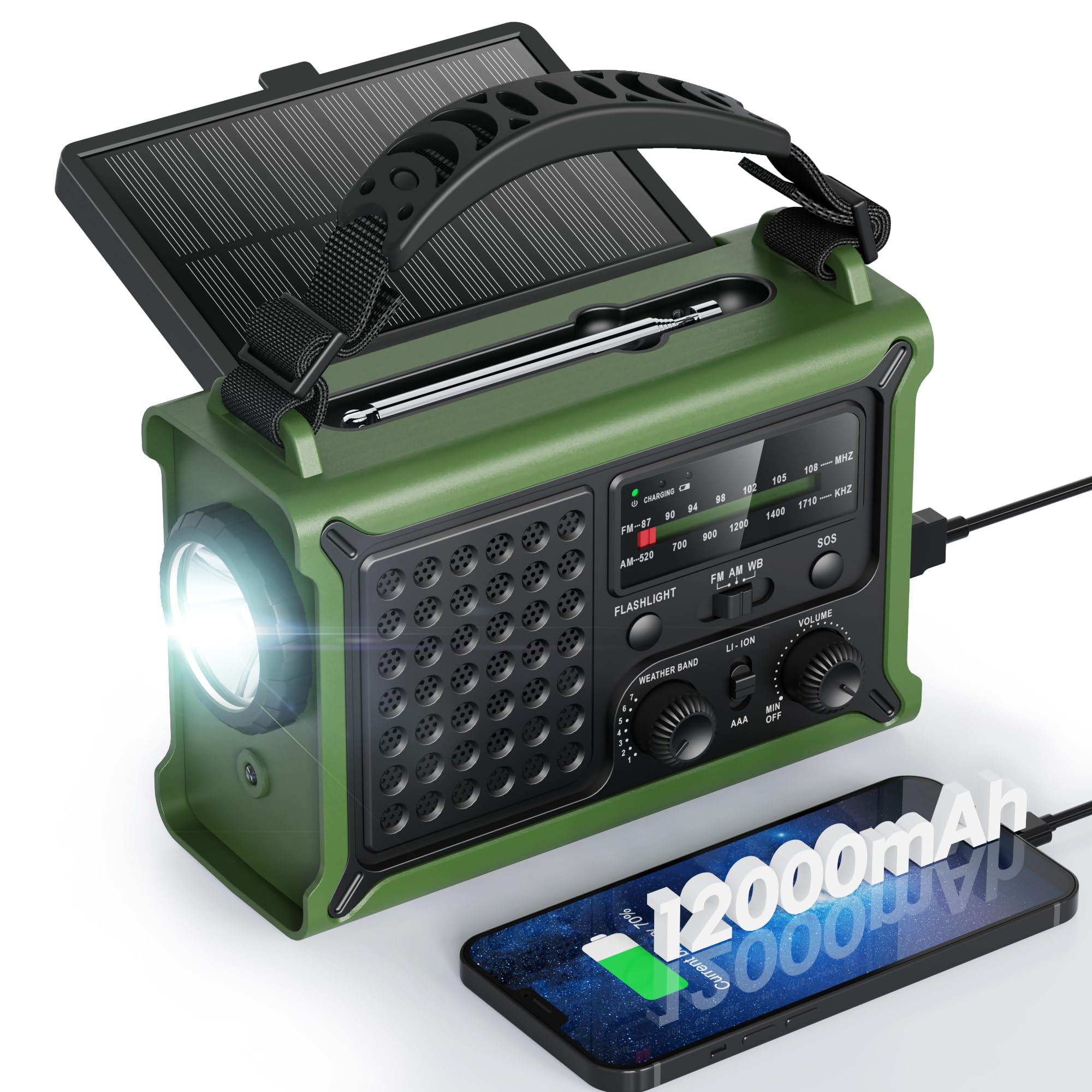
6. Raynic 12000mAh Emergency Weather Radio
A 57mm speaker that lets you actually enjoy listening while you wait out the storm.
Most emergency radios sound thin and tinny, but the Raynic stands apart with a 57mm full-range driver that delivers rich bass, clear highs, and a balanced midrange. That makes a real difference when you are stuck indoors for hours — news broadcasts are intelligible, and music actually sounds like music. It is also NOAA-certified for emergency use, meaning the weather alerts are reliable and timely.
The 12000mAh battery keeps everything running overnight and can charge a phone multiple times via both USB and USB-C outputs. The high-efficiency monocrystalline solar panel charges noticeably faster in real use, owners confirm. The hand crank is also longer and smoother than average, with buyers praising how easily it rotates. The 5W flashlight and reading lamp are bright enough for any task, and the 120db SOS siren is among the loudest on this list. The build quality is sturdy, with anti-slip knobs and a soft silicone strap that makes it easy to grab in the dark.
The main trade-off is weight and size — at 6.81 x 2.91 x 4.76 inches with a relatively hefty frame, it is not the most portable option for ultralight backpacking. Some owners also note that the buttons, while large and easy to use, require a firm press. For a home emergency kit, a car trunk, or a camping base camp where audio quality matters, this is the best-sounding radio you can buy in this category.
The standout spec: a 57mm full-range speaker with rich bass and clear highs — something you will appreciate during long stretches of indoor waiting.
Choose this for: the best audio quality in an emergency radio, plus a real 12000mAh battery and fast solar charging.
Consider something smaller if: you need a radio to fit in a hip belt pouch or a very tight go-bag pocket.
7. Mesqool 12000mAh Weather Radio
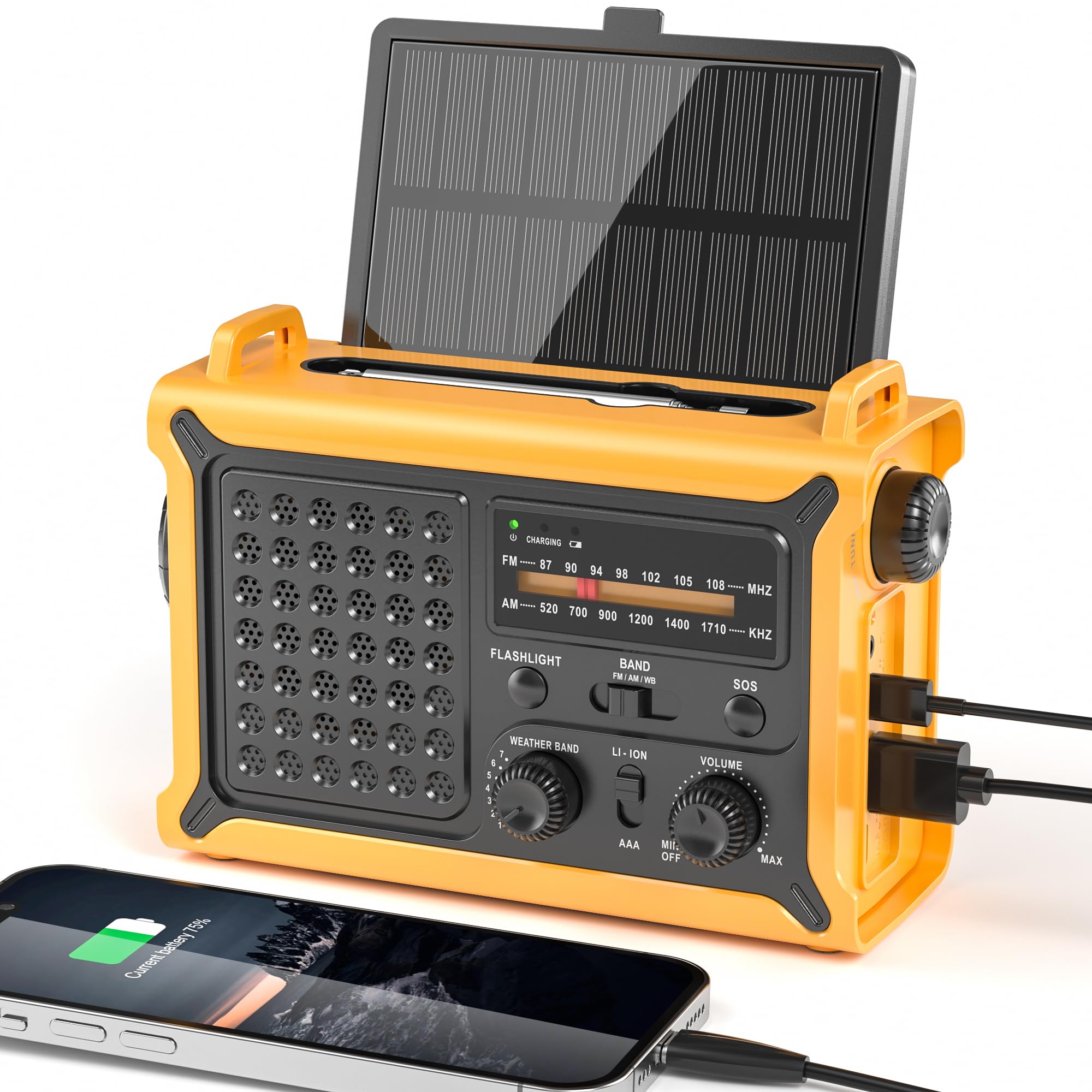
The radio that keeps going even when left on a cloudy windowsill all day.
This yellow powerhouse has earned an excellent reputation among owners — quality is the most-discussed aspect with 157 mentions, and functionality is right behind at 113. The massive 8500mm² monocrystalline solar panel (8500mm² versus 2000mm² decorative panels on cheaper radios) captures enough sunlight to keep the radio running daily without ever plugging it in, even in cloudy weather. One owner reported using it for a 10-day camping trip where the battery charged to 99% via solar alone.
The real 12000mAh lithium battery provides dependable energy through storms and blackouts, and the hand crank can power the radio or charge a phone in just 3 minutes of cranking. The flashlight casts a focused beam up to 260 feet, and the frosted reading lamp offers a soft, warm glow. Reception across AM, FM, and NOAA bands is described as crisp by owners, and the speaker is notably good for the category. At 6.8 x 2.9 x 4.7 inches and 1.6 pounds, it is solid but not oversized.
The main gap is the lack of a battery level indicator — you will have to guess how much charge remains until the radio starts warning you. Some owners also wish the tuning knob had slightly more resistance to avoid accidental bumps. For a comprehensive, well-built radio that can live on solar power alone in most climates, this is the premium pick.
What owners rave about
- 8500mm² monocrystalline panel charges even in cloudy weather
- Real 12000mAh battery lasts through multi-day outages
- crisp AM/FM/NOAA reception with extended antenna
- Flashlight beam reaches 260 feet for dark trails or navigation
The honest gaps
- No battery level indicator — you don’t know the remaining charge
- Tuning knob can be bumped accidentally due to light resistance
- At 1.6 pounds, heavier than the compact competition
Perfect for: off-grid living, extended camping, or homes where you want a radio that stays charged by the window without any effort.
Not ideal for: ultralight backpacking — the 1.6 lb weight and 6.8-inch length are more suited to base camp or vehicle kits.
8. Eton Odyssey Adventure Radio
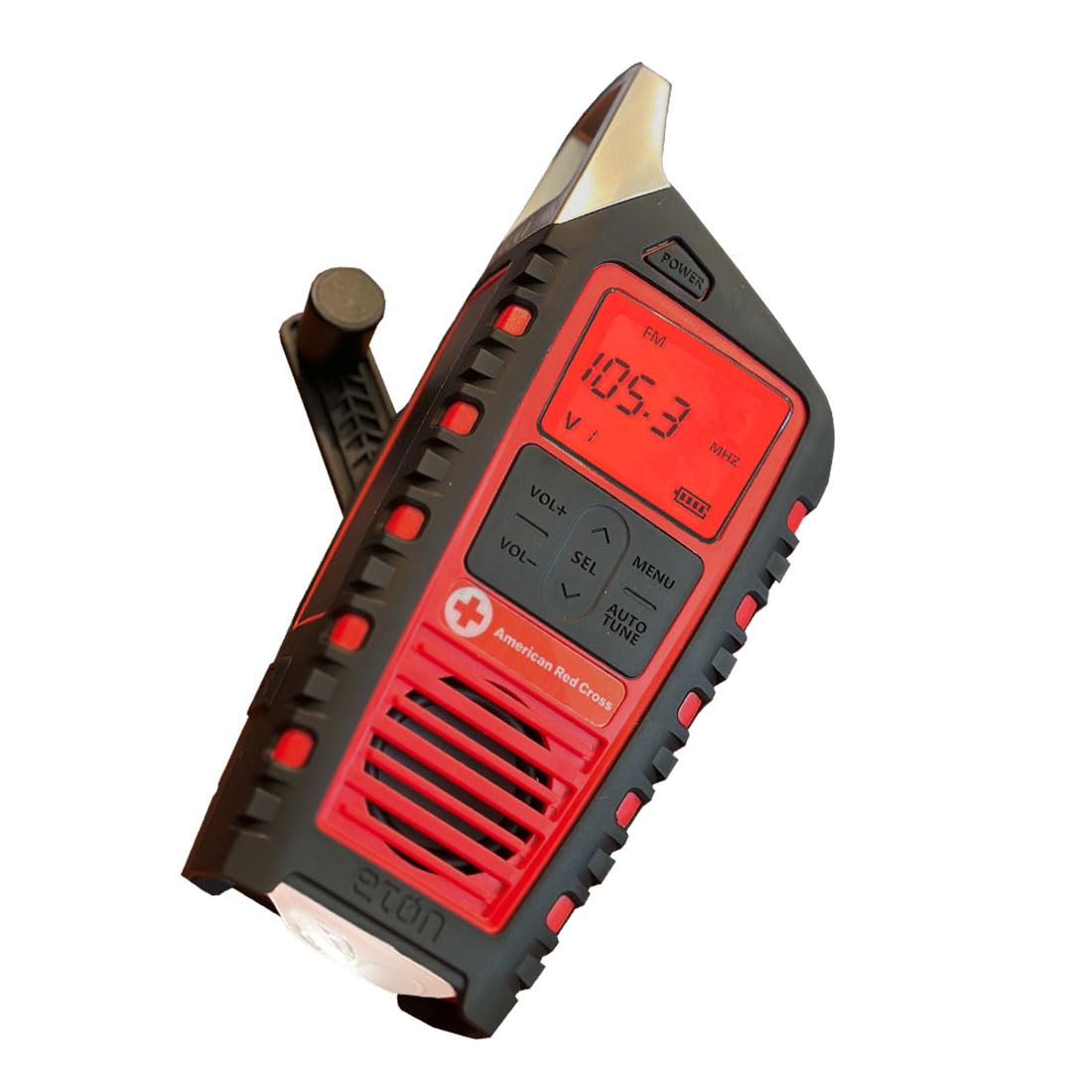
The only emergency radio that doubles as a Bluetooth speaker for campfire tunes.
Eton has been making emergency radios for over 20 years, and the Odyssey brings together AM, FM, shortwave, and NOAA weather bands with a modern Bluetooth speaker function. That means you can stream music or podcasts from your phone while sitting around camp, then switch to weather alerts when a storm rolls in. The digital tuner with a large backlit LCD display makes station selection precise, and the RDS (Radio Data System) shows station information on screen — a rarity in this category.
The 2000mAh battery is modest compared to the 12000mAh leaders, but the radio supports four power sources: solar panel, hand crank, USB-C, and AAA batteries. The hand crank and solar are genuinely useful for extending runtime during a power outage. The 3-mode LED flashlight with SOS alarm covers basic signaling, and the IPX4 splash-proof rating means it can handle light rain. At 1.2 pounds and with a compact 3.5 x 2.5 x 8.5 inch form factor, it stands upright like a traditional portable radio.
The honest feedback is more mixed here than on other picks. Owners praise the clear weather and FM reception and the Bluetooth functionality, but some struggled with shortwave reception and found the tuning process cumbersome. A few units arrived with cosmetic or build issues, and one owner found the phone charger drained the radio’s battery quickly. The 2000mAh capacity means you will rely more on the crank and solar for extended use. This is a solid choice for someone who wants one device for both daily Bluetooth listening and emergency backup, rather than a pure dedicated emergency radio.
The unique angle: Bluetooth streaming + NOAA alerts in one rugged shell — a versatile companion for camping trips that also covers the basics in an outage.
Best suited for: casual campers and daily users who want Bluetooth, shortwave, and weather alerts in one package without needing the longest battery life.
Pass if: you need a dedicated emergency radio with multi-day battery reserves — the 2000mAh pack falls short of the heavy hitters on this list.
Understanding the Specs
Battery Capacity (mAh vs mWh)
mAh (milliamp-hours) measures how much charge the battery can hold. A higher mAh means the radio lasts longer and can charge your phone more times. Some brands list mWh (milliwatt-hours) — to compare, roughly divide mWh by 3.7 to get mAh. For example, a 37000mWh battery is about 10000mAh. A good emergency radio should have at least 4000mAh, while 12000mAh is the gold standard for multi-day outages.
NOAA Weather Band and Alerts
The National Oceanic and Atmospheric Administration broadcasts continuous weather information on seven specific frequencies between 162.400 and 162.550 MHz. A true emergency radio lets you tune into all seven channels. Some models also feature a NOAA alert function that triggers a loud alarm — often 9 seconds or more — when a warning is issued for your area, even if the radio is on a different band.
Solar Panel Size and Type
Monocrystalline solar panels are more efficient than the cheaper polysilicon panels, especially in indirect light. The size is measured in mm² — a large panel like 8500mm² captures significantly more sunlight than a typical 2000mm² decorative panel. A bigger panel means the radio can maintain or gradually increase its charge when left in a sunny window, reducing the need for hand cranking.
Hand Crank Efficiency
Hand cranks generate power by spinning a small dynamo inside the radio. The best models use a reinforced crank arm and a high-efficiency generator with a larger copper coil and stronger magnet. A well-designed crank can deliver several minutes of radio time from one minute of cranking. Look for smooth rotation and a comfortable grip — a cheap crank that feels gritty or wobbly is likely to fail after repeated use.
FAQ
Will an emergency radio work without any power at all?
Can I charge my phone with an emergency radio?
How long does a hand crank emergency radio last before needing fresh batteries?
Do I need a radio with shortwave or just AM/FM and NOAA?
How do I know if the solar panel on a radio is actually useful?
What does IPX6 waterproof mean on an emergency radio?
Can I leave my emergency radio plugged in all the time?
How many NOAA weather channels does a good emergency radio need?
Is a heavier radio always better built?
Final Thoughts: The Verdict
For most people, the emergency radio winner is the Roxicosly CR1030 because its genuine 12000mAh battery, large solar panel, IPX6 waterproofing, and strong reception make it the most dependable companion for real multi-day outages. If you want the highest battery capacity in the smallest package, grab the QAUYYW 74000mWh. And for the proven value pick that has been through millions of emergencies, the RunningSnail MD-090P is the one to reach for.
How We Picked
We do not accept paid placement. Every pick is matched to a real buyer and a real use-case; we do not hands-on test units.
Sources & Methodology
Specifications: manufacturer listings and product documentation. Review insights: verified customer reviews, as of July 2026. Pricing: not shown on this page (it changes often); check the current price via the retailer link.
As an Amazon Associate, WellFizz earns from qualifying purchases. This does not affect which products we feature.
Related Guides

Mo Maruf
I created WellFizz to bridge the gap between vague wellness advice and actionable solutions. My mission is simple: to decode the research and give you practical tools you can actually use.
Beyond the data, I am a passionate traveler. I believe that stepping away from the screen to explore new environments is essential for mental clarity and physical vitality.