Our readers keep the lights on and my smoothie glass nicely filled. As an Amazon Associate, I earn from qualifying purchases.
Specs are compiled from manufacturer listings and verified buyer reviews and can change over time — please confirm the key details on the product page before buying.
The key question is whether a sub-$800 machine can deliver café-quality espresso. This guide covers semi-automatic machines for hands-on learning and fully automatic bean-to-cup models for push-button convenience. You will get verified specs and owner feedback to identify which machine produces rich crema rather than watery shots.
I’m Mohammad Maruf — the founder and writer behind WellFizz. This guide is built by comparing the manufacturers’ published specifications and the patterns across verified customer reviews, so you get each pick’s real strengths and trade-offs instead of marketing spin.
The right espresso machine under $800 changes your kitchen into a coffee bar, and The choice depends on whether you prefer manual control or automated convenience for your morning routine.
Our Picks at a Glance


How To Choose The Best Espresso Machine Under $800
Before you scroll through reviews, lock in the two things that matter most: your workflow and your milk habit. A semi-automatic machine like the Breville Barista Express puts you in charge of every variable — grind, tamp, pull, steam. That is fantastic for learning and dialing in a perfect shot, but it takes about a minute of active work per drink. A fully automatic model like the KitchenAid KF2 does nearly everything at the touch of a button, which is a lifesaver on a rushed Tuesday morning.
Pump Pressure
The pump is what forces hot water through the coffee puck. You will see 15-bar and 20-bar pumps in this price range, and the raw bar number is a bit of a marketing game. The golden extraction pressure for espresso is around 9 bars. A 15-bar Italian pump has plenty of overhead to hit that 9-bar mark consistently throughout the shot. A 20-bar pump offers a wider safety margin, especially if you grind finer than usual or use a non-standard basket, but the extra bars do not give you a “stronger” shot — the puck can only take so much pressure before the flow channels. Look for a pump from a reputable maker like ULKA; that is the real sign of build quality in this part of the machine.
The Grinder Inside
A built-in conical burr grinder is the single biggest convenience feature on these machines, and it is one area where the number of settings genuinely matters. An 8-setting grinder (the De’Longhi La Specialista) is fine if you mostly use medium-roast beans and stick with it. A 30- or 31-setting grinder gives you the room to switch between a light-roast single-origin and a dark-roast blend without feeling locked into a mediocre grind. The real catch is that an integrated grinder saves counter space and morning steps, but if it breaks, the whole machine goes in for service. A separate grinder is more sturdy, but it also costs more and takes up another outlet.
Milk Frothing: Steam Wand vs. Auto Frother
Your steaming setup determines what kind of milk drinks you can make. A manual steam wand — like on the Hanrose or Breville — gives you total control over texture, which is essential for latte art. But it takes practice, and you have to steam, purge, wipe, and purge again to keep it clean. An automatic frother, like the LatteCrema system on the De’Longhi Magnifica Evo or the hands-free system on the Ninja Luxe Café, textures milk (even oat milk) at a single button press. The trade-off is less control over the final foam microtexture, though many owners say the results are “surprisingly good” for a home machine. If you only make a cappuccino on weekends, the auto system is the smarter, easier choice.
Quick Comparison
| Model | Best For | Grinder Settings | Portafilter Size | Pump / Boiler | Amazon |
|---|---|---|---|---|---|
| Hanrose TCMSA02-US★ Best Overall | Best Overall Value | 15 settings | 58mm commercial | 20-bar ULKA pump | Amazon |
| Chefman Crema SupremeBudget Champion | Budget All-in-One | 30 settings | 58mm | 15-bar pump | Amazon |
| KitchenAid KES6503Compact & Solid | Countertop Fit | — (no built-in) | 58mm commercial | Single boiler | Amazon |
| Gevi Dual Boiler | Beginner Workflow | 31 settings | 58mm commercial | Dual boiler + PID | Amazon |
| De’Longhi La Specialista | Café Replicator | 8 settings | 58mm | 15-bar Italian pump | Amazon |
| Cuisinart EM-550 | Fully Automatic Ease | Built-in burr grinder | — | Automatic, hot/cold | Amazon |
| KitchenAid KES8452 KF2 | Quiet Café Menu | Intelligrind adapts | — | Fully automatic | Amazon |
| Breville BES870XL | The Classic Choice | Precision conical burr | 54mm stainless | 15-bar + PID | Amazon |
| De’Longhi Magnifica Evo | Total Automation | 13 settings | — (bean-to-cup) | Fully automatic | Amazon |
| Ninja Luxe Café Pro | Versatile Multi-Brew | 25 settings | 58mm | 15-bar | Amazon |
| Terra Kaffe Demi | Minimalist Design | Precision conical burr | — (bean-to-cup) | Fully automatic | Amazon |
In‑Depth Reviews
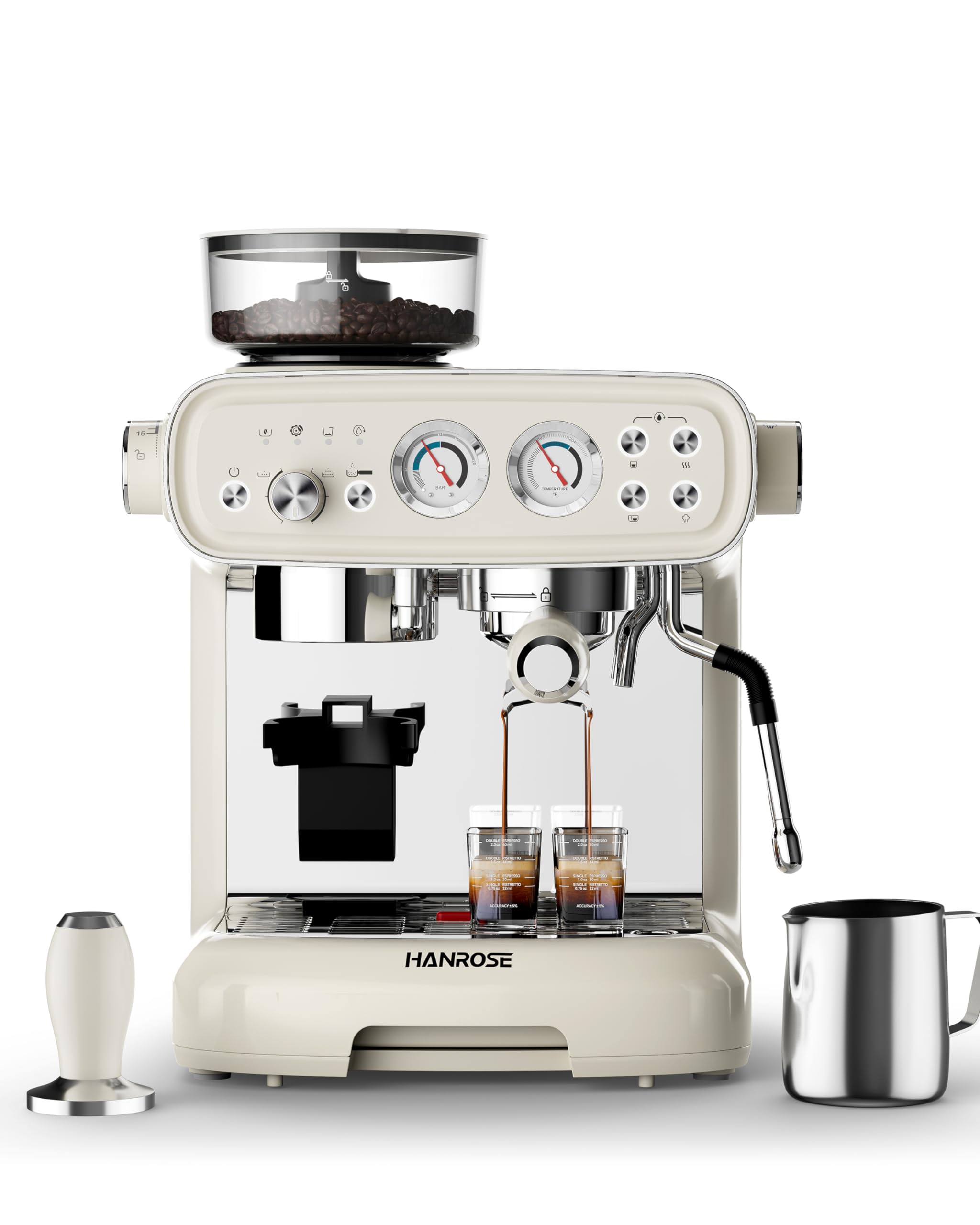
1. Hanrose TCMSA02-US
The 20-bar Italian pump that finally delivers a creamy, balanced shot without a burnt taste.
This is the machine that wins owners over with its combination of a commercial 58mm portafilter and a true Italian ULKA pump. The 20-bar pressure means you have plenty of headroom past the ideal 9-bar extraction, so even a slightly inconsistent tamp still produces a drinkable shot with real crema. The built-in burr grinder offers 15 settings from coarse to fine, and fresh grounds drop right into the portafilter basket — no scooping, no mess on the counter. Owners consistently praise the balanced espresso quality, noting the grind-and-brew workflow is both fast and intuitive.
The separate hot-water outlet is an underrated detail: you can pull an Americano without running hot water through the brew group or steam wand, which keeps the machine ready for the next shot. The 2.5-liter removable tank supports a full morning for a couple without needing a refill. At 4.3 stars across a solid pool of reviews, the performance and build quality outrank several more expensive options. While the body is painted rather than solid metal, the internals — that ULKA pump and the stainless steel burrs — are where the money went.
What Wins People Over
- 20-bar ULKA pump delivers smooth, balanced espresso without a burnt aftertaste, as many owners confirm.
- The 58mm commercial portafilter ensures even water distribution and thick crema.
- Fully removable burr assembly and 2.5L tank make cleaning and refilling genuinely easy.
The Trade-Off
- The exterior is painted plastic rather than solid metal — it looks retro and creamy, but it may not feel as premium as a stainless steel chassis.
- A few owners mention that the coffee temperature can be lukewarm if you do not preheat the cup and the brew group.
Who This Picks Suits: The buyer who wants the real espresso workflow — grind, tamp, pull, steam — without paying Breville prices, and who values a removable burr assembly they can actually clean.
Before You Buy: Think twice if you want a fully automatic “push one button” experience; this is a semi-automatic that asks you to tamp, purge, and steam by hand, which is part of the fun for some and a morning chore for others.
2. Chefman Crema Supreme
30 grind settings and a 3-liter tank — the workhorse for a household that drinks espresso all day.
The Chefman Crema Supreme packs a staggering set of numbers for the price. It holds 3 liters of water, which is a full 2.1x more capacity than the KitchenAid KES6503 (right, that 3-liter vs. 1.4-liter gap means you refill way less often). The conical burr grinder has 30 settings, so you can dial from a coarse French press grind to a fine Turkish powder with real precision. Owners consistently mention the value-for-money as a top selling point: it is easy to learn, heats up quickly, and the 15-bar pump pulls a decent shot with a reasonable crema. The included accessories — tamper, milk pitcher, cleaning tools — all store inside the detachable drip tray, which keeps the counter tidy.
The honest catch is that grinder reliability is a mixed topic among owners. Some report it stops working after a few months, while others still going strong after six months with daily use. The machine also runs on the louder side — one owner specifically timed the brew noise at 27 seconds. The 15-bar pump at this price point is adequate, but it does not have the overhead of the 20-bar ULKA found on the Hanrose, so you have to be more careful with your grind and dose to avoid channeling. It only costs around the same as the Hanrose, and the extra tank capacity is great for entertaining.
The Real Take: If you need a machine that serves a crowd on weekends and has every bell and whistle (30 grind settings, pressure gauge, touchscreen) at an entry-level price, the Crema Supreme is the play. But if grinder longevity worries you, the Hanrose’s Italian pump and fully removable burr assembly give you better odds of long-term reliability.
Reach For This If: You want a full all-in-one espresso system for the lowest stretch of the budget, and you like the idea of tweaking grind across 30 different levels.
Pause If: Consistent performance matters more than maximum features — grinder and heat performance reviews show mixed results, and a few owners experienced early failures that make reliability a question mark.
3. KitchenAid KES6503
The first residential machine with dual temperature sensors that talk to each other mid-brew for authentic flavor.
This KitchenAid is remarkably compact — at 6.38″D x 13.15″W x 11.26″H, it is more than 2.5x shallower than the Chefman Crema Supreme, which means it fits on a narrow counter or under low cabinets where most machines cannot go. The metal body weighs 17 pounds, giving it a dense, sturdy feel on the counter that smaller machines lack. The dual smart temperature sensors are the headline feature: they actively communicate throughout the brew process to keep water at the ideal temperature for extraction. The 58mm commercial-grade portafilter has recessed spouts that let the tamper sit flat for a more stable, consistent tamp compared to traditional sloping spouts.
Owners highlight the coffee quality — it pulls a good shot with warm honey color and pleasant crema — and the steam wand steams oat milk well. But the biggest trade-off is that this model does not have a built-in grinder. You need a separate grinder (or pre-ground coffee), which adds cost and counter space. The included four filter baskets (for single and double, pressurized and non-pressurized) give you flexibility to use pre-ground beans or dial in your own grind. A minority of buyers report units arriving with internal leaks or steam wand issues, though the metal build quality is widely praised.
Where It Shines
- Compact footprint — 6.38 inches deep, it fits almost anywhere a tall mug will.
- Dual temperature sensors actively monitor brew water for consistent results.
- Solid metal construction feels built to last, and many owners say it looks great with other KitchenAid appliances.
The Catch
- No integrated grinder — you must buy a separate one or use pre-ground coffee.
- Average ratings are a bit lower than the Hanrose and Breville, with some reports of defective units from the start.
Best Suited For: The cook who already owns a good separate grinder and wants a compact, metal-bodied machine that pulls a shot with consistent temperature control.
Think Twice If: You want the all-in-one simplicity of a grind-and-brew machine, or you are concerned about the mixed reliability ratings in the owner reviews.
4. Gevi Dual Boiler

A dual-boiler machine with PID control that costs less than a single-boiler from Breville.
The Gevi Dual Boiler is the heavy hitter in the mid-range: it has two separate heating systems — one for brewing and one for steaming — so you can steam milk immediately after pulling a shot without waiting for the boiler to switch temperature. The NTC & PID temperature control system keeps the brew water precise within a narrow window, which directly translates to balanced flavor shot after shot. The 31 grind settings on the built-in burr grinder make it the most adjustable grinder in this roundup, and the 58mm commercial portafilter is standard equipment that serious baristas will recognize. The 15-pound overall weight is relatively light, and the compact build lets it sit on an average counter without dominating the space.
Build quality and functionality are the most-praised aspects among owners, with many calling it a “good choice for beginners” who want to learn on a proper dual-boiler system. The included accessories are generous: four interchangeable filter baskets, a tamper, a cleaning tool, and a milk frothing pitcher. The honest limitations: some users say the espresso does not come out piping hot, and the milk frothing has a learning curve to get a truly fine microfoam. The Gevi is a strong alternative to the Breville Barista Express for about half the price, but it has a smaller base of long-term reviews — 377 ratings vs. Breville’s massive 27,000+, so durability is less proven.
Bottom Line: If you want a dual boiler and PID the way a “real” espresso setup works, but your budget is closer to mid-range, the Gevi is the smartest play — it gives you the same core thermal architecture as machines costing twice as much, and the 31 grind settings mean you have almost no excuse for a bad shot.
Perfect For: The new home barista who wants a dual-boiler system to learn on, and who values grind flexibility with 31 settings.
Potential Issue: If you want piping-hot espresso straight into a cold cup, this machine may not deliver that temperature kick; preheating the cup and brew group is essential.
5. De’Longhi La Specialista Arte Evo
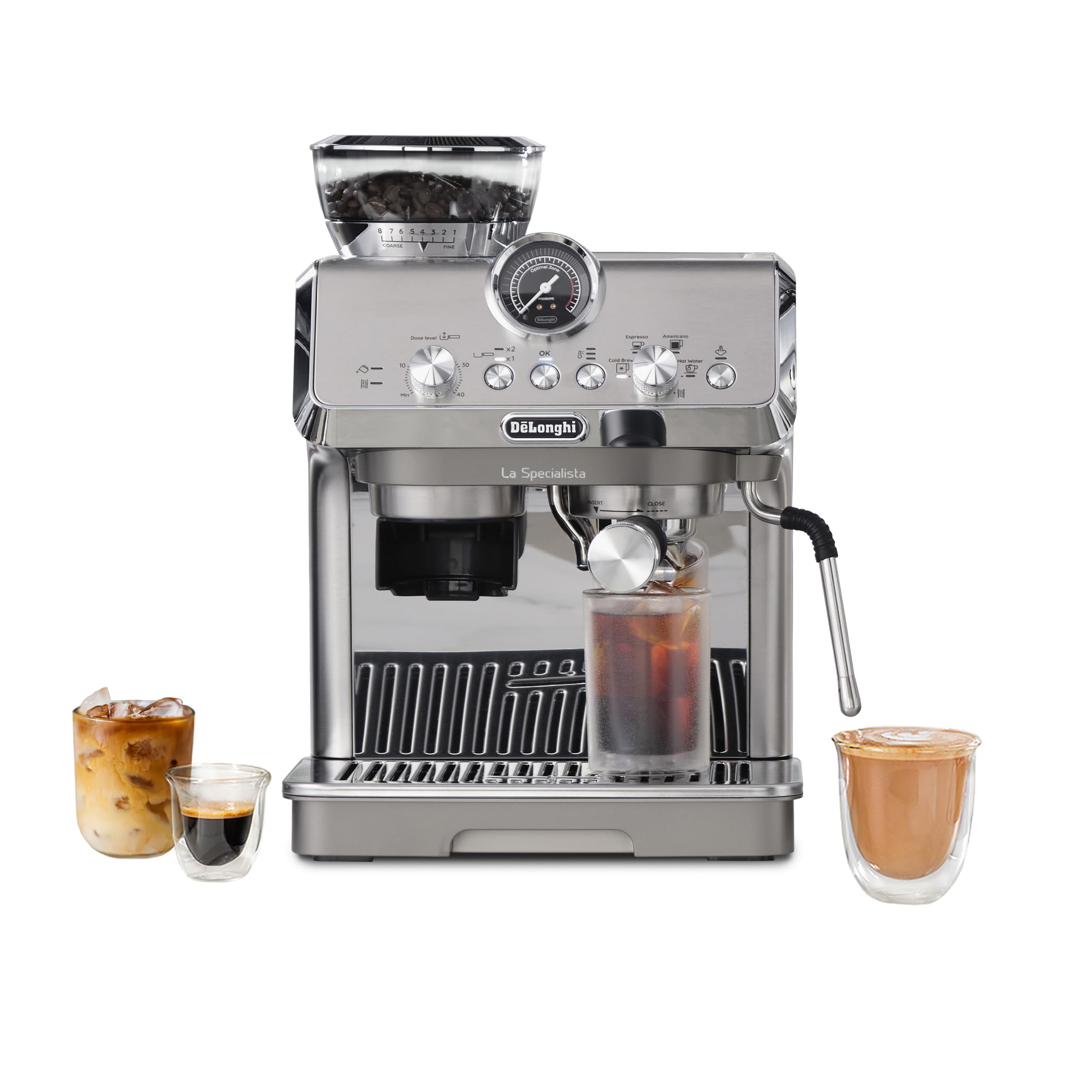
The only machine in this range that makes cold brew in under 5 minutes using proprietary Cold Extraction Technology.
This De’Longhi stands out for a single trick: cold brew in less than five minutes. It uses a precisely measured water flow and pressure at a specific temperature (developed in collaboration with the Specialty Coffee Association) to extract cold coffee without heat or time. For the rest of the day, it is a capable semi-automatic with a 15-bar Italian pump, an 8-setting conical burr grinder, and Active Temperature Control that lets you choose between three infusion temperatures to match your bean roast. The commercial-style steam wand heats up quickly and delivers the right pressure for smooth microfoam — one owner flatly describes it as “wonderful.”
The pressure gauge on the front panel lets you monitor extraction visually, which is a big help when you are learning to dial in. The Barista Kit (dosing funnel, tamping mat, and tamper) is a thoughtful bonus that keeps the process mess-free. The main weakness reported is the grinder: a small number of owners say it clogs with oily beans and needs regular disassembly to clean. Others note that at the mid-range price, the lack of a dual boiler means you wait between brewing and steaming. The La Specialista Arte Evo is a great choice if iced coffee is your year-round drink and you want a machine that handles both hot and cold extraction without a separate cold brew system.
Strengths
- Cold Extraction Technology makes a cold brew in less than 5 minutes, a unique feature for this price bracket.
- Active Temperature Control with 3 infusion settings lets you match the brew temperature to your specific bean roast level.
- The included Barista Kit (dosing funnel, tamping mat) minimizes mess on the counter.
Weaknesses
- The built-in grinder has only 8 settings, which may not be enough for dialing in light-roast single-origin beans.
- Grinder can clog with oily beans, requiring manual disassembly to clear the burrs.
Ideal For: Anyone who wants both hot espresso and proper cold brew from a single machine and does not want to wait 12 hours for a cold steep.
A Note: If you primarily drink dark-roast espresso and want the widest range of grind adjustments, the Hanrose or Gevi give you more settings and a dual boiler for the same money.
6. Cuisinart Espresso Bar EM-550
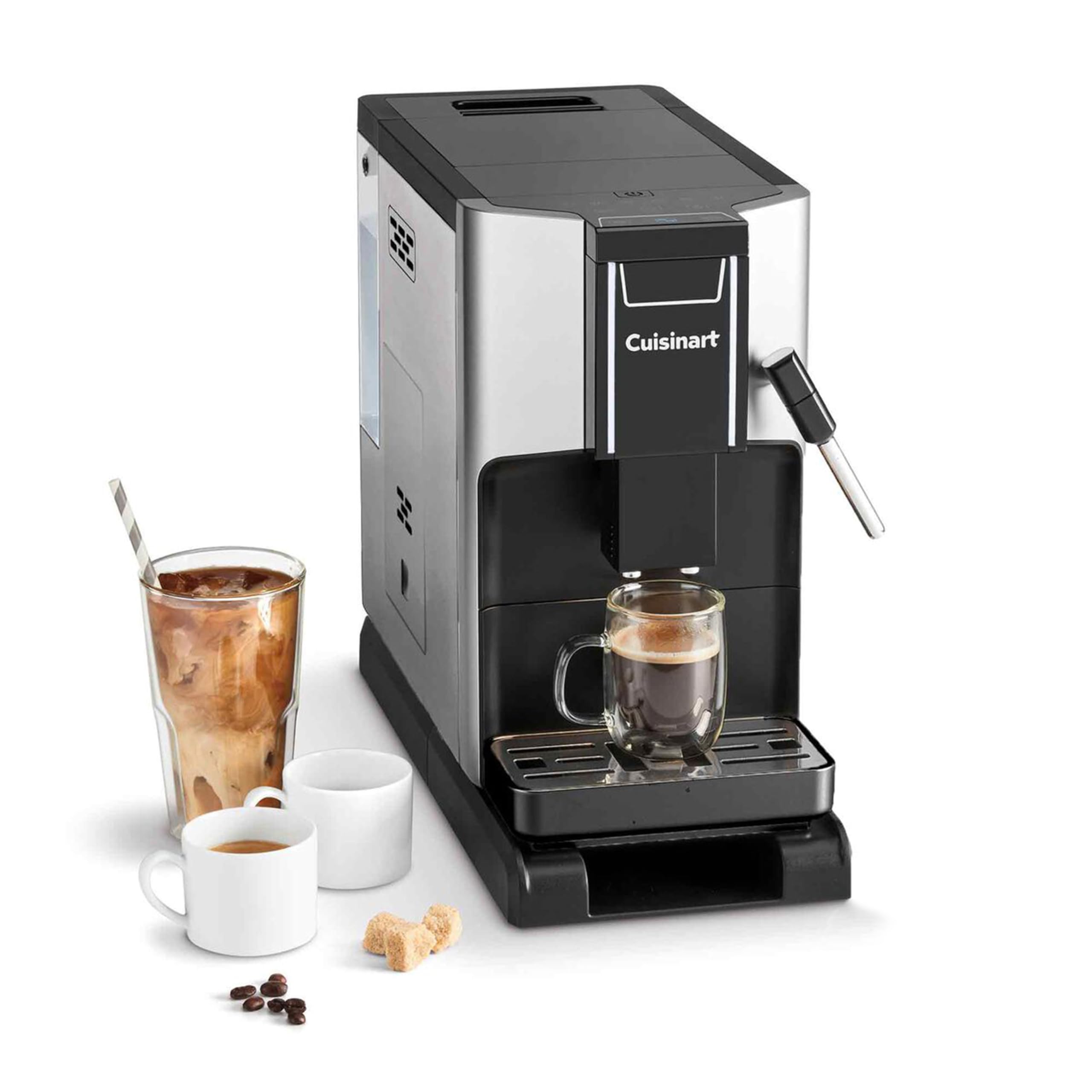
A true one-touch fully automatic machine that also pulls cold-extracted espresso at the press of a button.
The Cuisinart Espresso Bar is a fully automatic machine that grinds, doses, brews, and even does cold extraction without you lifting a finger beyond pressing the button. It has a built-in stainless steel conical burr grinder that auto-grinds the right amount of beans for your selected beverage. You can choose single or double shots, Americano, or cold-extracted espresso. The steam wand is simple to use for milk, and the touchscreen panel is intuitive. A 50-ounce water tank is generous, and the removable brew group makes cleanup straightforward — owners specifically note that “cleanup was straightforward too.”
The feel is a mix of metal and plastic: some owners find the plastic parts cheap-feeling for the price, and the touchscreen can be sluggish. It also only brews a single Americano at a time, while the previous machine some owners upgraded from offered two. Still, for the fully automatic workflow — you do not tamp, you do not time the shot — it is the most affordable entry point in this list that includes cold extraction.
The Smart Bet: If you want a fully automatic machine that also does cold extraction and you are willing to be an early adopter, the Cuisinart EM-550 is a solid risk at this price. Just go in knowing that the review pool is tiny, so durability data is thin compared to the established Breville or De’Longhi models.
Best For: The low-maintenance drinker who wants a built-in grinder and one-touch recipes, and is comfortable buying a first-generation product from a trusted brand.
Caution: With only a few dozen ratings, you are buying potential, not a proven track record — the Hanrose or Breville have thousands of owners backing their performance.
7. KitchenAid KF2 (KES8452)
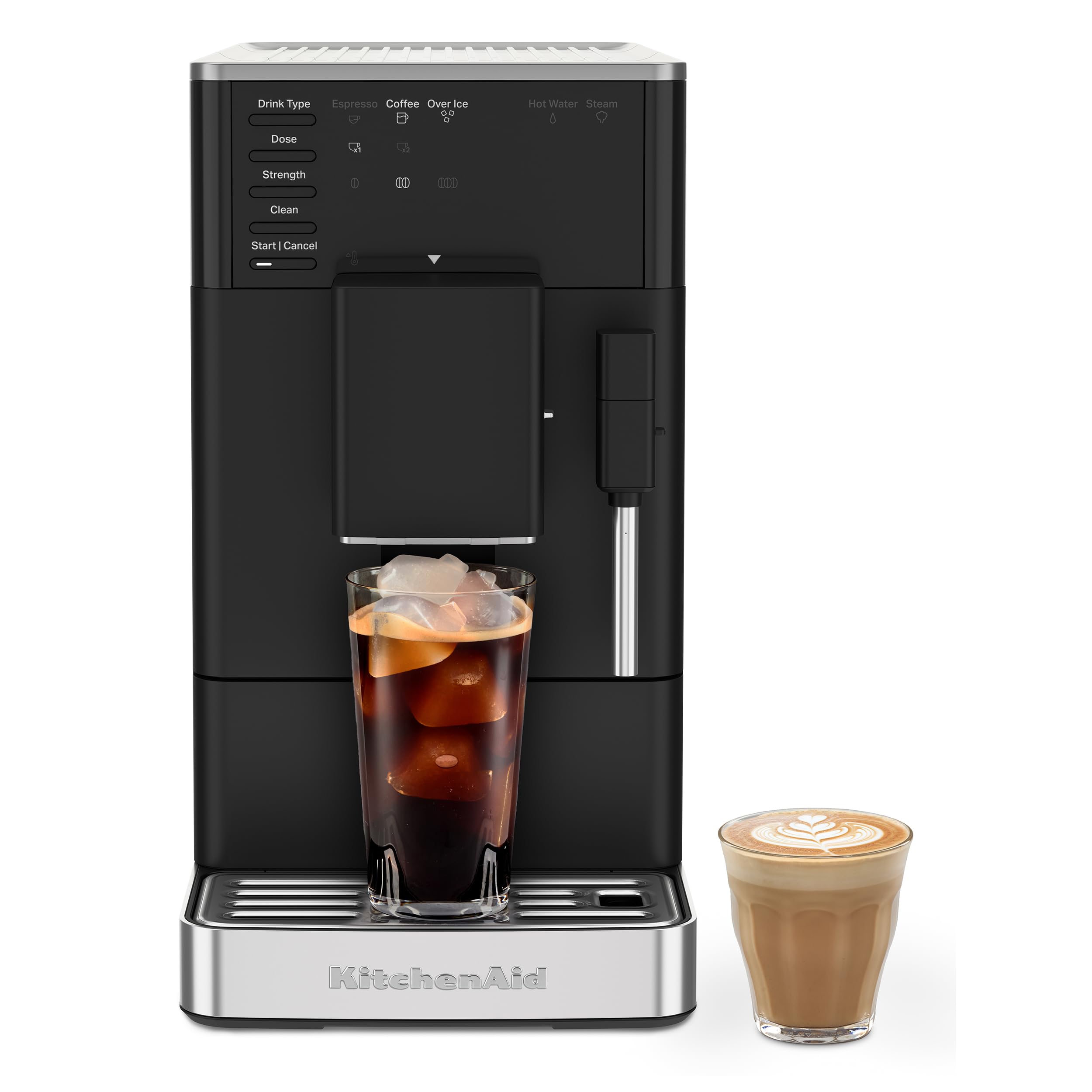
A fully automatic machine with a quiet grinding system that won’t wake your partner at 6 a.m.
The KitchenAid KF2 is a fully automatic bean-to-cup machine that handles six hot and iced recipe options — espresso, Americano, iced coffee, hot water, and more — all at the push of a button. The headline feature is the Quiet Grinding System: the burr grinder adapts automatically to every bean type and roast using the Intelligrind system, which fine-tunes the dose so each new bag of beans is dialed in without you touching a setting. The auto steam wand pulls air into the milk during steaming to create a smooth, velvety microfoam, and it works with dairy or non-dairy milk. The 1.8-liter tank is on the smaller side compared to the Chefman or De’Longhi, so you will refill more often.
Owners consistently praise the coffee quality and ease of use, with one owner saying the machine “immediately replaced my office’s daily… runs.” The over-ice coffee setting brews at a lower temperature to protect flavor and prevent over-extraction, which is a thoughtful detail for iced drink fans. The catch: it is a very young model (42 ratings), so longevity data is minimal. The 22.3-pound weight gives it a solid counter feel. The auto steam wand is excellent for beginners but less capable of the extreme microfoam control a latte artist would demand.
High Points
- Quiet Grinding System is genuinely less intrusive — you can make coffee while someone sleeps.
- Intelligrind system auto-adjusts the dose for each new bean type, removing a big learning curve.
- The over-ice setting brews at lower temperature, preserving flavor in iced drinks.
Low Points
- Small water tank (1.8L) and puck bin require frequent refills and emptying after about 10 shots.
- Very new to market — only 42 ratings, so long-term reliability is unproven compared to the Breville or De’Longhi Magnifica.
Perfect For: The early riser who wants a quiet, fully automatic machine that adapts to different beans without fiddling, and who values a compact design (it is 25% smaller than the bigger KitchenAid KF6/KF7/KF8 models).
Keep In Mind: The water tank and waste bin are small for a household of heavy drinkers — plan on daily refills if you pull more than 8-10 shots a day.
8. Breville BES870XL Barista Express
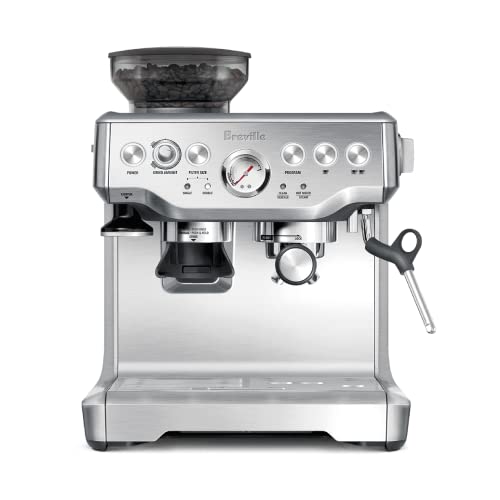
30,000+ owners cannot be wrong — the Barista Express is the gold standard for entry-level semi-automatic espresso.
The Breville BES870XL is the most-reviewed espresso machine in this entire list by a massive margin, and the consensus is clear: it is the machine that most people start their espresso journey with and stay with for years. The integrated precision conical burr grinder grinds on demand directly into the 54mm stainless steel portafilter, and the Razor Dose Trimming Tool ensures you are not overpacking the basket. Digital temperature control (PID) keeps water at a precise temperature for optimal extraction. The low-pressure pre-infusion gradually ramps up pressure at the start of the brew, which helps ensure even extraction — this is the same technique used by commercial machines costing thousands more. The price is the highest among the semi-automatics here, and it only comes with a 1-year limited warranty.
The honest reality from owners is that this machine requires daily maintenance: purge the steam wand and showerhead, clean the basket, and change the water filter every 60 uses or 2 months. Common issues around the 6-12 month mark include o-ring replacements and solenoid valve failure (buzzing or leaking). Several owners mention their unit lasting 8-9 years with regular care, which is proof of its repairability — parts are widely available. The 67-ounce water tank (nearly 2 liters) is adequate but will need refilling for a busy household; the 1/2 lb bean hopper is generous for a home machine. If you are willing to learn the 4 Keys Formula (dose, grind, temperature, pressure), this machine produces shots that rival machines costing three times as much.
Why It’s the Classic
- Digital PID temperature control delivers water at the exact temperature for optimal extraction every time.
- The integrated grinder and Razor Trimming Tool remove the guesswork from dosing, and the grinder goes from beans to portafilter in under one minute.
- Widely available parts and repair guides online mean this is among the most repairable home espresso machines ever made.
What to Watch For
- Common repair needs around the 6-12 month mark (o-ring replacements, solenoid valve issues) can surprise owners who skip regular maintenance.
- Plastic top and side panels feel less premium than the all-metal KitchenAid, and the small water tank needs frequent refills for a busy kitchen.
Reach For This If: You want the most established, community-backed espresso machine with the deepest owner knowledge base available, the crowd favorite for over a decade, and you plan to maintain it as a hobby, not a chore.
Pause If: You prefer a fully automatic “push and go” machine, or if your counter space is very tight — at 13.8 inches deep, it is not the most compact option, especially when you add space to access the water tank and bean hopper.
9. De’Longhi Magnifica Evo
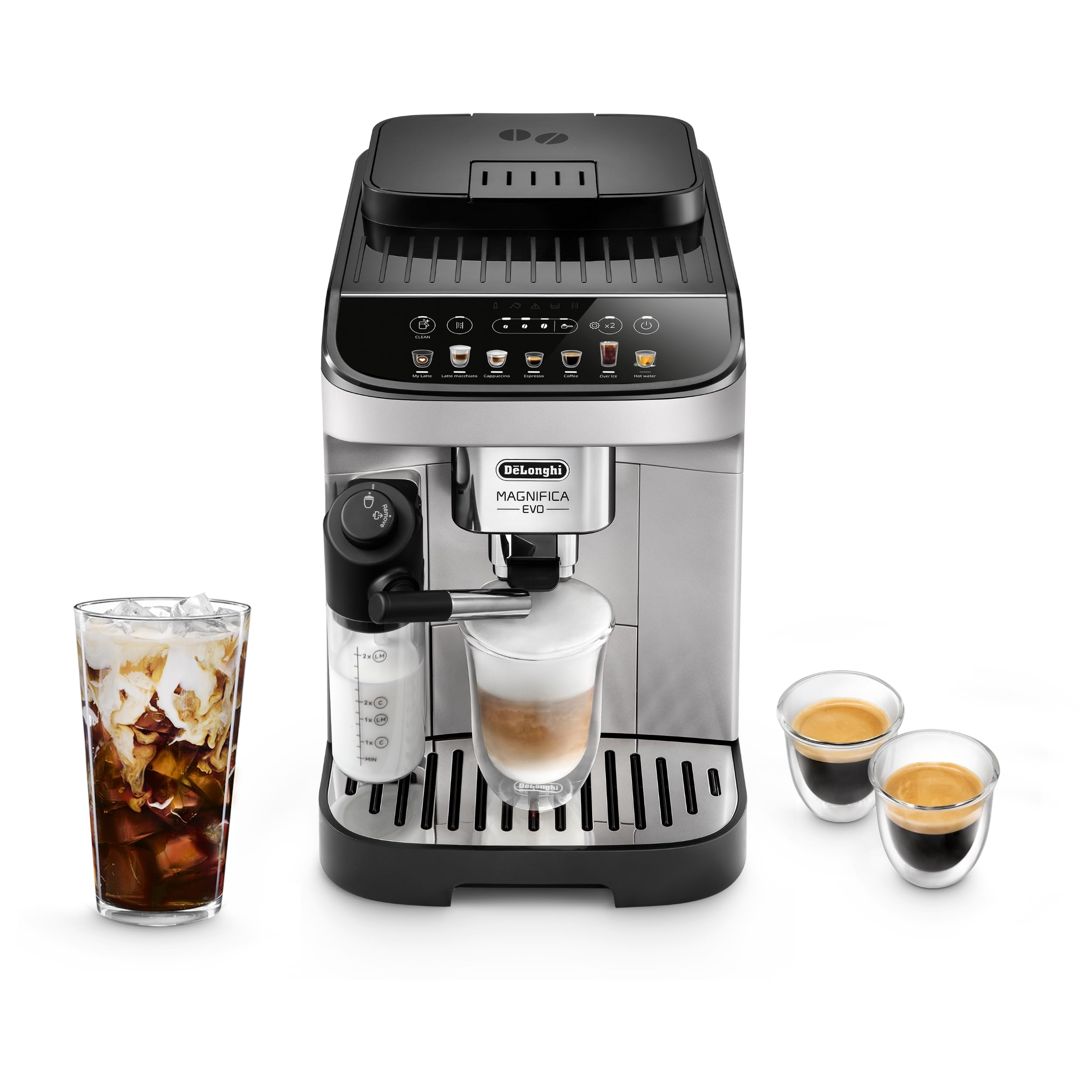
7 one-touch recipes from a single bean-to-cup machine that also textures oat milk with its LatteCrema system.
The Magnifica Evo is the fully automatic machine for the person who wants every drink — espresso, cappuccino, latte macchiato, iced coffee, Americano, coffee, and a personalized “My Latte” — without touching a tamper or a steam wand. It uses De’Longhi’s LatteCrema System, which textures both dairy and plant-based milk (oat milk included) and stores the milk container in the fridge when not in use to keep it fresh. The conical burr grinder has 13 grind settings, and the machine can automatically prepare two cups at once. The 60-ounce water tank is generous, and many removable parts are dishwasher-safe, making cleanup easy. The Over Ice recipe auto-adjusts the dose and brew for a balanced iced coffee, a feature shared with the La Specialista but in a fully automatic format.
Coffee quality is the most-praised aspect, with owners calling it “great coffee without the coffee shop hassle.” The machine is straightforward to set up and the indicator lights guide you through each step. But the reliability is a mixed bag: some units arrive used or missing parts, and the milk frother has been known to fail on some machines. The noise level is also notable — several owners describe it as “loud operation.” At this price, you are paying for the convenience of a fully automatic bean-to-cup system, but the plastic construction and mixed reliability records mean you should buy from a retailer with a solid return policy. The 13 grind settings are adequate but not expansive; if you switch between drastically different bean roasts often, you might wish for more adjustment range.
The Verdict: The Magnifica Evo is the logical choice if you want the ultimate hands-off espresso experience: add beans, fill the tank, press the drink button, and walk away. The LatteCrema system is genuinely good with milk alternatives, making it the best pick for a household with a mix of dairy and non-dairy drinkers. The risk is the mixed reliability reports — prepare for a potential customer service interaction.
Who It Suits: The coffee drinker who values speed and consistency over the ritual of manual espresso — press one button and get a latte, no skills required, with the option to personalize and save your own recipe via the My Latte feature.
Consider the Alternative: If reliability concerns you, the KitchenAid KF2 has a quieter grinder and a newer, possibly better-factory-tested build, but it has far fewer reviews to prove it.
10. Ninja Luxe Café Pro ES701

A single machine that makes espresso, drip coffee, cold brew, and hot water — and does all of them well.
The Ninja Luxe Café Pro is the Swiss Army knife of coffee machines: it replaces a separate espresso machine, a drip coffee maker, a cold brew system, and a hot water dispenser. It makes five espresso styles (single, double, quad, ristretto, and lungo) and three drip coffee sizes (classic, rich, or over ice) up to 18 ounces. The Dual Froth System Pro uses a self-cleaning steam wand with five preset froth functions (steamed milk, thin, thick, extra-thick, and cold foam) that works with dairy and non-dairy milks hands-free. The built-in conical burr grinder has 25 grind settings, and the Barista Assist Technology uses weight-based dosing — it actually weighs the grounds and adjusts the grind recommendation for the next shot to eliminate trial and error. The integrated tamper is a lever, so you do not overfill or make a mess.
Performance is the most-praised aspect among owners, who consistently say the machine produces “superior espresso” and is “intuitive and easy to use” with a short learning curve. The auto-clean steam wand cycle is a standout convenience feature. At 27.1 pounds, it is the heaviest machine here — nearly a third heavier than the Chefman — so plan for a permanent counter spot. The 68-ounce water capacity is the largest in this guide, which supports extended brewing sessions. The honest downsides: the espresso crema is not as thick as a dedicated machine like the Breville, and the machine uses a lot of water during its cleaning cycle, meaning the drip tray needs frequent emptying. It also takes up significant counter space at 13.39″D x 12.48″W, though the built-in storage compartment for baskets and cleaning tools helps offset the footprint.
What It Excels At
- Four machines in one — espresso, drip coffee, cold brew, and hot water — all from a single countertop appliance.
- Weight-based dosing with the built-in scale removes the biggest source of inconsistency in home espresso: guessing the dose.
- The self-cleaning steam wand cycles automatically, saving you a manual purge step every time.
The Trade-Offs
- Espresso crema is not as thick or velvety as a dedicated machine like the Breville Barista Express.
- Large footprint (nearly 14 inches deep) and heavy weight (27.1 lb) mean it is not a countertop traveler.
Who Should Get This: The household that drinks drip coffee, espresso, and cold brew throughout the day and wants one machine to handle all of it — the Ninja replaces three countertop appliances with one, saving you outlets and clutter.
Who Might Skip It: If you are an espresso purist who wants the thickest crema possible, or if your counter space is limited — a dedicated semi-auto with a separate drip maker actually takes up less total space, but it also costs more.
11. Terra Kaffe Demi
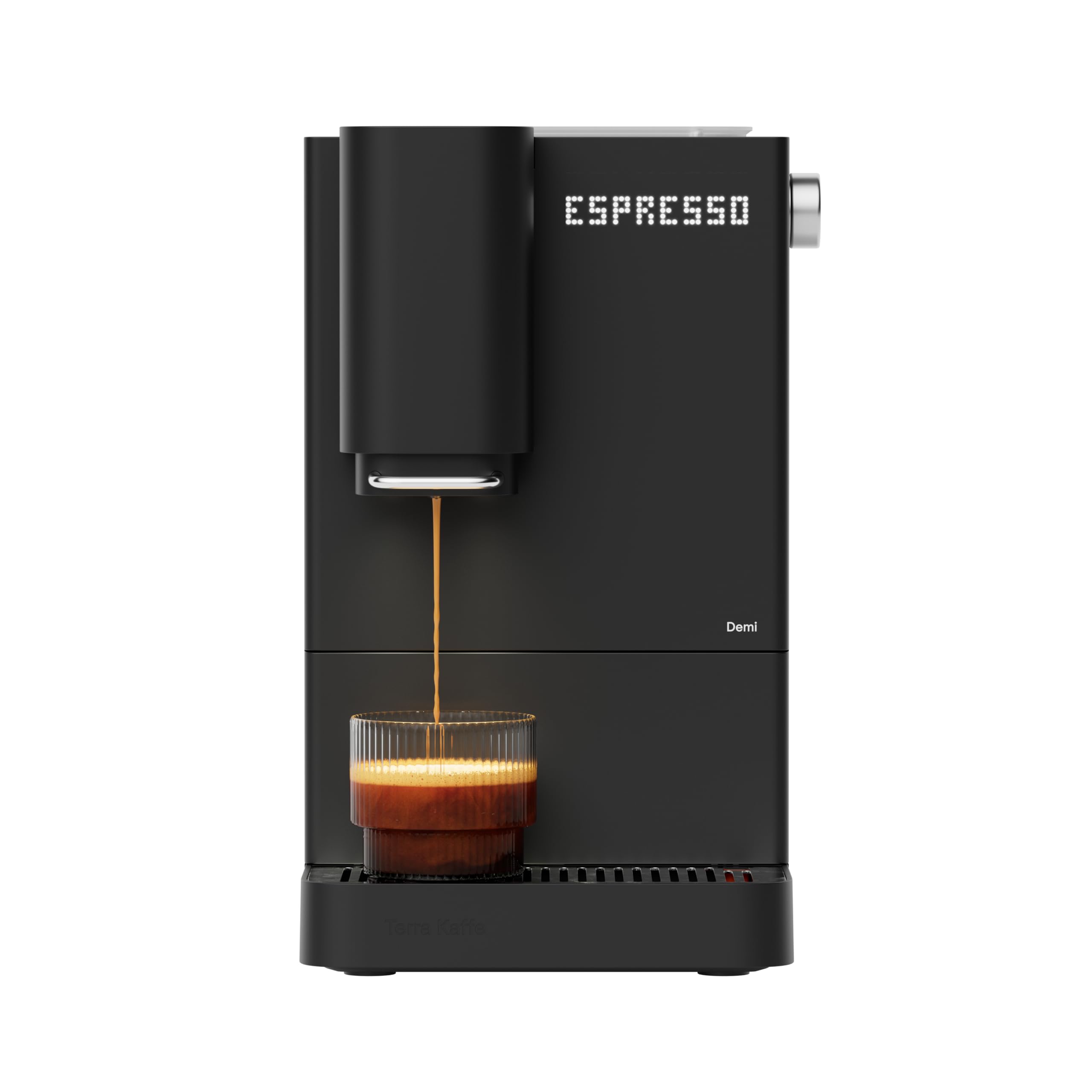
A compact, fully automatic machine with a stainless steel dial that lets you adjust strength, temperature, and volume.
The Terra Kaffe Demi is the smallest fully automatic machine in this lineup, designed for apartments and tight counter spaces. It has an integrated precision conical burr grinder that grinds whole beans for every brew — so every cup is freshly ground. The brewing range is impressively wide: it can make espresso, lungo, Americano, or even drip-style coffee. The intuitive stainless-steel customization dial gives you control over brew strength, water temperature, and drink volume, making it easy for beginners and enthusiasts to dial in each cup. The self-cleaning system plus a front-loading drip tray and waste bin keep daily maintenance simple. The 37.2-fluid-ounce water tank is small but understandable for the machine’s low profile.
Owners almost universally praise the coffee quality — calling it “rich, smooth, and less bitter” than pod systems — and the ease of use. The machine has a 10-minute setup and an intuitive on-screen guide for rinsing and cleaning cycles. The compact design (15.5″D x 12.4″W x 12.4″H and only 17 pounds) and quiet grinder make it office-friendly. The honest, and significant, catch: the reliability is a serious concern at this early stage. Multiple customers note unit failures within days — water leaks, grinding issues, and brew unit jams. The small waste hopper and shallow drip tray mean frequent emptying, and the machine does not come with a water filter or a printed manual. Given that the price is at the ceiling of this bracket, the Terra Kaffe Demi is a high-risk, high-reward bet on a beautiful design that may or may not hold up.
My Take: The Demi is the most beautiful machine in this list, and when it works, it apparently makes excellent espresso — owners describe it as “a real step up from Nespresso.” But the failure reports are too frequent and too consistent to ignore. If you buy it, do so from a retailer with a generous return window and hold onto the box. The alternative KitchenAid KF2 offers a similar quiet, fully automatic experience with a more established brand warranty.
Understanding the Specs
Pump Pressure (15-bar vs 20-bar)
The pump creates the force that pushes hot water through the coffee puck. The golden number for proper espresso extraction is around 9 bars of pressure. A 15-bar pump has enough headroom to hit this consistently. A 20-bar pump has more overhead — useful if you grind very fine or use a non-standard basket, but it does not mean your shot is “twice as strong.” What matters more is the pump brand; an Italian ULKA pump is widely regarded as higher quality than generic alternatives.
Portafilter Size (54mm vs 58mm)
The portafilter diameter directly affects how much coffee you can use and how evenly water flows through it. A 58mm portafilter is the commercial standard — it holds about 18-22 grams of coffee, allowing larger, more balanced shots. A 54mm portafilter (like on the Breville) holds around 15-18 grams, which is fine for home use but limits your dose. If you plan on using a bottomless portafilter for checking your technique, stick with a 58mm machine.
FAQ
What is the difference between a semi-automatic and a fully automatic espresso machine?
Can I use pre-ground coffee in a machine with a built-in grinder?
How long does cleaning take on a daily basis?
Is a machine with a dual boiler worth the extra cost?
Why do some machines have more grind settings than others?
How much maintenance do the built-in grinders need?
Is a higher bar pump always better for espresso?
Can these machines handle light-roast beans for a fruity, acidic espresso?
What should I look for in the water tank capacity?
How does the “cold brew” feature work on the De’Longhi La Specialista?
Final Thoughts: The Verdict
For most people, the espresso machine under $800 winner is the Hanrose TCMSA02-US because it combines a pro-grade 58mm portafilter with a genuine 20-bar Italian ULKA pump and a fully cleanable burr assembly, all while holding the highest owner satisfaction in the mid-range. If you want a fully automatic machine that makes cold brew in minutes and adapts to different beans, grab the De’Longhi La Specialista Arte Evo. And for the traditionalist who wants the most established, best-supported machine in the world, the Breville BES870XL Barista Express is the one to reach for.
How We Picked
We do not accept paid placement. Every pick is matched to a real buyer and a real use-case; we do not hands-on test units.
Sources & Methodology
Specifications: manufacturer listings and product documentation. Review insights: verified customer reviews, as of July 2026. Pricing: not shown on this page (it changes often); check the current price via the retailer link.
As an Amazon Associate, WellFizz earns from qualifying purchases. This does not affect which products we feature.
Related Guides

Mo Maruf
I created WellFizz to bridge the gap between vague wellness advice and actionable solutions. My mission is simple: to decode the research and give you practical tools you can actually use.
Beyond the data, I am a passionate traveler. I believe that stepping away from the screen to explore new environments is essential for mental clarity and physical vitality.