Our readers keep the lights on and my smoothie glass nicely filled. As an Amazon Associate, I earn from qualifying purchases.
Specs are compiled from manufacturer listings and verified buyer reviews and can change over time — please confirm the key details on the product page before buying.
If your zero-turn mower is losing power, burning oil, or simply refusing to start, the engine swap is the single most effective fix you can make. But with shaft sizes, mounting patterns, and horsepower ratings that all look similar on paper, picking the wrong replacement means weeks of downtime, return shipping headaches, and a mower that still won’t cut right. This guide breaks down the eight best engines for zero-turn mowers, matching each one to the mower brand, the job size, and the budget that fits your real situation.
I’m Mohammad Maruf — the founder and writer behind WellFizz. This guide is built by comparing the manufacturers’ published specifications and the patterns across verified customer reviews, so you get each pick’s real strengths and trade-offs instead of marketing spin.
Whether you are breathing new life into a residential John Deere or upgrading a commercial Exmark, the right engine for zero turn mower depends on matching the crankshaft dimensions, mounting-hole layout, and power delivery to your specific machine and the acres you cut each week.
Our Picks at a Glance
How To Choose The Best Engine For Zero Turn Mower
Choosing the right engine for your zero-turn mower starts with three measurements: the crankshaft diameter, its length, and the keyway width. These dimensions must match your mower’s existing pulley and clutch assembly perfectly. A 1-inch by 3-5/32-inch shaft is the most common residential size, while 1-1/8-inch by 4-9/32-inch shafts are often found on heavier-duty commercial decks. Measure your old engine’s crankshaft before you shop — buying the wrong shaft size means the engine will not physically connect to the blade drive system.
Horsepower and Displacement: What Actually Matters
Gross horsepower (GHP) is the number you see on the box, but displacement in cubic centimeters (cc) tells you more about how the engine handles thick grass and hill climbs. A 27 HP engine like the commercial-series V-twin displaces 810cc, giving it the torque to push a 72-inch deck through wet, tall grass without bogging down. A 19 HP engine with 540cc is lighter and perfectly adequate for a 42-inch residential deck on flat lawns. More cc generally means more lugging power, but it also adds weight and fuel consumption — match the displacement to the deck size and terrain you actually cut.
Mounting Holes: Tapped vs. Self-Tapping
Some engines arrive with all four mounting holes already threaded and ready for bolts. Others leave the holes unthreaded, requiring you to tap them yourself or use bolts with nuts. This is not a flaw — it’s a design choice that lets the engine fit a wider range of mower models. If you are comfortable with a tap-and-die set, unthreaded holes are fine. If you want the simplest possible swap, look for an engine where buyers specifically confirm the holes were threaded from the start.
Quick Comparison
| Model | Best For | Displacement | Horsepower | Shaft Size | Amazon |
|---|---|---|---|---|---|
| Briggs & Stratton 33S877-0043★ Best Overall | Residential JD LA Series | 540cc | 19 HP | 1″ x 3-5/32″ | Amazon |
| Briggs & Stratton 386447-0090-G1Commercial Grade | Heavy debris & boat repower | — | 23 HP | — | Amazon |
| Kawasaki FR730VJS00S | Plug-and-play Gravely upgrade | 726cc | 24 HP | 1″ x 3-5/32″ | Amazon |
| Kawasaki FR730V-ES16S | Large-shaft commercial decks | 726cc | 24 HP | 1-1/8″ x 4-9/32″ | Amazon |
In‑Depth Reviews
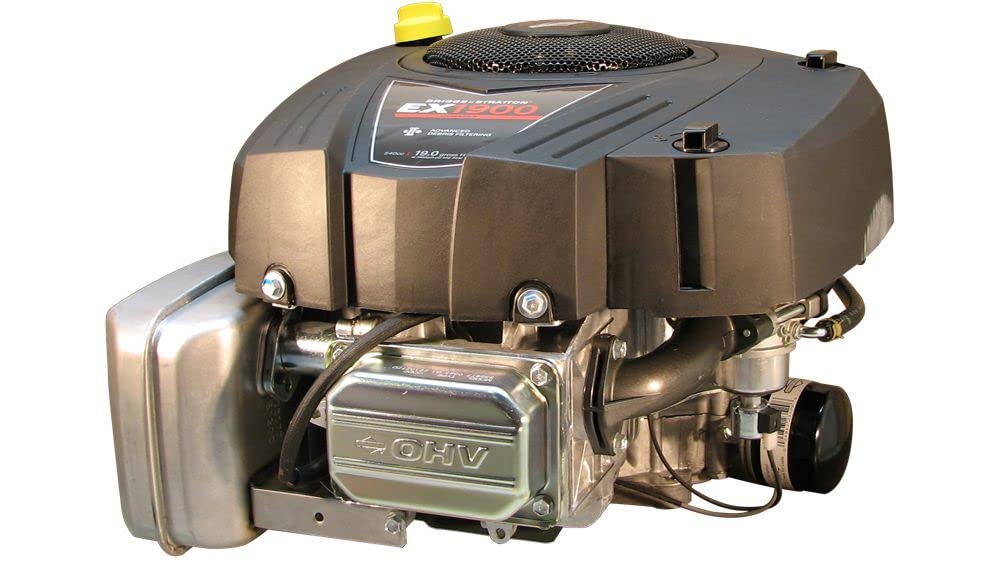
1. Briggs and Stratton Vertical Engine 19 HP 540cc 1″ x 3-5/32″ #33S877-0043
Our pick — over 4.5★ from 100+ verified ratings; the strongest balance of quality and price.
This 540cc 19 HP engine is the most cost-effective way to revive a John Deere LA-series mower for under.
This is the engine most residential zero-turn owners end up buying, and for a clear reason: at 56.9 pounds, while some of the commercial-tier 25 HP engines above weigh 83.8 pounds, making it far easier to lift into place without a shop crane. The 540cc displacement delivers 19 HP; the commercial units deliver 27 HP, but that power is still enough to spin a 42 or 48-inch deck through typical suburban turf without strain.
The mounting holes arrive unthreaded — a recurring point in the feedback. Owners confirm all four holes line up perfectly with the John Deere LA105 and LA125 bolt pattern, but you will need to run a 3/8 NC tap into them before the bolts can bite. A buyer put it plainly: “installed in about 3 hours pretty much plug and play, old pully on main shaft was correct fit, you will need to tap engine mounting bolts… started right up and no problems.” The cast-iron cylinder sleeve and dual-element air filter are the durability features that justify the purchase over a scrap-yard used motor — they extend the life span well beyond the stamped-aluminum alternatives found on economy lawn tractors.
Honest swap trade-off: The bolt-tapping requirement adds about 30 minutes to the install, and a few owners wished a paper manual came in the box (there is none). But once the oil and gas are in, it fires on the first crank and the muffler is already pre-attached — no extra shopping for parts.
Reach for this if: You own a John Deere LA105, LA125, or similar residential zero-turn and you want the most cost-effective way to get five more seasons out of a machine you already know and trust.
Think twice if: Your mower runs a 60-inch or larger commercial deck — the 19 HP will struggle in wet, heavy grass at that width.
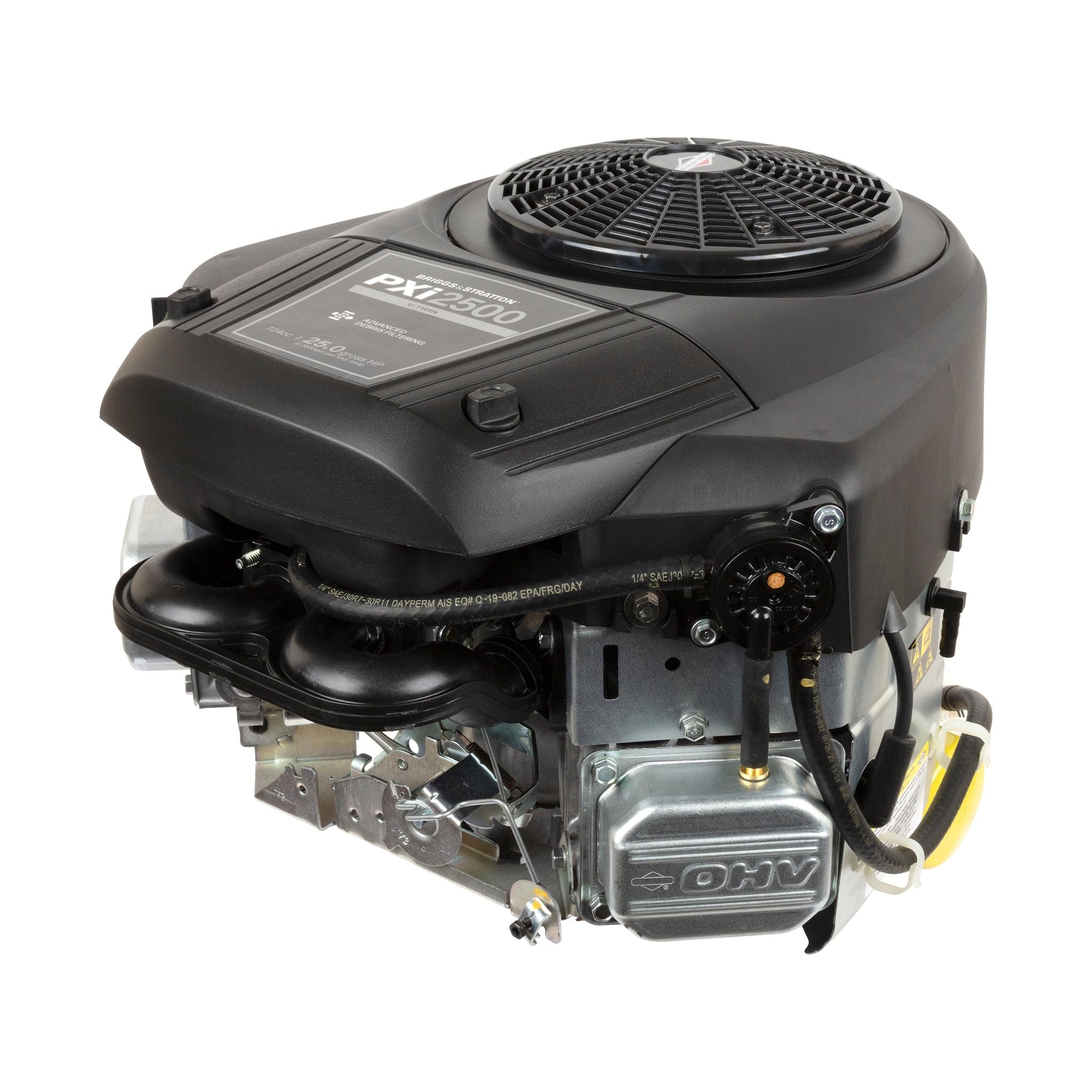
2. Briggs & Stratton 44S977-0032-G1 25 GHP Vertical Shaft Engine
The 0033-G1 is nearly identical to the 0032-G1 but uses a float-feed carburetor for more reliable cold starts.
The “33” and “32” suffixes on these two 25 GHP models confuse buyers every day. This 44S977-0033-G1 shares the same Dura-Bore cast iron sleeve and 16 amp alternator as the 44S977-0032-G1 above, but the key difference is the float-feed carburetor — a design that uses a traditional fuel bowl and float mechanism rather than a fixed-jet system. The practical result is more consistent starting after the engine has sat through the winter, because the float bowl holds a reserve of fuel that the carb can draw from immediately. Buyers describe it as a “direct replacement, installed and running great,” and the 145 total ratings (the highest count of any engine in this roundup) make it the most-vetted choice here.
The dimensions of this engine measure 18.81 x 17.9 x 14.96 inches — a 1% size reduction compared to the 19 x 16 x 18-inch 0032-G1, which is not noticeable during installation but hints at slightly tighter packaging under the hood. Oil leakage from the shipping box is mentioned by a handful of owners — the engine can arrive on its side in transit. If you buy this one, plan to top off the oil and wipe the exterior before installation. The mounting holes do not come pre-threaded on some units, so have your tap set ready just in case.
Why owners pick it
- Float-feed carburetor means reliable restarting after months of storage — the fuel bowl does not drain as fast as fixed-jet designs.
- Highest review volume of any engine here, giving the strongest data set on long-term reliability.
- Identical horsepower and charging output to the 0032-G1, but sometimes priced slightly lower.
Keep an eye on
- Some units arrive with oil leakage from box tipping during shipping; check the oil level before first start.
- The drive pulley compatibility varies by mower model — double-check your original clutch assembly aligns before you commit.
Best for: A buyer who wants the most commonly purchased 25 GHP option with the largest sample size of owner experiences to confirm reliability. The float carb is a genuine advantage if you store the mower for months at a time.
Skip if: You are replacing an engine on a mower with a non-standard clutch or unusual exhaust routing — the fit feedback here is slightly more mixed than the 0032-G1.
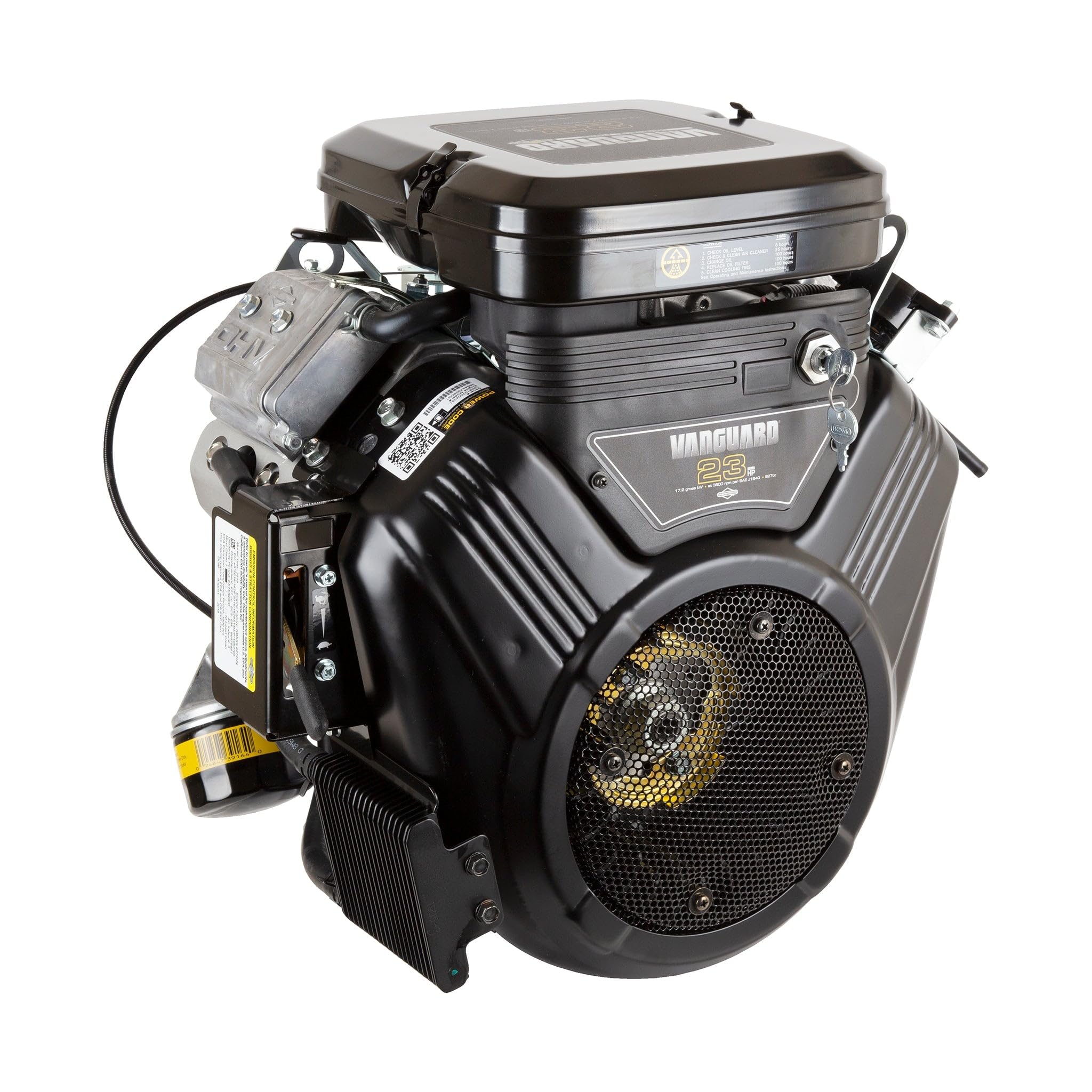
3. Briggs & Stratton 386447-0090-G1 23 HP Vanguard Engine
The Vanguard series packs industrial-grade internals, including an oil cooler, into a 23 HP package for sustained high-RPM operation.
This engine lives in a different world from the residential and even commercial Briggs units above. The Vanguard line is built for applications that demand continuous full-throttle runs: commercial mowing, pressure washers, generators, and even longtail boat builds, where owners confirm it runs “flawlessly in extreme weather (freezing, rain).” The oil cooler is the standout feature — it keeps the lubricant temperature in check during summer mowing sessions that last six to eight hours, preventing the varnish buildup that kills non-cooled engines. The dynamically balanced crankshaft reduces vibration at the handlebars, which translates to less operator fatigue over a full day of cutting. At 92 pounds, this is the heaviest engine in the review (the 19 HP unit weighs 56.9 pounds), so plan for two-person installation or an engine hoist.
The major caveat that surfaces across buyer reports is the lack of an included muffler. Multiple owners express frustration, with one comparing it to “buying a car without rims and tires.” You will need to source and purchase a muffler separately, and the exhaust port dimensions are not always standard. Another risk: the warranty. The review data includes a verified case where a stator failed within three months and local dealers refused warranty service because the engine was used in a non-standard application. If you are installing this on a zero-turn mower — which is a standard application — this may not apply, but it is worth knowing that warranty enforcement can be inconsistent.
When to step up: If you mow commercially in hot climates (90+°F summers) or you plan to run the engine at full throttle for extended hours without shutdown, the oil cooler and full-pressure lubrication justify the premium over the standard Briggs V-twin. The low-profile dual-clean air cleaner is also noticeably easier to service than the cyclonic unit on the 49T877.
Ideal for: Operators who mow large acreage commercially in high-heat conditions and want the vibration reduction of a dynamically balanced crank. The compact overall size (44.5 x 39.25 x 39.25 inches) helps it fit in tighter engine bays than the 810cc V-twins.
Consider carefully: The muffler must be bought separately and the warranty protection is weaker than the three-year plan on the Commercial Series engines — budget for that muffler cost upfront.
4. 24hp Vertical 1″x3-5/32″ Shaft, Kawasaki Engine (FR730VJS00S)
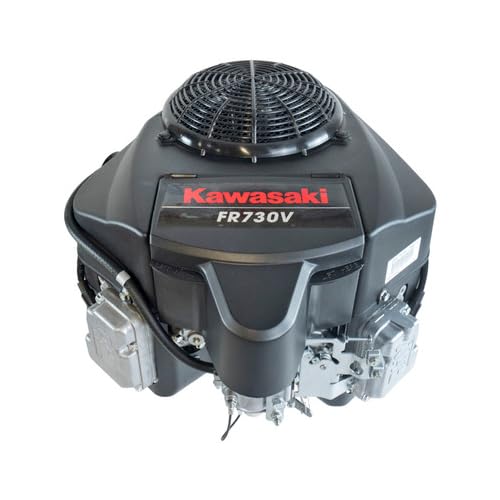
This 726cc Kawasaki V-twin bolts directly into a Gravely with no wire splicing required.
Kawasaki engines have a reputation among zero-turn owners that is almost religious — they are perceived as smoother, more fuel-efficient, and longer-lived than equivalent Briggs & Stratton units. This FR730VJS00S model delivers 24 HP from 726cc, which puts it between the 19 HP and 27 HP Briggs options in displacement but ahead of both in real-world refinement. The 1-inch x 3-5/32-inch shaft is the most common residential and light-commercial size, meaning it fits a huge range of mowers from Gravely, Husqvarna, and John Deere without a crankshaft adapter. Buyers confirm it is a “direct fit from FS730V, plug-and-play with no wire splicing.” The revised air filter housing on this model keeps the filter cleaner than the previous generation, according to owners.
It weighs 95 pounds, while the 25 GHP Briggs weighs 83.8 pounds and the 19 HP unit weighs 56.9 pounds. Some of that weight comes from the thicker cylinder walls and the aluminum/steel construction that Kawasaki uses — it is built to handle sustained high-RPM without flexing the block. The electric start is standard, and the fuel pump is integrated, so you do not need to buy a separate pump for gravity-feed tanks. The one known hazard: packaging. The review data includes a verified case of a cracked box with the engine arriving damaged. This appears to be a shipping issue rather than a product flaw, but it means you should inspect the crate thoroughly before signing for delivery and photograph any damage immediately.
Where it beats the Briggs V-twins: Owners consistently report smoother idle and less vibration at the grips compared to the 44S977 and 49T877 series. If you are sensitive to handlebar buzz during a three-hour mowing session, the Kawasaki is worth the extra money.
Perfect for: Mower owners who prioritize vibration comfort and long-term reliability over raw peak horsepower. The 24 HP is enough for any deck up to 60 inches, and the engine sips fuel more gently than the 810cc Briggs units.
One note: The 95-pound weight makes solo lifting a challenge — have a helper or a hoist ready for installation day.
5. 24hp Vertical 1-1/8″x4-9/32″ Shaft, Kawasaki Engine (FR730V-ES16S)
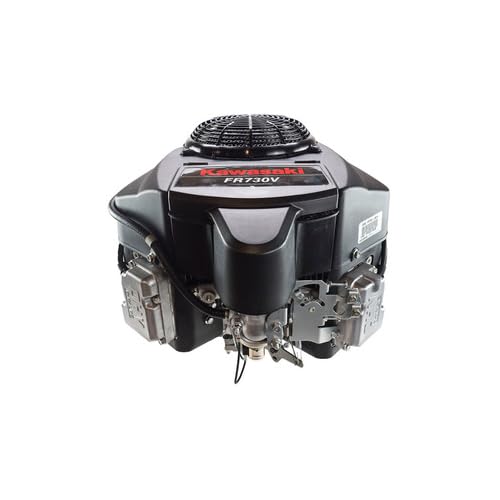
This 726cc Kawasaki V-twin features a 1-1/8-inch shaft for heavier commercial pulleys and clutches.
This is the engine you need if your zero-turn mower uses a larger crankshaft diameter than the standard 1-inch. The 1-1/8-inch by 4-9/32-inch shaft is common on wider commercial decks (typically 60-inch and above) where the thicker shaft resists bending under the higher side-load of a heavy dual-blade spindle assembly. The Kawasaki FR730V-ES16S shares the same 726cc V-twin block and 24 HP rating as product 7, so you get the same smooth idle and fuel efficiency — but the shaft dimension is non-negotiable. If your mower’s pulley and clutch are designed for 1-1/8 inches, the 1-inch engines above will wobble and fail prematurely. Measure your old shaft with a caliper before ordering; the difference between 1 inch and 1-1/8 inches is easy to miss visually.
Buyers call it a “brand new crate engine, direct bolt in replacement” and confirm it “cranked up on the first try.” The installation took a couple of hours. One nuance: the wire harness on this model may differ from the old engine on some mowers. A buyer noted they “had to use the old harness” because the connector shape was different — a straightforward workaround, but it adds 15 minutes to the swap. The included oil filter and minimal shipping oil mean you need to buy and add oil before the first start. A few owners reported the recommended muffler part number (JZGRDN 49070-0877) does not fit without cutting and welding, so hold off on buying that muffler until you can test-fit your existing unit.
What earns the premium
- 1-1/8-inch shaft resists flex on wide commercial decks — a genuine mechanical advantage over the standard 1-inch shaft engines.
- Same proven Kawasaki 726cc V-twin architecture that powers thousands of commercial mowers, with a reputation for lasting past 2,000 hours.
- Fuel pump and electric start are integrated, reducing the number of separate parts to buy.
Installation realities
- The wire harness plug shape may not match your mower’s harness — you may need to swap in your old connector or splice wires.
- No muffler included and the recommended OEM muffler reportedly requires modification to fit.
Buy this if: Your mower uses a 1-1/8-inch shaft and you want the gold-standard Kawasaki V-twin with the highest owner rating (4.9 out of 5) of any engine in this guide. The thick shaft is not optional — it is a requirement for the pulley system on your particular machine.
Pick something else if: Your mower has a standard 1-inch shaft. You would be paying more for a shaft size that will not fit your clutch, and the 1-inch Kawasaki (product 7) gives you the same engine with the correct shaft for less money.
Understanding the Specs
Crankshaft Shaft Size: 1-Inch vs 1-1/8-Inch
The shaft diameter is the most critical measurement when replacing a zero-turn mower engine. The shaft is the steel rod that extends downward from the engine and connects to the blade pulley system via a keyway and bolt. The majority of residential zero-turns use a 1-inch diameter shaft that is 3-5/32 inches long, with a 1/4-inch keyway. Commercial mowers with heavier decks often step up to a 1-1/8-inch diameter shaft that is 4-9/32 inches long. Installing a 1-inch shaft engine on a mower built for 1-1/8 inches will leave the pulley loose and dangerous — the blades may slip or detach under load. Always measure your old engine’s shaft with a caliper before ordering a replacement.
Gross Horsepower (GHP) vs Actual Cutting Power
Briggs & Stratton uses the Gross Horsepower (GHP) rating standard on their larger engines, while Kawasaki and some other brands use SAE net horsepower. The GHP number is measured at the flywheel with no accessories like an alternator or muffler attached, which means the real power delivered to the mower deck is about 10-15% lower. Do not get fixated on the sticker number — the displacement (cc) and the torque curve are more reliable indicators of how the engine will handle thick grass. An 810cc V-twin engine will pull through wet grass better than a 540cc single-cylinder, even if the horsepower labels are close. For a 48-inch residential deck, 19-24 HP is sufficient. For a 60 to 72-inch commercial deck, you want at least 24 HP and 700cc or more.
FAQ
Will a 19 HP engine replace a 21 HP or 22 HP engine on my zero-turn mower?
Do I need to tap the mounting holes myself on these engines?
How do I know if my mower needs a 1-inch or 1-1/8-inch crankshaft?
Does the muffler come included with these replacement engines?
How long does a replacement engine last on a zero-turn mower?
Can I install a bigger engine than the original one on my mower?
What is the difference between a V-twin and a single-cylinder engine for zero-turn mowers?
Does the engine come pre-filled with oil?
Is a Kawasaki engine really better than a Briggs & Stratton?
Will these engines work on a zero-turn mower with a manual PTO clutch?
Final Thoughts: The Verdict
For most owners, the clear winner among the engine for zero turn mower options is the Briggs & Stratton 33S877-0043 19 HP because it strikes the best balance of trusted brand, enough power for standard residential decks, and a price that does not force you into a “while you are at it” upgrade spiral. If your mower runs a 60-inch or larger deck and you deal with thick, wet grass every week, step up to the Briggs & Stratton 44S977-0032-G1 25 GHP for the extra torque and the 16 amp charging system. And for owners who prioritize buttery-smooth operation and a V-twin that will likely outlast the mower chassis itself, the Kawasaki FR730VJS00S 24 HP is the engine that tens of thousands of commercial operators trust — just be ready for the higher upfront investment.
How We Picked
We do not accept paid placement. Every pick is matched to a real buyer and a real use-case; we do not hands-on test units.
Sources & Methodology
Specifications: manufacturer listings and product documentation. Review insights: verified customer reviews, as of July 2026. Pricing: not shown on this page (it changes often); check the current price via the retailer link.
As an Amazon Associate, WellFizz earns from qualifying purchases. This does not affect which products we feature.
Related Guides

Mo Maruf
I created WellFizz to bridge the gap between vague wellness advice and actionable solutions. My mission is simple: to decode the research and give you practical tools you can actually use.
Beyond the data, I am a passionate traveler. I believe that stepping away from the screen to explore new environments is essential for mental clarity and physical vitality.