Our readers keep the lights on and my smoothie glass nicely filled. As an Amazon Associate, I earn from qualifying purchases.
Specs are compiled from manufacturer listings and verified buyer reviews and can change over time — please confirm the key details on the product page before buying.
Spring is the moment your Bermuda grass shakes off winter dormancy and races to thicken up. The right fertilizer delivers the nitrogen punch that turns a patchy, pale lawn into a deep-green carpet before summer heat arrives. Get the mix wrong, and you either burn the blades or starve the roots just when growth is peaking.
I’m Mohammad Maruf — the founder and writer behind WellFizz. This guide is built by comparing the manufacturers’ published specifications and the patterns across verified customer reviews, so you get each pick’s real strengths and trade-offs instead of marketing spin.
These nine picks cover every price tier and feeding style you need. The one that fits your yard depends on how much time you want to spend spreading, whether you prefer organic or synthetic, and whether pets and kids will be playing on it an hour after application. This is the fertilizer for bermuda grass in spring your lawn has been waiting for.
Our Picks at a Glance


How To Choose The Best Fertilizer For Bermuda Grass In Spring
Bermuda grass is a warm-season powerhouse that demands a high-nitrogen diet as soon as soil temperatures hit 65°F. Pick the wrong analysis — too much phosphorus or too little potassium — and you will encourage weeds or weaken roots before summer stress arrives.
NPK Ratio — The Three Numbers That Matter
Nitrogen (the first number) drives leaf growth and that dark green color Bermuda is famous for. A spring fertilizer should carry a first number between 15 and 30. Phosphorus (the middle number) helps root development, but most established Bermuda lawns already have enough phosphorus in the soil. Potassium (the last number) strengthens cell walls, improving drought tolerance and disease resistance. A ratio like 28-0-12 or 30-0-12 works beautifully for a mature lawn.
Slow-Release vs Quick-Release Nitrogen
Slow-release nitrogen feeds the grass steadily over weeks, producing even growth without a sudden green-up that fades fast. Quick-release nitrogen delivers an immediate color change but can leach away or burn the turf if applied too heavily. The best spring formulas blend both — a fast green-up now plus slow nutrition that lasts six to twelve weeks, so you are not reapplying every two weekends.
Granular vs Liquid Application
Granular fertilizers (the ones you toss with a spreader) are the traditional choice for larger lawns. They are less prone to drift and can cover big areas quickly. Liquids, on the other hand, enter the leaf tissue immediately and show results within a week. The trade-off is that liquids require a hose-end or backpack sprayer and more frequent applications. Your choice depends on yard size, equipment, and how often you want to be out there.
Quick Comparison
| Model | Best For | NPK Ratio | Form | Coverage | Amazon |
|---|---|---|---|---|---|
| Espoma Organic Spring Lawn Booster★ Best Overall | Eco-conscious yards with wildlife | 8-0-0 | Granules | 5,000 sq ft | Amazon |
| Superior 15-0-15 LiquidBest Liquid | No-phosphorus feeding programs | 15-0-15 | Liquid | Full lawn | Amazon |
| Advanced 16-4-8 Balanced NPKTop Performer | Fast green-up with seaweed boost | 16-4-8 | Liquid | Full lawn | Amazon |
| PetraMax 16-4-8 | Dual quick/slow release in one bottle | 16-4-8 | Liquid | Up to 25,600 sq ft | Amazon |
| Covington Naturals 3-18-18 | Seed-starting and root development | 3-18-18 | Liquid | 3,250 sq ft | Amazon |
| GreenView Fairway Formula | Large lawns, low-effort feeding | 30-0-12 | Granules | 10,000 sq ft | Amazon |
| Lawnbox Grass Genie 10-0-6 | Pet-safe organic with humic acid | 10-0-6 | Granules | 2,500 sq ft | Amazon |
| The Andersons 28-0-12 Premium | Heat-stress resistance for summer | 28-0-12 | Granules | Full lawn | Amazon |
| Eco Solutions 25-5-10 Slow Release | Minimal-reapplication convenience | 25-5-10 | Granules | 4,000 sq ft per app | Amazon |
In‑Depth Reviews
1. Espoma Organic Spring Lawn Booster 8-0-0
Our pick — over 4.5★ from 200+ verified ratings; the strongest balance of quality and price.
The organic nitrogen bomb that wildlife families trust over synthetic alternatives.
This 30-pound bag of slow-release granules delivers a gentle 8-0-0 analysis enhanced with calcium — a feeding approach that greens up Bermuda without the aggressive flush that can stress a lawn emerging from dormancy. The crowd favorite — nearly 250 owners have given it 4.6 stars — and buyers report “great dark green growth on Bermuda grass in wet conditions,” exactly what a spring lawn needs when rains are frequent.
The thing everyone raves about is the zero burn risk. You can layer it heavily on sandy soil and the grass just drinks it in. That same organic composition means it is also safe for wildlife, birds, and pets, which is a big deal if your yard doubles as a family hangout. The trade-off is real: the smell is strong (imagine a barnyard aroma that hangs around a few days) and the powder creates a brown fog when you broadcast it. Keep the bag in an outdoor shed and wear a dust mask while spreading.
Why it wins: In a category where overshooting nitrogen burns your lawn, this organic 8-0-0 lets you feed confidently while supporting soil biology. At 30 pounds covering up to 5,000 sq ft, it is also a respectable value for mid-sized yards.
Your lawn it suits: The organic-first Bermuda grower who wants deep green color without chemical concern — and who can stomach a few days of earthy smell.
Moment to pause: If your Bermuda is already thick and you just want a rapid cosmetic green-up, a synthetic high-nitrogen product will show color faster.
2. Superior 15-0-15 Liquid Fertilizer
A phosphorus-free liquid that pours strong nitrogen and potassium straight to the roots.
If your Bermuda lawn already tested high in phosphorus — or your state restricts phosphorus use — this 15-0-15 liquid is exactly the answer. The 15% nitrogen drives green color and lateral spread while the 15% potassium (potash) toughens the turf against the temperature swings of early spring. The included humic acid, derived from leonardite, helps that nutrition actually reach the root zone instead of washing away.
Owners mention that “it takes a few months to see full results” — a reminder that liquid organics work as a soil-building program, not an overnight cosmetic fix. It pairs nicely with a granular program for season-long feeding. The 32-ounce bottle mixes easily in any hose-end or backpack sprayer, and being a USA-made product from a family turf company adds confidence.
The pairing move: Use this as a supplemental liquid feed 2–3 weeks after your initial granular spring application. The quick leaf uptake fills any gaps your spreader misses.
Reach for this if: You need a zero-phosphorus formula that still delivers serious nitrogen and potassium for a Bermuda lawn. Ideal for environmentally sensitive areas.
Look elsewhere if: Your lawn is struggling and you want a dramatic color change within a week — this feed works slowly and patiently.
3. Advanced 16-4-8 Balanced NPK — Simple Lawn Solutions
The liquid that turns patchy dead spots into thick green in under two weeks.
With over 11,000 ratings and tally, this 16-4-8 concentrate is the most widely trusted liquid in the category. The 16% nitrogen drives leaf color, the 4% phosphorus supports early root recovery, and the 8% potassium boosts stress tolerance. what separates it, though, is the addition of seaweed and fish emulsion — organic matter that feeds soil microbes and improves nutrient uptake. Customers note grass “greened up significantly” in about 10 days, with several noting it outperforms Scotts granular products at a lower cost per application.
The thing that wins people over is the ease of use. Hook the hose-end sprayer to the garden hose, set the dial, and walk. The 31.9 fluid ounce bottle treats a small to medium lawn with room to spare. Value for money gets a mixed verdict from some owners — the math depends on how often you apply — but the overwhelming consensus lands on the positive side.
How it stacks up: Compared to the Superior 15-0-15 above, this delivers a more complete NPK profile with phosphorus, making it better for lawns that need root rebuilding after a tough winter.
Best fit: The Bermuda owner who wants fast, visible greening with minimal equipment hassle. Great for smaller lawns where a spreader feels like overkill.
The catch: A small number of users find the cost-per-application higher than granular alternatives if you have a very large lawn.
4. PetraMax 16-4-8 Liquid Lawn Fertilizer
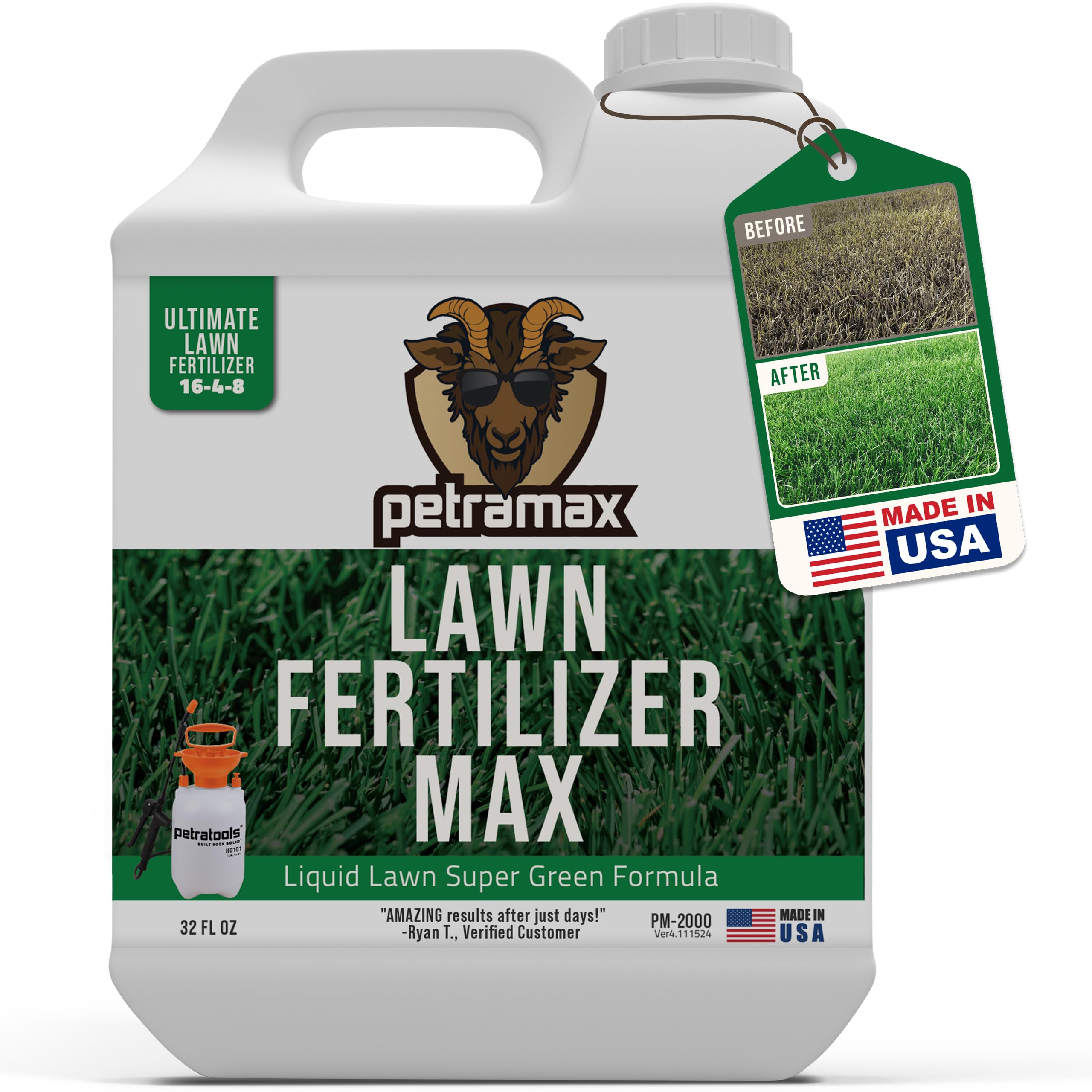
A 2-in-1 liquid that hits your lawn with quick green and slow feed in one pour.
This 16-4-8 formula from PetraTools combines quick-release nitrogen for an immediate color pop with slow-release nitrogen that keeps feeding between applications — a dual-action approach that saves you from spraying every weekend. The 32-ounce bottle treats up to 25,600 sq ft for maintenance (or 12,800 sq ft if your lawn is deficient), making it the most coverage-efficient liquid on this list. Owners note it works as advertised when you shake well before use, and the pet-friendly label offers confidence.
The recurring gripe is clogging — some units arrive with solid chunks that can block a siphon tube. A vigorous shake before mixing resolves most cases, but it is worth noting. Effectiveness is the most-praised aspect by a wide margin, with quality a close second.
The difference maker: The slow-release component means you can push applications to every 14 days rather than every 7, cutting your labor in half compared to standard liquids.
Your lawn it fits: The mid-size yard (up to a quarter acre) where you want liquid feeding but do not want to spray every weekend.
Moment to check: The clogging reports are real — if you are unlucky, breaking up solids adds an extra step to your routine.
5. Covington Naturals 3-18-18 Liquid Fertilizer
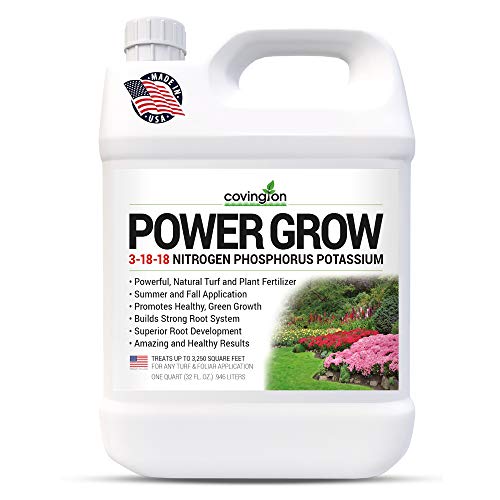
A root-building specialist for Bermuda lawns that need deep anchoring after winter.
Most spring fertilizers pile on nitrogen for leaf color. This 3-18-18 flips the priority: high phosphorus and potassium for root architecture and stress tolerance. The low nitrogen number means the top growth stays moderate while the underground structure develops — exactly what you want if you are overseeing bare patches or planting new Bermuda sprigs. Reviewers point out seed germinated in 4 days with “lush green filling in by day 11,” an impressive timeline for spring establishment.
One owner candidly notes the grass stayed “a little pale” and wished the nitrogen content were higher. That is an honest trade-off of this formula: it builds roots first, color second. The mixing ratio calls for 2–4 oz per gallon, and a 32-ounce bottle covers about 3,250 sq ft. Covington Naturals is a family-owned USA company with roots in the commercial turf industry, adding serious credibility.
Use this product in early spring before the main growth flush, not as your primary nitrogen feed.
Best paired with: A high-nitrogen liquid like the Advanced 16-4-8 above — root builder in early spring, nitrogen booster once the lawn is actively growing.
Reach for it: The spring after a hard winter when your Bermuda looks thin and you want to thicken the turf from the ground up.
skip it if: Your lawn is already thick and you just want a green cosmetic lift. A higher first-number formula will give you the color you are after.
6. GreenView Fairway Formula 30-0-12

A high-nitrogen granular that feeds a large Bermuda lawn for 12 weeks straight.
If your yard is an acre or more, this 33-pound bag covering 10,000 square feet is the most efficient way to handle spring feeding. The 30-0-12 analysis is exactly what established Bermuda craves: heavy nitrogen for dense, dark green growth and potassium for heat and drought tolerance. Most of the nitrogen (63%) is slow-release, so one application in early spring carries the lawn to early summer without a second round.
Owners consistently praise the product for greening up Bermuda within a week of application. The granules are noticeably small, which means you get even coverage with less risk of burning from overlap. The formula is phosphate-free, protecting nearby waterways — a strong environmental argument. Quality and effectiveness are the two most-discussed aspects, and the 4.5-star rating across 500+ ratings puts it among the most trusted granulars you can buy.
A practical difference: At 33 pounds versus the Espoma organic’s 30 pounds, you get a denser nutrient load — more feeding per pound of product carried.
Your lawn it fits: The large-lot owner who wants one-and-done spring feeding. Works beautifully on bermuda and St. Augustine alike.
The honesty check: Because the nitrogen is so high (30), you must water it in within 24 hours to avoid leaf burn, especially on thin turf.
7. Lawnbox Grass Genie 10-0-6 Organic Fertilizer
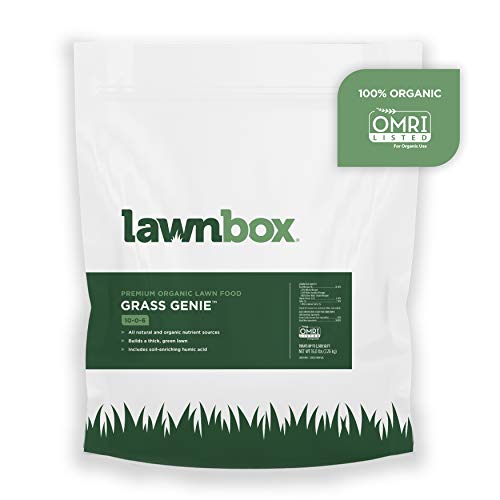
The organic pick that gets dogs and kids back on the lawn immediately.
This 100% organic granule (10-0-6) is designed for the family that uses the lawn as a living room. It contains no animal byproducts, manures, biosolids, or other waste material — just plant-based nutrients plus humic acid for soil health. The blend delivers both quick and slow-release nitrogen, so your Bermuda sees an immediate spring green-up followed by steady feeding lasting up to six weeks.
Repeat buyers swear by it: “I will keep buying Lawnbox over and over… safe for kids and pets is a MUST.” The bag covers 2,500 sq ft, which makes it best for smaller yards where the per-square-foot cost matters less than safety. The 4.4-star rating across 100+ ratings confirms the consistency. It is not the cheapest option per square foot, but if organic inputs and instant family access are your priorities, this is the one.
Where it stands out: Unlike the Espoma organic (8-0-0) which uses natural materials including manures, Lawnbox avoids waste entirely — a meaningful distinction for the purity-focused gardener.
Best fit: The household with young children and pets who are on the grass daily — and who value zero synthetic inputs.
Trade-off worth naming: At 16 pounds covering just 2,500 sq ft, the per-application cost is higher than most synthetics. For large lawns, the math gets rough.
8. The Andersons Premium Lawn Food 28-0-12

A 28-0-12 granular built to weather the summer stress that breaks lesser lawns.
The 28-0-12 analysis here is a classic third-application (spring-to-summer transition) feed in The Andersons’ lawn program. The high nitrogen plus iron delivers that deep greening you want going into June, while the 12% potassium fortifies cell walls against drought and heat — the two biggest threats to Bermuda in July and August. Both fast and slow-release nitrogen are present, so you see green in days while the lawn stays fed for weeks.
Owners who switched from big-box brands report “yellow areas turned greener, healthy areas deepened within days.” The 4.5-star score across 155 ratings puts it neck-and-neck with GreenView for trust, though the 18-pound bag covers less ground. Application timing matters: spread it after mowing and water it in within 12 hours for best results — several owners emphasize this step.
Head-to-head: The GreenView Fairway Formula (30-0-12) has a 30% nitrogen content and covers 10,000 sq ft, while The Andersons (28-0-12) has a 28% nitrogen content and includes iron for even deeper greening — a meaningful edge if your soil tends toward chlorosis (a yellowing from lack of iron).
Reach for this if: You live in a region where summers hit 95°F+ and want your Bermuda armored against heat dormancy.
Look elsewhere if: Your lawn is small (under 3,000 sq ft) and a 28-0-0 granular is more nitrogen than you need — a 16-4-8 liquid might give you better control.
9. Eco Solutions Slow Release 25-5-10
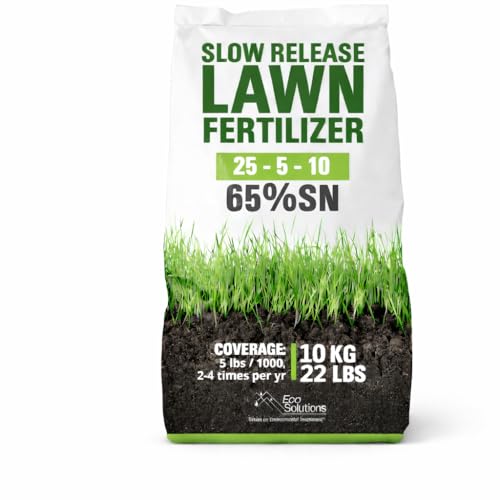
A 110-day nitrogen release that lets you apply once and forget until July.
This 22-pound bag (25-5-10 NPK) is engineered for the low-effort Bermuda owner. The 65% granular nitrogen is slow-release, feeding steadily for up to 110 days — meaning a single spring application covers most of the growing season. The included potassium from sulphate of potash provides a natural mineral boost that improves root depth and overall plant health without a chemical burn risk.
Buyers with challenging conditions — high elevation, desert terrain — report the fertilizer “worked wonders on my extremely difficult grass” and “in 8 days I saw a significant difference.” The 4.2-star rating across 265 ratings confirms it works, though some owners feel the cost per bag runs high. It is labeled kid and pet-safe when used as directed, and the list of approved applications extends from residential yards to sports fields, so the formulation has some backing from commercial use.
The practical reality: The 110-day window means you miss that mid-summer nitrogen boost that the GreenView 12-week feed would require. For deep-feeding the entire growing season, this is class-leading.
Your lawn it fits: The busy owner who wants to fertilize once in early spring and not think about it until fall. Great for vacation homes or rental properties.
Watch out for: The product runs strong — on weak or stressed Bermuda, shoppers say it can dry out already struggling patches. Water well after spreading.
Understanding the Specs
NPK Ratio — The Three Numbers
The three-digit code on every bag (like 16-4-8 or 30-0-12) tells you the percentages of nitrogen, phosphorus, and potassium by weight. The first number is the most important for spring Bermuda: it drives leaf growth and that deep green color. A 30 in the first slot is a heavy feeder — great for established lawns, but it must be watered in immediately. An 8 in the first slot is gentler and works well for organic soils or if you are prone to heavy-handed spreading.
Slow-Release vs Quick-Release
Slow-release nitrogen is coated or chemically modified so it dissolves gradually over weeks or months. Quick-release nitrogen dissolves instantly and the grass uses it within days. The best spring fertilizers blend both: you get a fast cosmetic green-up from the quick portion plus steady feeding from the slow portion that prevents the lawn from fading between applications. High-performance products like GreenView (63% slow-release) and Eco Solutions (65% slow-release) excel at this.
FAQ
When should I apply spring fertilizer to Bermuda grass?
What is the best NPK ratio for Bermuda grass in spring?
Can I use a fertilizer with phosphorus on my Bermuda lawn?
How often should I fertilize Bermuda grass during spring?
Will a liquid fertilizer work better than granular on Bermuda?
Can I fertilize Bermuda grass if I have pets and kids?
What happens if I apply too much fertilizer to Bermuda in spring?
Should I use a spreader for granular fertilizer?
Is it safe to seed Bermuda and fertilize at the same time?
Final Thoughts: The Verdict
If you want one dependable pick, the fertilizer for bermuda grass in spring winner is the GreenView Fairway Formula 30-0-12 because it delivers one of the highest nitrogen concentrations in a slow-release granular that feeds for 12 weeks, covering 10,000 square feet per bag with consistent results owners trust. If you want organic confidence for a family yard, grab the Lawnbox Grass Genie. And for fast liquid feeding on a smaller Bermuda lawn, the Advanced 16-4-8 by Simple Lawn Solutions is the one to reach for after seeing what the data shows — over 11,000 owners can not be wrong about how quickly it greens up a lawn.
How We Picked
We do not accept paid placement. Every pick is matched to a real buyer and a real use-case; we do not hands-on test units.
Sources & Methodology
Specifications: manufacturer listings and product documentation. Review insights: verified customer reviews, as of July 2026. Pricing: not shown on this page (it changes often); check the current price via the retailer link.
As an Amazon Associate, WellFizz earns from qualifying purchases. This does not affect which products we feature.
Related Guides

Mo Maruf
I created WellFizz to bridge the gap between vague wellness advice and actionable solutions. My mission is simple: to decode the research and give you practical tools you can actually use.
Beyond the data, I am a passionate traveler. I believe that stepping away from the screen to explore new environments is essential for mental clarity and physical vitality.