Our readers keep the lights on and my smoothie glass nicely filled. As an Amazon Associate, I earn from qualifying purchases.
Specs are compiled from manufacturer listings and verified buyer reviews and can change over time — please confirm the key details on the product page before buying.
The right electric scooter for a 6-year-old is a tricky balance — fast enough to be thrilling, slow enough for a parent’s nerves, and sturdy enough to survive a tumble on the driveway. The nine picks here cover that range, from ultra-safe beginner models with 6 mph tops to more advanced rides with enough range for neighborhood cruises.
I’m Mohammad Maruf — the founder and writer behind WellFizz. This guide is built by comparing the manufacturers’ published specifications and the patterns across verified customer reviews, so you get each pick’s real strengths and trade-offs instead of marketing spin.
Whether you are looking for your child’s first motorized ride or an upgrade that lasts several years, this breakdown of the best electric scooter for 6 year old options will help you match the right set of wheels to your young rider’s confidence level and your budget.
Our Picks at a Glance

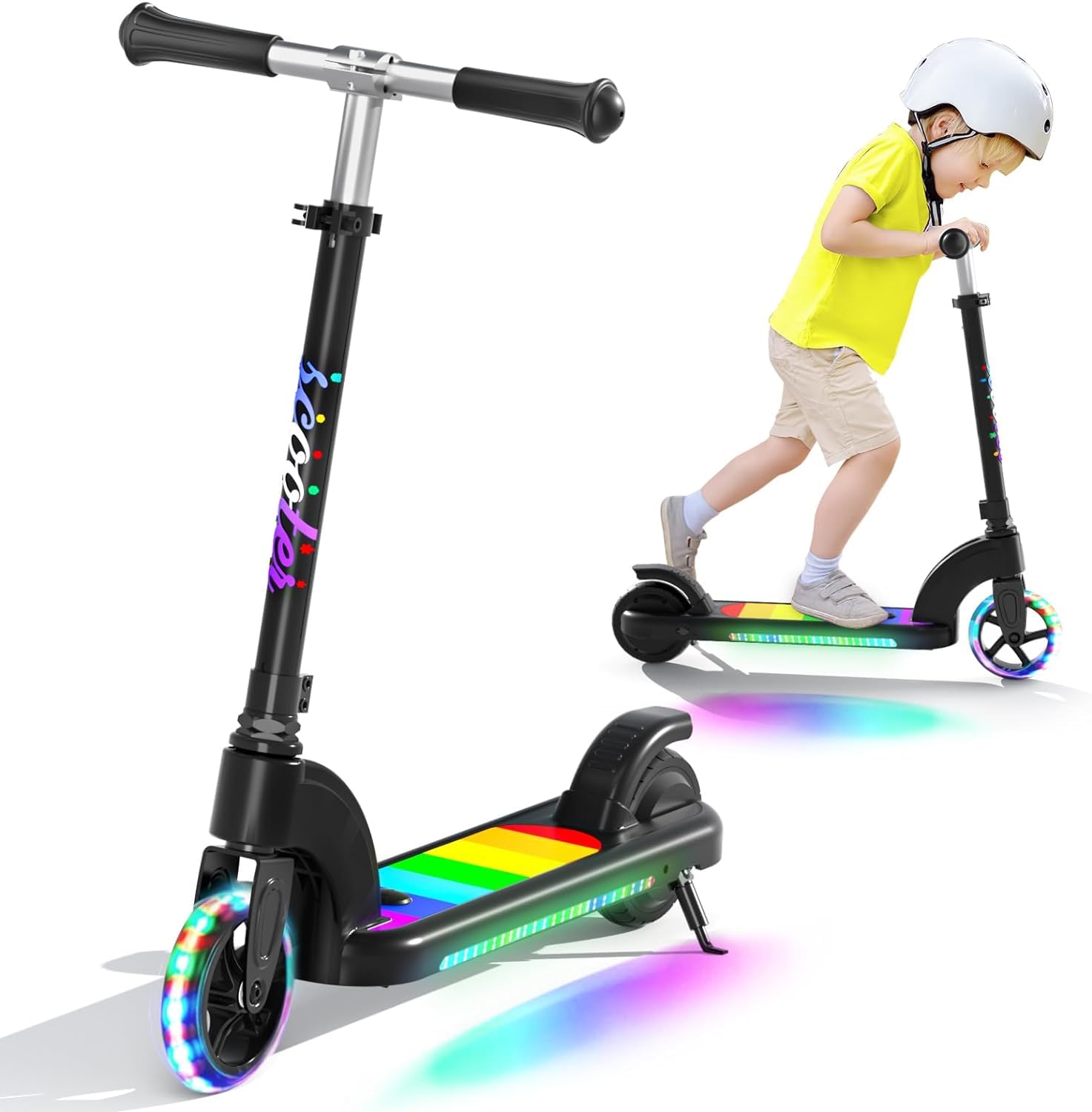
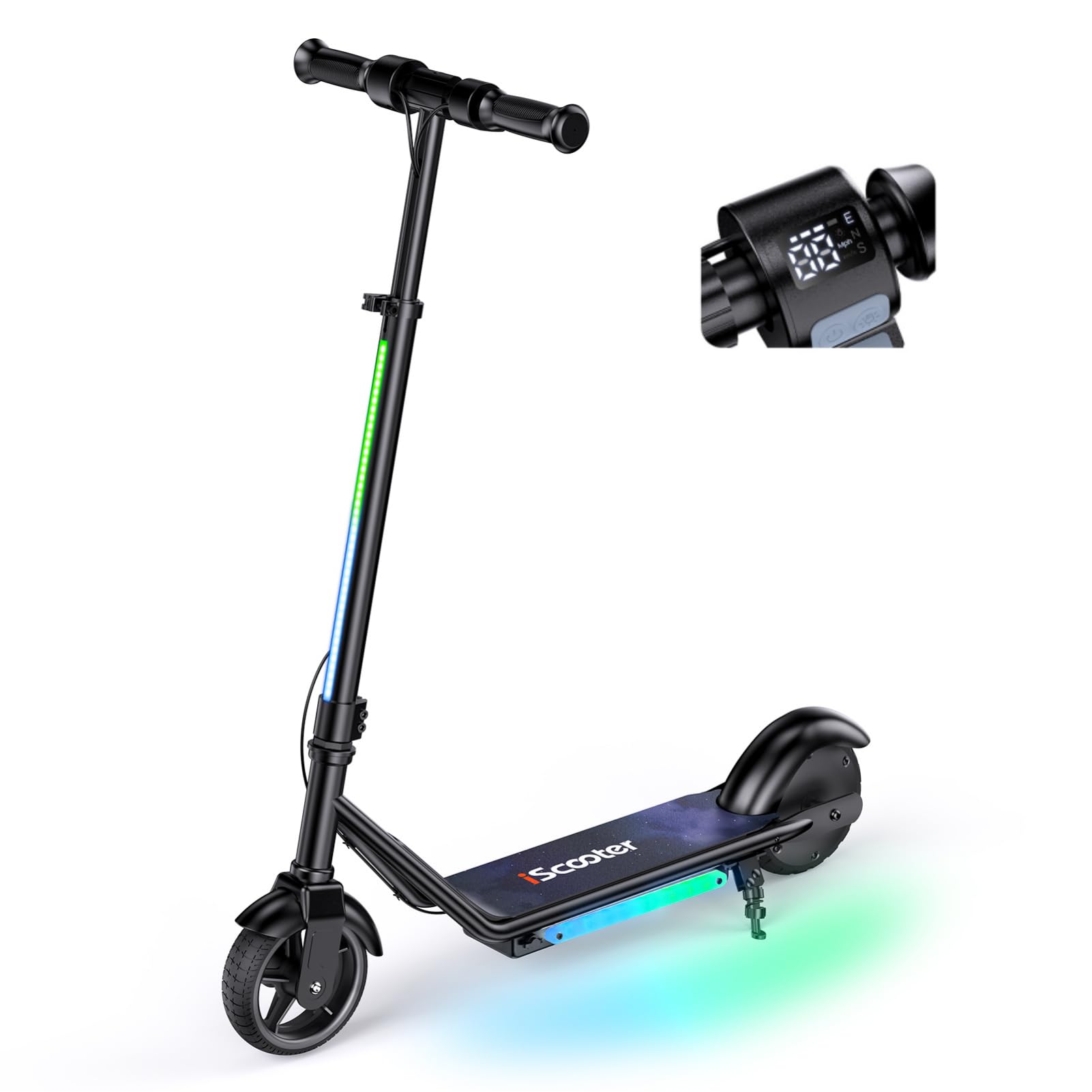
How To Choose The Best Electric Scooter For 6 Year Old
Every parent wants a scooter their child can actually handle. The three specs that determine that are top speed, maximum rider weight, and whether the scooter has a kick-start safety feature. Get these right, and the rest — battery life, lights, adjustable height — are bonuses.
Speed Modes and Kick-Start
A 6-year-old learning to balance on a motorized deck is not the same as a 10-year-old zipping down a sidewalk. Look for a scooter with at least two speed settings (a beginner mode around 4-6 mph and a faster mode up to 8-10 mph) and a kick-start requirement. That kick-start means the motor does not engage until the child pushes off with their foot — no accidental acceleration from a stationary start.
Weight Capacity and Adjustable Handlebars
Many models claim a 110 lb limit, but if you want the scooter to last through age 8 or 9, look for a 132 lb or 154 lb maximum. The handlebar height should adjust at least 3 inches, ideally from about 32 to 39 inches, so the scooter grows with the child’s inseam. Fixed handlebars on a budget model are fine for a single season; adjustable ones stretch your investment.
Battery Life and Charging Time
Typical ride times run 40 to 80 minutes per charge, and most scooters need 4 to 5 hours to refill. A magnetic charging port is a nice bonus — it eliminates the struggle of aligning a plug and reduces wear on the port. The actual range depends on the child’s weight, the terrain, and how aggressively they use the throttle.
Brakes and Tire Type
A dual-brake setup (electronic handbrake plus a rear foot brake) gives a child two ways to stop. Solid rubber tires never go flat, which is a huge convenience for parents; they also provide consistent grip on pavement. Pneumatic (air-filled) tires offer a softer ride on uneven ground but require occasional inflation. For a 6-year-old riding mostly on smooth sidewalks, solid tires are the lower-maintenance choice.
Quick Comparison
| Model | Best For | Top Speed | Rider Weight Max | Battery Life | Amazon |
|---|---|---|---|---|---|
| Segway Ninebot Kids eKickScooter★ Best Overall | Best Overall | 9.9 mph | 132 lbs | 70 min | Amazon |
| ANHAO Electric ScooterBudget Starter | Budget Starter | 6 mph | 110 lbs | — | Amazon |
| iScooter IK3 SeriousThree-Speed Versatility | Three-Speed Versatility | 10 mph | 154 lbs | 60-80 min | Amazon |
| Caroma Electric Scooter | Lightweight Build | 8 mph | — | 85 min | Amazon |
| escoone K2 Pro | One-Button Simplicity | 10 mph | 154 lbs | 5.6 mile range | Amazon |
| WERHY Foldable | Long-Range Cruiser | 19 mph | — | 12 miles | Amazon |
| Gyroor H30 Max | Bluetooth Music Fun | 10 mph | 132 lbs | — | Amazon |
| Hiboy Q2 Lite | Includes a Seat | 9.3 mph | — | 2.5 hr charge | Amazon |
| Gyroor H40 | Premium Build Quality | 10 mph | 143 lbs | 2 hr charge | Amazon |
In‑Depth Reviews
1. Segway Ninebot Kids eKickScooter
Our pick — 4.5★ from 250+ verified ratings; the strongest balance of quality and price.
The neighborhood favorite that pairs Segway reliability with a kid-friendly 9.9 mph ceiling.
Your 6-year-old gets three adjustable riding modes here, so you can start them on the lowest speed and move up as their confidence grows. The safety kick-start is a standout: the throttle only wakes up after the child pushes to 3 mph, which stops the scooter from lurching forward unexpectedly. That safety-first approach is why it holds the top slot — it pairs a 70-minute ride time with the UL2272 safety certification, giving parents real confidence.
The alloy steel frame supports riders up to 132 lbs, which means this scooter will handle your child well into their elementary years. The 17.2-pound weight is a bit heavy for a small kid to carry up stairs, but the solid tires shrug off rough pavement without any risk of a flat. Owners consistently praise the build quality over the battery life — the battery gets described as decent rather than exceptional. The rear drum brake and mechanical handbrake provide two distinct stopping actions, which helps a young rider learn to slow down before slamming the brake.
At a top speed of 9.9 mph, it is noticeably faster than budget starters like the ANHAO (6 mph), so it suits a child who has already spent time on a kick-scooter. The 5-hour charge time is average for the category, and the IPX4 water resistance means a light rain shower will not end the ride. Buyers report that “my daughter was timid on it at first,” but quickly built confidence — a common pattern that speaks to the scooter’s manageable acceleration.
What wins parents over
- Three-speed modes let you dial in the pace as your child learns
- Kick-start prevents any standing-start surprises
- Segway brand means solid parts availability and known safety certs
The honest trade-offs
- 17.2 lb weight is heavy for a young child to carry
- Struggles on even gentle hills — stick to flat sidewalks
- No front or rear lights included (buy a separate set for dusk rides)
Who this fits: A 6- to 8-year-old ready for their first electric ride, with a parent who values safety certifications and adjustable speed more than raw power.
Think twice if: Your neighborhood has steep driveways or you need a scooter a small child can lift into the car alone — the 17.2 lb frame is not a featherweight.
2. ANHAO Electric Scooter for Kids Ages 6-12
A gentle 6 mph ceiling and a start button on the deck make this the ideal first-ever electric scooter.
Unlike most electric scooters that place the throttle on the handlebar, ANHAO puts a pressure-sensitive button on the deck pad — a child simply steps on it to go. That design eliminates the coordination challenge of twisting a grip while balancing, so a 6-year-old can focus on steering and braking. The two speed modes (4 mph and 6 mph) are among the slowest in this lineup, which is exactly what you want for a complete beginner.
The aluminum frame keeps the scooter light, and the four adjustable height settings (up to 31.8 inches) accommodate children from about preschool to early middle school. The 110 lb maximum rider weight is lower than the Segway or iScooter, so a growing child will outgrow the weight limit before they outgrow the height adjustments. The light-up wheels and deck LEDs add visibility at dusk without needing batteries or separate lights.
Durability is the main caveat here — a small number of owners mention bolts loosening or the front wheel detaching after several months. The consensus is that this scooter delivers excellent value for the first season or two, but may not survive rough daily use into a third year. The foot brake is simple and intuitive: press down on the rear fender to slow down, which works well at 6 mph but would feel inadequate at higher speeds.
Why it works for beginners
- Step-on deck button is much easier for small hands than a throttle
- 4 mph beginner mode feels safe on the driveway
- Aluminum frame is lightweight enough for a child to steer easily
Where it cuts corners
- 110 lb weight limit means a fast-growing kid will max it out quickly
- Some units show wear — bolts need occasional tightening
- No electronic brake; the foot brake alone is less responsive
Reach for this if: Your child has never used any electric scooter and needs the gentlest possible introduction — the deck button and 4 mph mode make that almost simple to use.
Look elsewhere if: You want a scooter that will last three or more years of heavy use, or your child already weighs over 100 lbs.
3. iScooter IK3 Serious Electric Scooter for Kids Aged 6-12
Three distinct speeds (3, 6, and 10 mph) plus a 154 lb weight limit that outgrows the competition.
This scooter solves a common problem: most kids’ models cap at 110 or 132 lbs, but the IK3 supports 154 lbs. That extra 44 lbs over the ANHAO means a tall or heavy 8-year-old can still ride comfortably. The three-level adjustable handlebar (32, 35.5, and 39 inches) is also taller than most rivals, making this a genuine long-term pick. The 150W motor delivers smooth power, and the magnetic charging port is a genuinely kid-friendly touch — it snaps into place without precise plug alignment.
The speed variety (3, 6, and 10 mph) is broader than the Segway’s three modes, letting you start a nervous 6-year-old at a walking pace. The dual brake system combines an electronic handbrake with a rear foot brake, which gives children a backup if they forget to squeeze the lever. The LED display on the handlebar shows real-time speed and battery level — a feature usually reserved for adult scooters — which helps older kids learn to monitor their own range.
Battery life is a frequent discussion point in owner feedback: the 60-80 minute claim works out closer to 40-50 minutes in real use with a heavier child on slight hills. The colorful ambient lights on the handlebars are a hit at dusk, and owners say the scooter feels “sturdy” and “smooth” right from the start. Some units arrive with cosmetic scuffs, but the 360-day warranty on certain parts provides a safety net.
Stands out for: The 154 lb weight limit and 39-inch max handlebar height mean this scooter fits kids who have outgrown every other “ages 6-12” model on the market.
The caveat: Real-world battery life is shorter than the 60-80 minute estimate — plan for about 40-50 minutes of active riding per charge on gentle hills.
Best for: A growing 6-year-old who will use this for several years, especially if they are tall or already near the 110 lb mark of budget scooters.
skip it if: Your child is very small for their age — even the lowest speed mode (3 mph) may feel too peppy, and the 6-inch wheels are better suited to smooth pavement.
4. Caroma Electric Scooter for Kids Ages 6-14
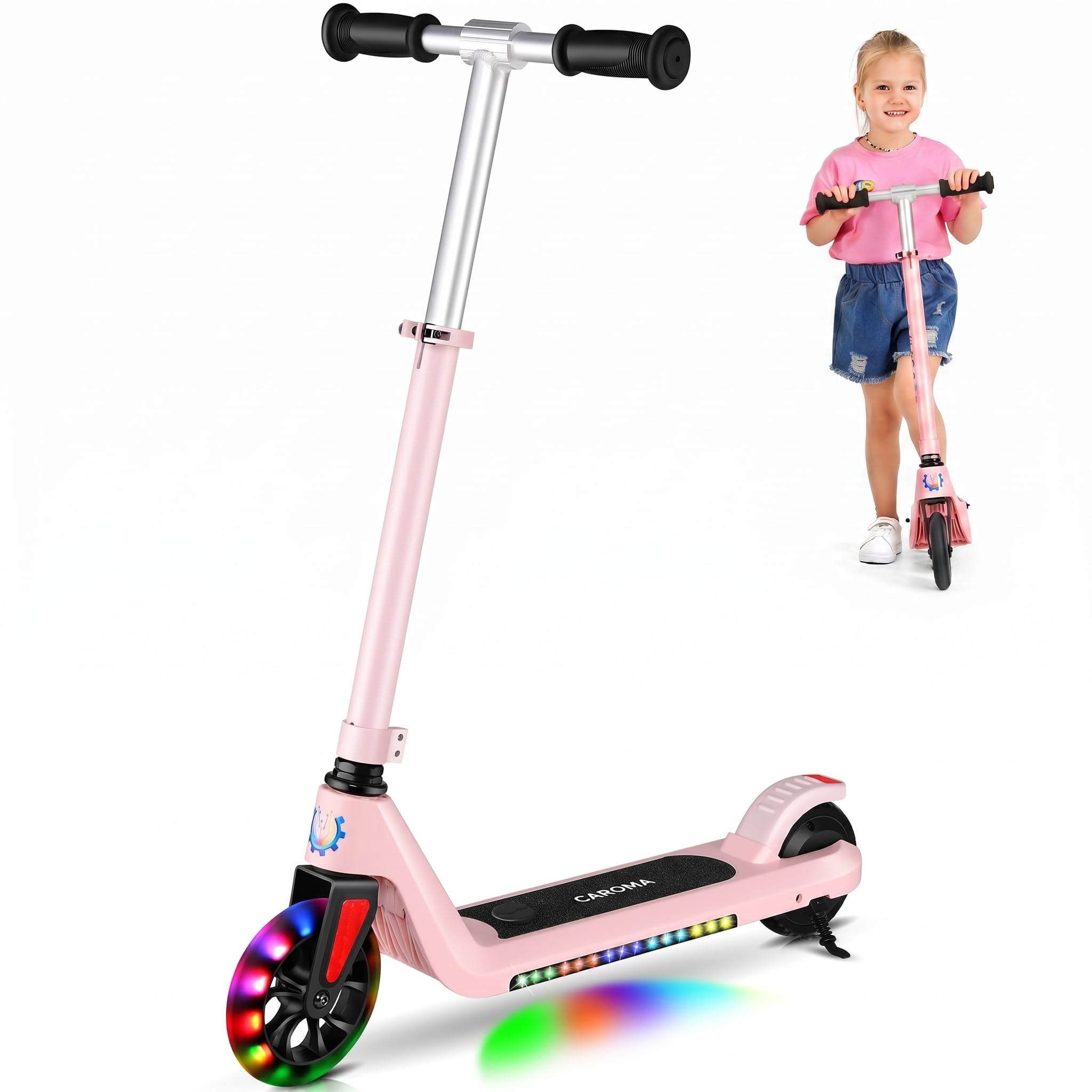
At 12.1 lbs, it is the lightest scooter here — a child can pick it up and carry it into the house.
Most kids’ electric scooters weigh 15 to 25 pounds, which leaves them stranded at the bottom of the driveway when the battery dies. The Caroma weighs only 12.1 lbs, so a 6-year-old can lift it over a curb or carry it up a few porch steps without help. The aluminum frame and 8 mph top speed keep the weight down without feeling underpowered for flat pavement cruising. The two-speed modes (4 mph and 8 mph) give a clear step-up once the child masters the lower setting.
The auto power-off feature is a nice battery-saver — if the scooter is left idle for one minute, it beeps and shuts down. The child just kicks the pedal switch to restart, which also prevents the scooter from rolling away if it is left outside. Owners consistently mention the bright colored lights on the front wheel and deck, which make the rider visible at twilight. The 85-minute ride time is competitive with the Segway, and the 5-hour charge is standard for the category.
The biggest limitation is the single braking system — a rear foot brake only, with no electronic handbrake. At 8 mph, the foot brake provides enough stopping power on flat ground, but a steep downhill would demand more control than the foot brake alone offers. Some owners also note the handlebar height (36.2 inches) is a fixed adjustment, not a telescoping range, so taller kids or very short adults may find the posture slightly off.
What owners love: The sheer lightness — kids who struggle to manage 17+ lb scooters find this one completely manageable. The lights on the wheels are also a frequent hit.
One limitation: The rear foot brake is your only stopping option — no handbrake backup means steeper paths require extra attention from the rider.
Perfect for: A younger or smaller 6-year-old who needs a scooter they can physically control and carry. Also great for parents who need to toss it in the trunk often.
Not ideal if: Your neighborhood has significant slopes — the foot brake alone and 8 mph top speed may feel underpowered on a sustained hill.
5. escoone K2 Pro Electric Scooter for Kids Ages 6-12
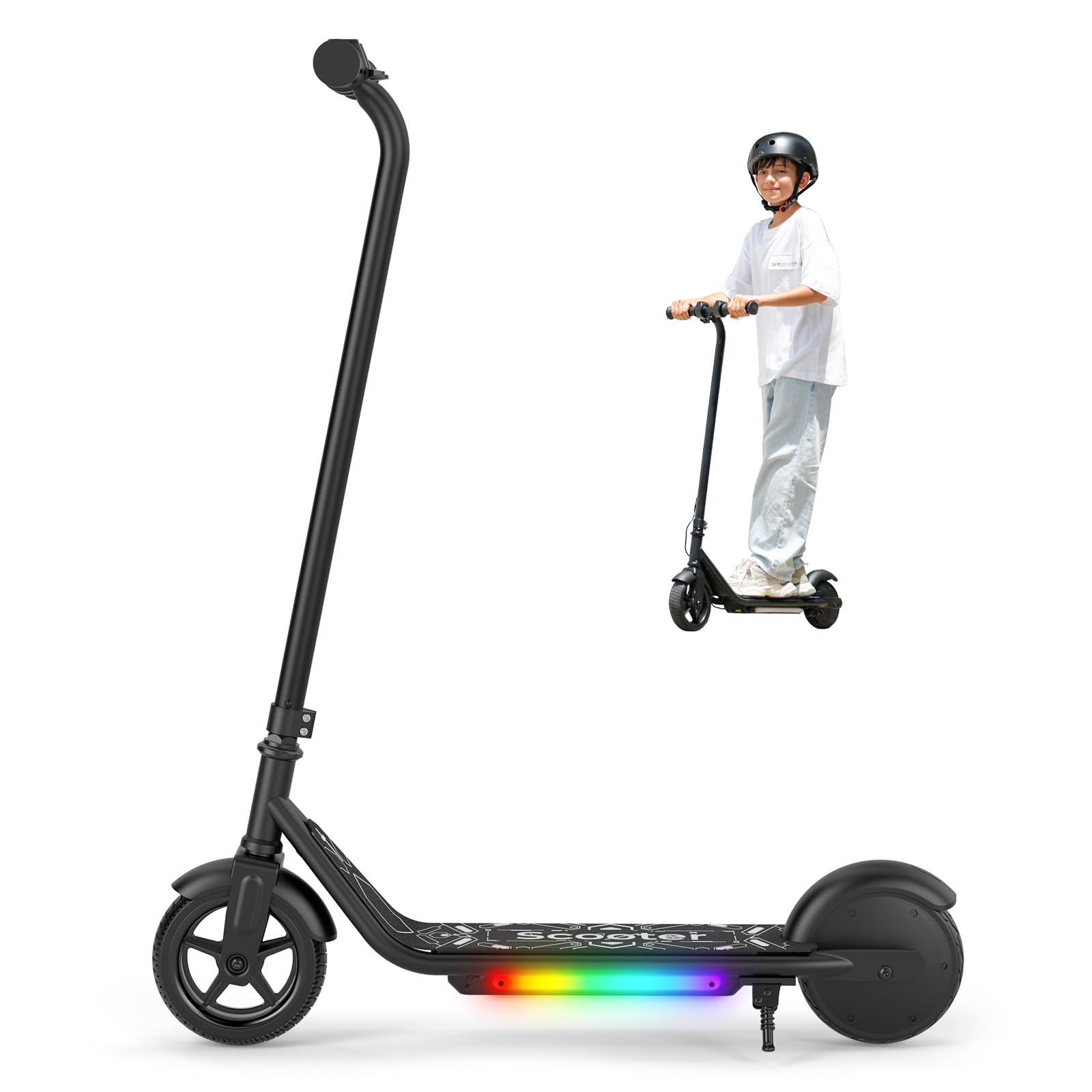
Every control lives on one button — no screen distractions, no multi-button confusion for small fingers.
The K2 Pro strips away the LED dashboard and replaces it with a single multi-function button. Press once to power on, press again to cycle between 6 mph and 10 mph modes, hold to turn on the lights. That simplicity is intentional: a 6-year-old does not need to look down at a screen to figure out their speed — they just ride. The 150W motor provides enough torque for flat sidewalks, and the dual braking system (electronic front brake plus rear foot brake) gives two independent ways to stop.
The magnetic charger snaps on easily and auto-detaches if someone trips over the cable, which reduces port damage over time. The 5.6-mile claimed range is realistic for a 50-60 pound rider on flat ground at the lower speed setting. Owners appreciate the “sturdy” aluminum frame and the colorful ambient lights that make the scooter visible at dusk. The 15.5 lb weight is middle-of-the-pack — lighter than the Segway but heavier than the Caroma.
The biggest complaint from owners is the battery life — several report that the scooter delivers closer to 30 minutes of actual riding time before needing a recharge, especially in the 10 mph mode. The K2 Pro also lacks a kick-start requirement, so the motor can engage from a standstill if the button is pressed, which is a safety consideration for a very impulsive 6-year-old.
The smart design choice: One-button operation means no distracted fiddling — the child’s eyes stay on the road. The magnetic charger is also genuinely easier for kids.
The honest trade-off: Real-world battery life runs about half the advertised estimate for heavier riders or at the higher speed, so plan for shorter outings.
Pick this for: A child who gets overwhelmed by multiple buttons or displays — the single-button design removes all complexity from the riding experience.
Consider another if: You need more than 30 minutes of continuous ride time, or you want the extra safety of a mandatory kick-start before the motor engages.
6. WERHY Foldable Kids Electric Scooter for Aged 6-10
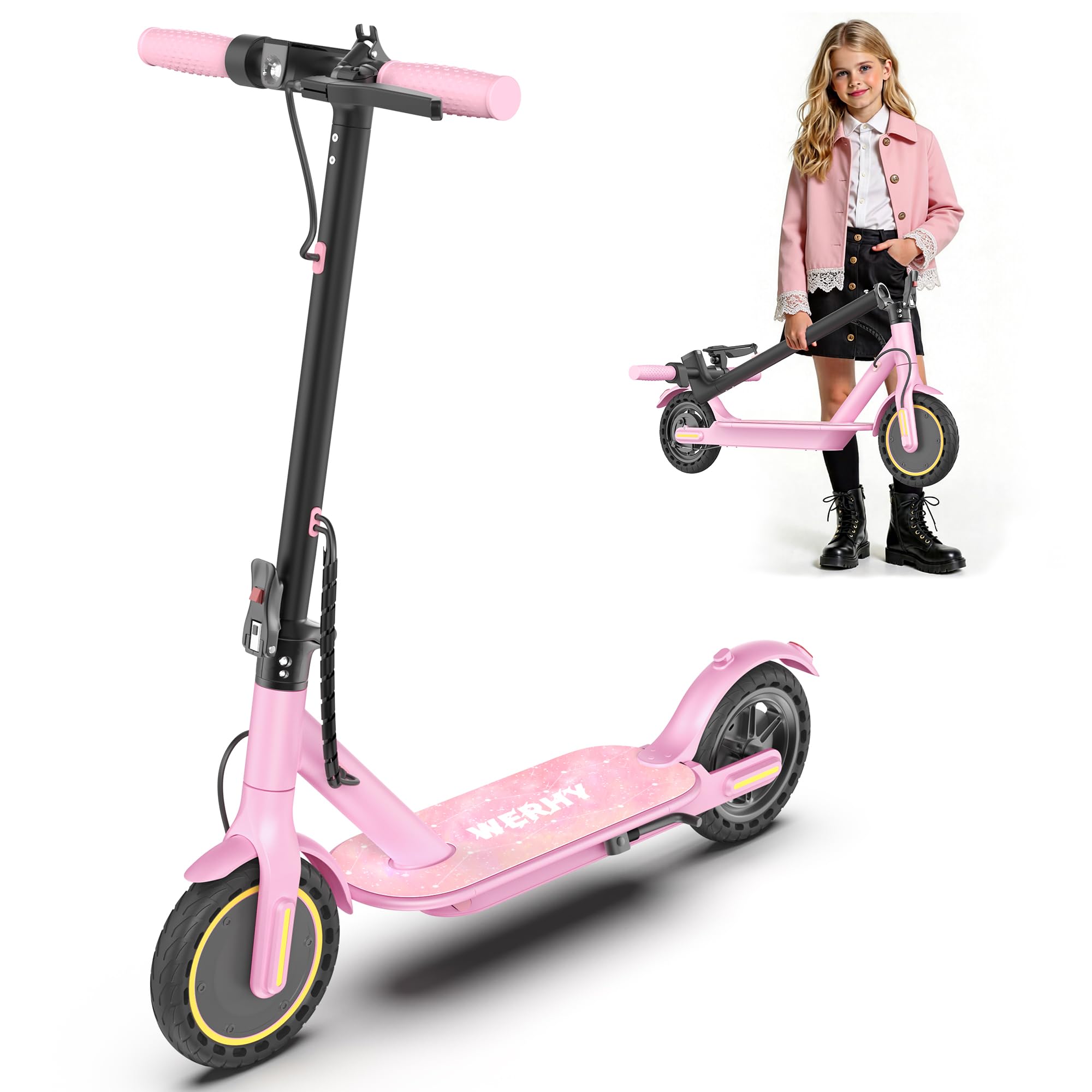
A 350W motor and 12-mile range turn this into the distance king for kids who dread coming home.
The WERHY is the most powerful scooter in this lineup, with a 350W motor (the iScooter has a 150W motor). The 12-mile range means a child can ride to a friend’s house, explore the park, and still have battery left for the return trip — uncommon in the kids’ category where 60-80 minutes is the norm. The top speed of 19 mph is significantly faster than any other pick here, so this is really a choice for a confident 8-10 year old rather than a cautious beginner.
The dual brake system (electronic e-brake plus drum brake) provides control at higher speeds that a foot brake alone cannot match. The foldable frame collapses to 22 lbs for trunk storage, though that weight is still substantial for a 6-year-old to carry. The smart LED dashboard shows real-time stats, and the companion app lets a parent set speed limits and track ride distance — a rare feature that adds a layer of parental oversight. The 4-hour charge time is quicker than most competitors.
The main caveat is that 19 mph is objectively fast for a young child — a fall at that speed can mean scraped knees or worse. The recommended age of 6-10 feels ambitious at the higher end of the speed range. Owners praise the “sturdy” build and “long battery” but also note that the scooter feels “fast but safe” when restricted to the lower speed mode via the app. The 8.5-inch solid tires provide stable handling on pavement but transmit more vibration than pneumatic tires.
Why it stands out
- 350W motor handles gentle hills that stall lesser scooters
- 12-mile range enables proper neighborhood adventures
- App-based speed controls give parents remote oversight
What limits it
- 19 mph is too fast for most 6-year-olds — use the app to lock it down
- 22 lb folded weight is heavy for a child to carry
- Solid tires transmit bumps on rough pavement
Best suited for: An older child (7-10) who has outgrown beginner scooters and needs the range and hill-climbing power to keep up with siblings or parents.
Not for: A 6-year-old’s first scooter — the power and weight are better matched to an experienced rider who has already mastered balance and braking.
7. Gyroor H30 Max Electric Scooter for Kids Ages 6-12

A built-in Bluetooth speaker turns every ride into a rolling dance party — parents love the speed control.
The Gyroor H30 Max distinguishes itself with a bottom-mounted Bluetooth speaker that lets a child stream music directly from a phone. That may sound gimmicky, but owners consistently report it is the feature kids remember most — the ability to play their own soundtrack while cruising. Under the fun exterior is a solid 150W motor with three speed modes (6, 8, and 10 mph) and a dual brake system that combines an electronic brake with a rear foot brake for backup stopping power.
The scooter supports riders up to 132 lbs, and the adjustable handlebar offers three heights (34, 36, and 38 inches) to accommodate growth from age 6 through about age 12. At 13.2 lbs, it is significantly lighter than the Segway (17.2 lbs), making it more manageable for a child to steer and carry. The UL2272 certification provides the same safety assurance as the Segway, so parents know the battery and electrical system meet a recognized standard. The colored panel lights add visibility at dusk without adding separate batteries.
The reliability feedback is split: many customers note the scooter runs smoothly for months, while a smaller group notes that units stop working after a few months. The manufacturer offers responsive customer support that often sends replacement parts or new units for warranty issues. The 10 mph top speed is at the higher end of the safe range for a 6-year-old, so starting in the 6 mph mode is wise for the first few rides.
The kid magnet: The Bluetooth speaker is the detail that makes this scooter a hit at birthday parties — kids love riding with their own music playing.
The reliability note: Most units perform well, but a small number of reviewers point out early failures. The responsive warranty support helps offset that risk.
Ideal for: A child who already has some riding experience and wants a scooter that feels special — the music and lights create an event out of every trip to the park.
Think twice if: You want a no-frills workhorse with proven long-term durability — the simpler Segway is the safer bet for sheer reliability over years.
8. Hiboy Q2 Lite Electric Scooter for Kids w/Seat
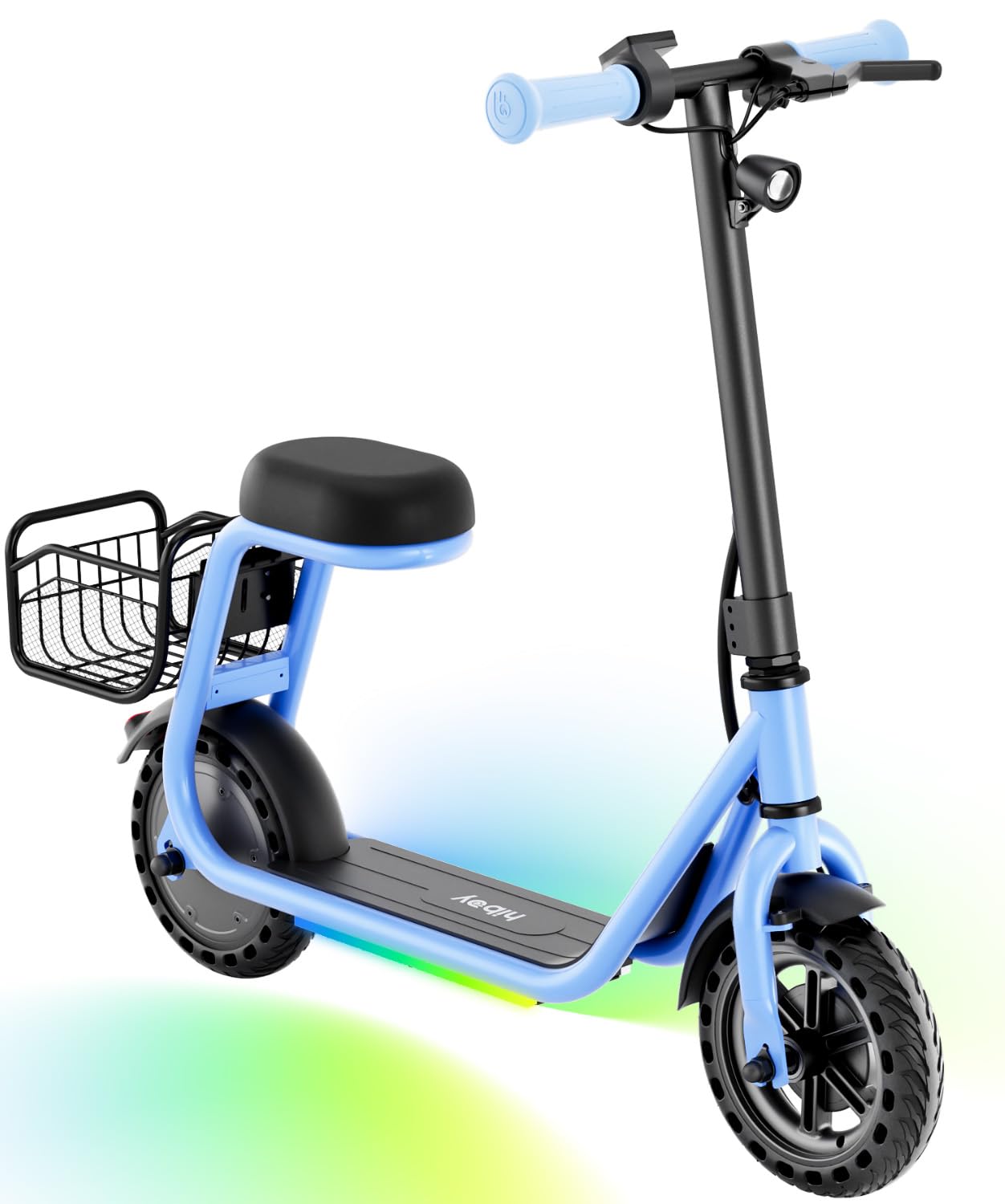
The only scooter here with a proper seat — perfect for kids who get tired standing or prefer a moped-style ride.
Some children simply do not enjoy standing on a narrow deck for 40 minutes. The Hiboy Q2 Lite solves that with a soft TPR-material seat that provides cushioning and support, turning the scooter into a seated cruiser. The 100W motor is less powerful than most standing models, but the 9.3 mph top speed is still enough to keep up with a parent on a bicycle in low gear. Three speed modes (ECO at 4 mph, D at 6 mph, and S at 9.3 mph) let you start the child slow and gradually increase.
The 8.5-inch solid tires are the largest in this lineup, providing a stable ride that absorbs small bumps better than the 6-inch wheels on most competitors. The integrated headlight and brake light improve visibility at dusk, and the neon accents underneath the deck create a cool glow that kids love. The scooter also includes a small front basket — a rare feature that lets a child carry a water bottle or small toy. The UL2272 certification provides the same safety assurance as the Segway and Gyroor models.
The 25.8 lb weight is the heaviest pick here by a wide margin — this scooter is not something a 6-year-old will lift into a car or carry up stairs. The seated design also limits the riding positions; once a child wants to stand, the seat post takes up deck space. Owners who use it for a year report the battery holds up well (7-10 rides per charge in the lower speed modes), though a few note that the real-world ride time at the highest speed is closer to 15-20 minutes.
What makes it special
- Seated design is ideal for kids who lack the stamina for standing rides
- 8.5-inch solid tires roll smoothly over cracks and small debris
- Includes a front basket and full lighting system
The downsides
- 25.8 lbs is too heavy for a child to lift or carry
- 100W motor feels underpowered on inclines
- Seat post takes up deck space if the child wants to stand
Great for: A younger or less physically confident 6-year-old who feels steadier sitting down — the seat removes the balance challenge of standing on a moving deck.
Not for: Anyone who needs to carry the scooter regularly (the 25.8 lb weight is prohibitive) or who lives on a hilly street.
9. Gyroor H40 Kids Electric Scooter 180W 10MPH
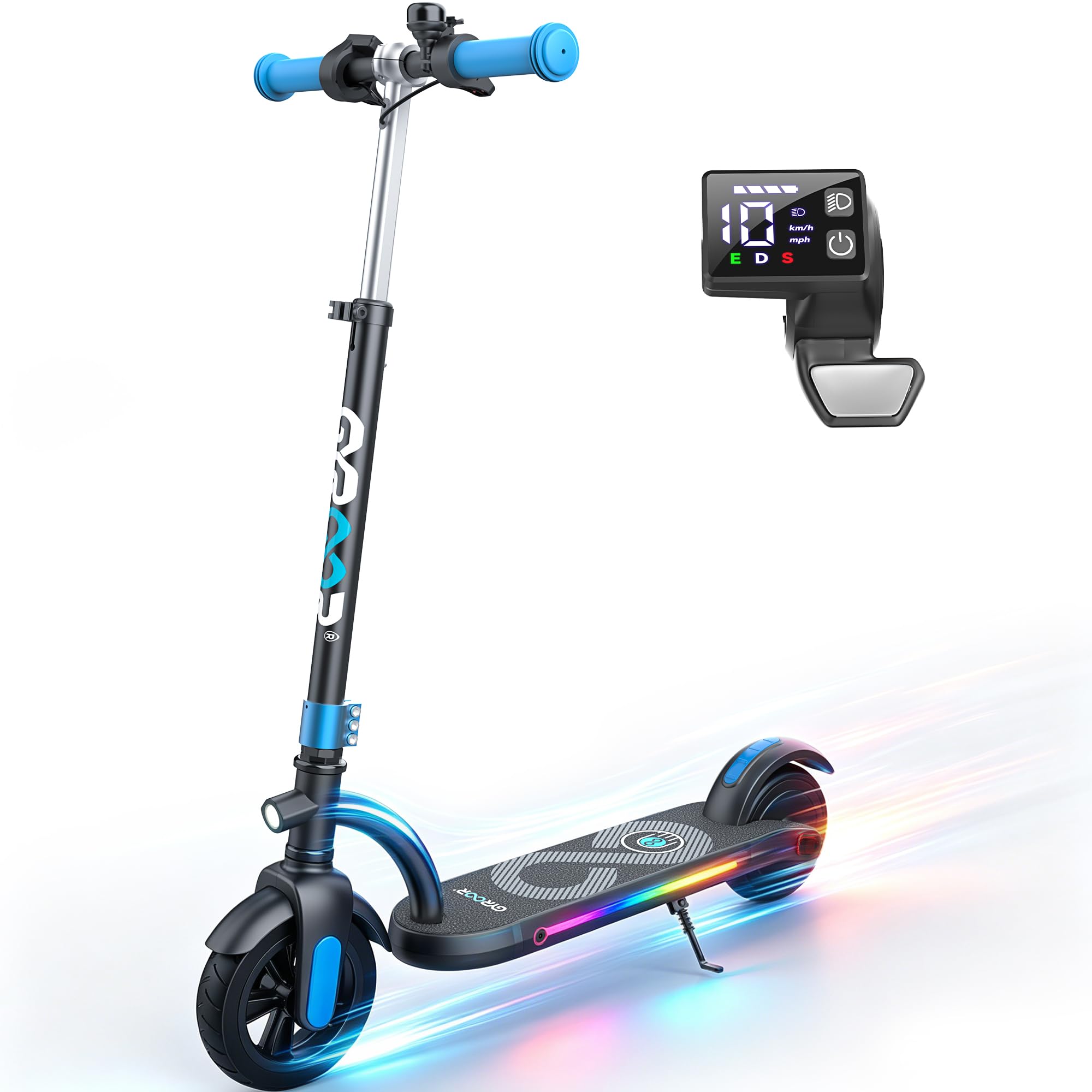
A 180W brushless motor and aircraft-grade aluminum frame make this the most refined ride in the group.
The Gyroor H40 feels noticeably more premium than the rest. The 180W brushless hub motor delivers smooth acceleration without the jerky engagement that some cheaper motors produce, making it easier for a beginner to stay balanced. The aircraft-grade aluminum alloy frame supports 143 lbs while keeping the overall weight reasonable, and the three handlebar height settings (35.4 to 39.4 inches) cover a wider growth span than most competitors. The 2-hour charge time is the fastest in this lineup — half the typical 4-5 hour wait.
The smart LED dashboard integrates into the deck rather than the handlebar, displaying real-time speed, gear mode, and battery level in a large, easy-to-read format. The motion-activated neon deck lights and bright front LED headlight provide 360-degree visibility without needing separate accessories. The dual tires (7-inch front, 6.5-inch rear) are both solid rubber, eliminating flat-tire maintenance while offering a slightly more compliant ride than single-size solid tires. The UL2272 certification covers the safety baseline.
The most common reliability pattern across owner experiences is that the H40 works beautifully for the first few months but a small fraction of units stop functioning after 2-3 months. The manufacturer backs it with a 1-year limited warranty and 6-month battery support, and owners who contact support report positive outcomes — replacement scooters are sometimes sent when troubleshooting fails. The 10 mph top speed is appropriate for a 6-year-old who has graduated from a lower-powered scooter, but beginners should start in the lower gear mode.
The build difference: The 180W brushless motor delivers noticeably smoother acceleration than the 150W motors on most competitors — less lurch, more glide.
The honest risk: A small percentage of units fail after 2-3 months. The 1-year warranty is solid, but it means you may need to use the support process if you get a lemon.
Choose this for: The smoothest, quietest ride in the category and the fastest recharge time — perfect for a family that uses the scooter daily and wants minimal downtime.
Consider an alternative if: You want the absolute lowest risk of early failure — the Segway’s track record with 272 reviews is more proven, even if the spec sheet is less impressive.
Understanding the Specs
Speed Modes & Kick-Start
A scooter with multiple speed modes (usually 2-3 settings) lets you start your child at a walking pace and increase as their skills develop. The kick-start feature means the motor only engages after the child pushes the scooter to about 2-3 mph with their foot — this prevents the jarring acceleration that happens when a throttle is accidentally pressed from a standstill. For a 6-year-old, a scooter with a kick-start requirement and at least one mode below 6 mph is the safest starting point.
UL2272 Safety Certification
UL2272 is an electrical and fire safety standard developed specifically for electric scooters and hoverboards. A scooter with this certification has passed testing for battery overheating, short-circuit protection, and overall electrical system safety. While not every scooter for kids carries this cert, it provides an independent verification that the battery and charger are designed to reduce fire risk. If you plan to charge the scooter indoors overnight, UL2272 certification is a reasonable requirement.
Battery Life vs. Ride Time
Ride time (measured in minutes or miles) is a real-world estimate that depends on rider weight, terrain, speed setting, and outside temperature. A scooter claiming 70 minutes of ride time may deliver 40-50 minutes with a heavier child on a hilly route at top speed. Charging time typically ranges from 2 to 5 hours. Magnetic charging ports reduce wear on the connector and are easier for small hands to use than traditional plug-in chargers.
Tire Type and Brakes
Solid rubber tires never go flat and require zero maintenance, but they transmit more road vibration than pneumatic (air-filled) tires. Pneumatic tires provide a cushioned ride but need occasional inflation and are vulnerable to punctures. For the brakes, a dual system (one hand-operated electronic brake plus a rear foot brake) gives the rider a backup if they forget or fail to engage the primary brake. A foot brake alone works at low speeds but becomes less effective as speed increases.
FAQ
What is the safest speed for a 6 year old on an electric scooter?
How do I know if a scooter is the right size for my child?
How long does the battery last on a typical kids electric scooter?
Will an electric scooter work for a 6 year old who has never ridden a kick scooter?
What does UL2272 certification mean and why does it matter?
Is 10 mph too fast for a 6 year old?
Which type of brake is best for a child: foot brake or hand brake?
How much weight can a typical kids electric scooter hold?
Are solid tires better than air filled tires for kids scooters?
My child is scared of the scooter. What should I do?
Final Thoughts: The Verdict
For most families, the best electric scooter for 6 year old is the Segway Ninebot Kids eKickScooter because it combines a trusted brand, three adjustable speed modes, a mandatory kick-start safety feature, and a UL2272 certification that covers electrical safety — all in a durable alloy steel frame that supports riders up to 132 lbs. If you want a gentler, budget-friendly first scooter that tops out at 6 mph with a simple deck button instead of a handlebar throttle, grab the ANHAO Electric Scooter. For a child who needs more weight capacity and height range over the years, the iScooter IK3 supports 154 lbs with a 39-inch handlebar height. And if your child prefers sitting to standing, the electric scooter for 6 year old is the Segway Ninebot Kids eKickScooter because it combines a trusted brand, three adjustable speed modes, a mandatory kick-start safety feature that prevents unexpected acceleration, and a UL2272 safety certification — all in a durable alloy steel frame that supports riders up to 132 lbs. If you want the gentlest possible introduction with a 6 mph top speed and a simple deck button instead of a handlebar throttle, grab the ANHAO Electric Scooter. For a child who needs more weight capacity and height range over multiple years, the iScooter IK3 supports 154 lbs with a 39-inch handlebar height and three speed modes from 3 to 10 mph. And if your child prefers sitting to standing, the Hiboy Q2 Lite with its removable seat and 8.5-inch solid tires is the unique solution that no other pick here offers.
How We Picked
We do not accept paid placement. Every pick is matched to a real buyer and a real use-case; we do not hands-on test units.
Sources & Methodology
Specifications: manufacturer listings and product documentation. Review insights: verified customer reviews, as of July 2026. Pricing: not shown on this page (it changes often); check the current price via the retailer link.
As an Amazon Associate, WellFizz earns from qualifying purchases. This does not affect which products we feature.
Related Guides

Mo Maruf
I created WellFizz to bridge the gap between vague wellness advice and actionable solutions. My mission is simple: to decode the research and give you practical tools you can actually use.
Beyond the data, I am a passionate traveler. I believe that stepping away from the screen to explore new environments is essential for mental clarity and physical vitality.