Our readers keep the lights on and my smoothie glass nicely filled. As an Amazon Associate, I earn from qualifying purchases.
Specs are compiled from manufacturer listings and verified buyer reviews and can change over time — please confirm the key details on the product page before buying.
Your phone, tablet, and laptop all need power, but one wrong charger leaves you waiting hours instead of minutes. The difference between a good block and a great one depends on the output wattage, the number of ports, and the safety features that keep heat under control. This guide walks through the best options across every scenario — from a single ultra-portable charger to a multi-device hub — so you grab so you grab the right charger on your first try..
I’m Mohammad Maruf — the founder and writer behind WellFizz. This guide is built by comparing the manufacturers’ published specifications and the patterns across verified customer reviews, so you get each pick’s real strengths and trade-offs instead of marketing spin.
Finding the right fast charging block means looking past the brand name and focusing on the wattage that matches your devices and the safety tech that keeps them protected.
Our Picks at a Glance


How To Choose The Best Fast Charging Block
Choosing a charger feels simple until you see the wall of options. The key is to match the block’s output to what you actually own today and plan to buy tomorrow. Start with the device that needs the most power — usually a laptop — then fill in the rest.
Matching Wattage to Your Device
Every device has a maximum charging speed. A standard iPhone 16 series maxes out around 30W to 40W, while a MacBook Pro needs 67W or more to charge at full speed during use. A 20W block is fine for a single phone, but if you want to charge a tablet or laptop, aim for at least 45W to 65W. The higher wattage also future-proofs you for the next upgrade.
Port Count and Smart Power Sharing
A single-port block is the smallest and cheapest, but a multi-port block lets you charge a phone, earbuds, and a watch at once. The catch is power sharing: a 65W block with two ports will split that power when both ports are in use (often 45W + 20W). Look for blocks with PD (Power Delivery) and PPS (Programmable Power Supply) protocols — they automatically adjust voltage for each connected device, which keeps everything safe and fast.
GaN vs. Old Silicon
GaN (Gallium Nitride) is a semiconductor material that runs cooler and allows chargers to be dramatically smaller than traditional silicon-based blocks. A 30W GaN charger can be the size of an old 5W cube, which makes it ideal for travel and crowded power strips. Silicon blocks are still reliable but are noticeably bulkier at the same wattage.
Quick Comparison
| Model | Best For | Wattage | Ports | Safety Tech | Amazon |
|---|---|---|---|---|---|
| Anker Nano 30W★ Best Overall | Ultra-compact single-device travel | 30W | 1x USB-C | ActiveShield 2.0 | Amazon |
| YEOTSMUT 4-Pack 20WBest Value Multi-Pack | Whole-house / multi-location budget | 20W | 1x USB-C | Overcharge protection | Amazon |
| Apple 20W USB-CApple Ecosystem Pick | First-party iPhone / iPad reliability | 20W | 1x USB-C | Apple standard | Amazon |
| CSODINCE 6-Port 100W | Family hub for all devices at once | 100W | 3x USB-C, 3x USB-A | Surge & overheat protection | Amazon |
| Qwinjwin 50W 2-Pack | Furniture-clearance & slim travel | 50W | 1x USB-C, 1x USB-A | Overload & short-circuit | Amazon |
| UGREEN Nexode 65W | Laptop + phone daily driver | 65W | 3x USB-C, 1x USB-A | GaN over-current | Amazon |
| Belkin 42W Dual Port | Premium dual-device road warrior | 42W | 1x USB-C, 1x USB-A | PPS & 2-year warranty | Amazon |
| Anker Prime 67W GaN | Laptop powerhouse in a small shell | 67W | 2x USB-C, 1x USB-A | ActiveShield 2.0 | Amazon |
In‑Depth Reviews
1. Anker Nano Phone Charger, 30W
Our pick — over 4.5★ from 19,500+ verified ratings; the strongest balance of quality and price.
The pocket-sized GaN block that charges an iPhone to 50% in half an hour.
You get 30W of power in a shell roughly 70% smaller than Apple’s old brick, thanks to GaN (a semiconductor that runs cooler and shrinks the charger). That 30W is enough to fast-charge an iPhone 16 series, top off an iPad Air to 50% in 45 minutes, and even trickle-charge a MacBook Air in a pinch. The foldable prongs (prongs that rotate flat) let it slide into a purse or pocket without snagging, which is why owners call it the perfect travel companion.
The ActiveShield 2.0 system (a temperature monitor that checks conditions over 3 million times per day) automatically adjusts power if things get too warm — meaning no overheating even during rapid top-ups. Buyers report that it “charges iPhone to 50% in 30 min” and delivers a genuine 30W to devices like the ROG Ally X, tested on airplane outlets. A couple note that pairing it with a magnetic charging pad can generate noticeable heat, but a high-quality 240W USB-C cable resolves that. It also runs cooler than the YEOTSMUT 20W multi-pack blocks, which owners mention get warm during use.
While the 30W output covers most phones and tablets, it will not fuel a 15-inch MacBook Pro at full speed. For a single-device setup where size and speed matter most, this is the one nearly 20,000 owners have rated highly.
Why owners stick with it
- GaN construction delivers 30W in a shell smaller than most 5W bricks.
- Foldable prongs slide into any pocket without puncturing fabric.
- ActiveShield 2.0 checks temperature millions of times daily, preventing overheating.
The limits of the size
- Single USB-C port — cannot charge a phone and watch simultaneously.
- 30W is not enough for full-speed laptop charging on a MacBook Pro 14-inch or larger.
Grab it for: anyone who wants the smallest possible 30W charger for travel or daily pocket carry.
Think twice if: you need to charge a laptop at full speed or require multiple ports on a single block.
2. YEOTSMUT 4-Pack 20W USB-C Wall Charger
Four 20W blocks for less than the price of one Apple brick — and they work just as fast.
You get four 20W blocks for the price of a single premium charger. Each block delivers 20W through a single USB-C port — a 50% higher wattage than the Anker Nano’s single-port output for a fraction of the per-unit cost. “Great price for 4,” owners consistently say, noting that the blocks work flawlessly with every USB-C cable they own, from iPhones to iPads. The built-in intelligent chip guards against overcharging, overheating, overvoltage, and short circuits.
That said, a small handful of owners mention that the blocks do get warm during use — “get hot when charging so be careful of that” — which is a common trade-off at this power level without active cooling. At 3 A, the amperage here is actually 50% higher than the Anker Nano 30W (which runs at 2 A), meaning each block can push more current to compatible devices. If you want to scatter chargers across the office, living room, bedroom, and a travel bag without thinking twice, this multi-pack solves that problem elegantly. skip it if you prefer a single cool-running GaN block like the Anker Nano.
Who this really fits: families, shared households, or anyone who wants a charger at every outlet without buying singles.
One honest note: these run warmer than premium blocks — keep them in well-ventilated spots.
3. Apple 20W USB-C Compact Power Adapter
The official Apple block — compact, trusted, and proven over a year of daily use.
Over 12,500 owners give this 20W brick a near-perfect rating — for good reason. It is the first-party adapter Apple designed specifically for iPhone 8 and later fast charging, and it delivers exactly what it promises: up to 50% battery in around 30 minutes when paired with the right iPhone. The build quality is unmistakably Apple — a solid, smooth shell with a strong USB-C port that feels like it will outlast the device it charges. “Works well after a year of use,” one owner’s summary captures the sentiment across the reviews.
The compact dimensions (roughly 1 x 0.5 x 1.3 inches) mean you can stack two of these in a single power strip without blocking adjacent outlets. The catch is that Apple does not include a cable in the box — you must supply your own USB-C cable. It also tops out at 20W, so while it is plenty fast for an iPhone or iPad mini, it will not charge an iPad Pro or MacBook at full speed. This block runs cooler than the YEOTSMUT 20W multi-pack, customers note, and is the benchmark for single-device reliability.
What makes it the reference
- Proven durability across a year or more of daily charging sessions.
- Compact enough to use two side by side on one power strip.
- Stays cool — no overheating noted even during rapid top-ups.
What it lacks
- No cable included — the box contains only the adapter itself.
- 20W is not enough for fast-charging an iPad Pro or any laptop.
Reach for this if: you want the exact charger Apple designed for your iPhone and value long-term build quality above raw specs.
Look elsewhere if: you need a higher wattage for a laptop or want a cable included in the package.
4. CSODINCE GaN 6-Port 100W Charging Station
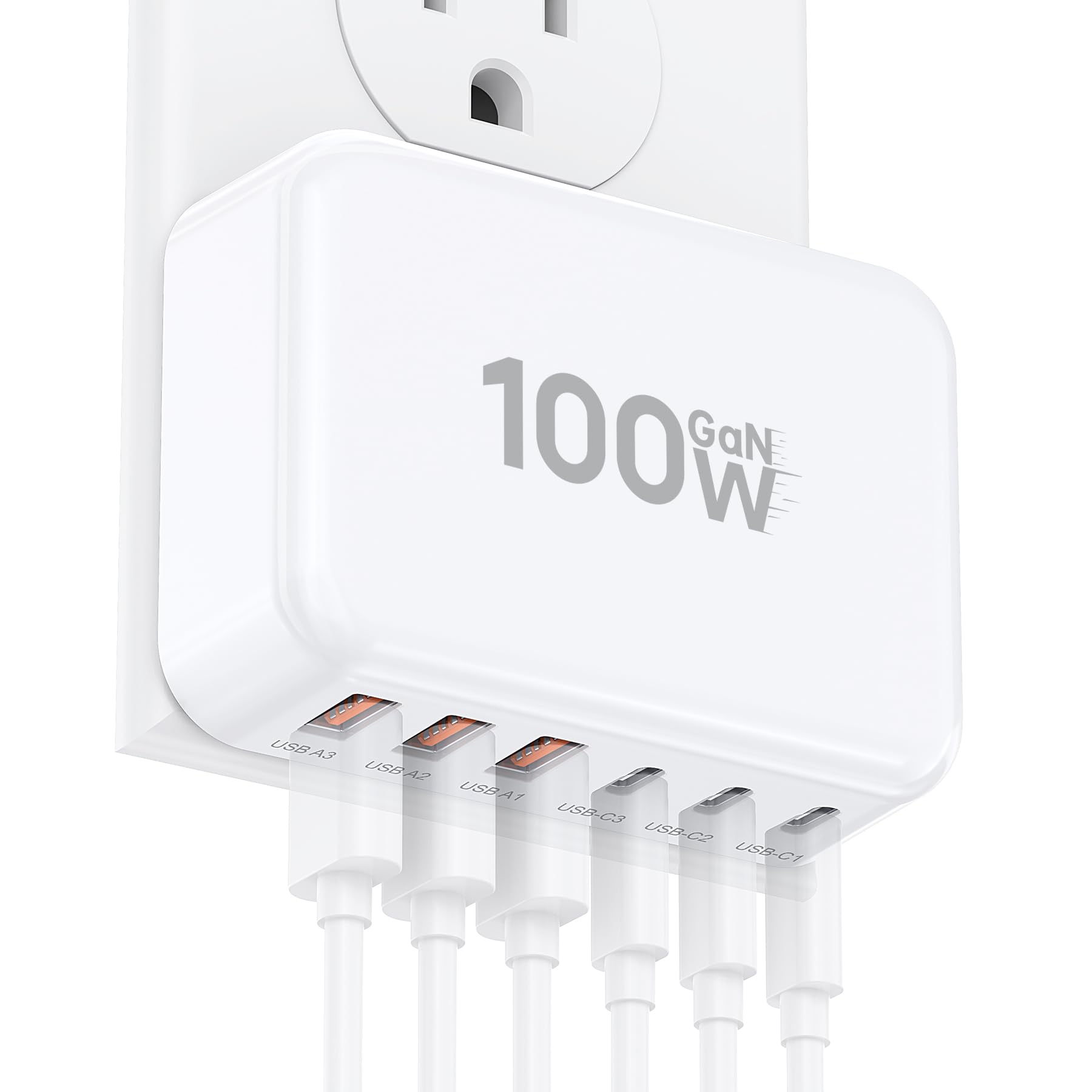
One cube, six ports, and enough power to charge every device on the nightstand at once.
You get three USB-C ports and three USB-A ports — six total — in a compact cube chassis, all fed by a total output of 100W. That means you can juice up an iPhone, an iPad, AirPods, an Apple Watch, a Samsung phone, and a desk fan simultaneously without needing a single extra block. The ABS fire-resistant casing (a plastic shell that resists catching fire) adds a layer of safety for overnight charging, and the intelligent chip handles overvoltage, overcurrent, and short-circuit protection automatically.
Reliability is the most-discussed topic among owners, though it is a mixed picture. While many praise its convenience — “this charger saved my sanity” one owner says — a portion of reviewers point out that their unit stopped working after about a month. The charging speed also gets mixed marks, which is typical for a multi-port hub where power is split across six ports simultaneously. The Anker Prime 67W is more compact and reliable for a three-device load, but this station is class-leading for raw port count. If your goal is simultaneous slow-to-moderate charging for many devices rather than turbo-speed for one, this cube solves the clutter problem beautifully.
The convenience factor
- Six ports (3 USB-C + 3 USB-A) handle every device in a family nightstand or desk setup.
- Fire-resistant ABS shell adds safety for overnight and unattended charging.
The trade-offs
- A notable portion of shoppers say units failing after a month of use.
- Charging speed per port drops once you load all six simultaneously.
5. Qwinjwin 50W Dual Port 2-Pack
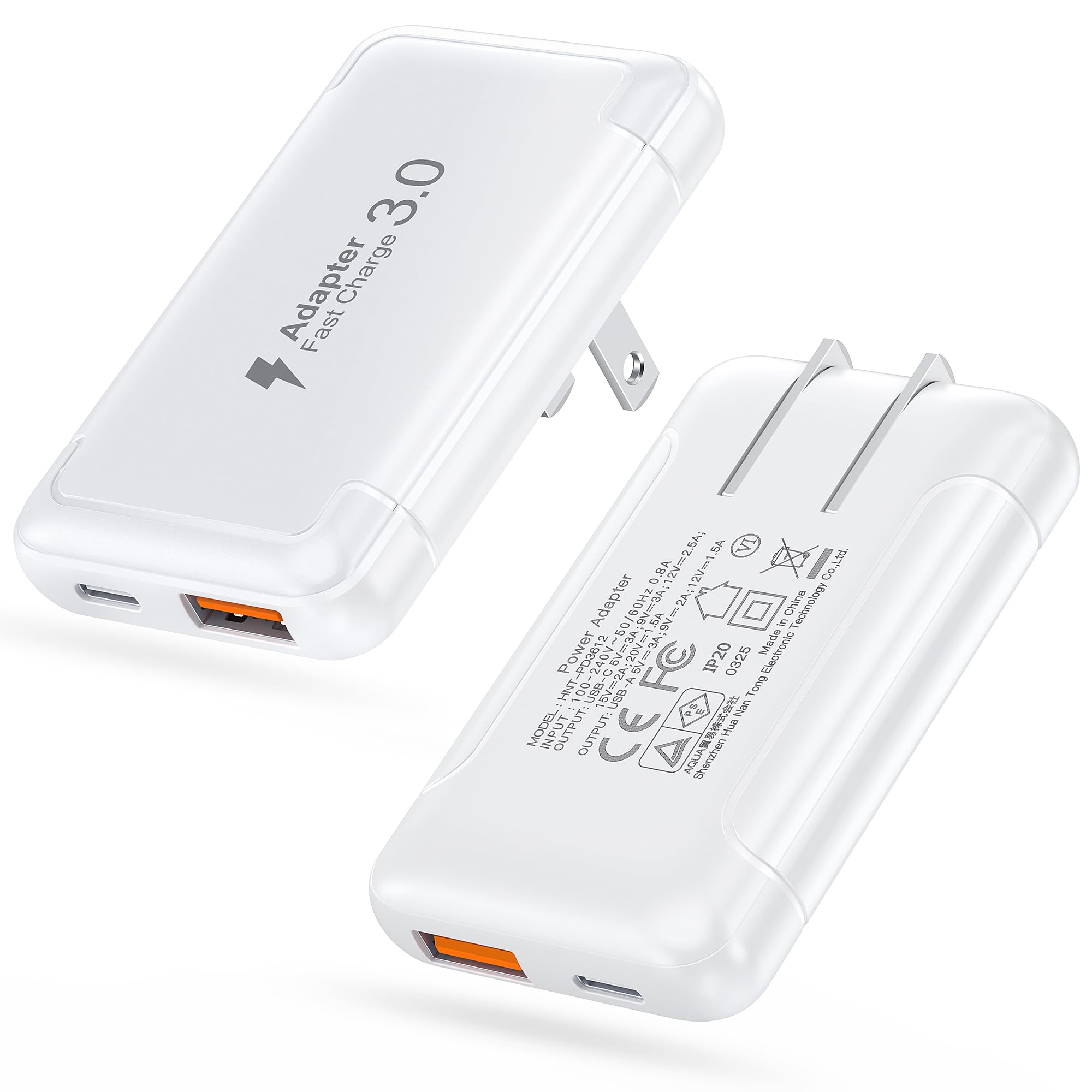
The ultra-slim block that slides behind furniture without blocking the next outlet.
Standard wall warts stick out horizontally and monopolize the outlet. This flat-profile design flips the orientation so the charger sits flush against the wall, letting you tuck it behind a sofa, bed frame, or refrigerator without bending the cable. The foldable 90-degree plug makes it equally pocket-friendly for travel — you can slip one into a backpack without the prongs catching on anything. Each block delivers a combined 50W between a 30W USB-C port and a 20W USB-A port.
In single-port mode, the USB-C side pushes near-40W output, enough to charge an iPhone 13 rapidly (0% to 58% in 30 minutes by the data) and power a Ring Stick Up Cam or a portable monitor. Owners love the low-profile form factor for camera installations and tight spaces: “Slim design fits tight spaces behind furniture,” one buyer notes. The USB-C and USB-A ports share the total 50W when both are active, so the speed drops to normal charging rates. The ABS + PC fireproof casing and protection against overheating, overcurrent, and short circuits round out a thoughtful safety suite. It is a more space-efficient alternative to the YEOTSMUT 4-pack if you need slim profile over raw unit count.
Why it works where others don’t
- Ultra-slim horizontal profile frees up the second outlet and fits behind furniture.
- Foldable plug and flat body make this naturally travel-friendly.
The sharing compromise
- 50W total is split between both ports — using both slows the USB-C side.
- No single-port delivers the full 50W; expect near 30W from the USB-C alone.
6. UGREEN Nexode 65W Wall Charger
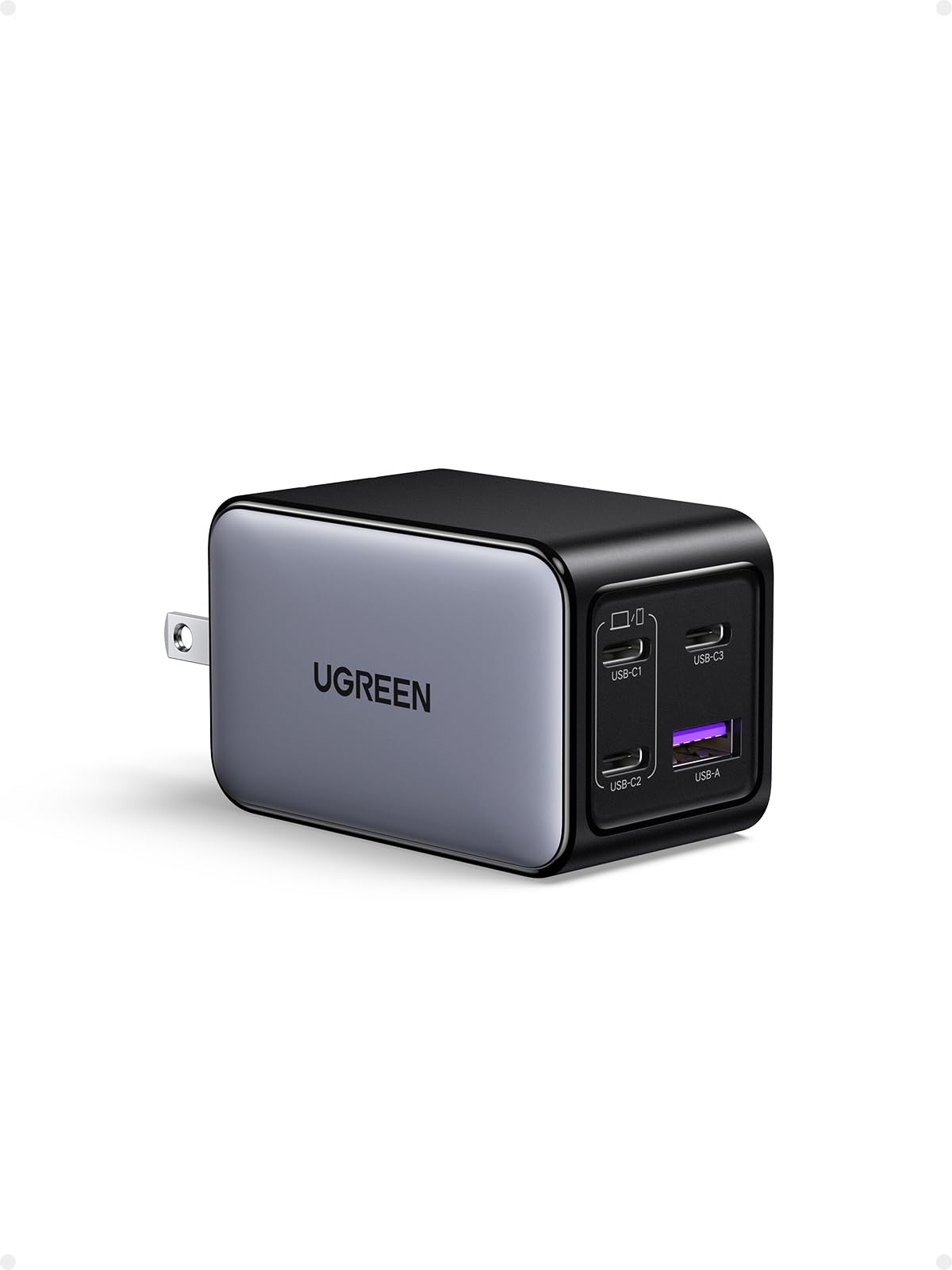
Four ports and 65W — enough to charge a MacBook Air to 51% in half an hour while still powering a phone.
You get three USB-C ports and one USB-A port in a block that measures just 2.64 x 1.65 x 1.5 inches — smaller than the laptop charger you probably have now. The 65W total is enough to fast-charge a MacBook Air (to 51% in 30 minutes), an iPad, a Steam Deck, or a Galaxy S-series phone simultaneously. The foldable plug makes it a natural travel companion. GaN technology (Gallium Nitride, a semiconductor that shrinks the charger and reduces heat) keeps the size and heat in check.
Owners note it gets warm when charging a Dell Latitude alongside other devices, and the weight is slightly higher than some single-port blocks, which can cause the block to slip out of loose wall sockets. A few owners had trouble with charging during power fluctuations in areas with unstable grids. The build quality and reliability draw consistent praise — owners call it a worthy replacement for failing Anker chargers — and the price per port is among the best in the 65W category. It is a more versatile daily driver than the Anker Nano 30W if you need to charge a laptop and phone from one block.
The multi-device advantage
- Four ports (3 USB-C + 1 USB-A) handle a laptop, phone, and watch from one block.
- Compact GaN footprint is much smaller than original laptop bricks.
The trade-offs
- Gets warm under heavy multi-device load, especially charging a laptop.
- Heavier than single-port blocks; can wobble in loose outlets.
7. Belkin 42W Dual Port Charger Block

The road warrior’s dual-port block that fast-charges an iPhone or Galaxy to 50% in under 25 minutes.
You get a 42W dual-port charger that is USB-C PD 3.1 certified (the latest universal fast-charging standard) and supports PPS technology (Programmable Power Supply, which adjusts voltage in fine increments for Samsung’s “Super Fast Charging”). That means the block dynamically adjusts its voltage and current to match the receiving device — whether it is an iPhone 16, a Samsung Galaxy S25, or a Google Pixel. The result is a charge that hits 0 to 50% in just 24 minutes for compatible phones. The USB-C and USB-A ports can power two devices simultaneously, making it ideal for a driver and passenger on a road trip.
The housing is made from post-consumer recycled content, and the packaging is 100% plastic-free — a meaningful sustainability angle. Belkin also backs it with a 2-year Connected Equipment Warranty (it covers your devices if the charger damages them). The foldable prongs and compact design draw positive feedback, though the 42W total is a notch below what a MacBook Pro needs for full-speed charging — making it less laptop-capable than the UGREEN Nexode 65W. The dual-port focus is deliberate: two fast ports with no power-sharing compromises, rather than four ports that split the wattage thinly.
The premium touches
- PPS technology adjusts output voltage for precise, safe charging of multiple phone brands.
- 2-year Connected Equipment Warranty covers both the charger and your devices.
The practical limits
- 42W total output is not enough for a full-speed laptop charge.
- Two ports only — less versatile than four-port alternatives at a similar price.
8. Anker Prime 67W GaN Wall Charger

The 67W powerhouse that is 51% smaller than Apple’s original brick — and charges three devices at once.
You get 67W of output in a GaN shell roughly half the size of the original 67W MacBook charger. That is enough power to fast-charge a 14-inch MacBook Pro, a Galaxy S23 Ultra, or an iPad Pro. It has two USB-C ports and one USB-A port, so you can plug in a laptop, a phone, and a pair of earbuds without needing a separate brick for each. The ActiveShield 2.0 system (temperature monitoring over 3 million times per day) is the same found in the Anker Nano 30W, adapted for higher wattage.
Owners consistently praise the build quality and the stable power delivery across all three ports, noting it stays impressively cool for a 67W block. A few mention it is slightly heavier than expected for its size, but the weight-to-power ratio is considered excellent. The foldable plug and compact proportions make it a natural for both a daily desk setup and a weekend bag — you can charge three devices at once without hunting for separate adapters. It outperforms the UGREEN Nexode 65W in terms of temperature control and weight efficiency, though both deliver similar wattage.
Why it leads the premium tier
- 67W output covers laptops, tablets, and phones at full speed from a compact GaN shell.
- Three ports (2 USB-C + 1 USB-A) charge a complete daily device load from one block.
The small concessions
- Slightly heavier than ultra-compact single-port blocks of the same power class.
- When all three ports are active, the maximum drops from 67W to 65W shared output.
Understanding the Specs
Wattage — The Real Speed Limiter
Wattage is the total power a charger can deliver. A 20W block is perfectly fast for a single phone (it charges an iPhone to 50% in about 30 minutes). A 30W block adds a bit of headroom for an iPad or a small laptop like the MacBook Air, while a 65W block is the minimum you want for a MacBook Pro 14-inch or a Steam Deck. The rule is simple: match or slightly exceed your device’s maximum charging speed. Going higher does not hurt the device — the device only pulls what it can handle. Going lower just leaves you waiting longer.
GaN — Why Tiny Blocks Are Possible Now
GaN stands for Gallium Nitride, a semiconductor material that handles high voltages more efficiently than traditional silicon. The practical result is that a 30W GaN charger can be the size of an old 5W cube — about 70% smaller than a silicon-based charger of the same wattage. GaN also produces less heat, so the internal components stay cooler over long charging sessions. If you travel often or use a crowded power strip, the compact size of a GaN block is a genuine daily convenience.
PD, PPS, and Quick Charge Explained
USB Power Delivery (PD) is the universal fast-charging standard used by iPhones, iPads, MacBooks, and many Android phones. It communicates between the charger and the device to deliver the highest safe wattage. Programmable Power Supply (PPS) is a more advanced version of PD that allows the charger to adjust voltage in fine increments, which Samsung phones use for their “Super Fast Charging” mode. Quick Charge (QC) is Qualcomm’s older standard, mostly found on Android phones released before 2020. Most modern blocks support PD, and the best ones add PPS for wider compatibility.
Safety Systems — Beyond the Basic Chip
Every reputable charger has a basic safety chip that cuts power during a short circuit or overheating. The more advanced systems, like Anker’s ActiveShield 2.0, go further by monitoring the internal temperature millions of times per day and dynamically adjusting the power output to keep the charger cool. This active management is why some blocks stay cool during a full 30W charge while others warm up noticeably. For overnight or unattended charging, a block with active thermal monitoring is a worthwhile investment.
FAQ
Can I use a 67W charger with an iPhone that only supports 30W charging?
Does using a higher-wattage block damage my phone’s battery over time?
What is the difference between a single-port and a multi-port charger?
What does foldable plug mean and why does it matter?
Is GaN technology really better than traditional silicon chargers?
How do I know which fast charging protocol my phone supports?
Can I use these chargers with my Nintendo Switch or Steam Deck?
Why do some chargers get hot while others stay cool?
Is it safe to leave a fast charging block plugged in all the time?
How do I clean my charging block safely?
Final Thoughts: The Verdict
Related Guides

Mo Maruf
I created WellFizz to bridge the gap between vague wellness advice and actionable solutions. My mission is simple: to decode the research and give you practical tools you can actually use.
Beyond the data, I am a passionate traveler. I believe that stepping away from the screen to explore new environments is essential for mental clarity and physical vitality.