Our readers keep the lights on and my smoothie glass nicely filled. As an Amazon Associate, I earn from qualifying purchases.
Specs are compiled from manufacturer listings and verified buyer reviews and can change over time — please confirm the key details on the product page before buying.
You put good money into your diesel truck. The most important fluid you pour into it is the oil. A wrong viscosity or a low-quality base causes more wear, worse fuel economy, and a rough cold start. This guide cuts through the shelf noise to show you the real oils owners trust for long hauls, heavy towing, and bitter cold mornings.
I’m Mohammad Maruf — the founder and writer behind WellFizz. This guide is built by comparing the manufacturers’ published specifications and the patterns across verified customer reviews, so you get each pick’s real strengths and trade-offs instead of marketing spin.
Choosing the right engine oil for diesel trucks depends on matching viscosity, synthetic base, and additive package to your engine’s age and your climate. Whether you drive a Cummins, Power Stroke, or Duramax, the same rules apply.
Our Picks at a Glance


How To Choose The Best Engine Oil For Diesel Trucks
Diesel engines run hotter and build more soot than gasoline engines, so the oil has to hold its viscosity under extreme heat while suspending contaminants. Your owner’s manual is the final word, but three specs define the decision for most trucks.
Viscosity Grade: 15W-40 vs 5W-40 vs 10W-30
The number before the W tells you how the oil flows in cold weather. A 5W-40 flows better at sub-zero temperatures than a 15W-40. That means easier cranking and faster oil pressure on a winter morning. The number after the dash is the hot-running grade. A 40-weight oil (15W-40 or 5W-40) keeps a protective film at high operating temperatures during towing or climbing grades. A 10W-30 flows a little easier when cold and can improve fuel economy slightly in milder climates, but it thins out more under extreme heat.
API Service Category: CK-4 vs CJ-4
CK-4 is the current standard for older and modern diesel engines. It is backward-compatible with previous categories (like CJ-4, an earlier specification) and offers better protection against oxidation, shear, and aeration. All the oils on this list meet or exceed CK-4. That means they work with exhaust after-treatment systems (DPF, SCR — parts that trap soot and reduce emissions) without clogging them.
Conventional vs Full Synthetic Base
Conventional oils (like Shell Rotella T4) cost less and are perfectly adequate for older engines on standard drain intervals (the usual miles between changes). Full synthetics (like Mobil 1 Turbo Diesel Truck) resist thermal breakdown longer, flow better in the cold, and enable extended drain intervals — sometimes 15,000 to 20,000 miles with oil analysis (a test that checks if the oil is still usable). If your truck works hard or sits outside in a northern winter, a full synthetic pays for itself in fewer oil changes and reduced wear.
Quick Comparison
| Model | Best For | Viscosity | Base Type | API Spec | Amazon |
|---|---|---|---|---|---|
| Schaeffer SynShield 15W-40★ Best Overall | Ultimate wear & quiet operation | 15W-40 | Conventional | CK-4 | Amazon |
| Valvoline Premium Blue 10W-30Cummins Favorite | Cummins engines & budget | 10W-30 | Blend | CK-4 | Amazon |
| Shell Rotella T4 10W-30Triple Protection | Versatile fleet & generator use | 10W-30 | Conventional | CK-4 | Amazon |
| Lucas Oil 15W-40 | Value & older engines | 15W-40 | Conventional | CK-4 | Amazon |
| Mobil 1 TDT 5W-40 | Cold starts & long drains | 5W-40 | Full Synthetic | CK-4 | Amazon |
| Triax Fleet Supreme 5W-40 | PowerStroke & injector quieting | 5W-40 | Full Synthetic | CK-4 | Amazon |
| Delo 400 XSP 5W-40 | Sub-zero starts & smooth shifting | 5W-40 | Full Synthetic | CK-4 | Amazon |
| Hot Shot’s Green Diamond 15W-40 | Fuel economy & wear reduction | 15W-40 | Full Synthetic | CK-4 | Amazon |
| Schaeffer SynShield OTR Plus 5W-40 | Extended drains & high heat | 5W-40 | Full Synthetic | CK-4 | Amazon |
In‑Depth Reviews
1. Schaeffer Manufacturing Co. 0700CK4-006S SynShield 15W-40 Diesel Engine Oil
Our pick — over 4.5★ from 400+ verified ratings; the strongest balance of quality and price.
The oil-geek favorite that quiets a Duramax tick and delivers a real fuel-economy bump.
Buyers report a near-instant reduction in diesel rattle after switching to Schaeffer SynShield 15W-40. On a 2002 Duramax with 145,000 miles, the idle tick virtually disappeared and oil pressure climbed about 5 psi (pounds per square inch) at idle — one owner called the engine quieter than new. The secret is friction modification with micron moly and penetrate (fine particles that reduce metal-on-metal contact), which cuts wear in the valvetrain and injectors.
Oil quality is the most-discussed strength here by a wide margin. It is not just about sound. One owner running a 2001 Power Stroke 7.3L with 220,000 miles found the engine started easier, idled better, and even improved turbo sound after switching. Another tracked fuel economy and saw roughly 2 more miles per gallon — a real-world number you do not get from most conventional oils. At 128 fluid ounces per gallon, this gives you a full standard fill.
Genuine wear protection: The oxidation and viscosity control here is strong enough that owners with tractors from 2016 back to 1950 trust it for extended service. The consensus is clear — this is the best oil for an older diesel that still has to earn its keep.
Reach for this if: you want the quietest idle and best wear numbers backed by almost 400+ owners giving it a near-perfect score. It is a conventional oil, so standard drain intervals apply, but the additive package is a class above.
Think twice if: your climate drops below zero — a 15W-40 will be thicker on start-up. For extreme cold, the 5W-40 variant (product 9) is a better fit.
2. Valvoline Premium Blue One Solution SAE 10W-30 Diesel Engine Oil
The only oil endorsed by Cummins, and the one a 6.7L owner calls great for his engine.
Valvoline Premium Blue One Solution uses proprietary One Solution Gen2 technology, and it is the only diesel engine oil exclusively recommended by Cummins. That alone makes it a first-stop choice for any Ram with a 6.7L Cummins. The feedback matches — owners mention “great oil for Cummins 6.7 L diesel” and note smoother operation after the swap. The 10W-30 viscosity gives a slight fuel-economy advantage over a 15W-40 in milder climates because the engine does not have to push through thicker oil.
It resists oxidation and fights deposits with higher-quality synthetic base oils and special inhibitors, so sludge stays under control during long oil-drain intervals. The shear stability (resistance to thinning under mechanical stress) is strong enough that the oil holds its viscosity grade through heavy hauling. Feedback on value is consistently positive — owners mention it is well priced for the quality level.
Handling and packaging: The recurring practical gripe is the jug design — owners wish it had a handle on top like competing gallon jugs. That is a minor annoyance at fill-up time, not a knock on the oil itself.
Perfect for: Cummins owners who want a factory-recommended oil at a reasonable price. The 10W-30 grade also suits warmer climates and moderate-duty driving.
Consider the 15W-40 version if: you tow heavy loads in summer heat, where a thicker hot-grade provides extra film strength.
3. Shell Rotella T4 Triple Protection 10W-30 Diesel Engine Oil
The tough-as-nails conventional oil that survived two weeks of non-stop generator use after a tornado.
Shell Rotella T4 is among the most trusted names in diesel. The T4 Triple Protection formulation delivers against wear, deposits, and oil breakdown. One owner put it in a Predator generator that ran continuously for two weeks after a post-tornado power outage — no oil filter, splash lubrication only, and the engine never burned oil or showed metal flakes in the pan. That is real-world confidence. The lower 10W-30 viscosity also improves fuel economy compared to a 15W-40, because there is less resistance in the engine when it spins.
The advanced low-ash formulation helps control blocking of particulate filters (DPF — a device that traps soot from exhaust), keeping it clean and maintaining emissions compliance. It meets API CK-4, CJ-4, and major OEM (original equipment manufacturer) specs including Caterpillar ECF-3, Cummins CES 20086, and Ford WSS-M2C171-F1. That coverage makes it suitable for agricultural, mining, and construction equipment in addition to pick-up trucks.
Fleet-friendly value: Owners with two diesel trucks order this by subscription because it is cheaper per jug than local stores. The 128-ounce bottle means no partial fills.
Best for: mixed-fleet operators who need one oil for tractors, generators, and trucks. It is a conventional oil, so extended drains are not the goal here — consistent, proven protection is.
Swap to a synthetic: if you live in a very cold climate or want to push past 7,500-mile oil changes.
4. Lucas Oil 10287 SAE 15W-40 API CK-4 Heavy Duty Motor Oil
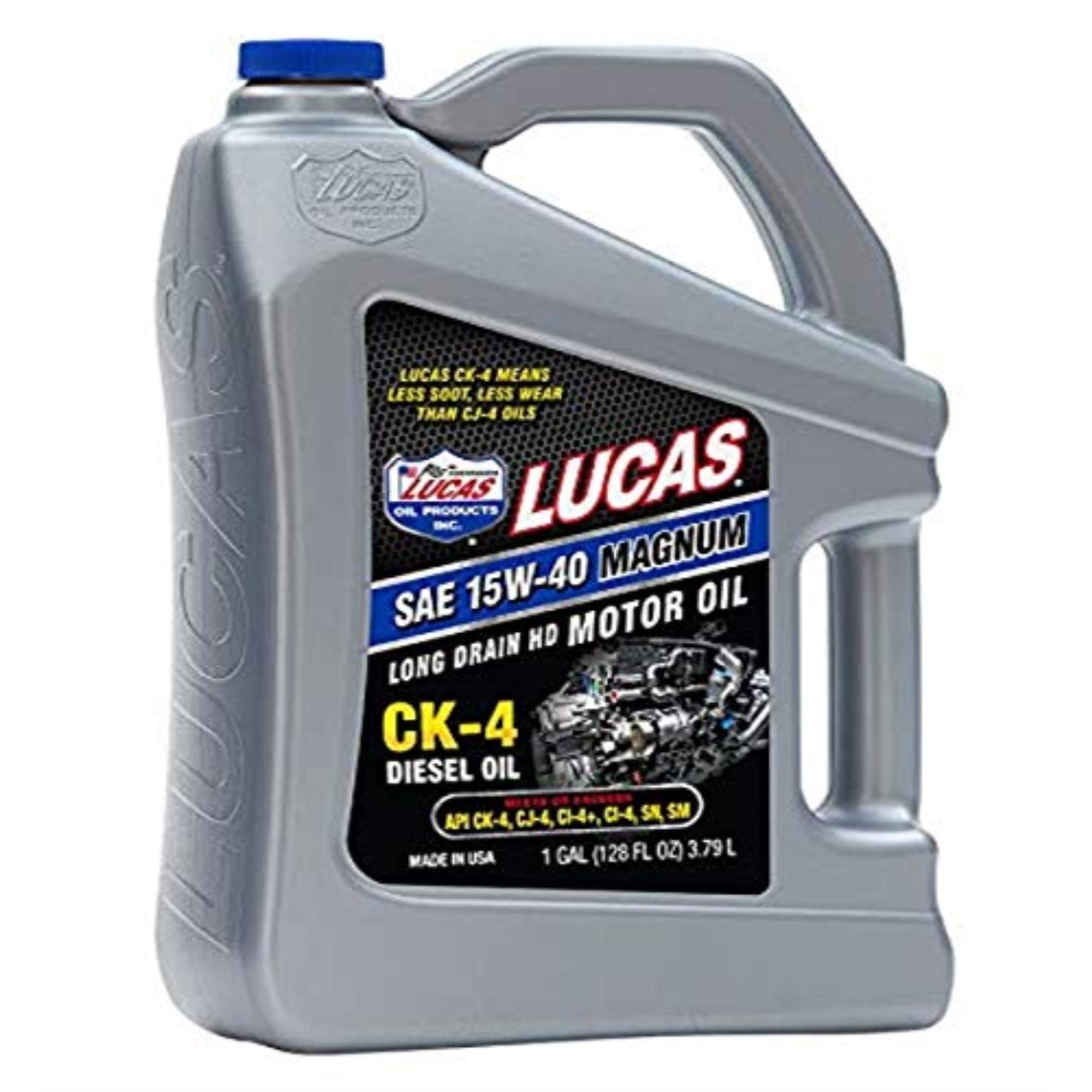
The entry-level price that does not skimp on protection for older motors and farm equipment.
Lucas Oil is a household name among diesel owners. This CK-4 15W-40 brings that reputation at a very accessible price point. Customers note it quiets a 45-year-old diesel motor and makes it run smoother — not a placebo, as one buyer put it, but a noticeable difference in daily driving. The oil is designed for longer engine life and extended oil changes, so it works well for trucks that see moderate duty or seasonal use. It also gets strong marks for backhoe use, meaning it holds up in dirty, dusty operating conditions.
The 3.55 kg (about 7.8 lb) weight per gallon indicates a full-bodied conventional formulation. It is API CK-4 rated, which means it is compatible with modern exhaust after-treatment systems. It fits buses, cars, trucks, and construction equipment. For someone maintaining multiple vehicles — a truck, a tractor, and a mower — this is the one-bottle solution that does not strain the wallet.
Honest value: Quality and value both get the most mentions from buyers. This is not the most advanced oil on the list, but it delivers on the basics without fuss. Lucas also recommends it for John Deere walk-behind mowers, so versatility is a real trait.
Reach for this if: you run an older diesel that does not need synthetic protection and you change oil on a standard schedule. Great for farm trucks, backup generators, and low-mileage weekend rigs.
Upgrade to a 5W-40 or full synthetic: if you face northern winters or tow heavy loads daily — the conventional 15W-40 will be sluggish when cold.
5. Mobil 1 Turbo Diesel Truck Full Synthetic 5W-40

The 5W-40 synthetic that fires right up on the coldest mornings and keeps a hard-working engine clean.
Mobil 1 Turbo Diesel Truck is a full synthetic (man-made base oil) designed for modern diesel engines. It delivers on the biggest complaint diesel owners have: hard cold starts. One owner driving a diesel van 3,000 miles a week said that since switching, the van “fires right up without hesitation” even in very cold weather. That is the 5W-40 viscosity doing its job — at low temperatures it flows like a 5-weight oil, so the oil pump sends protection to bearings and cams much faster than a 15W-40 would. The flash point (the temperature at which the oil can ignite) is 234 °C, which means it resists burning off under extreme heat.
The feedback on cleanliness is strong: owners note it keeps engines spotless inside, reducing low-temperature sludge buildup and high-temperature deposits. It meets the demanding specs of major truck manufacturers, so you can use it across a mixed fleet of low-emission and conventional diesel engines. It is also one of the go-to alternatives to Shell Rotella T6, with owners calling it top-tier oil.
Extended drain confidence: The full synthetic base enables longer drain intervals than conventional oil. The thermal stability means it holds up under sustained heavy load — exactly what a tow rig needs.
Best for: drivers in cold climates, high-mileage commuters, and anyone who wants a proven full synthetic that does not cost a fortune. The 1-gallon jug gives a standard fill for most trucks.
Consider the Triax below if: you drive a PowerStroke or want even more injector-quieting moly additive.
6. Triax Fleet Supreme ESP 5W-40 Full Synthetic Diesel Engine Oil
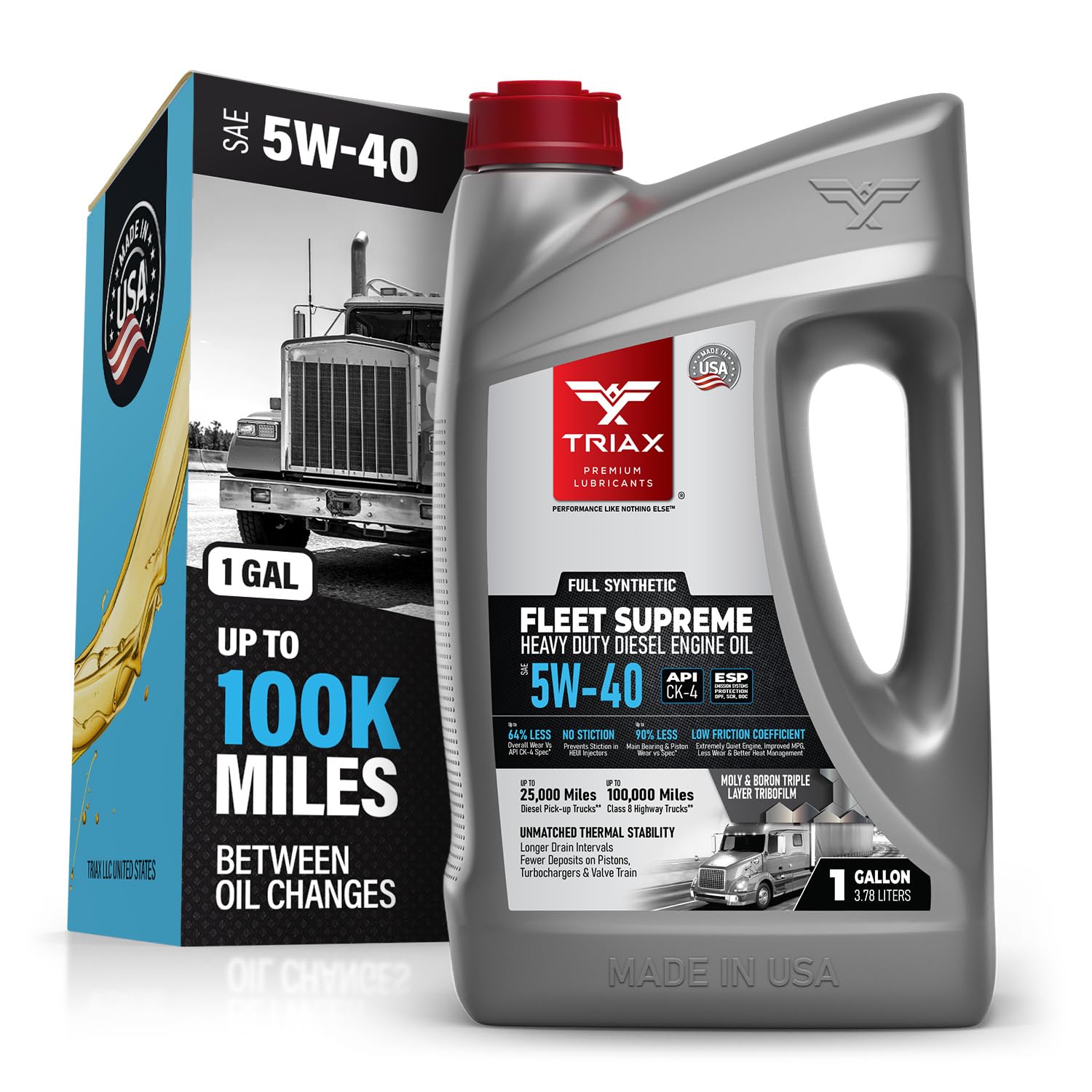
The moly-boron blend that stops HEUI injector stiction and quieted a Duramax tick no other oil could.
Triax Fleet Supreme ESP is boosted with Nano-Boron and Moly friction modifiers (chemicals that reduce friction). The difference is immediately audible. One owner with a 2003 Duramax reported that Rotella T6 and Mobil 1 both produced the typical diesel ticking sound, while Triax eliminated it entirely — “claims of quieter operations are valid,” he wrote. Another called it “the absolute best oil for PowerStroke” because the high moly content quiets lifters and injectors. The brand claims up to 68% less wear than OEM standards, with a friction coefficient 50% lower than the competition. If injector noise is driving you crazy, this oil is built to address exactly that.
The cold-start performance is designed to be exceptional down to -45 °F, a serious claim for owners in the far north. A 2022 RAM 1500 EcoDiesel owner in Texas saw oil temperatures rise from 206°F to 219°F (normal under load) but noted the oil stayed clean after 1,300 miles, with the level stable and the idle noticeably smoother.
Extended drain capability: Triax is capable of drain intervals exceeding 100,000 miles for highway semi trucks and 30,000 miles for super-duty pickups, though oil analysis is recommended to confirm. The DPF/SCR compatibility means it won’t clog particulate filters.
Reach for this if: you drive a PowerStroke or Duramax and want the quietest valvetrain possible, plus the flexibility of a full synthetic that handles extreme cold. It costs a bit more than Mobil 1 TDT, but the nano-additive package is unique.
Not necessary for: older mechanical diesels that do not have HEUI injectors (hydraulic electronic unit injectors) — the additional moly boron is still beneficial but less critical.
7. Delo 400 XSP SAE Heavy Duty Synthetic Diesel Engine Oil 5W-40

The Chevron synthetic that a generator owner says runs 30°F cooler and starts on the first pull every time.
Delo 400 XSP is a Chevron full synthetic designed for consistent cold-weather starting in sub-zero temperatures. One owner running it in a generator reported a 30°F lower operating temperature — 99°F vs the previous oil — with no breeze for cooling, and spark plugs stayed visibly cleaner. The same oil in a Honda mower ran 18°F cooler and started on the first pull every time. That thermal stability is a direct result of the full synthetic base holding its viscosity when the engine gets hot, where conventional oils would thin out and run hotter.
The oil is also surprisingly popular with motorcycle owners. A sport bike rider on a 15,000 rpm (revolutions per minute) machine reported no clutch slip, crisp take-up, buttery shifts, and less shear than Rotella T. That is a good proxy for how well the oil holds its film strength under extreme shear conditions — the same stresses that occur in a high-torque diesel at full load. The 3.402 kg package ships from the US, and owners in Alaska report prompt delivery with good packaging.
Versatility note: It is API SN rated, so it works in gasoline engines too. One owner used it in a Mazda CX-5 turbo for 7,500 miles with zero oil consumption and better fuel economy than Mobil 1 5W-30. That means one jug can serve your truck and your car.
Perfect for: owners in very cold climates who want a full synthetic that delivers immediate cold-flow and runs cooler under load. The 5W-40 grade is ideal for modern turbo diesels.
The trade-off: some owners find it slightly expensive compared to other 5W-40 synthetics, though the quality feedback is overwhelmingly positive.
8. Hot Shot’s Secret Green Diamond 15W-40 Full Synthetic Diesel Engine Oil

The FR3 nanotechnology oil that bumped a Duramax from 18 to 22 MPG at highway speed.
Hot Shot’s Secret Green Diamond uses patented FR3 nanotechnology (microscopic particles that reduce friction) to reduce friction inside the engine’s tightest crevices. The real-world results are striking. One owner with an LLY Duramax and 265,000 miles saw fuel economy jump from 18 to 22 miles per gallon at 70 mph with 33-inch tires — a 4 MPG improvement — while the engine ran quieter and throttle response improved. Another owner with a 2017 Cummins 6.7 noted higher oil pressure than Amsoil after 15,000 miles and a slightly quieter idle. The manufacturer claims up to 3% fuel economy improvement from the Group III base oil blend, which appears conservative based on these reports.
Compared to the older CJ-4 spec oils, the manufacturer claims Green Diamond reduces wear on engine components by 71 percent. The CK-4 additive packaging keeps the oil clean and helps maintain horsepower even under demanding operating conditions. For a stock setup, the additive package and viscosity remain intact even after 14,000 miles of hard use, which is an impressive indicator of shear stability.
Emissions note: Some reviewers point out a more pungent emissions smell, likely from the high zinc additive content — this is normal for a high-performance diesel oil and does not indicate a problem.
Best for: owners who want real fuel economy gains and reduced engine wear, especially Duramax and Cummins trucks that see highway miles. The 15W-40 grade is ideal for warmer climates.
Consider the 5W-40: if you live where winter temperatures regularly drop below freezing. Hot Shot’s also offers a 5W-40 variant for cold climates.
9. Schaeffer Manufacturing Co. 9000CK4-006S SynShield OTR Plus Full Synthetic 5W-40

The full-synthetic Schaeffer that oil tests still call good at 20,000 miles — the king of extended drains.
Schaeffer SynShield OTR Plus is the full-synthetic sibling of the 15W-40 that took our top spot, and it pushes performance even further. One owner who runs oil analysis reported taking this 5W-40 to 20,000 miles on a single fill with the oil still testing good — changing only the oil filter every 10,000 miles. The highest EP (extreme pressure) additive molybdenum content among tested oils is the reason: moly bonds to metal surfaces and stays there, providing a sacrificial wear layer that conventional additives cannot match. Another owner with a 2024 6.7 Cummins driving 50,000 miles a year said engine performance improved after switching.
For cold-weather starting, the 5W-40 grade is a standout. An owner of a poorly maintained 2005 6.0 Power Stroke found that moving from non-synthetic 15W-40 to this Schaeffer 5W-40 full synthetic halved cranking time. The oil stayed clean after 3,000 miles on that engine, which had known issues. The superior soot-busting and deposit-dispersing capability means it handles high-heat, high-soot conditions — exactly what an OTR (over-the-road) truck produces — without thickening or forming sludge.
Mixed value perception: While the oil quality and performance get the most praise, the value rating among owners is mixed — it is undeniably premium-priced, but the extended drain capability offsets the higher per-gallon cost for high-mileage drivers.
Reach for this if: you drive 50,000+ miles a year and want one oil that lasts 15,000-20,000 miles between changes with proper filtration. The cold-flow advantage of 5W-40 also makes it ideal for northern fleets.
Not cost-effective for: seasonal truck owners who change oil once a year — the 15W-40 Schaeffer (product 1) delivers most of the same benefits at a lower price for standard drain intervals.
Understanding the Specs
SAE Viscosity Grade (15W-40 vs 5W-40 vs 10W-30)
The SAE J300 viscosity grade is the single most important spec for your engine. The first number with the W (like 5W or 15W) is the cold-weather rating — a 5W oil flows much better at sub-zero temperatures than a 15W, so your engine builds oil pressure faster on a winter start-up. The second number (30 or 40) is the hot-running grade. A 40-weight oil maintains a thicker protective film at high operating temperatures during towing or climbing steep grades. A 10W-30 is a compromise: easier cold flow than a 15W-40, but thinner at high heat. Always start with what your owner’s manual specifies for your climate.
API Service Category and CK-4
API stands for the American Petroleum Institute, and their service categories tell you what protection level the oil meets. CK-4 is the current diesel standard — it is backward-compatible with earlier categories like CJ-4 (a previous diesel standard) and provides better protection against oxidation, shear, and aeration in high-heat conditions. CK-4 oils are formulated with lower ash content to protect diesel particulate filters (DPF — a device that traps soot) and selective catalytic reduction (SCR) systems from clogging. If your truck is a 2010 or newer, you should use a CK-4 oil. Older engines can also use CK-4 safely; there is no downside. Some premium oils also meet the older CJ-4 spec, but CK-4 is the more modern, sturdy choice.
FAQ
Can I use 5W-40 instead of 15W-40 in my diesel truck?
What is the difference between CK-4 and CJ-4 diesel oil?
How long can I go between oil changes with full synthetic diesel oil?
Will a 10W-30 oil protect my engine during heavy towing?
Is Valvoline Premium Blue the only oil endorsed by Cummins?
What does moly and boron additive do in diesel oil?
Can I use diesel oil in a gas generator or lawn mower?
Does the jug design matter — should I care about handles?
Final Thoughts: The Verdict
If you want one dependable pick, the engine oil for diesel trucks winner is the Schaeffer SynShield 15W-40 because it delivers the quietest idle, the best wear protection from micron moly, and real fuel economy gains — all at a reasonable price for a conventional oil with premium additives. If you face extreme cold or want extended drain intervals, grab the Mobil 1 Turbo Diesel Truck 5W-40 for proven cold-start reliability and full synthetic protection. And for Cummins owners who want the factory endorsement, the Valvoline Premium Blue One Solution 10W-30 is
Related Guides

Mo Maruf
I created WellFizz to bridge the gap between vague wellness advice and actionable solutions. My mission is simple: to decode the research and give you practical tools you can actually use.
Beyond the data, I am a passionate traveler. I believe that stepping away from the screen to explore new environments is essential for mental clarity and physical vitality.