Our readers keep the lights on and my smoothie glass nicely filled. As an Amazon Associate, I earn from qualifying purchases.
Specs are compiled from manufacturer listings and verified buyer reviews and can change over time — please confirm the key details on the product page before buying.
Choosing the wrong engine oil is one of the fastest ways to shorten your engine’s life. The right one keeps everything moving smoothly under the hood, prevents sludge from building up, and helps your car start easily in freezing weather. This guide cuts through the marketing to nine of the best options on the shelf right now — matched to your engine’s age, your driving habits, and your budget.
I’m Mohammad Maruf — the founder and writer behind WellFizz. This guide is built by comparing the manufacturers’ published specifications and the patterns across verified customer reviews, so you get each pick’s real strengths and trade-offs instead of marketing spin.
Whether you drive a truck that hauls every weekend or a daily commuter pushing past 150,000 miles, choosing the right engine oil can mean years of trouble-free driving.
Our Picks at a Glance


How To Choose The Best Engine Oil
The single most important thing you can do is ignore the hype on the front label and look at the back. Every bottle carries two key pieces of information: the SAE viscosity grade and the API/ILSAC performance standard. Your owner’s manual lists exactly what your car needs — use nothing less than that standard, and you cannot go wrong.
Viscosity Grades: What 5W-30 Actually Means
The first number (the “W” stands for Winter) tells you how the oil behaves when the engine is cold. A 0W oil stays thinner at very low temperatures than a 10W, meaning it flows faster to critical engine parts during a cold start. The second number tells you the oil’s thickness at operating temperature — a 30-grade is the standard for most modern cars, while a 40-grade is thicker and often used in older or high-performance engines. The right grade is the one your car was designed around.
Full Synthetic vs. Conventional vs. High Mileage
Full synthetic oils are engineered for the best protection under extreme heat and cold, which makes them ideal for turbos, frequent towing, or very cold climates. Conventional oil works fine for older, simpler engines that do not see severe conditions. A high-mileage oil includes seal conditioners that can reduce leaks and oil consumption in engines that have already passed 75,000 miles — it is a targeted fix for aging seals, not a general upgrade. skip it if your engine is still young and tight.
Quick Comparison
| Model | Best For | Viscosity Grade | Volume | Item Weight | Amazon |
|---|---|---|---|---|---|
| Mobil 1 High Mileage 10W-30★ Best Overall | High-mileage gas engines over 75k | 10W-30 | 5 Quarts | 9 lbs | Amazon |
| LIQUI MOLY Molygen 0W-20Top Performer | Asian & American cars, quiet starts | 0W-20 | 1 Liter | 1.9 lbs | Amazon |
| Mobil 1 Truck & SUV 0W-20Hauling Grade | Towing & heavy-duty driving | 0W-20 | 5 Quarts | — | Amazon |
| Castrol EDGE EP 0W-20 | Long intervals up to 25,000 miles | 0W-20 | 5 Quarts | — | Amazon |
| Valvoline High Mileage 150K 5W-30 | Engines over 150,000 miles | 5W-30 | 5 Quarts | — | Amazon |
| Motorcraft 5W-30 | Ford & Lincoln vehicles | 5W-30 | 5 Quarts | 9 lbs | Amazon |
| Royal Purple HMX 5W-20 | High-mileage, tick suppression | 5W-20 | 5 Quarts | 9.4 lbs | Amazon |
| Liqui Moly Special Tec LL 5W-30 | European makes (BMW, Audi) | 5W-30 | 5 Liters | 9.4 lbs | Amazon |
| Motul 8100 ECO-nergy 5W-30 | European & performance engines | 5W-30 | 5 Liters | — | Amazon |
In‑Depth Reviews
1. Mobil 1 High Mileage Full Synthetic Motor Oil 10W-30, 5 Quart
Our pick — over 4.5★ from 10,000+ verified ratings; the strongest balance of quality and price.
The crowd favorite for engines that have already seen serious miles.
This is the oil designed specifically for engines with over 75,000 miles, using Mobil 1’s Triple Action Formula to keep them running clean, protected, and efficient for up to 10,000 miles between changes. Owners of everything from old trucks to high-mileage sedans report impressively smooth operation after switching from conventional oil. One buyer summed up the common sentiment: “Switched old truck from conventional to full synthetic.” The results speak for themselves — cars running “like a sewing machine” even past 140,000 miles.
The 10W-30 grade handles heat up to 500 degrees Fahrenheit and cold down to -30 degrees, which means it works well across most climates. At 9 pounds for a full 5-quart bottle, this is a heavy, stable container that pours cleanly thanks to a clear fill marker. The bottle’s low center of gravity also helps prevent spills.
The real-world value is what people rave about most — value for money is the top praised aspect. It meets ILSAC GF-6 standards, so you also get protection against low-speed pre-ignition, a modern concern for turbocharged engines. For any gas car past the 75,000-mile mark that needs a dependable synthetic, this is where you start.
What wins owners over
- Triple Action Formula for cleaning, protection, and performance
- Up to 10,000-mile oil change intervals
- Meets ILSAC GF-6 for modern turbo protection
- Clear fill marker for mess-free pouring
The honest trade-off
- 10W-30 grade may be too thick for very cold climates vs. 0W or 5W options
- Best suited for high-mileage engines; unnecessary for newer, low-mileage cars
Grab it if: Your gas engine has passed 75,000 miles and you want a proven full synthetic that delivers smooth operation and strong cleaning power at a price that makes financial sense.
Think twice if: Your engine is still under 75,000 miles — a standard full synthetic without the high-mileage additives will serve you better.
2. LIQUI MOLY Molygen New Generation SAE 0W-20 | 1 L | Fully synthetic engine oil | SKU: 20436
A German-engineered synthetic that instantly quiets the valvetrain.
LIQUI MOLY’s Molygen 0W-20 is built for Asian and American gasoline cars, including those with multi-valve technology and turbocharging. Its claim to fame is “instant lubrication after cold start” — and the reviews back it up. Buyers report noticeably cleaner, quieter engines and “very little burn off between changes.” One owner using it across many different car brands put it simply: “it always performs.” The unique UV-reactive green color is a bonus — it glows under a UV light, making leak detection trivially easy.
The 0W-20 viscosity is a common recommendation for modern fuel-efficient engines from Honda, Toyota, Mazda, and many others. At just 1.9 pounds for a liter, this is a much lighter bottle than the bulk 5-quart jugs — a 4.7x weight gap compared to the Mobil 1 10W-30. If you need only a quart for a top-off or your car calls for a specific liter-measured fill, this avoids waste.
Extended service intervals and reduced emissions are part of the package, making this a solid pick for anyone who wants to stretch time between changes without sacrificing engine health. It is a premium choice that asks a little more per quart but delivers measurable quietness.
Worth the switch for: Anyone driving a 0W-20 vehicle who wants the quietest possible cold start and a synthetic additive package that visibly cleans as it runs.
Keep in mind: The 1-liter bottle means you will need multiple bottles for a full oil change on most engines — check your capacity before ordering.
Reach for this if… you value immediate cold-start protection and want an oil that makes its presence felt through reduced valvetrain noise.
Look elsewhere if… your engine requires a 5W-30 or 10W-30 grade — this is a 0W-20 formula only.
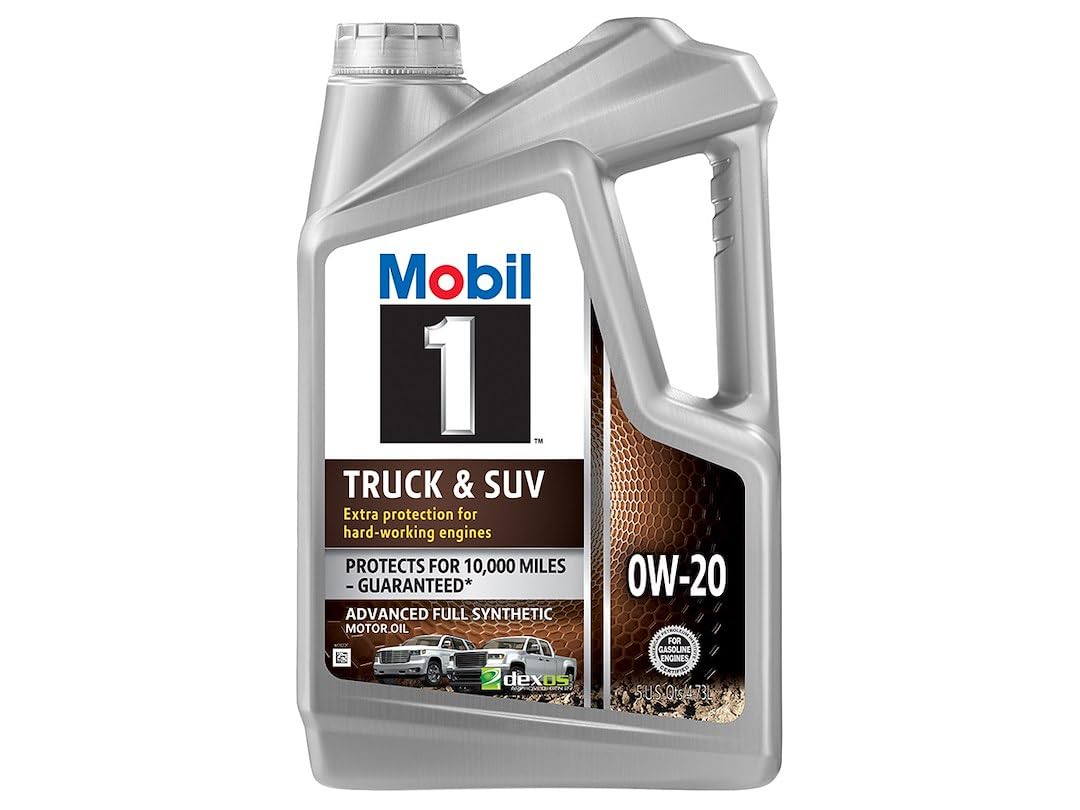
3. Mobil 1 Truck & SUV Full Synthetic Motor Oil 0W-20, 5 Quart
Formulated for heavy loads, high heat, and long hauls.
This is Mobil 1’s specialized 0W-20 for trucks and SUVs that regularly tow, haul, or operate in tough conditions. The Triple Action Formula is the same core technology, but the additives here focus on controlling oxidation under sustained heavy load and preventing deposit formation at high oil temperatures. Internal engine heat protection reaches 500 degrees Fahrenheit, while cold flow drops to -40 degrees — a wider cold-temperature range than the standard Mobil 1 10W-30.
Owner feedback highlights its stability in extreme heat — one report from Arizona confirms clean cold starts and consistent protection even in desert summers. The 5-quart jug is a practical size for most full-size trucks and SUVs. It also meets the 0W-20 recommendation found in many newer GM and Ford vehicles, making it a solid OEM-style choice for owners who want to stick with a trusted brand.
For anyone towing a trailer or camper, the protection against viscosity breakdown under load is the defining advantage here. The 0W-20 grade keeps fuel economy up during daily driving while the heavy-duty additive package kicks in when the engine works hardest.
The standout spec: Heat protection up to 500°F and cold-flow down to -40°F, tested in a towing scenario — real-world validation for anyone who works their truck.
Best for: Truck and SUV owners whose vehicles earn their keep through towing, hauling, or operating in extreme heat — the additive package is purpose-built for sustained load.
Not ideal for: Light passenger cars that see only gentle driving — a standard Mobil 1 will provide the same protection without the truck-specific formulation.
4. Castrol EDGE Extended Performance 0W-20 Advanced Full Syn Motor Oil 5 Qt

An endurance formula that promises 25,000 miles between changes.
Castrol claims this oil is 3X stronger than the leading full synthetic in viscosity breakdown tests, with 50X better high-temperature performance as measured in the Seq IIH test. The headline number is a 25,000-mile or one-year oil change interval, which is among the longest claims on the shelf. For a long-haul driver who racks up miles quickly, that can mean one oil change per year instead of four. The oil carries an impressive list of approvals including API SQ/SP, ILSAC GF-7, ACEA C5, GM dexos1 Gen 3, and MB-Approval 229.71.
Owners who have used Castrol for decades — one buyer mentions 35+ years — report quiet idling, great gas mileage, and smooth operation across multiple vehicles. One long-term user of Castrol EDGE EP calls it his “#1 in my books,” changing every 5,000 miles with a good filter and seeing no performance loss even when the oil darkens between changes.
This is a premium-tier price, but the extended interval math works in its favor if you drive enough to actually hit that 25,000-mile window. If you change oil once a year regardless of mileage, the confidence from the high-performance additive package still makes it a strong choice.
Who it suits: High-mileage drivers, long-commute highway warriors, and anyone who wants the longest possible oil change interval backed by serious lab-test numbers.
Grab it if: You want maximum change interval length and the strongest lab-tested viscosity retention available — the 25,000-mile claim is the best on this list.
Think twice if: You change oil every 3,000-5,000 miles regardless — many of this oil’s capabilities will go unused, and a mid-range synthetic would serve you the same.
5. Valvoline High Mileage 150K with Maxlife Plus Technology 5W-30 Motor Oil 5 Quart

A targeted fix for engines that have already seen a quarter-million miles.
Valvoline’s MaxLife Plus Technology is formulated with a Moly Additive Protection system and seal conditioners specifically for engines that have passed 150,000 miles. The seal conditioners are the star here — they prevent leaks and reduce oil consumption, which is exactly what older engines need. Multi-dimensional anti-wear additives fight surface friction exceeding standard protection levels, while extra detergents combat the sludge and deposits that accumulate in high-mileage engines. The flash point is 394 degrees Fahrenheit, providing good thermal stability for an older engine that may run hotter than it used to.
The reviews confirm the claims. One owner with a 2006 Chevrolet Silverado 1500 at slightly over 150,000 miles calls it “perfect.” Another who switched after “mileage finally crept over 175k” says it is “definitely worth it.” Multiple reports of stopped leaks and reduced oil consumption. Noise level gets mixed opinions — some engines quiet down, others do not — but the overall verdict is strong for high-mileage applications.
It meets API SP and ILSAC GF-6A standards, so it is fully compatible with modern engine requirements while being designed for older ones. The 5-quart bottle is the standard size for most trucks and full-size sedans. If your car has lived a long life and is starting to sweat or sip oil, this is the most targeted solution on the list.
What stands out
- Seal conditioners to stop leaks in old engines
- Extra detergents for sludge removal
- Meets API SP and ILSAC GF-6A standards
- American-made; brand trusted for 150+ years
The honest caveat
- Noise reduction is not guaranteed — some engines stay the same volume
- Overkill for any engine under 150,000 miles
Reach for this if… your engine has crossed 150,000 miles and you are seeing oil consumption or small leaks — the seal conditioners are the most effective fix short of a mechanic.
Look elsewhere if… your engine is still under 100,000 miles; a standard synthetic will protect it without the high-mileage formulation.
6. MOTORCRAFT – Oil – Engine (XO5W305Q3SP)
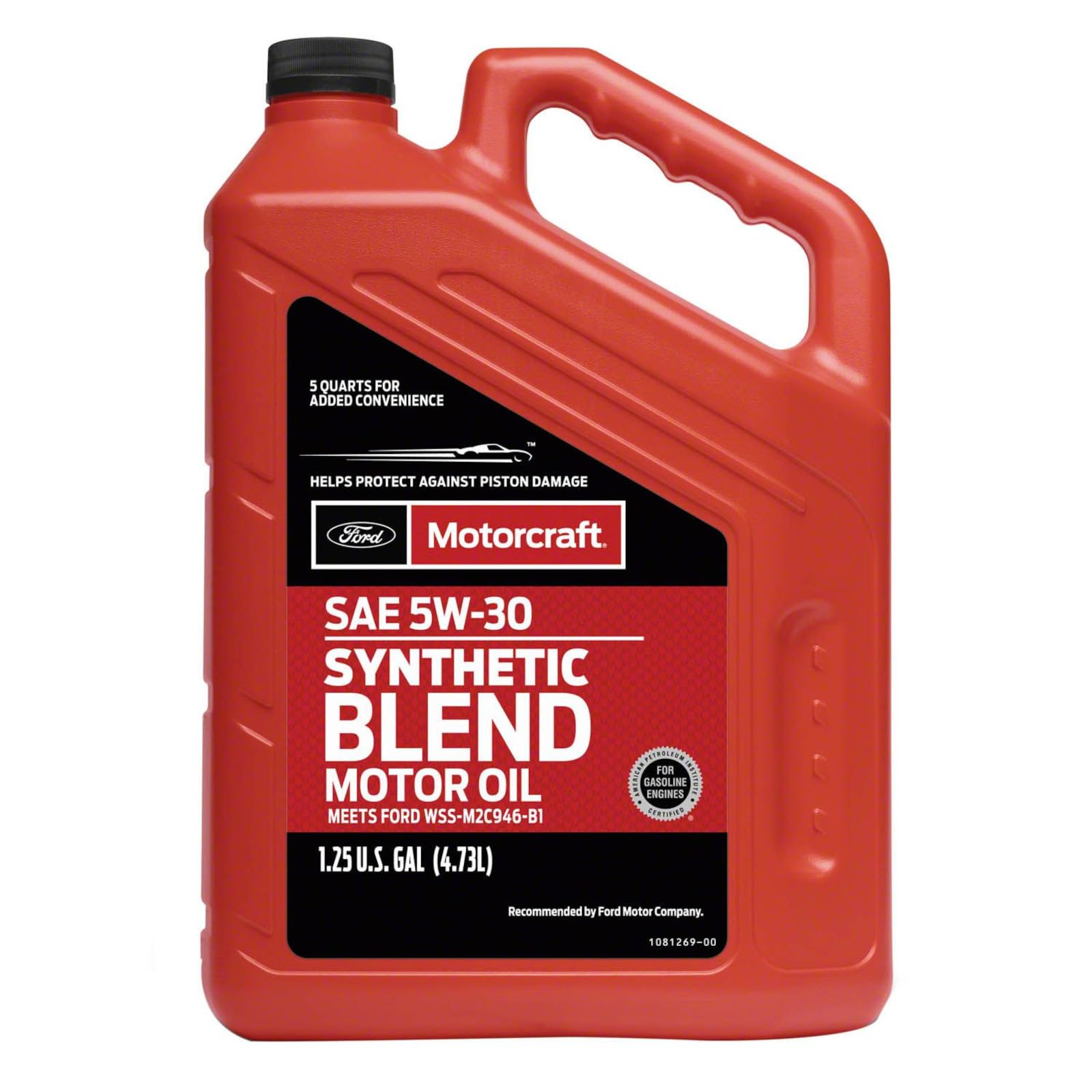
The factory-fill oil Ford trusts for its own engines.
If you drive a Ford, Lincoln, or any American SUV, truck, or van, Motorcraft is the oil the engineers designed the engine around. The 5W-30 grade is a staple for many Ford vehicles including the 2.7 EcoBoost — one owner simply says it is “the right oil for a 2.7 ecoboost. ‘Nuff said.” The oil is well-reviewed for making engines feel quieter and running smoother, with a flash point of 446 degrees Fahrenheit indicating strong thermal resistance. The 5-quart jug weighs 9 pounds and is straightforward to pour.
Value for money is a consistently praised aspect — owners find it cheaper and more convenient than making a trip to the dealership parts counter. “Good price and didn’t have to deal with the people of walmart,” as one buyer put it. The oil quality itself earns the highest praise count in the reviews.
It is a full synthetic, so it provides the cold-flow and high-temp protection expected from modern oil, but priced closer to a conventional or blend. For anyone who wants to maintain the factory-specified oil without paying dealership prices, this is the match.
The key advantage: Direct OE engineering — this is not a generic oil labeled for Ford; it is the oil Ford puts in its own vehicles. That alone makes it the right choice for Ford, Lincoln, and Mercury owners.
Best for: Ford and Lincoln owners who want the factory-specified oil without the dealership markup — a drop-in replacement for the same oil used at the factory.
Not for: Owners of vehicles outside the Ford family; the additive package is tuned for Ford engines and may not match other manufacturers’ specifications.
7. Royal Purple HMX w/Synerlec | High Mileage SAE 5W-20 Premium Synthetic Motor Oil |5 Quart | SKU: 17518
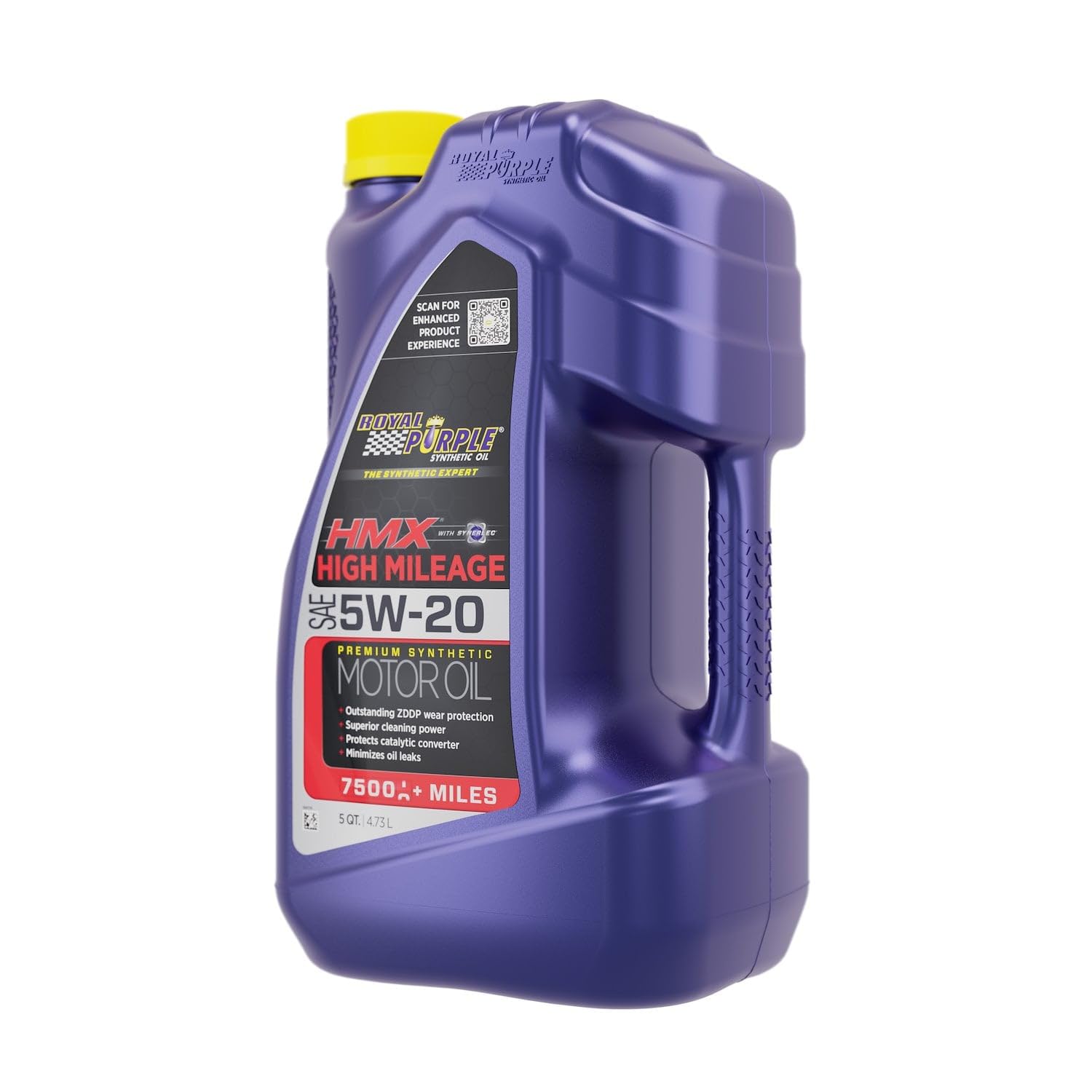
The oil that quiets a noisy lifter tick and keeps it quiet.
Royal Purple’s HMX is a high-mileage 5W-20 synthetic fortified with a zinc/phosphorus anti-wear additive — a traditional chemistry that many older engines rely on for flat-tappet cam protection. It includes Synerlec additive technology to increase oil film strength, which translates to better protection during extended intervals. The product is also formulated to minimize wear and “restore lost engine performance,” which aligns with what owners mention: “tends to take the tick out of the engine idle” is a common note. One owner with a 5.7 Hemi reports smooth operation and calls it “worth the extra money.”
At 9.4 pounds for a 5-quart jug, it is slightly heavier than the Mobil 1 5-quart bottle, reflecting a denser additive package. An owner who has used Royal Purple for decades on a Jeep Wrangler with over 115,000 miles says that when they replaced valve cover gaskets, the heads had “little to no varnish” — a strong real-world sign of deposit control. The oil’s color is also frequently mentioned as a positive, though that is cosmetic rather than performance.
The zinc/phosphorus content (ZDDP) is higher than what many modern API SP oils allow, which makes this oil especially interesting for older engines — pre-2000s pushrod engines, classic cars, and high-mileage V8s benefit the most. It also includes LSPI protection for modern turbo engines.
Standout features
- Zinc/phosphorus anti-wear for flat-tappet cam engines
- Synerlec tech for extended oil film strength
- Customers note near-spotless valve trains after 100k+
- LSPI protection included
The honest downside
- Premium price point vs. Mobil 1 or Valvoline
- 5W-20 grade fits only vehicles that specify it
Grab it if: You own a high-mileage V8, a classic pushrod engine, or a 5W-20 vehicle with a persistent lifter tick — the zinc additive package is purpose-built for this.
Think twice if: Your engine is a modern 0W-20 design requiring low-friction additives; this is a 5W-20 formula only.
8. Liqui Moly Special Tec LL SAE 5W-30 | 5 L | Synthesis Technology Motor Oil | SKU: 2249

The benchmark 5W-30 for European engines, especially BMW.
This 5-liter jug of Liqui Moly Special Tec LL is the go-to synthetic for BMW, Audi, and other European marques that specify a LongLife (LL) 5W-30. Owners of BMW 7-series, X5s, and even tuned cars report that engines run “smooth and quiet years later” and that the oil handles extra boost without issue. At 5 liters (169.1 fluid ounces), this jug provides enough for most European engines that require a larger sump capacity, which avoids buying a second bottle. The jug weighs 9.4 pounds, comparable to other full-size containers.
The “Special Tec LL” designation means it meets the long-life oil change intervals that BMW and Audi often recommend — up to two years or 20,000 miles depending on the model. One owner who has “only ran this oil since my car was new” notes that despite rising prices, the engine remains “smooth and quiet even while tuned.” Another found it cheaper than BMW OEM oil and reports quieter engine operation and reduced misfiring on an older X5.
Noise reduction is the most frequently mentioned real-world benefit — the quality of the base oil and the additive package seem to have a measurable effect on valvetrain noise in European engines. For anyone who wants the exact spec their German car requires without a trip to the dealership, this is the direct equivalent.
The spec that matters: 5-liter (169.1 fl oz) capacity — many European engines need more than the standard 5-quart US jug, and this hits the exact volume without waste.
Best for: BMW, Audi, and Mercedes owners who want the factory-equivalent long-life oil at a price that beats the dealership parts counter — the quietness improvement is real.
Not for: Most Asian or American makes that do not require a LongLife 5W-30; you will pay for additives your engine does not need.
9. Motul 8100 ECO-nergy 5W-30 Full Synthetic Motor Oil with Advanced Low-Friction Formula – ACEA A5/B5 & API SP Approved for Ford, Jaguar Land Rover, VW & European Applications – 5 Liter
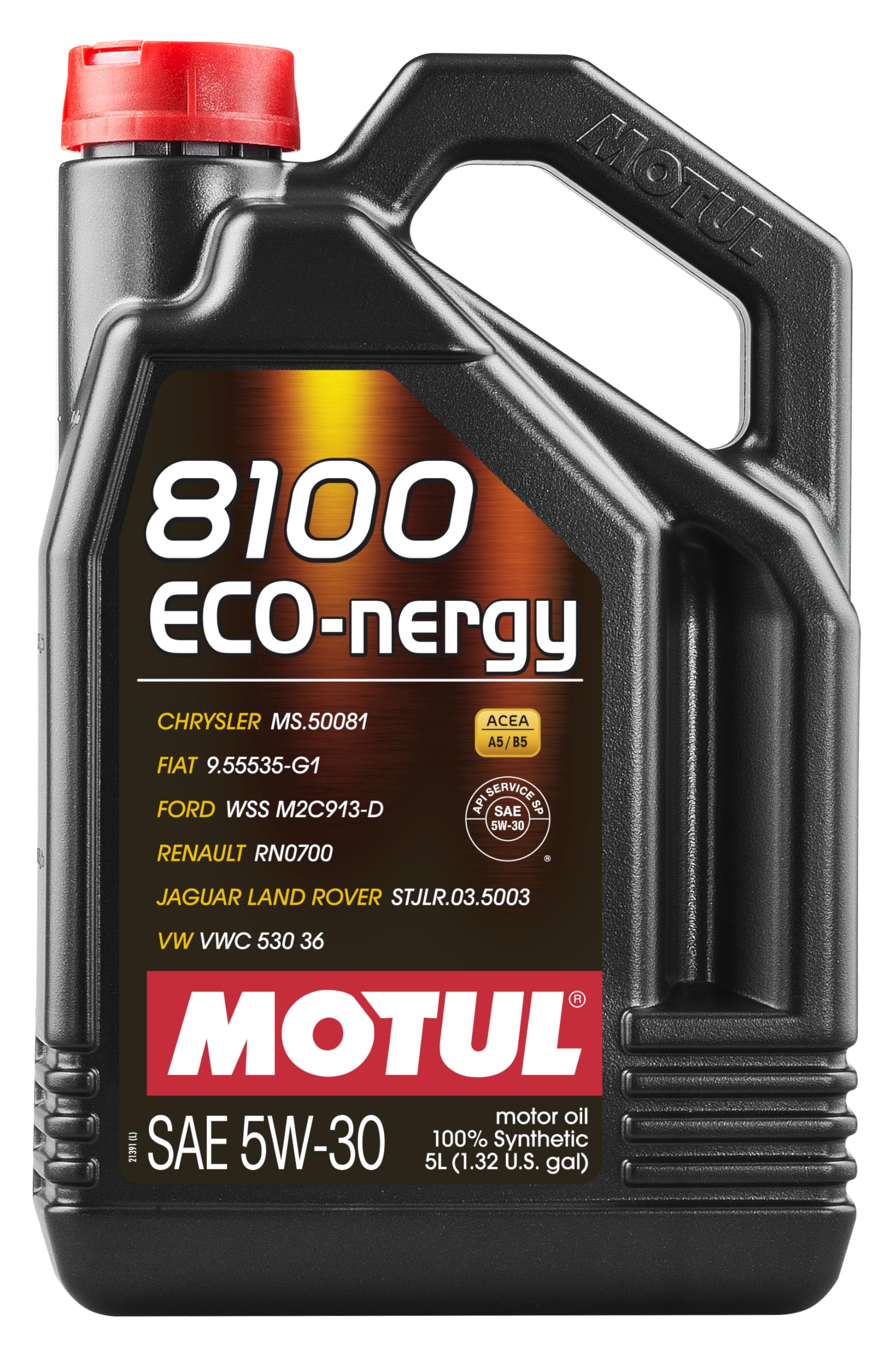
A full-synthetic that outperforms Royal Purple and Mobil 1 in many owners’ experience.
Motul’s 8100 ECO-nergy 5W-30 is a high-performance synthetic that carries ACEA A5/B5 and API SP approvals, making it suitable for Ford, Jaguar, Land Rover, VW, and a wide range of European applications. The “ECO-nergy” name points to its low-friction formula, which reviewers point out translates into real-world fuel economy gains of 5-10%. It is also suitable for all types of gasoline or diesel engines, and is designed to maintain oil pressure while decreasing operating temperature — a critical factor for turbocharged engines that generate a lot of heat.
The review cluster is impressive. Owners of LS1 Camaros and Subaru STIs report elimination of oil burn, quieter valvetrain noise, and improved efficiency. One owner of a 2022 Hyundai Palisade saw gas mileage improve from 19 to 24 mpg after switching. The 5-liter jug is the perfect size for many European performance cars that need a larger fill than the standard US 5-quart measure. A flash point of 100 degrees Celsius indicates strong resistance to thermal breakdown.
The biggest praise is for oil quality — it tops the aspect counts at 56 mentions. Owners who have tried Royal Purple and Mobil 1 rank Motul higher for staying cleaner longer and holding its lubricity through extended intervals.
Owner’s verdict: “Outperforms Royal Purple and Mobil 1; reduces wear and emissions; oil stays cleaner and holds lubricity longer.” That is a direct comparison from an owner who has used all three.
Reach for this if… you drive a European or high-performance car (especially turbo) and want an oil that reduces operating temperatures, improves fuel economy, and keeps your valvetrain quiet.
Look elsewhere if… your budget prioritizes the lowest per-quart price over additive technology; this is a premium synthetic with a price to match.
Understanding the Specs
SAE Viscosity Grade
The Society of Automotive Engineers (SAE) grade tells you how the oil flows at different temperatures. A 0W-20 oil stays thin in the cold (the “0W” grade means it flows at -35°C) and thickens to a specific range at operating temperature (the “20” grade). A 5W-30 is slightly thicker when cold and at running temperature. The right grade is the one your engine was designed for — too thin and you lose protection; too thick and the oil struggles to reach tight clearances at start-up.
API Performance Standard
The American Petroleum Institute (API) marks like “SP” or “SN” tell you the protection level the oil provides. API SP is the current standard and includes protection against low-speed pre-ignition (LSPI), which affects modern turbocharged engines. An older standard like “SN” is fine for engines that predate LSPI concerns. The “C” prefix (e.g. CK-4) means the oil is for diesel engines. Always use at least the standard listed in your owner’s manual.
FAQ
Can I switch from conventional to full synthetic oil?
What happens if I use the wrong viscosity like a 10W-30 instead of 5W-30?
How often should I change engine oil with full synthetic?
Is high-mileage oil worth the extra cost?
What does ILSAC GF-6 mean on an oil bottle?
Can I mix different brands of synthetic oil?
Is it safe to use a 0W-20 oil in an engine that requires 5W-30?
What is the difference between ACEA A5/B5 and API SP?
How do I dispose of used engine oil?
Final Thoughts: The Verdict
For most drivers, the engine oil winner is the Mobil 1 High Mileage 10W-30 because it combines proven cleaning performance, Triple Action Formula protection, and a value that owners praise more than any other aspect of the oil — backed by the highest star rating on this list. If you drive a truck that tows regularly, the Mobil 1 Truck & SUV 0W-20 is the one to reach for, with its towing-tested formulation and heat protection up to 500 degrees. And for European car owners who want factory-spec protection, the Liqui Moly Special Tec LL 5W-30 delivers the quiet, smooth operation that makes the long drive home feel easy.
How We Picked
We do not accept paid placement. Every pick is matched to a real buyer and a real use-case; we do not hands-on test units.
Sources & Methodology
Specifications: manufacturer listings and product documentation. Review insights: verified customer reviews, as of July 2026. Pricing: not shown on this page (it changes often); check the current price via the retailer link.
As an Amazon Associate, WellFizz earns from qualifying purchases. This does not affect which products we feature.
Related Guides

Mo Maruf
I created WellFizz to bridge the gap between vague wellness advice and actionable solutions. My mission is simple: to decode the research and give you practical tools you can actually use.
Beyond the data, I am a passionate traveler. I believe that stepping away from the screen to explore new environments is essential for mental clarity and physical vitality.