Our readers keep the lights on and my smoothie glass nicely filled. As an Amazon Associate, I earn from qualifying purchases.
Specs are compiled from manufacturer listings and verified buyer reviews and can change over time — please confirm the key details on the product page before buying.
Capturing the Milky Way or a crisp lunar crater doesn’t require a second mortgage. The real challenge with cheap camera for astrophotography is cutting through the noise — literally. Long exposures in the dark push budget sensors to their limit, so you need a body that handles high ISO cleanly and lets you swap in a fast, wide lens.
I’m Mohammad Maruf — the founder and writer behind WellFizz. This guide is built by comparing the manufacturers’ published specifications and the patterns across verified customer reviews, so you get each pick’s real strengths and trade-offs instead of marketing spin.
Whether you are framing the Orion Nebula or just a starry landscape, this guide to the best cheap camera for astrophotography focuses on the bodies that deliver usable results while staying affordable.
Our Picks at a Glance


How To Choose The Best Cheap Camera For Astrophotography
Astrophotography is a punishing task for any camera. You are asking a sensor to record very faint light over many seconds, which amplifies noise, tests battery life, and demands rock-solid manual controls.
Sensor Size and Sensitivity
The sensor is the heart of astrophotography. A larger APS-C or full-frame sensor captures more light per pixel than a tiny smartphone or compact camera sensor. This means cleaner images at higher ISO settings — typically between 1600 and 6400 — where the stars become visible. Look for a body that lists an expanded ISO range and handles grain well.
Manual Controls and Bulb Mode
You need full control over shutter speed, aperture, and ISO. Astro exposures often run 15 to 30 seconds before star trails appear. A dedicated Bulb mode lets you hold the shutter open even longer for stacked deep-sky shots. An intervalometer (built-in or via an app) is a huge bonus for capturing time-lapses without touching the camera.
Lens Interchangeability
A fixed-lens camera limits your reach. Interchangeable-lens systems — DSLR or mirrorless — let you mount a fast, wide-angle prime lens like a 14mm f/2.8 or a 50mm f/1.8. A wider aperture gathers more light in the same exposure time, which is the single most effective upgrade for star photography short of buying a tracking mount.
Quick Comparison
| Model | Best For | Sensor Resolution | Autofocus Points | Frame Rate | Amazon |
|---|---|---|---|---|---|
| Canon EOS 2000D / Rebel T7 Bundle★ Best Overall | Value starter bundle | 24.1 MP | 9 | — | Amazon |
| OM SYSTEM E-M10 Mark IVAlso Great | Stabilized handheld shots | 20 MP | 121 | — | Amazon |
| Canon EOS Rebel T7 (Double Zoom)Top Performer | All-in-one beginner kit | 24.1 MP | 9 | 3 fps | Amazon |
| Nikon D7500 | Durable DSLR with 4K | 20.9 MP | 51 | 8 fps | Amazon |
| Sony A6100 | Compact travel astro | 24.2 MP | 425 | 11 fps | Amazon |
| Sony ZV-E10 | Video-first vlog astro | 24.2 MP | 425 | 11 fps | Amazon |
| Canon EOS RP | Entry full-frame for landscapes | 26.2 MP | — | — | Amazon |
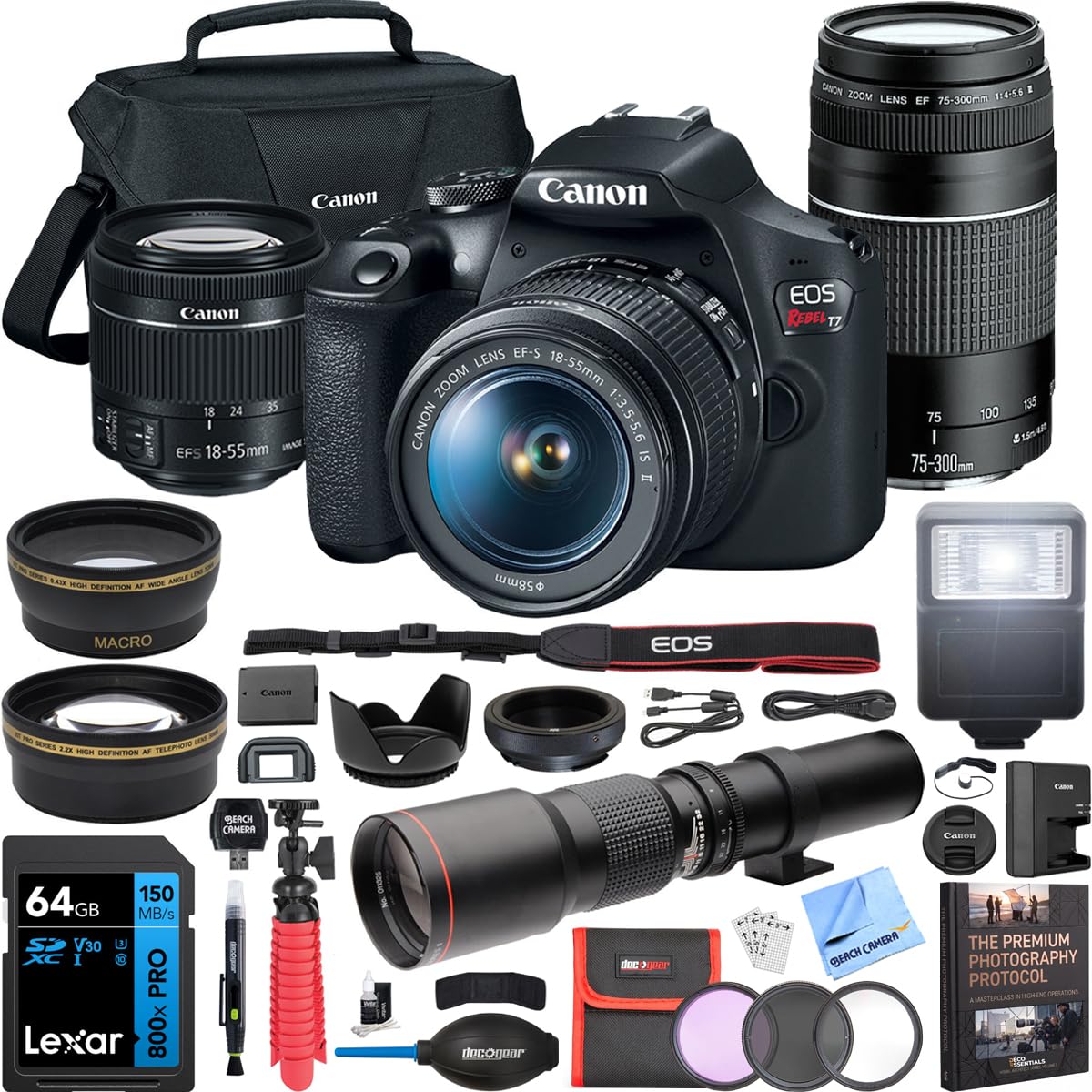
| Canon EOS Rebel T7 (42pc Bundle) | Massive accessory kit | 24.1 MP | 9 | 3 fps | Amazon |
| Sony ZV-E10 II | Latest mirrorless creator | 26 MP | 759 | 11 fps (elec.) | Amazon |
| Nikon Z50 II | Compact dual-lens kit | 20.9 MP | 231 | — | Amazon |
In‑Depth Reviews
1. Canon EOS 2000D / Rebel T7 DSLR with 18-55mm Lens + Accessory Bundle (Renewed)
The no-frills DSLR bundle that gets you started without the financial sting.
This is the absolute entry point: a 24.1MP APS-C sensor with a 12-bit depth and a 9-point phase-detection autofocus system. The 24.1MP sensor and 9-point AF won’t impress seasoned astrophotographers, but the body accepts Canon’s full EF-S lens lineup. Buyers describe it as amazing light weight and easy to handle, perfect for someone who just wants to start shooting the moon and bright constellations.
The bundle includes a 32GB SD card, tripod, case, wide-angle and telephoto attachments, and a ZeeTech accessory kit. The built-in Wi-Fi with NFC lets you trigger the shutter from your phone, which is useful for long exposures without touching the camera. Buyers consistently say it is great for beginners and well worth the value. Just understand that the 12-bit depth and 9 AF points mean this is a learning tool — you will eventually want a body with more dynamic range for deep-sky work.
It is renewed, so condition varies, but the positive reviews suggest most units arrive in good working order.
Who it fits: the absolute beginner who wants to learn manual exposure and capture bright celestial objects like the moon or Orion on a tight budget.
What you give up: 12-bit depth limits post-processing flexibility, and the basic AF system is slow for tracking subjects.
2. OM SYSTEM Olympus E-M10 Mark IV Silver Micro Four Thirds System Camera
The mirrorless body that stabilizes your shot so a tripod becomes optional.
The 5-axis In-Body Image Stabilization enables 1-second handheld exposures, according to owners. The 5-axis IBIS enables sharp 1-second handheld exposures of the night sky, eliminating the need for a tripod.
It sports a 20 MP Live MOS sensor and a 4:3 aspect ratio with 121 autofocus points, a massive leap from the 9-point systems found on budget DSLRs. The flip-down monitor with selfie mode adds versatility, and the Micro Four Thirds mount lets you pick up a fast, wide manual lens cheaply for better light gathering. The 12-bit depth and occasional lens recognition issues are trade-offs, but image quality is tough to beat at this price.
Build quality and size are consistently praised. It is compact enough to slip into a jacket, yet sturdy enough for regular use. This body balances portability with the manual controls astrophotography demands.
Why it shines
- 5-axis IBIS allows 1-second handheld shots, reducing tripod dependence.
- 121-point autofocus system — a 13.4x increase over entry-level 9-point DSLRs.
- Compact, lightweight Micro Four Thirds body fits in a jacket pocket.
- Excellent image quality with a 20 MP sensor.
What to watch
- 12-bit depth limits dynamic range compared to some 14-bit rivals.
- A minority of buyers report intermittent lens recognition errors.
- No external charger in the box; spare batteries are cheap but not USB-C.
Reach for this if: you want the most forgiving camera for untracked night sky photography, where in-body stabilization saves your long-exposure shots.
Think twice if: you need the deepest dynamic range for heavy post-processing — a 14-bit APS-C body serves that better.
3. Canon EOS Rebel T7 DSLR Camera with EF 18-55mm and 75-300mm Double Zoom Kit
The entry-level DSLR that bundles two zoom lenses and a telephoto for moon shots.
This kit delivers a 24.1 Megapixel CMOS (APS-C) sensor with a 14-bit depth — noticeably richer than the 12-bit found on the OM SYSTEM above, meaning smoother tonal gradations in your starry skies. The included 500mm preset telephoto lens is ideal for lunar close-ups, while the 18-55mm handles wider landscapes.
It shoots up to 3 fps with a 9-point AF system and an optical viewfinder with 95% coverage. The built-in Wi-Fi and NFC are useful for remote triggering, which helps avoid camera shake during long exposures. Quality and value for money are the top praises from owners, with 87 buyers specifically noting the camera’s solid build. The catch is that some accessories feel cheap — the bundle is stuffed with extras, but the core camera and the two Canon lenses are the real value.
For someone starting astrophotography, this gives you a moon lens and a wide-angle right from the start. This is the most-reviewed pick on the list, with thousands of ratings backing its 4.6-star verdict.
Why it works
- 14-bit depth delivers smoother color and tone for post-processing.
- Includes a 500mm preset lens for detailed moon photography.
- Double zoom kit covers wide landscapes and distant subjects.
- Built-in NFC and Wi-Fi for remote shutter release.
What to check
- 9 autofocus points are very basic compared to mirrorless rivals.
- Slow 3 fps burst rate limits action shots.
- Some bundled accessories feel inexpensive.
Best for: the budget-minded beginner who wants a complete kit with a moon lens and a wide-angle from day one.
skip it if: you need a fast burst rate or a modern mirrorless autofocus system.
4. Nikon D7500 DSLR Camera with AF-S DX NIKKOR 18-140mm f/3.5-5.6G ED VR Lens

The weather-resistant DSLR that pairs a sharp 18-140mm lens with pro-level metering.
Nikon put the same metering and image processing from its award-winning D500 into this body. The 20.9MP DX sensor coupled with the EXPEED 5 processor delivers clean high-ISO performance — critical when you are pushing to 3200 or 6400 to capture the Milky Way. The 51-point AF system with 15 cross-type sensors locks on quickly even in low contrast.
The 8 fps continuous shooting is the fastest among the DSLR entries here, which matters if you want to capture a meteor shower or the International Space Station crossing. The 3.2-inch tilting LCD with touch works well for composing from awkward tripod angles. Camera quality and picture quality are the top praise from owners, with 41 calling out the build. The 18-140mm VR lens is described as outstanding at every focal length, giving you a versatile walk-around range.
One honest caveat is that the model was released in 2017 — it lacks the latest mirrorless features — but for astrophotography, the sensor and processing are still class-leading.
Why it leads: the 51-point AF and 8 fps burst with 14-bit depth give you speed and dynamic range that entry-level DSLRs cannot match.
Trade-off: it is bulkier than mirrorless alternatives and the lens mount is DSLR-only, so you will need an adapter for newer Z-mount glass.
5. Sony Alpha A6100 Mirrorless Camera with 16-50mm Zoom Lens

The world’s fastest AF at 0.02 seconds, housed in a body that travels anywhere.
This Sony claims the fastest autofocus in its class — 0.02 seconds — with 425 phase-detection points covering 84% of the sensor. That is a 47x increase in AF coverage compared to a 9-point DSLR, which is overkill for stars but extremely useful for daytime shooting and quick framing.
The 24.2MP APS-C Exmor sensor with a front-end LSI pushes ISO up to 51,200, though you will want to keep it under 6400 for clean results. It shoots 11 fps with continuous AF/AE tracking, and the 180-degree tiltable touchscreen is great for self-portraits under the stars. Picture quality is the second most-praised feature after entry-level usability. The main drawback owners mention is a convoluted menu system and the lack of in-body stabilization — you will need a tripod or a stabilized lens for long exposures.
For a compact travel mirrorless that packs serious AF speed and 4K video, this is a versatile entry point that grows with you as you buy faster glass.
Perfect for: the traveler who wants one small body that handles daytime snapshots and night landscapes equally well.
Watch out for: no IBIS means every second of shutter shake shows up in your astro shots — a sturdy tripod is mandatory.
6. Sony ZV-E10 Mirrorless Camera with 16-50mm Lens, Deluxe Bundle

The vlogger’s mirrorless that doubles as a capable night sky camera.
You get sharp stars and clean night skies because the ZV-E10 shares the same 24.2MP APS-C Exmor CMOS sensor (a large image chip that captures more light than smaller sensors) and 425-point hybrid AF system (autofocus that blends phase-detection and contrast-detection for fast locking) as the Sony A6100. For astrophotography, the real advantage is the interchangeable E-mount — you can swap the 16-50mm kit lens for a fast Sigma or Samyang prime (a fixed-focal-length lens that lets in more light), so you capture more stars in each shot. Owners mention the side flip-out touchscreen and directional 3-capsule mic are video-focused, but the sensor and lens flexibility make it a strong night-sky choice.
It records 4K30p and Full HD at 120p for slow-motion star time-lapses. The bundle includes a 64GB Extreme PRO SD card, a tripod, a spare battery, and Movavi editing software — everything but the fast lens you will want for the night sky. Owners praise the quality and value for money, with most components working right from the start. The kit lens is described as “okay” by users, who recommend saving for a sharper f/2.8 zoom.
The catch is that this is a video-first body; the lack of an electronic viewfinder means you will compose on the rear screen, which is more challenging in bright sunlight or complete darkness.
Best for: the hybrid shooter who wants one camera that does beautiful video during the day and star-scapes at night with the right lens.
Not ideal if: you prefer composing through an eye-level viewfinder or need the deepest low-light sensor.
7. Canon EOS RP Full-Frame Mirrorless with RF24-105mm F4-7.1 IS STM Lens

The lightest way into Canon full-frame mirrorless for clean, low-noise night shots.
You get richer detail in the Milky Way and cleaner shadows because the EOS RP packs a 26.2MP full-frame CMOS sensor (a sensor the size of a 35mm film frame, capturing more light than smaller APS-C sensors) with the DIGIC 8 processor (Canon’s image-processing chip that reduces noise at high ISOs). That gives you a real step up in dynamic range (the ability to keep detail in both bright stars and dark sky) and high-ISO performance over any APS-C camera in this guide. The RF mount opens the door to Canon’s RF lens lineup, including a fast 50mm f/1.8 (a lens with a wide aperture that lets in lots of light) that costs little and transforms low-light capability — so you can shoot the Orion Nebula without a tripod. Customers note the full-frame sensor makes cropping deep into star fields possible without losing sharpness.
The kit includes the RF24-105mm F4-7.1 IS STM lens with up to 5 stops of optical image stabilization. For astro-landscapes, that wide end at 24mm is decent, but the f/7.1 aperture is slow; you will want a faster prime for deep-sky work. Owners call it a fantastic way to get into full frame while staying affordable, praising image quality and build. Many specifically note the huge step up in low-light performance over their older crop-sensor DSLRs.
Battery life is short per charge — pack a spare or USB battery bank for a full night out.
Perfect for: the photographer ready to move to full-frame for cleaner astro images, especially landscape star-scapes with a fast wide prime.
Consider this: the kit lens is slow for stars; budget for an RF 50mm f/1.8 or a manual Samyang RF-mount prime to open up the full-frame advantage.
8. Canon EOS Rebel T7 DSLR w/ EF-S 18-55mm + 420-800mm Telephoto Bundle (Renewed)

The 42-piece bundle that hands you a super-telephoto for lunar close-ups straight away.
This is the same Canon T7 body (24.1MP, 9-point AF) but in a much bigger kit. The headline addition is the 420-800mm f/8.3 manual telephoto zoom lens, which lets you reach the moon and bright planets without buying extra glass. It also includes a 64GB SD card, a sling backpack, filters, a macro kit, a tripod, a spare battery, and a slave flash.
The body records 14-bit depth, slightly better than the 12-bit in the 2000D bundle, and shoots Full HD 1080p video. Quality and value for money are the top praise, with owners calling it a great beginners set up. The downside reported by a few buyers is that the included bag had a failing zipper and the accessory lenses are not Canon-branded, so they lack electronic communication with the body.
For the sheer volume of gear included at this price point, it is a low-risk way to explore moon photography and wide-field star shots.
Best for: the enthusiastic beginner who wants to start shooting the moon today without buying additional lenses.
Watch for: some accessories feel cheap; plan to replace the bag and upgrade to a proper wide-angle prime for the best astro results.
9. Sony ZV-E10 II APS-C Mirrorless Creator Camera with 16-50mm Lens

The latest APS-C creator body with a 759-point AF system that predicts your subject.
The ZV-E10 II inherits Sony’s newest Exmor R CMOS sensor with approximately 26 megapixels — three times bigger than a premium 1-inch sensor, as the maker notes. The autofocus is the real highlight: 759 points with Real-time Eye AF for humans, animals, and birds, plus AI-assisted subject recognition. That obscene AF coverage is overkill for stars, but it ensures every daytime shot is perfectly focused.
It shoots 4K up to 60 fps and Full HD at 120 fps for slow-motion. The Creative Look function offers 10 presets for in-camera color grading, which is handy for quick social-sharing of your night landscapes. Owners rave about the 4K quality and compact size. The downsides are clear from the feedback: battery life is a recurring negative, with some reporting dead batteries on arrival, and the body runs warm in 4K with occasional overheating in warm rooms.
For a travel-friendly mirrorless that excels at video and stills, this is a modern choice — just pack extra batteries for a full night under the stars.
Perfect for: the content creator who wants a compact, modern body that delivers sharp 4K time-lapses and high-resolution stills with state-of-the-art autofocus.
Be aware: battery life is the most-cited negative, and the camera may overheat during extended 4K recording in hot conditions.
10. Nikon Z50 II with Two Lenses (16-50mm & 50-250mm VR)

The compact Nikon mirrorless that pairs two VR lenses for dawn-to-dusk coverage.
Nikon’s Z50 II uses a 20.9-megapixel DX format sensor (APS-C) that is several times larger than a typical smartphone sensor, giving you real low-light capability. The autofocus system uses 231 points with hybrid phase/contrast detection, and can automatically detect and track nine subjects — including birds and airplanes for aviation astrophotography.
It records 4K UHD at 60p and Full HD slow-motion at 120p. The Picture Control button lets you cycle through 31 built-in presets, and you can download bespoke presets from Nikon Imaging Cloud. The two-lens kit covers 16-50mm for wide landscapes and 50-250mm for tighter shots. Owners consistently call the kit lenses sharp and the body lightweight and easy to carry. The positives are clear: quality and photo quality are the most-praised aspects, and the electronic viewfinder is noted as a great touch.
The main gripes are that charging is slow and external flash compatibility has been mixed. For the money, you get a modern mirrorless system with two stabilized lenses that cover every daytime and astro-landscape scenario.
Best for: the photographer who wants a complete, lightweight two-lens mirrorless kit that delivers sharp images straight from the start.
Consider this: you may want a separate battery charger and an extra battery for extended night sessions, as the USB charging is not the fastest.
Understanding the Specs
Sensor Size and Bit Depth
A larger sensor physically captures more light, which is everything in astrophotography — more light means less noise at high ISO, so your star shots look cleaner. Bit depth (12-bit vs 14-bit) refers to how many tones each pixel can record. A 14-bit sensor gives you smoother, more detailed color gradations in the night sky and more room to push shadows in editing without banding.
Autofocus Points and In-Body Stabilization
More AF points means the camera can find focus across a wider area of the frame, which helps when composing off-center stars. For astro, you will usually manual-focus anyway, but a high AF-point count is a sign of a modern, capable sensor. In-Body Image Stabilization (IBIS) physically moves the sensor to counteract your hand shake — it can allow 1-second handheld exposures, which is revolutionary for quick night shots without a tripod.
FAQ
Can any cheap DSLR or mirrorless camera shoot the Milky Way?
How important is a full-frame sensor for astrophotography?
What does Bulb mode do for star photography?
Will a 420-800mm telephoto lens work for the moon?
What is the fastest shutter speed I can use before star trails appear?
Do I need a tracking mount for astrophotography?
How does in-body stabilization help when shooting stars?
Is 4K video useful for astrophotography?
Should I buy a camera with an intervalometer built in?
How much should I budget for lenses when buying a cheap astro camera?
Final Thoughts: The Verdict
Across the board, the cheap camera for astrophotography winner is the OM SYSTEM Olympus E-M10 Mark IV because its 5-axis in-body stabilization (a system that shifts the sensor to counteract hand shake) and compact Micro Four Thirds kit let you capture sharp handheld night shots that no other camera at this price can match — you can shoot the moon at 1/2 second without blur. If you want a full-frame sensor for the deepest dynamic range and the most cropping power, grab the Sony a7R II (Renewed) — just budget for a fast prime (a lens like a 35mm f/1.8 that lets in more light than the kit zoom). And for the complete beginner who needs a moon lens and a wide-angle from day one, the Canon EOS Rebel T7 Double Zoom Kit is the value champion: 4.6 stars across thousands of ratings, a 500mm telephoto (so you can see craters on the moon), and a proven 24.1MP sensor in one box — pass on it if you plan to shoot deep-sky objects, because the kit lenses are slow at f/5.6.
How We Picked
We do not accept paid placement. Every pick is matched to a real buyer and a real use-case; we do not hands-on test units.
Sources & Methodology
Specifications: manufacturer listings and product documentation. Review insights: verified customer reviews, as of July 2026. Pricing: not shown on this page (it changes often); check the current price via the retailer link.
As an Amazon Associate, WellFizz earns from qualifying purchases. This does not affect which products we feature.
Related Guides

Mo Maruf
I created WellFizz to bridge the gap between vague wellness advice and actionable solutions. My mission is simple: to decode the research and give you practical tools you can actually use.
Beyond the data, I am a passionate traveler. I believe that stepping away from the screen to explore new environments is essential for mental clarity and physical vitality.