Our readers keep the lights on and my smoothie glass nicely filled. As an Amazon Associate, I earn from qualifying purchases.
Specs are compiled from manufacturer listings and verified buyer reviews and can change over time — please confirm the key details on the product page before buying.
You want even slices without the noise, the mess, or the dread of cleanup. The best electric slicer does that. The wrong one bogs down on semi-frozen meat, scatters crumbs everywhere, and takes longer to clean than the actual prep. The difference depends on three things: motor torque (how much force the blade gets), blade size (the diameter that decides what fits), and whether the parts come off for a real wash.
I’m Mohammad Maruf — the founder and writer behind WellFizz. This guide is built by comparing the manufacturers’ published specifications and the patterns across verified customer reviews, so you get each pick’s real strengths and trade-offs instead of marketing spin.
Here are the seven best electric slicers — from compact home models to near-commercial workhorses — ranked by real-world owner feedback and measurable specs that actually determine whether a machine will hold up to weekly use. This is the definitive electric slicer shortlist for anyone who wants consistent cuts without the frustration.
Our Picks at a Glance


How To Choose The Best Electric Slicer
Buying an electric slicer means matching the machine to what you actually plan to cut — and how often. A weekend jerky maker needs different torque than someone slicing a whole ham every Sunday. Here are the three specs that separate a slicer you will love from one you will regret.
Motor power and type
The motor is the heart of the machine. A 200W DC motor (direct current — it runs on a steady electrical flow) delivers steady torque with less noise than a standard AC motor (alternating current — the type in most small appliances). That quiet hum means you can hold a conversation while you slice. For occasional use on cheese, bread, and cooked meat, 200W is plenty. If you regularly cut semi-frozen meat or process large batches in one session, a higher-torque belt-driven motor in the 240W to 320W range keeps the blade spinning without bogging down, so you don’t have to stop and wait for it to catch up.
Blade size and material
Blade diameter determines the largest piece of food you can feed through. A 7.5-inch blade handles standard roasts and blocks of cheese. An 8.7-inch blade gives you more clearance for larger cuts — think whole pork loins or tall loaves of sourdough. A 10-inch blade is the commercial standard, capable of handling bigger product with less waste, which means fewer end pieces. Stainless steel resists rust and staining; high-carbon chromium-plated steel holds its edge longer and requires less frequent sharpening.
Ease of cleaning
A slicer with a removable blade and carriage is dramatically easier to clean than one where you have to wipe around a fixed blade. Look for a detachable design where the blade, food tray, and pusher come off for a quick wash. Machines that require disassembly with a screwdriver for every cleaning session get skipped — and skipped cleaning leads to meat residue buildup and dulling, so eventually the blade won’t cut cleanly.
Quick Comparison
| Model | Best For | Motor Power | Blade Diameter | Thickness Range | Amazon |
|---|---|---|---|---|---|
| Borlebbi 200W★ Best Overall | All-around home slicing | 200W DC | 7.5″ | 0–15 mm | Amazon |
| NutrichefBest Value | Budget bread & deli slicing | 200W | 7.5″ | 0–15 mm | Amazon |
| TOKASS 200W | Durable daily use | 200W | 7.5″ | 0–15 mm | Amazon |
| OSTBA 200W | Larger cuts, wider blade | 200W DC | 8.7″ | 0–15 mm | Amazon |
| Valley Sportsman | Premium home & jerky prep | 180W | 8.7″ | 0–15 mm | Amazon |
| KWS 10NS Commercial | Heavy home & light commercial | 320W | 10″ | 0–14 mm | Amazon |
| BESWOOD Royal Red | Professional-grade precision | 240W | 10″ | Adjustable | Amazon |
In‑Depth Reviews
1. Borlebbi 200W Meat Slicer Machine for Home
Our pick — 4.5★ from 650+ verified ratings; the strongest balance of quality and price.
A quiet, torque-rich machine that slices block cheese and whole hams without the clatter.
The Borlebbi earns the top spot because its 200W DC motor delivers stable torque at lower noise than an AC motor — you can actually hear yourself think while the blade does the work. The two removable 7.5-inch stainless steel blades (one serrated, or toothed, for crusty bread; one non-serrated for smooth cuts on meat) let you swap between a crusty loaf of bread and a roast without cross-contaminating raw and cooked foods. Owners consistently call out how easy it is to change blades and to strip the whole thing down for a quick clean, with 64 of them mentioning ease of cleaning as a standout feature.
Adjustable thickness from 0 to 15 mm covers paper-thin deli slices all the way up to hearty sandwich cuts. The child safety lock (a switch that requires two hands to start the machine) and non-slip feet are there for confidence, but what buyers really rave about is the slicing performance — 67 owners specifically praise how it cuts. One owner sums it up as “best for partially frozen fresh meat (1-2 hours),” which is exactly the balance for even, tear-free slices. The trade-off: the suction cups don’t grab every countertop well, and a few owners note that meat can sneak behind the blade into the gear compartment, which complicates cleanup. Go in expecting to wipe down the blade housing after a heavy batch.
What gets the praise
- Quiet DC motor with steady torque — doesn’t bog down on semi-frozen meat
- Two blades included for raw and cooked food separation
- Owners call out ease of cleaning 64 times as a standout feature
- Adjusts from paper-thin to 15 mm with a simple dial
The honest caveats
- Suction feet don’t hold on all counter surfaces
- Meat can work its way behind the blade into the gear area
- Blade lock can feel stubborn on first uses
Reach for it if: you want a quiet, dual-blade slicer that handles weekly meat and cheese prep without breaking a sweat — the 200W DC motor is the real differentiator here
Look elsewhere if: you plan to slice rock-solid frozen meat or need a commercial-duty machine that runs for hours without a pause — this is a home tool for home batches.
2. Nutrichef Electric Meat Slicer
A lightweight entry point that handles bread and deli meat without denting the wallet.
The Nutrichef is a solid choice if you slice mostly bread, salami, and standard deli meats. The 200W motor drives a 7.5-inch tooth blade through a 0-to-15 mm thickness range, and owners consistently praise its effectiveness as a sourdough slicer. The removable blade and food carriage make cleaning straightforward — one of the top positives across 87 mentions of functionality. At just over 13 inches deep, it tucks into a smaller counter footprint than most, unlike the heavier TOKASS.
The catch is the duty cycle (how long you can run it before a rest): buyers report the machine requires a 30-minute cool-down for every 10 minutes of use, so this is not a batch-processing tool for a whole deer or a 20-pound cheese wheel. The body is largely plastic, and the food pusher has seen durability complaints from some owners. It also measures 13.9 inches long vs the Borlebbi’s 14.6 inches — a more compact footprint, but that smaller carriage means larger roasts won’t fit easily. Think of it as a capable light-duty slicer for a couple of loaves and a pound of ham every week.
Who it serves best: home bakers and sandwich-makers who want an electric slicer under the premium tier and don’t push it through heavy meat sessions.
The one limit to know: the 30-minute cool-down per 10-minute run means you will be waiting between batches if you try to process more than a few pounds at once.
3. TOKASS 200W Meat Slicer Machine for Home

A year-in, year-out performer that still slices like new after 12 months of steady use.
The TOKASS focuses on longevity: the company specifically calls out motor service life as the key upgrade, and owners back that up. After a year of regular use, one buyer reports it “works perfectly fine like new.” The 200W motor drives two German high-carbon stainless steel blades (serrated and non-serrated), both 7.5 inches. The stepless adjustment knob (no click-stops, just continuous control) lets you dial in any thickness from ultra-thin to about 3/4 inch. Slice performance leads the positive mentions at 49 counts.
The build is noticeably larger than the Nutrichef — 16.33 inches wide vs 13.9 — giving you more carriage room for bigger roasts. At 10.6 inches deep, it also has a wider stance. The body is stainless steel, not plastic, which owners cite as a reason it “likely lasts longer” than lighter competitors. The durability aspect is mixed, however: some owners mention the machine breaking within a year, so the warranty matters here. TOKASS offers a 12-month machine warranty and free parts replacement — a genuine safety net that the budget options lack.
What stands out
- Two high-carbon steel blades resist rust and staining
- Stepless thickness dial from ultra-thin to 3/4 inch
- 12-month warranty with free parts replacement
- Owners confirm it stays sharp and functional past one year
What to watch
- Bulky footprint at 16.33 inches wide
- Some units have reported durability issues within the first year
- Not as powerful as a deli-grade slicer for continuous heavy loads
Best if: you want a stainless-steel workhorse with a warranty backing it up — the two-blade set and continuous thickness dial make it versatile for everything from jerky prep to zucchini slicing.
skip it if: counter space is tight or you only slice a loaf of bread once a week — the size and weight are overkill for occasional use.
4. OSTBA Electric Meat Slicer with 200W DC Motor
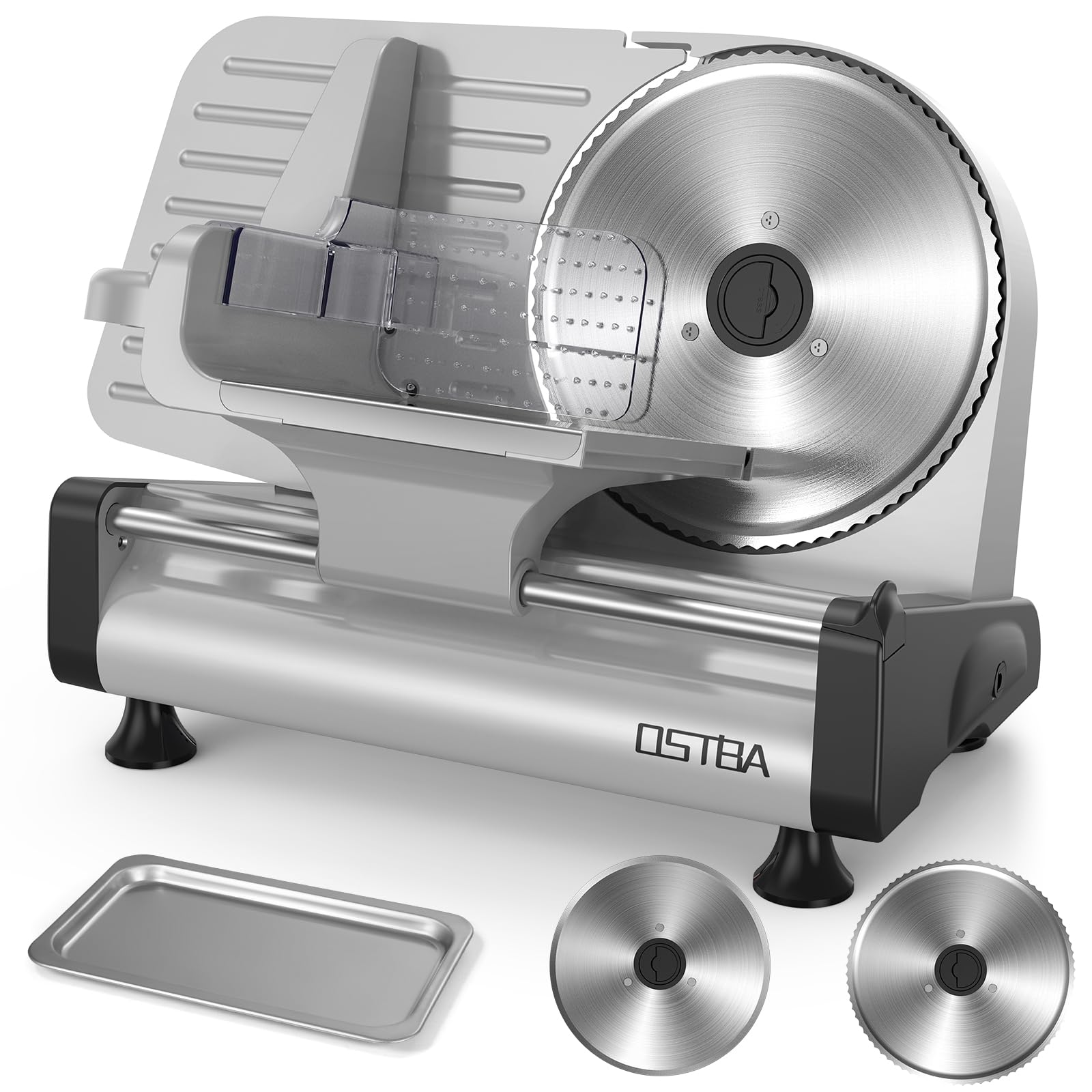
An 8.7-inch blade that swallows whole roasts and loaves without breaking stride.
The OSTBA steps up from the 7.5-inch standard to a larger 8.7-inch blade (serrated and smooth included), which means you can feed bigger cuts through — whole pork loins, tall loaves of homemade sourdough, and thick blocks of cheese. The 200W DC motor is the same quiet, torque-rich type that makes the Borlebbi a favorite, so noise stays low. Two safety features stand out: the child lock switch requires both hands to start the machine, and the blade cover protects fingers during cleaning.
Owners who use it for homemade jerky and weekly bulk prep report clean cuts and reliable performance. The adjustable thickness knob clicks into place and stays there — a welcome detail given that some rival machines let the plate drift during use. The catch here is that the thickness setting does not have a positive lock, and a few owners note the backing plate can shift if not held by hand. The plastic food pusher also broke for one owner after three weeks (the manufacturer replaced it in two days). It is not designed for frozen meat, so stick to chilled or partially thawed cuts for best results. At 12.2 pounds and 18.11 inches wide, it demands dedicated counter space.
What owners love
- 8.7-inch blade handles larger roasts and tall bread loaves
- Quiet DC motor with enough torque for raw beef jerky prep
- Stable on the counter with rubber feet — no slipping during use
- Dishwasher-safe removable parts simplify cleanup
The trade-offs
- Thickness plate can drift if not held; no lock mechanism
- Not meant for frozen meat — chills are fine
- Plastic pusher is a weak point under heavy use
Reach for it if: you routinely slice large roasts for jerky or need a blade wide enough for tall sourdough loaves — the 8.7-inch blade is a genuine step up from the standard 7.5-inch machines.
Think twice if: you plan to slice frozen meat or prefer a machine you can use straight from the box without consulting online research for lubricant placement — the manual is thin on maintenance details.
5. Valley Sportsman Deli Slicer 8.7″
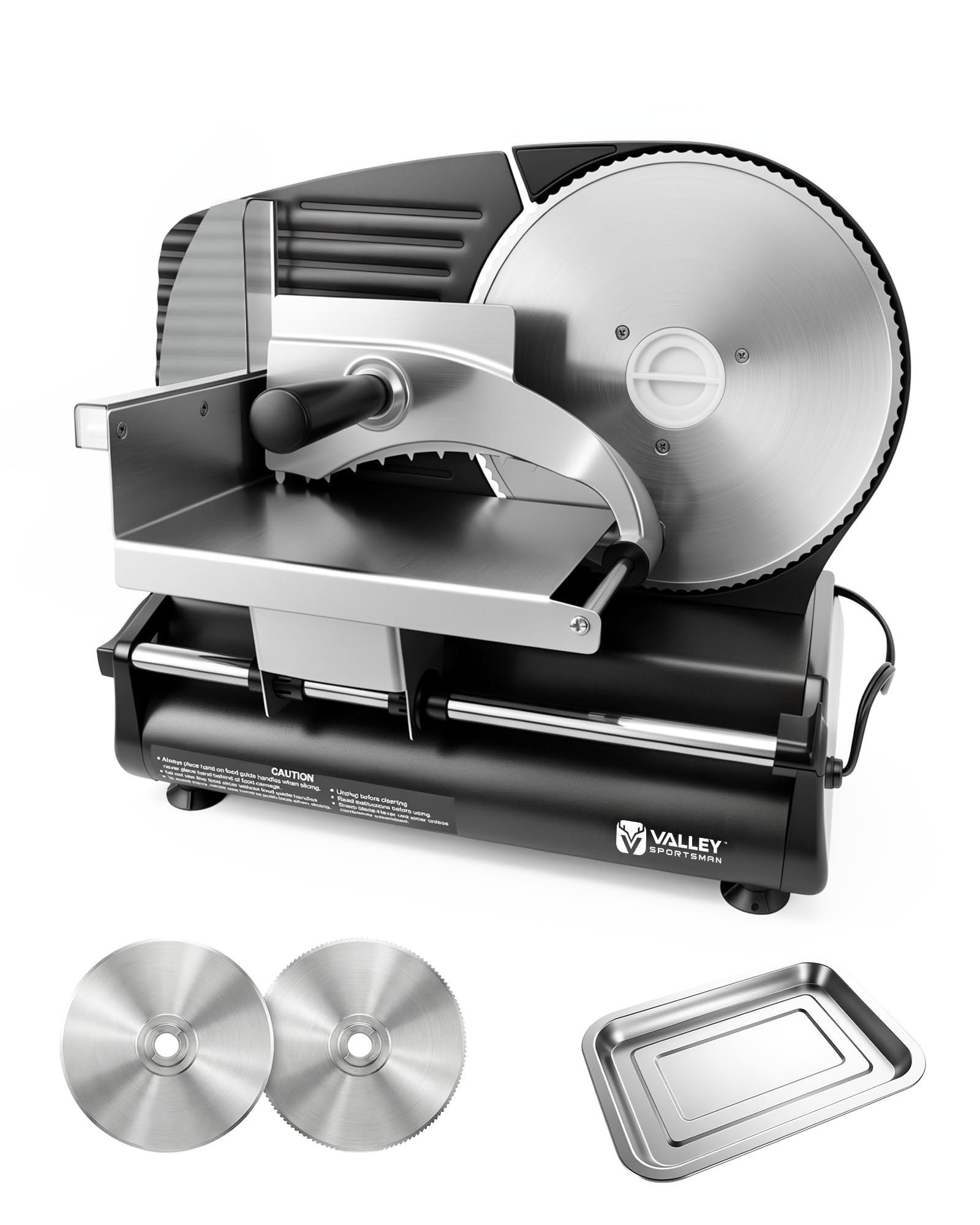
A sleek, sturdy machine that turns a roast into jerky slices in minutes.
The Valley Sportsman brings a dark black, corrosion-resistant stainless steel look to the countertop with two 8.7-inch blades. The 180-watt motor is the quietest nominal power in this lineup, but customers note it handles roasts “very efficiently” for jerky and deli prep. The 0-to-15 mm thickness dial lets you dial in everything from paper-thin to hearty slices. The non-slip base and fixed ring blade guard add a layer of safety that owners appreciate — the machine stays planted while you push food through.
Over a year of use, one owner calls it “durable and sturdy” for a first-time meat slicer. The quality and performance metrics both hit positive notes in the review data. Some buyers wish the thickness range went even thinner, and the cleaning process gets mixed feedback — the smooth surfaces wipe down easily, but the blade and carriage need careful attention to avoid meat residue buildup. The 180-watt motor is a step below the 200W DC units in torque, so thicker or denser cuts may slow it down more noticeably.
Who this fits: home cooks who want a mid-size machine with a wide blade and a premium look — the dark black finish is distinct from the sea of silver slicers.
The honest trade-off: at 180W, the motor has less grunt than the 200W DC machines above, so plan to keep your meat chilled (not frozen) for best results. Owners at one year report it holds up well, but the motor power is a genuine difference vs the Borlebbi or OSTBA.
6. KWS 10NS Commercial 10″ Electric Meat Slicer

A 37-pound, 320W belt-driven machine that chews through venison and cheese like butter.
The KWS 10NS is built for a different league of work. Its 320W belt-driven motor handles continuous slicing of meat, cheese, and semi-frozen products without slowing down — a true step above the 200W home machines. The 10-inch NSF-certified (certified by NSF International, a public health and safety organization) stainless steel blade resists rust and food-acid damage, and it holds its edge well under normal use. When it does need a touch-up, the built-in dual whetstone sharpener lets you refresh the edge without disassembly. The cast aluminum body and balanced design keep vibration and noise low despite the power.
The food tray accepts products up to 7 inches long by 7.5 inches wide by 5.5 inches high — large enough for whole roasts. The thickness dial adjusts from paper-thin to 14 mm, and owners confirm the setting stays consistent through a batch. But the trade-off is the size: at 20.1 inches wide, 18.5 inches deep, and 37 pounds, this is a permanent countertop resident, not a pull-from-the-cabinet tool. Cleaning requires unscrewing the blade — a process owners describe as thorough but time-consuming. Some note that meat can catch in the bottom, and thicker pieces may not fit the carriage. It is ETL listed (listed by Intertek for electrical safety) and comes from a U.S.-based company with replacement parts available.
What makes it a workhorse
- 320W belt-driven motor runs continuously without bogging down
- 10-inch NSF-certified stainless steel blade with built-in sharpener
- Cast aluminum body reduces vibration; quiet for the power output
- Owners rate quality as the top aspect — 131 mentions of solid build
What to plan for
- 37 pounds and 20 inches wide — needs permanent counter space
- Cleaning requires unscrewing the blade; more involved than home models
- Thicker pieces of meat may not fit the carriage opening
Reach for it if: you process game meat, run a small catering operation, or simply want a single machine that will outlast every other kitchen gadget — the 320W motor and 10-inch blade are in a different class from the home-tier options.
pass on it if: you slice a ham and a loaf of bread once a week — the cleaning routine and footprint are overkill for light home use.
7. BESWOOD 10″ Electric Deli Meat Slicer (Royal Red)
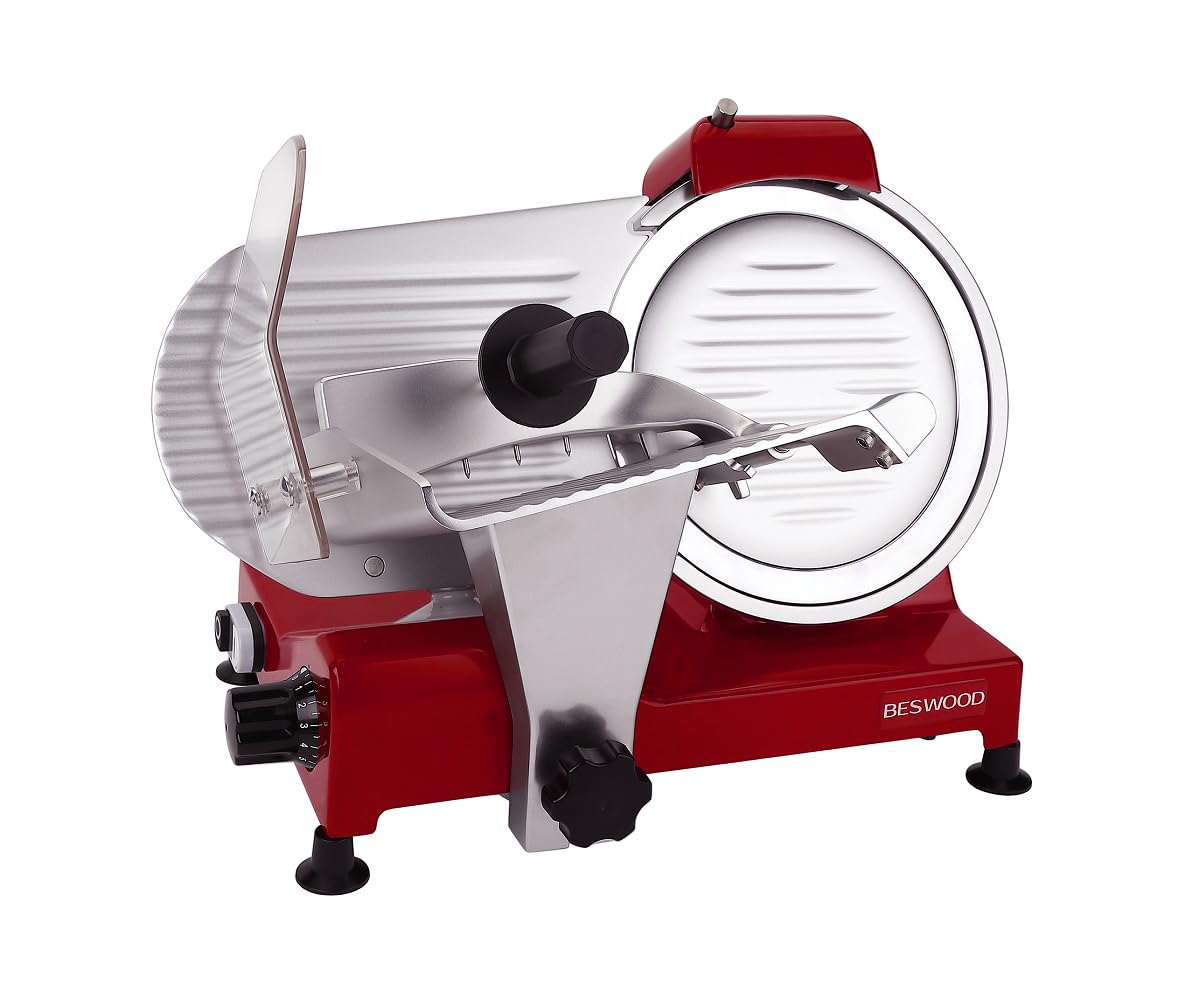
A quiet 240W slicer that delivers paper-thin cuts and a head-turning Royal Red finish.
The BESWOOD stands apart with its premium chromium-plated steel blade that resists corrosion and stays sharp without frequent sharpening. At 240W, the motor is quieter than you expect from a 10-inch machine — owners consistently describe it as “very quiet” while slicing everything from lunch meat to soft sourdough. The double illuminated on/off switch operates at 24V (volts, a measure of electrical pressure) to eliminate shock risk, a rare safety touch even in the premium tier. The removable serving plate is specifically designed for BESWOOD slicers, making collection and cleanup more convenient.
Reviewers point out it cuts paper-thin potato chips and paper-thin lunch meat with equal precision, and the thickness adjustment is easy to dial in. The blade, however, cannot be removed for cleaning — you have to wipe around it carefully, which owners describe as the main difficulty. The machine weighs 33 pounds and measures 20 inches wide, so it demands space and a strong shelf. The included plexiglass bread attachment and cleaning brush are thoughtful additions, but the non-removable blade means you will need hot vinegar water and patience for a thorough clean. For someone who wants commercial-grade results at home and doesn’t mind the cleaning trade-off, this is a beautiful, capable machine.
What owners rave about
- Quiet 240W motor with smooth, consistent slicing
- Chromium-plated steel blade resists corrosion and holds edge
- Cuts paper-thin slices of meat, bread, and even potato chips
- 24V illuminated switch for shock protection; ETL approved
The caveats to know
- Blade is fixed — cannot be removed for a full wash
- 33 pounds and 20 inches wide; needs permanent counter space
- Cleaning requires careful wiping rather than disassembly
Best for: the home cook who wants near-professional results — paper-thin, even slices — and values quiet operation and a striking design that stands out in the kitchen.
Think twice if: easy cleaning is your top priority. The fixed blade requires wiping in place, not a quick trip to the sink.
Understanding the Specs
Motor Type and Power
A DC motor (direct current — steady electrical flow) is quieter and delivers more consistent torque (twisting force) at lower speeds than a standard AC motor (alternating current — the more common household type). This matters when you are slicing through a semi-frozen roast without the machine laboring and slowing down. Power is measured in watts (W). For home use, 200W to 240W is the balance — enough force for cheese and meat without being overpowered. A 320W belt-driven motor, like the one in the KWS, is designed for continuous commercial or heavy home use where you run the machine for longer sessions without stopping.
Blade Size and Material
The blade diameter, measured in inches (7.5, 8.7, or 10), determines the largest piece of food you can feed through. A 10-inch blade accepts bigger roasts and taller loaves than a 7.5-inch blade — so you get fewer unusable end pieces. Blade material matters for longevity: stainless steel resists rust and staining, while high-carbon chromium-plated steel holds its edge longer and is less prone to corrosion. A serrated blade (with teeth) is better for bread and crusty items because it grips the hard surface; a non-serrated (smooth) blade works best for meat and cheese, giving you clean, even slices without tearing.
FAQ
Can an electric slicer cut through frozen meat?
How thick can an electric slicer cut?
Is it safe to use an electric slicer at home?
How do you clean an electric meat slicer?
What is the difference between a serrated and non-serrated blade?
Will an electric slicer fit on my countertop?
What foods can I slice with an electric slicer?
How long do electric slicer blades stay sharp?
Is a 200W motor enough for home use?
What is the warranty on electric slicers?
Final Thoughts: The Verdict
Across the board, the electric slicer winner is the Borlebbi 200W Meat Slicer because it combines a quiet DC motor, dual 7.5-inch blades, and a simple cleaning routine while still earning top marks from hundreds of owners. If you want a wider blade for larger roasts, grab the OSTBA with an 8.7-inch blade. And for heavy-duty commercial-grade performance that will last for years, the KWS 10NS or the BESWOOD Royal Red are the ones to reach for.
How We Picked
We do not accept paid placement. Every pick is matched to a real buyer and a real use-case; we do not hands-on test units.
Sources & Methodology
Specifications: manufacturer listings and product documentation. Review insights: verified customer reviews, as of July 2026. Pricing: not shown on this page (it changes often); check the current price via the retailer link.
As an Amazon Associate, WellFizz earns from qualifying purchases. This does not affect which products we feature.
Related Guides

Mo Maruf
I created WellFizz to bridge the gap between vague wellness advice and actionable solutions. My mission is simple: to decode the research and give you practical tools you can actually use.
Beyond the data, I am a passionate traveler. I believe that stepping away from the screen to explore new environments is essential for mental clarity and physical vitality.