Our readers keep the lights on and my smoothie glass nicely filled. As an Amazon Associate, I earn from qualifying purchases.
Specs are compiled from manufacturer listings and verified buyer reviews and can change over time — please confirm the key details on the product page before buying.
A dry basement starts with stopping groundwater before it reaches your foundation walls. That means stopping water before it reaches your foundation walls — and that takes a proper exterior waterproofing system. These systems block hydrostatic pressure (the force of groundwater pushing against your wall), prevent mold, and stop concrete cracks through a flexible membrane, a drainage mat, or both. Your ideal system depends on soil type, climate, and excavation depth.
I’m Mohammad Maruf — the founder and writer behind WellFizz. This guide is built by comparing the manufacturers’ published specifications and the patterns across verified customer reviews, so you get each pick’s real strengths and trade-offs instead of marketing spin.
The nine products here cover everything from a weekend DIY trench job to a commercial-grade below-grade wrap, so you can find the exterior foundation waterproofing systems that match your specific soil, climate, and budget.
Our Picks at a Glance

How To Choose The Best Exterior Foundation Waterproofing Systems
Choose your system by first assessing your water issue and excavation scope. A thin paint-on sealer where a dimple board is needed will leave you with a wet wall and wasted labor.
Liquid-Applied Membranes
You brush or roll a liquid rubber or asphalt emulsion coating onto the foundation after excavation. The key number is elongation percentage — how much the dried membrane stretches before tearing. A coating with 900% to 1200% elongation moves with the wall as temperatures shift and the house settles, so hairline cracks do not turn into leaks. DIYers favor these because they apply with a brush or roller and self-level into gaps.
Sheet Membranes and Dimple Mats
A dimple drainage mat or a peel-and-stick sheet creates a physical barrier between the soil and the foundation. The raised HDPE dimples form a continuous air gap that channels water downward to a drain tile or sump. Sheet membranes like self-adhesive rubberized asphalt offer extreme puncture resistance during backfill. Use dimple mats when hydrostatic pressure is high — the air gap relieves pressure so water never pushes against the wall.
Coverage and Dry Time
Liquid membranes cover a specific area per gallon. A typical exterior concrete wall might get 20 square feet per gallon for a 3- to 4-coat system, while an interior wall using the same material could see 50 square feet per gallon. Drying time between coats also matters — many water-based formulas need 12 to 24 hours depending on temperature and humidity. Schedule exterior application during a dry weather window.
Quick Comparison
| Model | Best For | Type | Elongation | Coverage Per Unit | Amazon |
|---|---|---|---|---|---|
| Liquid Rubber Foundation Sealant★ Best Overall | DIY brush-on exterior | Liquid Rubber | 900% | 20 sq ft/gal (exterior) | Amazon |
| Black Jack 6190 Liquid AsphaltBest Value | Budget large-area coating | Asphalt Emulsion | — | ~40 sq ft/gal (est.) | Amazon |
| Whitecap Dimple Drainage MattingTop Performer | High-pressure drainage gap | HDPE Dimple Mat | — | 100 sq ft / roll | Amazon |
| Meticuloso Waterproof Membrane | Thick shower & foundation underlayment | Polypropylene Sheet | — | 371 sq ft / roll | Amazon |
| Daich ElastoLock Waterproof Membrane | Multi-surface crack spanning | Liquid Rubber | — | ~100 sq ft/gal (approx.) | Amazon |
| Ames Blue Max Liquid Rubber | High-elongation total coverage | Liquid Rubber | 1200% | 640 fl oz / 5 gal pail | Amazon |
| MFM SubSeal40 House Wrap | Below-grade peel-and-stick | Rubberized Asphalt Sheet | — | ~9 sq ft / roll | Amazon |
| Delta-MS Foundation Waterproofing Mat | Professional dimple drainage | Polyethylene Dimple Board | — | 328 sq ft / roll | Amazon |
| LATICRETE 9235 Waterproofing Membrane | Tile & shower-specific systems | Liquid Rubber | — | 1 unit | Amazon |
In-Depth Reviews
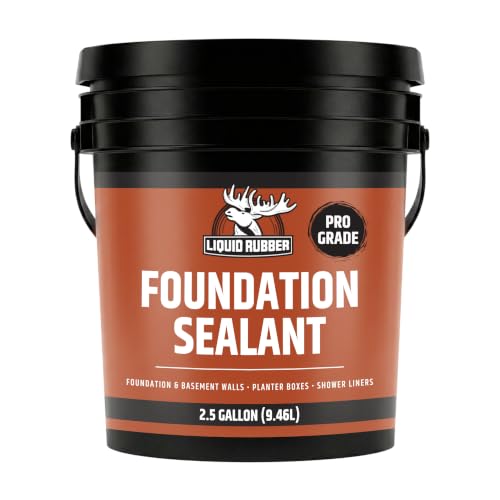
1. Liquid Rubber Foundation Sealant Basement Waterproof Sealer, Black, 2.5 Gal
Our pick — over 4.5★ from 3,000+ verified ratings; the strongest balance of quality and price.
The brush-on membrane that stretches 900% so your foundation moves without springing a leak.
This water-based liquid rubber dries to a flexible black membrane that stretches 900% — meaning when the ground freezes and thaws next winter, the coating moves with the wall instead of splitting open. The formula has zero VOCs (volatile organic compounds, the harsh chemicals that create strong fumes), so you can apply it in a tight trench or near an occupied basement without respiratory irritation.
Buyers who excavated 25 feet by 18 inches deep around their foundation, patched cracks, and applied four coats with a brush report zero leaks through heavy rain seasons. Coverage varies by surface: exterior concrete gets about 20 square feet per gallon with 3 to 4 coats, while interior walls cover 50 square feet per gallon with 2 to 3 coats. The product goes on brown and dries black, so you can see where you have already coated.
Downside — the tacky finish: Liquid Rubber stays slightly tacky when cured, so it is not suitable for walking surfaces — it is a membrane, not a floor coating. Also, the shipping company can damage the bucket in transit — one owner received a half-full pail — so inspect the seal upon delivery.
What wins people over
- 900% elongation prevents freeze-thaw cracking
- Zero VOCs (safe for indoor-adjacent application)
- Bonds to concrete, masonry, wood, and metal
- Easy brush or roller application with no mixing required
The honest trade-offs
- Remains tacky when dry — not a walkable surface
- Bucket can leak in transit; inspect immediately
- Exterior wall requires 3–4 coats for full protection
Reach for this if: you have an excavated foundation wall and want a DIY-friendly liquid membrane that stretches rather than cracks.
Think twice if: you need a hard, walkable surface or a peel-and-stick sheet for a fast backfill.
2. Black Jack 6190 Roof and Foundation Liquid Asphalt Coating, 5-Gallon Pail
The 45-pound bucket of asphalt that covered a 10×10 shed roof with a quarter left over.
Black Jack 6190 is a non-fibered asphalt emulsion (a water-based blend of asphalt particles that forms a waterproof film as water evaporates). At 45 pounds per bucket, the 5-gallon pail is the heaviest item in this lineup — at 45 pounds versus the Whitecap dimple mat at 11.32 pounds — but you get enough material to coat a 10-by-10-foot roof generously with about a quarter of the bucket left for touch-ups. It is odorless and solvent-free, so cleanup is soap and water.
Owners use it on concrete block foundations, wooden fence posts, metal surfaces, and flat garage roofs. One buyer reports it passed a foundation inspection with no issues. The coating dries to a deep black finish and remains slightly tacky — that permanent tackiness actually aids waterproofing by sealing pinholes, but it means boards stacked on top will stick together.
No elongation spec: Unlike the liquid rubber options above, Black Jack does not list an elongation percentage. It is a budget-friendly asphalt coating, not a high-stretch elastomeric membrane. If your foundation experiences significant soil movement, the Liquid Rubber Foundation Sealant above is a better fit.
Where it shines: Large-area coverage at a fraction of the cost of name-brand waterproofers. Buyers report the 5-gallon bucket covering a 10×10 roof with material to spare.
Where it falls short: The asphalt formula is not as flexible as rubber-based membranes, and the 45-pound bucket is heavy to haul around a job site.
Best for: coating large flat surfaces — shed roofs, concrete block walls, wood fences — where cost matters more than stretch rating.
Skip this if: you need a high-elongation membrane for an active crack-prone foundation.
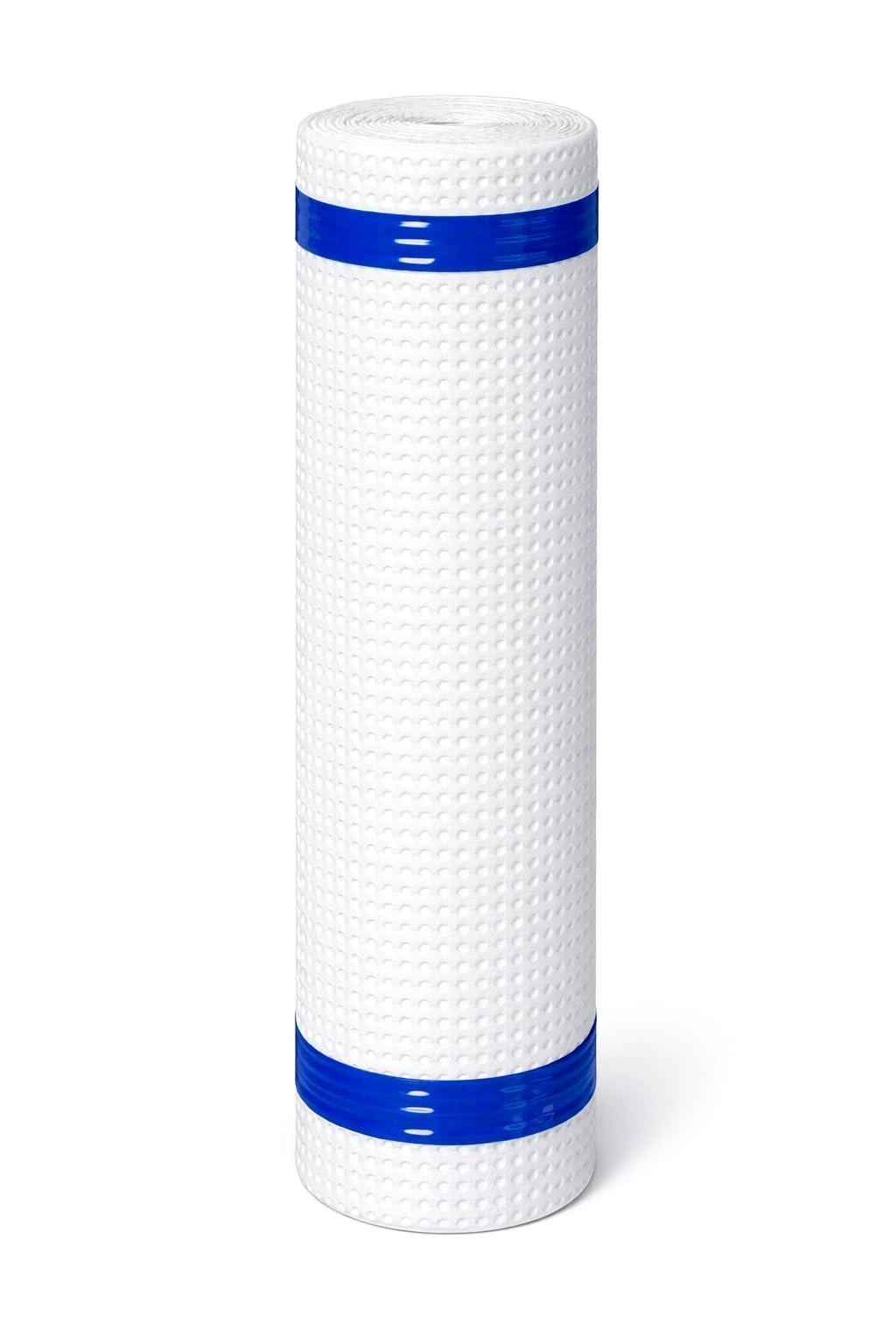
3. Whitecap Dimple Drainage Matting 2′ x 50′
The dimpled HDPE sheet that creates an air gap so hydrostatic pressure never touches your wall.
Raised dimples on this mat form a continuous air gap — a space between the soil and the foundation — that directs groundwater down toward a French drain or sump system instead of letting it press against the wall. The mat is made from HDPE (high-density polyethylene, a rigid plastic that resists punctures from rocks during backfill). At 11.32 pounds per roll, it is dramatically lighter than the 45-pound asphalt bucket above, making it far easier to maneuver in a crawl space or trench.
Buyers consistently call out the build quality as the standout feature. One owner says it “protects expensive 20 mil very well, highly recommended.” The material cuts easily with scissors or a utility knife, and you can join sections by butting them together or using tape. The dimples also add a cushioning effect — when you kneel on the mat after installation in a crawl space, it is noticeably more comfortable than bare dirt.
No liquid sealant: This is a drainage mat, not a waterproof coating. It works best as part of a complete system: mat against the wall, vapor barrier over the dirt, and a drain tile at the base. It does not seal the wall itself — it channels water away.
Its biggest strength: The dimple gap relieves hydrostatic pressure — the most common cause of wet basement walls — by giving water a path to the drain.
Its honest limit: It is a drainage solution, not a sealant. You still need a waterproofing membrane or coating on the wall behind the mat for complete protection.
Best for: crawl space encapsulation and foundation drainage projects where soil pressure is the primary water source.
Not enough if: your foundation has active cracks that need sealing first — pair this with a liquid membrane.
4. Upgraded Waterproof Membrane Thickened 23.6 mils 3.77ft x 98.5 ft
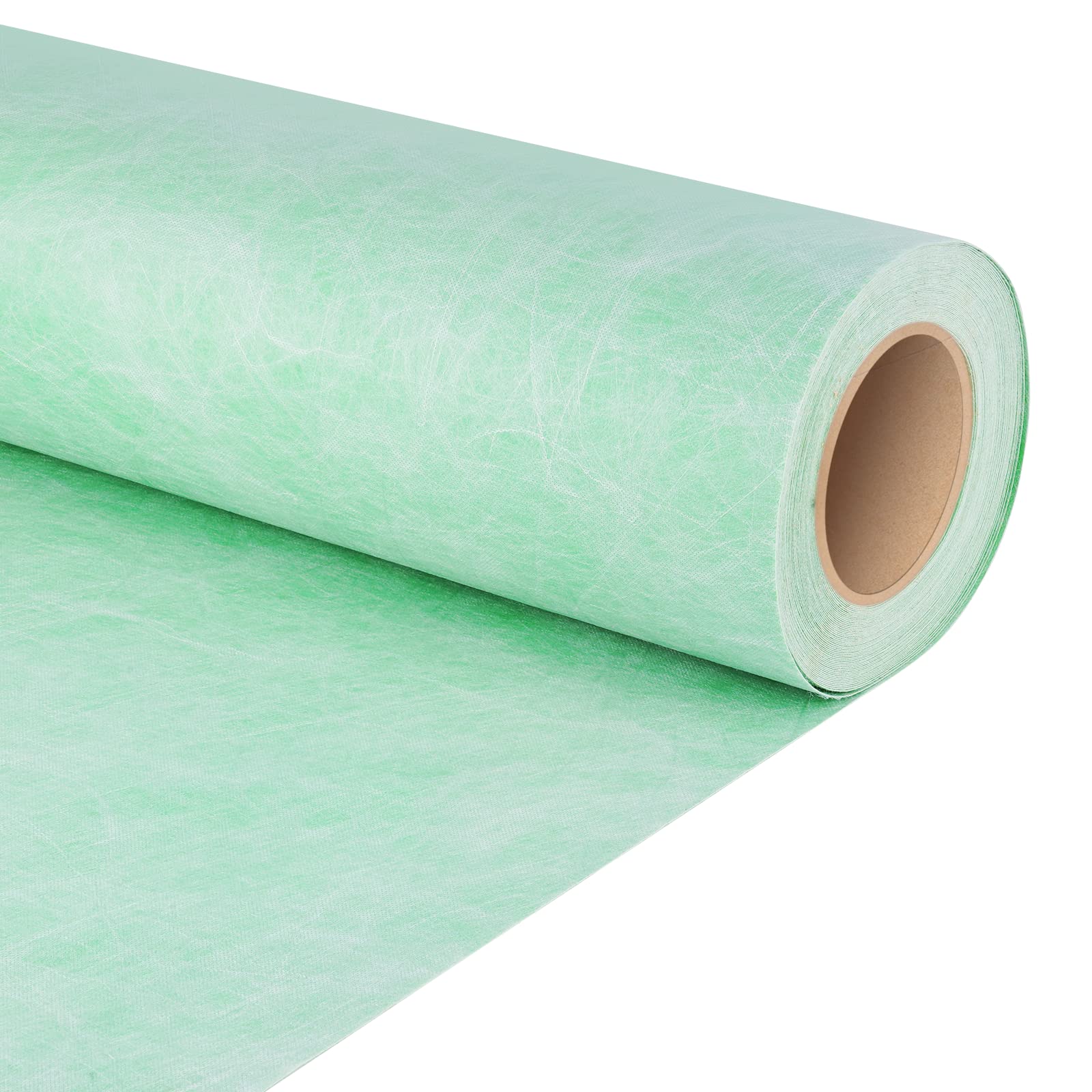
A 23.6 mil thick polypropylene sheet that covers 371 square feet in one unbroken roll.
This membrane is 23.6 mils (0.6 mm) thick — thicker than many generic shower pan liners — and comes in a single roll spanning 3.77 feet by 98.5 feet. It is made from polypropylene, a plastic that resists tearing and bending without cracking. While it is marketed primarily for shower walls, bathrooms, and wet rooms, the material works equally well as an underlayment for foundation waterproofing because it is waterproof by composition rather than by a chemical cure.
Buyers who used it in tiled showers call it “heavy duty and much cheaper than Schluter” (a well-known tile membrane brand). The roll is easy to cut to any shape with a utility knife, and you simply lay it into a bed of thin-set mortar. Because it is a physical sheet rather than a liquid, there is no drying time between coats — one application is the full system. At 30.4 pounds per roll, it is manageable for one person to carry.
Adhesion concerns from one buyer: A single review noted conflicting advice on mortar type (unmodified vs. modified) and that the membrane is not recommended for installation over wood or drywall — only cement board. This is a niche issue for shower installs, but note if you are using it as a foundation underlayment rather than a direct wall coating.
What owners love
- 23.6 mil thickness provides strong puncture resistance
- Covers 371 sq ft in a single roll — fewer seams to seal
- Easy to cut and install in mortar beds
What to watch
- Not recommended over wood or drywall — only cement board
- Primarily designed for interior wet areas, not direct soil contact
Pick this if: you want a thick, no-dry-time sheet for a basement underlayment or shower waterproofing project.
Look elsewhere if: you need a direct-to-foundation coating that bonds to concrete without thin-set mortar.
5. Daich ElastoLock Waterproof Membrane Coating 1 Gallon
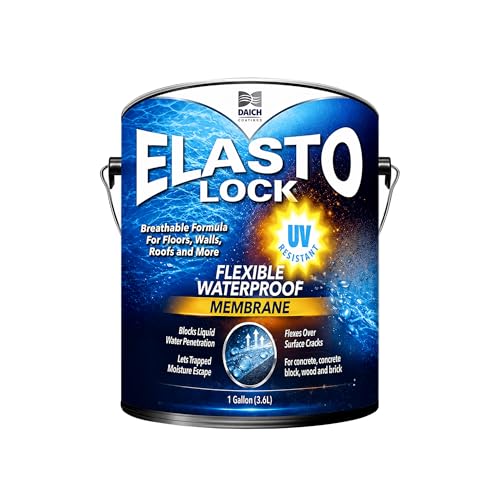
A roll-on rubber membrane that bridges cracks across concrete, wood, drywall, and primed metal.
Daich ElastoLock bonds to an unusually wide range of surfaces — concrete, wood, primed metal, drywall, plastic, and fiberglass. The formula stays flexible in low temperatures, so it moves with the substrate during freeze-thaw cycles rather than cracking. It applies with a brush, roller, or sprayer, and because it is water-based, cleanup is simply soap and water.
Owners mention using it to fill gaps between cinder block and plywood, to seal a custom PVC-to-porcelain drain connection, and to coat exterior foundation cracks from both inside and outside. One owner notes that the coating is thick and smooth, covering nail heads and small cracks without adhesion issues even on dusty surfaces. The 1-gallon size weighs 13 pounds and is easy to handle for small-to-medium foundation repairs.
Packaging weak point: One unit arrived with the lid off, causing a messy spill in the box. The product itself is praised for its build quality, but Amazon packaging can be inconsistent. Also, the dried coating is hard to wash off hands — wear gloves.
Why it stands out: The multi-surface adhesion — it sticks to wood and plastic as readily as it does concrete — makes it a go-to for hybrid foundation repairs that involve multiple materials.
Where it is limited: At 1 gallon, this is for targeted crack repairs and small foundation sections, not for coating an entire excavated basement wall in one go.
Reach for this when: you have a mixed-material foundation (concrete touching wood framing or metal posts) and need a single coating that bonds to all of them.
skip it if: you need to cover hundreds of square feet — buy the 5-gallon pail options instead.
6. Ames Research Laboratories BMX5RG Blue MAX Waterproofer, 5 Gallon

The 1200% elongation liquid rubber that expands more than any other coating here without cracking.
This is an elastomeric liquid rubber — it behaves like a rubber band when dried — and it sticks to concrete, wood, and metal. The 5-gallon pail provides 640 fluid ounces, and the coating can be brushed, rolled, or sprayed on vertical or horizontal surfaces. Its 1200% elongation is the highest in this guide, meaning it stretches twelve times its original length, even more than the Liquid Rubber Foundation Sealant (900%).
Buyers praise its sealing performance on leaky basements and below-grade foundations. One owner describes it as a durable coating that supports underlayment cement board, while another applied two coats on a crack in a tub and reports zero leaks. The formula is non-toxic and VOC-compliant in all 50 states, which matters if you are working in a confined excavation near living space. The brand is a veteran-founded company based in the USA.
Slow drying and strong odor: Despite being non-toxic, the product has a noticeable smell, and one buyer reports it stayed tacky for over four days even in 95°F heat, contradicting the label’s 4-hour claim. The blue color also requires extra coats for full coverage compared to black membranes, because the pigment is less opaque.
What makes it a top choice
- 1200% elongation — best-in-guide flexibility for shifting foundations
- Non-toxic and VOC-compliant nationwide
- Sprayable for large-project speed
Honest drawbacks
- Odor is strong despite being VOC-free
- Dries slowly in cool or humid weather — plan for 24+ hours between coats
- Blue pigment needs extra coats for uniform coverage
Best suited for: large-area exterior foundation work where soil movement is a real concern and you need the highest possible elongation.
Less ideal for: quick one-day jobs — the drying time demands patience, and the odor is noticeable for hours.
7. MFM SubSeal40 Waterproof House Wrap – 40 mil (36in.)

A self-adhesive 40-mil rubberized asphalt sheet that seals below-grade walls with no mixing or drying.
MFM SubSeal40 is a 40-mil (0.040 inches) thick rubberized asphalt membrane with a peel-off backing — you stick it directly to the foundation wall, overlap the edges, and backfill. There is no liquid, no roller cleanup, and no waiting for coats to dry. The outer film is compatible with most construction sealants, so you can caulk the edges for an extra-tight seal. The rubberized asphalt formula is designed to not crack or dry out over time, even in direct soil contact.
Owners use it for cinderblock walls below ground level, sealing areas exposed to heavy rain and snow. One buyer who could not locate a specific water leak on a cinderblock wall covered the entire area with this membrane and reports no more water ingress. The membrane self-seals around fastener penetrations, which prevents leaks at nail or screw holes. Some buyers have purchased it multiple times in different sizes for ongoing projects.
Dust kills adhesion: The self-adhesive backing is extremely sticky — but if any dust or dirt gets on the adhesive before it hits the wall, it will not bond properly. Surface prep needs to be immaculate: clean, dry, and dust-free. Also, installation is awkward for one person because the sheet is stiff and heavy for its size.
Its standout feature: Zero drying time — peel, stick, and backfill the same day. No waiting 24 hours between coats like liquid membranes.
The catch: Any dust on the adhesive compromises the bond, so you must wire-brush and clean the wall thoroughly before application.
Ideal for: a fast backfill situation where you cannot wait for liquid membrane drying times.
Not for: rough, dirty, or damp wall surfaces where perfect adhesion is impossible.
8. Delta-MS 5 ft x 65.6 ft (328 SqFt/Roll) Brown Foundation Waterproofing Mat

The 5-foot-wide dimple board from Cosella Dorken that survived 4.5 inches of rain in 32 hours with zero leaks.
Delta-MS is a polyethylene dimple board that is 5 feet wide — significantly wider than the Whitecap mat above — so each roll covers 328 square feet. The 5-foot width reduces the number of horizontal seams you need to seal along a tall foundation wall. The dimples create an air gap for water drainage, just like the Whitecap mat, but the Delta-MS is from Cosella Dorken, a well-known name in below-grade waterproofing.
One buyer used this on a 110-foot run of 4-foot-high stone foundation, then installed it on a 60-foot run of 9-foot wall with a 12-inch overlap and Delta Seal flashing. A 4.5-inch rainfall over 32 hours produced no leaks. Another owner ran it down a basement wall across the footing and over gravel as part of an interior drain tile system, and reports that heavy rainfall no longer causes water issues — the hydrostatic pressure cannot push water through the concrete.
Requires fasteners and sealant: This is not a self-adhesive product. You need Tapcons (concrete screws), Delta Seal (a sealant tape for seams), and cleats to secure the board. The material is durable polyethylene, so it will last, but the installation hardware adds to the total cost and labor time.
Why contractors choose it
- 5-foot-wide roll means fewer seams on tall walls
- Proven performance under extreme rainfall (4.5 inches)
- Attractive brown finish that looks clean in exposed applications
Installation considerations
- Requires mechanical fasteners and seam tape — not peel-and-stick
- Higher initial investment than liquid-only solutions
Choose this for: a serious below-grade foundation project where water pressure is extreme and you want proven dimple drainage from a trusted brand.
Not the simplest pick if: you need a quick one-person install — this system demands fasteners, sealant, and careful planning.
9. LATICRETE 9235 Waterproofing Membrane Full Unit

The liquid rubber membrane from a globally proven brand that remodeling companies trust for shower and foundation work.
LATICRETE 9235 is a liquid rubber membrane designed for tile-ready waterproofing in showers, wet rooms, and foundation applications. It is the only product in this guide with a tile-compatible surface recommendation built into its spec sheet. The black liquid cures to a flexible rubber layer that you can tile directly onto, making it a dual-purpose system: it waterproofs the foundation or shower substrate while also serving as a crack isolation membrane under tile.
One remodeling company used 9235 to fix a drainage and water infiltration problem caused by improper grading around a foundation. They applied it with stone drainage channels, and a customer who had lived with water ingress for ten years reported zero water intrusion after the fix.
Mixed consistency feedback: One buyer reports that the product arrived “half baked” — partially cured or separated — which affected performance. This is an isolated issue but worth flagging because LATICRETE is otherwise a premium brand with strict quality control. If you receive a compromised unit, the brand suggests contacting the manufacturer immediately.
Why professionals reach for it: LATICRETE’s globally proven construction formulations and the ability to tile directly onto the cured membrane make this a dual-purpose waterproofing and tile underlayment solution.
The risk: An occasional unit may arrive with consistency issues — inspect the liquid upon delivery before starting the job.
Best for: a combination project — waterproofing a foundation wall that will also receive tile or stone cladding.
Overkill if: you only need a simple below-grade membrane with no tile bonding requirement — simpler options cost less.
Understanding the Specs
Elongation Percentage
This is the most important number for a liquid-applied membrane. It tells you how far the dried coating can stretch before tearing. A coating with 900% elongation stretches nine times its original length, which means it moves with the foundation as the soil freezes, thaws, or settles. Anything below 500% is risky for exterior below-grade use in cold climates. The Ames Blue Max leads this guide at 1200%, while the Liquid Rubber Foundation Sealant holds at 900%.
Dimple Mat Air Gap
A dimple drainage mat creates a physical air space — typically 8 mm to 12 mm deep — between the soil and the foundation wall. This gap relieves hydrostatic pressure, which is the force of groundwater pushing against the wall surface. Without that gap, water pressure can force moisture through hairline cracks in the concrete. The Whitecap and Delta-MS dimple mats both use this principle, but the Delta-MS (at 5 feet wide) reduces the number of seams you need to seal on tall walls.
FAQ
Can I apply a liquid waterproofing membrane over damp concrete?
How deep do I need to excavate to apply exterior waterproofing?
What is the difference between a dimple mat and a liquid membrane?
How long does a liquid-applied waterproofing membrane last?
Can I use exterior foundation waterproofing on interior walls?
Do I need to use a primer before applying a liquid membrane?
How many coats of liquid rubber do I need on an exterior foundation wall?
Will a dimple mat alone stop basement leaks?
Final Thoughts: The Verdict
For the majority of shoppers, the exterior foundation waterproofing systems winner is the Liquid Rubber Foundation Sealant because its 900% elongation, zero-VOC formula, and straightforward brush-on application make it the most DIY-friendly full-coverage membrane that actually stretches with your foundation. If you want the highest elongation rating in the lineup and need
Related Guides

Mo Maruf
I created WellFizz to bridge the gap between vague wellness advice and actionable solutions. My mission is simple: to decode the research and give you practical tools you can actually use.
Beyond the data, I am a passionate traveler. I believe that stepping away from the screen to explore new environments is essential for mental clarity and physical vitality.