Our readers keep the lights on and my smoothie glass nicely filled. As an Amazon Associate, I earn from qualifying purchases.
Specs are compiled from manufacturer listings and verified buyer reviews and can change over time — please confirm the key details on the product page before buying.
You want that faraway bird, the moon in full crater detail, your kid’s goal from the bleachers — without hauling a massive DSLR kit. You want one camera that does both the wide landscape and the super-telephoto shot. That’s the promise of a bridge camera: a fixed-lens superzoom that mimics the feel and control of a DSLR but keeps everything in one body. The catch is that the specs get dense, and not every model handles low light the same way.
I’m Mohammad Maruf — the founder and writer behind WellFizz. This guide is built by comparing the manufacturers’ published specifications and the patterns across verified customer reviews, so you get each pick’s real strengths and trade-offs instead of marketing spin.
We have sorted through the options to find the most capable dslr like bridge cameras that let you zoom like a pro without needing to switch lenses or empty your savings.
Our Picks at a Glance


How To Choose The Best DSLR Like Bridge Cameras
A bridge camera is the middle ground between a point-and-shoot and a full DSLR. It has a fixed lens with a huge zoom range, meaning you never have to swap lenses. This makes it ideal for travel, wildlife, sports, and anyone who wants versatility without the bulk and cost of interchangeable lenses. Your decision hinges on three key specifications.
Optical Zoom: The defining spec of this category
Optical zoom is the defining spec of this category. A higher optical zoom (like 125x) brings distant subjects incredibly close, but it also adds weight and requires more care when shooting handheld. Lower zoom cameras (around 40x) are lighter, cheaper, and easier to stabilize, but you will not catch a bird at 300 yards.
Sensor and Megapixels: Sensor size and megapixels determine image quality.
Most bridge cameras use a small 1/2.3-inch sensor. A higher megapixel count (like 20MP) is not always better — a small sensor with high megapixels can produce noise in low light. The best bridge cameras balance a decent sensor with good processing. The Leica uses a much larger 1-inch sensor, which gives it a major advantage in image quality, especially in dim conditions.
Image Stabilization: Image stabilization is essential for sharp telephoto shots.
At max zoom, even the slightest hand shake looks like an earthquake in your viewfinder. Good optical image stabilization (OIS) or vibration reduction (VR) is not optional — it is essential. Without it, you will need a tripod for every shot beyond 20x zoom. The Nikon P1000 has Dual Detect VR, while the Panasonic FZ80D uses Power O.I.S., and both are praised by owners for keeping shots steady.
Quick Comparison
| Model | Best For | Optical Zoom | Megapixels | 4K Video | Amazon |
|---|---|---|---|---|---|
| Nikon COOLPIX P1000★ Best Overall | Best Overall / Extreme Reach | 125x | 16 MP | Yes | Amazon |
| Nikon COOLPIX P950Top Performer | Premium Wildlife/Birding | 83X | 16 MP | Yes | Amazon |
| Nikon COOLPIX P1100 (Bundle)Latest Generation | Latest Extreme Zoom Bundle | 125x | 16 MP | Yes | Amazon |
| KODAK PIXPRO AZ528 | Budget with Wi-Fi | 52X | 16 MP | No (1080p) | Amazon |
| Kodak Pixpro AZ425 | Value Bundle / Beginners | 42x | 20 MP | No (1080p) | Amazon |
| MINOLTA MN40Z (Black) | Family Bundle Starter | 40x | 20 MP | No (1080p) | Amazon |
| Panasonic LUMIX FZ80D | Budget 4K Superzoom | 60X | 18.1 MP | Yes | Amazon |
| Canon PowerShot SX740 HS | Compact Travel Zoom | 40x | ~21.1 MP | Yes | Amazon |
| Leica V-LUX (Typ 114) | Best Image Quality / Premium Compact | 16x | 20 MP | Yes (3840×2160) | Amazon |
In‑Depth Reviews
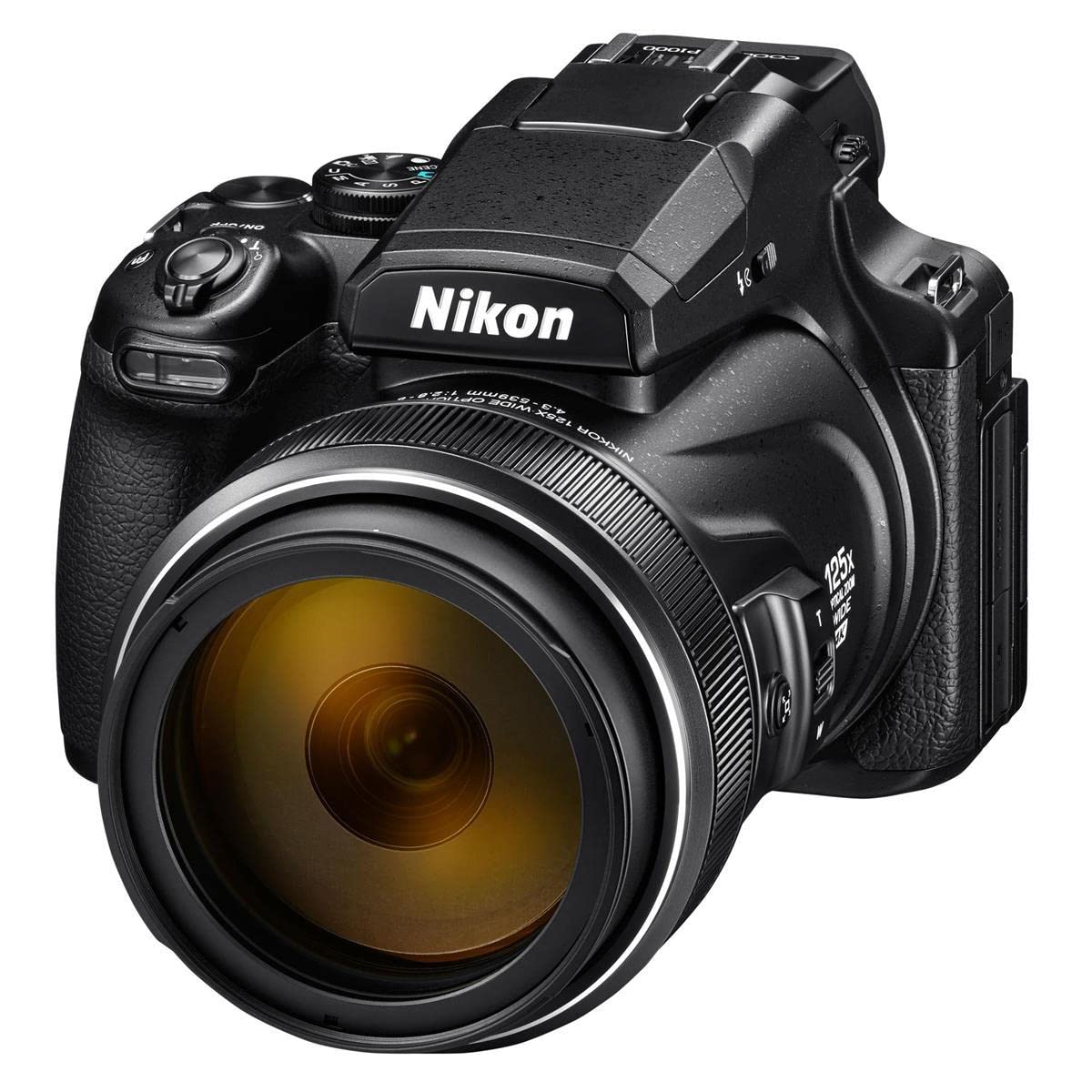
1. Nikon COOLPIX P1000 Superzoom Digital Camera
Our pick — 4.5★ from 700+ verified ratings; the strongest balance of quality and price.
The Nikon P1000’s 125x zoom turns distant specks into frame-filling portraits.
The Nikon P1000 is the absolute ruler of optical zoom in the bridge camera world. Its 125x optical zoom hits a staggering 3000mm (35mm equivalent), meaning you can shoot the moon’s craters or a bird at 200 yards with stunning clarity. It shoots 4K Ultra HD video, has RAW format support for serious editing, and features Dual Detect image stabilization to keep those extreme telephoto shots steady. Owners consistently rave about the quality and zoom — the image quality and zoom are the two most-praised aspects of this camera.
The trade-off is size and weight. At over 3.3 lbs, buyers report that the camera is “heavy (3.3 lbs), poor weight distribution for strap/tripod.” It is not a casual carry-around camera. The autofocus also struggles at the very end of the zoom range, and the small sensor means low-light performance is limited. This is the camera for the dedicated birder, wildlife enthusiast, or moon photographer who wants the absolute maximum reach available without a lens.
The P1000 leads on resolution depth with 14-bit color compared to the 8-bit of many budget competitors, which gives your images richer gradations. It has 100 autofocus points, compared to the KODAK AZ405’s 25-point system. The P1000’s 125x optical zoom compared to the AZ405’s 40X zoom — a difference that means seeing a feather detail versus just seeing a bird.
What gets the praise
- class-leading 125x optical zoom reaches things no other bridge camera can touch.
- RAW format and 14-bit depth give serious control over final images.
- 4K video and accessory hot shoe expand creative options.
The honest trade-off
- Very heavy (3.3 lbs) and bulky; needs a good strap or tripod.
- Small sensor limits low-light performance despite the 16 MP count.
- Autofocus can hunt at extreme max zoom distances.
This camera offers the ultimate reach. This is your camera if you must shoot the moon, a bird at 300 yards, or distant wildlife without a massive lens investment.
skip it if: You plan to hike all day or need a camera that fits in a small bag — its weight and bulk are real.
2. Nikon COOLPIX P950
If you shoot wildlife, you need a camera that reaches far without weighing you down—this one balances a 42x optical zoom with a compact body you can carry all day.
The Nikon P950 is the little sibling of the P1000, and for many, it is the better choice. With an 83x optical zoom reaching 2000mm, it still packs incredible reach but is lighter and easier to handle. The built-in Bird and Moon modes are not gimmicks — owners use them constantly. The “Bird mode” is praised for being “amazing at 300-400 yards.” It records 4K UHD video and has both Wi-Fi and Bluetooth for easy image transfer. Quality is the most mentioned positive aspect, with picture quality and zoom close behind.
The main trade-off is the autofocus. While the image stabilization is great for handheld shooting, the auto-focus can struggle and “often fails on zoomed birds,” according to experienced users. The manual focus wheel on the lens is a welcome improvement over older models. It is also not cheap, but it sits at a more accessible price point than the P1000. This is the pick for the serious birder or sports fan who wants maximum zoom without the P1000’s extreme bulk.
The P950 is the birder’s choice. The P950’s 83x zoom with dedicated Bird and Moon modes makes it the top pick for wildlife without the extreme weight of the P1000.
Autofocus caveat: While great in good light, the contrast-detection autofocus can be frustrating at full zoom; plan to use manual focus for critical shots.
Yes, if you shoot wildlife daily: It is one of the best dedicated birding tools under.
Pass if you need fast action capture: The autofocus is not fast enough for birds in flight or fast sports.
3. Nikon COOLPIX P1100 Bundle
The newest king retains the throne of extreme zoom with improved handling.
The Nikon COOLPIX P1100 is the latest iteration of the iconic super-zoom, keeping the same 125x optical zoom (24-3000mm) that made the P1000 famous. It pairs this with a 16MP BSI CMOS sensor for better low-light performance, a 3.2-inch vari-angle LCD, and a 2.36M-dot electronic viewfinder. It shoots 4K UHD video at 30fps and supports Clean HDMI output. The bundle includes two 64GB memory cards, extra batteries, a charger, and a padded bag. Camera quality is the single most-praised aspect, with buyers describing it as “great for birding and butterflies.”
The honest feedback from owners is that the bundle’s extras are not all top-tier. Several note that “all the extra stuff isn’t necessary” and that the included generic batteries drain quickly compared to Nikon branded ones. The SnapBridge app also has issues, forcing manual downloads via a card reader. If you love the idea of the P1000’s reach but want the latest model, the P1100 is it — but consider buying the camera body alone and skipping the bundle.
The P1100’s hybrid autofocus with 179 points is a significant step up from the P1000’s 100-point contrast detection, potentially offering quicker lock-on.
What wins people over
- 125x optical zoom with 3000mm reach is top-tier.
- Hybrid autofocus (179 points) improves on the P1000.
- 4K video with clean HDMI output for external recording.
The trade-off
- Bundle batteries are generic and short-lived; buy the camera alone.
- SnapBridge app for transfer is finicky; card reader is more reliable.
- Very heavy and bulky lens barrel.
For the raw reach: The P1100 is the ultimate tool for extreme distance photography, period.
Skip the bundle: Most owners suggest buying just the camera body, as the included accessories are not worth the premium.
4. Leica V-LUX (Typ 114) Digital Camera
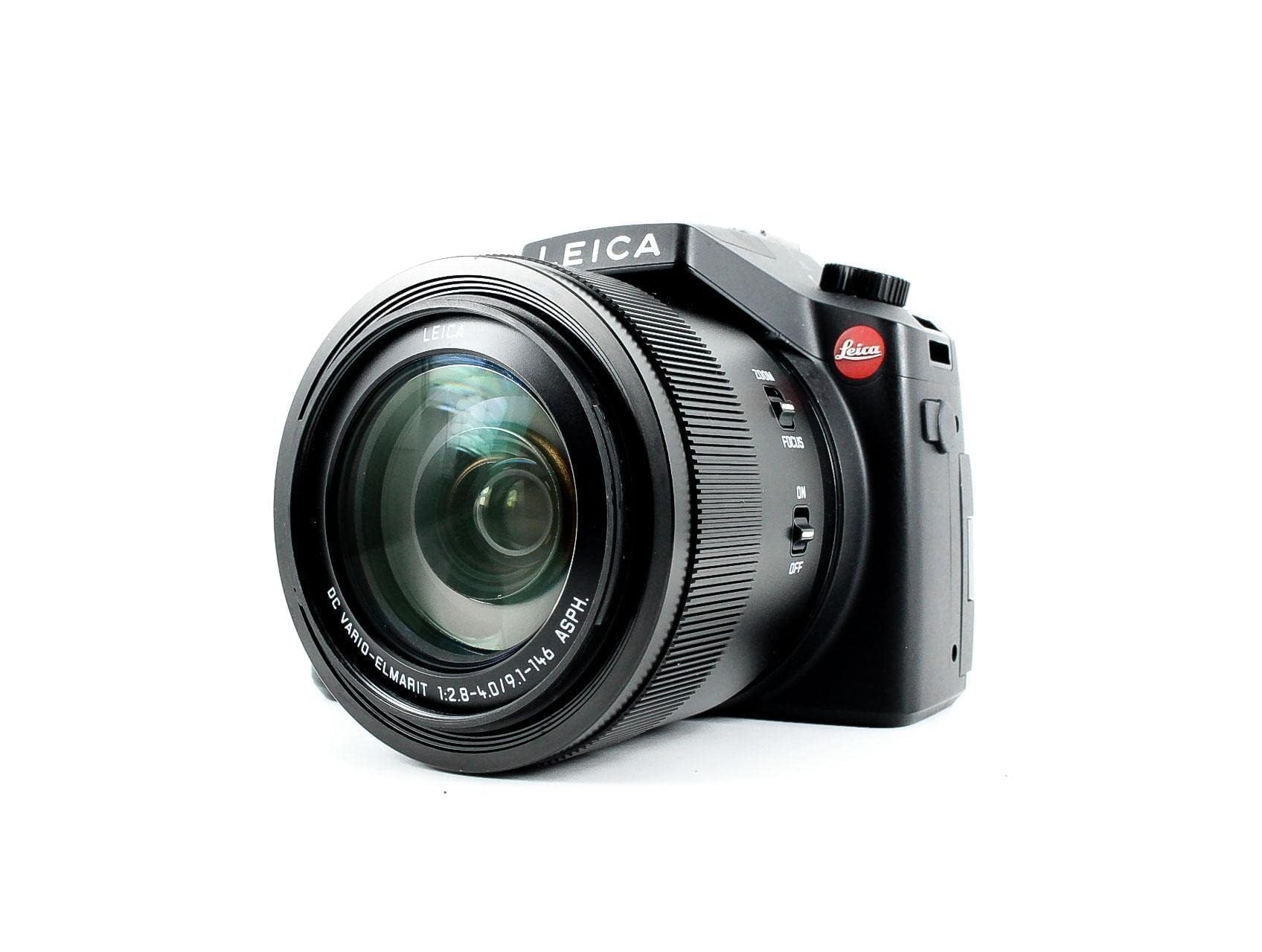
The only bridge camera that combines a large sensor with a legendary red dot.
The Leica V-LUX (Typ 114) is the outlier on this list, and for a good reason. It is the only camera here with a large 20MP 1-inch MOS sensor — roughly four times the surface area of the small 1/2.3-inch sensors used in every other camera on this list. This gives it a massive advantage in image quality, dynamic range, and low-light performance. It pairs this with a Leica DC VARIO-ELMARIT f/2.8-4.0 lens (25-400mm equivalent, 16x optical zoom), a 3-inch rotatable LCD, and UHD 4K video. The electronic shutter lets it shoot at up to 50 frames per second.
The catch, and it’s a big one, is the zoom range. At only 16x, it cannot compete with the 83x or 125x of the Nikon cameras for extreme reach. It also lacks the extreme telephoto of a dedicated birding camera. Some reviewers have pointed out that it is essentially identical to the Panasonic FZ1000 II, with a “red LEICA badge” commanding a premium. It is a camera for image quality first, zoom second. If you value sharpness and clean files at moderate zoom, this is the one. If you need to shoot a deer at 300 yards, it is not.
The image quality king: The 1-inch sensor paired with a Leica f/2.8-4.0 lens delivers far superior low-light performance and sharpness than any superzoom competitor.
Limited reach: The 16x optical zoom (400mm) is modest compared to 83x and 125x models, making it unsuitable for extreme wildlife photography.
Reach for this if: Image quality is your priority, you shoot in moderate light, and you want a compact Leica optic.
Look elsewhere if: You need to photograph tiny birds 100 yards away — this camera cannot see that far.
5. Panasonic LUMIX FZ80D

The budget-friendly superzoom that packs 4K video into a lightweight body.
The Panasonic LUMIX FZ80D is a strong contender for anyone who wants 4K video and a solid 60x optical zoom (20-1200mm equivalent) without spending a fortune. It features an 18.1MP 1/2.3 MOS sensor, Power O.I.S. (Optical Image Stabilization) to suppress hand shake, and a high-resolution 2,360K-dot OLED Live Viewfinder. A standout feature is Post Focus — you can touch the area you want in focus *after* you take the shot, saving blurry misses. It also includes a 4K Photo mode to extract 8-megapixel stills from 4K video. The contrast detection autofocus has 39 points.
Where it falls short is low light and connectivity. The small sensor produces noisy images in dim conditions. It also lacks built-in Wi-Fi, which means you must use a memory card reader to download photos. The interface is also described by some owners as “unintuitive.” This camera is perfect for daytime wildlife, macro photography, and budget-conscious vloggers, but its image quality and lack of Wi-Fi are honest drawbacks.
Why it stands out
- 4K Photo mode and Post Focus are unique, very useful features.
- 60x optical zoom (1200mm equivalent) for under.
- Lightweight and easy to carry on a hike.
Where it cuts corners
- No built-in Wi-Fi — you need a cable or card reader to transfer files.
- Poor low-light performance; stick to daytime shooting.
- Interface is less polished than Nikon or Canon competitors.
For the budget-conscious zoomer: It is the cheapest way to get 4K video and a long zoom in a single, light package.
Not for low light: If you shoot indoors, at dawn, or dusk, the small sensor will disappoint you.
6. Canon PowerShot SX740 HS

The pocket-sized superzoom that slides into a jacket with a 40x reach.
The Canon PowerShot SX740 HS is all about portability. Weighing just 299g (the lightest camera on this list, about as heavy as a mug of coffee) with dimensions of 110.1×63.8×39.9mm, it is the most pocketable superzoom here. It packs a 21.1MP sensor with a DIGIC 8 image processor, a 40x optical zoom (24-960mm equivalent), and 4K video. It shoots at up to 10 frames per second continuous shooting, and the 3.0-inch tilt LCD is great for low-angle or selfie shots.
The trade-off for the compact size is zoom speed and grip. The 40x zoom is versatile but not extreme. It has a variable aperture of f/3.3-6.9, which will struggle in low light at the tele end. The autofocus uses phase detection with only 1 point. It includes Wi-Fi and Bluetooth for easy image transfer. This camera is best for the travel photographer who wants a “do it all” compact camera without carrying a DSLR body. One reviewer called it a “great camera, great price” for its combined portability and zoom.
The travel companion: Weighing only 299g with a 40x zoom, 4K video, and a tilt screen, it is the ultimate pocketable superzoom for trips.
Zoom is moderate: The 40x zoom is about half the reach of the Nikon P950, making it weaker for distant wildlife.
Yes for travel: It is the smallest, lightest way to get a 40x zoom and 4K video in your pocket.
No for extreme reach: The 960mm max focal length is not enough for serious birding.
7. KODAK PIXPRO AZ528

The budget bridge camera with a long lens and Wi-Fi for instant sharing.
The KODAK PIXPRO AZ528 is a strong entry-level bridge camera. It offers a 52x optical zoom (24mm wide-angle to tight telephoto), a 16MP BSI CMOS sensor, and built-in optical image stabilization. It records 1080p Full HD video. The built-in Wi-Fi is a big plus at this price point, letting you transfer photos to your phone for instant sharing. It uses a rechargeable Li-Ion battery and accepts SD cards up to 512GB. Camera quality and ease of use are the top positive aspects, with owners calling it “easy to use” and “great, first time camera.”
The downsides are real. The 8-bit color depth means fewer color gradations than more expensive models. When zoomed in, the image gets blurry without a steady hand — as owners note, “when you have it zoomed in, you have to have steady hands or it is very blurry.” The autofocus can be slow. It is a great first camera for a teenager or a casual wildlife watcher, but serious enthusiasts will be frustrated by the image quality limits. It is also one of the lighter options, which helps with stability.
What buyers love
- Solid 52x optical zoom for the price.
- Built-in Wi-Fi for easy phone transfer is valuable.
- Lightweight and easy to use — great for beginners.
What to expect
- 8-bit color limits editing flexibility.
- Blurry shots at full zoom without a very steady hand or tripod.
- Autofocus is not fast for action shots.
Perfect for the first-timer: If you want a long zoom camera for a teenager or casual family use, this is an excellent, affordable entry point.
Not for the enthusiast: Image quality and autofocus speed are below what a serious photographer will accept.
8. Kodak Pixpro AZ425
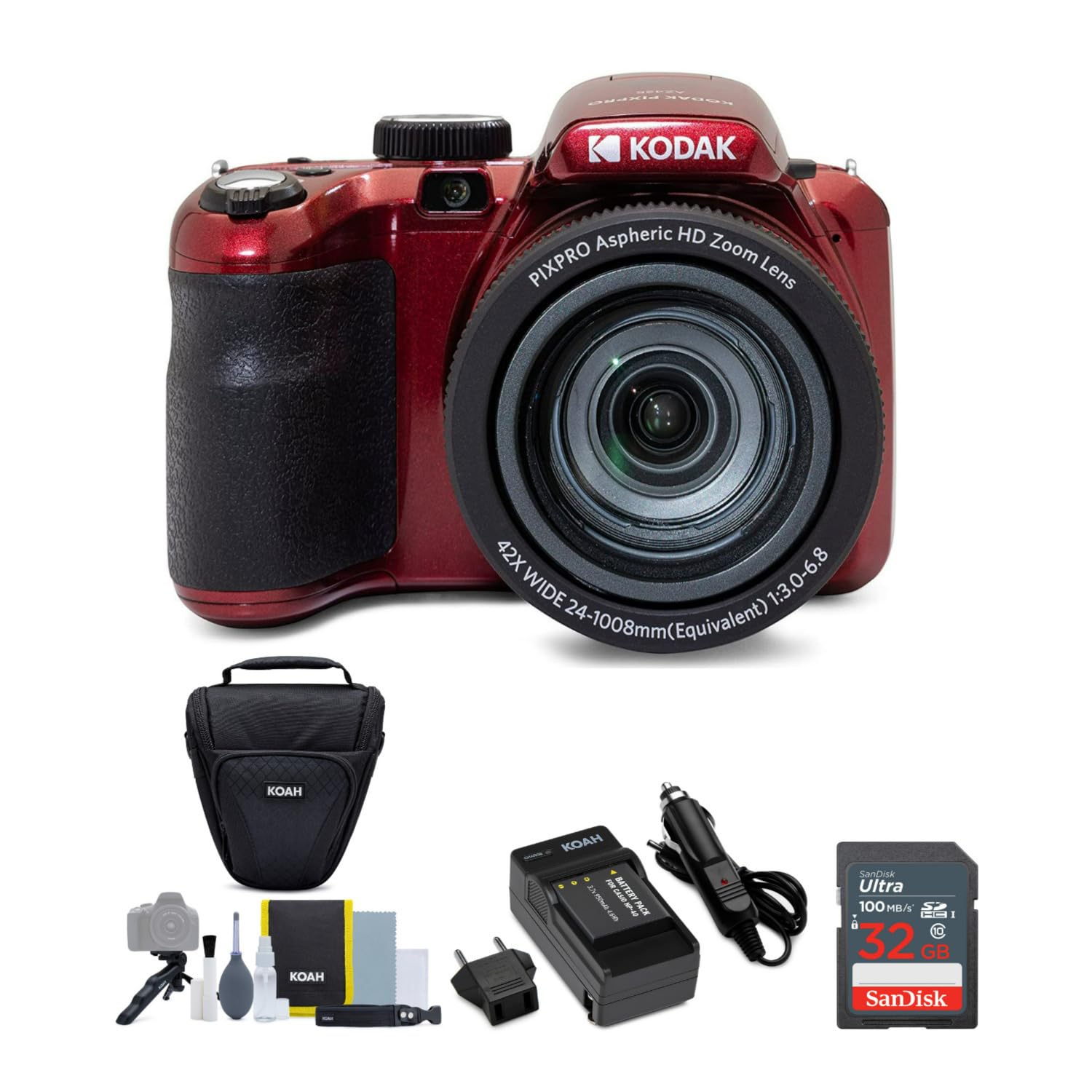
A ready-to-shoot kit with a 42x zoom that arrives with everything you need.
The Kodak Pixpro AZ425 bundle gets you shooting right from the start. It includes the camera (a 20MP model with a 42x optical zoom and a 24mm wide-angle lens), a 32GB memory card, a rechargeable battery and charger kit, and a holster case. Optical image stabilization (which reduces blur from shaky hands) helps you get sharp handheld shots, and the 3-inch LCD display makes framing easy. A red color option is available, which owners describe as “chic and classy.” Buyers most often praise the image quality, calling it “great photos” and noting the camera is “easy to use.”
The limitations are those of a budget camera. The autofocus uses only 1 point, making precise focusing slower than more advanced models. The 8-bit color depth is standard for budget cameras, and battery life is mixed. The included extra battery (960 mAh) has slightly less capacity than the camera’s original battery (1100 mAh). It shoots 1080p video, not 4K. This is a perfect choice for a child’s first camera, a casual family shooter, or someone who wants a simple point-and-shoot with a long zoom.
Best value bundle: The box includes a case, memory card, and extra battery, saving you time and money on accessories.
Performance ceiling: The single-point autofocus and 8-bit color are basic, limiting this to daylight scenes and simple subjects.
Yes for a child or absolute beginner: It is a complete kit that is very easy to use.
Skip if you need speed or 4K: The autofocus is slow, and video is limited to 1080p.
9. MINOLTA MN40Z (Black) Bundle
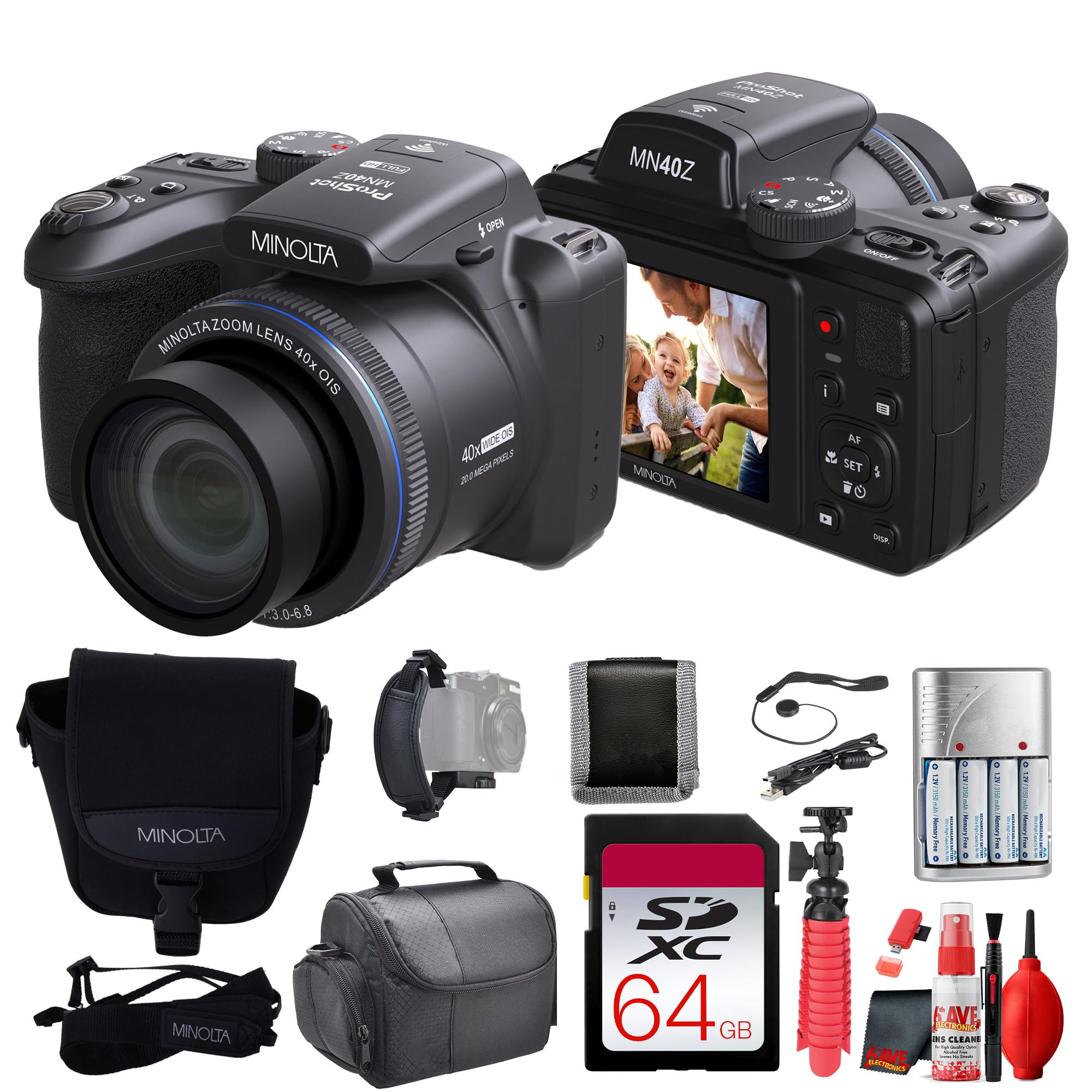
A 20MP superzoom with a massive accessories bundle for the value-conscious buyer.
The MINOLTA MN40Z (Black) comes as a comprehensive kit for a new photographer. It features a 20MP sensor, 40x optical zoom (24-960mm equivalent), 1080p Full HD video recording, optical image stabilization, and a 3-inch LCD monitor. The bundle includes a 64GB memory card, a vlog tripod, AA batteries with a charger, a travel bag, a cleaning kit, and more. Buyers call it “as good as advertised” and say it is a “great beginners camera” with “all you need to take great pictures.” It also has Wi-Fi and app integration for easy sharing.
The MN40Z uses AA batteries, which are convenient and universal but offer less runtime than a dedicated lithium-ion pack. The autofocus is a single-point contrast detection system, which is basic. The bundle is the main draw here — you get essentially everything you need to start shooting. It is an excellent option for someone who wants a complete kit without separate purchases.
What makes it a great deal
- Massive bundle includes tripod, bag, cards, and charger.
- Wi-Fi and app integration for easy photo transfer.
- Optical image stabilization helps with handheld zoom shots.
What to know
- Uses AA batteries — less efficient than a lithium-ion pack.
- Basic single-point contrast detection autofocus.
- 40x zoom is moderate; not for extreme long-distance shots.
For the starter: This is the most complete “everything you need” kit for a first-time superzoom buyer.
Not for a pro: The basic autofocus and AA batteries will frustrate experienced photographers.
Understanding the Specs
Optical Zoom (125x, 83x, 40x, etc.)
This is the heart of a bridge camera. It tells you how much closer a subject appears compared to a standard 50mm lens. A 40x zoom (like on the KODAK AZ405) is enough for a zoo or sporting event. A 125x zoom (like the Nikon P1000) pulls the moon into frame-filling detail. The number is a multiplication factor: 40x means the lens can zoom 40 times further than its widest angle. More zoom means heavier and more expensive.
Megapixels (MP) and Sensor Size
Megapixels measure the number of detail-points in your image. 16MP, 20MP, and 21.1MP are all common on these cameras. The real difference is the sensor size. Most bridge cameras use a tiny 1/2.3-inch sensor (good, but noisy in low light). The Leica V-LUX uses a much larger 1-inch sensor, giving it a huge advantage in image quality, especially at night. A higher MP count on a small sensor does not always mean better quality — it often means more noise.
Image Stabilization (OIS / VR / Power O.I.S.)
Brands call it different names: Optical Image Stabilization (Kodak), Vibration Reduction (Nikon), Power O.I.S. (Panasonic). All do the same job — they physically move a lens element to counteract your hand shake. This is mandatory for shooting at full zoom. Without it, your 1200mm shot will be a blurry mess. The Nikon P950’s “Dual Detect VR” and the Panasonic FZ80D’s “Power O.I.S.” are specifically praised by owners for keeping shots sharp at full telephoto.
4K Video and Bit Depth
4K video (3840×2160 resolution) records four times more detail than standard 1080p. It lets you crop and still have high definition. It is a premium feature found on the Nikon P1000, P950, Panasonic FZ80D, Canon SX740 HS, and Leica V-LUX. Bit depth (8-bit, 12-bit, 14-bit) refers to the number of color steps your sensor captures. A 14-bit camera (Nikon P1000) can show smoother color gradients (like a sunset sky) without visible banding, compared to an 8-bit camera (Kodak AZ528).
FAQ
What is a bridge camera?
Is a bridge camera as good as a DSLR?
Why is optical zoom more important than digital zoom?
Which bridge camera has the longest zoom?
Do bridge cameras shoot 4K video?
Are bridge cameras good for bird photography?
How heavy is a typical bridge camera?
Can I use a bridgebridge camera for astrophotography?
What does “RAW” format mean on a bridge camera?
Which is better, a bridge camera or a smartphone?
Final Thoughts: The Verdict
Across the board, the dslr like bridge cameras winner is the Nikon COOLPIX P1000 because its 125x optical zoom is simply class-leading—it brings distant subjects so close you can see individual feathers on a bird across a field—and owners consistently praise its build quality and reach. If you want a more manageable size and a massive zoom, grab the Nikon COOLPIX P950 with its 83x zoom and dedicated Bird mode (a preset that tune settings for avian subjects). And for the best overall image quality with a professional-grade 1-inch sensor (larger than typical bridge-camera sensors, so it captures more light and detail), the Leica V-LUX (Typ 114) is the one to reach for.
How We Picked
We do not accept paid placement. Every pick is matched to a real buyer and a real use-case; we do not hands-on test units.
Sources & Methodology
Specifications: manufacturer listings and product documentation. Review insights: verified customer reviews, as of July 2026. Pricing: not shown on this page (it changes often); check the current price via the retailer link.
As an Amazon Associate, WellFizz earns from qualifying purchases. This does not affect which products we feature.
Related Guides

Mo Maruf
I created WellFizz to bridge the gap between vague wellness advice and actionable solutions. My mission is simple: to decode the research and give you practical tools you can actually use.
Beyond the data, I am a passionate traveler. I believe that stepping away from the screen to explore new environments is essential for mental clarity and physical vitality.