Our readers keep the lights on and my smoothie glass nicely filled. As an Amazon Associate, I earn from qualifying purchases.
Specs are compiled from manufacturer listings and verified buyer reviews and can change over time — please confirm the key details on the product page before buying.
Boondocking in a blizzard or just trying to keep the morning chill out of the camper — an electric heater for RV use is the safety-first way to stay warm without running your propane furnace dry. The catch is that RV electrical systems are limited, and the wrong heater can pop your breaker or take up floor space you don’t have. This guide focuses on models built for tight quarters and limited power — from a wall-mounted smart heater you can control with your voice to a rugged little cube that survives years on a sailboat.
I’m Mohammad Maruf — the founder and writer behind WellFizz. This guide is built by comparing the manufacturers’ published specifications and the patterns across verified customer reviews, so you get each pick’s real strengths and trade-offs instead of marketing spin.
If you want to skip the research, the best electric heater for rv life depends on how much power you can spare and if you want to bolt it in or keep it portable — we have a pick for every setup.
Our Picks at a Glance

How To Choose The Best Electric Heater For RV
An RV is not a house. The electrical system is smaller, the space is tighter, and the heater has to live with bumps and vibration. These are the three things you need to get right before you buy.
Wattage — how much your RV can actually handle
A standard 1500-watt heater pulls around 12.5 amps. Most RV circuits are rated for 15 or 20 amps per outlet circuit, so a 1500W heater often uses nearly every amp you have on that circuit — leaving almost nothing for lights, a fridge, or a coffee maker on the same breaker. If your RV has older wiring or you are running on a 30-amp shore power connection, an 800-watt model (about 6.67 amps) or a 750-watt setting gives you heat without tripping the breaker. That is why you see lower-wattage options in this list: they trade a little top-end warmth for real-world compatibility.
Safety features — mandatory in a moving vehicle
Every RV heater should have tip-over auto shutoff and overheat protection. But there is another layer: proximity sensors. Some RV-specific fireplaces include close-proximity cut-off sensors that shut the unit down when something is within a few inches — important in a space where a towel or curtain can shift during travel. Look for a stable, low-profile base that won’t tip if the RV takes a corner. The RecPro fireplace, for example, uses Zero Clearance Safety Technology with 6-inch proximity cut-off sensors.
Form factor — floor space vs installation
You have three main types here. Portable ceramic tower heaters (like the BLACK+DECKER BHTC571) are easy to move around but take up floor and counter space. Wall-mounted units (like the GiveBest) free up every inch of horizontal space but require drilling and a permanent installation. Radiant dish heaters (like the BHRO608) sit low on the floor and heat objects directly — good for under a desk or next to a dinette bench. The fireplace-style units (RecPro and Furrion) are recessed into a cabinet or wall, so they become part of the RV’s look and use zero floor space.
Quick Comparison
| Model | Best For | Wattage / BTUs | Amperage | Heating Coverage | Amazon |
|---|---|---|---|---|---|
| Caframo True North★ Best Overall | All-around portable reliability | 5200 BTU | 12.5 A | 170 sq ft | Amazon |
| BLACK+DECKER Tower BHTC571Top Performer | Budget-friendly oscillating heat | 1500 W | 8.33 A | 150 sq ft | Amazon |
| BLACK+DECKER Dish BHRO608 | Low-wattage safe for old circuits | 800 W | 6.67 A | 161 sq ft | Amazon |
| GiveBest Wall Heater | Smart wall-mounted convenience | 1500 W | — | 150 sq ft | Amazon |
| Xtreme Heaters Cabin Heater | Safe 24/7 running in boats and vans | 1500 W | — | — | Amazon |
| RecPro 18″ Fireplace | Recessed fireplace with flame effects | 1500 W | — | — | Amazon |
| Furrion 30″ Fireplace | Wide built-in fireplace for larger RVs | 5100 BTU | — | 500 sq ft | Amazon |
In‑Depth Reviews
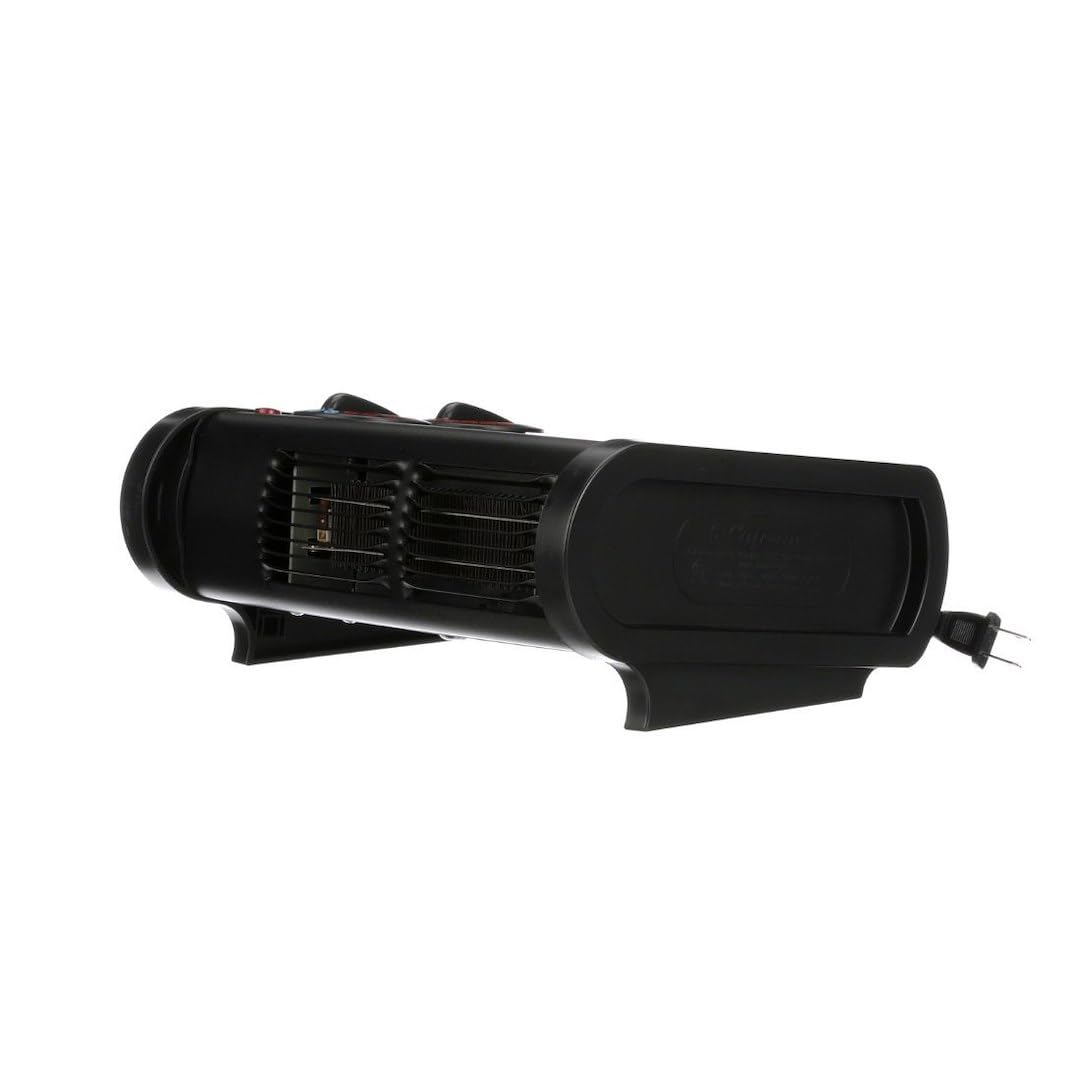
1. Caframo True North Heater (9206CABBX)
Our pick — over 4.5★ from 750+ verified ratings; the strongest balance of quality and price.
The rugged little box that RV owners, boaters, and cabin dwellers swear by — built in Canada with a 5-year warranty.
This is not a plastic fan-forced tower. The True North heater is mostly steel — solid steel housing with a low profile that measures just 5 inches deep by 8 inches wide. It sits so low and stable that tip-overs are nearly impossible, and the design is intentional: it prevents them. Three heat settings (around 500W, 900W, and 1200W depending on line voltage) plus a fan-only mode give you fine control over your power draw. The anti-freeze setting is a standout for RV winter storage — it turns on automatically when the temperature drops to 38°F (3°C), keeping the interior above freezing without wasting power the rest of the time.
Unlike the BLACK+DECKER BHTC571 tower heater that relies on a plastic oscillating head, the Caframo uses a forced-air system that pushes heat forward in a concentrated stream — owners call the heat output reliable even in un-insulated vans. Buyers report it works well in a boat motor area to “keep the temperature above freezing” and shuts off by itself when not needed. The thing owners rave about is quality: “Made in Canada, 5-year warranty, mostly steel case” is a common sentiment. The noise level is a nuance — some call it fairly quiet, others say it is very noisy — so it may not be the right pick for a silent bedroom heater.
Why owners pick this for years
- Mostly steel housing — built to last, not to throw away
- Three heat levels plus fan-only and anti-freeze mode
- 5-year warranty and made in Canada
- Heats 170 sq ft — compact but powerful
The honest trade-offs
- Audible fan — not silent; noise level gets mixed opinions
- Internal thermostat can be unreliable; some owners pair it with an external thermostat
- Premium pricing — the highest up-front cost in the portable tier
Best for the long haul: If you want one heater that will still be running five years from now on the road or on the water, and you can handle the fan noise, this is the one.
Think twice if: You need whisper-quiet operation in a bedroom or you want the absolute lowest price.
2. BLACK+DECKER Oscillating Ceramic Tower Heater BHTC571
A 1500-watt tower that oscillates 75 degrees — and at a price that makes it an easy impulse buy.
This is the heater you grab when you want fast, wide-reaching heat without spending much. The BHTC571 runs on 1500 watts on high, 1000 watts on low, or fan-only mode — three settings that let you dial back the power when your RV circuit is already loaded. The oscillating head rotates 75 degrees, which spreads the warmth across a room instead of blasting one spot, and the 3.7-pound body (with a carry handle) is light enough to move from the bedroom to the dinette as you need it. The heating coverage of 150 square feet is nearly identical to the BHRO608 dish heater’s 161 square feet, but the tower form factor takes up vertical space rather than floor width.
The safety package includes overheat protection and tip-over auto shutoff — the non-negotiable features for RV use. The temperature control gets positive feedback from owners, with one noting the heater is a “perfect size” that works great for family rooms and large bedrooms. The catch is reliability: the most-mentioned aspect in reviews is a mixed one, and a few owners mention units that stopped working after a couple of months. One buyer received a unit that “was obviously a used item” with scuff marks and no hot air blowing. The oscillating tower design is best suited for moderate use — not necessarily as a 24/7 workhorse for boondocking in extreme cold.
What wins owners over
- Oscillates 75 degrees — even heat distribution in larger spaces
- Three modes: fan, low heat (1000W), high heat (1500W)
- Light at 3.7 lbs with a carry handle for easy moving
Where it falls short
- Reliability is mixed — a few customers note failure after two months
- 1500W draws 8.33 amps — may share a circuit carefully in a 30-amp RV
- Oscillation and timer are not as sturdy as pricier picks
Reach for this if: You need a quick, portable heat blaster for mild cold spells and you are keeping the cost under control.
Look elsewhere if: You plan to run a heater non-stop all winter or you want a unit with a proven multi-year track record.
3. BLACK+DECKER 14″ Oscillating Radiant Dish Heater BHRO608

The 800-watt radiant heater built for RVers who worry about tripping a breaker — it draws just 6.67 amps.
This is the low-wattage champion on the list. At 800 watts max, the BHRO608 pulls only 6.67 amps — an 88% smaller draw than the 12.5 amps the Caframo True North needs at full power. That makes it safe for almost any RV outlet circuit, even with lights and a fridge running on the same breaker. The radiant heating method (a glowing dish) warms people and objects directly rather than heating the air, so you feel the warmth immediately when you sit near it. There are four settings: low heat (400W) and high heat (800W), each with or without oscillation.
The thing owners praise most is the heat output (44 mentions) — reviewers point out it “keeps my gal toasty warm” and the radiant heat “feels nice” compared to the dry blast of a forced-air fan. Quality also gets strong marks (28 mentions). The trade-off is durability: a few shoppers say the timer knob breaking after about a year, and the bottom falling off after two months in a couple of cases. The tip-over shutoff and 1-hour timer are good safety features, but the design is “a bit flimsy” per some reviews, and the exposed radiant element means it is not safe around pets or kids who could touch the dish. The low-wattage advantage is also a limitation — at 800W, it will struggle to heat a large or poorly insulated RV on a truly frigid night.
Why the wattage wins
- 800W max — leaves room on the circuit for other appliances
- Radiant heat warms you directly — no waiting for the air to cycle
- Runs quietly — no loud fan noise while you sleep
Areas to be careful about
- Durability is a recurring note — some parts feel flimsy
- 800W may not cut it in sub-freezing weather in an un-insulated rig
- Hot surface — keep away from kids, pets, and anything flammable
Best for the circuit-saver: If your RV has limited electrical headroom or you just need to take the edge off a cool night without worrying about breakers, this is the safest bet.
skip it if: You need to heat a large RV through a hard freeze, or you have pets and kids who might bump into a hot radiant dish.
4. GiveBest Smart Wall Heater UPH310M
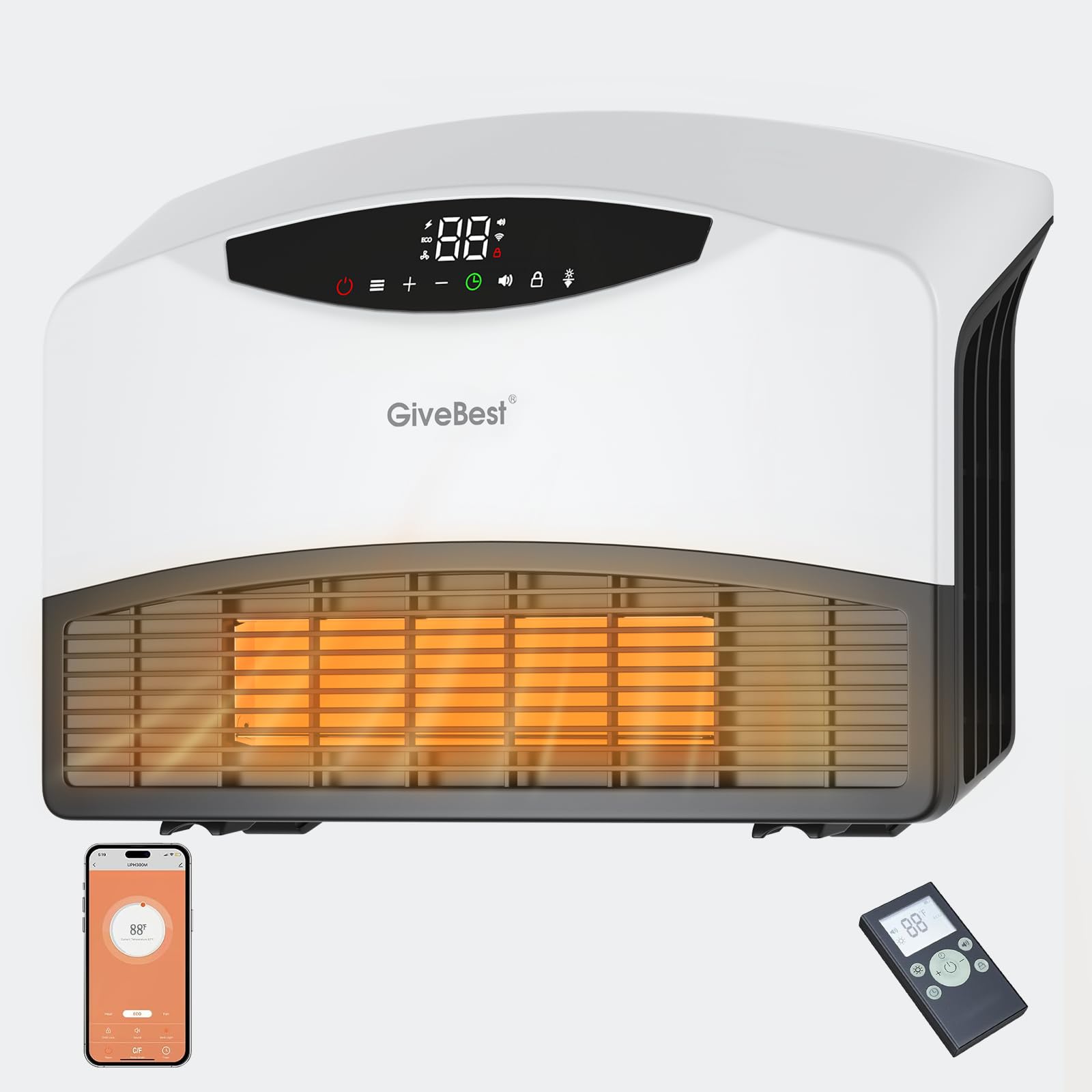
A 1500W wall-mounted heater you can control with your voice — and it frees up every inch of floor space.
This is the only smart heater on the list. The GiveBest UPH310M mounts on the wall (included template makes the install straightforward) and runs 1500 watts of PTC forced-air heat with an impressively quiet 34 dB operation — about as loud as a quiet library. The app control and Alexa voice commands mean you can turn the heat on from your phone before you even walk into the cold RV, and the 24-hour timer keeps it running only when you need it. Three modes handle the real work: Heat for full warmth, ECO for energy-saving, and Fan for air circulation. The ECO mode is designed for high energy efficiency. The wall-mount design measures 16.1 inches deep (it protrudes from the wall) by 11 inches wide by 4.3 inches high — a compact footprint that tucks into a tight corner.
Unlike the portable BHRO608 that sits low on the floor, this heater mounts up and out of the way, which is a huge advantage in a small RV. Coverage is rated at 150 square feet as a primary heat source, or up to 750 square feet as a supplement in a well-insulated space. The flame-retardant V-0 rating and overheat protection mean it can run 24/7 safely. One owner noted the wall mount drill holes were slightly misaligned — a minor install hiccup — but the unit itself “heats a 10×12 sunroom quickly” and the ability to adjust the display brightness is a nice touch for nighttime use. Note: this runs only on 2.4 GHz Wi-Fi, not 5G, so check your RV’s network setup before buying.
What makes it unique
- Voice, app, or remote control — turn on heat before you arrive
- 30-minute setup with included template; gets it off the floor
- ECO mode cuts power use automatically; real buyers report lower electric bills
Install details to know
- Requires drilling into the wall — not for renters or quick setups
- 2.4 GHz Wi-Fi only — no 5G compatibility
- Mount placement matters: install about 2 feet off the ground for best thermostat performance
Grab this for: A permanent, hands-free heating solution where you want smart controls and zero floor clutter.
Pass on it if: You need a portable heater you can move between rooms, or your RV has no wall space to mount it.
5. Xtreme Heaters Boat, Cabin & RV Heater XTRCAB
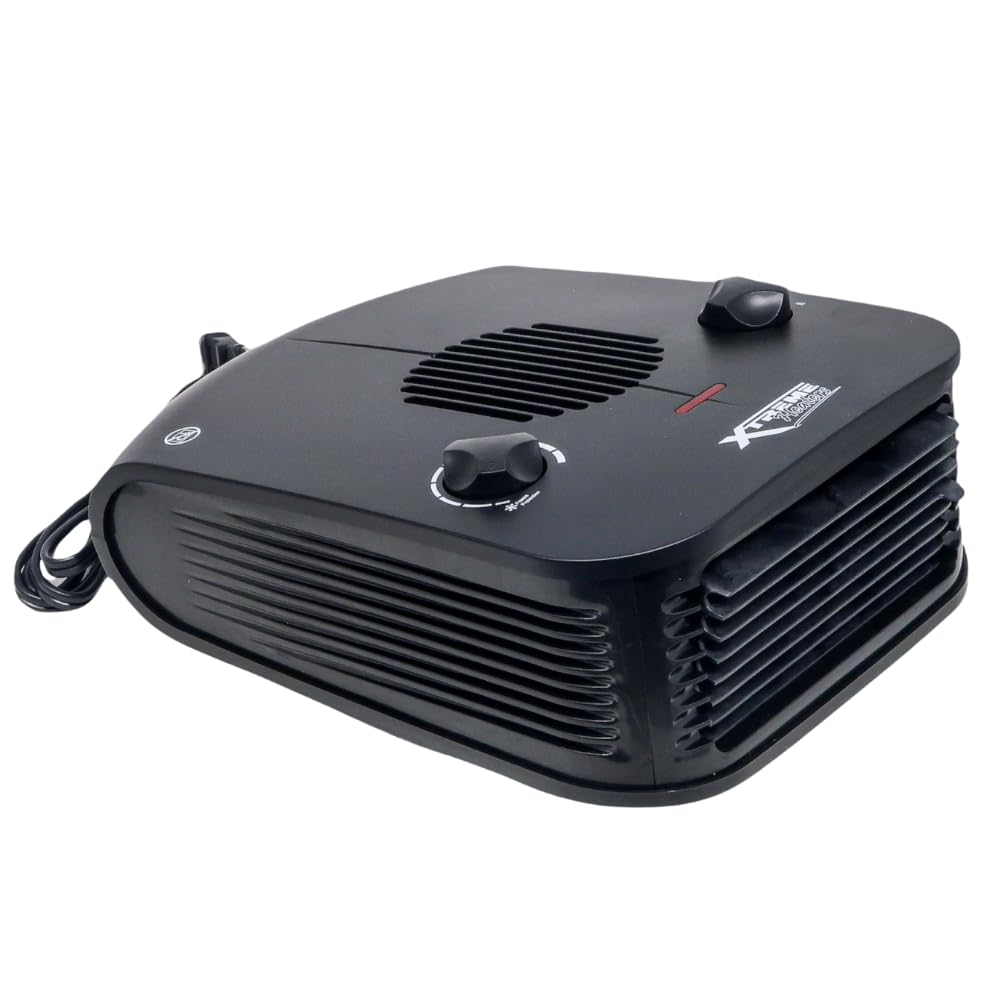
A 12-by-10-by-6-inch cube that draws air from the top — so you can push it against a wall or a carpet without worry.
The Xtreme Heaters XTRCAB is a different shape from the rest: its top-mounted air intake means you can place it flush against walls or on carpeted surfaces without blocking the airflow. Most portable heaters need 6 to 12 inches of clearance all around, but this one draws air from above, giving back usable space in a cramped RV. It runs on two heat settings — 750 watts for moderate warmth and 1500 watts for full power — and the thermostat can be set as low as 40°F, which is useful for keeping the RV just above freezing while you are away. The low profile (12 inches deep by 10 inches wide by 6 inches tall) fits under a dinette bench or in a tight corner where the BHRO608 radiant dish or the BHTC571 tower simply will not go.
Reliability is the most-discussed aspect with 23 mentions, and it is positive — owners say it is “small but mighty” and keeps a boat cabin at a “nice regulated 70 degrees.” The heat output also gets strong marks. One owner describes using it on a boat to reduce humidity and prevent mildew, running for long periods. The tip-over switch works in any direction, and the UL 1278 standard certification gives confidence for 24/7 operation. The clear trade-off is that the thermostat is uncalibrated — the markings on the dial are approximate, and you will need to experiment to find your ideal setting. And while the company fixed a past hot-cord issue with extra testing, a few owners mention the auto shut-off feature can trigger if the internal motor bearings stiffen over time.
The space-saving design
- Top air intake — place it against walls, under furniture, on carpet
- Cut-off sensors in every direction for safe 24/7 use
- 750W setting for low-wattage use or 1500W for fast heat
A few nuances
- Thermostat dial is not calibrated — needs trial and error to set
- Drawn 1215W in one review, not a full 1500W on low line voltage
- Past batch had a hot-cord issue; company says it is now fixed
Pick this for: A heater that tucks into tight spots and runs reliably for hours, especially in boats, vans, or small campers.
Think twice if: You want a precise digital thermostat or you need to heat a large RV in deep winter.
6. RecPro 18″ RV Recessed Electric Fireplace
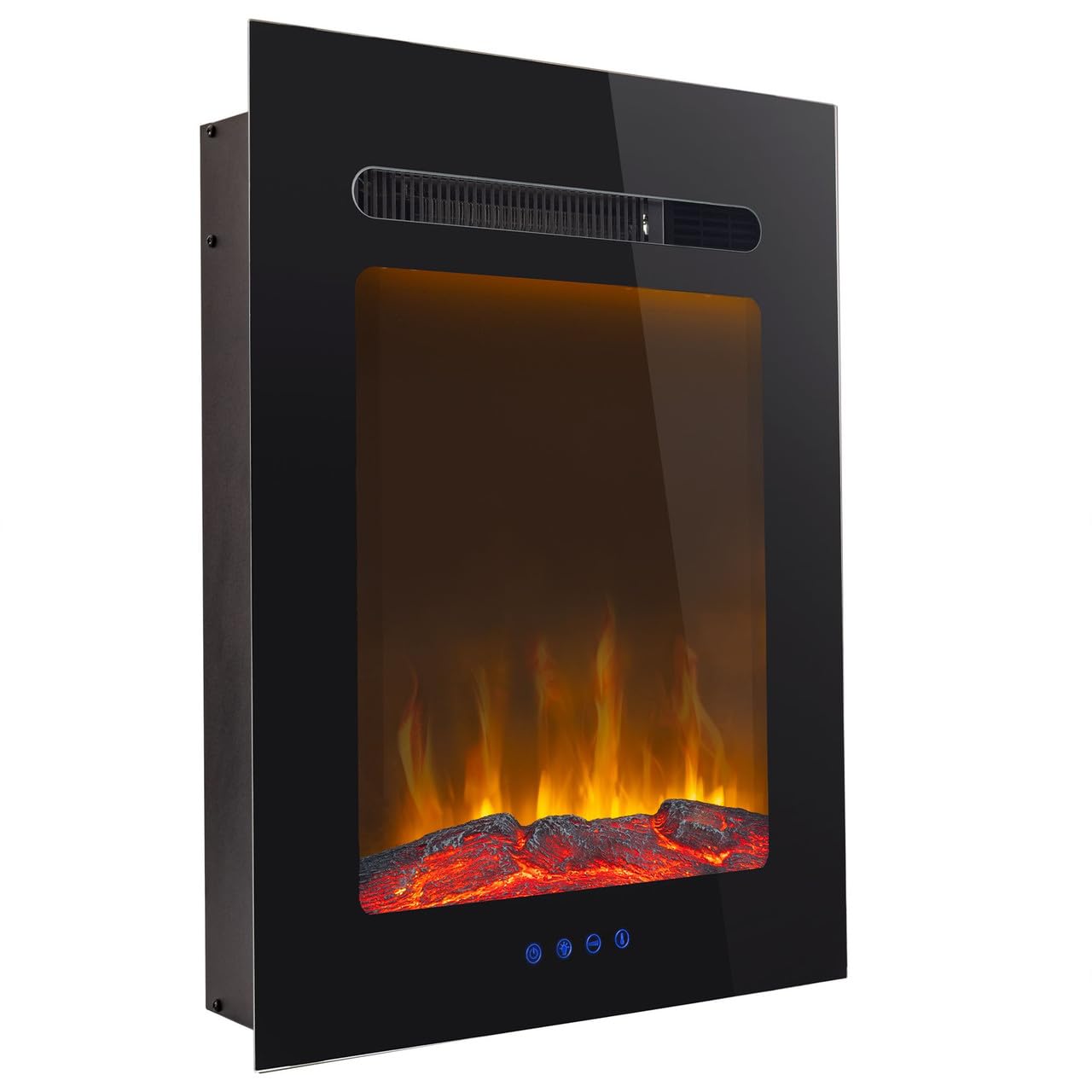
A 1500W recessed fireplace with multicolor flames — it turns your RV’s cabinet into a cozy focal point.
The RecPro is not a heater you sit on the floor; it recesses into a wall or cabinet cutout (rough-in dimensions: 22.5 inches high by 14.5 inches wide by 6.5 inches deep) and becomes part of the RV’s furniture. The 18-inch chamber width means it fits into a lower cabinet under the TV, which is exactly how many owners install it. It runs on 1500 watts with a quartz heating element, and the flame effects are the real attraction: orange, blue, or a combination of both, with four intensity settings. The flame realism gets solid marks — owners call it “beautiful” and “reasonably realistic” for an electric fireplace.
The Zero Clearance Safety Technology is what makes it RV-safe: close-proximity cut-off sensors shut the unit down when anything is within 6 inches, and thermal cut-off sensors prevent overheating. Owners say it heats a 30-foot camper quickly, and the steel construction with a powder-coated black finish feels substantial compared to the plastic towers. The noise level is a sticking point — the “crackling sound and loud clicking beep” get negative mentions from 11 owners, which is high enough to call out. And one important spec check: a reviewer notes the unit is only 1500 watts and does not actually have a 750-watt setting as described, so run it on a circuit that can handle the full 1500W load.
Why owners love it
- Multicolor flames (orange, blue, combo) with 4 brightness levels
- Recessed into the wall — uses zero floor space
- Zero Clearance Safety — 6-inch proximity sensors for low-maintenance operation
The downsides to know
- Noise level — the crackling sound and click are the top complaint
- May not have the advertised 750W setting; runs at full 1500W only
- Installation requires cutting into a cabinet or wall — not a quick setup
Best for: RV owners who want the look and feel of a fireplace plus real heat, and are willing to do a permanent installation.
Not for: Anyone who needs a portable heater or is sensitive to clicking beeps and fireplace crackling sounds.
7. Furrion 30″ Electric Fireplace FF30SC15A-BL

A 30-inch-wide built-in fireplace rated to heat up to 500 square feet — the biggest coverage in this list.
The Furrion is the powerhouse of the fireplace category. At 30 inches wide, it is nearly double the width of the RecPro 18-inch unit, and its 5100 BTU output heats up to 500 square feet — enough for a sizable fifth-wheel or motorhome. The quartz heating element delivers real warmth, and the multicolor flame effect (with 4 brightness settings) simulates a wood fire with a choice of flame colors. The VibrationSmart and ClimateSmart technologies are specifically designed for RV travel: they let the fireplace withstand the constant vibration of the road and the extreme temperature swings inside a parked RV. The glass stays cool to the touch except at the heat output area, a safety detail that matters in tight quarters.
Owners consistently describe it as “not hard to install” with a cutout and an outlet nearby, and it “works great when we don’t want to turn the furnace on” — a common RV scenario where you want to save propane. The remote control is essential for setting the temperature between 65°F and 95°F in 5-degree increments. The most-discussed positives are how well it heats and how natural the logs and flames look. The big caveat is longevity: a few owners mention the fan failing after just over a year, with the unit being discontinued, so if you plan to keep your RV for many years, this may not be the last fireplace you buy. Also, the remote uses a 2025 battery, not standard AAA, and some units ship without a remote at all.
The big advantages
- 30-inch width gives a grand fireplace look in large RVs
- Heats 500 sq ft — the widest coverage in the lineup
- VibrationSmart and ClimateSmart handle road travel and temperature swings
Points to check
- Fan reliability is mixed — a few reports of failure after a year
- Remote uses a CR2025 battery (not AAA) and may not ship with the unit
- 30-inch width requires a substantial wall cutout — measure twice
Reach for this if: You own a large RV with the wall space to mount a 30-inch unit and want the biggest heating coverage available on this list.
pass on it if: You need a compact heater for a small camper or van, or you want to avoid a built-in installation.
Understanding the Specs
Wattage and Amperage
The two numbers that matter most for an RV. Wattage (measured in watts) tells you how much heat the heater produces — higher watts means hotter and faster heat. Amperage (measured in amps) tells you how much electrical current the heater pulls from your RV’s system. The formula is simple: watts divided by voltage equals amps. On a 120-volt RV system, a 1500-watt heater pulls about 12.5 amps, an 800-watt heater pulls about 6.67 amps. Most RV circuits are 15 or 20 amps for a single outlet circuit, so a 1500-watt heater uses most of that capacity. If you have a 30-amp RV, you can run one 1500-watt heater plus lights and a fridge, but not a second heater or a microwave on the same circuit. Lower-wattage models (750W, 800W) are safer for older wiring and shared circuits.
BTU vs Watts — two ways to measure heat
BTU (British Thermal Unit) and watts are both measures of heat output. One watt equals about 3.41 BTUs. So a heater rated at 5100 BTUs is generating about 1500 watts of heat. Some manufacturers list both numbers; some use only one. BTU ratings tend to look bigger on paper (5100 BTUs sounds more impressive than 1500 watts), but they describe the same amount of heat. For comparison purposes, just look at wattage — it is the standard measurement for electric heaters. The 5200 BTU rating on the Caframo True North and the 5100 BTU rating on the Furrion fireplace are nearly identical in real-world heat output.
Radiant vs Forced Air vs Convection
These are the three ways an electric heater transfers heat. Radiant heaters (like the BLACK+DECKER BHRO608 dish) use a glowing element that heats objects and people directly — you feel the warmth immediately when you are in front of it, but the air stays cooler. Forced-air heaters (like the GiveBest wall heater and the Caframo True North) use a fan to blow air over a hot element and push it into the room — they heat the air itself, so the whole room warms up over time, but the fan creates noise. Convection heaters (some modes on the BHTC571 tower) pull cool air from the bottom, heat it, and let warm air rise naturally — silent but slower. For an RV, forced air is usually the most practical because it spreads heat into all corners of a small space.
Safety Certifications for RV Use
Not all space heaters are safe for RV use. The certification to look for is UL 1278, which is the safety standard for portable electric heaters in the US. The Xtreme Heaters XTRCAB carries a UL 1278 standard certification. Beyond that, RV-specific safety features include tip-over auto shutoff (the heater turns off if it is knocked over in any direction), overheat protection (shuts off if the internal temperature gets too high), and cool-touch exteriors (the outside of the heater stays cool enough to touch even when running). For built-in fireplaces like the RecPro and Furrion, Zero Clearance Safety Technology means the unit can be installed close to walls and cabinets without a fire risk. Proximity sensors that shut the unit down when an object is within a specific distance (e.g., 6 inches for the RecPro) add another layer of safety in a small RV.
FAQ
Can I run a 1500-watt heater in my RV without tripping the breaker?
What does anti-freeze mode do on an RV heater?
Is a radiant dish heater or a forced-air heater better for an RV?
Can I use a wall-mount heater from a regular RV outlet?
How do I know if a heater is safe to leave on overnight in an RV?
What is the difference between an RV electric fireplace and a portable space heater?
Does an electric heater for an RV need a special outlet?
How long does an RV electric fireplace last?
Can I use an electric heater to keep my RV from freezing when I am away?
What is PTC ceramic heating and why is it good for RV heaters?
Final Thoughts: The Verdict
For most RV owners, the electric heater for rv that balances power, durability, and amp-wise operation is the Caframo True North — a steel-bodied forced-air unit that has earned its crowd of devoted owners over years of use. If you want to save floor space and add smart controls, reach for the GiveBest Wall Heater, which mounts out of the way and works with Alexa. And for owners of larger RVs who want a built-in with visual ambience, the Furrion 30-inch Fireplace delivers the widest heating coverage at 500 square feet.
How We Picked
We do not accept paid placement. Every pick is matched to a real buyer and a real use-case; we do not hands-on test units.
Sources & Methodology
Specifications: manufacturer listings and product documentation. Review insights: verified customer reviews, as of July 2026. Pricing: not shown on this page (it changes often); check the current price via the retailer link.
As an Amazon Associate, WellFizz earns from qualifying purchases. This does not affect which products we feature.
Related Guides

Mo Maruf
I created WellFizz to bridge the gap between vague wellness advice and actionable solutions. My mission is simple: to decode the research and give you practical tools you can actually use.
Beyond the data, I am a passionate traveler. I believe that stepping away from the screen to explore new environments is essential for mental clarity and physical vitality.