Our readers keep the lights on and my smoothie glass nicely filled. As an Amazon Associate, I earn from qualifying purchases.
Specs are compiled from manufacturer listings and verified buyer reviews and can change over time — please confirm the key details on the product page before buying.
You can fight exposure times, washout failures, and stencil breakdown with a wrong emulsion, or you can pick the right one and get sharp, repeatable screen burns on your first try. The best emulsion for screen printing coats evenly, exposes predictably, and holds up through multiple pulls with plastisol or water-based inks. This guide covers eight proven emulsions, each matched to a skill level and shop setup, so you can buy the bottle that fits your needs.
I’m Mohammad Maruf — the founder and writer behind WellFizz. This guide is built by comparing the manufacturers’ published specifications and the patterns across verified customer reviews, so you get each pick’s real strengths and trade-offs instead of marketing spin.
Getting a clean stencil on your screen that lasts through your print run depends on one thing: the right emulsion for screen printing.
Our Picks at a Glance


How To Choose The Best Emulsion For Screen Printing
Don’t just grab the cheapest bottle. The right emulsion works with your ink, your light source, and your experience level. Focus on these three factors to narrow the field fast.
Pre-sensitized vs. Diazo
A pre-sensitized (ready-to-use) emulsion is ready to pour straight from the container — no mixing, no guessing. That is the easiest route for beginners and small-shop printers because you avoid measuring and the clock that starts once you add a diazo sensitizer. Diazo-based emulsions require mixing a powder into the liquid, but they often provide a longer shelf life and a tougher stencil once cured. If you print in volume and reclaim (clean and reuse) screens regularly, a diazo system gives you more control over durability.
Ink compatibility
Plastisol inks are thick and forgiving. Most emulsions handle them without issue. Water-based and discharge (a type that bleaches fabric) inks are more aggressive — they pull moisture out of the stencil and can break down a standard emulsion mid-run. For those inks, you need a water-resistant formula (often labeled “WR” or “dual cure”) that holds its structure against wet ink. Using a standard emulsion with water-based ink can cause the stencil to soften, blur detail, or even peel off the mesh mid-job.
Exposure source and speed
Your light source determines how long it takes to burn a screen. LED and UV units expose fast — often under 30 seconds — while a standard 500W halogen work light takes several minutes. Each emulsion is formulated for a specific light spectrum. An “LED” emulsion is tune for the narrow wavelength of an LED array, so it exposes far quicker under that light than a generic dual-cure would. If you use a DIY halogen setup, stick with an emulsion that explicitly lists halogen compatibility to avoid under-exposure (stencil washes out) or overexposure (stencil won’t wash out).
Quick Comparison
| Model | Best For | Type | Volume | Ink Compatibility | Amazon |
|---|---|---|---|---|---|
| Ecotex Tex-Red Pre-Sensitized | All-around shop workhorse | Pre-sensitized | 1 Quart | Plastisol & UV | Amazon |
| Caydo Screen Printing Photo Emulsion Kit | Budget-friendly beginner kit | Diazo (mix required) | 8.5 oz | Water-based & Solvent-based | Amazon |
| Ecotex PWR Screen Printing Emulsion | Dual-ink versatility | Pre-sensitized, water resistant | 1 Quart | Plastisol & Water-based | Amazon |
| Chromaline Chroma/Blue Dyed Photopolymer Emulsion | Fine-detail and halftone work | Pre-sensitized photopolymer | 32 oz | General purpose | Amazon |
In‑Depth Reviews
1. Ecotex Tex-Red Pre-Sensitized Screen Printing Emulsion (Qt)
The go-to quart that suits beginners and production printers alike because it is pre-sensitized and forgiving.
This is the emulsion that keeps showing up in every conversation because it works. It is pre-sensitized (ready-to-use) and pre-mixed — no diazo powder to measure, no guessing whether you mixed it right. You open the container, pour it into your scoop coater, and start coating screens. The formula is thick and covers a lot of mesh area per quart; buyers report that “it is thick and goes really far,” which matters when you are trying to keep per-screen costs low.
Compatibility is broad — it works with plastisol and UV inks, so you can run standard tee jobs or specialty UV-cured prints from the same batch of emulsion. Exposure time is forgiving, which is rare for a single-part emulsion. The crowd-sourced advice is sharp: work in a darkroom because the stuff cures fast under ambient light, and do not overexpose your burn, or you will fight to wash out the stencil. A 12-month shelf life means you can buy a quart and use it over the course of a year without worrying it will go bad.
It is not cheap, and a few owners mention the price feels high compared to smaller bottles. But the coverage offsets that — you get more screens per quart than thinner emulsions. The standalone downside is that it is formulated for plastisol and UV only; if you run water-based ink primarily, one of the dedicated water-resistant options below is a better fit.
Why it earns the top spot
- Pre-sensitized and ready to use — no mixing, no diazo
- Thick consistency covers many screens per quart
- Forgiving exposure window for a single-part emulsion
- 12-month shelf life reduces waste
Who should look elsewhere
- Not designed for water-based or discharge inks
- Premium price per bottle vs. smaller containers
Reach for this if: you want a workhorse emulsion that handles plastisol and UV across a range of skill levels without mixing steps.
Think twice if: water-based or discharge inks are your mainstay — you need a water-resistant formula for those.
2. Caydo Screen Printing Photo Emulsion Kit (8.5 oz)
An all-in-one starter kit (8.5 oz) that takes the guesswork out of your first burn.
This is not just a bottle of emulsion — it is a full kit with a 1g diazo (a light-sensitive powder you mix in) sensitizer, a 50ml measuring cup, a pair of gloves, and five wooden stir sticks. For someone setting up their first darkroom space, having all the bits in one box removes the friction of piecing together supplies. The emulsion itself (8.5 oz) is a quality standard diazo formula that works with water-based and solvent-based (chemical-resistant) inks, making it suitable for fabric printing onto t-shirts and totes as well as paper prints.
The review data reports a specific working recipe that works reliably: “I used a 30-watt UV light placed about 18 inches away and exposed it for 20 minutes.” Owners highlight that the detailed instructions make the process easy to follow, and the kit has delivered consistent results across approximately 30 shirts for some users. The trade-off is that once you mix the diazo into the emulsion, the clock starts — you need to use it up fairly quickly because the sensitized mixture does not store well. The bottle itself is smaller and more affordable than a full quart, which suits small projects but means you will need to repurchase sooner if you print regularly.
The kit also includes the ink in some configurations, but owners mention that the ink is not sold separately in larger bottles — a small frustration if you run out of ink but still have emulsion left. Still, for the price of entry, this is the lowest-risk way to test whether screen printing clicks for you.
The kit advantage: everything you need except the screen and light arrives in one box, and the results are repeatable if you follow the documented exposure recipe.
The volume caveat: 8.5 oz coats a handful of screens, and the diazo mix has a short shelf life once combined.
Grab it for: a low-cost, complete trial run to learn the screen-printing process without hunting for separate tools.
skip it if: you already have gear and need a bulk quart to keep production moving without repurchasing.
3. Ecotex Beginner Screen Printing Emulsion (8 oz)
Pre-mixed and forgiving, this 8 oz bottle is built for new printers to learn on.
This is the entry-level bottle from Ecotex, and it is designed to take the intimidation out of the process. It arrives pre-sensitized and ready to squeeze onto your screen — no diazo, no mixing, no refrigeration needwithout swapping emulsions. That flexibility is rare in a ready-to-use bottle. The purple dye gives good visual contrast during coating, and the 1-quart container is the standard production size. It works with LED, DIY halogen, and UV exposure units, making it compatible with almost any home or shop setup.
The exposure speed is fast. Reviewers point out successful burns at 28 seconds under 2x100W blacklights placed 24 inches away, and at 15 seconds with a 50W LED UV unit at 18 inches. For halogen users, the recommended starting point is about 4 minutes with a 500W lamp at the same distance. The stencil becomes tough enough to withstand pressure washing during reclaim, which is a strong sign of a well-cured emulsion. The most common success story involves a user applying the emulsion in a dark room, letting the screen dry for a full 24 hours, then exposing and washing out cleanly.
The biggest complaint is that the emulsion can be thin — it tends to drip through 180-mesh (fine) screens if you are not careful with your coating pressure, ruining a screen and wasting time. A few owners also mention that the emulsion washes away too easily when they try to reclaim screens, while others say it does not wash out well enough. Those contradictory reports suggest that exposure time is the pivot: under-expose and the stencil washes out, over-expose and it refuses to budge. Dial it in carefully and this is among the most versatile options on the list.
The versatility win: one bottle that works across plastisol, water-based, and discharge inks without needing a second formula.
The technique demand: thin consistency means scoop-coater technique matters — light pressure and steady pulls keep drips off your screens.
Perfect for: printers who switch between ink types regularly and want a single emulsion that handles both without mixing.
Not the best if: you work with 180-plus mesh counts where thin emulsion tends to drip through the mesh.
4. Ecotex DC Blue Dual Cure Photo Emulsion (1 Qt)
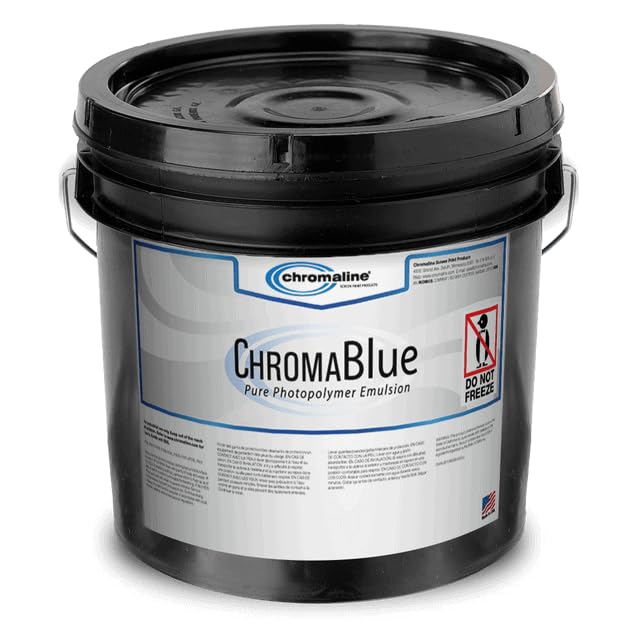
A photopolymer (pre-sensitized) formula that delivers the sharpest detail for fine-art and halftone work, with a 32 oz quart that edges out the Ecotex options for precision.
Chromaline is a less mainstream brand in the home-printing space, but it has a strong following among printers who chase razor-sharp edges. The Chroma/Blue is a photopolymer (pre-sensitized, no mixing required) that is marketed specifically for fast exposure and excellent detail. The quart is a 32 oz container, and the blue dye gives good contrast during coating and washout. The recommendation from experienced printers is consistent: this is “one of the better products” they have used across multiple brands, with particular praise for its thickness consistency and accurate exposure information.
The real-world exposure recipe from one owner is 16 seconds under an LED blacklight, with the design washing out quickly and leaving clean, crisp edges. That speed and sharpness make it an ideal choice for detailed logo work or halftone (a printing technique for creating shades using dots) dots where any edge softening ruins the print. The pre-sensitized nature also means no measuring, no mixing, and no clock ticking down once the bottle opens. The review volume is small — only a few dozen ratings — so the data points are limited, but the signal is positive. The minority report comes from a single buyer who found the product did not work at all and called it messy, though no other owner corroborates that experience.
The trade-offs are few but worth noting. The brand is harder to find on retail shelves compared to Ecotex, and the small review pool makes it harder to troubleshoot specific scenarios (high humidity, unusual mesh counts, etc.). If you need a straight-to-screen emulsion that rewards precision work with precision results, this is a strong contender. The per-ounce cost is higher than the Ecotex options, but for low-volume, high-detail jobs, the consistency is worth the premium.
The detail payoff: of all the bottles on this list, this one is most likely to hold a 1-point halftone dot without blowing out.
The small-community caveat: with limited owner data, you are more on your own if you hit an issue — there are fewer shared solutions to draw from.
Reach for this when: your artwork demands the sharpest edges and you value no-mix convenience over price per ounce.
Choose an Ecotex option instead if: you want a wealth of community troubleshooting and a lower per-screen cost for volume work.
Understanding the Specs
Pre-sensitized vs. Diazo (Two-Part)
A pre-sensitized (ready-to-use) emulsion is mixed at the factory and ready to pour onto the screen with no extra steps. It is the easiest for beginners because you cannot mess up the ratio. A diazo (two-part) emulsion comes with a separate powder sensitizer that you stir in before use. The trade-off is that once you mix them, the emulsion has a shorter usable life — typically a few weeks at room temperature — but the resulting stencil is often tougher and more resistant to water-based inks. If you are storing emulsion for months between projects, go pre-sensitized. If you print regularly and reclaim screens within days, diazo offers better durability.
Water Resistance and Ink Compatibility
Not all emulsions hold up against water-based and discharge (bleaching) inks. Standard formulas work fine with plastisol because plastisol sits on top of the fabric and does not attack the stencil. Water-based ink soaks through the mesh and can soften a standard emulsion mid-run, causing the stencil to lift or blur. Water-resistant emulsions (often labeled WR or dual cure) create a harder stencil that stays intact against moisture. If you ever plan to print with water-based or discharge inks, a water-resistant formula is a necessity, not a luxury. Check the bottle’s listed ink compatibility — if it says “plastisol only,” do not push it with water-based.
FAQ
What does “pre-sensitized” mean for screen printing emulsion?
Can I use the same emulsion for plastisol and water-based ink?
How long does screen printing emulsion last in the bottle?
What light source do I need to expose screen printing emulsion?
Why does my emulsion not wash out of the screen?
How do I apply emulsion to a screen evenly?
What mesh count should I use with each emulsion type?
Can I use a screen printing emulsion on vinyl or plastic surfaces?
Final Thoughts: The Verdict
For the majority of shoppers, the emulsion for screen printing that balances convenience, coverage, and quality is the Ecotex Tex-Red Pre-Sensitized because it removes mixing steps while still exposing quickly and covering many screens per quart. If you print primarily with water-based inks, the
Related Guides

Mo Maruf
I created WellFizz to bridge the gap between vague wellness advice and actionable solutions. My mission is simple: to decode the research and give you practical tools you can actually use.
Beyond the data, I am a passionate traveler. I believe that stepping away from the screen to explore new environments is essential for mental clarity and physical vitality.