Our readers keep the lights on and my smoothie glass nicely filled. As an Amazon Associate, I earn from qualifying purchases.
Specs are compiled from manufacturer listings and verified buyer reviews and can change over time — please confirm the key details on the product page before buying.
When wood rots, cracks, or splits, a dab of standard wood glue or a squeeze of caulk is just a temporary cover-up. You need something that actually rebuilds the missing material, bonds deep into the fibers, and ends up harder than the wood surrounding it. That is what a quality epoxy does — it works like a liquid patch that turns into a structural part of your door frame, windowsill, or deck post.
I’m Mohammad Maruf — the founder and writer behind WellFizz. This guide is built by comparing the manufacturers’ published specifications and the patterns across verified customer reviews, so you get each pick’s real strengths and trade-offs instead of marketing spin.
Whether you are facing dry rot on a window sill or a split in a favorite piece of furniture, finding the right formula for the job makes all the difference. Below are the top-rated options for the best epoxy for wood repair, broken down by working speed, durability, and real-world ease of use.
Our Picks at a Glance
How To Choose The Best Epoxy For Wood Repair
Picking the wrong epoxy usually ends in one of two frustrations: it hardens before you get it into the crack, or it never hardens at all because the conditions are wrong. Here are the three factors that separate a smooth repair from a sticky mess.
Working Time vs. Cure Speed
Working time (often called “pot life”) is the window you have to mix, apply, and shape the epoxy before it becomes too stiff to move. Fast-set formulas give you 5 to 15 minutes — perfect for small spot repairs where you want to move on quickly. Slower options offer 30 to 60 minutes, which you will want for large areas or complex shapes. Full cure time (24 to 72 hours) is different; that is how long before the repair reaches full hardness and can be sanded or painted.
Viscosity: Liquid, Paste, or Putty
The texture determines what the epoxy can do. Thin liquids (like consolidants) soak deep into porous rotted wood to strengthen it from the inside. Pastes are thick enough to fill cracks and build up missing corners without dripping off a vertical surface. Putties are the stiffest — you can roll them into a ball, press them into a gaping hole, and mold them by hand. Matching the consistency to your damage is the key step beginners skip.
Environmental Resistance
If your repair is outdoors or in a wet area (a deck, a window sill, a door jamb exposed to rain), the epoxy needs to resist UV light, moisture, and temperature swings. Check the service temperature range and whether the product is marked as waterproof or suitable for fresh and salt water. Interior-only repairs have fewer demands, but any epoxy used outdoors that lacks UV stabilizers may yellow or become brittle over a season.
Quick Comparison
| Model | Best For | Working Time | Full Cure | Form | Amazon |
|---|---|---|---|---|---|
| Bob Smith Industries BSI-203H★ Best Overall | Versatile small repairs & crafts | 15 minutes | 30-45 min | Liquid | Amazon |
| PC Products PC-Woody 6 ozStructural Paste | Rot repair on window sills | 30-40 min | 24 hours | Paste | Amazon |
| J-B Weld WoodWeld SyringeFast & Strong | Fast bonding & trim work | 15 minutes | 1 hour | Syringe | Amazon |
| PC-Products PC-Woody + Petrifier Kit | Deep rot restoration | 30-40 min | 25 hours | Liquid + Paste | Amazon |
| TotalBoat Thixo | Overhead & vertical repairs | 50 minutes | 24 hours | Gel | Amazon |
| J-B Weld Wood Restore Putty | Large structural rebuilds | ~20 min | 60 minutes | Putty | Amazon |
| TotalBoat Fixwood | Marine-grade waterproofing | ~30 min | 7 days | Putty | Amazon |
| PC Products PC-Woody 48 oz | Large volume repairs | 30-40 min | 24 hours | Paste | Amazon |
| Abatron LiquidWood | Consolidating rotted wood | 30-45 min | 24 hours | Liquid | Amazon |
In‑Depth Reviews
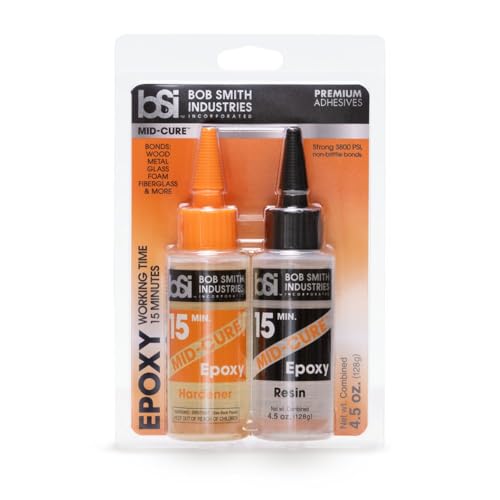
1. Bob Smith Industries BSI-203H Mid-Cure Epoxy
Our pick — over 4.5★ from 900+ verified ratings; the strongest balance of quality and price.
The universal go-to that balances a comfortable working pace with a fast-enough cure.
This is the epoxy that model builders, knife makers, and DIYers keep coming back to because the 15-minute working time is a balance — long enough to position parts carefully, short enough that you are not waiting around. The cure fires off in 30 to 45 minutes, so a small project like reattaching a broken chair leg or filling a crack in a picture frame is ready to handle the same evening, not the next day. Buyers report it “works great and you get a lot of it, dries slow enough to work with but fast enough that I had no problem with drips.”
Unlike the putties below, this is a liquid that flows into tight gaps and saturates porous wood fibers. The resulting bond is tough, rigid, and resists impact well enough for high-stress spots like a tool handle repair. It also bonds to metal, fiberglass, and most plastics, which makes it a smarter choice than the PC-Woody paste if your repair crosses between materials — for instance, gluing a metal bracket back into a wooden frame. The light amber color is barely visible on most finished wood.
Because it is thin, it will run on vertical surfaces if you over-apply. For overhead or large vertical patches, you would want the TotalBoat Thixo or the PC-Woody paste instead. But for 90% of household wood repairs — and at a price that undercuts most competitors — this is the one to keep in the drawer.
Fast curing epoxy
- Fast 30-45 minute cure means you can move on quickly.
- Flows into fine cracks and wood pores for deep adhesion.
- Generous quantity for the cost — buyers consistently call it good value.
- Multi-material bond works on wood, metal, glass, and fiberglass.
Short working time
- Thin liquid consistency can drip on vertical applications if you are not careful.
Quick repairs: you need a fast, strong fix for household wood, crafts, or mixed-material repairs and you want to be done in under an hour.
Large projects: you are filling a deep, gaping hole or working on an overhead surface — a paste or putty will be less messy.
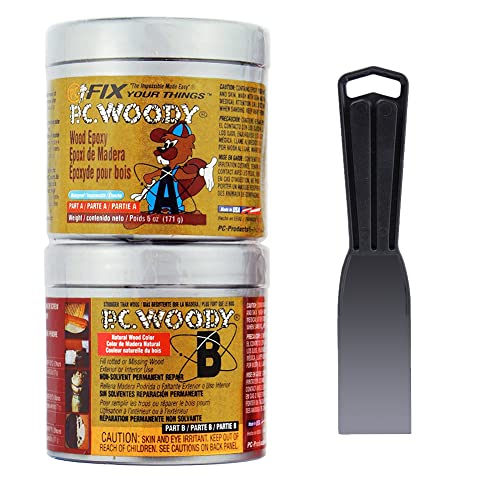
2. PC Products PC-Woody Wood Repair Epoxy Paste Kit, 6 oz
The paste that rebuilds rotted wood to its original shape and strength.
When rot has eaten away a chunk of your window sill or door frame, a thin liquid epoxy will just run through the hole. That is where the PC-Woody paste steps in — it is thick enough to stay put on a vertical surface and stiff enough to build back missing corners. The two-part paste mixes to a high-tack consistency that reduces drips and sags, so an outdoor column repair or a rotted window sill rebuild actually stays where you trowel it. Owners mention it “sets in 24 hours even in cold” and that it “sands very well” once fully cured, accepting paint without a fuss.
The real-world edge over the J-B Weld WoodWeld syringe is scale: with a 6-ounce kit (and the included mixing tool), you can tackle a palm-sized damaged area in one batch. The working window of 30 to 40 minutes at 70°F gives you time to shape and smooth before the chemical reaction stiffens it. Just do not try to mix tiny teaspoon-size batches — the data warns that off-ratio mixing is likely at that scale, which ruins the cure.
The biggest complaint is stickiness. The paste grabs spatulas, fingers, and latex gloves aggressively, so have disposable tools and denatured alcohol ready for cleanup. If your repair is purely cosmetic and superficial — a hairline crack in furniture — the thinner Bob Smith epoxy above will be easier to work with and finish faster.
Filling gaps: rebuilding missing or rotted wood on window sills, door frames, and exterior trim where structural strength and paintability matter.
Thin applications: tiny crack repairs or quick fixes — the sticky paste is messy for small precision work.
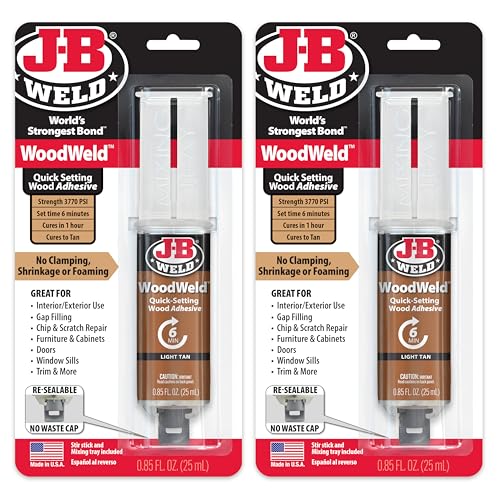
3. J-B Weld WoodWeld Syringe, 25ml 2-Pack
Syringe precision that delivers a bond stronger than the wood itself.
With a tensile strength of 3,770 PSI, this two-part adhesive is the clear brute-force leader of the group. The 1:1 mix ratio is dead simple — push the plunger, stir the equal beads that come out, and you have a consistent batch every time. It sets in 15 minutes and cures fully in about 1 hour, which is dramatically faster than the 24-hour cure of the PC-Woody. Customers note it “dried hard as a rock” and has held trim in place for several months without any give. The light tan color blends into most unfinished wood tones better than a bright white filler would.
Where this syringe really shines over the Bob Smith Industries epoxy is convenience: no measuring, no separate cans, and the resealable cap keeps the mixed product fresh for the next use. It is perfect for jobs where you need to squeeze a bead into a tight crack (like a split pick-axe handle) and walk away. The 25ml 2-pack gives you two separate applications, so you are not rushing against a clock on day two.
The honest trade-off is that it does not take stain well — one owner found it dried shiny and “absolutely wouldn’t take stain.” If the repair needs to match a stained finish, you will want to paint over it or hide it in an inconspicuous spot. And the included mixing paddle is small, so grab a popsicle stick for larger batches.
Precise repairs: you need the fastest, strongest bond for a trim piece, tool handle, or any spot where you want to clamp and be done in an hour.
Big jobs: the repair must match a stained wood finish — the shiny, stain-resistant cured surface is a real limitation.
4. PC-Products PC-Woody + PC-Petrifier Kit
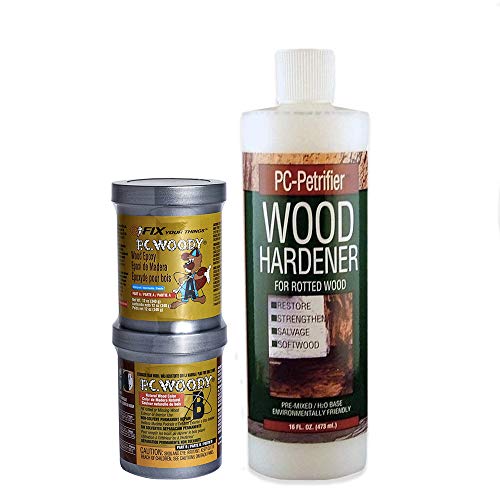
A two-step system that hardens rotten wood first, then fills it.
This is the kit for the ugly stuff — where the wood is so far gone it is spongy. The PC-Petrifier is a water-based liquid hardener that soaks deep into rotted fibers and turns them into a solid, paintable surface. You apply that first, wait 24 hours, and then use the PC-Woody paste (the same formula from product 2 above) to fill in the missing chunks. The result is a repair that screws can bite into, sandpaper can shape, and paint can hide. Reviewers point out that after treatment, “screws now hold firmly” in areas that had turned to dust.
Compared to the single-step products, this is the only option here that addresses both the cause (soft, punky wood) and the solution (structural filler) in one package. The 16 oz bottle of Petrifier goes a long way — you can brush it onto a whole windowsill or door bottom before mixing the 12 oz of paste. Effectiveness is the most-mentioned aspect across customer feedback, with 71 mentions, and the majority call it a “must-buy” for window and door rot.
The downside is the sticky paste frustration that carries over from the standalone PC-Woody. It is “very sticky, hard to smooth,” as one owner put it, and sanding the cured epoxy takes real elbow grease — owners describe it as “hammer-proof” once set. If you are only filling a small screw hole, this kit is overkill and you would be better off with the J-B Weld syringe.
Rot repair: advanced rot that has turned wood soft — the two-step harden-then-fill approach is the only permanent fix for that scenario.
Simple fills: simple cracks or surface damage where a single-component paste or liquid will do the job faster.
5. TotalBoat Thixo Thickened Epoxy Adhesive

The thickened formula that stays exactly where you put it, even on a ceiling.
If you have ever watched thin epoxy run down a vertical door frame and pool at the bottom, you will understand why the Thixo exists. This is a no-mixing cartridge that uses a static mixing tip to combine the two parts as you squeeze, so there is zero measuring error. The gel-like consistency is thick enough to wet out fiberglass but stiff enough that it “does not sag” on overhead or vertical surfaces. The 50-minute working time at 77°F is the longest in this lineup, which professionals and slow workers will appreciate for large or complex shapes.
Where it outperforms the PC-Woody paste is in precision and cleanliness — because it comes out of a caulking-gun cartridge, you can lay a neat bead along a crack without the sticky-finger mess of hand-mixed paste. It cures clear, so it is a better choice when the repair will be visible. And at 100% waterproof once cured, it is the go-to for marine wood repair, boat hull patches, or any exterior application where moisture is constant.
The real drawback is the tool requirement: you need a standard caulking gun to dispense it, and the user must apply strong pressure to get the mixing tip working properly. The price per ounce is higher than the Bob Smith and PC-Woody options, making it more of a specialty purchase for specific vertical or marine work rather than an everyday household epoxy.
Upright repairs: overhead repairs, vertical gaps, and marine settings where a drip-free, waterproof bond is non-negotiable.
Horizontal use: small spot repairs — you need a caulking gun, and the cartridge volume may be more than you need.
6. J-B Weld Wood Restore Premium Epoxy Putty Kit, 32 oz

The putty that rebuilds large missing sections like modeling clay.
When a chunk of wood is just gone — rotted away or snapped off — you need something you can roll into a ball and press into the void. This putty is hand-mixable, meaning you knead the two parts together with your fingers until the color is uniform, then mold it into any shape. It cures to the same density as natural wood, so sanding, drilling, and tapping feel just like working with the real material. It sets in about 40 minutes and cures fully in 60 minutes, which is remarkably fast for a putty this thick.
The volume here is what separates it from the PC-Woody paste: at 32 ounces, it can handle large-scale rebuilds like a rotted porch post or a full window sill. Owners have used it to “repair rotted window sill” and found it “paints like wood.” The brown color is also more natural-looking than the tan of the PC-Woody, so it hides better in unfinished applications. The most-mentioned positive aspect is effectiveness, with 117 mentions, and quality comes second at 86 — suggesting that professionals and serious DIYers consistently choose this for heavy jobs.
The biggest challenge is workability. Owners describe the consistency as “sticky like playdough” and note it is “hard to smooth” with a trowel. It is best used for filling deep voids first, then finishing the surface with a lightweight filler like Bondo. And one buyer issued a counterfeit warning about unsealed cans that never harden — buy from a reputable seller.
Big projects: large structural repairs on exterior wood where you need to rebuild volume quickly and the result must machine and paint like wood.
Small fixes: you are doing a small, cosmetic repair — the sticky putty is unwieldy for fine work.
7. TotalBoat Fixwood Marine Grade Epoxy Putty
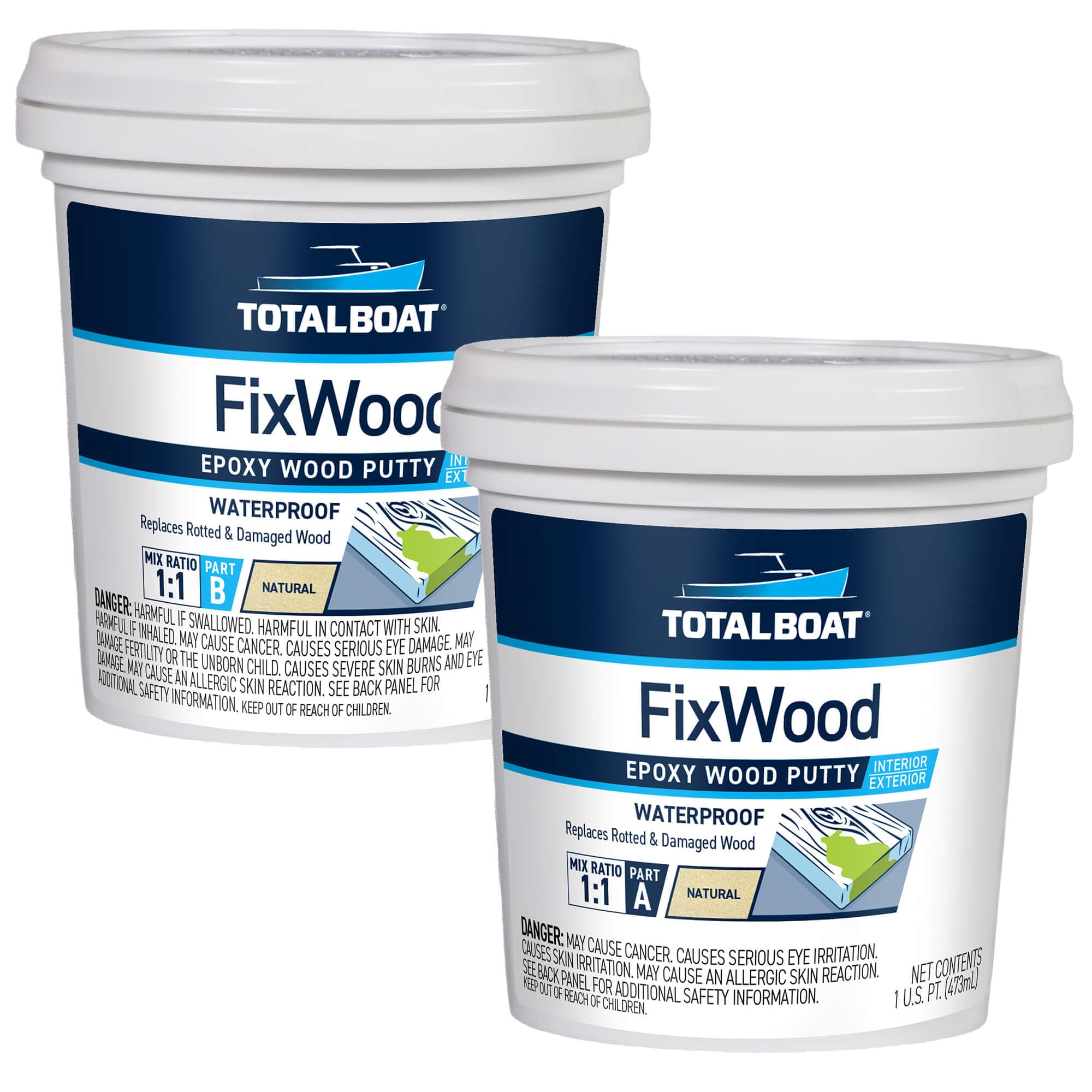
A waterproof putty that carves and stains like real wood after curing.
This marine-grade putty is formulated for the harshest environments — think boat deck repairs, exterior fascia boards, and garage door frames exposed to rain. Mix it in equal parts, and it has a putty consistency that can be molded into any shape without sagging or shrinking. The standout claim is that it can be stained to match the surrounding wood, unlike several other products in this guide that dry to a shiny, stain-resistant finish. Owners confirm it “easily sands and touches up to most any paint or stain.”
Compared to the J-B Weld Wood Restore putty above, Fixwood is more specialized for wet environments. The 100% waterproof claim is backed by its marine label, and the ability to fasten with nails and screws after cure makes it a genuine structural repair rather than a cosmetic fill. The cured putty acts like wood — it can be carved, drilled, and cut — which is why boat builders and woodworkers specifically reach for TotalBoat rather than the PC-Woody paste.
The major catch is the 7-day full cure time, which is the longest in the entire lineup. While the putty hardens enough to sand in a day, full chemical cross-linking takes a week. If you need a same-day repair, this is not the choice. The price per volume is also steep — one owner called it “very expensive” for the coverage, which makes it a poor choice for gaping holes unless you are committed to the marine-grade performance.
Boat repairs: exterior, wet, or marine wood repairs where the repair must be waterproof and stainable to match the surrounding finish.
Indoor use: you need a fast turnaround — the full 7-day cure is a genuine wait.
8. PC Products PC-Woody Wood Repair Epoxy Paste, 48 oz

The same reliable PC-Woody formula in a bulk size for major projects.
This is essentially the same two-part epoxy paste as the 6-ounce kit in product 2, but scaled up to 48 ounces for jobs like rebuilding an entire window frame, filling multiple deck posts, or repairing a set of exterior columns. The formula resists dry rot, UV light, and fresh and salt water, and its high tack means it stays on overhead and sidewall surfaces without sagging — a critical feature for big exterior repairs. Shoppers say it is “easy mix, 45 minute working time, excellent adhesion, sands well” and that it “accepts paint beautifully.”
Where this bulk version truly beats the smaller kit is economy of scale. If you have a large repair that would empty the 6-ounce can in one batch, buying the 48-ounce can costs less per ounce and saves a trip back to the store. The storage is also impressive — owners note a shelf life of 3+ years unopened, so you can keep a can in the workshop for emergencies. The consistency is sticky, just like the smaller version, so the same advice applies: use disposable tools, mix in small batches, and overfill then sand flush.
The working window shrinks noticeably at higher temperatures, and some owners find the 30 to 40 minutes goes fast when you are trying to fill a large area. It is also “hard to sand smooth” if you let it cure proud of the surface — the material is hard enough to require 60-grit sandpaper and significant effort. If you only need a single small repair, the 6-ounce kit is the smarter choice.
Volume work: you have multiple large repairs or one big structural job — the bulk can is the most cost-effective way to stock up.
Occasional use: you only have a single windowsill repair. The 48 oz can will cure before you use it all.
9. Abatron LiquidWood 2-Part Structural Epoxy, 2 Pint Kit
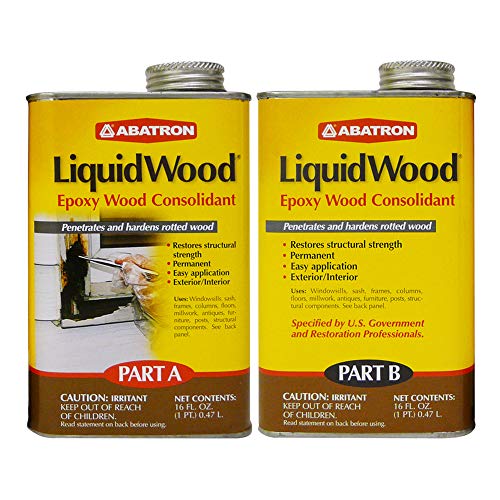
A low-odor liquid that soaks into rotted wood and turns it into plastic.
While most products in this guide sit on top of the wood, the LiquidWood penetrates into the wood cells. It is a low-viscosity liquid epoxy that you brush or pour onto deteriorated wood, where it soaks in and cures into a waterproof plastic structure that is stronger than the original material. It is specifically designed for windows, doors, trim, columns, and posts where the rot has not yet destroyed the shape but has made the wood soft and punky. Owners say it “absorbs into wood cells, curing into a waterproof plastic structure” — a fundamentally different approach from the paste fillers.
The working time of 30 to 45 minutes gives you enough to apply multiple coats if the wood is very porous. Deteriorated wood may need two or three coats to reach saturation. Once cured, you can use the companion WoodEpox compound (sold separately) to fill any remaining voids. The formula is Greenguard Certified with very low VOCs (volatile organic compounds — the smelly chemicals that evaporate from most epoxies), so the odor is minimal and the product is safer for indoor use than the others. Effectiveness is the most-praised aspect — noted 115 times — with buyers calling it “an excellent wood repair system.”
It is a specialty item, not a general-purpose filler. If your wood is still structurally sound but has surface damage, a paste like PC-Woody or the J-B Weld putty will be faster and cheaper. And at the premium price point, it is an investment for serious restoration work rather than everyday patching. Some owners find it “a little thick” and wish it were thinner for better deep penetration — consider thinning with a compatible solvent or using it on wood that is not fully rotted through.
Rot saturation: restoring structurally sound but rotted wood on heritage windows, doors, and trim where you want to preserve the original material rather than replace it.
Surface fills: filling large missing chunks or quick cosmetic fixes — you need the companion WoodEpox for that, and the price is steep for small jobs.
Understanding the Specs
Working Time vs. Full Cure
Working time (also called pot life) is the number of minutes you have to mix, apply, and shape the epoxy before it starts gelling. A 15-minute working time is fine for small repairs; a 50-minute window lets you fill large areas or do detailed molding. Full cure time is how long until the epoxy reaches its maximum hardness and can be sanded, drilled, or painted. A 1-hour full cure is very fast, while a 7-day cure (like the TotalBoat Fixwood) requires patience but yields a tougher final result. These are different numbers, and confusing them is the most common mistake — an epoxy can be firm to the touch in 30 minutes but not fully cured for 24 hours.
Viscosity: Why Form Matters
Epoxy comes in three main textures, and picking the wrong one is a recipe for frustration. Thin liquids (like the Abatron LiquidWood) seep into porous wood fibers and strengthen them from the inside — perfect for soft rot where the wood is still in place but spongy. Pastes (like PC-Woody) are thick enough to fill cracks and gaps without running off vertical surfaces, so you can build back a missing corner. Putties (like the J-B Weld Wood Restore) are the stiffest — you can roll them into a ball and press them into deep holes, then mold them to shape. For a surface crack, use a paste; for a missing chunk, use a putty; for punky rot, use a liquid consolidant.
FAQ
Can I use general-purpose epoxy for wood repair?
How do I prepare rotted wood before applying epoxy?
Will epoxy hold up outdoors in rain and sun?
How long does epoxy last once mixed?
Can I sand and paint epoxy after it cures?
Is epoxy stronger than wood?
Can I use epoxy on pressure-treated wood?
What temperature should I apply epoxy at?
How do I clean up epoxy spills and tools?
Can I use epoxy to repair a load-bearing beam?
Final Thoughts: The Verdict
For most people, the best epoxy for wood repair is the Bob Smith Industries BSI-203H because it combines a fast 30-45 minute cure with a versatile bond that works on wood, metal, glass, and plastic — covering the vast majority of household repairs in one affordable bottle. If you are dealing with deep rot on a windowsill, grab the PC Products PC-Woody 6 oz kit for its sag-resistant paste that sands and paints beautifully. And for a quick, ultra-strong fix on trim or furniture where you want to be done in an hour, the J-B Weld WoodWeld Syringe delivers nearly 4,000 PSI of bond strength without any measuring fuss.
How We Picked
We do not accept paid placement. Every pick is matched to a real buyer and a real use-case; we do not hands-on test units.
Sources & Methodology
Specifications: manufacturer listings and product documentation. Review insights: verified customer reviews, as of July 2026. Pricing: not shown on this page (it changes often); check the current price via the retailer link.
As an Amazon Associate, WellFizz earns from qualifying purchases. This does not affect which products we feature.
Related Guides

Mo Maruf
I created WellFizz to bridge the gap between vague wellness advice and actionable solutions. My mission is simple: to decode the research and give you practical tools you can actually use.
Beyond the data, I am a passionate traveler. I believe that stepping away from the screen to explore new environments is essential for mental clarity and physical vitality.