Our readers keep the lights on and my smoothie glass nicely filled. As an Amazon Associate, I earn from qualifying purchases.
Specs are compiled from manufacturer listings and verified buyer reviews and can change over time — please confirm the key details on the product page before buying.
A power outage that drags on for hours is the moment a generator proves its worth — or its weakness. You are here because you want one source of backup power that handles both gasoline and propane, delivers the clean electricity your electronics need, and runs long enough to last through the night. That narrows the field to dual fuel inverter generators, which pair the convenience of two fuel types with the stable sine-wave output that protects your fridge, furnace, and phone chargers.
I’m Mohammad Maruf — the founder and writer behind WellFizz. This guide is built by comparing the manufacturers’ published specifications and the patterns across verified customer reviews, so you get each pick’s real strengths and trade-offs instead of marketing spin.
The question is which unit gives your home genuine confidence without breaking you financially or waking the neighbors. Here is everything you need to know to pick the right dual fuel inverter generator for home backup.
Our Picks at a Glance


How To Choose The Best Dual Fuel Inverter Generator For Home Backup
The right backup generator does not just turn on — it matches your home’s actual power draw, fits your fuel storage plan, and runs quietly enough that your neighbors do not complain during a multi-day outage. The three specs that decide everything are running watts, THD (Total Harmonic Distortion), and runtime on a single tank.
Running Watts vs. Starting Watts
Your appliances need a burst of power to start motors (refrigerator compressor, well pump, furnace blower) and then less to keep them running. The “running watts” number is the constant load the generator can sustain. The “peak” or “starting” watts handle those brief motor surges. Add up the running watts of everything you plan to power simultaneously — a fridge (700W), a sump pump (800W), lights (300W), and a modem (20W) — and choose a generator whose running watts exceed that total comfortably.
THD and Clean Power
THD stands for Total Harmonic Distortion, a measure of how “clean” the electricity waveform is. Conventional generators often produce THD above 6%, which can damage the internal power supply of modern electronics. Inverter generators keep THD well below 3%, producing a pure sine wave that is just like the power from your wall outlet. That means your laptop, TV, and refrigerator control board are safe.
Fuel Flexibility in a Blackout
Propane stores indefinitely — it does not go stale like gasoline. Gasoline is easier to find in quantity during a storm, but it degrades in as little as three months without stabilizer. A dual fuel generator lets you run a car trip to refill gas cans, then switch to stored propane when supplies run low. Look at the runtime on each fuel at half load to gauge how many refills you will realistically make.
Quick Comparison
| Model | Best For | Running Watts (Gas) | Weight | Runtime (hrs at 25% load) | Amazon |
|---|---|---|---|---|---|
| WEN DF680iXBest Value | EV Level 2 Home Charging | 5,100 W | 99.2 lb | — | Amazon |
| WEN DF360iX | Lightweight RV & Home Backup | 2,900 W | 49 lb | — | Amazon |
| Champion 2500W | Ultra-Quiet LP Runtime | 1,850 W | 43.2 lb | 25 hrs (propane) | Amazon |
| Generac iQ5200 DF | Electric Start with COsense | 3,900 W | 107 lb | 15 hrs (gas) | Amazon |
| DuroMax XP16000iH | Whole-Home Max Power | 13,000 W | 368 lb | — | Amazon |
In‑Depth Reviews
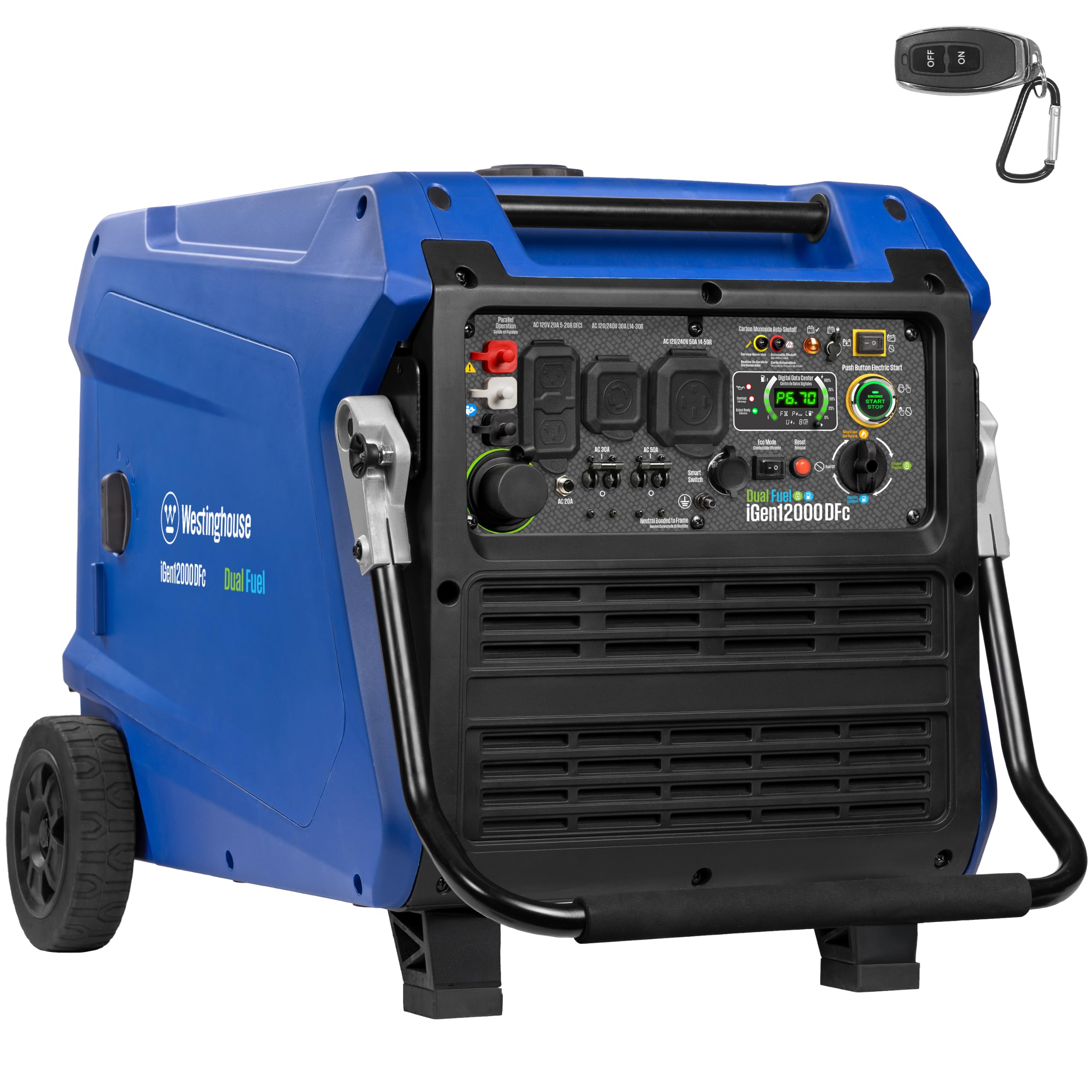
1. Westinghouse 12000 Peak Watt Dual Fuel Portable Inverter Generator
Our pick — over 4.5★ from 650+ verified ratings; the strongest balance of quality and price.
The heavy lifter that runs your whole house and an EV on the side.
This is the kind of power that changes what you consider an outage. The Westinghouse delivers 12,000 peak watts on gasoline and 11,000 peak watts on propane — at 11,000 peak watts on propane versus the Westinghouse 2800W model’s 2,520 peak watts on propane. At 187.4 pounds it is not portable in the grab-and-go sense, but the flat-free tires and foldable handle make it manageable to position near your transfer switch. The real headline is the clean sine wave: buyers report running a full 2,700-square-foot home without strain and charging a Tesla at 20–25 miles per hour through the integrated 50A outlet.
The engine is a 457cc 4-stroke OHV that sips from a 7.9-gallon tank for up to 19 hours at 25% load. That is an overnight run on a single fill, and with Eco Mode matching engine speed to demand, fuel consumption drops noticeably compared to a conventional generator. The CO sensor and low-oil shutdown add layers of automatic safety. Assembly takes minutes — bolt on the wheels and handle, add oil, connect the battery, and the remote key fob fires it from 50 feet away.
The one real-world nuance is that the included break-in oil is not rated for temperatures below 23°F. Owners who run this in a northern winter swap to a 5W-30 synthetic after the first five hours. The LP hose regulator connection can loosen over vibration, so a quick check before each use is smart.
What Powers It Forward
- Truly whole-home output: 9,000W running on gas, 8,100W on propane.
- 50A and 30A twist-lock outlets are transfer-switch ready — no adapter needed.
- Digital display shows fuel level, power output, remaining run time, and lifetime hours.
Where It Gets Heavy
- At 187.4 pounds it demands respect — plan for a stationary home position.
- Fuel efficiency dips noticeably under sustained heavy load despite Eco Mode.
Reach for this if: you need true whole-home backup with enough headroom for a well pump, central AC, and an EV charger all at once.
Think twice if: you need a generator you can toss into a truck bed for camping — this stays parked near the transfer switch.
2. WEN 6800-Watt Dual Fuel RV-Ready Electric Start Portable Inverter Generator (DF680iX)
The mid-weight performer that also charges your electric vehicle at Level 2.
At 99.2 pounds with a telescoping handle and wheels, the WEN DF680iX strikes a rare balance between enough juice for serious home backup and a weight you can actually reel across the garage floor. Its 224cc engine pushes 5,100 running watts on gasoline and 4,500 running watts on propane — enough to handle two 15,000 BTU air conditioners plus lights and a stove fan, as owners have verified. The bonded-neutral 240V configuration enables low-power Level 2 EV charging, a feature almost no other inverter generator at this price point offers.
The electric start fires the unit instantly, and the CO Watchdog sensor automatically shuts everything down if dangerous carbon monoxide levels build up around the generator. Fuel shut-off is built in: a single valve lets you drain the carburetor before storage, preventing the gummed-up jets that plague most generators left sitting. In Eco Mode, owners describe it as quiet enough at 25 feet that you forget it is running — which matters when outages stretch into days.
The catch is that the 240V outlet is the bonded-neutral type, so if you plan to run it through a code-compliant home transfer switch, you will need to unbond the neutral. That is a simple job, but it is worth knowing before installation. A small number of owners mention the 240V outlet failing early, though the three-year warranty covers it.
Smartest middle ground: More power than the portable class yet at 99.2 pounds versus the Westinghouse 12,000W model’s 187.4 pounds — and it charges your EV. The propane efficiency is impressive: owners note a 40-pound tank lasting two weekends for about in fuel costs.
This one fits if: your backup needs cover a decent-size home plus you want EV charging without buying a separate station.
The catch to know: the bonded-neutral 240V requires unbonding for a standard transfer switch, and occasional 240V outlet failures suggest a backup plan for the warranty period.
3. 8000W Dual Fuel Inverter Generator by Gidrox
Premium inverter power with a built-in RV adapter and a 3-year warranty.
This Gidrox unit arrives with a rare combination: a 50A outlet for transfer-switch home backup and a 30A RV adapter (NEMA L14-30P to TT-30R) already in the box — no hunting for separate adapters. With 8,000 starting watts and a 317cc engine, it runs a furnace fan in Eco Mode at under 25% load without breaking a sweat. The pure sine wave output stays below 3% THD, so your laptop, TV, and any medical devices in the house are safe from dirty power.
The fuel tank holds 3.6 gallons, good for up to 9.5 hours at 25% load on gasoline. You can start the unit three ways: push-button electric, a manual recoil backup, or a remote key fob from inside your RV or house. The digital control center handles the CO detection, low-oil shutdown, and overload protection automatically — no mental load on a stressful outage day. At 122 pounds, it is heavy but the wheels and handle make it rollable.
The trade-off is that this is a newer model with a relatively small review sample (24 ratings), so the long-term reliability picture is still forming. The 3-year warranty and 24/7 support do offer some reassurance. A few owners note the electric start needs a battery ground connection check before first use.
What Stands Out
- 50A outlet plus included RV adapter means no extra purchases for home or camper.
- Triple start options: remote, electric, and manual pull.
- Quiet enough at 74 dB to run a furnace in Eco Mode without disturbing the house.
What to Watch
- Young product — 24 reviews is a small data set for a purchase this size.
- At 122 pounds, you will not carry it up stairs; plan for ground-level placement.
Best if: you want a modern inverter with a full suite of outlets and start methods, plus a strong warranty on a new platform.
Not for early adopters who prefer a deep five-year track record before buying a premium generator.
4. WEN 3600-Watt Dual Fuel RV-Ready Portable Inverter Generator (DF360iX)

Barely 50 pounds yet it powers a 15k BTU RV air conditioner with ease.
This is the generator that solves the “I need backup power but I also need to lift it into a truck bed” problem. At 49 pounds and roughly the size of a carry-on cooler, the WEN DF360iX fits into the side compartment of a camper or the corner of a garage shelf. It pushes 3,600 surge watts (2,900 running) on gasoline and 3,500 surge watts (2,600 running) on propane — which owners confirm is enough to run a 15,000 BTU RV air conditioner, a fridge, TV, lights, and phone chargers simultaneously.
What wins people over is the reliability: the customer consensus calls out reliability and noise level as the top two aspects by a wide margin. The 149cc engine starts easily on both fuels, and the WEN Watchdog CO Shutdown Sensor adds a layer of safety that is rare at this weight class. The panel includes a fuel shut-off valve, a TT-30R RV receptacle, two 120V 20A outlets, a 12V DC outlet, and two USB ports. Owners running it on propane report it works flawlessly for days with no carburetor issues — a common complaint in non-inverter dual-fuel generators.
A few owners note the 20A outlets hold plugs a bit loosely, which is annoying but not dangerous. The LP hose includes an extra regulator that the manual does not always show clearly, so read the included diagrams carefully. On a standard 20-pound propane tank, real-world runtime is about 6 hours at moderate load — shorter than the claimed 14 hours but still solid for overnight backup.
The real balance: enough power to run your home essentials (fridge, freezer, sump pump) plus RV gear, all at a weight your back will thank you for. The consistent praise for reliability — 137 positive mentions — tells you this is a unit you can trust when the grid goes dark.
Reach for this if: you need a portable backup that is light enough to move solo, powerful enough for a small house or a travel trailer, and reliable from the start.
Look elsewhere if: you need to run a well pump or central AC — those typically demand 4,000+ running watts.
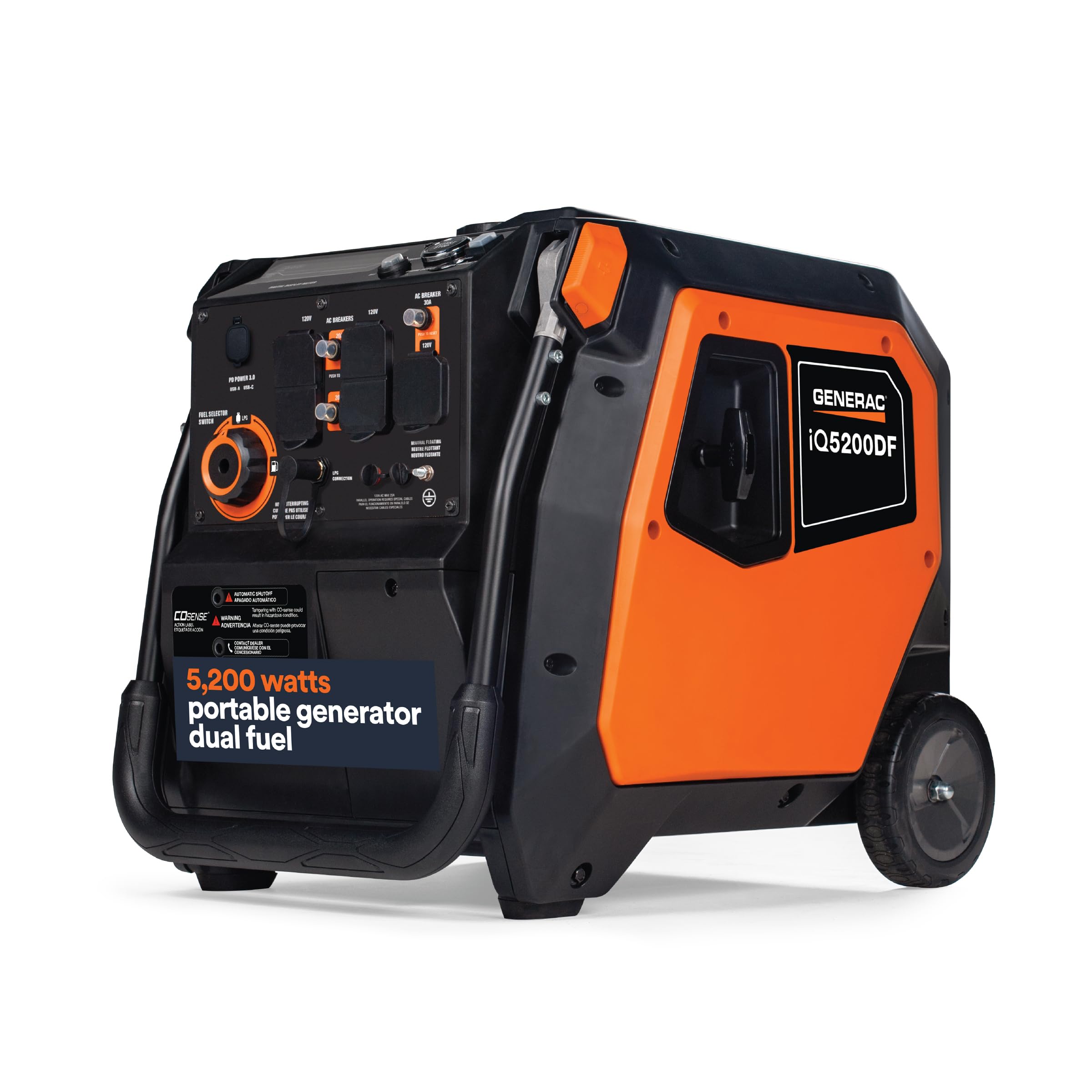
5. Generac 5,200 Watt Dual-Fuel Portable Inverter Generator
Generac’s inverter entry with a reputation for quiet that rivals the Honda crowd.
Generac is a household name in standby generators, and this iQ5200 DF brings that engineering pedigree into a portable, dual-fuel inverter package. It delivers 5,200 starting watts and 3,900 running watts on gasoline, or 4,700 starting and 3,500 running on propane. Owners coming from older non-inverter Generac units are struck by how much lighter and quieter this one is — many say they can lift it into a truck bed alone, and at idle it registers 85–92 dB right next to the unit but drops to 70–76 dB at 12 to 15 feet, which is conversation-level.
The electric start with the included battery eliminates any pull-cord frustration, and the COsense technology automatically shuts the unit down if carbon monoxide builds up around it. The control panel includes a 120V 30A (L5-30R) outlet for RV use, two GFCI 120V 20A outlets, USB-A and USB-C ports, and a clear LED display that shows real-time power output and fuel level. Run time hits up to 15 hours on a full tank of gasoline at 25% load, or 11 hours on a standard 20-pound propane tank at 50% load. The first oil change is at 20 hours, then every 100 hours or annually — easy maintenance.
The handle is known to rattle during transport — a small annoyance that owners solve by wedging something between the handle and the frame. Some have reported a broken regulator on the propane quick-connect line, and Generac’s warranty process for that small part required an inconvenient dealer visit instead of a simple part replacement, which is frustrating for a premium brand.
Why It Stands Out
- Quiet operation that owners compare directly to Honda inverter generators.
- Parallel ready — combine two units for up to 7,800 running watts with the optional kit.
- USB-A and USB-C ports are a modern convenience most generators overlook.
Where It Trips
- Propane regulator issues and a rigid warranty process for small parts.
- Handle rattle during transport — minor but noticeable at a premium price point.
Buy it for: quiet, reliable power from a name you trust, with enough output for a 40-foot camper or a modest home backup setup.
Pass if: you want the lowest-maintenance propane experience — the occasional regulator issue and dealer-only warranty path can be a hassle.
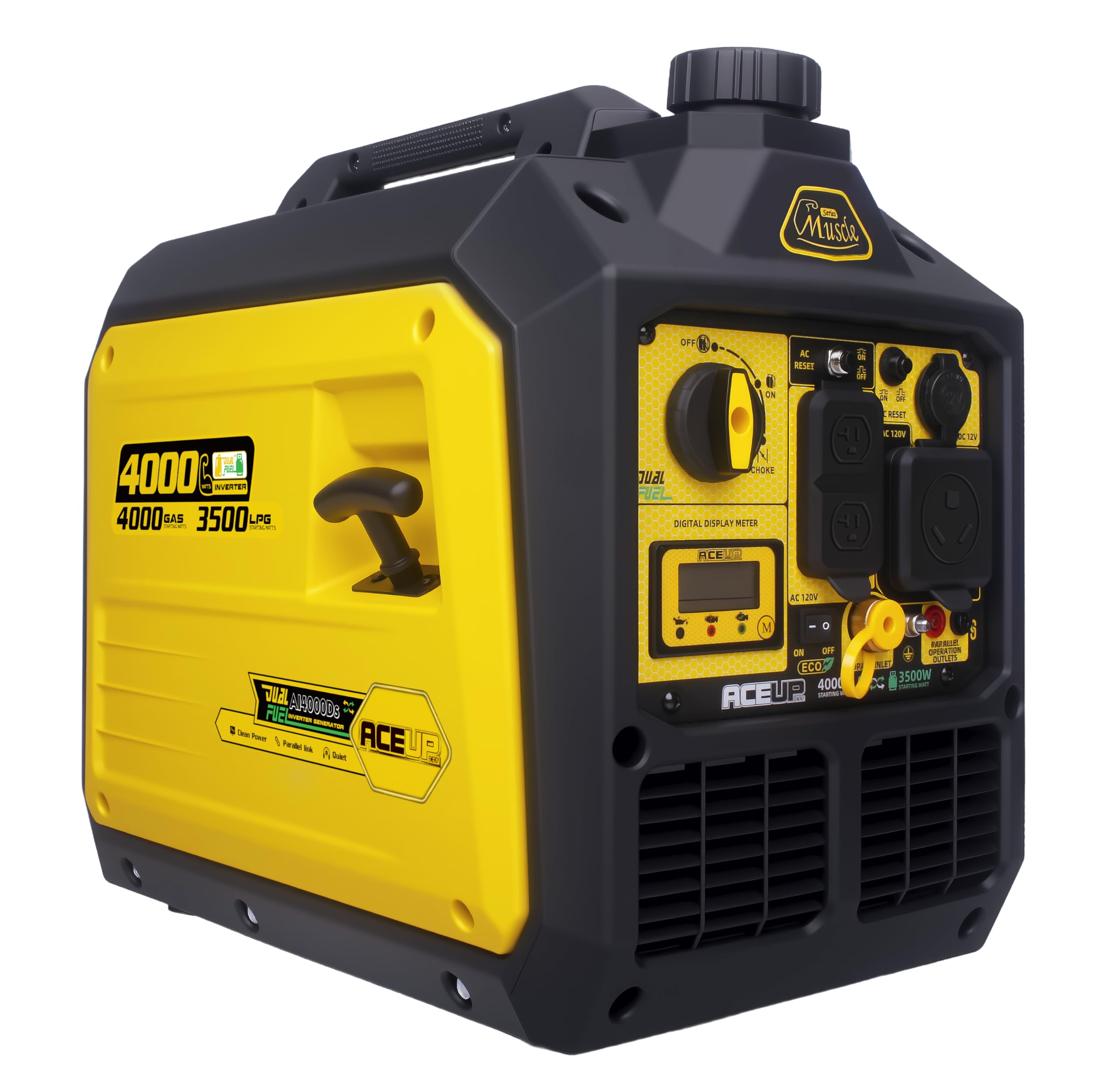
6. Aceup Energy 4000 Watt Dual Fuel Inverter Generator
A legit 4,000W inverter that slips into a camper compartment and starts first pull.
Not every home needs a 180-pound beast. If your backup plan covers a fridge, a few lights, a furnace blower, and a 6,000 BTU window AC unit — which owners confirm this Aceup does — the 4,000 peak watts (3,200 running on gas, 3,000 running on propane) hit the balance The 149cc 4-stroke engine weighs just 51.8 pounds and measures 19.6 inches long, small enough to store in a basement corner or strap in a truck bed for camping.
Noise is a strong point: at 60 decibels in Eco Mode at 23 feet under 25% load, it is quieter than most conversations. The THD stays below 1.5%, making it safer for your phone and TV than many generators twice its price. The control panel includes a 30A RV receptacle, a 12V DC car charger outlet, and a digital gauge that tracks voltage, runtime, and hertz. The recoil start fires on the first pull after the initial oil and gas fill — owners consistently report the ease of startup as a standout feature.
The real gotcha is a tank design issue: if you run it on gasoline with the vent closed tightly, the cooling fuel creates a vacuum that can collapse the tank. The fix is simple — keep the vent open — but the manual does not warn you clearly. A few owners also note the runtime is closer to 5 hours at half load on the 1.32-gallon tank, which is adequate for overnight use if you refill at the 10-hour mark with a backup can.
The honest trade-off: unbeatable value for a true inverter dual-fuel generator under 52 pounds. The tank vent quirk is a one-time learning curve, not a dealbreaker. For small-home or RV backup, this is the budget pick that actually delivers on its specs.
Reach for this if: your budget is tight, your power needs are modest (fridge, lights, small AC), and portability matters.
Pass if: you need sustained high-wattage output or want to avoid any post-purchase learning curve about vent management.
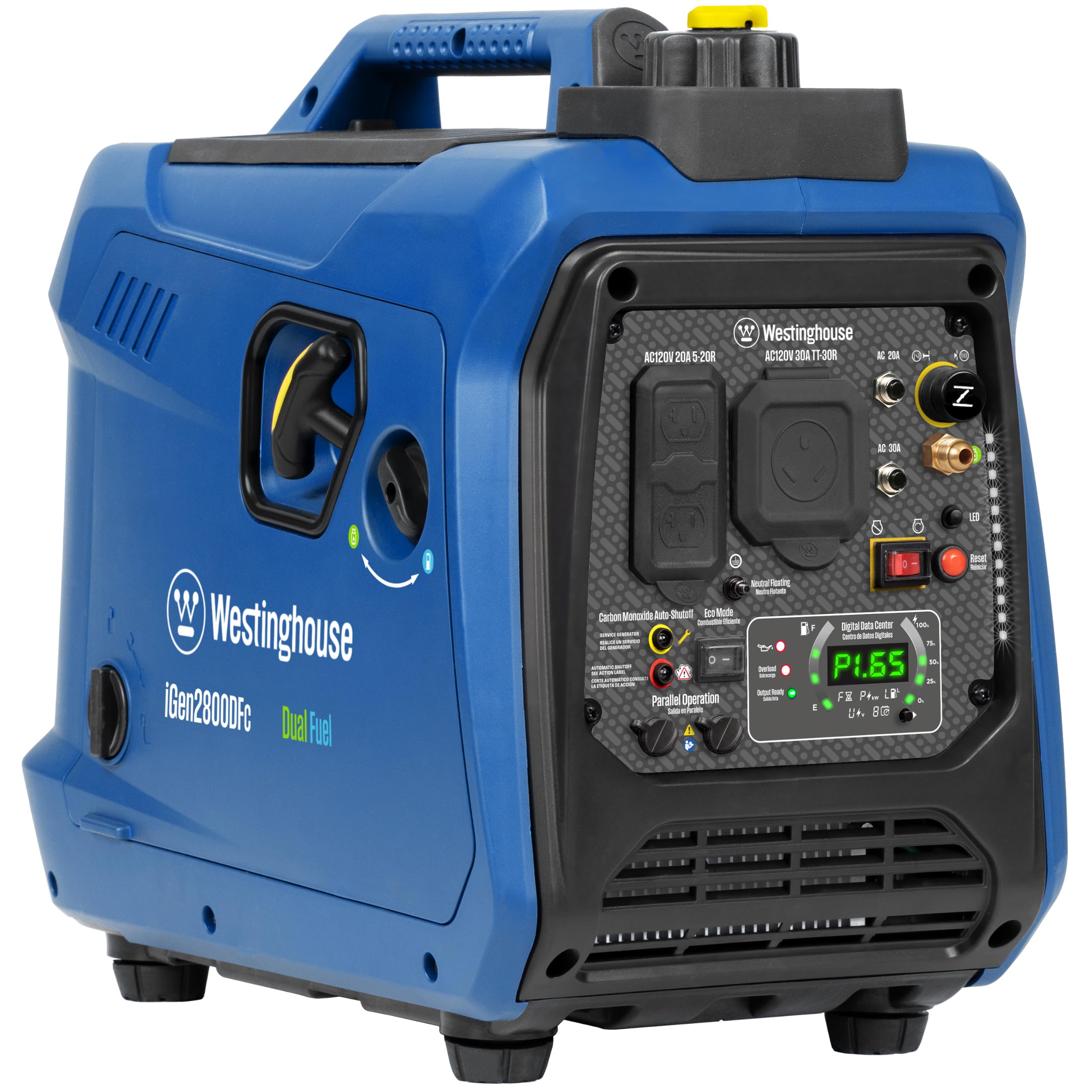
7. Westinghouse 2800 Peak Watt Super Quiet & Lightweight Dual Fuel Portable Inverter Generator
The 45-pound propane whisperer that keeps your fridge running without waking the block.
At just 45 pounds — at 45 pounds versus the Westinghouse 12,000W model’s 187.4 pounds — this is the generator for the home backup buyer who also camps, tailgates, or simply does not have a dedicated garage spot for a 200-pound machine. It delivers 2,800 peak watts and 2,200 running watts on gasoline, or 2,520 peak and 1,980 running on propane. That is enough to run a refrigerator, a sump pump, a few lights, and charge devices throughout an outage, as owners have demonstrated during hurricanes.
The noise level is the real standout: the customer consensus ranks noise level as the top positive aspect with 105 mentions, and at as low as 52 dBA it is genuinely hard to hear from inside the house. The thing everyone raves about is how quietly it sits at a campsite or in a neighbor’s yard. The inverter technology keeps THD below 3%, so your TV and computer are safe. The TT-30R 30A outlet powers an RV directly, and you can parallel two units with a separate cable for full 30A output.
The downsides are specific: a few units arrive with minor shipping damage (smashed air filter, initial spark issues), though most customers note it starts on the first or second pull after the initial oil fill. The customer support experience is mixed — the parts website has been reported as nonfunctional, and callback times are slow. At this weight and price, it is an incredible value for light backup, but plan for self-service on minor issues.
Why It Is Loved
- At 45 pounds, you can carry it one-handed — a genuine life convenience.
- 52 dBA quiet — quieter than a normal conversation, ideal for neighborhoods with noise restrictions.
- Excellent fuel economy: reviewers point out 13–14 hours per gallon on a continuous 1,800W load.
Where It Falls Short
- Customer support and parts ordering have reliability issues — you might be on your own.
- Not enough power for a well pump, central AC, or a whole-house transfer switch.
Perfect for: essential appliance backup (fridge, freezer, lights, phone charging) where noise and weight are the #1 priorities.
Not if: you plan to back up your whole home or run large motor loads — step up to the 5,000W+ class.
8. Champion Power Equipment 2500-Watt Dual Fuel Portable Inverter Generator

The propane specialist that runs 25 hours on a single tank — carburetor jet swaps be gone.
This Champion is the unit you grab if propane is your primary fuel and you want zero carburetor fuss. The 79cc engine produces 2,500 starting watts and 1,850 running watts on gasoline (1,665 running on propane), and it is the propane runtime that separates it: up to 25 hours at 25% load on a standard grill-sized tank. It is also 53 dBA at 23 feet, which is genuinely quiet.
The CO Shield carbon monoxide auto shutoff system is built in, and the 15.4A duplex household outlet delivers clean electricity with less than 3% THD. A 12V regulated automotive-style outlet adds flexibility for charging batteries directly. Setup takes about 15 minutes, and owners switching from other brands note that Champion’s dual-fuel system runs reliably on propane right from the start without needing carburetor jet changes for elevation — a pointed contrast to some competitor units that stumble on LP.
The mixed feedback on dual fuel is real: some shoppers say it only starts reliably on propane after a few tries on gasoline first, and a small number received units with defective coils that required warranty intervention. Champion’s 3-year warranty and free lifetime technical support are solid, but the service process can involve shipping to a repair shop if the local dealer is far away.
The propane endurance champ: if you store propane long-term and want a generator that uses it as a primary fuel rather than a backup option, this Champion is purpose-built for that. The 25-hour runtime on a single 20-pound tank is a real outage-planning advantage.
Reach for this if: propane is your main or only fuel plan and you want the longest possible runtime between refills.
Look elsewhere if: you need to run a household without relying on a secondary gasoline startup — the dual-fuel system here sometimes prefers gas for the first run.
9. AIVOLT 4300W Dual Fuel Inverter Generator
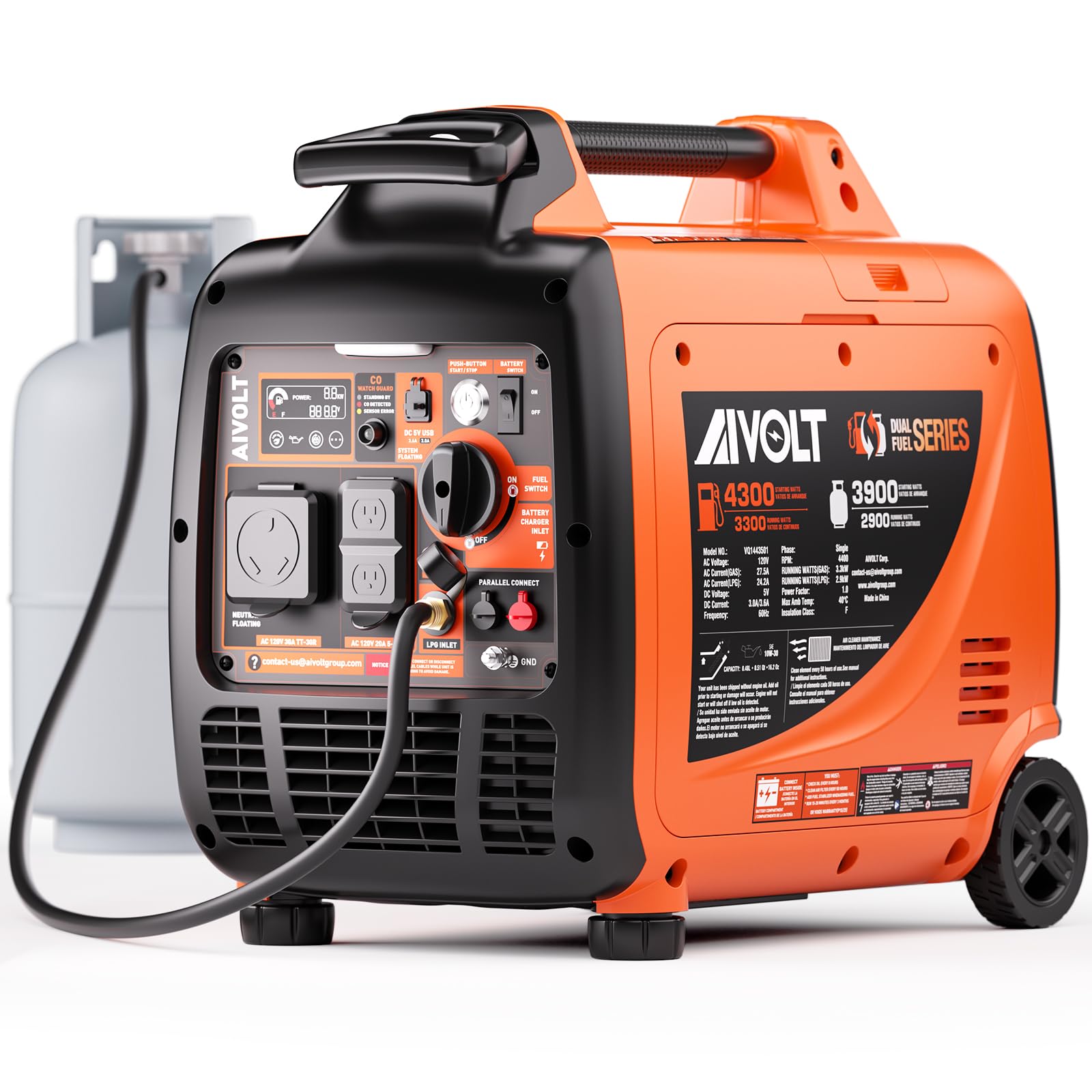
Propane runtime that lasts 34 hours — start it from your RV couch with the key fob.
The headline spec on the AIVOLT is the 34-hour runtime on propane at 25% load, which makes it the endurance leader on this list for LP users. The 4,300 surge watts (clean inverter power) handle a rooftop RV air conditioner and microwave simultaneously, and the electric start with a key fob remote means you never step outside in the rain to crank it. At 64 pounds with built-in wheels and a telescoping handle, it rolls over grass and gravel without feeling like a workout.
The UL2201 and EPA certified CO auto-shutoff and low-oil protection add legitimate safety layers. The dual-fuel auto-switch between gasoline (11.5 hours) and propane (34 hours) means you can run propane all night for silent, low-maintenance operation, then switch to gas for a quick top-up during the day. The parallel capability lets you double the output with a second unit — useful if you upgrade to a larger RV later.
The noise claim of 53 dBA is measured at 23 feet under light load; closer to the unit or under heavy load, buyers report 72–73 dB at 5 feet and around 80 dB right next to the generator — still acceptable but not quite whisper-quiet. A small but notable defect pattern: some units have a propane system issue that requires a full replacement from the manufacturer (handled promptly by customer service, according to affected owners). A few also mention the unit goes into a thermal safety mode if you shut it off hot and try to restart before it cools for an hour — plan your stops accordingly.
The Big Wins
- 34-hour propane runtime — the longest on this list for a portable inverter generator.
- Remote start key fob is a genuine convenience for RV life or bad-weather outages.
- UL2201 certified for carbon monoxide safety — a meaningful certification.
The Real Trade-offs
- Noise at close range (80 dB right next to it) is louder than the 53 dBA marketing implies at distance.
- Thermal restart delay can be frustrating if you need to cycle power quickly.
Ideal for: RV owners who want to run propane all night without refueling, and anyone who values remote start more than absolute decibel silence.
Skip if: you need the quietest possible unit (the Westinghouse 2800W is quieter) or cannot tolerate any chance of a thermal restart delay.
10. DuroMax XP16000iH 16,000-Watt Dual Fuel Portable Digital Inverter Generator
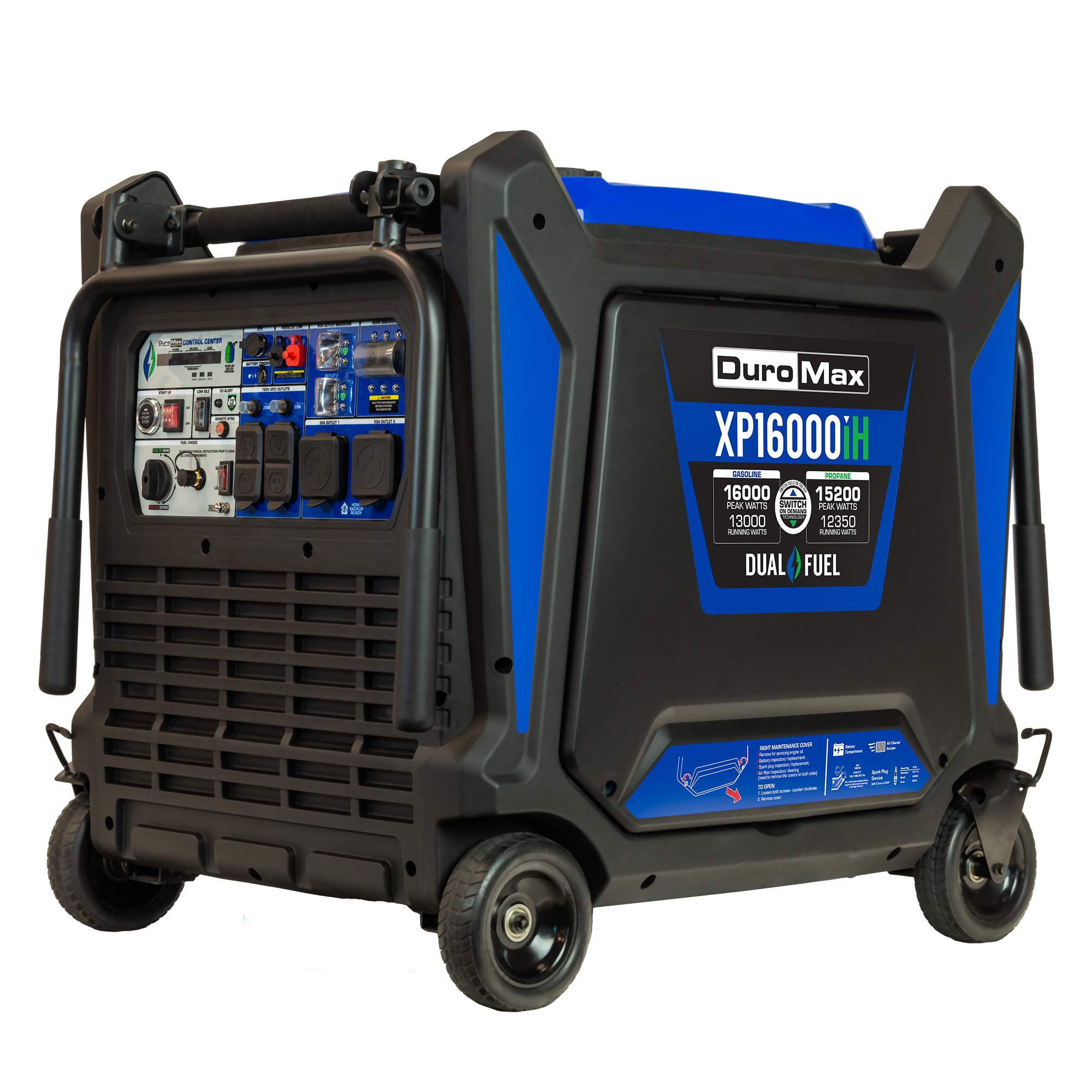
16,000 peak watts of invertor power — runs a mobile sports bar for 12 hours straight.
When “home backup” means the entire house plus a workshop plus a commercial appliance, the DuroMax XP16000iH is the only unit on this list that can deliver. With 16,000 peak watts and 13,000 running watts, it operates on a completely different scale than the rest — this is the generator that runs a 2,000-square-foot house at 6,500 feet elevation without struggling. The 368-pound weight and 38.3 x 30.8 x 34.4-inch dimensions place it firmly in permanent-placement territory, but the handles on both sides and the wheels make repositioning possible with two people.
The dual-fuel system runs on gasoline or propane, and the inverter technology delivers the clean power that sensitive electronics demand at a wattage level most inverters cannot touch. The remote start key fob, battery tender, and digital control center with LCD display (hours run, voltage, load level) are standard. Owners who successfully run demanding setups — mobile sports bars running 8 to 12 hours non-stop without a skip — confirm the raw capability is real. The EPA and CARB compliance means it is legal in all 50 states.
This is where the review data demands honest caution. The 3.6-star rating across only 28 reviews includes reports of excessive metal particles in the break-in oil (indicating premature engine wear), a starter that failed in under 50 hours with only two starts, and one unit that caught fire between the alternator and exhaust during the first break-in. DuroMax’s customer service and Amazon’s A-to-Z guarantee process did not resolve these issues quickly for the affected owners. This is a high-power, high-risk purchase with a small review sample — strong warranty support is critical, and the data suggests it is inconsistent at best.
The honest bottom line: the raw output is class-leading in the inverter generator space, and when it works, it works brilliantly for a full day of heavy use. But the defect rate in the small review pool raises real questions about quality control at this price level. If 16,000 watts is genuinely the minimum you can work with, plan for the possibility of early failure and ensure your purchase channel has a straightforward return path.
Only for: buyers whose power needs genuinely exceed 13,000 running watts and who accept the higher risk profile of a niche product with a limited track record.
Avoid if: you want proven reliability for whole-home backup — a standby natural gas generator from a major brand will serve you better at a similar total cost.
Understanding the Specs
Total Harmonic Distortion (THD)
THD measures how much the generator’s electrical waveform deviates from a perfect sine wave. The wall outlets in your home produce a pure sine wave — 0% THD. Conventional generators can produce 6% to 12% THD, which creates small power fluctuations that can shorten the life of sensitive electronics like modern refrigerators with digital control boards, laptops, and smart TVs. Inverter generators compress this to under 3%, and often as low as 1.5%, making them safe for anything you plug in. If you plan to run any electronics during an outage, insist on an inverter generator with a stated THD below 3%.
Running Watts vs. Peak Watts
Every generator has two wattage numbers. Peak watts (or starting watts) handle the brief surge of power needed to start a motor — your refrigerator compressor, your well pump, or a furnace fan. This surge lasts a second or two. Running watts (or rated watts) is the continuous load the generator can handle indefinitely. The critical rule is that the total running watts of everything you power simultaneously must stay under the generator’s running watt rating — not its peak rating. A typical home backup load (fridge 700W, sump pump 800W, lights 300W, modem 20W, furnace fan 500W) totals about 2,320 running watts. Add a microwave or a window AC and you cross into the 3,000+ range.
FAQ
Can a dual fuel inverter generator power my entire house?
Is propane better than gasoline for home backup?
How quiet is a dual fuel inverter generator really?
Do I need a transfer switch for home backup?
Can I run my RV air conditioner on a dual fuel inverter generator?
What does THD under 3% protect against?
How do I maintain a dual fuel generator that sits unused for months?
Can I parallel two generators for more power?
What does the CO sensor do and do I need it?
How many watts do I need for a refrigerator and freezer during an outage?
Final Thoughts: The Verdict
For most buyers looking for a dual fuel inverter generator for home backup, the Westinghouse 12,000W earns the crown because it truly powers a whole house — including an EV — while running for 19 hours on a single gas fill. If your home is smaller and your budget is tighter, the WEN DF360iX punches well above its weight at 49 pounds with rock-solid reliability. And for RV owners who want to run a 34-hour stretch on propane without refueling, the AIVOLT 4,300W with its remote start is a genuinely clever tool. Whichever you choose, pair it with a proper transfer switch and a propane backup plan — that combination is what turns a generator from a gadget into real home resilience.
How We Picked
We do not accept paid placement. Every pick is matched to a real buyer and a real use-case; we do not hands-on test units.
Sources & Methodology
Specifications: manufacturer listings and product documentation. Review insights: verified customer reviews, as of July 2026. Pricing: not shown on this page (it changes often); check the current price via the retailer link.
As an Amazon Associate, WellFizz earns from qualifying purchases. This does not affect which products we feature.
Related Guides

Mo Maruf
I created WellFizz to bridge the gap between vague wellness advice and actionable solutions. My mission is simple: to decode the research and give you practical tools you can actually use.
Beyond the data, I am a passionate traveler. I believe that stepping away from the screen to explore new environments is essential for mental clarity and physical vitality.