Our readers keep the lights on and my smoothie glass nicely filled. As an Amazon Associate, I earn from qualifying purchases.
Specs are compiled from manufacturer listings and verified buyer reviews and can change over time — please confirm the key details on the product page before buying.
You want big, sweet clusters of blackberries and raspberries, but your brambles need more than just water and sunshine. These plants are heavy feeders that require acidic soil and a steady supply of nutrients to produce a heavy harvest. The wrong fertilizer — one that lacks sulfur or has too much nitrogen — will give you tall, leafy canes with hardly any fruit. This guide covers the top products that give your brambles exactly what they need, from fast-acting liquids to slow-release organic granules.
I’m Mohammad Maruf — the founder and writer behind WellFizz. This guide is built by comparing the manufacturers’ published specifications and the patterns across verified customer reviews, so you get each pick’s real strengths and trade-offs instead of marketing spin.
Knowing which fertilizer for blackberries and raspberries delivers results without burning your plants is the difference between a decent harvest and buckets of fruit you have to give away.
Our Picks at a Glance

How To Choose The Best Fertilizer For Blackberries And Raspberries
Blackberries and raspberries are not heavy feeders in their first year, but once they start fruiting they need consistent nutrition. The wrong N-P-K ratio or a formula without sulfur will produce lots of leaves and very little fruit. Here is what to check before you buy.
The N-P-K Ratio and Why It Matters
The three numbers on every bag tell you the percentage of nitrogen (N), phosphorus (P), and potassium (K). Nitrogen drives leafy growth. Too much nitrogen on an established fruiting bush gives you a monster cane with hardly any berries. Look for a balanced ratio where the middle number (phosphorus) and the last number (potassium) are close to the first — something like 4-3-4 or 5-4-4 is ideal for fruiting brambles.
Sulfur and Soil pH
Blackberries and raspberries prefer a slightly acidic soil pH between 5.5 and 6.5. If your soil is too alkaline, essential micronutrients (like iron) lock up and the leaves turn yellow. Many of the best berry fertilizers include sulfur to help lower the pH naturally.
Granules, Powder, or Liquid — Which Delivery Wins?
Granular fertilizers (like Berry Tone and Down To Earth) are slow-release. You apply them once or twice per season and they break down gradually. They are the most forgiving for beginners. Water-soluble powders (like Jack’s Classic) give you faster results because the nutrients hit the roots immediately, but you have to mix and apply more often. Liquid concentrates (like Bloom City) are the quickest to work but also the most expensive per feeding. Your choice depends on how much hands-on time you want.
Quick Comparison
| Model | Best For | N-P-K Ratio | Form | Weight | Amazon |
|---|---|---|---|---|---|
| Berry Tone Plant Food★ Best Overall | Overall best for brambles | 4-3-4 | Granules | 4 lb | Amazon |
| Espoma Organic Holly-ToneBest Value | Value / acid-loving gardens | 4-3-4 | Granules | 4.1 lb | Amazon |
| True Organic Berry FoodAcid Fixer | Quick pH adjust + feed | 5-4-4 | Granules | 4 lb | Amazon |
| Big A Berries Fertilizer | Small-space & potted berries | — | Powder | 13.5 oz | Amazon |
| Jack’s Classic Acid Special | Rapid growth / foliar feed | 17-6-6 | Powder | 4 lb | Amazon |
| Bloom City Organic Berry | Liquid feed for containers | — | Liquid | 1 gal | Amazon |
| TPS Blueberry Fertilizer | Reviving struggling bushes | — | Liquid | 1 gal | Amazon |
| ENVY Acid-Loving Special | Multi-plant acid garden | — | Powder | 3 lb x 3 | Amazon |
| Down To Earth Acid Mix | Large patch / long season | 4-3-6 | Granules | 25 lb | Amazon |
In‑Depth Reviews
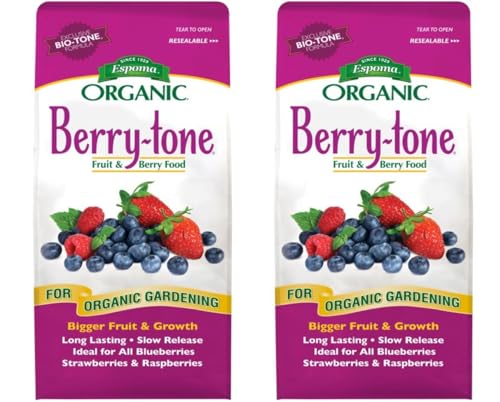
1. Berry Tone Plant Food, 4-3-4, 4-Lbs.
Our pick — over 4.5★ from 450+ verified ratings; the strongest balance of quality and price.
The crowd-favorite granular feed that turns canes into a “drowning in fruit” situation.
This is the product most frequently recommended by experienced berry growers because the 4-3-4 ratio is tuned almost perfectly for brambles. It gives you enough phosphorus (P) to push flower clusters and potassium (K) for fruit size, without the nitrogen (N) overload that produces only leaves. You scatter the granules, which require no mixing, around the drip line twice a year (early spring and late spring) and water them in.
Buyers report bowls of raspberries after one summer application. One owner who forgot to feed their blackberries in the second year saw a dramatic drop in flowers. The Bio-tone formula (Espoma’s proprietary blend of beneficial soil microbes) enhances microbial activity in the soil, which is a rare bonus in a non-synthetic product. The honest trade-off is the smell — the organic ingredients give off a noticeable odor for a day or two after application, though it fades fast.
If you want a single fertilizer that works across blueberries, strawberries, raspberries, and blackberries, this is it. The target species list on the bag names blackberries and raspberries, so you know it is formulated for your patch.
Balanced Berry Boost
- Targeted for all berries including blackberries and raspberries.
- No mixing — apply dry and water in.
- Approved for organic gardening.
- Lasts longer into the growing season than many granular feeds.
Smaller Bag
- The organic odor is strong for the first day or two.
Grab For: Anyone who wants a simple to use, twice-a-season feed that is proven on blackberries and raspberries.
Think Twice If: You are especially sensitive to organic smells near your garden path.
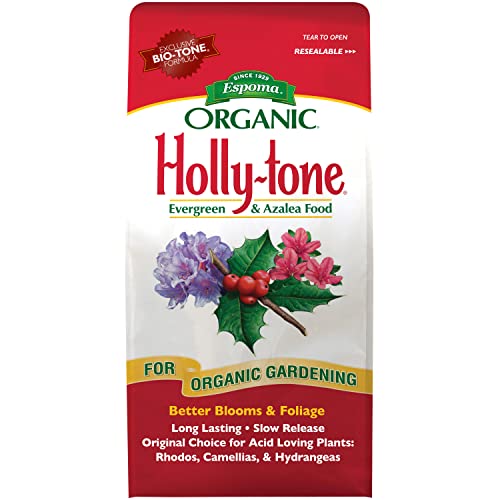
2. Espoma Organic Holly-Tone 4-3-4, 4.1 lb
The original acid-loving plant feed, around since 1929, that keeps blackberry leaves dark green and florists jealous.
Holly-Tone’s reputation is built on results you can see: darker foliage, more blooms, and berries that hold their color longer than your neighbors’ plants. The 4-3-4 ratio mirrors the Berry Tone, and at 4 pounds it weighs the same as the Berry Tone’s 4 lb. The label targets hydrangeas and evergreens, but the 5 percent sulfur and acidic formulation work directly on blackberries and raspberries.
Buyers consistently describe seeing “a marked increase in growth” within a week. One owner noted that their azaleas were still blooming vibrantly while neighboring plants were fading — a sign that the slow-release organics provide sustained nutrition. The downside is that some find it a bit pricey per feeding compared to synthetic alternatives, though the organic certification and the 4-pound weight justify the cost.
If you have a mixed acid-loving garden with hydrangeas or camellias alongside your brambles, this bag feeds everything at once. It is a more economical buy than Berry Tone for the same ratio, if you can overlook the non-berry label.
Organic Holly Blend
- Exclusive Bio-tone formula for root and soil health.
- Works on a wide range of acid plants beyond just berries.
- Ready to use, no mixing required.
Lower Nitrogen
- Some find the per-bag cost higher than non-organic granular feeds.
Reach For This If: You want the original organic formula for an entire acid-soil garden at a budget-friendly per-ounce price.
skip it if: You need a berry-specific label printed on the front — the bag says “Holly & Evergreen” but works perfectly on brambles.
3. True Organic Berry Food, 5-4-4, 4 lb
An organic granular feed that naturally nudges soil pH down while pushing fruit production up.
True Organic Berry Food delivers a slightly higher nitrogen ratio (5-4-4) than the Espoma options, which gives you a small edge in vegetative growth for young canes. But the real story here is the 5-4-4 analysis combined with sulfur — a 5-4-4 ratio compared to the 4-3-4 formulas. The bag covers up to 58 square feet, so it is well-suited for a medium-sized berry patch.
The ingredients list seabird guano and shrimp and crab shell meal, which sounds unusual but delivers a rich micronutrient profile that conventional granules lack. Owners mention almost instant results — within a couple of days on blueberries, raspberries, and strawberries. One owner described their berries “tripling in size.” The 4-pound weight is standard, but the higher N-P-K density means a little goes further per feeding. The smell is more noticeable than standard organic blends.
If your soil is borderline neutral or you have noticed yellowing leaves (a classic sign of high pH locking out iron), this is the best bet for correcting that imbalance while feeding.
Higher Potassium: 5-4-4 analysis with sulfur — a 25% higher nutrient density than the 4-3-4 formulas.
Not Organic: The organic smell from guano and shell meal is stronger than less potent blends.
Best For: Gardeners dealing with slightly alkaline soil who need both a pH correction and a nutrient boost in one application.
Not For: Anyone who prefers odorless applications or already has very acidic soil.
4. Big A Berries Fertilizer Nutrients, 13.5 oz

A small-package powder that punches above its size, especially for container brambles.
This is the smallest product in the lineup — 13.5 ounces in a resealable pouch — but it is formulated specifically for berries including blackberries, raspberries, strawberries, and blueberries. Unlike the granular options, this is a powder that you mix with water. The advantage is precision: you can tailor the concentration to the age and size of each plant.
Buyers at high elevation reported that two applications (late May and June) plus pruning produced berries so perfect they looked “like AI made them.” Another owner noticed new leaf growth within days. Because it is a water-soluble mineral supplement rather than a slow-release granule, you have to apply it more often (at first bud, then when fruit starts forming). The main complaint is availability — it can go out of stock, so grab it when you see it.
If you only have a few bushes in raised beds or pots, this 13.5-ounce pouch gives you concentrated power without the bulk of a 4 lb bag.
Compact Size: High-concentration powder that shows leaf and fruit changes within days, ideal for small-space growers.
Low Volume: Runs out of stock intermittently; buy ahead of the growing season.
Perfect For: Container gardeners and anyone with a small berry patch who wants a fast-acting liquid feed.
Consider Something Else If: You have a large in-ground patch — the small pouch will not stretch that far.
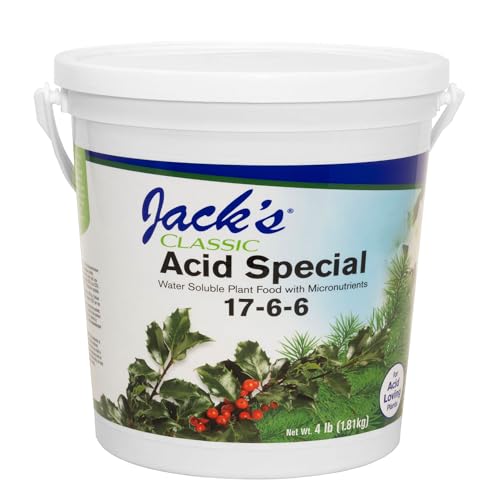
5. Jack’s Classic 17-6-6 Acid Special, 4 lbs
A water-soluble powerhouse that delivers rapid green-up and bloom set when brambles need a shot in the arm.
Jack’s Classic Acid Special is a completely different animal from the organic granules. The 17-6-6 analysis is dramatically higher in nitrogen, so this is not a maintenance feed — it is a booster for established canes that are lagging. The high iron and sulfur content targets acid-loving plants specifically, and it works as a foliar spray or a root drench. A 4-pound bag of powder concentrate makes many gallons of liquid fertilizer, so the sticker price goes further than it looks.
Buyers who switched to Jack’s after using organic blends saw immediate results: new whips (the long, vigorous canes that produce next year’s fruit) appeared weeks faster. One owner described it as a “shot in the arm” for struggling bushes. The included measuring spoon takes the guesswork out of mixing. The downside is the high nitrogen — if you apply it too late in the season or too frequently, you will get leafy canes at the expense of fruit. Use it only in early spring.
This is the specialist pick for growers who want to push vegetative growth on young or stressed plants before switching to a lower-N formula for fruiting.
Strong Acidifier
- 17-6-6 ratio with added micronutrients for fast, visible results.
- Can be used as root drench or foliar feed.
- Each 4 lb bag makes many gallons of liquid fertilizer.
- Comes with a measuring spoon for easy mixing.
Synthetic Mix
- High nitrogen can encourage too much leaf growth if used late in the season.
Grab It For: Reviving weak canes or pushing fast growth on first-year blackberry and raspberry plants.
pass on it if: You prefer a single all-season organic feed — this is a targeted tool, not a maintenance routine.
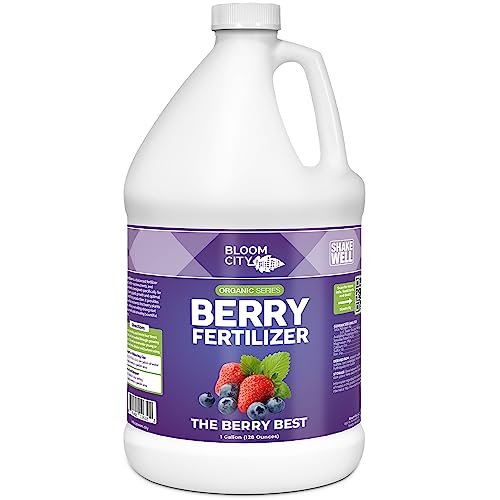
6. Bloom City Organic Berry Fertilizer, 1 Gallon
A concentrated liquid that reaches roots instantly — no waiting for granules to break down.
Bloom City’s liquid organic fertilizer is the obvious choice if you want fast results without the guesswork. It comes as a 128-fluid-ounce concentrate (1 gallon) and mixes at a ratio roughly around 1:10 with water. Because it is liquid, the nutrients are immediately available to the root zone the moment you water it in. This is especially useful for container-grown blackberries and raspberries, where granular feeds can sometimes sit on top of the potting mix without penetrating.
Customers note excellent results on strawberries and blueberries, and the same formulation supports blackberries and raspberries. One owner using 3 tablespoons per gallon every two weeks saw new growth and fruit development within three weeks. The 8-pound jug is heavy, but it lasts longer than the small 13.5-ounce powder packs for the same price tier. A small minority note the smell is “weird but not the greatest” — a common trait for liquid organics. Effectiveness is the most-mentioned positive aspect, with 27 counts of praise.
If you grow in raised beds or containers where soil microbes are less active, liquid organic feed gives your plants a direct nutrient line that granules cannot match.
Liquid Ready: 128 fluid ounces (1 gallon) of concentrated liquid — enough for many weeks of biweekly feedings.
Large Bottle: Odor gets mixed reviews; some find it noticeable, others say very little smell.
Best For: Container and raised-bed growers who want an organic liquid feed that starts working immediately.
Not For: Large in-ground patches where the cost per feeding is higher than granular alternatives.
7. TPS Blueberry Fertilizer Liquid, 1 Gallon
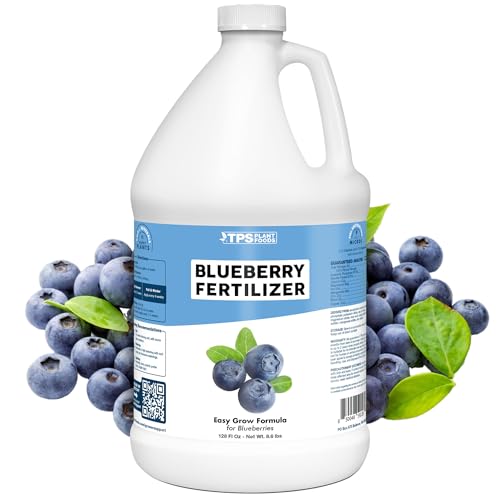
The liquid lifeline for a dying bush — reviewers point out it “perked up” in days.
TPS Nutrients designed this specifically for blueberries, but the same acid-loving formulation works directly on blackberries and raspberries. The mixing ratio is simple: 2 tablespoons per gallon of water or 1 teaspoon per quart. Like Bloom City, it delivers nutrients instantly to the root system. what separates it is the number of success stories about saving plants on the brink — a dying blueberry bush perked up and started “growing like crazy again” within days, according to one reviewer.
The bottle is a full 128 fluid ounces (1 gallon) and weighs 8 pounds, giving you a long season of feedings. The product target species says “Blueberry” on the label, but the results cover blackberries and raspberries in practice. The effectiveness aspect gets 21 counts, and fruit growth gets 12. One buyer notes that this product may not lower soil pH significantly on its own — if your soil is very alkaline, you might need a separate acidifier or pine wood chip mulch alongside it.
This is the pick for the owner who has one sad-looking bush and needs to see improvement in a week, not a month.
Blueberry Focus: Fast-acting liquid that buyers use to rescue struggling acid-loving plants with visible results in days.
Liquid Only: May not lower pH significantly on its own — pair with organic mulch if your soil is highly alkaline.
Perfect For: Saving a single stressed plant or giving a quick boost to established bushes between granular feedings.
Consider Something Else If: You need a heavy soil-acidifier built into the same product.
8. ENVY Plant Foods Acid-Loving Special, 3 lb x3
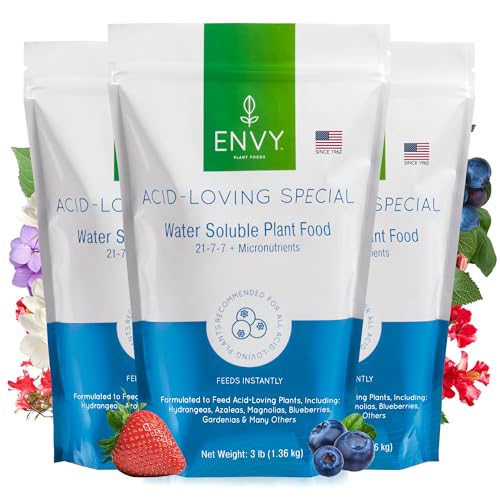
Three resealable pouches of water-soluble powder — one for now, two for later in the season.
ENVY’s Acid-Loving Special comes as a 3-pack of 1-pound resealable pouches, so you get 3 total pounds of water-soluble powder. This format is convenient if you want to keep one pouch in the shed and store the rest without worrying about moisture clumping granules. The product is 100 percent water soluble and includes a measuring scoop.
Shoppers say that a spring application led to significantly boosted hydrangea blooms, and blueberries came through “great” in the same season. The resealable pouch design earns praise because it keeps the powder dry between uses. Because it is a multi-pack, the cost per pouch is higher than buying a single bulk bag, but the convenience of three discrete units is what you are paying for. The formula targets acid-loving plants broadly, which includes blackberries and raspberries.
If you split your garden into zones and want to keep a dedicated feeding pouch for each section (ornamentals, berries, shrubs), this three-pack is neatly purpose-built for that.
Triple Pack: Three separate 1 lb resealable pouches — no risk of a soggy bag mid-season.
Heavy Weight: Per-pound cost is higher than buying a single 4 lb bag of powder.
Best For: Gardeners who like organization — one pouch for berries, one for hydrangeas, one stored for backup.
Not For: Growers on a strict per-pound budget who want the cheapest concentrate.
9. Down To Earth Acid Mix 4-3-6, 25 lb
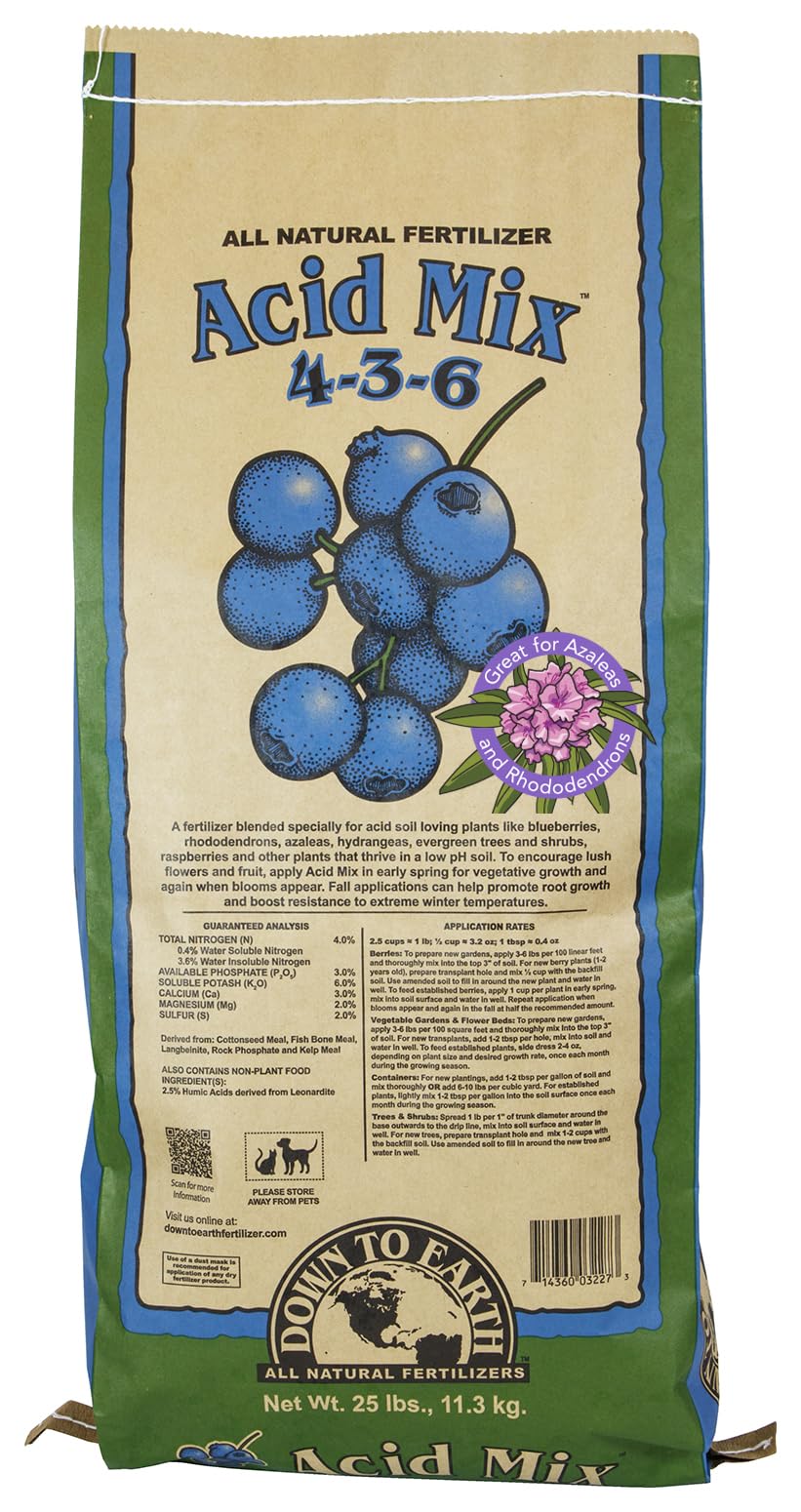
A 25-pound bulk bag that feeds a serious berry patch for seasons without running out.
Down To Earth Acid Mix is the heavy lifter of this list — 25 pounds of all-natural granules with a 4-3-6 formulation. The potassium (the last number) is the highest of any product here at 6, which directly supports fruit size, firmness, and disease resistance in blackberries and raspberries. The ingredients are cottonseed meal, langbeinite, fish bone meal, rock phosphate, humates, and kelp meal — all organic inputs that feed both the plant and the soil microbiome.
The bag lists raspberries, blueberries, and strawberries on the label alongside ornamentals, so it is officially approved for what you need. Buyers who have used it for years on their berry bushes describe it as “great stuff” that produces lush foliage and heavy fruit set. The 25 pounds will last a couple of seasons for most home growers, making the per-feeding cost significantly lower than smaller bags. The one caveat is that for initial planting in very alkaline soil, you may need a soil acidifier alongside it to drop the pH to 4.5; this formula maintains acidity rather than drastically changing it.
If you have a large in-ground patch of blackberries and raspberries — say, a dozen or more bushes — this is the most economical and effective seasonal feed you can buy.
Bulk Value
- 25 lb bag — the largest capacity, ideal for big patches.
- 4-3-6 ratio with boosted potassium for fruit size.
- All-natural ingredients including kelp meal and fish bone meal.
- Lasts multiple seasons for most home growers.
Huge Bag
- Requires a separate strong acidifier if your soil pH is significantly above 6.5 at planting.
Reach For This If: You have a large established berry patch and want the lowest cost per feeding in the long run.
it’s not for you if: You only have a couple of bushes — the 25 lb bag is more storage commitment than you need.
Understanding the Specs
N-P-K Ratio — The Three Numbers
The three numbers on a fertilizer bag stand for nitrogen (N), phosphorus (P), and potassium (K). Nitrogen drives leaf and cane growth — too much gives you tall, leafy brambles with few berries. Phosphorus supports root development and flower clusters. Potassium boosts fruit size, sweetness, and disease resistance. For blackberries and raspberries, a balanced ratio like 4-3-4 or 5-4-4 works well. A higher potassium number (like the 6 in Down To Earth’s 4-3-6) is especially good for fruit production.
Water-Soluble vs. Granular
Granular fertilizers (like Berry Tone or Down To Earth) release nutrients slowly as soil microbes and moisture break them down. You apply once or twice per season. Water-soluble powders and liquids (Jack’s Classic, Big A, Bloom City) deliver nutrients to the roots immediately after watering. They work faster but need more frequent application — usually every one to two weeks during the growing season. Granular is better for low-maintenance feeding; liquid is better for correcting a specific problem fast.
Sulfur and Soil pH
Blackberries and raspberries thrive in slightly acidic soil, ideally between pH 5.5 and 6.5. If the pH creeps above 7.0, iron and manganese become unavailable and the leaves turn yellow. Many berry-specific fertilizers include sulfur to lower pH naturally. Products like True Organic Berry Food and Espoma Holly-Tone both contain sulfur. If your soil is already very acidic, you do not need extra sulfur — look for a feed without it.
Organic vs. Synthetic — Which Matters More for Berries?
Both work, but organic fertilizers (like those from Espoma, Down To Earth, and True Organic) improve soil structure and microbial life over time. Synthetic fast-release formulas (like Jack’s Classic) give faster green-up but do not build long-term soil health. For fruiting plants that stay in the ground for years like blackberries and raspberries, organic is generally better for sustained production. If you are growing in containers where soil is replaced annually, synthetic can be fine.
FAQ
When should I fertilize my blackberries and raspberries?
Can I use a general-purpose garden fertilizer on my berry bushes?
How much fertilizer does one blackberry or raspberry bush need?
What happens if I use a fertilizer without enough potassium?
Should I fertilize first-year blackberry and raspberry plants?
Can I mix two different berry fertilizers together?
How long does a 4-pound bag of granular fertilizer last?
What is Bio-tone and why does it matter?
Do I need to water after applying granular berry fertilizer?
Final Thoughts: The Verdict
Across the board, the fertilizer for blackberries and raspberries winner is the Berry Tone Plant Food because it is specifically formulated for brambles, requires no mixing, and delivers consistent results with just two applications per season. If you want an even more economical option that also feeds hydrangeas and evergreens, the Espoma Organic Holly-Tone is the value king at 4 pounds. And for large patches where you need bulk and potassium-heavy fruit support, the Down To Earth Acid Mix 25 lb bag is the one to reach for — it will keep your berry patch producing for seasons to come.
How We Picked
We do not accept paid placement. Every pick is matched to a real buyer and a real use-case; we do not hands-on test units.
Sources & Methodology
Specifications: manufacturer listings and product documentation. Review insights: verified customer reviews, as of July 2026. Pricing: not shown on this page (it changes often); check the current price via the retailer link.
As an Amazon Associate, WellFizz earns from qualifying purchases. This does not affect which products we feature.
Related Guides

Mo Maruf
I created WellFizz to bridge the gap between vague wellness advice and actionable solutions. My mission is simple: to decode the research and give you practical tools you can actually use.
Beyond the data, I am a passionate traveler. I believe that stepping away from the screen to explore new environments is essential for mental clarity and physical vitality.