Our readers keep the lights on and my smoothie glass nicely filled. As an Amazon Associate, I earn from qualifying purchases.
Specs are compiled from manufacturer listings and verified buyer reviews and can change over time — please confirm the key details on the product page before buying.
If the power goes out, you need something that keeps your fridge running, your phone charged, and your family comfortable — without drowning out conversation or filling your yard with fumes. But the real question is whether you are better off with a traditional gas inverter generator or a modern battery power station that runs silently indoors. This guide covers both approaches, from ultra-quiet portable stations to whole-home backup units, so you can pick the right match for your situation.
I’m Mohammad Maruf — the founder and writer behind WellFizz. This guide is built by comparing the manufacturers’ published specifications and the patterns across verified customer reviews, so you get each pick’s real strengths and trade-offs instead of marketing spin.
After analyzing the specs and thousands of owner experiences across eleven models, here are the best electric generator options available right now for every use case — from a silent 39.5-pound battery station that runs a fridge for over 21 hours to a tri-fuel beast that keeps an entire house running on natural gas.
Our Picks at a Glance
How To Choose The Best Electric Generator
The first fork in the road is fuel type. Gas-powered generators give you high wattage and long runtime for the dollar, but they produce exhaust — so you operate them outdoors only. Battery power stations (often called solar generators) run silently indoors with zero fumes, but their stored energy is limited, and recharging takes hours. Your choice depends on what matters more: uninterrupted runtime during a multi-day outage, or safe silence in an apartment or a camper van.
Running Watts vs. Peak Watts
Every generator advertises a peak wattage — the very brief burst it can deliver to start a motor (like a refrigerator compressor or an air conditioner). The running watts are what it can sustain for hours. The running number is the one that decides whether your generator actually works for you. A refrigerator typically needs 600–800 running watts; a 15,000 BTU RV air conditioner needs around 3,000 running watts. Add up everything you want to run at once, and choose a generator whose running wattage comfortably exceeds that total.
Clean Power (Total Harmonic Distortion)
If you plan to plug in a laptop, TV, smartphone, or any modern electronics, you need what is called inverter technology. Inverters produce clean power with less than 3% total harmonic distortion (THD), which means the electricity is as smooth as what comes from your wall outlet. A generator without inverter technology can send raw, dirty power that fries sensitive circuits. Every model on this list is either an inverter generator or a pure sine wave battery station — your electronics are safe.
Fuel Type and Runtime
Gas powered generators are the most common and offer the best price per watt. A dual-fuel or tri-fuel generator lets you switch to propane or natural gas, which store indefinitely and burn cleaner. Battery power stations give you instant power with no fuel to store, but once the battery is empty — typically after 10 to 24 hours under normal household loads — you need a wall outlet or solar panels to recharge. Think about the longest outage in your area and whether you can realistically repower a battery station during that time.
Quick Comparison
| Model | Best For | Rated Watts | Weight | Fuel Type | Amazon |
|---|---|---|---|---|---|
| EcoFlow DELTA 3 Classic★ Best Overall | Silent indoor backup | 1800W | 26.7 lbs | Battery | Amazon |
| Oxseryn 4400W InverterTop Value | Heavy load / RV 30A | 3400W | 56 lbs | Gasoline | Amazon |
| Oxseryn 2800W InverterQuiet Cruiser | Quiet camping & travel | 2000W | 39 lbs | Gasoline | Amazon |
| WEN 3600W Inverter | Reliable entry-level RV | 2900W | 46 lbs | Gasoline | Amazon |
| WEN DF360iX Dual Fuel | Flexible fuel RV backup | 2900W (gas) / 2600W (propane) | 49 lbs | Gas + Propane | Amazon |
| Champion 4000W Inverter | Lightest 4000W class | 3000W | 48.1 lbs | Gasoline | Amazon |
| Jackery Explorer 2000 v2 | Lightest 2kWh battery | 2200W | 39.5 lbs | Battery | Amazon |
| Westinghouse iGen5000c | Remote-start RV & home | 3900W | 105.8 lbs | Gasoline | Amazon |
| DuroMax XP13000HXT | Whole-home tri-fuel | 13,000W (peak) | — | Gas + Propane + NG | Amazon |
| EcoFlow DELTA Pro | Max-capacity battery rig | 3600W | 99 lbs | Battery | Amazon |
| Westinghouse iGen12000DFc | Whole-home dual-fuel inverter | 9000W (gas) / 8100W (propane) | 187.4 lbs | Gas + Propane | Amazon |
In‑Depth Reviews
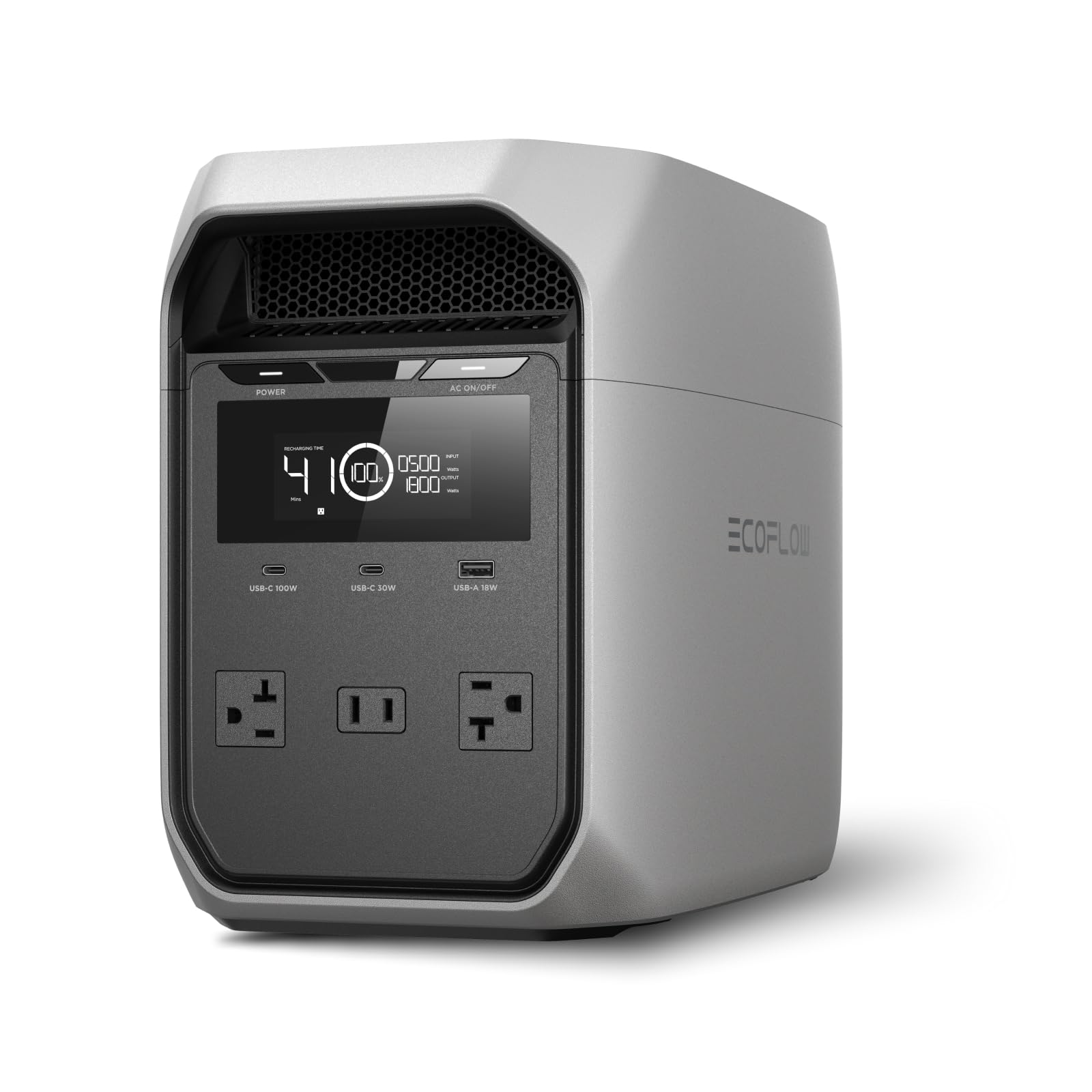
1. EF ECOFLOW Portable Power Station Delta 3 Classic
Our pick — over 4.5★ from 950+ verified ratings; the strongest balance of quality and price.
The silent, fume-free backup that fits under a desk and charges in under an hour.
This battery station delivers 1800W of output (3600W surge via X-Boost) from a compact 26.7-pound package — a fraction of the weight of a gas generator of similar capability. The 1024Wh LiFePO4 battery is rated to last over a decade with daily use, and the real a neat extra is the charging speed: it goes from zero to 80 percent in just 45 minutes. One owner summed it up: “It charges fully in about one hour, which is much faster than I expected.” That means you can power a refrigerator, a few laptops, and a modem through a blackout and have the station ready to go again from a wall outlet during a lull.
The sub-10ms UPS mode is a hidden gem for anyone with sensitive electronics — this generator switches to battery so fast that a desktop PC or a medical device never blinks. You also get a USB-C port delivering 100W, six total outlets, and full app control for scheduling and monitoring. It is 26.7 pounds versus the 57 pounds of the Oxseryn 4400W gas generator next in line, which is a 2.1x weight difference. The trade-off is that this is a finite battery: once the 1024Wh is depleted, you need grid power or a solar panel to refill. For multi-day outages without a solar panel, a gas generator offers longer continuous runtime.
portable power station
- Ultra-fast charging — 0 to 80% in 45 minutes.
- Versatile 6 outlets including 100W USB-C.
- Sub-10ms UPS protects computers and medical gear.
- Weighs just 26.7 lbs, so it moves room to room easily.
limited capacity
- Battery capacity is finite; not for days-long heavy loads without solar or wall recharging.
balance for home: Anyone wanting zero-fume, whisper-quiet backup for a fridge, devices, and lights — especially apartment dwellers, van-lifers, and home-office setups.
heavy for trips: You need to run a central air conditioner or heavy-duty tools for 24 hours straight without access to recharging.
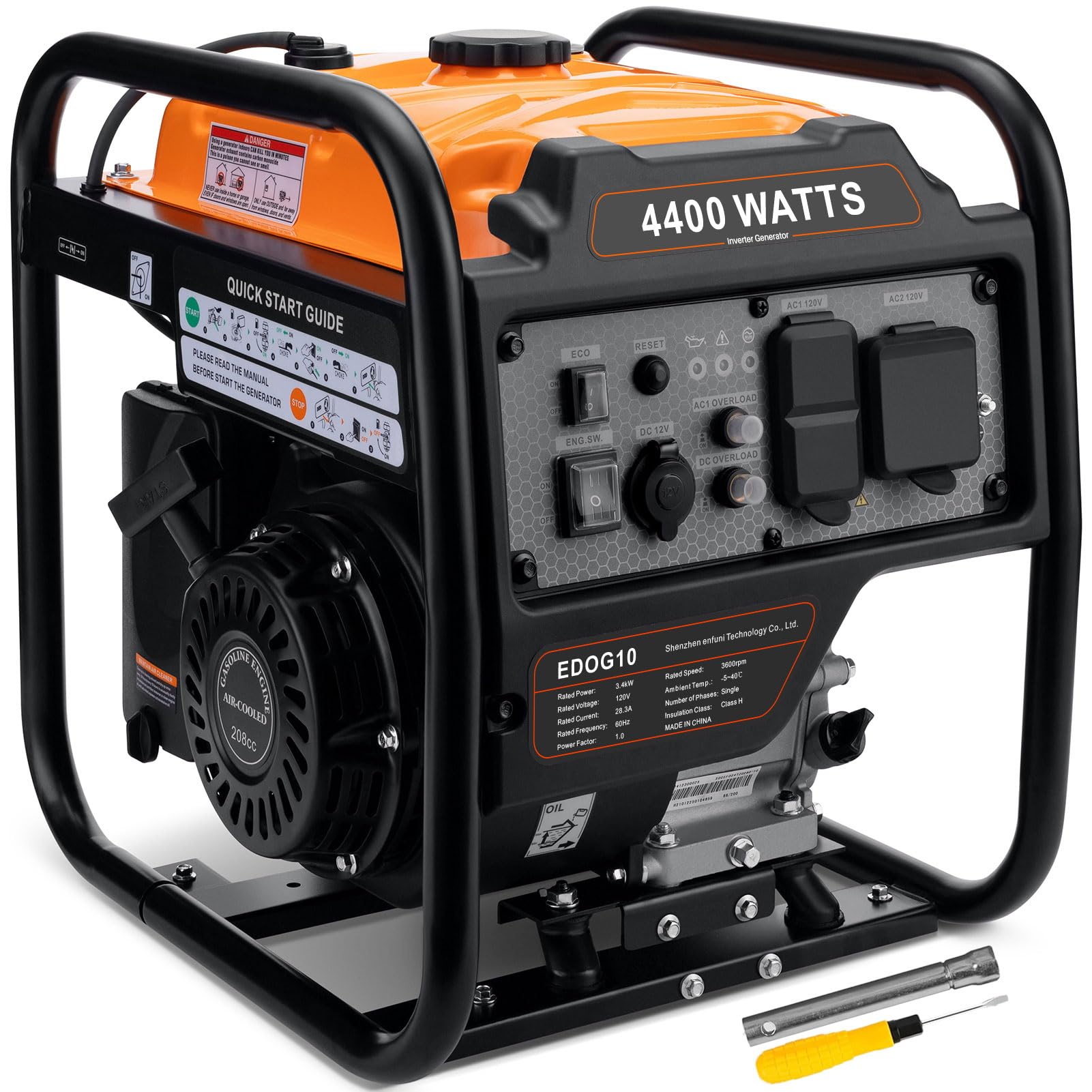
2. Oxseryn 4400-Watts Inverter Generator
The budget-friendly inverter that delivers 3400 running watts and an RV-ready 30A outlet.
This gas generator produces 4400 peak watts and 3400 running watts — enough to run a 15,000 BTU RV air conditioner plus a refrigerator and lights simultaneously, as buyers report. It features a 30A RV port, two 120V AC ports, and a 12V DC port, making it genuinely ready for camper hookups. The inverter technology means the power is clean enough for phones and laptops. On the fuel economy front, owners mention getting roughly 5 hours per gallon with eco mode engaged, and the 2-gallon tank supports up to 14 hours of runtime at a 25% load.
The engine is a 4-stroke 4.4 KW unit with cold start technology and automatic low-oil shutdown, which adds a layer of protection if you forget to check the oil before a long run. At 57 pounds, it is heavier than the 40-pound Oxseryn 2800W below, but 57 pounds is about 48 pounds lighter than the 105.8-pound Westinghouse iGen5000c, making it a solid middle-ground for portability. The catch is the noise: owners give it a 4.6-star average across over 350 ratings, but the noise level gets mixed feedback — it is quieter than most open-frame generators but still too loud for quiet campgrounds. One reviewer who camps said it is “a little noisy for our taste” but noted it worked wonderfully powering the overhead AC and fridge.
high wattage inverter: The 30A RV port and 3400 running watts at this price point are tough to top. The performance and value-for-money take the top two aspect spots, with over 160 buyers praising those qualities specifically.
noisy operation: Expect engine noise similar to an open-frame inverter — fine for emergency backup or RVing with neighbors at a distance, but not a silent-camping companion.
power hungry jobs: You need a high-output gas inverter on a budget, especially for RVing with a 30A camper.
quiet camping: You camp in tight, quiet spaces where generator noise would disturb others.
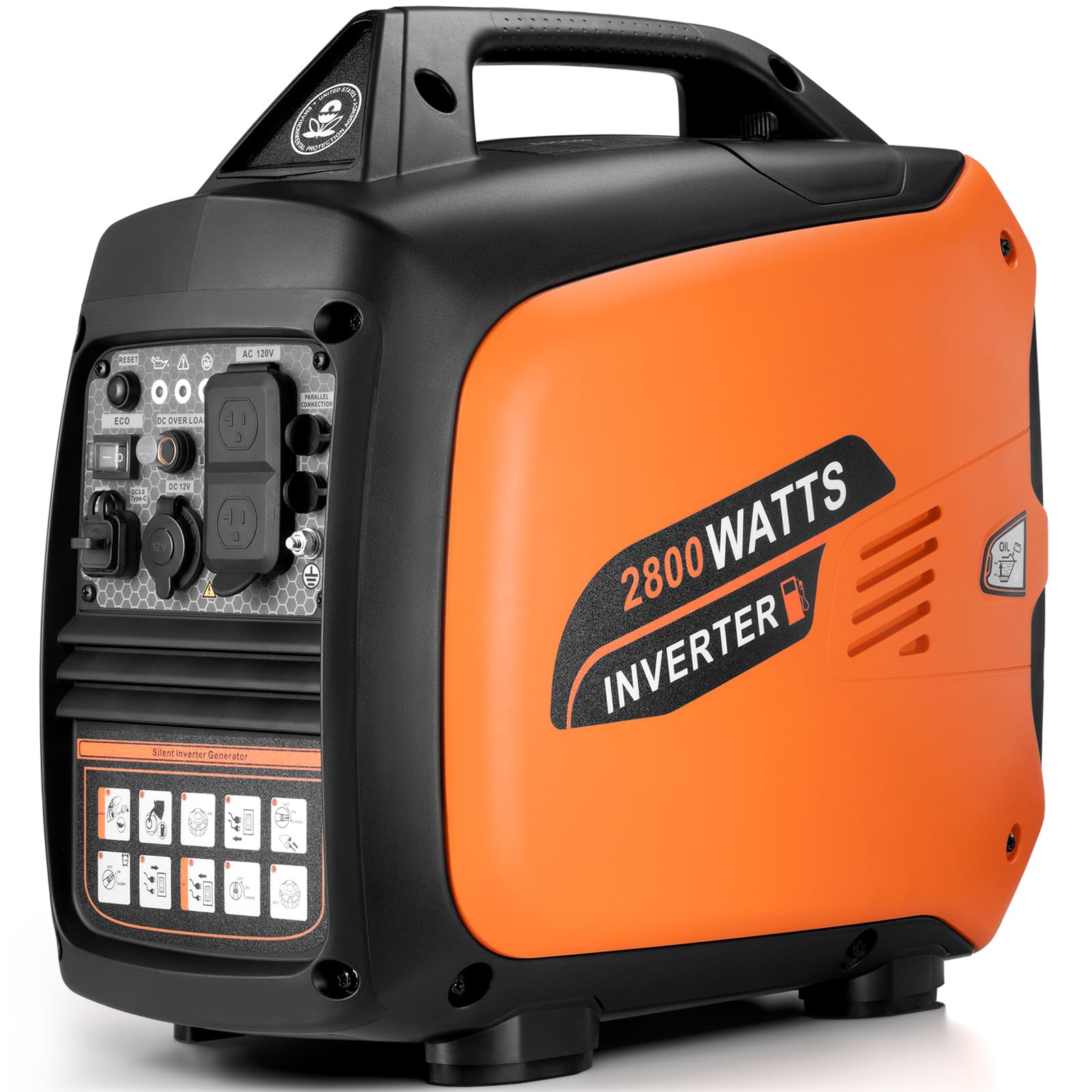
3. Oxseryn 2800-Watts Portable Inverter Generator
A 40-pound gas inverter that runs under 58 dBA and goes 9 hours on a single tank.
This is the right pick when you need gas power but you refuse to deal with a heavy, loud machine. The 79.8cc engine delivers 2800 peak watts and 2000 running watts, which is enough for an RV fridge, a toaster oven, phone charging, and even a 15,000 BTU air conditioner — though owners caution it will stumble near max load and the eco mode can overload if you push it. The quiet operation — under 58 dBA from 23 feet — is roughly the volume of a normal conversation.: under 58 dBA from 23 feet away, which is roughly the volume of a normal conversation. Owners consistently call it “super quiet” and “fantastic little generator.”
At 40 pounds and measuring 17.9 by 11.2 by 17.35 inches, it is 8 percent more compact in one dimension than the Oxseryn 4400W above, and 17 pounds lighter. It also adds a USB and Type-C port alongside the two 120V AC ports and a 12V DC port. The fuel shut-off feature lets the carburetor run dry before shutdown, extending engine life. The oil fill requires removing a side panel and filling through the dipstick opening, which is messy. A few owners also reported metal grit in the oil during break-in, requiring several changes. Plan for an initial service session, and this unit will treat you well.
compact inverter gen: Light emergency backup, weekend RV trips, and tailgating where you want something you can carry with one hand and barely hear from inside the camper.
lower runtime: You need sustained power for a microwave plus AC simultaneously, or you want a tool-free oil-check experience.
4. WEN 3600-Watt Portable Inverter Generator (56360i)

A 149cc inverter that starts on the first pull and earns the top mark for reliability from its owners.
This generator delivers 3600 surge watts and 2900 rated watts from a 149cc 4-stroke engine, and the first thing owners praise is how reliably it starts — many report first-pull starts even in 14°F weather. It weighs 46 pounds, which is right in the portable balance, and the fuel shut-off extends the generator’s life by burning the last gas out of the carburetor before shutdown. The outlet selection includes two three-prong 120V receptacles, a TT-30R RV receptacle rated for 30 amps, a 12V DC port, and two 5V USB ports, all wrapped in a three-year warranty.
What wins people over is the combination of quiet operation and genuine power: owners say it runs a 13,000 BTU RV air conditioner without issue and gets about 4 hours per tank under heavy AC load. At 17.9 by 11.6 by 19.7 inches, it shares a similar footprint to the Oxseryn 2800W but packs noticeably more punch. A small number of units arrive with a dirty carburetor or surging issues., though the recommendation from experienced owners is to use a magnetic oil drain plug and run a fuel additive. The wider consensus — with over 110 owners citing reliability as the top aspect — is that this generator performs flawlessly from the start.
home backup: The budget-conscious RVer who needs a reliable, quiet generator that fires up every time for their camper’s AC and essentials.
portable needs: A few units need an initial carburetor cleaning; consider it a proactive tune-up for long-term confidence.
5. WEN DF360iX Dual Fuel Inverter Generator

The dual-fuel inverter that runs on propane or gas, with a CO watchdog that shuts it down automatically.
This is essentially the WEN 3600W above but with a critical upgrade: dual-fuel capability and a built-in CO shutdown sensor. You get 3600 surge watts and 2900 rated watts on gasoline, and 3500 surge watts and 2600 rated watts on propane, giving you fuel flexibility if gas becomes scarce during an emergency. The CO Watchdog sensor is a real safety net — it automatically turns the generator off if carbon monoxide reaches dangerous levels.
The quiet operation is a recurring theme in owner feedback: the noise level is compared to a normal conversation, and customers note it is quieter than the Onan built-in units on many RVs. One owner said they run their small RV on propane exclusively, with no issues starting easily even below 40°F. The fuel efficiency on a 20-pound propane tank runs about 6 hours in eco mode. Where it falls a touch short is the 20A outlets — a few owners note they hold plugs a little loosely, which is worth checking before relying on a critical device. Overall, reliability gets 137 mentions from owners, the highest aspect count for this product, giving you strong confidence in the long haul.
fuel options: Travel trailer owners who want the flexibility of propane (stores forever, no gummed-up carburetor) plus the safety of an automatic CO shutoff.
simple operation: You need a transfer-switch-ready 240V output — this unit is strictly 120V.
6. Champion 4000-Watt RV Ready Portable Inverter Generator

One of the lightest 4000-watt inverters you can buy, at 48.1 pounds with 10 hours of runtime.
Champion claims this is one of the lightest 4000-watt inverters in the industry, and the numbers back it up: 3000 running watts and 4000 starting watts at 48.1 pounds, delivering up to 10 hours of runtime. The noise level is rated at 64 dBA from 23 feet — quiet enough for campground conversation. It includes a TT-30R 30-amp RV outlet, a 120V 20-amp household duplex, a 12V automotive outlet, and parallel outlets to connect a second unit and double your output. The CO Shield auto shutoff system adds a safety layer that shuts the generator down when it detects dangerous carbon monoxide levels.
Owners with RV setups are particularly happy: one ran their 15,000 BTU air conditioner plus lights and a fridge for 55 hours with no issues, noting fuel consumption of about 5 gallons per 24 hours under heavy load. It starts easily on the first pull. The fuel tank size means refueling every 4 to 5 hours under heavy AC load. One owner wished it had a larger tank. The 3-year limited warranty with free lifetime technical support gives you a strong safety net, and Champion’s customer service gets positive marks for handling rare defects quickly.
camper power: RV owners who want 4,000-watt-class power at under 50 pounds, paired with a brand known for solid support.
home use: Plan on refueling every 4 to 5 hours under heavy AC load, and you cannot run the AC and microwave at the same time.
7. Jackery Explorer 2000 v2 Portable Power Station

The lightest 2kWh battery station on the market, at 39.5 pounds, running a fridge for over 21 hours.
Jackery claims this is 41 percent lighter and 34 percent smaller than typical 2kWh LiFePO4 power stations, and that makes a real difference when you are carrying it from the car to a campsite or moving it room to room during an outage. The 2042Wh capacity powers a refrigerator for 21.3 hours, according to one owner’s test. It outputs 2200W through three AC ports, plus a 100W USB-C PD port that charges a laptop in under 90 minutes. The CTB (Cell-to-Body) technology — the same approach used in electric vehicles — makes the structure more compact and secure.
Charging is flexible: AC fast charging brings you from 0 to 80 percent in 66 minutes, or 102 minutes to full using Emergency Super Charging mode through the app. In Silent Charging mode, it operates at under 30 dB — essentially a whisper. It also features a 20ms uninterruptible power supply (UL1778 certified) that switches smoothly during an outage, so your computer never resets. The drawback: the solar barrel ports flex inward when a plug is inserted, and owners note that point could use reinforcement. The weight also gets mixed feedback — some find 39.5 pounds light for the capacity, but others (calling it 80 pounds in older reviews) may be comparing to smaller units.
quiet power: Home backup, van-life, and off-grid situations where weight and silence matter more than infinite runtime. The quality and charging speed are the two most-praised aspects, with 94 and 86 owner mentions respectively.
high draw: Running central AC or heavy machinery for days without solar panels — you will need a way to recharge.
8. Westinghouse iGen5000c Portable Inverter Generator
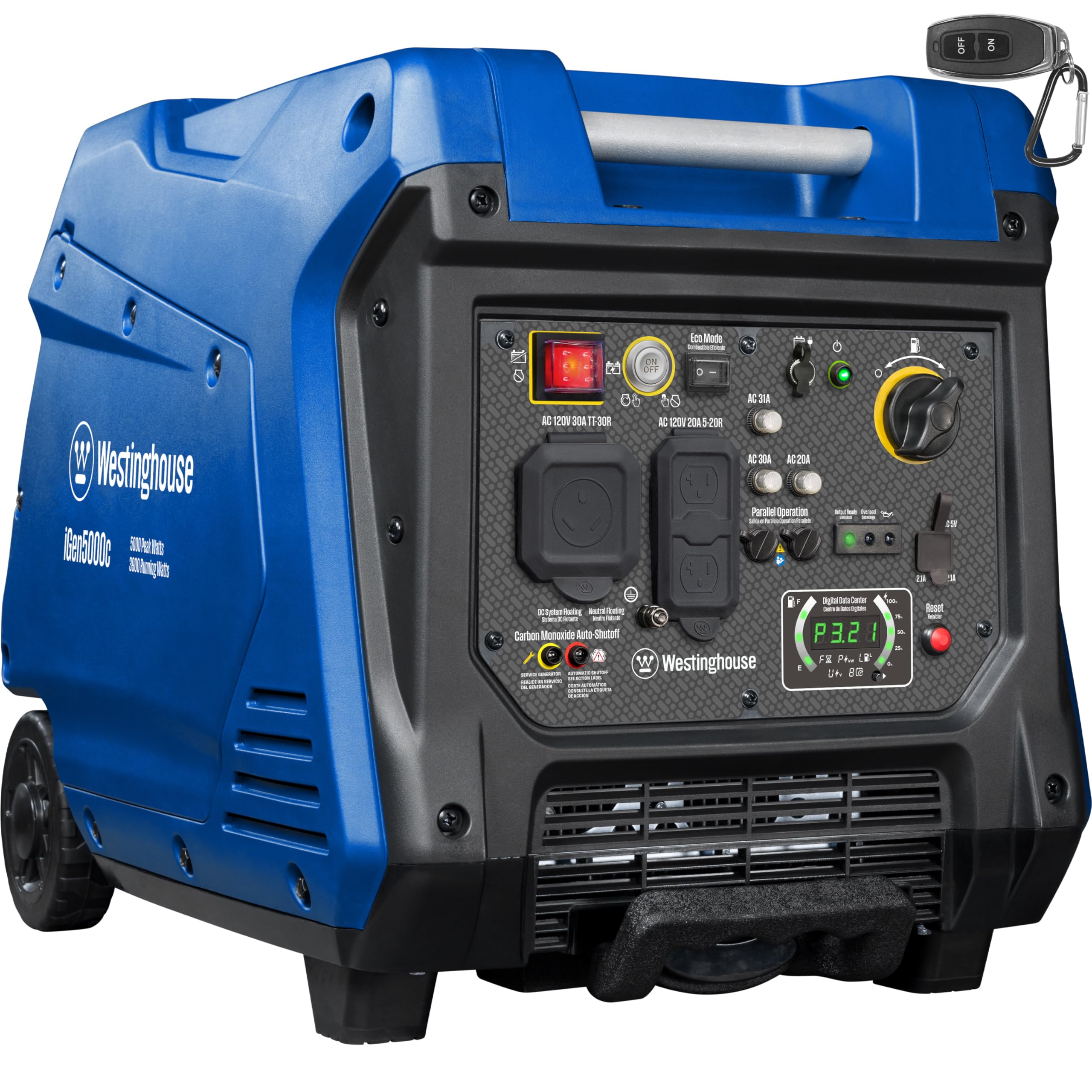
Fire it up from your living room couch with the key fob remote start, and get 18 hours of runtime.
This 5000 peak watt, 3900 rated watt inverter generator comes with a remote start key fob, electric start, and a backup recoil pull — so you can turn it on from inside your house during a Texas winter storm, as one owner described doing. The noise level is as low as 52 dBA, making it genuinely quiet for its output class. The 3.4-gallon fuel tank supports up to 18 hours of runtime at 25% load, and the LED data center rotates through fuel level, power output, remaining run time, voltage, and lifetime hours. It includes a TT-30R 30-amp RV outlet, a 5-20R household duplex, and two USB ports.
The telescoping handle and wheels transform the 105.8-pound weight into something you can roll to the job site or campsite. Owners running job-site tools say it powers a pancake compressor and a portable table saw simultaneously without strain. One owner says they use it with their RV and appreciate that a tank of fuel lasts all day. At 105.8 pounds, this wheeled unit is not designed for lifting into a truck bed alone. It is a wheeled unit designed to stay on the ground. The auto low-oil shutoff and CO sensor provide essential safety features, and the 3-year warranty backs it up.
large appliances: Homeowners who want to start the generator from inside during bad weather, and RVers with a 30-amp camper who value remote convenience.
small loads: You need to carry the generator up stairs or lift it frequently — the wheeled frame assumes mostly flat ground.
9. DuroMax XP13000HXT Tri Fuel Generator
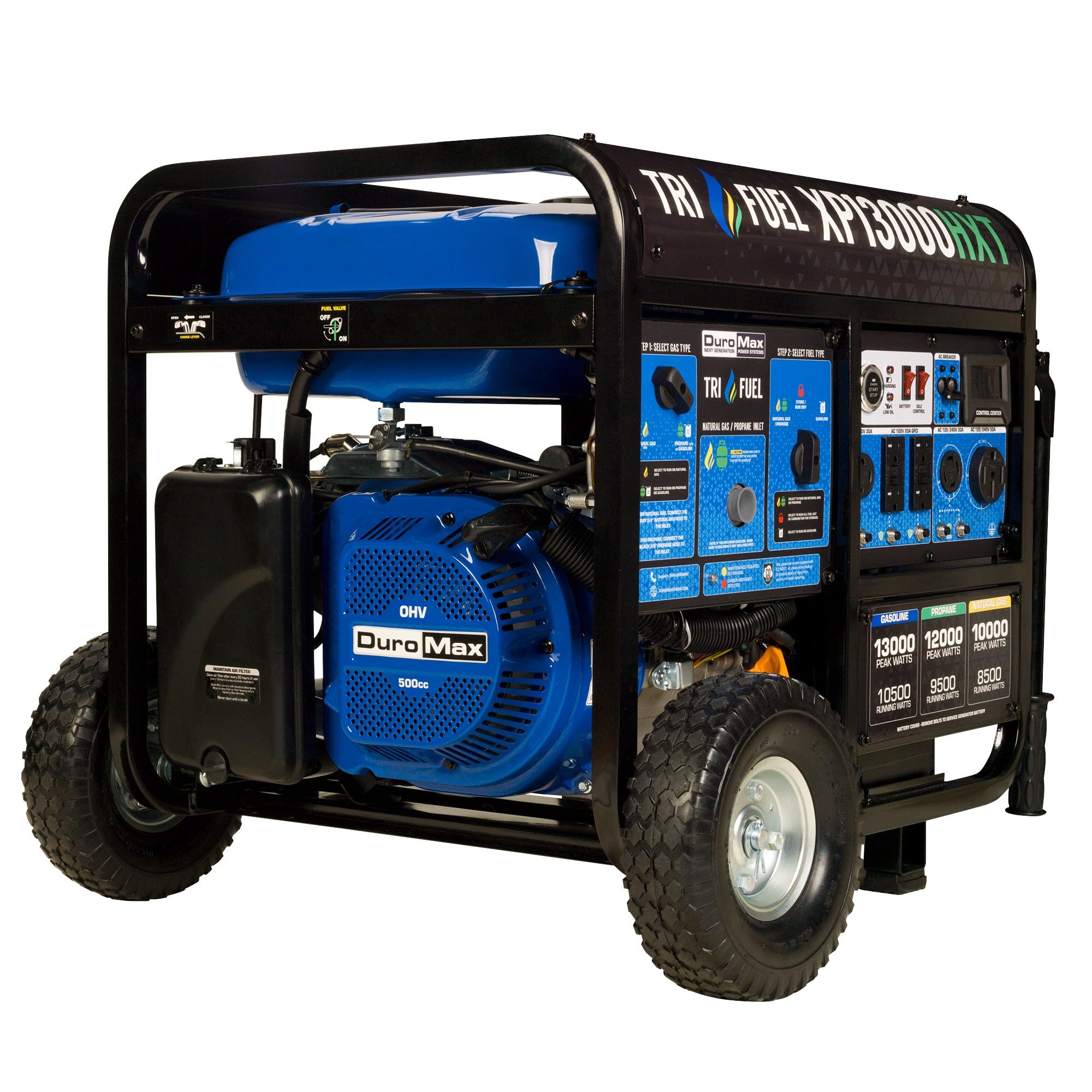
13,000 peak watts that runs on gasoline, propane, or natural gas — enough to power a whole house.
This is the tri-fuel heavy hitter for serious whole-home backup. The 500cc DuroMax engine delivers 13,000 peak watts and runs on three fuel sources: gasoline, propane, or natural gas. The front-facing interface lets you switch fuel type in seconds, and the push button start plus remote start means you can fire it up from a distance. It includes a transfer-switch-ready 50-amp outlet, which connects directly to your home’s electrical panel so you can power your furnace, well pump, fridge, lights, and more. The CO Alert system monitors for carbon monoxide and shuts the generator down if levels get dangerous.
Owners who use natural gas emphasize that you need a 3/4-inch line supplying 225,000 BTU per hour to feed it — a plumber may be needed. The generator runs “semi-loud” but not unbearably so, and the wheel kit makes the heavy unit manageable. One owner called it “good inexpensive insurance vs. Generac.” The included tools are basic, the NG hose reducer is very tight, and you must supply your own oil and trickle charger. The push button start sometimes takes 4 to 5 attempts on initial setup. Once running, it handles a smaller AC unit, two refrigerators, and general household loads at about 60 percent capacity.
extended backup: If you own a home, want the fuel flexibility of natural gas or propane for indefinite emergency power, and have space to park a large-frame generator outside.
frequent moves: If you need something portable for camping, or if your natural gas line requires expensive upgrades to feed this unit.
10. EF ECOFLOW DELTA Pro 3600Wh Power Station
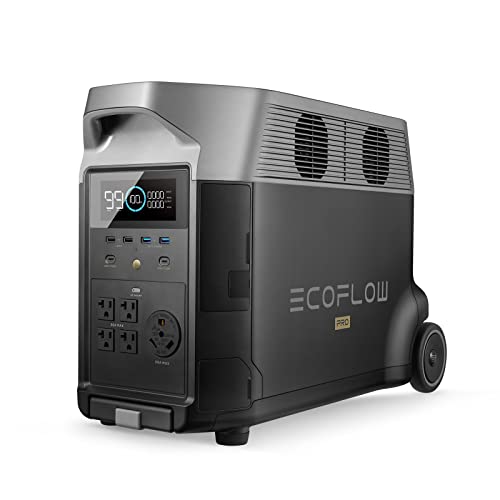
A 3,600Wh battery that expands to 25kWh and charges from a wall outlet in 2.7 hours.
For those who want battery power but need serious capacity, the DELTA Pro delivers 3600Wh of storage and 3600W of AC output across five 120V outlets. X-Boost technology extends that output to 4500W for heavy-duty devices, and you can pair two units for 7200W total. The charging speed is a big story: X-Stream technology recharges fully in 2.7 hours from an 1800W wall outlet, or in just 1.8 hours from a 240V outlet. It also supports solar charging at up to 23% conversion efficiency, reaching full charge in 2.8 hours with four 400W panels. You can even charge it at an EV station.
Owners running mobile businesses and medical equipment give it high marks. One vendor market user says it runs a heat press with no voltage drops and is impressively quiet. Another owner reports it runs a home oxygen concentrator for 10 hours and 47 minutes on a single charge. The build quality and fast charging are consistently praised. At 99 pounds, this is a rolling unit, not something you carry. Also, like all battery stations, if the 3600Wh depletes during a multi-day outage, you need grid power, solar, or a smart generator to refill. The 30% Residential Clean Energy Tax Credit may apply, making the long-term cost more reasonable.
whole house: Homes with solar panels, E
V owners, small businesses needing silent backup, and anyone with medical devices that must stay on during an outage.
budget buy: Heavy and expensive upfront, but capable of running virtually any 120V appliance silently for hours and recharging faster than any other battery station in its class.
11. Westinghouse iGen12000DFc Dual Fuel Inverter Generator
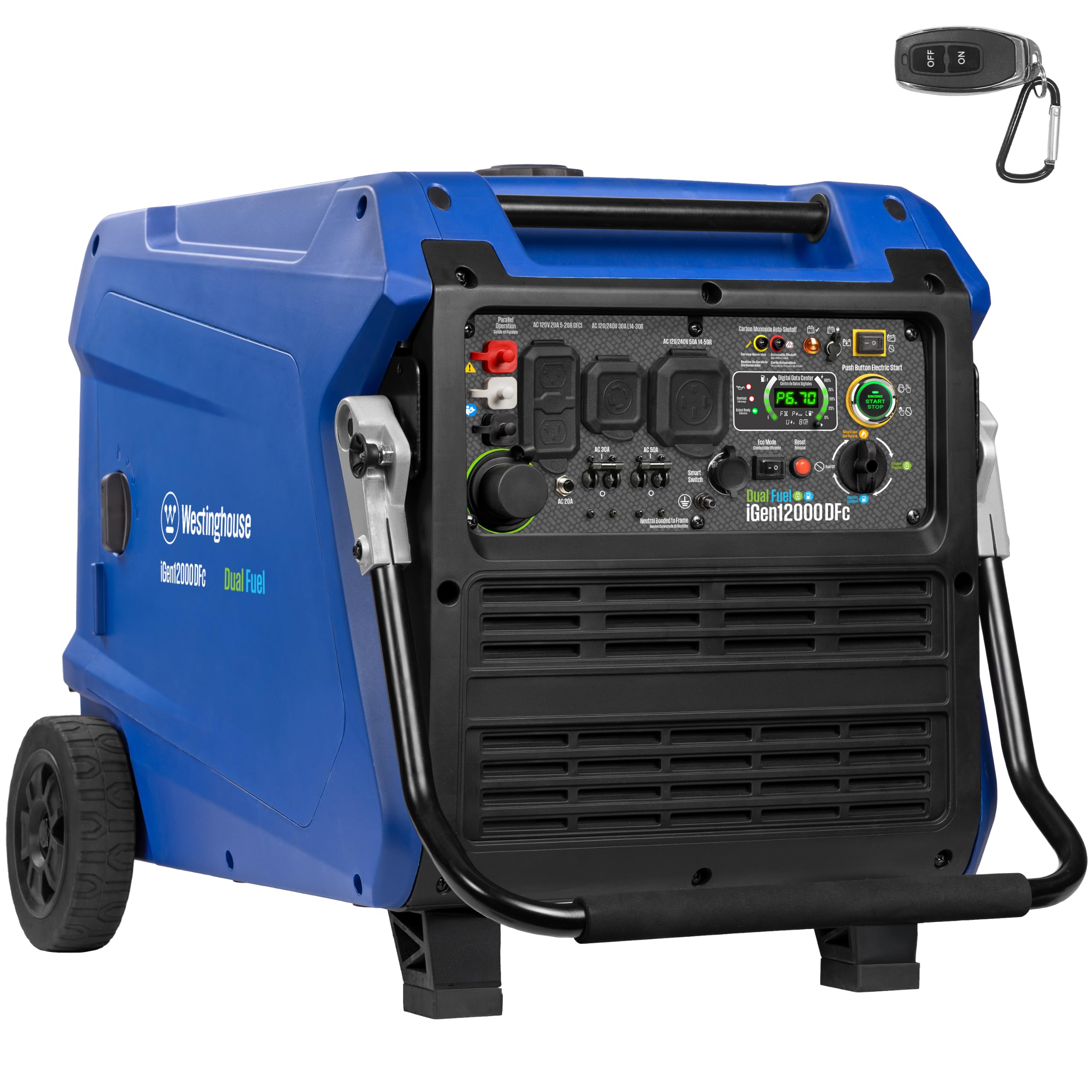
A dual-fuel inverter with 12,000 peak watts that runs a whole house at just 64 dBA.
This is the generator for people who want whole-home backup but refuse to sacrifice clean inverter power for their electronics. On gasoline, it delivers 12,000 peak watts and 9,000 running watts; on propane, it delivers 11,000 peak and 8,100 running. The 457cc Westinghouse 4-stroke OHV engine uses inverter technology to match engine speed to demand, which can cut fuel consumption compared to a traditional generator. The 7.9-gallon fuel tank gives up to 19 hours of runtime at 25% load. The noise level is rated as low as 64 dBA — quiet enough for suburban neighborhoods.
Owners across nearly 700 ratings call it quiet, well-built, and easy to set up — with quiet operation being the top praised aspect at 269 mentions. It includes a 50-amp 14-50R outlet for transfer switch or RV hookup, plus a 30-amp L14-30R twist-lock and a GFCI 20-amp duplex. The remote start key fob works from a stated 50-foot range. One owner noted they charge their Tesla at 20-25 miles per hour via the 50A outlet. At 187.4 pounds, this wheeled unit stays outdoors. The included oil is unsuitable for temperatures below 23°F, so cold-climate owners need to switch to 5W-30 synthetic after the 5-hour break-in. The propane hose regulator connection can also loosen over time — worth checking periodically.
large rv: Homeowners who want one generator that can run their entire house (heat pump, well pump, fridge, lights, internet) on propane or gas with inverter-quality power and remote start.
neighborhood use: Anyone who needs portability beyond rolling it on flat ground, or who lives in climates where temperatures drop below freezing and must remember to swap the oil to synthetic.
Understanding the Specs
Inverter Technology
An inverter generator converts the raw AC power from the engine into DC, then back into clean AC. The result is electricity with less than 3% total harmonic distortion (THD) — that is the technical way of saying the power is as stable and smooth as your home wall outlet. This protects sensitive electronics like laptops, TVs, phones, and medical devices from voltage spikes that could damage their circuits. A non-inverter generator can produce distorted power with 6–15% THD, which is fine for power tools and lights but risky for anything with a circuit board.
Peak vs. Running Watts
Peak watts (also called surge or starting watts) is the extra burst of power a generator can deliver for a few seconds to start a motor — like the compressor kick in a refrigerator or the fan start in an air conditioner. Running watts (rated watts) is what the generator can produce continuously for hours. The running watt number is the one that matters for everyday use. To size a generator, add up the running watts of everything you plan to power at once, then make sure the generator’s rated watts exceeds that total. A common mistake is buying based on peak watts and finding the generator cannot sustain the load.
FAQ
Can I run a generator inside my house or garage?
How long will a battery power station run my refrigerator?
What is the difference between a dual-fuel and a tri-fuel generator?
What size generator do I need for my RV?
What is THD and why does it matter?
Can I connect a portable generator directly to my house’s electrical panel?
How often should I change the oil in a gas generator?
How do I maintain a generator that I only use occasionally?
Final Thoughts: The Verdict
Across the board, the electric generator winner is the EcoFlow DELTA 3 Classic because it blends silent indoor-safe operation, ultra-fast charging, and enough capacity to run a fridge and devices through a blackout — all in a 26.7-pound package that slips under a desk. If you want fuel flexibility and the ability to power your entire house indefinitely on propane or natural gas, the Westinghouse iGen12000DFc is the one to reach for. And for a budget-friendly gas inverter that is light enough forcamping and still powers an RV air conditioner, the Oxseryn 2800W is the smart middle-ground pick. The crowd favorite — the EcoFlow Delta 3 Classic with 4.7 stars across nearly a thousand owners — gives you the confidence that comes from a proven product with a decade-long battery lifespan.
How We Picked
We do not accept paid placement. Every pick is matched to a real buyer and a real use-case; we do not hands-on test units.
Sources & Methodology
Specifications: manufacturer listings and product documentation. Review insights: verified customer reviews, as of July 2026. Pricing: not shown on this page (it changes often); check the current price via the retailer link.
As an Amazon Associate, WellFizz earns from qualifying purchases. This does not affect which products we feature.
Related Guides

Mo Maruf
I created WellFizz to bridge the gap between vague wellness advice and actionable solutions. My mission is simple: to decode the research and give you practical tools you can actually use.
Beyond the data, I am a passionate traveler. I believe that stepping away from the screen to explore new environments is essential for mental clarity and physical vitality.